 by Tom Gurney
Tom Gurney BSc (Hons) is an art history expert with over 20 years experience
Email: tomgurney1@gmail.com / Phone: +44 7429 011000
Railroad Sunset: Introduction
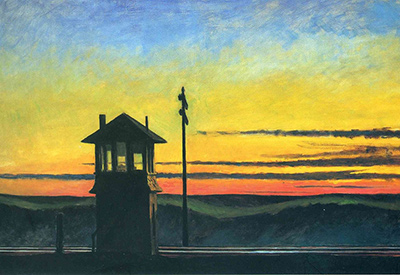
The sky takes up most of Railroad Sunset. Blue at the top gives way to yellow, orange and a narrow red glow above low hills. Across those colours run dark cloud bands, while a signal tower and a slender pole rise from the railway below. Edward Hopper makes an immense evening out of a small amount of land and a few practical structures. No train enters the view, but the tracks keep the possibility of passage close at hand.
The Whitney Museum of American Art dates the painting to 1929 and records oil on canvas, 74.5 × 122.2 cm. It entered the collection through the Josephine N. Hopper Bequest, accession 70.1170. Its width allows the tracks and horizon to stretch across the picture while the comparatively small tower gives the open landscape a point of human scale. [1]
At a Glance
- ArtistEdward Hopper [1]
- Date1929 [1]
- MediumOil on canvas [1]
- Collection / recordWhitney Museum of American Art [1]
- Accession70.1170 [1]
This work across Edward Hopper’s career
American Village
1912Soir Bleu
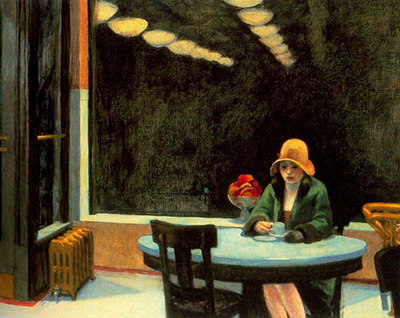
1914Automat
1927New York Movie
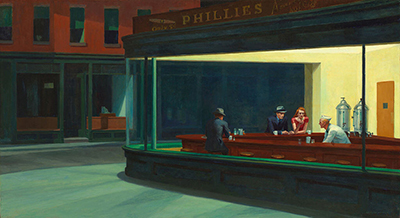
1939Nighthawks
1942Morning Sun
1952Two Comedians
1966Contents
- A sky built from changing colour
- The low hills and the railway
- Tower, windows and pole
- A drawing with colour notes
- Travel remembered in the studio
- A later historical interpretation
- Railway subjects at different distances
A sky built from changing colour
The sunset is striking because its colours occupy such different amounts of space. A broad yellow field spreads above the horizon, becoming cooler as it approaches the blue overhead. The orange-red passage is much narrower, held close to the dark edge of the land. It gives the lower sky an intense glow without turning the whole scene uniformly warm.
These areas are not separated like stripes of painted decoration. Their edges shift and mingle, with shorter marks allowing one colour to enter another. The upper blue contains lighter, warmer touches; the yellow has cooler disturbances within it. The sky consequently feels expansive while remaining visibly worked with a brush.
The dark clouds introduce a different kind of edge. Their long, low forms interrupt the bright colour, particularly towards the right. Some strands are close to parallel, but their thickness varies and their ends become irregular. They make the sky feel layered rather than flat, suggesting different distances within a surface that has no conventional architectural perspective.
There is no prominent sun disc at the centre of this spectacle. Light is distributed through the sky itself. The eye can move from one transition to another without arriving at a single bright object that explains everything around it. This helps the sunset remain a broad condition of the scene rather than a small event on its horizon.
The painting's strongest warmth is also separated from the spectator by cooler land. The red and orange seem far away, while the bank and railway remain comparatively dark. Colour gives the view much of its depth: a nearby shadowed world faces a distant luminous one.
The low hills and the railway
The hills form a narrow, uneven band beneath the sky. Their subdued greens and blues differ from both the warm horizon and the darker railway foreground. Small rises and dips interrupt the long boundary, keeping the countryside from becoming a perfectly straight dividing line.
The tracks are straighter. They cross close to the bottom, almost parallel with the canvas edge, supplying a clear manufactured direction beneath the irregular land. Their pale and dark lines make a compact sequence that can be followed from side to side. A larger map of the railway is unnecessary for the sense of continuation: the tracks enter and leave the selected view.
This arrangement gives the painting two kinds of breadth. The countryside appears to extend through low hills and distant sky; the railway extends through a constructed route. One is uneven and varied, the other more closely ruled. Their coexistence makes the scene particular to a landscape already crossed by modern transport.
The small amount of foreground is consequential. A higher horizon would have given the railway and land more descriptive prominence. Here, their compression leaves the sky dominant while retaining enough practical detail to prevent it from becoming an independent cloud study. The view remains a railway landscape even when most of its surface is devoted to evening colour.
Tower, windows and pole
The signal tower stands left of centre. Its overhanging roof and upper windows give it a recognizable form, but much of its body is in deep shadow. Against the brighter sky, the roofline becomes especially crisp. The building supplies a compact set of slopes, uprights and rectangular openings within a composition otherwise dominated by long horizontal forms.
The windows are lighter than the surrounding walls. They briefly complicate the silhouette, allowing the tower to suggest an interior without revealing anyone inside. Their small illuminated rectangles give the eye something close and definite after the larger, less bounded changes in the sky.
Immediately to the right, a narrow pole rises higher than the roof. Its small fittings break the line at intervals. Because it is so slender, it can occupy a substantial height without competing with the tower's mass. Together, building and pole create an unequal pair: one is broad and inhabited in type, the other a thin piece of railway equipment.
Their placement leaves much of the canvas open towards the right. The tower does not sit at the middle of a symmetrical sunset, and the pole does not provide a matching structure on the far side. This imbalance makes the sky and railway seem to continue beyond the group. The structures mark a place along a route rather than a final destination.
The practical purpose of the tower adds another implication. Railway movement normally involves people watching, signalling and coordinating passage, even when those actions are not shown. The building acknowledges that system through a small visible part of it. The painting's quiet is therefore the quiet of a working landscape between visible events.
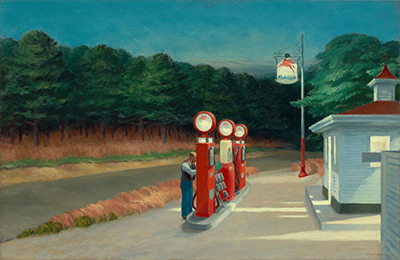
Compare: Gas, 1940.
A drawing with colour notes
The Whitney preserves a related 1929 study in fabricated chalk on paper, accession 70.223. Across the sheet, broad strokes and thinner horizontal lines distinguish sky, cloud and lower ground. Handwritten colour indications accompany the monochrome marks, linking areas of the drawing to the colour relationships Hopper was considering. [2]
The sheet is useful precisely because it cannot reproduce the oil painting's luminous colour. Its darker passages establish relative weight and position, while the written notes supply another kind of information. Looking between the two reveals planning that concerns both the arrangement of masses and the character of their colour.
The drawing contains a substantial dark cloud shape towards the upper right. In the finished painting, the most conspicuous darker strands are lower and more extended across the bright horizon. The difference directs attention to how much the effect depends on the amount of open colour left between cloud forms.
Near the lower left, a compact dark shape interrupts the longer bands. In the painting, the signal tower becomes much more architecturally definite, with its pitched roof and windows. Hopper could move from a rough indication of weight to a sharply legible structure while retaining the larger horizontal organization.
The written colour notes and worked divisions show attention to relationships that could be carried from the sheet into a subsequent painting. The final image combines the appearance of a moment with a considered pictorial order.
Watch: Edward Hopper’s Life and Art
Explore Hopper’s paintings and the places behind them in these museum films. Choose a film below.
Travel remembered in the studio
The Whitney relates the painting to the Hoppers' journeys of 1929, which took them from New York to Charleston and to places in Massachusetts and Maine. Its account identifies the canvas as a studio synthesis of remembered and imagined elements, rather than an exact record of one location. [1] The title gives a railway and a time of day, but leaves the scene open geographically.
That distinction makes sense of the viewpoint. The tracks run across the picture as they might in a glimpse from another train, while the tower briefly holds attention against the sky. A traveller could encounter such elements in passing without learning the name or history of the place. Hopper gives that intermediate landscape enough presence to become the whole subject.
The Fondation Beyeler's 2020 exhibition guide similarly treats the work as a composed memory of American space. It emphasizes the horizontal bands, the transition into night and the distance implied by lines extending across the image. [3] That reading draws attention to the relationship between a limited view and a much larger landscape beyond it.
The painting does not require a particular journey to become legible. The tower, rails and receding hills supply recognizable forms; the enormous sky changes their ordinary setting.
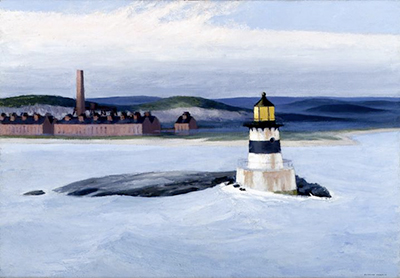
Compare: 5 A.M., 1937.
A later historical interpretation
Gail Levin offered a different emphasis in her 1996 essay on biography and the catalogue raisonné. She reported that Hopper painted Railroad Sunset in the autumn of 1929 but did not exhibit it until spring 1937. Connecting the Hoppers' return from New England with the October stock-market crash, she interpreted the extreme palette and railway equipment through the failure of technological confidence. [4]
This is a historical argument about the painting's possible significance. It is not an explanation recorded from Hopper about the tower or sunset. The distinction allows the interpretation to be considered seriously without making every dark rail or red cloud a fixed economic symbol.
The visible arrangement can sustain more than one emphasis. Its strong colours may appear ominous, but they can also be absorbing as a record of changing evening light. The railway can evoke a large modern system, while the small tower remains an ordinary building beside the line. The picture's concentration does not depend on resolving these possibilities into one message.
The gap between making and first exhibition, as Levin describes it, also complicates a simple account of immediate public response to 1929. The work's later audiences encountered a painting already separated from the circumstances of its creation. Its historical associations and its lasting visual effect need to be considered together.
Railway subjects at different distances
In Railroad Train, painted in 1908, a dark carriage dominates a close, low view. Smoke, cropped equipment and the steep embankment make the vehicle physically insistent. Railroad Sunset leaves the train outside the scene and gives the sky the scale that the carriage occupied in the earlier picture.
Hills, South Truro, from the following year, places a railway within a much more extensive description of ground. Its ridges and broad slopes make the land itself the main structure. Here, the low hills act as a brief interval between the track and the glowing horizon.
The dark tower brings these large relationships back to a few precise details. Its roof breaks the warm sky; its windows open small lighter areas within the shadow; the adjacent pole rises beyond it. Around those modest interruptions, Hopper lets colour occupy an expanse far greater than the railway buildings that give the painting its name.
Artworks and studies directory
This researched directory includes finished works and separately identified studies. It is not a complete catalogue raisonné. Linked titles open the articles; unlinked studies are identified by their collection accessions. Watercolours retain their recorded media, and original prints remain distinct from reproductions.
| Name | Date | Medium |
|---|---|---|
| (Bridge and Embankment) (70.1298) | 1906 | Oil on wood |
| (Jo Sketching at Good Harbor Beach) (70.1129) | 1923–1924 | Watercolor and fabricated chalk on paper |
| (Manhattan Bridge) (70.1098) | 1925–1926 | Watercolor and graphite pencil on paper |
| (Rooftops) (70.1114) | 1926 | Watercolor and graphite pencil on paper |
| (Seated Male Model, Bent Over) (70.1277) | c. 1902–1903 | Oil on canvas |
| (Self-Portrait) (70.1254) | 1903–1906 | Oil on canvas |
| (Solitary Figure in a Theater) (70.1418) | c. 1902–1904 | Oil on board |
| 5 A.M. | 1937 | oil on canvas |
| Adam's House | 1928 | watercolour and charcoal on paper |
| American Village | 1912 | Oil on canvas |
| Apartment Houses | 1923 | oil on canvas |
| Approaching a City | 1946 | oil on canvas |
| August in the City | 1945 | oil on canvas |
| Automat | 1927 | oil on canvas |
| Barber Shop | 1931 | oil on canvas |
| Blackwell's Island | 1928 | oil on canvas |
| Bridge on the Seine | 1909 | Oil on canvas |
| Bridle Path | 1939 | oil on canvas |
| Burly Cobb's House South Truro | 1930–1933 | oil on canvas |
| Cape Cod Evening | 1939 | oil on canvas |
| Cape Cod Morning | 1950 | oil on canvas |
| Chair Car | 1965 | oil on canvas |
| Chop Suey | 1929 | oil on canvas |
| City Roofs | 1932 | Oil on canvas |
| Coast Guard Station | 1929 | oil on canvas |
| Compartment C, Car 293 | 1938 | oil on canvas |
| Conference at Night | 1949 | oil on canvas |
| Corn Hill | 1930 | oil on canvas |
| Dawn in Pennsylvania | 1942 | oil on canvas |
| Drug Store | 1927 | oil on canvas |
| Early Sunday Morning | 1930 | Oil on canvas |
| East Side Interior (70.1020) | 1922 | Etching |
| East Wind Over Weehawken | 1934 | oil on canvas |
| El Palacio | 1946 | Watercolor and graphite pencil on paper |
| Eleven A.M. | 1926 | oil on canvas |
| Evening Wind | 1921 | etching |
| Excursion into Philosophy | 1959 | oil on canvas |
| First Row Orchestra | 1951 | oil on canvas |
| Freight Car at Truro | 1931 | watercolour over graphite on paper |
| Gas | 1940 | oil on canvas |
| Girl at a Sewing Machine | c. 1921 | oil on canvas |
| Gloucester Harbor | 1912 | Oil on canvas |
| Ground Swell | 1939 | oil on canvas |
| Haskell's House | 1924 | watercolour over graphite on paperboard |
| High Noon | 1949 | oil on canvas |
| Hill and Houses Cape Elizabeth Maine | 1927 | watercolour over graphite pencil |
| Hills South Truro | 1930 | oil on canvas |
| Hotel by a Railroad | 1952 | oil on canvas |
| Hotel Lobby | 1943 | oil on canvas |
| Hotel Room | 1931 | oil on canvas |
| Hotel Window | 1955 | oil on canvas |
| House by the Railroad | 1925 | oil on canvas |
| House by the Squam River | 1926 | watercolour over graphite on paper |
| Le Bistro or The Wine Shop | 1909 | Oil on canvas |
| Le Pont des Arts | 1907 | Oil on canvas |
| Le Pont Royal | 1909 | Oil on canvas |
| Le Quai des Grands Augustins | 1909 | Oil on canvas |
| Lighthouse and Buildings Portland Head | 1927 | watercolour over graphite pencil on paper |
| Lighthouse Hill | 1927 | oil painting |
| Manhattan Bridge Loop | 1928 | oil on canvas |
| Model Sitting | c. 1902 | oil painting; support not asserted |
| Morning Sun | 1952 | oil on canvas |
| New York Movie | 1939 | oil on canvas |
| New York New Haven and Hartford | 1931 | oil on canvas |
| New York Office | 1962 | oil on canvas |
| New York Pavements | 1924–1925 | oil on canvas |
| New York Restaurant | c. 1922 | oil on canvas |
| Night Windows | 1928 | oil on canvas |
| Nighthawks | 1942 | oil on canvas |
| October on Cape Cod | 1946 | oil on canvas |
| Office at Night | 1940 | oil on canvas |
| Office in a Small City | 1953 | oil on canvas |
| Pennsylvania Coal Town | 1947 | oil on canvas |
| People in the Sun | 1960 | oil on canvas |
| Portrait of Orleans | 1950 | oil on canvas |
| Queensborough Bridge | 1913 | Oil on canvas |
| Railroad Sunset | 1929 | Oil on canvas |
| Railroad Train | 1908 | oil on canvas |
| Road in Maine | 1914 | oil on canvas |
| Room in Brooklyn | 1932 | oil on canvas |
| Room in New York | 1932 | oil on canvas |
| Rooms by the Sea | 1951 | oil on canvas |
| Rooms for Tourists | 1945 | oil on canvas |
| Route 6 Eastham | 1941 | oil on canvas |
| Second Story Sunlight | 1960 | Oil on canvas |
| Self-Portrait | 1925–1930 | Oil on canvas |
| Self-Portrait with Hat (70.1903) | c. 1918, posthumous print | Drypoint |
| Seven A.M. | 1948 | Oil on canvas |
| Soir Bleu | 1914 | oil on canvas |
| South Carolina Morning | 1955 | Oil on canvas |
| Stairway at 48 Rue de Lille Paris | 1906 | Oil on wood |
| Study for 5 A.M. (70.153) | 1937 | Fabricated chalk on paper |
| Study for 5 A.M. (70.429) | 1937 | Fabricated chalk and graphite pencil on paper |
| Study for Approaching a City (70.869) | 1946 | Fabricated chalk and charcoal on paper |
| Study for August in the City (70.158a-b) | 1945 | Fabricated chalk on paper |
| Study for August in the City (70.159) | 1945 | Fabricated chalk on paper |
| Study for Bridle Path (70.220) | 1939 | Fabricated chalk on paper |
| Study for Bridle Path (70.235) | 1939 | Fabricated chalk on paper |
| Study for Compartment C, Car 293 (70.430) | 1938 | Fabricated chalk on paper |
| Study for Compartment C, Car 293 (70.431a-b) | 1938 | Fabricated chalk and charcoal on paper |
| Study for Conference at Night (70.170) | 1949 | Fabricated chalk on paper (recto); Typewriter ink on paper (verso) |
| Study for Conference at Night (70.174) | 1949 | Fabricated chalk on paper ( recto); Typewriter ink on paper (verso) |
| Study for East Wind over Weehawken (70.249) | 1934 | Graphite pencil on paper |
| Study for East Wind over Weehawken (70.252) | 1934 | Fabricated chalk and charcoal on paper |
| Study for Evening Wind (70.343a-b) | 1921 | Fabricated chalk on paper |
| Study for First Row Orchestra (70.841) | 1951 | Fabricated chalk and charcoal on paper |
| Study for Gas (70.263) | 1940 | Fabricated chalk on paper |
| Study for Ground Swell (70.339) | 1939 | Fabricated chalk, charcoal and graphite pencil on paper |
| Study for Hotel by a Railroad (70.199) | 1952 | Fabricated chalk on paper |
| Study for Hotel by a Railroad (70.427) | 1952 | Fabricated chalk on paper |
| Study for Hotel by a Railroad (70.428) | 1952 | Fabricated chalk on paper |
| Study for Hotel Lobby (70.117) | 1942 | Fabricated chalk and graphite pencil on paper |
| Study for Hotel Lobby (70.839) | 1942 | Fabricated chalk and charcoal on paper |
| Study for Hotel Window (70.161) | 1955 | Fabricated chalk, graphite pencil and colored pencil on paper |
| Study for Morning Sun (70.243) | 1952 | Fabricated chalk on paper |
| Study for Morning Sun (70.244) | 1952 | Fabricated chalk on paper |
| Study for Morning Sun (70.290) | 1952 | Fabricated chalk on paper |
| Study for Morning Sun (70.291) | 1952 | Fabricated chalk and graphite pencil on paper |
| Study for New York Movie (70.273) | 1939 | Fabricated chalk on paper |
| Study for New York Movie (70.274a-b) | 1938 or 1939 | Fabricated chalk and charcoal on paper (recto); Fabricated chalk on paper (verso) |
| Study for New York Movie (70.455) | 1939 | Fabricated chalk and charcoal on paper |
| Study for New York Office (70.822) | 1962 | Fabricated chalk on paper |
| Study for Nighthawks (70.192) | 1941 or 1942 | Fabricated chalk on paper |
| Study for Nighthawks (70.193) | 1941 or 1942 | Fabricated chalk on paper |
| Study for Office at Night (70.340) | 1940 | Fabricated chalk and charcoal on paper |
| Study for Office at Night (70.341) | 1940 | Fabricated chalk and graphite pencil on paper |
| Study for Pennsylvania Coal Town (70.198) | 1947 | Fabricated chalk on paper |
| Study for Pennsylvania Coal Town (70.229) | 1947 | Fabricated chalk and charcoal on paper |
| Study for Rooms for Tourists (70.438) | 1945 | Fabricated chalk and charcoal on paper |
| Study for Rooms for Tourists (70.848) | 1945 | Fabricated chalk and charcoal on paper |
| Study for Route 6, Eastham (70.369) | 1941 | Fabricated chalk and graphite pencil on paper |
| Study for Route 6, Eastham (70.854) | 1941 | Fabricated chalk and graphite pencil on paper |
| Study for South Carolina Morning (70.162a-b) | 1955 | Fabricated chalk on paper (recto and verso) |
| Study for The Sheridan Theatre (70.969) | 1937 | Graphite pencil on paper |
| Study for Two on the Aisle (70.128) | 1927 | Fabricated chalk on paper |
| Study for Two on the Aisle (70.129) | 1927 | Fabricated chalk on paper |
| Study for Yawl Riding a Swell (70.439) | 1935 | Fabricated chalk and graphite pencil on paper |
| Summer Evening | 1947 | oil on canvas |
| Summer Interior | 1909 | Oil on canvas |
| Sun in an Empty Room | 1963 | oil on canvas |
| Sunlight in a Cafeteria | 1958 | oil on canvas |
| Sunlight on Brownstones | 1956 | oil on canvas |
| Tables for Ladies | 1930 | oil on canvas |
| The Bootleggers | 1925 | oil on canvas |
| The Camel's Hump | 1931 | oil on canvas |
| The Circle Theatre | 1936 | oil on canvas |
| The City | 1927 | oil on canvas |
| The Lighthouse at Two Lights | 1929 | oil on canvas |
| The Long Leg | 1935 | oil on canvas |
| The Mansard Roof | 1923 | watercolour over graphite on paper |
| The Sheridan Theatre | 1937 | oil on canvas |
| Tramp Steamer | 1908 | oil on canvas |
| Two Comedians | 1966 | oil on canvas |
| Two on the Aisle | 1927 | oil on canvas |
| Valley of the Seine | 1909 | Oil on canvas |
| Western Motel | 1957 | oil on canvas |
Frequently Asked Questions
Edward Hopper made Railroad Sunset in 1929. [1]
The recorded medium is Oil on canvas. [1]
The sky takes up most of Railroad Sunset. Blue at the top gives way to yellow, orange and a narrow red glow above low hills. Across those colours run dark cloud bands, while a signal tower and a slender pole rise from the railway below. Edward Hopper makes an immense evening out of a small amount of land and a few practical structures. No train enters the view, but the tracks keep the possibility of passage close at hand.
Discussion
Look again at the images and ideas explored in Railroad Sunset. These editorial prompts invite your observations.
Reader Insights
Which boundary, gesture or change of light first holds your attention in Railroad Sunset?
Compare Gas with Railroad Sunset. Which visual difference matters most to your reading?
Which detail would you look at again after reading “Tower, windows and pole”?
Join the Conversation
Share a detail, comparison or question about Railroad Sunset below.
References
- Whitney Museum of American Art, Railroad Sunset, 1929, accession 70.1170; current object metadata, commentary and exhibition history. View source.
- Whitney Museum of American Art, Study for Railroad Sunset, 1929, fabricated chalk on paper, accession 70.223; object record and drawing. View source.
- Fondation Beyeler, Edward Hopper, English exhibition guide, 2020, room 1, Railroad Sunset. View source.
- Gail Levin, “Biography & Catalogue Raisonné: Edward Hopper in Two Genres”, Biography and Source Studies 2 (1996), pp. 111–123, especially pp. 120–121. View source.
- Collection or catalogue record, American Village, 1912; medium and identity as discussed in the linked article. View source.
- Collection or catalogue record, Soir Bleu, 1914; medium and identity as discussed in the linked article. View source.
- Collection or catalogue record, House by the Railroad, 1925; medium and identity as discussed in the linked article. View source.
- Collection or catalogue record, Automat, 1927; medium and identity as discussed in the linked article. View source.
- Collection or catalogue record, Early Sunday Morning, 1930; medium and identity as discussed in the linked article. View source.
- Collection or catalogue record, New York Movie, 1939; medium and identity as discussed in the linked article. View source.
- Collection or catalogue record, Nighthawks, 1942; medium and identity as discussed in the linked article. View source.
- Collection or catalogue record, Morning Sun, 1952; medium and identity as discussed in the linked article. View source.
- Collection or catalogue record, Second Story Sunlight, 1960; medium and identity as discussed in the linked article. View source.
- Collection or catalogue record, Two Comedians, 1966; medium and identity as discussed in the linked article. View source.
- Whitney Museum of American Art, Study for Route 6, Eastham, 1941, accession 70.854; exact object record. View source.
- Whitney Museum of American Art, Study for Conference at Night, 1949, accession 70.170; exact object record. View source.
- Whitney Museum of American Art, Study for First Row Orchestra, 1951, accession 70.841; exact object record. View source.
- Whitney Museum of American Art, (Bridge and Embankment), 1906, accession 70.1298; exact object record. View source.
- Whitney Museum of American Art, (Seated Male Model, Bent Over), c. 1902–1903, accession 70.1277; exact object record. View source.
- Whitney Museum of American Art, Study for Morning Sun, 1952, accession 70.244; exact object record. View source.
- Whitney Museum of American Art, Study for Morning Sun, 1952, accession 70.243; exact object record. View source.
- Whitney Museum of American Art, Study for Two on the Aisle, 1927, accession 70.128; exact object record. View source.
- Whitney Museum of American Art, Study for New York Office, 1962, accession 70.822; exact object record. View source.
- Whitney Museum of American Art, Study for Two on the Aisle, 1927, accession 70.129; exact object record. View source.
- Whitney Museum of American Art, Study for Pennsylvania Coal Town, 1947, accession 70.229; exact object record. View source.
- Whitney Museum of American Art, (Rooftops), 1926, accession 70.1114; exact object record. View source.
- Whitney Museum of American Art, Study for South Carolina Morning, 1955, accession 70.162a-b; exact object record. View source.
- Whitney Museum of American Art, (Self-Portrait), 1903–1906, accession 70.1254; exact object record. View source.
- Whitney Museum of American Art, (Manhattan Bridge), 1925–1926, accession 70.1098; exact object record. View source.
- Whitney Museum of American Art, (Solitary Figure in a Theater), c. 1902–1904, accession 70.1418; exact object record. View source.
- Whitney Museum of American Art, Study for Approaching a City, 1946, accession 70.869; exact object record. View source.
- Whitney Museum of American Art, Study for August in the City, 1945, accession 70.159; exact object record. View source.
- Whitney Museum of American Art, Study for Compartment C, Car 293, 1938, accession 70.430; exact object record. View source.
- Whitney Museum of American Art, Study for Compartment C, Car 293, 1938, accession 70.431a-b; exact object record. View source.
- Whitney Museum of American Art, Study for East Wind over Weehawken, 1934, accession 70.252; exact object record. View source.
- Whitney Museum of American Art, Study for East Wind over Weehawken, 1934, accession 70.249; exact object record. View source.
- Whitney Museum of American Art, Study for Evening Wind, 1921, accession 70.343a-b; exact object record. View source.
- Whitney Museum of American Art, Study for The Sheridan Theatre, 1937, accession 70.969; exact object record. View source.
- Whitney Museum of American Art, Study for New York Movie, 1939, accession 70.455; exact object record. View source.
- Whitney Museum of American Art, Study for New York Movie, 1939, accession 70.273; exact object record. View source.
- Whitney Museum of American Art, Study for New York Movie, 1938 or 1939, accession 70.274a-b; exact object record. View source.
- Whitney Museum of American Art, Study for 5 A.M., 1937, accession 70.153; exact object record. View source.
- Whitney Museum of American Art, Study for 5 A.M., 1937, accession 70.429; exact object record. View source.
- Whitney Museum of American Art, (Jo Sketching at Good Harbor Beach), 1923–1924, accession 70.1129; exact object record. View source.
- Whitney Museum of American Art, Study for August in the City, 1945, accession 70.158a-b; exact object record. View source.
- Whitney Museum of American Art, Study for Morning Sun, 1952, accession 70.291; exact object record. View source.
- Whitney Museum of American Art, Study for Morning Sun, 1952, accession 70.290; exact object record. View source.
- Whitney Museum of American Art, Study for Office at Night, 1940, accession 70.340; exact object record. View source.
- Whitney Museum of American Art, Study for Office at Night, 1940, accession 70.341; exact object record. View source.
- Whitney Museum of American Art, Study for Hotel by a Railroad, 1952, accession 70.427; exact object record. View source.
- Whitney Museum of American Art, Study for Hotel by a Railroad, 1952, accession 70.199; exact object record. View source.
- Whitney Museum of American Art, Study for Hotel by a Railroad, 1952, accession 70.428; exact object record. View source.
- Whitney Museum of American Art, Study for Hotel Lobby, 1942, accession 70.117; exact object record. View source.
- Whitney Museum of American Art, Study for Hotel Lobby, 1942, accession 70.839; exact object record. View source.
- Whitney Museum of American Art, Study for Conference at Night, 1949, accession 70.174; exact object record. View source.
- Whitney Museum of American Art, Study for Hotel Window, 1955, accession 70.161; exact object record. View source.
- Whitney Museum of American Art, Study for Pennsylvania Coal Town, 1947, accession 70.198; exact object record. View source.
- Whitney Museum of American Art, Study for Route 6, Eastham, 1941, accession 70.369; exact object record. View source.
- Whitney Museum of American Art, Study for Bridle Path, 1939, accession 70.220; exact object record. View source.
- Whitney Museum of American Art, Study for Bridle Path, 1939, accession 70.235; exact object record. View source.
- Whitney Museum of American Art, Study for Ground Swell, 1939, accession 70.339; exact object record. View source.
- Whitney Museum of American Art, Study for Yawl Riding a Swell, 1935, accession 70.439; exact object record. View source.
- Whitney Museum of American Art, Study for Rooms for Tourists, 1945, accession 70.848; exact object record. View source.
- Whitney Museum of American Art, Study for Rooms for Tourists, 1945, accession 70.438; exact object record. View source.
- Whitney Museum of American Art, Study for Nighthawks, 1941 or 1942, accession 70.193; exact object record. View source.
- Whitney Museum of American Art, Study for Nighthawks, 1941 or 1942, accession 70.192; exact object record. View source.
- Whitney Museum of American Art, Study for Gas, 1940, accession 70.263; exact object record. View source.
- Whitney Museum of American Art, Self-Portrait with Hat, c. 1918, posthumous print, accession 70.1903; exact object record. View source.
- Whitney Museum of American Art, East Side Interior, 1922, accession 70.1020; exact object record. View source.
- Art Institute of Chicago, Selected Chronology for Edward Hopper; training, travels, exhibitions, New York and Truro chronology. View source.
- Emily C. Burns, Spectral figures: Edward Hopper’s empty Paris, chapter 5 in Empty Spaces: Confronting Emptiness in National, Cultural and Urban Histories, 2019; complete chapter and notes consulted. View source.
- Charles Brock, Regionalism and Folk Art, National Gallery of Art; complete essay and two notes consulted. View source.