 by Tom Gurney
Tom Gurney BSc (Hons) is an art history expert with over 20 years experience
Email: tomgurney1@gmail.com / Phone: +44 7429 011000
Chair Car: Introduction
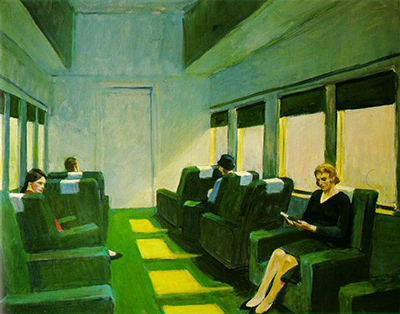
Rows of green seats lead towards the end of a railway carriage. Four passengers occupy different places among them, separated by empty chairs and an aisle patterned with sunlight. In Edward Hopper's Chair Car, travel is the reason for the room's existence, but the scene gives us very little movement to follow.
Painted in 1965, the oil on canvas measures 40 × 50 inches, or 101.6 × 127 cm. Its historical provenance records a purchase from the Frank K. M. Rehn gallery by David and Helen Pall in that year. [1] The large horizontal format allows the carriage to extend around the passengers, making their positions within its repeated furniture as consequential as their individual poses.
At a Glance
This work across Edward Hopper’s career
American Village
1912Soir Bleu
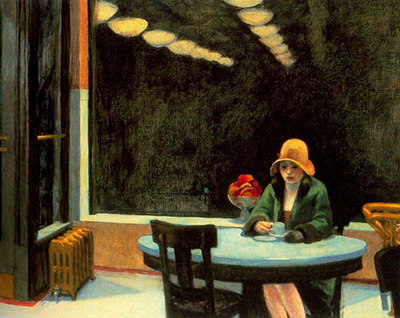
1914Automat
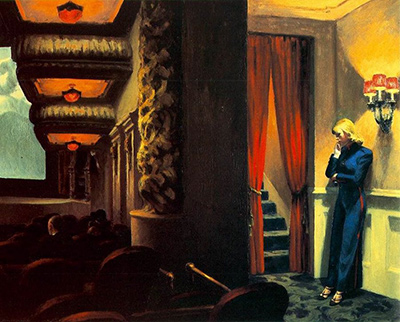
1927New York Movie
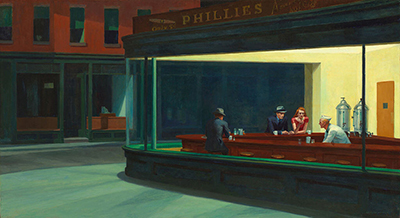
1939Nighthawks
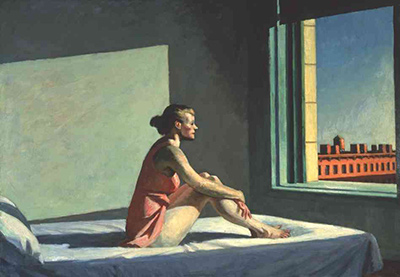
1942Morning Sun
1952Two Comedians
1966Contents
- Following the aisle
- Four passengers and different directions of attention
- Windows without a travelling landscape
- Sunlight on the floor
- A moving vehicle held still
- A glimpse of the artist at work
- The 2005 sale
- Late work and continuing subjects
Following the aisle
The aisle gives the spectator a clear direction into the scene. Its sides converge as the seats diminish, leading towards a pale end wall. The outlined shape of a door offers a possible continuation, but we cannot follow the carriage beyond it.
The chairs make this recession particularly strong. Their high green backs overlap, while pale headrest covers provide smaller repeated accents. Close seats are large enough to block part of the bodies behind them. More distant seats reduce the passengers to heads and portions of upper clothing.
This produces a space that is easy to recognise and difficult to survey completely. We understand that more chairs belong to the rows than we can inspect individually. The crop includes enough of the nearest seats to place us among them, rather than giving us the detached overview of a carriage diagram.
Above the windows, long boxed forms and ceiling edges repeat the direction of the aisle. Almost every large architectural element points farther into the car. The people introduce smaller turns across or away from that dominant movement.
Four passengers and different directions of attention
The nearest woman at the right holds reading material. Her head inclines towards it, and the light on her lower legs gives her figure an emphatic position against the green seat. The pose contains a recognisable activity without telling us what she is reading.
Across the aisle, another woman turns her head towards the right. Her face is visible above the intervening chair backs. The direction can suggest that she notices the nearer reader, but the two do not exchange an unmistakable greeting or gesture.
Farther back on the right, a man is seen largely from behind. His position directs attention towards the windows and the forward part of the carriage. A smaller woman's head appears on the left near the rear of the visible group. Distance and furniture withhold much of her body.
Hopper gives these figures different degrees of visibility. We can inspect one person's hands and legs, another's turned face, and the back of a third person's head. The fourth is present chiefly as a small figure beyond the nearer seats. They share a vehicle without being presented as a single social unit.
Empty chairs contribute to this effect, but they do not prove that the passengers have deliberately avoided one another. The picture supplies their spacing, not their reasons for choosing seats. A nearly empty car can permit solitude, casual observation or the simple convenience of spreading out.
Windows without a travelling landscape
The windows at the right are filled with pale, warm colour. Instead of opening onto a recognisable succession of houses, fields or stations, they become bright rectangles within the carriage wall. Their frames remain firm while the world outside becomes difficult to identify.
This is a major decision in a railway picture. An external view could tell us where the train is travelling and give the passengers something specific to look at. Here the windows chiefly admit brightness. They define the interior's illumination more readily than its location.
The lowered dark shades add another repeated band above the light areas. Their edges divide each window into separate zones, while the long line of frames carries the eye towards the end wall. The opening to the outside has become an important part of the room's internal design.
The absence of a clear landscape also keeps our attention with the people. We cannot turn away from their poses to follow a conspicuous mountain or skyline. The carriage holds the main descriptive interest even though it exists to pass through places beyond itself.
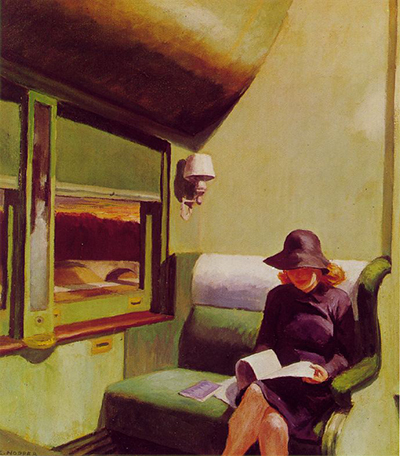
Compare: Compartment C, Car 293, 1938.
Sunlight on the floor
Bright patches cross the aisle at intervals. Their sharp edges relate them to the windows, and their changing shapes register the floor's recession. Light gives the route between the seats a second rhythm within the larger rhythm of the furniture.
The green floor remains visible between those patches. Sunlight does not cover it uniformly. A sequence of light and darker green allows the aisle to feel continuous while repeatedly interrupting our passage along it.
The illumination is warm enough to complicate a uniformly bleak response. It falls into a space occupied by ordinary travellers, including someone absorbed in reading. The painting offers no clear event that makes the brightness reassuring or threatening. It can be experienced as warmth before it becomes a proposed symbol.
The same is true of the green. It unifies chairs, floor and parts of the surrounding architecture through related tones. Small differences keep those surfaces distinct. Within that restricted range, a pale headrest, blue garment or lighted leg can become unusually noticeable.
A moving vehicle held still
Nothing in the canvas establishes the train's speed or confirms whether it is moving at the depicted instant. Its purpose implies a journey, but there is no blurred landscape or leaning body that measures motion. The empty aisle remains clear while the seated figures hold their separate positions around it.
That suspension helps explain why the scene can prompt stories. We recognise an experience that normally unfolds through time: boarding, finding a seat, reading, arriving. The painting shows one arrangement within such a sequence while leaving its earlier and later stages unseen.
Robert Hobbs's account of Hopper describes this broader practice as an interruption of narrative continuity. A viewer is encouraged to imagine the missing parts but is not given enough evidence to complete them definitively. [2] The argument is particularly relevant to a carriage whose destination and passengers' relationships remain withheld.
The missing sequence does not have to conceal a crisis. Ordinary journeys contain intervals in which very little happens visibly. The apparent pause can be compelling because we know that the people have lives and destinations outside the limited moment offered to us.
Watch: Edward Hopper’s Life and Art
Explore Hopper’s paintings and the places behind them in these museum films. Choose a film below.
A glimpse of the artist at work
The Whitney's 2022 exhibition labels identify a short 1965 documentary segment showing Edward and Jo Hopper in their Washington Square studios. The museum describes Edward with a brush before the canvas that became Chair Car, while cautioning that he was probably performing the action for the camera. [3]
That qualification preserves the value of the footage. An artist appearing to paint before a film camera is a record of a studio encounter, but not necessarily an uninterrupted record of how the work was created. A brush held at the canvas cannot reveal every earlier revision, model session or decision.
The distinction is especially relevant to the picture's finished clarity. Its orderly rows and quiet poses can seem inevitable after completion. They remain choices, whether or not a camera happens to witness one moment in the studio.
The painting was included in the Whitney's 1965 annual exhibition, and it returned for Edward Hopper's New York in 2022–23, where the labels credited a private collection. [3] That later exhibition brought the late carriage scene into an account of Hopper's sustained engagement with the city, including the interiors and routes through which it was experienced.
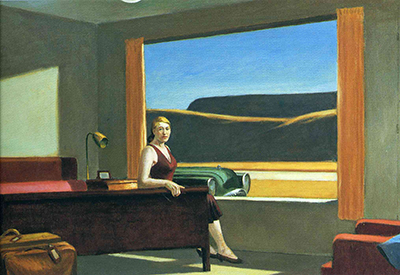
Compare: Western Motel, 1957.
The 2005 sale
Christie's sold Chair Car from the Pall collection on 11 May 2005. Its official result announcement reported $14,016,000 and described the result as a new auction record for Hopper at that time. [4] The figure belongs to a documented sale, rather than a current valuation or identification of the present owner.
The sale catalogue records the painting’s exhibitions in Richmond, São Paulo, New York and Brussels. [1] Its history of public display gives a wider context to an image whose subject seems almost entirely withdrawn from public action. A small, dispersed group of passengers has repeatedly been gathered before large audiences.
That history should not displace the differences within the picture. The nearest reader, the woman looking across, and the distant backs remain more particular than a general description of four lonely people. The canvas's public reputation depends partly on how much it lets those private-looking positions remain unresolved.
Late work and continuing subjects
Chair Car belongs near the end of Hopper's career, but its railway setting continues a much earlier interest. Compartment C, Car 293 had placed a reader in a smaller compartment in 1938. Its visible landscape gives the window a different role from the pale, largely opaque rectangles here.
Western Motel offers a contrasting arrangement: travel is suggested through a vehicle outside a room whose occupant faces towards us. In Chair Car, the room itself is the vehicle, and the passengers direct their attention elsewhere.
The later Two Comedians, dated 1966 by the Whitney, also prevents the carriage from being treated as Hopper's final statement. [5] A journey can invite thoughts of an ending without establishing that its painter intended one particular farewell.
The aisle continues towards the end wall, passing the reader's seat and the bright floor patches. It gives the viewer a route that the seated passengers do not follow within the image. Around that clear line of passage, Hopper arranges several quieter directions of attention, allowing a shared journey to contain separate experiences.
Artworks and studies directory
This researched directory includes finished works and separately identified studies. It is not a complete catalogue raisonné. Linked titles open the articles; unlinked studies are identified by their collection accessions. Watercolours retain their recorded media, and original prints remain distinct from reproductions.
| Name | Date | Medium |
|---|---|---|
| (Bridge and Embankment) (70.1298) | 1906 | Oil on wood |
| (Jo Sketching at Good Harbor Beach) (70.1129) | 1923–1924 | Watercolor and fabricated chalk on paper |
| (Manhattan Bridge) (70.1098) | 1925–1926 | Watercolor and graphite pencil on paper |
| (Rooftops) (70.1114) | 1926 | Watercolor and graphite pencil on paper |
| (Seated Male Model, Bent Over) (70.1277) | c. 1902–1903 | Oil on canvas |
| (Self-Portrait) (70.1254) | 1903–1906 | Oil on canvas |
| (Solitary Figure in a Theater) (70.1418) | c. 1902–1904 | Oil on board |
| 5 A.M. | 1937 | oil on canvas |
| Adam's House | 1928 | watercolour and charcoal on paper |
| American Village | 1912 | Oil on canvas |
| Apartment Houses | 1923 | oil on canvas |
| Approaching a City | 1946 | oil on canvas |
| August in the City | 1945 | oil on canvas |
| Automat | 1927 | oil on canvas |
| Barber Shop | 1931 | oil on canvas |
| Blackwell's Island | 1928 | oil on canvas |
| Bridge on the Seine | 1909 | Oil on canvas |
| Bridle Path | 1939 | oil on canvas |
| Burly Cobb's House South Truro | 1930–1933 | oil on canvas |
| Cape Cod Evening | 1939 | oil on canvas |
| Cape Cod Morning | 1950 | oil on canvas |
| Chair Car | 1965 | oil on canvas |
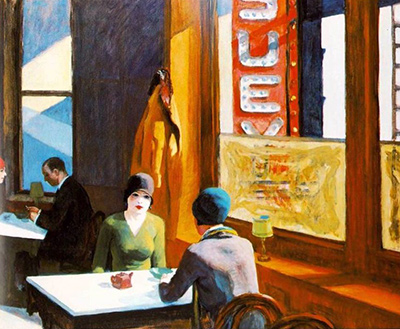
| Chop Suey | 1929 | oil on canvas |
| City Roofs | 1932 | Oil on canvas |
| Coast Guard Station | 1929 | oil on canvas |
| Compartment C, Car 293 | 1938 | oil on canvas |
| Conference at Night | 1949 | oil on canvas |
| Corn Hill | 1930 | oil on canvas |
| Dawn in Pennsylvania | 1942 | oil on canvas |
| Drug Store | 1927 | oil on canvas |
| Early Sunday Morning | 1930 | Oil on canvas |
| East Side Interior (70.1020) | 1922 | Etching |
| East Wind Over Weehawken | 1934 | oil on canvas |
| El Palacio | 1946 | Watercolor and graphite pencil on paper |
| Eleven A.M. | 1926 | oil on canvas |
| Evening Wind | 1921 | etching |
| Excursion into Philosophy | 1959 | oil on canvas |
| First Row Orchestra | 1951 | oil on canvas |
| Freight Car at Truro | 1931 | watercolour over graphite on paper |
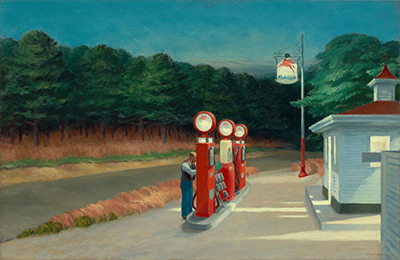
| Gas | 1940 | oil on canvas |
| Girl at a Sewing Machine | c. 1921 | oil on canvas |
| Gloucester Harbor | 1912 | Oil on canvas |
| Ground Swell | 1939 | oil on canvas |
| Haskell's House | 1924 | watercolour over graphite on paperboard |
| High Noon | 1949 | oil on canvas |
| Hill and Houses Cape Elizabeth Maine | 1927 | watercolour over graphite pencil |
| Hills South Truro | 1930 | oil on canvas |
| Hotel by a Railroad | 1952 | oil on canvas |
| Hotel Lobby | 1943 | oil on canvas |
| Hotel Room | 1931 | oil on canvas |
| Hotel Window | 1955 | oil on canvas |
| House by the Railroad | 1925 | oil on canvas |
| House by the Squam River | 1926 | watercolour over graphite on paper |
| Le Bistro or The Wine Shop | 1909 | Oil on canvas |
| Le Pont des Arts | 1907 | Oil on canvas |
| Le Pont Royal | 1909 | Oil on canvas |
| Le Quai des Grands Augustins | 1909 | Oil on canvas |
| Lighthouse and Buildings Portland Head | 1927 | watercolour over graphite pencil on paper |
| Lighthouse Hill | 1927 | oil painting |
| Manhattan Bridge Loop | 1928 | oil on canvas |
| Model Sitting | c. 1902 | oil painting; support not asserted |
| Morning Sun | 1952 | oil on canvas |
| New York Movie | 1939 | oil on canvas |
| New York New Haven and Hartford | 1931 | oil on canvas |
| New York Office | 1962 | oil on canvas |
| New York Pavements | 1924–1925 | oil on canvas |
| New York Restaurant | c. 1922 | oil on canvas |
| Night Windows | 1928 | oil on canvas |
| Nighthawks | 1942 | oil on canvas |
| October on Cape Cod | 1946 | oil on canvas |
| Office at Night | 1940 | oil on canvas |
| Office in a Small City | 1953 | oil on canvas |
| Pennsylvania Coal Town | 1947 | oil on canvas |
| People in the Sun | 1960 | oil on canvas |
| Portrait of Orleans | 1950 | oil on canvas |
| Queensborough Bridge | 1913 | Oil on canvas |
| Railroad Sunset | 1929 | Oil on canvas |
| Railroad Train | 1908 | oil on canvas |
| Road in Maine | 1914 | oil on canvas |
| Room in Brooklyn | 1932 | oil on canvas |
| Room in New York | 1932 | oil on canvas |
| Rooms by the Sea | 1951 | oil on canvas |
| Rooms for Tourists | 1945 | oil on canvas |
| Route 6 Eastham | 1941 | oil on canvas |
| Second Story Sunlight | 1960 | Oil on canvas |
| Self-Portrait | 1925–1930 | Oil on canvas |
| Self-Portrait with Hat (70.1903) | c. 1918, posthumous print | Drypoint |
| Seven A.M. | 1948 | Oil on canvas |
| Soir Bleu | 1914 | oil on canvas |
| South Carolina Morning | 1955 | Oil on canvas |
| Stairway at 48 Rue de Lille Paris | 1906 | Oil on wood |
| Study for 5 A.M. (70.153) | 1937 | Fabricated chalk on paper |
| Study for 5 A.M. (70.429) | 1937 | Fabricated chalk and graphite pencil on paper |
| Study for Approaching a City (70.869) | 1946 | Fabricated chalk and charcoal on paper |
| Study for August in the City (70.158a-b) | 1945 | Fabricated chalk on paper |
| Study for August in the City (70.159) | 1945 | Fabricated chalk on paper |
| Study for Bridle Path (70.220) | 1939 | Fabricated chalk on paper |
| Study for Bridle Path (70.235) | 1939 | Fabricated chalk on paper |
| Study for Compartment C, Car 293 (70.430) | 1938 | Fabricated chalk on paper |
| Study for Compartment C, Car 293 (70.431a-b) | 1938 | Fabricated chalk and charcoal on paper |
| Study for Conference at Night (70.170) | 1949 | Fabricated chalk on paper (recto); Typewriter ink on paper (verso) |
| Study for Conference at Night (70.174) | 1949 | Fabricated chalk on paper ( recto); Typewriter ink on paper (verso) |
| Study for East Wind over Weehawken (70.249) | 1934 | Graphite pencil on paper |
| Study for East Wind over Weehawken (70.252) | 1934 | Fabricated chalk and charcoal on paper |
| Study for Evening Wind (70.343a-b) | 1921 | Fabricated chalk on paper |
| Study for First Row Orchestra (70.841) | 1951 | Fabricated chalk and charcoal on paper |
| Study for Gas (70.263) | 1940 | Fabricated chalk on paper |
| Study for Ground Swell (70.339) | 1939 | Fabricated chalk, charcoal and graphite pencil on paper |
| Study for Hotel by a Railroad (70.199) | 1952 | Fabricated chalk on paper |
| Study for Hotel by a Railroad (70.427) | 1952 | Fabricated chalk on paper |
| Study for Hotel by a Railroad (70.428) | 1952 | Fabricated chalk on paper |
| Study for Hotel Lobby (70.117) | 1942 | Fabricated chalk and graphite pencil on paper |
| Study for Hotel Lobby (70.839) | 1942 | Fabricated chalk and charcoal on paper |
| Study for Hotel Window (70.161) | 1955 | Fabricated chalk, graphite pencil and colored pencil on paper |
| Study for Morning Sun (70.243) | 1952 | Fabricated chalk on paper |
| Study for Morning Sun (70.244) | 1952 | Fabricated chalk on paper |
| Study for Morning Sun (70.290) | 1952 | Fabricated chalk on paper |
| Study for Morning Sun (70.291) | 1952 | Fabricated chalk and graphite pencil on paper |
| Study for New York Movie (70.273) | 1939 | Fabricated chalk on paper |
| Study for New York Movie (70.274a-b) | 1938 or 1939 | Fabricated chalk and charcoal on paper (recto); Fabricated chalk on paper (verso) |
| Study for New York Movie (70.455) | 1939 | Fabricated chalk and charcoal on paper |
| Study for New York Office (70.822) | 1962 | Fabricated chalk on paper |
| Study for Nighthawks (70.192) | 1941 or 1942 | Fabricated chalk on paper |
| Study for Nighthawks (70.193) | 1941 or 1942 | Fabricated chalk on paper |
| Study for Office at Night (70.340) | 1940 | Fabricated chalk and charcoal on paper |
| Study for Office at Night (70.341) | 1940 | Fabricated chalk and graphite pencil on paper |
| Study for Pennsylvania Coal Town (70.198) | 1947 | Fabricated chalk on paper |
| Study for Pennsylvania Coal Town (70.229) | 1947 | Fabricated chalk and charcoal on paper |
| Study for Rooms for Tourists (70.438) | 1945 | Fabricated chalk and charcoal on paper |
| Study for Rooms for Tourists (70.848) | 1945 | Fabricated chalk and charcoal on paper |
| Study for Route 6, Eastham (70.369) | 1941 | Fabricated chalk and graphite pencil on paper |
| Study for Route 6, Eastham (70.854) | 1941 | Fabricated chalk and graphite pencil on paper |
| Study for South Carolina Morning (70.162a-b) | 1955 | Fabricated chalk on paper (recto and verso) |
| Study for The Sheridan Theatre (70.969) | 1937 | Graphite pencil on paper |
| Study for Two on the Aisle (70.128) | 1927 | Fabricated chalk on paper |
| Study for Two on the Aisle (70.129) | 1927 | Fabricated chalk on paper |
| Study for Yawl Riding a Swell (70.439) | 1935 | Fabricated chalk and graphite pencil on paper |
| Summer Evening | 1947 | oil on canvas |
| Summer Interior | 1909 | Oil on canvas |
| Sun in an Empty Room | 1963 | oil on canvas |
| Sunlight in a Cafeteria | 1958 | oil on canvas |
| Sunlight on Brownstones | 1956 | oil on canvas |
| Tables for Ladies | 1930 | oil on canvas |
| The Bootleggers | 1925 | oil on canvas |
| The Camel's Hump | 1931 | oil on canvas |
| The Circle Theatre | 1936 | oil on canvas |
| The City | 1927 | oil on canvas |
| The Lighthouse at Two Lights | 1929 | oil on canvas |
| The Long Leg | 1935 | oil on canvas |
| The Mansard Roof | 1923 | watercolour over graphite on paper |
| The Sheridan Theatre | 1937 | oil on canvas |
| Tramp Steamer | 1908 | oil on canvas |
| Two Comedians | 1966 | oil on canvas |
| Two on the Aisle | 1927 | oil on canvas |
| Valley of the Seine | 1909 | Oil on canvas |
| Western Motel | 1957 | oil on canvas |
Frequently Asked Questions
Edward Hopper made Chair Car in 1965. [1]
The recorded medium is oil on canvas. [1]
Rows of green seats lead towards the end of a railway carriage. Four passengers occupy different places among them, separated by empty chairs and an aisle patterned with sunlight. In Edward Hopper's Chair Car, travel is the reason for the room's existence, but the scene gives us very little movement to follow.
Discussion
Look again at the images and ideas explored in Chair Car. These editorial prompts invite your observations.
Reader Insights
Which boundary, gesture or change of light first holds your attention in Chair Car?
Compare Compartment C, Car 293 with Chair Car. Which visual difference matters most to your reading?
Which detail would you look at again after reading “Windows without a travelling landscape”?
Join the Conversation
Share a detail, comparison or question about Chair Car below.
References
- Christie's, Chair Car, from the Collection of Helen and David B. Pall, 2005, complete object details, provenance, exhibition record and catalogue essay. Dimensions, 1965 date and historical acquisition from Rehn; catalogue raisonné number O-365 is not a museum accession. View source.
- Robert Hobbs, Edward Hopper, introduction, 1987, pp. 9–20, especially pp. 16–20 on interrupted narrative and the viewer. This is the directly consulted excerpt, distinct from the sale catalogue's inconsistent quotation attributions. View source.
- Whitney Museum of American Art, Edward Hopper's New York, exhibition labels, 2022, Washington Square documentary caption and “Reality and Fantasy” labels, PDF pp. 35 and 62; Christie's exhibition history also records the 1965 annual. The documentary is described through the museum's account, not an independent viewing here. View source.
- Christie's, New York Post-War and Contemporary evening-sale result announcement, 11 May 2005, complete Chair Car discussion on PDF p. 1. Reported sale result and its record status at that date. View source.
- Whitney Museum of American Art, Two Comedians, 1966: Kambui Olujimi commentary, 2 October 2022, accompanying date and published transcript. View source.
- Collection or catalogue record, American Village, 1912; medium and identity as discussed in the linked article. View source.
- Collection or catalogue record, Soir Bleu, 1914; medium and identity as discussed in the linked article. View source.
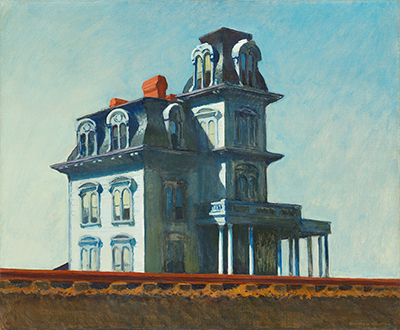
- Collection or catalogue record, House by the Railroad, 1925; medium and identity as discussed in the linked article. View source.
- Collection or catalogue record, Automat, 1927; medium and identity as discussed in the linked article. View source.
- Collection or catalogue record, Early Sunday Morning, 1930; medium and identity as discussed in the linked article. View source.
- Collection or catalogue record, New York Movie, 1939; medium and identity as discussed in the linked article. View source.
- Collection or catalogue record, Nighthawks, 1942; medium and identity as discussed in the linked article. View source.
- Collection or catalogue record, Morning Sun, 1952; medium and identity as discussed in the linked article. View source.
- Collection or catalogue record, Second Story Sunlight, 1960; medium and identity as discussed in the linked article. View source.
- Collection or catalogue record, Two Comedians, 1966; medium and identity as discussed in the linked article. View source.
- Whitney Museum of American Art, Study for Route 6, Eastham, 1941, accession 70.854; exact object record. View source.
- Whitney Museum of American Art, Study for Conference at Night, 1949, accession 70.170; exact object record. View source.
- Whitney Museum of American Art, Study for First Row Orchestra, 1951, accession 70.841; exact object record. View source.
- Whitney Museum of American Art, (Bridge and Embankment), 1906, accession 70.1298; exact object record. View source.
- Whitney Museum of American Art, (Seated Male Model, Bent Over), c. 1902–1903, accession 70.1277; exact object record. View source.
- Whitney Museum of American Art, Study for Morning Sun, 1952, accession 70.244; exact object record. View source.
- Whitney Museum of American Art, Study for Morning Sun, 1952, accession 70.243; exact object record. View source.
- Whitney Museum of American Art, Study for Two on the Aisle, 1927, accession 70.128; exact object record. View source.
- Whitney Museum of American Art, Study for New York Office, 1962, accession 70.822; exact object record. View source.
- Whitney Museum of American Art, Study for Two on the Aisle, 1927, accession 70.129; exact object record. View source.
- Whitney Museum of American Art, Study for Pennsylvania Coal Town, 1947, accession 70.229; exact object record. View source.
- Whitney Museum of American Art, (Rooftops), 1926, accession 70.1114; exact object record. View source.
- Whitney Museum of American Art, Study for South Carolina Morning, 1955, accession 70.162a-b; exact object record. View source.
- Whitney Museum of American Art, (Self-Portrait), 1903–1906, accession 70.1254; exact object record. View source.
- Whitney Museum of American Art, (Manhattan Bridge), 1925–1926, accession 70.1098; exact object record. View source.
- Whitney Museum of American Art, (Solitary Figure in a Theater), c. 1902–1904, accession 70.1418; exact object record. View source.
- Whitney Museum of American Art, Study for Approaching a City, 1946, accession 70.869; exact object record. View source.
- Whitney Museum of American Art, Study for August in the City, 1945, accession 70.159; exact object record. View source.
- Whitney Museum of American Art, Study for Compartment C, Car 293, 1938, accession 70.430; exact object record. View source.
- Whitney Museum of American Art, Study for Compartment C, Car 293, 1938, accession 70.431a-b; exact object record. View source.
- Whitney Museum of American Art, Study for East Wind over Weehawken, 1934, accession 70.252; exact object record. View source.
- Whitney Museum of American Art, Study for East Wind over Weehawken, 1934, accession 70.249; exact object record. View source.
- Whitney Museum of American Art, Study for Evening Wind, 1921, accession 70.343a-b; exact object record. View source.
- Whitney Museum of American Art, Study for The Sheridan Theatre, 1937, accession 70.969; exact object record. View source.
- Whitney Museum of American Art, Study for New York Movie, 1939, accession 70.455; exact object record. View source.
- Whitney Museum of American Art, Study for New York Movie, 1939, accession 70.273; exact object record. View source.
- Whitney Museum of American Art, Study for New York Movie, 1938 or 1939, accession 70.274a-b; exact object record. View source.
- Whitney Museum of American Art, Study for 5 A.M., 1937, accession 70.153; exact object record. View source.
- Whitney Museum of American Art, Study for 5 A.M., 1937, accession 70.429; exact object record. View source.
- Whitney Museum of American Art, (Jo Sketching at Good Harbor Beach), 1923–1924, accession 70.1129; exact object record. View source.
- Whitney Museum of American Art, Study for August in the City, 1945, accession 70.158a-b; exact object record. View source.
- Whitney Museum of American Art, Study for Morning Sun, 1952, accession 70.291; exact object record. View source.
- Whitney Museum of American Art, Study for Morning Sun, 1952, accession 70.290; exact object record. View source.
- Whitney Museum of American Art, Study for Office at Night, 1940, accession 70.340; exact object record. View source.
- Whitney Museum of American Art, Study for Office at Night, 1940, accession 70.341; exact object record. View source.
- Whitney Museum of American Art, Study for Hotel by a Railroad, 1952, accession 70.427; exact object record. View source.
- Whitney Museum of American Art, Study for Hotel by a Railroad, 1952, accession 70.199; exact object record. View source.
- Whitney Museum of American Art, Study for Hotel by a Railroad, 1952, accession 70.428; exact object record. View source.
- Whitney Museum of American Art, Study for Hotel Lobby, 1942, accession 70.117; exact object record. View source.
- Whitney Museum of American Art, Study for Hotel Lobby, 1942, accession 70.839; exact object record. View source.
- Whitney Museum of American Art, Study for Conference at Night, 1949, accession 70.174; exact object record. View source.
- Whitney Museum of American Art, Study for Hotel Window, 1955, accession 70.161; exact object record. View source.
- Whitney Museum of American Art, Study for Pennsylvania Coal Town, 1947, accession 70.198; exact object record. View source.
- Whitney Museum of American Art, Study for Route 6, Eastham, 1941, accession 70.369; exact object record. View source.
- Whitney Museum of American Art, Study for Bridle Path, 1939, accession 70.220; exact object record. View source.
- Whitney Museum of American Art, Study for Bridle Path, 1939, accession 70.235; exact object record. View source.
- Whitney Museum of American Art, Study for Ground Swell, 1939, accession 70.339; exact object record. View source.
- Whitney Museum of American Art, Study for Yawl Riding a Swell, 1935, accession 70.439; exact object record. View source.
- Whitney Museum of American Art, Study for Rooms for Tourists, 1945, accession 70.848; exact object record. View source.
- Whitney Museum of American Art, Study for Rooms for Tourists, 1945, accession 70.438; exact object record. View source.
- Whitney Museum of American Art, Study for Nighthawks, 1941 or 1942, accession 70.193; exact object record. View source.
- Whitney Museum of American Art, Study for Nighthawks, 1941 or 1942, accession 70.192; exact object record. View source.
- Whitney Museum of American Art, Study for Gas, 1940, accession 70.263; exact object record. View source.
- Whitney Museum of American Art, Self-Portrait with Hat, c. 1918, posthumous print, accession 70.1903; exact object record. View source.
- Whitney Museum of American Art, East Side Interior, 1922, accession 70.1020; exact object record. View source.
- Art Institute of Chicago, Selected Chronology for Edward Hopper; training, travels, exhibitions, New York and Truro chronology. View source.
- Emily C. Burns, Spectral figures: Edward Hopper’s empty Paris, chapter 5 in Empty Spaces: Confronting Emptiness in National, Cultural and Urban Histories, 2019; complete chapter and notes consulted. View source.
- Charles Brock, Regionalism and Folk Art, National Gallery of Art; complete essay and two notes consulted. View source.