 by Tom Gurney
Tom Gurney BSc (Hons) is an art history expert with over 20 years experience
Email: tomgurney1@gmail.com / Phone: +44 7429 011000
First Row Orchestra: Introduction
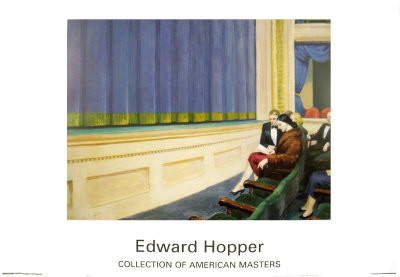
The curtain fills most of the view, but the performance has yet to become visible. Along the right edge of Edward Hopper's First Row Orchestra, a few people occupy green theatre seats beside the pale front of the stage. One figure bends over a programme; another sits more upright nearby. The expansive blue curtain and small cluster of spectators make an unexpectedly unequal pair of subjects.
Hopper painted the work in 1951. The Hirshhorn Museum and Sculpture Garden records oil on canvas, 31⅛ × 40⅛ inches, accession 66.2506. It entered the Smithsonian collection through the Joseph H. Hirshhorn Foundation's gift in 1966. [1] The title names a seating position rather than a play, performer or particular theatre. That position determines almost everything we can see.
At a Glance
- ArtistEdward Hopper [1]
- Date1951 [1]
- Mediumoil on canvas [1]
- Collection / recordHirshhorn Museum and Sculpture Garden [1]
- Accession66.2506 [1]
This work across Edward Hopper’s career
American Village
1912Soir Bleu
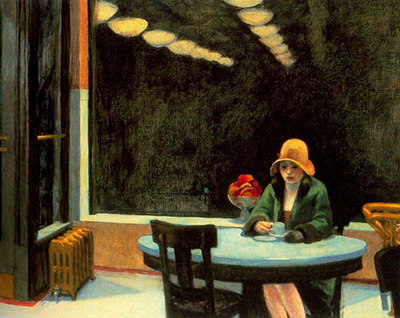
1914Automat
1927New York Movie
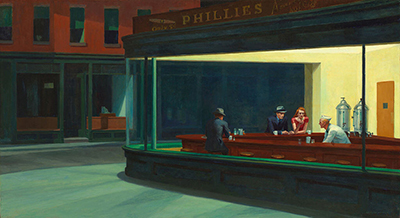
1939Nighthawks
1942Morning Sun
1952Two Comedians
1966Contents
- Facing the curtain from the side
- A large field of blue
- The pale front of the stage
- Reading while waiting
- Green seats and an open strip of floor
- The surviving compositional drawing
- Theatre-going and the painting's public life
- Other positions within the theatre
Facing the curtain from the side
The view comes from close to the front seats, looking obliquely across the stage. We see a long section of its pale front and a broad stretch of hanging fabric above. The audience is gathered at the far end of those forms, where the available space narrows towards the right.
This arrangement gives us a spectator's location without the expected spectacle. Nothing beyond the curtain explains what the people have come to watch. Instead, the theatre's fittings occupy the space in which actors or scenery might normally command attention.
The angle is especially important. Seen straight on, the curtain could form a nearly symmetrical rectangle, with the audience spread across a foreground. Hopper chooses a lateral view that sends the stage front towards the people. The architecture becomes a strong diagonal, bringing a distant corner into relation with our own position.
The picture's right edge prevents the audience from becoming a complete group portrait. Seats and bodies continue beyond it. We occupy one selected part of a larger auditorium, sufficiently close to notice a programme and a hat but unable to survey the full gathering.
This partial view also changes the meaning of the title. The orchestra seating area is the subject we inhabit, rather than something presented to us from an elevated balcony. The painting gives the ordinary act of sitting near a stage a distinctive visual structure.
A large field of blue
The curtain occupies a striking amount of canvas. Its blue and violet passages descend in long vertical folds, with darker divisions giving depth to the hanging fabric. Near the bottom, a narrow warmer fringe makes the edge more explicit.
The folds keep this large area from becoming a blank backdrop. Their repeated uprights vary in width and tone, supplying a slower rhythm than the small angles of arms, hats and seat backs. The eye can follow them upwards even though the top of the curtain is cropped.
The fringe introduces a different direction. It runs across the lower edge, joining the cloth to the long horizontal construction beneath. Its warmer colour stands between the cooler curtain and the cream of the stage front, preventing those two large areas from meeting without interruption.
The curtain is both a material object and an obstruction. Its folds and weighted edge establish substantial cloth, while its closure keeps the space behind it unavailable. The unseen performance is made present through the very object that conceals it.
At the far right, a smaller blue drapery and warmer architectural framing complicate the broad field. A few red seats or upholstered forms appear beyond the main figures. These fragments suggest the theatre's continuing interior without opening a second large view into it.
The pale front of the stage
Below the curtain, the stage front has a sequence of inset rectangular panels. Their pale surfaces catch more light than the seats and lower floor. Mouldings create slender changes of tone, allowing the long surface to remain articulated without becoming densely patterned.
The rectangles diminish towards the people. They make recession legible within a painting where much of the upper half is almost frontal. The curtain's hanging folds and the wall's diagonal movement therefore establish different spatial directions at the same time.
The upper edge is darker and more emphatic. It separates fabric from constructed surface, giving the curtain a definite point of contact with the theatre. Below, smaller shadows within the panels keep the pale front from appearing as an uninterrupted band of light.
This decorative structure takes the place of more conspicuous stage scenery. We are looking at something intended to remain a support for performances, yet Hopper gives it much of the painting's width. A familiar piece of theatre architecture becomes an independent subject through scale and angle.
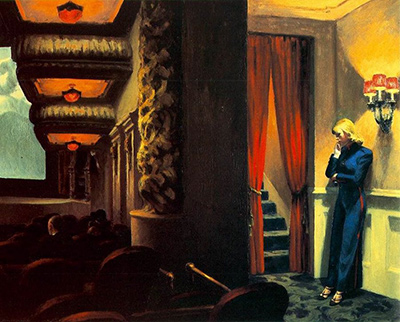
Compare: New York Movie, 1939.
Reading while waiting
The most conspicuous seated figure wears a brown outer garment and a dark hat. Her head is lowered towards a light-coloured programme held across the lap. The compact triangle of head, hands and paper brings a different kind of attention into the room.
The paper's pale surface is small compared with the stage front, but it has a similar power to catch the eye. One light area belongs to the building; another is held by a person and used for reading. Hopper places the public setting beside a more immediate, handheld object.
The figure's clothing spreads across the seat, with the coat making a warmer mass among the cooler greens and blues. The crossed or angled lower limbs introduce further changes of direction beneath the programme. The pose has enough specificity to suggest someone settled into a seat, rather than a figure merely placed upright for scale.
The neighbouring spectator's lighter shirt front and darker jacket are arranged more vertically. This difference makes the two nearby people distinct without requiring an exchange of glances. They share a seating area while directing attention differently.
Further towards the edge, another body is only partly available. The incomplete view discourages a neat count of a self-contained party. A small number of visible spectators can belong to a larger audience beyond the frame, just as the cropped curtain belongs to a larger stage.
The reading figure also changes how waiting looks. The interval is occupied by an activity, however modest. The painting gives that activity room without explaining whether the person is studying a cast list, looking ahead to a scene or simply passing time.
Watch: Edward Hopper’s Life and Art
Explore Hopper’s paintings and the places behind them in these museum films. Choose a film below.
Green seats and an open strip of floor
The seats supply curved backs and armrests beneath the more rigid panels. Their repeated shapes are close enough to the bodies to become part of the way we read each posture. A coat folds over a seat, an arm rests near its edge, and legs extend into the narrow space before it.
Their green colour relates to the cooler floor, but their structure remains distinct. The floor runs between spectators and stage, leaving an open passage that makes the long pale front easier to see. The painting's emptier area is therefore a practical part of the auditorium as well as a compositional interval.
The nearest seating forms are cropped, bringing their scale close to ours. By contrast, the small red areas towards the rear belong to another depth. Hopper gives a relatively confined view several spatial stages through changes in overlap, colour and size.
The surviving compositional drawing
A 1951 study in the Whitney Museum of American Art brings together the same main arrangement: curtain across the left, a long stage front receding to the right, and nearby seated figures. The museum identifies fabricated chalk and charcoal on paper, accession 70.841. [2]
The drawing makes the long diagonal especially forceful. Dark strokes gather around the spectators and seats, while the panelled surface remains lighter. The curtain is built from broad vertical marks whose uneven density gives the upper area weight.
In the painting, colour makes distinctions that the drawing must establish through tone and line. Brown clothing separates from green seating; blue fabric differs from the cream architecture. The relation of large setting to small human group remains clear in both media.
The study connects the audience with the theatre around it. The poses occupy the end of the long architectural diagonal, where the darkest strokes gather. Both the paper and the canvas give that small group its prominence through the space extending beside it.
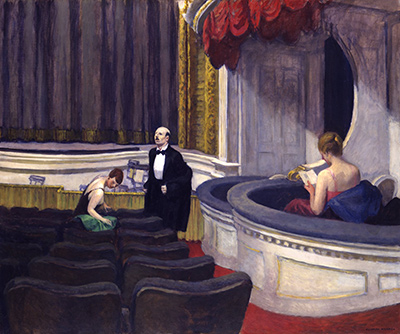
Compare: Two on the Aisle, 1927.
Theatre-going and the painting's public life
The Hoppers' interest in performances was sustained rather than incidental. In the Whitney's account of their saved ticket stubs, curator David Crane describes their frequent attendance and attention to staging, lighting and theatre design. The archive also records a preference for balcony seats on many visits. [3] First Row Orchestra explores a different, lower relationship to the stage, bringing its constructed front close to the spectator.
The Hirshhorn's exhibition history places the painting in the Whitney's 1951 annual exhibition, opening in November of the year it was made. Its provenance records a transfer from Rehn's gallery to Joseph H. Hirshhorn on 11 September 1954, followed by the Foundation gift in 1966. [1] These dates separate early public display, private collecting and eventual museum ownership.
Other positions within the theatre
Two on the Aisle gives the auditorium a more conspicuous moment of arrival. A standing man and a woman bending towards a seat animate its centre, while another spectator reads in a box. Here, reading is brought into the front seating group and the surrounding architecture stretches into a quieter, more extended diagonal.
New York Movie separates a brightly lit usher from the people watching a film. Its division is between work, audience and screen. First Row Orchestra places people together beside a curtain whose closure prevents us from sharing a performance at all.
The small programme offers a final way back into the composition. It is open and available to its reader while the much larger curtain remains shut. Hopper builds the theatre around those different kinds of access: what one person can examine immediately, what the audience is waiting to see, and what the painting allows us to inspect from our place nearby.
Artworks and studies directory
This researched directory includes finished works and separately identified studies. It is not a complete catalogue raisonné. Linked titles open the articles; unlinked studies are identified by their collection accessions. Watercolours retain their recorded media, and original prints remain distinct from reproductions.
| Name | Date | Medium |
|---|---|---|
| (Bridge and Embankment) (70.1298) | 1906 | Oil on wood |
| (Jo Sketching at Good Harbor Beach) (70.1129) | 1923–1924 | Watercolor and fabricated chalk on paper |
| (Manhattan Bridge) (70.1098) | 1925–1926 | Watercolor and graphite pencil on paper |
| (Rooftops) (70.1114) | 1926 | Watercolor and graphite pencil on paper |
| (Seated Male Model, Bent Over) (70.1277) | c. 1902–1903 | Oil on canvas |
| (Self-Portrait) (70.1254) | 1903–1906 | Oil on canvas |
| (Solitary Figure in a Theater) (70.1418) | c. 1902–1904 | Oil on board |
| 5 A.M. | 1937 | oil on canvas |
| Adam's House | 1928 | watercolour and charcoal on paper |
| American Village | 1912 | Oil on canvas |
| Apartment Houses | 1923 | oil on canvas |
| Approaching a City | 1946 | oil on canvas |
| August in the City | 1945 | oil on canvas |
| Automat | 1927 | oil on canvas |
| Barber Shop | 1931 | oil on canvas |
| Blackwell's Island | 1928 | oil on canvas |
| Bridge on the Seine | 1909 | Oil on canvas |
| Bridle Path | 1939 | oil on canvas |
| Burly Cobb's House South Truro | 1930–1933 | oil on canvas |
| Cape Cod Evening | 1939 | oil on canvas |
| Cape Cod Morning | 1950 | oil on canvas |
| Chair Car | 1965 | oil on canvas |
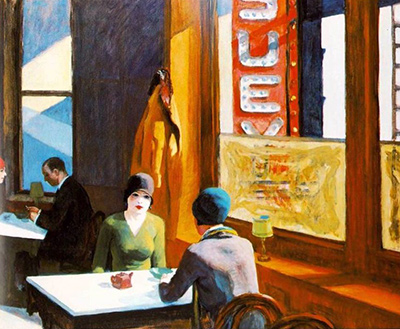
| Chop Suey | 1929 | oil on canvas |
| City Roofs | 1932 | Oil on canvas |
| Coast Guard Station | 1929 | oil on canvas |
| Compartment C, Car 293 | 1938 | oil on canvas |
| Conference at Night | 1949 | oil on canvas |
| Corn Hill | 1930 | oil on canvas |
| Dawn in Pennsylvania | 1942 | oil on canvas |
| Drug Store | 1927 | oil on canvas |
| Early Sunday Morning | 1930 | Oil on canvas |
| East Side Interior (70.1020) | 1922 | Etching |
| East Wind Over Weehawken | 1934 | oil on canvas |
| El Palacio | 1946 | Watercolor and graphite pencil on paper |
| Eleven A.M. | 1926 | oil on canvas |
| Evening Wind | 1921 | etching |
| Excursion into Philosophy | 1959 | oil on canvas |
| First Row Orchestra | 1951 | oil on canvas |
| Freight Car at Truro | 1931 | watercolour over graphite on paper |
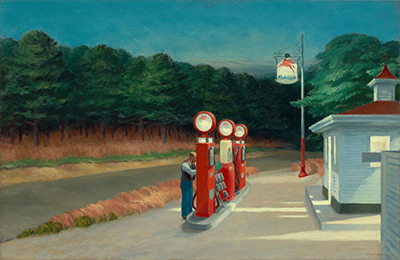
| Gas | 1940 | oil on canvas |
| Girl at a Sewing Machine | c. 1921 | oil on canvas |
| Gloucester Harbor | 1912 | Oil on canvas |
| Ground Swell | 1939 | oil on canvas |
| Haskell's House | 1924 | watercolour over graphite on paperboard |
| High Noon | 1949 | oil on canvas |
| Hill and Houses Cape Elizabeth Maine | 1927 | watercolour over graphite pencil |
| Hills South Truro | 1930 | oil on canvas |
| Hotel by a Railroad | 1952 | oil on canvas |
| Hotel Lobby | 1943 | oil on canvas |
| Hotel Room | 1931 | oil on canvas |
| Hotel Window | 1955 | oil on canvas |
| House by the Railroad | 1925 | oil on canvas |
| House by the Squam River | 1926 | watercolour over graphite on paper |
| Le Bistro or The Wine Shop | 1909 | Oil on canvas |
| Le Pont des Arts | 1907 | Oil on canvas |
| Le Pont Royal | 1909 | Oil on canvas |
| Le Quai des Grands Augustins | 1909 | Oil on canvas |
| Lighthouse and Buildings Portland Head | 1927 | watercolour over graphite pencil on paper |
| Lighthouse Hill | 1927 | oil painting |
| Manhattan Bridge Loop | 1928 | oil on canvas |
| Model Sitting | c. 1902 | oil painting; support not asserted |
| Morning Sun | 1952 | oil on canvas |
| New York Movie | 1939 | oil on canvas |
| New York New Haven and Hartford | 1931 | oil on canvas |
| New York Office | 1962 | oil on canvas |
| New York Pavements | 1924–1925 | oil on canvas |
| New York Restaurant | c. 1922 | oil on canvas |
| Night Windows | 1928 | oil on canvas |
| Nighthawks | 1942 | oil on canvas |
| October on Cape Cod | 1946 | oil on canvas |
| Office at Night | 1940 | oil on canvas |
| Office in a Small City | 1953 | oil on canvas |
| Pennsylvania Coal Town | 1947 | oil on canvas |
| People in the Sun | 1960 | oil on canvas |
| Portrait of Orleans | 1950 | oil on canvas |
| Queensborough Bridge | 1913 | Oil on canvas |
| Railroad Sunset | 1929 | Oil on canvas |
| Railroad Train | 1908 | oil on canvas |
| Road in Maine | 1914 | oil on canvas |
| Room in Brooklyn | 1932 | oil on canvas |
| Room in New York | 1932 | oil on canvas |
| Rooms by the Sea | 1951 | oil on canvas |
| Rooms for Tourists | 1945 | oil on canvas |
| Route 6 Eastham | 1941 | oil on canvas |
| Second Story Sunlight | 1960 | Oil on canvas |
| Self-Portrait | 1925–1930 | Oil on canvas |
| Self-Portrait with Hat (70.1903) | c. 1918, posthumous print | Drypoint |
| Seven A.M. | 1948 | Oil on canvas |
| Soir Bleu | 1914 | oil on canvas |
| South Carolina Morning | 1955 | Oil on canvas |
| Stairway at 48 Rue de Lille Paris | 1906 | Oil on wood |
| Study for 5 A.M. (70.153) | 1937 | Fabricated chalk on paper |
| Study for 5 A.M. (70.429) | 1937 | Fabricated chalk and graphite pencil on paper |
| Study for Approaching a City (70.869) | 1946 | Fabricated chalk and charcoal on paper |
| Study for August in the City (70.158a-b) | 1945 | Fabricated chalk on paper |
| Study for August in the City (70.159) | 1945 | Fabricated chalk on paper |
| Study for Bridle Path (70.220) | 1939 | Fabricated chalk on paper |
| Study for Bridle Path (70.235) | 1939 | Fabricated chalk on paper |
| Study for Compartment C, Car 293 (70.430) | 1938 | Fabricated chalk on paper |
| Study for Compartment C, Car 293 (70.431a-b) | 1938 | Fabricated chalk and charcoal on paper |
| Study for Conference at Night (70.170) | 1949 | Fabricated chalk on paper (recto); Typewriter ink on paper (verso) |
| Study for Conference at Night (70.174) | 1949 | Fabricated chalk on paper ( recto); Typewriter ink on paper (verso) |
| Study for East Wind over Weehawken (70.249) | 1934 | Graphite pencil on paper |
| Study for East Wind over Weehawken (70.252) | 1934 | Fabricated chalk and charcoal on paper |
| Study for Evening Wind (70.343a-b) | 1921 | Fabricated chalk on paper |
| Study for First Row Orchestra (70.841) | 1951 | Fabricated chalk and charcoal on paper |
| Study for Gas (70.263) | 1940 | Fabricated chalk on paper |
| Study for Ground Swell (70.339) | 1939 | Fabricated chalk, charcoal and graphite pencil on paper |
| Study for Hotel by a Railroad (70.199) | 1952 | Fabricated chalk on paper |
| Study for Hotel by a Railroad (70.427) | 1952 | Fabricated chalk on paper |
| Study for Hotel by a Railroad (70.428) | 1952 | Fabricated chalk on paper |
| Study for Hotel Lobby (70.117) | 1942 | Fabricated chalk and graphite pencil on paper |
| Study for Hotel Lobby (70.839) | 1942 | Fabricated chalk and charcoal on paper |
| Study for Hotel Window (70.161) | 1955 | Fabricated chalk, graphite pencil and colored pencil on paper |
| Study for Morning Sun (70.243) | 1952 | Fabricated chalk on paper |
| Study for Morning Sun (70.244) | 1952 | Fabricated chalk on paper |
| Study for Morning Sun (70.290) | 1952 | Fabricated chalk on paper |
| Study for Morning Sun (70.291) | 1952 | Fabricated chalk and graphite pencil on paper |
| Study for New York Movie (70.273) | 1939 | Fabricated chalk on paper |
| Study for New York Movie (70.274a-b) | 1938 or 1939 | Fabricated chalk and charcoal on paper (recto); Fabricated chalk on paper (verso) |
| Study for New York Movie (70.455) | 1939 | Fabricated chalk and charcoal on paper |
| Study for New York Office (70.822) | 1962 | Fabricated chalk on paper |
| Study for Nighthawks (70.192) | 1941 or 1942 | Fabricated chalk on paper |
| Study for Nighthawks (70.193) | 1941 or 1942 | Fabricated chalk on paper |
| Study for Office at Night (70.340) | 1940 | Fabricated chalk and charcoal on paper |
| Study for Office at Night (70.341) | 1940 | Fabricated chalk and graphite pencil on paper |
| Study for Pennsylvania Coal Town (70.198) | 1947 | Fabricated chalk on paper |
| Study for Pennsylvania Coal Town (70.229) | 1947 | Fabricated chalk and charcoal on paper |
| Study for Rooms for Tourists (70.438) | 1945 | Fabricated chalk and charcoal on paper |
| Study for Rooms for Tourists (70.848) | 1945 | Fabricated chalk and charcoal on paper |
| Study for Route 6, Eastham (70.369) | 1941 | Fabricated chalk and graphite pencil on paper |
| Study for Route 6, Eastham (70.854) | 1941 | Fabricated chalk and graphite pencil on paper |
| Study for South Carolina Morning (70.162a-b) | 1955 | Fabricated chalk on paper (recto and verso) |
| Study for The Sheridan Theatre (70.969) | 1937 | Graphite pencil on paper |
| Study for Two on the Aisle (70.128) | 1927 | Fabricated chalk on paper |
| Study for Two on the Aisle (70.129) | 1927 | Fabricated chalk on paper |
| Study for Yawl Riding a Swell (70.439) | 1935 | Fabricated chalk and graphite pencil on paper |
| Summer Evening | 1947 | oil on canvas |
| Summer Interior | 1909 | Oil on canvas |
| Sun in an Empty Room | 1963 | oil on canvas |
| Sunlight in a Cafeteria | 1958 | oil on canvas |
| Sunlight on Brownstones | 1956 | oil on canvas |
| Tables for Ladies | 1930 | oil on canvas |
| The Bootleggers | 1925 | oil on canvas |
| The Camel's Hump | 1931 | oil on canvas |
| The Circle Theatre | 1936 | oil on canvas |
| The City | 1927 | oil on canvas |
| The Lighthouse at Two Lights | 1929 | oil on canvas |
| The Long Leg | 1935 | oil on canvas |
| The Mansard Roof | 1923 | watercolour over graphite on paper |
| The Sheridan Theatre | 1937 | oil on canvas |
| Tramp Steamer | 1908 | oil on canvas |
| Two Comedians | 1966 | oil on canvas |
| Two on the Aisle | 1927 | oil on canvas |
| Valley of the Seine | 1909 | Oil on canvas |
| Western Motel | 1957 | oil on canvas |
Frequently Asked Questions
Edward Hopper made First Row Orchestra in 1951. [1]
The recorded medium is oil on canvas. [1]
The curtain fills most of the view, but the performance has yet to become visible. Along the right edge of Edward Hopper's First Row Orchestra, a few people occupy green theatre seats beside the pale front of the stage. One figure bends over a programme; another sits more upright nearby. The expansive blue curtain and small cluster of spectators make an unexpectedly unequal pair of subjects.
Discussion
Look again at the images and ideas explored in First Row Orchestra. These editorial prompts invite your observations.
Reader Insights
Which boundary, gesture or change of light first holds your attention in First Row Orchestra?
Compare New York Movie with First Row Orchestra. Which visual difference matters most to your reading?
Which detail would you look at again after reading “The pale front of the stage”?
Join the Conversation
Share a detail, comparison or question about First Row Orchestra below.
References
- Hirshhorn Museum and Sculpture Garden, Smithsonian Institution, First Row Orchestra, 1951, accession 66.2506; medium, dimensions, provenance and exhibition history. View source.
- Whitney Museum of American Art, Study for First Row Orchestra, 1951, fabricated chalk and charcoal on paper, accession 70.841; object record and drawing. View source.
- Whitney Museum of American Art, Edward Hopper's New York, guide, 2022, stop 511, “Performances,” transcript with David Crane; saved ticket stubs, theatre-going and seat preferences. View source.
- Collection or catalogue record, American Village, 1912; medium and identity as discussed in the linked article. View source.
- Collection or catalogue record, Soir Bleu, 1914; medium and identity as discussed in the linked article. View source.
- Collection or catalogue record, House by the Railroad, 1925; medium and identity as discussed in the linked article. View source.
- Collection or catalogue record, Automat, 1927; medium and identity as discussed in the linked article. View source.
- Collection or catalogue record, Early Sunday Morning, 1930; medium and identity as discussed in the linked article. View source.
- Collection or catalogue record, New York Movie, 1939; medium and identity as discussed in the linked article. View source.
- Collection or catalogue record, Nighthawks, 1942; medium and identity as discussed in the linked article. View source.
- Collection or catalogue record, Morning Sun, 1952; medium and identity as discussed in the linked article. View source.
- Collection or catalogue record, Second Story Sunlight, 1960; medium and identity as discussed in the linked article. View source.
- Collection or catalogue record, Two Comedians, 1966; medium and identity as discussed in the linked article. View source.
- Whitney Museum of American Art, Study for Route 6, Eastham, 1941, accession 70.854; exact object record. View source.
- Whitney Museum of American Art, Study for Conference at Night, 1949, accession 70.170; exact object record. View source.
- Whitney Museum of American Art, Study for First Row Orchestra, 1951, accession 70.841; exact object record. View source.
- Whitney Museum of American Art, (Bridge and Embankment), 1906, accession 70.1298; exact object record. View source.
- Whitney Museum of American Art, (Seated Male Model, Bent Over), c. 1902–1903, accession 70.1277; exact object record. View source.
- Whitney Museum of American Art, Study for Morning Sun, 1952, accession 70.244; exact object record. View source.
- Whitney Museum of American Art, Study for Morning Sun, 1952, accession 70.243; exact object record. View source.
- Whitney Museum of American Art, Study for Two on the Aisle, 1927, accession 70.128; exact object record. View source.
- Whitney Museum of American Art, Study for New York Office, 1962, accession 70.822; exact object record. View source.
- Whitney Museum of American Art, Study for Two on the Aisle, 1927, accession 70.129; exact object record. View source.
- Whitney Museum of American Art, Study for Pennsylvania Coal Town, 1947, accession 70.229; exact object record. View source.
- Whitney Museum of American Art, (Rooftops), 1926, accession 70.1114; exact object record. View source.
- Whitney Museum of American Art, Study for South Carolina Morning, 1955, accession 70.162a-b; exact object record. View source.
- Whitney Museum of American Art, (Self-Portrait), 1903–1906, accession 70.1254; exact object record. View source.
- Whitney Museum of American Art, (Manhattan Bridge), 1925–1926, accession 70.1098; exact object record. View source.
- Whitney Museum of American Art, (Solitary Figure in a Theater), c. 1902–1904, accession 70.1418; exact object record. View source.
- Whitney Museum of American Art, Study for Approaching a City, 1946, accession 70.869; exact object record. View source.
- Whitney Museum of American Art, Study for August in the City, 1945, accession 70.159; exact object record. View source.
- Whitney Museum of American Art, Study for Compartment C, Car 293, 1938, accession 70.430; exact object record. View source.
- Whitney Museum of American Art, Study for Compartment C, Car 293, 1938, accession 70.431a-b; exact object record. View source.
- Whitney Museum of American Art, Study for East Wind over Weehawken, 1934, accession 70.252; exact object record. View source.
- Whitney Museum of American Art, Study for East Wind over Weehawken, 1934, accession 70.249; exact object record. View source.
- Whitney Museum of American Art, Study for Evening Wind, 1921, accession 70.343a-b; exact object record. View source.
- Whitney Museum of American Art, Study for The Sheridan Theatre, 1937, accession 70.969; exact object record. View source.
- Whitney Museum of American Art, Study for New York Movie, 1939, accession 70.455; exact object record. View source.
- Whitney Museum of American Art, Study for New York Movie, 1939, accession 70.273; exact object record. View source.
- Whitney Museum of American Art, Study for New York Movie, 1938 or 1939, accession 70.274a-b; exact object record. View source.
- Whitney Museum of American Art, Study for 5 A.M., 1937, accession 70.153; exact object record. View source.
- Whitney Museum of American Art, Study for 5 A.M., 1937, accession 70.429; exact object record. View source.
- Whitney Museum of American Art, (Jo Sketching at Good Harbor Beach), 1923–1924, accession 70.1129; exact object record. View source.
- Whitney Museum of American Art, Study for August in the City, 1945, accession 70.158a-b; exact object record. View source.
- Whitney Museum of American Art, Study for Morning Sun, 1952, accession 70.291; exact object record. View source.
- Whitney Museum of American Art, Study for Morning Sun, 1952, accession 70.290; exact object record. View source.
- Whitney Museum of American Art, Study for Office at Night, 1940, accession 70.340; exact object record. View source.
- Whitney Museum of American Art, Study for Office at Night, 1940, accession 70.341; exact object record. View source.
- Whitney Museum of American Art, Study for Hotel by a Railroad, 1952, accession 70.427; exact object record. View source.
- Whitney Museum of American Art, Study for Hotel by a Railroad, 1952, accession 70.199; exact object record. View source.
- Whitney Museum of American Art, Study for Hotel by a Railroad, 1952, accession 70.428; exact object record. View source.
- Whitney Museum of American Art, Study for Hotel Lobby, 1942, accession 70.117; exact object record. View source.
- Whitney Museum of American Art, Study for Hotel Lobby, 1942, accession 70.839; exact object record. View source.
- Whitney Museum of American Art, Study for Conference at Night, 1949, accession 70.174; exact object record. View source.
- Whitney Museum of American Art, Study for Hotel Window, 1955, accession 70.161; exact object record. View source.
- Whitney Museum of American Art, Study for Pennsylvania Coal Town, 1947, accession 70.198; exact object record. View source.
- Whitney Museum of American Art, Study for Route 6, Eastham, 1941, accession 70.369; exact object record. View source.
- Whitney Museum of American Art, Study for Bridle Path, 1939, accession 70.220; exact object record. View source.
- Whitney Museum of American Art, Study for Bridle Path, 1939, accession 70.235; exact object record. View source.
- Whitney Museum of American Art, Study for Ground Swell, 1939, accession 70.339; exact object record. View source.
- Whitney Museum of American Art, Study for Yawl Riding a Swell, 1935, accession 70.439; exact object record. View source.
- Whitney Museum of American Art, Study for Rooms for Tourists, 1945, accession 70.848; exact object record. View source.
- Whitney Museum of American Art, Study for Rooms for Tourists, 1945, accession 70.438; exact object record. View source.
- Whitney Museum of American Art, Study for Nighthawks, 1941 or 1942, accession 70.193; exact object record. View source.
- Whitney Museum of American Art, Study for Nighthawks, 1941 or 1942, accession 70.192; exact object record. View source.
- Whitney Museum of American Art, Study for Gas, 1940, accession 70.263; exact object record. View source.
- Whitney Museum of American Art, Self-Portrait with Hat, c. 1918, posthumous print, accession 70.1903; exact object record. View source.
- Whitney Museum of American Art, East Side Interior, 1922, accession 70.1020; exact object record. View source.
- Art Institute of Chicago, Selected Chronology for Edward Hopper; training, travels, exhibitions, New York and Truro chronology. View source.
- Emily C. Burns, Spectral figures: Edward Hopper’s empty Paris, chapter 5 in Empty Spaces: Confronting Emptiness in National, Cultural and Urban Histories, 2019; complete chapter and notes consulted. View source.
- Charles Brock, Regionalism and Folk Art, National Gallery of Art; complete essay and two notes consulted. View source.