by Tom Gurney
Tom Gurney BSc (Hons) is an art history expert with over 20 years experience
Email: tomgurney1@gmail.com / Phone: +44 7429 011000
Edward Hopper's Paris Years: Introduction
Paris gave Edward Hopper a city to look at before New York became his best-known subject. Its bridges, riverbanks, rented rooms and café figures offered different problems of distance and light. The resulting pictures range from dark, enclosed interiors to bright river views. They also show that his interest in the space around people began long before the American diners and cinemas.
Hopper visited Paris three times between 1906 and 1910. On his first European journey he lived there through June 1907, then travelled to London, Amsterdam, Berlin and Brussels before returning to America in August. He was back in Paris from March to July 1909. A final European trip in May–June 1910 included Paris and Madrid. He never returned to Europe after that journey. [1]
Those dates define his travels, but they do not contain his French interests. French subjects continued to appear after he returned to New York. To understand the Paris years, it helps to follow two related histories: what Hopper painted while living abroad, and what he continued to make from the experience once he had left.
At a Glance
Contents
- A room near the Seine
- A staircase makes access difficult
- A street that ends in a wall of windows
- A lighter palette opens the river views
- The same river can produce a different kind of closeness
- The lighter river pictures did not erase the darker interiors
- People and settings do not always meet
- A woman at a café table
- Paris painted from New York
- Memory can retain a relationship rather than a complete view
A room near the Seine
Hopper arrived with substantial training behind him. Between 1900 and 1905 he had studied illustration and painting at the New York School of Art, with teachers including William Merritt Chase, Robert Henri and Kenneth Hayes Miller. Paris was a further opportunity to work, rather than the beginning of his education. [1]
His family arranged accommodation at a Baptist pension at 48 rue de Lille, near the Seine. He did not enrol in a Paris art school. Yet working independently did not mean knowing nobody: a November 1906 letter, discussed by Emily C. Burns, names the American painter Patrick Henry Bruce among people he had met. [2]
The distinction matters when looking at an unoccupied room or an almost empty riverbank. A painting can concentrate on architecture because its maker has chosen that problem. It cannot, by itself, establish how many friends the artist had or how he felt on a particular day.
The pension also supplied subjects at very close range. A staircase, a courtyard and a view through an opening offered a city encountered in fragments. Looking from rented accommodation involves limits: the wall opposite, the height of a window, the route through a building. These modest restrictions could become the principal structures of a painting.
A staircase makes access difficult
In Stairway at Rue de Lille, Paris, painted in 1906, the view turns upwards into a narrow interior. The small work is oil on wood, now in the Whitney Museum of American Art. [3] Its close proportions make a useful contrast with the broad river paintings that followed.
The steps are recognisable, but recognising them does not make the route simple. Their pale edges change direction as the staircase turns. The rail supplies another set of sloping lines, and the darker spaces behind the woodwork withhold information. We can follow the construction with our eyes more readily than imagine ourselves walking through it.
The reddish shape near the upper landing adds a concentrated area of colour. It arrests attention where one might otherwise expect the stairs to lead onwards. The painting makes the destination visually insistent while keeping the space around it difficult to resolve.
This is one reason the early interior remains interesting beside the later pictures. Hopper does not need a vast building or a mysterious event to complicate access. The turn of a stair and the contrast between a pale edge and a dark recess are enough. Architecture gives us practical information, then makes us aware of how little of the building we can see.
A street that ends in a wall of windows
The small oil Paris Street, dated 1906 by the Whitney, offers another closely bounded encounter. Its support is wood and its height is only about thirty centimetres. A pale building faces us beyond darker structures at either side. The street appears to lead towards it, but the façade gives the view a conspicuous stopping point. [4]
Repeated windows make that pale surface active. They are not painted as an exact grid of equally clear openings. Some have heavier dark surrounds, some seem partly closed, and small changes of handling interrupt the larger vertical sequences. The building can be understood quickly as a whole, then explored through these differences.
At the lower left, reddish architecture introduces a warmer and darker surface. A vessel or barrel-like form sits close to the pavement. The opposite side has a pale crosspiece and window that emerge from a much larger shaded mass. These near features establish a constrained position from which to see the building beyond.
The pavement changes colour across a diagonal. This division carries the eye inwards while keeping the lower part of the painting recognisable as a painted surface. It supplies a different rhythm from the rows of windows above. The narrow street is made through the meeting of these angled and upright forms.
There is no need to locate a famous monument to understand the picture's interest. The nearby walls restrict the view; the facing building receives light; the street joins them without opening into a panorama. The city has become a set of close spatial relations.
The scale of the support also matters. Individual strokes remain conspicuous within a building that is itself composed of many repeated parts. Hopper can indicate a sill with a short horizontal touch and a darker recess with a broader patch. The resulting architecture is recognisable without becoming a meticulously enumerated survey.
Set beside the rue de Lille staircase, the street shows a related concern with passage. The stair turns upwards, while the road runs between buildings. Both imply routes that continue beyond what the picture explains. The visual interest lies in how a plausible place guides and then interrupts the eye.
A lighter palette opens the river views
Le Pont des Arts, from 1907, changes the scale of the encounter. A bridge runs across the scene, with the river below and buildings beyond. The structure is much larger than its small crossing figures. The eye can read the sweep of the bridge before attending to any individual person.
The Whitney's curator Kim Conaty identifies a marked change in Hopper's Paris palette: the softer, lighter colours and loose handling contrast with the earthier, darker work that preceded the visits. She connects that change with his interest in the city and the meeting of its built and natural environments. [5]
The effect is visible in the relationship between the bridge and water. The bridge supplies a relatively continuous horizontal structure. Below it, short touches of paint prevent the river from becoming a single flat band. The same view contains a durable crossing and a surface that seems to change as light falls across it.
Small figures help measure the architecture. They also complicate the familiar idea that Hopper painted a city without inhabitants. Here people are present, but their scale limits their narrative importance. A viewer can register movement across the bridge without being asked to follow a particular pedestrian's story.
The bridge is a useful subject for that balance. It is designed for passage, but a painting can make its span, supports and shadow more prominent than the journeys it serves. Hopper's picture leaves both readings available: a working piece of the city and a set of forms extending across the canvas.
The same river can produce a different kind of closeness
In the 1909 Le Pont Royal, the building beyond the Seine has a more concentrated presence. The Whitney identifies the work as an oil on canvas from that year. [6] Looking between it and Le Pont des Arts shows how little a shared river tells us about the eventual composition.
The later view brings the pavilion's mass forward. Its roofline and walls provide a strong upright counterpart to the river. Instead of treating architecture as a distant background that merely locates the scene, Hopper allows it to dominate a substantial portion of the surface.
That decision changes the water too. With a large building above it, the river becomes a comparatively narrow interval through which the eye must travel. It separates us from the far bank while linking the different parts of the picture through reflected colour.
A useful comparison is Camille Pissarro's Le Pont Royal et le Pavillon de Flore, painted in 1903 and now in the Petit Palais. The museum records that Pissarro painted from a hotel room on the Quai Voltaire. [7] His higher view gives a branching tree a large place at the left, stretches the bridge across the middle distance and opens a broad area of water towards the right.
The comparison does not require proof that Hopper saw that particular Pissarro. The two pictures give a familiar location different proportions. Pissarro distributes attention among tree, bridge, river traffic and pavilion. Hopper's closer concentration gives the building a different weight. Neither viewpoint is the inevitable image of the place.
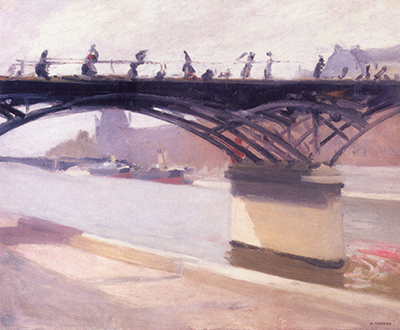
Compare: Le Pont des Arts, 1907.
The lighter river pictures did not erase the darker interiors
The contrast between these enclosed scenes and the river views is more useful than a simple account of Hopper becoming progressively brighter. Different subjects allowed him to make different demands on light. A shaded street can preserve a large dark flank while a bridge view admits more sky and reflected colour.
This is a change of conditions as well as palette. Narrow streets produce near obstructions and limited openings overhead. A position beside the Seine supplies a broad interval of water between the painter and the far bank. The available distance changes the proportion of architecture, atmosphere and open ground within the rectangle.
The bridge paintings also make movement available at several scales. A pedestrian can cross the span; a boat can pass beneath it; small strokes can describe a shifting surface. These forms of movement coexist with the much slower visual rhythm of the bridge's continuous structure.
The early Paris work consequently contains more than one solution. The heavier handling in a dark interior and the looser touches beside the river are part of a painter responding to particular settings. Recognising their coexistence gives the period more variety than a single conversion to Impressionist light would allow.
People and settings do not always meet
Burns draws attention to a recurring division in Hopper's French work: architectural paintings often reduce the importance of people, while drawings of Parisian figures frequently leave the surrounding place largely unspecified. She interprets that separation as part of his construction of an independent artistic position. [2]
The distinction offers a practical way to look across different media. A figure drawn against bare paper asks us to attend to posture, clothing and expression. An oil painting dominated by a façade asks us to judge weight, proportion and the spaces between objects. Bringing both into a single composition would require a further decision about which kind of attention should prevail.
One drawing reproduced in Burns's study, Sketch of Paris Courtyard at 48 rue de Lille with Nude, makes the difficulty particularly clear. A small figure stands in an opening at the left. A dark rail crosses in front, while a pale wall rises diagonally between that opening and the steeply angled architecture at the right. The woman has no securely established identity. [2]
The drawing's most striking effect is the imbalance of scale. A human body occupies a narrow strip, while the surrounding walls and roof take up most of the sheet. Dark strokes can describe a face, an open shutter or an enormous shaded surface, but the different sizes make those marks carry very different kinds of information.
It is possible to recognise a distant figure while remaining unable to approach her space. That visual condition is already present here without our supplying an encounter, a romance or a story about the artist at the opposite window.
A woman at a café table
The Whitney's Woman at Café Table, dated 1906–1907, makes the separation between figure and setting especially visible. Watercolour and graphite on board describe a seated woman whose blue-green dress occupies a substantial part of the sheet. The round table, pale chair and other chairs behind her receive much lighter treatment. [8]
Her hat sweeps outwards to the right, giving the head a broad upper silhouette. Dark hair and collar concentrate the area around the face. Red cheeks and lips make the features more assertive than the abbreviated café furniture, while a small red glass supplies another colour accent beside the extended hand.
The arm connects the figure to the table through a long, relatively level movement. Below it, the body turns into the folded shape of the skirt and the angled positions of the shoes. The painting alternates between extended and gathered forms: arm, torso, knees, hem and feet.
The clothing carries much of that organisation. The dress can be a broad area of colour while graphite lines give it changes of direction. Its darker passages deepen the folds without making every part equally dense. The chair remains sufficiently light that the body does not have to compete with a fully modelled seat.
Behind the figure, curved chair backs recur as loose, overlapping indications. They suggest a café beyond the main table while refusing the detailed architectural enclosure of Paris Street. The social location is legible through a small number of furnishings.
The contrast between the two works is revealing. In the street, a wall of openings holds attention and no clearly described inhabitant commands it. In the café sheet, a person has the strongest colour and detail while the surrounding establishment stays largely provisional. Hopper is experimenting with where to concentrate information.
The conspicuous face and fashionable clothing may encourage viewers to assign a social type or occupation. The current title does not establish the sitter's identity. What the picture securely offers is a particular arrangement of posture, costume, drink and furniture, described with unequal degrees of finish.
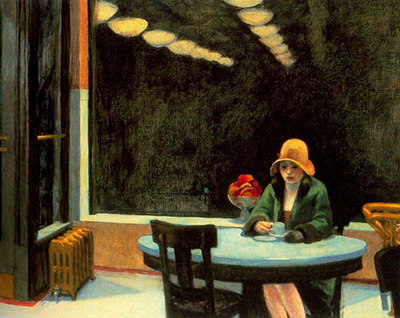
This early sheet also complicates an account based entirely on reserve. Its bright accents, sweeping hat and emphatic face differ from the smaller, lowered head in Automat. The comparison is valuable because the two women at tables are not equivalent characters separated only by twenty years.
Watch: Edward Hopper’s Life and Art
Explore Hopper’s paintings and the places behind them in these museum films. Choose a film below.
Paris painted from New York
The presence of a French bridge or café does not necessarily mean a canvas was painted in France. The Whitney's 2022 exhibition research identifies Le Bistro or The Wine Shop, dated 1909, as a painting made from memory in Hopper's Fourteenth Street studio in New York. [9]
In Bistro, two people sit close together at the far left, while open ground stretches towards trees and a bridge. The table establishes a small area of sociability. Most of the picture belongs to the much larger setting beside it.
That uneven distribution is particularly revealing in a work constructed after the return. The couple need not be connected to the distant bridge by a record of one observed instant. The painting can hold a remembered human group and a remembered landscape together, making their different scales part of its design.
The pale interval is therefore more than unused foreground. It makes the viewer shift between looking closely at the table and looking across a landscape. The two figures provide a subject, but they do not exhaust the picture's interest.
This also changes the meaning of a travel painting. A picture made abroad may respond directly to a place in front of the artist. A picture made afterwards can test what remains memorable: a grouping, a band of light, the relation of trees to a bridge. Both can belong to the history of the Paris years, provided their different circumstances are kept clear.
Memory can retain a relationship rather than a complete view
The later French subjects raise a question that goes beyond factual accuracy: what did the painter need to retain? A remembered table might preserve the nearness of two people; a bridge might remain as a long dark connection; a patch of open ground might survive as a strong interval between them.
Bistro brings such different kinds of attention into one image. The paired figures are close enough to suggest an exchange, while the bridge and trees belong to a larger distance. The painting does not have to provide all the intermediate detail that a traveller would encounter on foot.
The composition’s priorities are visible in its allocation of space. A large foreground can keep two remembered motifs apart and make the eye traverse that separation. Their relation becomes the subject of the picture, whether or not an exact site could be reconstructed.
The French years thus continued through acts of making rather than through recollection alone. A painted memory needs new proportions, new edges and a support on which to organise them. Leaving Paris did not end the work required to turn its material into pictures.
An early body of work remained important
Hopper did not immediately replace the French oils with an entirely American programme. His first solo exhibition, at the Whitney Studio Club in 1920, contained sixteen oils and made no sales. The Art Institute's chronology records the exhibition; Gail Levin's study of his French interests identifies eleven of its paintings as French subjects. [1] [10]
The choice gives those early pictures a long afterlife. Works made around a decade earlier still formed a substantial part of the material through which he presented himself to an audience. A journey that had ended was continuing as an artistic resource.
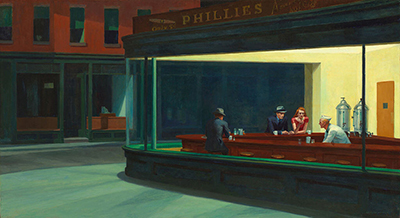
For a viewer now, the exhibition history also disrupts the impression that an artist's development must have been obvious at every stage. The Hopper associated with Nighthawks had not yet achieved that public identity in 1920. An unsuccessful exhibition could contain work he considered worth putting forward, even if later fame would settle around other pictures.
The French oils are consequently useful in their own right. Their brushwork, viewpoints and unusual distribution of figures do more than announce a future career. They constitute a sustained group of experiments with a particular city, and with the different ways a painter could inhabit it visually.
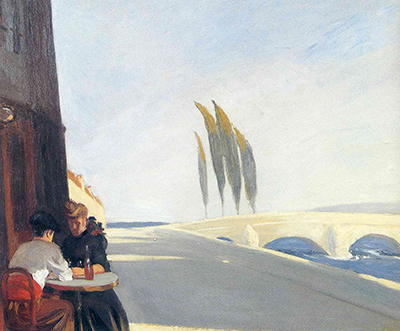
Compare: Le Bistro or The Wine Shop, 1909.
Soir Bleu brings the figures forward
Soir Bleu, painted in New York in 1914, gives French recollection a much wider stage. The Whitney's current record dates the canvas to 1914; the Thyssen-Bornemisza's account connects its French title with Rimbaud's verse. [11]
Here seven figures occupy an outdoor café setting. A white-faced performer near the centre, people in contrasting clothes and a standing woman give the canvas a succession of human presences. Tables, posts and the distant landscape separate them without reducing them to the minute scale of pedestrians on a bridge.
The change is especially clear beside Bistro. In the earlier picture, the pair competes with a large open foreground and a distant view. In Soir Bleu, differences among faces, gestures and clothes help organise the breadth of the painting. Human variety has become one of its principal structures.
The French title also preserves a cultural association after the artist's return. It does not name a documented group of acquaintances. Nor does the painted performer become an established self-portrait simply because viewers find that interpretation attractive. The scene can suggest social distinctions and the unease of performing in public while leaving individual identities uncertain.
Seeing the Paris years from Paris
The Grand Palais's 2012–13 exhibition returned Hopper's work to a French audience through an account of training and artistic exchange. Its educational dossier placed the Paris visits alongside his interest in Manet, Marquet and Vallotton, and treated his independent looking in museums and the city as a substantial part of his development. [12]
That later exhibition history should be distinguished from what an individual young painter is documented as seeing. Placing two artists together can make formal comparisons possible without proving that one particular canvas supplied the other's design. An exhibition proposes relationships; letters, dates and specific works can then test them.
The distinction is particularly helpful with the pale river pictures. A lighter palette can be compared with Impressionist practice, but its presence does not make every short stroke evidence of one named master. The bridge's proportion, the building's weight and the small figures' scale remain decisions Hopper had to make for his own surface.
Nor does independence require cultural isolation. Hopper could meet another American painter, read French literature and work without enrolling in a school. Those activities belong to different parts of a traveller's life. None obliges the canvases to depict either an avant-garde circle or a portrait of personal solitude.
The mature career can make these early choices appear more predictable than they were. Looking at the darker streets and lively café drawings restores a range of possibilities. Their importance lies partly in the directions that did not become the standard public image of Hopper.
French culture continued beyond the visits
Levin's research follows Hopper's French interests through literature, correspondence and paintings made long after his final journey. She discusses French poetry in his relationship with Jo, as well as the relevance of French entertainments and earlier painters to his imagery. [10] The Paris years therefore belong to a longer cultural history than their dates first suggest.
Hopper's later statements nevertheless resisted the idea that American art should remain dependent on France. In his 1933 Notes on Painting, he argued for an American artistic character and against extending an apprenticeship to French models indefinitely. [13] That position is part of the evidence, alongside the pictures and the continuing interests traced by Levin.
It is possible to value a tradition and still insist on developing an independent practice. The paintings make that relationship more complicated than a declaration alone. Light colours need not entail a crowded boulevard; a familiar river need not lead to a panoramic view; a French café can be reconstructed in an American studio.
Comparing these works means following what Hopper retained and altered: a lighter palette, a changed scale or a newly populated setting. The visits enlarged his visual resources. The later paintings show those resources being selected, rearranged and made to serve new compositions. Paris remained present because its buildings, people and culture could continue to be worked upon after the journey was over.
Artworks and studies directory
This researched directory includes finished works and separately identified studies. It is not a complete catalogue raisonné. Linked titles open the articles; unlinked studies are identified by their collection accessions. Watercolours retain their recorded media, and original prints remain distinct from reproductions.
| Name | Date | Medium |
|---|---|---|
| (Bridge and Embankment) (70.1298) | 1906 | Oil on wood |
| (Jo Sketching at Good Harbor Beach) (70.1129) | 1923–1924 | Watercolor and fabricated chalk on paper |
| (Manhattan Bridge) (70.1098) | 1925–1926 | Watercolor and graphite pencil on paper |
| (Rooftops) (70.1114) | 1926 | Watercolor and graphite pencil on paper |
| (Seated Male Model, Bent Over) (70.1277) | c. 1902–1903 | Oil on canvas |
| (Self-Portrait) (70.1254) | 1903–1906 | Oil on canvas |
| (Solitary Figure in a Theater) (70.1418) | c. 1902–1904 | Oil on board |
| 5 A.M. | 1937 | oil on canvas |
| Adam's House | 1928 | watercolour and charcoal on paper |
| American Village | 1912 | Oil on canvas |
| Apartment Houses | 1923 | oil on canvas |
| Approaching a City | 1946 | oil on canvas |
| August in the City | 1945 | oil on canvas |
| Automat | 1927 | oil on canvas |
| Barber Shop | 1931 | oil on canvas |
| Blackwell's Island | 1928 | oil on canvas |
| Bridge on the Seine | 1909 | Oil on canvas |
| Bridle Path | 1939 | oil on canvas |
| Burly Cobb's House South Truro | 1930–1933 | oil on canvas |
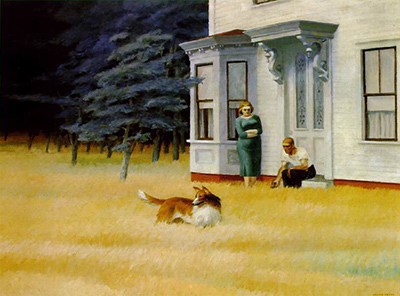
| Cape Cod Evening | 1939 | oil on canvas |
| Cape Cod Morning | 1950 | oil on canvas |
| Chair Car | 1965 | oil on canvas |
| Chop Suey | 1929 | oil on canvas |
| City Roofs | 1932 | Oil on canvas |
| Coast Guard Station | 1929 | oil on canvas |
| Compartment C, Car 293 | 1938 | oil on canvas |
| Conference at Night | 1949 | oil on canvas |
| Corn Hill | 1930 | oil on canvas |
| Dawn in Pennsylvania | 1942 | oil on canvas |
| Drug Store | 1927 | oil on canvas |
| Early Sunday Morning | 1930 | Oil on canvas |
| East Side Interior (70.1020) | 1922 | Etching |
| East Wind Over Weehawken | 1934 | oil on canvas |
| El Palacio | 1946 | Watercolor and graphite pencil on paper |
| Eleven A.M. | 1926 | oil on canvas |
| Evening Wind | 1921 | etching |
| Excursion into Philosophy | 1959 | oil on canvas |
| First Row Orchestra | 1951 | oil on canvas |
| Freight Car at Truro | 1931 | watercolour over graphite on paper |
| Gas | 1940 | oil on canvas |
| Girl at a Sewing Machine | c. 1921 | oil on canvas |
| Gloucester Harbor | 1912 | Oil on canvas |
| Ground Swell | 1939 | oil on canvas |
| Haskell's House | 1924 | watercolour over graphite on paperboard |
| High Noon | 1949 | oil on canvas |
| Hill and Houses Cape Elizabeth Maine | 1927 | watercolour over graphite pencil |
| Hills South Truro | 1930 | oil on canvas |
| Hotel by a Railroad | 1952 | oil on canvas |
| Hotel Lobby | 1943 | oil on canvas |
| Hotel Room | 1931 | oil on canvas |
| Hotel Window | 1955 | oil on canvas |
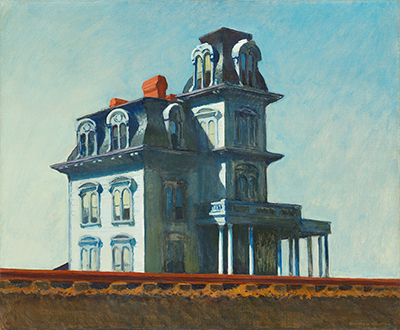
| House by the Railroad | 1925 | oil on canvas |
| House by the Squam River | 1926 | watercolour over graphite on paper |
| Le Bistro or The Wine Shop | 1909 | Oil on canvas |
| Le Pont des Arts | 1907 | Oil on canvas |
| Le Pont Royal | 1909 | Oil on canvas |
| Le Quai des Grands Augustins | 1909 | Oil on canvas |
| Lighthouse and Buildings Portland Head | 1927 | watercolour over graphite pencil on paper |
| Lighthouse Hill | 1927 | oil painting |
| Manhattan Bridge Loop | 1928 | oil on canvas |
| Model Sitting | c. 1902 | oil painting; support not asserted |
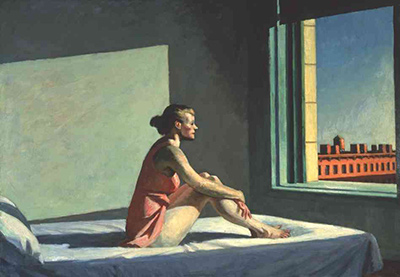
| Morning Sun | 1952 | oil on canvas |
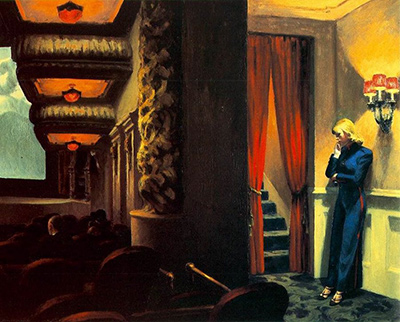
| New York Movie | 1939 | oil on canvas |
| New York New Haven and Hartford | 1931 | oil on canvas |
| New York Office | 1962 | oil on canvas |
| New York Pavements | 1924–1925 | oil on canvas |
| New York Restaurant | c. 1922 | oil on canvas |
| Night Windows | 1928 | oil on canvas |
| Nighthawks | 1942 | oil on canvas |
| October on Cape Cod | 1946 | oil on canvas |
| Office at Night | 1940 | oil on canvas |
| Office in a Small City | 1953 | oil on canvas |
| Pennsylvania Coal Town | 1947 | oil on canvas |
| People in the Sun | 1960 | oil on canvas |
| Portrait of Orleans | 1950 | oil on canvas |
| Queensborough Bridge | 1913 | Oil on canvas |
| Railroad Sunset | 1929 | Oil on canvas |
| Railroad Train | 1908 | oil on canvas |
| Road in Maine | 1914 | oil on canvas |
| Room in Brooklyn | 1932 | oil on canvas |
| Room in New York | 1932 | oil on canvas |
| Rooms by the Sea | 1951 | oil on canvas |
| Rooms for Tourists | 1945 | oil on canvas |
| Route 6 Eastham | 1941 | oil on canvas |
| Second Story Sunlight | 1960 | Oil on canvas |
| Self-Portrait | 1925–1930 | Oil on canvas |
| Self-Portrait with Hat (70.1903) | c. 1918, posthumous print | Drypoint |
| Seven A.M. | 1948 | Oil on canvas |
| Soir Bleu | 1914 | oil on canvas |
| South Carolina Morning | 1955 | Oil on canvas |
| Stairway at 48 Rue de Lille Paris | 1906 | Oil on wood |
| Study for 5 A.M. (70.153) | 1937 | Fabricated chalk on paper |
| Study for 5 A.M. (70.429) | 1937 | Fabricated chalk and graphite pencil on paper |
| Study for Approaching a City (70.869) | 1946 | Fabricated chalk and charcoal on paper |
| Study for August in the City (70.158a-b) | 1945 | Fabricated chalk on paper |
| Study for August in the City (70.159) | 1945 | Fabricated chalk on paper |
| Study for Bridle Path (70.220) | 1939 | Fabricated chalk on paper |
| Study for Bridle Path (70.235) | 1939 | Fabricated chalk on paper |
| Study for Compartment C, Car 293 (70.430) | 1938 | Fabricated chalk on paper |
| Study for Compartment C, Car 293 (70.431a-b) | 1938 | Fabricated chalk and charcoal on paper |
| Study for Conference at Night (70.170) | 1949 | Fabricated chalk on paper (recto); Typewriter ink on paper (verso) |
| Study for Conference at Night (70.174) | 1949 | Fabricated chalk on paper ( recto); Typewriter ink on paper (verso) |
| Study for East Wind over Weehawken (70.249) | 1934 | Graphite pencil on paper |
| Study for East Wind over Weehawken (70.252) | 1934 | Fabricated chalk and charcoal on paper |
| Study for Evening Wind (70.343a-b) | 1921 | Fabricated chalk on paper |
| Study for First Row Orchestra (70.841) | 1951 | Fabricated chalk and charcoal on paper |
| Study for Gas (70.263) | 1940 | Fabricated chalk on paper |
| Study for Ground Swell (70.339) | 1939 | Fabricated chalk, charcoal and graphite pencil on paper |
| Study for Hotel by a Railroad (70.199) | 1952 | Fabricated chalk on paper |
| Study for Hotel by a Railroad (70.427) | 1952 | Fabricated chalk on paper |
| Study for Hotel by a Railroad (70.428) | 1952 | Fabricated chalk on paper |
| Study for Hotel Lobby (70.117) | 1942 | Fabricated chalk and graphite pencil on paper |
| Study for Hotel Lobby (70.839) | 1942 | Fabricated chalk and charcoal on paper |
| Study for Hotel Window (70.161) | 1955 | Fabricated chalk, graphite pencil and colored pencil on paper |
| Study for Morning Sun (70.243) | 1952 | Fabricated chalk on paper |
| Study for Morning Sun (70.244) | 1952 | Fabricated chalk on paper |
| Study for Morning Sun (70.290) | 1952 | Fabricated chalk on paper |
| Study for Morning Sun (70.291) | 1952 | Fabricated chalk and graphite pencil on paper |
| Study for New York Movie (70.273) | 1939 | Fabricated chalk on paper |
| Study for New York Movie (70.274a-b) | 1938 or 1939 | Fabricated chalk and charcoal on paper (recto); Fabricated chalk on paper (verso) |
| Study for New York Movie (70.455) | 1939 | Fabricated chalk and charcoal on paper |
| Study for New York Office (70.822) | 1962 | Fabricated chalk on paper |
| Study for Nighthawks (70.192) | 1941 or 1942 | Fabricated chalk on paper |
| Study for Nighthawks (70.193) | 1941 or 1942 | Fabricated chalk on paper |
| Study for Office at Night (70.340) | 1940 | Fabricated chalk and charcoal on paper |
| Study for Office at Night (70.341) | 1940 | Fabricated chalk and graphite pencil on paper |
| Study for Pennsylvania Coal Town (70.198) | 1947 | Fabricated chalk on paper |
| Study for Pennsylvania Coal Town (70.229) | 1947 | Fabricated chalk and charcoal on paper |
| Study for Rooms for Tourists (70.438) | 1945 | Fabricated chalk and charcoal on paper |
| Study for Rooms for Tourists (70.848) | 1945 | Fabricated chalk and charcoal on paper |
| Study for Route 6, Eastham (70.369) | 1941 | Fabricated chalk and graphite pencil on paper |
| Study for Route 6, Eastham (70.854) | 1941 | Fabricated chalk and graphite pencil on paper |
| Study for South Carolina Morning (70.162a-b) | 1955 | Fabricated chalk on paper (recto and verso) |
| Study for The Sheridan Theatre (70.969) | 1937 | Graphite pencil on paper |
| Study for Two on the Aisle (70.128) | 1927 | Fabricated chalk on paper |
| Study for Two on the Aisle (70.129) | 1927 | Fabricated chalk on paper |
| Study for Yawl Riding a Swell (70.439) | 1935 | Fabricated chalk and graphite pencil on paper |
| Summer Evening | 1947 | oil on canvas |
| Summer Interior | 1909 | Oil on canvas |
| Sun in an Empty Room | 1963 | oil on canvas |
| Sunlight in a Cafeteria | 1958 | oil on canvas |
| Sunlight on Brownstones | 1956 | oil on canvas |
| Tables for Ladies | 1930 | oil on canvas |
| The Bootleggers | 1925 | oil on canvas |
| The Camel's Hump | 1931 | oil on canvas |
| The Circle Theatre | 1936 | oil on canvas |
| The City | 1927 | oil on canvas |
| The Lighthouse at Two Lights | 1929 | oil on canvas |
| The Long Leg | 1935 | oil on canvas |
| The Mansard Roof | 1923 | watercolour over graphite on paper |
| The Sheridan Theatre | 1937 | oil on canvas |
| Tramp Steamer | 1908 | oil on canvas |
| Two Comedians | 1966 | oil on canvas |
| Two on the Aisle | 1927 | oil on canvas |
| Valley of the Seine | 1909 | Oil on canvas |
| Western Motel | 1957 | oil on canvas |
Frequently Asked Questions
Hopper arrived with substantial training behind him. Between 1900 and 1905 he had studied illustration and painting at the New York School of Art, with teachers including William Merritt Chase, Robert Henri and Kenneth Hayes Miller. Paris was a further opportunity to work, rather than the beginning of his education. [1]
Le Pont des Arts, from 1907, changes the scale of the encounter. A bridge runs across the scene, with the river below and buildings beyond. The structure is much larger than its small crossing figures. The eye can read the sweep of the bridge before attending to any individual person.
Levin's research follows Hopper's French interests through literature, correspondence and paintings made long after his final journey. She discusses French poetry in his relationship with Jo, as well as the relevance of French entertainments and earlier painters to his imagery. [10] The Paris years therefore belong to a longer cultural history than their dates first suggest.
Discussion
Look again at the images and ideas explored in Edward Hopper's Paris Years. These editorial prompts invite your observations.
Reader Insights
Which difference between a Paris interior and a river view matters most to your reading?
Compare Le Pont des Arts with Le Bistro or The Wine Shop. Which visual difference matters most to your reading?
Which detail would you look at again after reading “A lighter palette opens the river views”?
Join the Conversation
Share a detail, comparison or question about Edward Hopper's Paris Years below.
References
- Art Institute of Chicago, Selected Chronology for Edward Hopper: schooling, European journeys and the 1920 exhibition. View source.
- Emily C. Burns, Spectral figures: Edward Hopper's empty Paris, in Empty Spaces, 2019, pp.111–132, including figure5.4 and notes: lodging, correspondence and the interpretation of figure and setting. View source.
- Whitney Museum of American Art, Stairway at 48 rue de Lille, Paris, 1906, accession70.1295. View source.
- Whitney Museum of American Art, (Paris Street), 1906, accession 70.1296, oil on wood, 30.5 × 23.7 cm. Current object record and actual complete painting image inspected. View source.
- Whitney Museum of American Art, Le Pont des Arts, 1907, accession70.1181, including Kim Conaty's written exhibition-guide transcript. View source.
- Whitney Museum of American Art, Le Pont Royal, 1909, accession70.1175. View source.
- Petit Palais, Paris Musées, Camille Pissarro, Le Pont Royal et le Pavillon de Flore, 1903, inventoryPPP134. View source.
- Whitney Museum of American Art, (Woman at Café Table), 1906–1907, accession 70.1372, watercolour and graphite pencil on board. Current record and actual full sheet inspected; not confused with the separately catalogued seated café figure 70.1379. View source.
- Whitney Museum of American Art, Edward Hopper's New York: exhibition labels, 2022: Le Bistro or The Wine Shop and the New York studio. View source.
- Gail Levin, Edward Hopper: Francophile, Arts Magazine, June1979, pp.114–121, including notes1–49. View source.
- Whitney Museum of American Art, Soir Bleu, 1914, accession70.1208; Museo Nacional Thyssen-Bornemisza, Hopper, 2012, discussion of Soir Bleu. View source 1. View source 2.
- Réunion des musées nationaux–Grand Palais, Edward Hopper, educational dossier, 2012, selected pp. 6–7, especially the Paris discussion. Indexed text consulted despite direct-download TLS failure; this does not claim inspection of the complete thirty-page dossier. View source.
- Edward Hopper, Notes on Painting, in Edward Hopper: Retrospective Exhibition, Museum of Modern Art,1933, pp.17–18. View source.
- Whitney Museum of American Art, Study for Route 6, Eastham, 1941, accession 70.854; exact object record. View source.
- Whitney Museum of American Art, Study for Conference at Night, 1949, accession 70.170; exact object record. View source.
- Whitney Museum of American Art, Study for First Row Orchestra, 1951, accession 70.841; exact object record. View source.
- Whitney Museum of American Art, (Bridge and Embankment), 1906, accession 70.1298; exact object record. View source.
- Whitney Museum of American Art, (Seated Male Model, Bent Over), c. 1902–1903, accession 70.1277; exact object record. View source.
- Whitney Museum of American Art, Study for Morning Sun, 1952, accession 70.244; exact object record. View source.
- Whitney Museum of American Art, Study for Morning Sun, 1952, accession 70.243; exact object record. View source.
- Whitney Museum of American Art, Study for Two on the Aisle, 1927, accession 70.128; exact object record. View source.
- Whitney Museum of American Art, Study for New York Office, 1962, accession 70.822; exact object record. View source.
- Whitney Museum of American Art, Study for Two on the Aisle, 1927, accession 70.129; exact object record. View source.
- Whitney Museum of American Art, Study for Pennsylvania Coal Town, 1947, accession 70.229; exact object record. View source.
- Whitney Museum of American Art, (Rooftops), 1926, accession 70.1114; exact object record. View source.
- Whitney Museum of American Art, Study for South Carolina Morning, 1955, accession 70.162a-b; exact object record. View source.
- Whitney Museum of American Art, (Self-Portrait), 1903–1906, accession 70.1254; exact object record. View source.
- Whitney Museum of American Art, (Manhattan Bridge), 1925–1926, accession 70.1098; exact object record. View source.
- Whitney Museum of American Art, (Solitary Figure in a Theater), c. 1902–1904, accession 70.1418; exact object record. View source.
- Whitney Museum of American Art, Study for Approaching a City, 1946, accession 70.869; exact object record. View source.
- Whitney Museum of American Art, Study for August in the City, 1945, accession 70.159; exact object record. View source.
- Whitney Museum of American Art, Study for Compartment C, Car 293, 1938, accession 70.430; exact object record. View source.
- Whitney Museum of American Art, Study for Compartment C, Car 293, 1938, accession 70.431a-b; exact object record. View source.
- Whitney Museum of American Art, Study for East Wind over Weehawken, 1934, accession 70.252; exact object record. View source.
- Whitney Museum of American Art, Study for East Wind over Weehawken, 1934, accession 70.249; exact object record. View source.
- Whitney Museum of American Art, Study for Evening Wind, 1921, accession 70.343a-b; exact object record. View source.
- Whitney Museum of American Art, Study for The Sheridan Theatre, 1937, accession 70.969; exact object record. View source.
- Whitney Museum of American Art, Study for New York Movie, 1939, accession 70.455; exact object record. View source.
- Whitney Museum of American Art, Study for New York Movie, 1939, accession 70.273; exact object record. View source.
- Whitney Museum of American Art, Study for New York Movie, 1938 or 1939, accession 70.274a-b; exact object record. View source.
- Whitney Museum of American Art, Study for 5 A.M., 1937, accession 70.153; exact object record. View source.
- Whitney Museum of American Art, Study for 5 A.M., 1937, accession 70.429; exact object record. View source.
- Whitney Museum of American Art, (Jo Sketching at Good Harbor Beach), 1923–1924, accession 70.1129; exact object record. View source.
- Whitney Museum of American Art, Study for August in the City, 1945, accession 70.158a-b; exact object record. View source.
- Whitney Museum of American Art, Study for Morning Sun, 1952, accession 70.291; exact object record. View source.
- Whitney Museum of American Art, Study for Morning Sun, 1952, accession 70.290; exact object record. View source.
- Whitney Museum of American Art, Study for Office at Night, 1940, accession 70.340; exact object record. View source.
- Whitney Museum of American Art, Study for Office at Night, 1940, accession 70.341; exact object record. View source.
- Whitney Museum of American Art, Study for Hotel by a Railroad, 1952, accession 70.427; exact object record. View source.
- Whitney Museum of American Art, Study for Hotel by a Railroad, 1952, accession 70.199; exact object record. View source.
- Whitney Museum of American Art, Study for Hotel by a Railroad, 1952, accession 70.428; exact object record. View source.
- Whitney Museum of American Art, Study for Hotel Lobby, 1942, accession 70.117; exact object record. View source.
- Whitney Museum of American Art, Study for Hotel Lobby, 1942, accession 70.839; exact object record. View source.
- Whitney Museum of American Art, Study for Conference at Night, 1949, accession 70.174; exact object record. View source.
- Whitney Museum of American Art, Study for Hotel Window, 1955, accession 70.161; exact object record. View source.
- Whitney Museum of American Art, Study for Pennsylvania Coal Town, 1947, accession 70.198; exact object record. View source.
- Whitney Museum of American Art, Study for Route 6, Eastham, 1941, accession 70.369; exact object record. View source.
- Whitney Museum of American Art, Study for Bridle Path, 1939, accession 70.220; exact object record. View source.
- Whitney Museum of American Art, Study for Bridle Path, 1939, accession 70.235; exact object record. View source.
- Whitney Museum of American Art, Study for Ground Swell, 1939, accession 70.339; exact object record. View source.
- Whitney Museum of American Art, Study for Yawl Riding a Swell, 1935, accession 70.439; exact object record. View source.
- Whitney Museum of American Art, Study for Rooms for Tourists, 1945, accession 70.848; exact object record. View source.
- Whitney Museum of American Art, Study for Rooms for Tourists, 1945, accession 70.438; exact object record. View source.
- Whitney Museum of American Art, Study for Nighthawks, 1941 or 1942, accession 70.193; exact object record. View source.
- Whitney Museum of American Art, Study for Nighthawks, 1941 or 1942, accession 70.192; exact object record. View source.
- Whitney Museum of American Art, Study for Gas, 1940, accession 70.263; exact object record. View source.
- Whitney Museum of American Art, Self-Portrait with Hat, c. 1918, posthumous print, accession 70.1903; exact object record. View source.
- Whitney Museum of American Art, East Side Interior, 1922, accession 70.1020; exact object record. View source.
- Art Institute of Chicago, Selected Chronology for Edward Hopper; training, travels, exhibitions, New York and Truro chronology. View source.
- Emily C. Burns, Spectral figures: Edward Hopper’s empty Paris, chapter 5 in Empty Spaces: Confronting Emptiness in National, Cultural and Urban Histories, 2019; complete chapter and notes consulted. View source.
- Charles Brock, Regionalism and Folk Art, National Gallery of Art; complete essay and two notes consulted. View source.
- Collection or catalogue record, American Village, 1912; medium and identity as discussed in the linked article. View source.
- Collection or catalogue record, Soir Bleu, 1914; medium and identity as discussed in the linked article. View source.
- Collection or catalogue record, House by the Railroad, 1925; medium and identity as discussed in the linked article. View source.
- Collection or catalogue record, Automat, 1927; medium and identity as discussed in the linked article. View source.
- Collection or catalogue record, Early Sunday Morning, 1930; medium and identity as discussed in the linked article. View source.
- Collection or catalogue record, New York Movie, 1939; medium and identity as discussed in the linked article. View source.
- Collection or catalogue record, Nighthawks, 1942; medium and identity as discussed in the linked article. View source.
- Collection or catalogue record, Morning Sun, 1952; medium and identity as discussed in the linked article. View source.
- Collection or catalogue record, Second Story Sunlight, 1960; medium and identity as discussed in the linked article. View source.
- Collection or catalogue record, Two Comedians, 1966; medium and identity as discussed in the linked article. View source.