 by Tom Gurney
Tom Gurney BSc (Hons) is an art history expert with over 20 years experience
Email: tomgurney1@gmail.com / Phone: +44 7429 011000
East Wind over Weehawken: Introduction
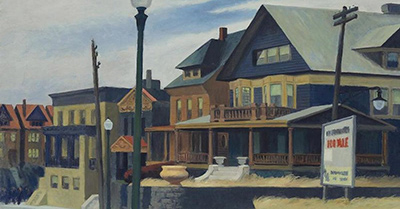
A steep-roofed house dominates the right of East Wind over Weehawken. Its long porch faces a street that falls away towards smaller buildings at the left. In front stand a tall lamp, utility poles, pale ornamental urns and a property sign. Edward Hopper gives each a definite place, yet their overlaps make the view difficult to enter as one continuous space. The street leads away, the foreground objects interrupt it, and the shaded porch remains set back from the spectator.
The oil on canvas dates from 1934 and measures approximately 86.4 × 127.6 cm. Christie's records the signature at the lower right and identifies its completion in March. The painting later belonged to the Pennsylvania Academy of the Fine Arts, which acquired it in 1952 and consigned it for sale in 2013. [1]
At a Glance
- ArtistEdward Hopper [1]
- Date1934 [1]
- Mediumoil on canvas [1]
- Collection / recordNot asserted [1]
- AccessionO-294 [1]
This work across Edward Hopper’s career
American Village
1912Soir Bleu
1914Automat
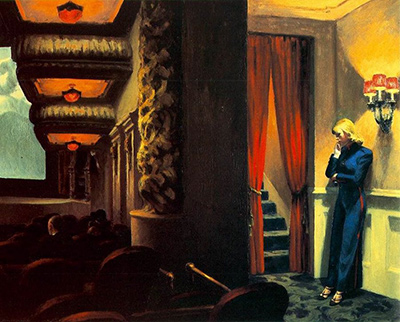
1927New York Movie
1939Nighthawks
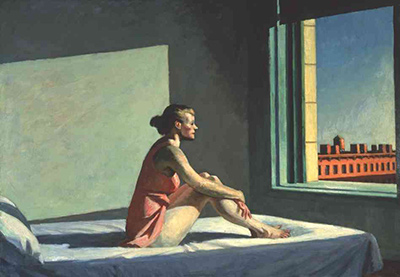
1942Morning Sun
1952Two Comedians
1966Contents
- A street on a slope
- The house with the long porch
- Objects between the spectator and the houses
- A sign without a complete household story
- A study of the whole arrangement
- Details and colour reminders
- Weehawken and the year 1934
- The PAFA years and the 2013 sale
- Architecture at different scales
A street on a slope
The ground does not give the houses a common, level base. Towards the left, the street drops away, exposing lower walls and the changing height of buildings along it. Rooflines step through the view at different levels. The effect is more complicated than a row of houses seen straight across a flat road.
The larger house at the right occupies higher ground. Steps, walls and a long porch distinguish its relation to the street, while the smaller structures further left appear more closely gathered. The slope allows several kinds of façade and roof to overlap without lining them up in a single regular sequence.
This makes the leftward recession especially important. The eye can follow the buildings down the street, but encounters new obstructions as it goes. A projecting roof or wall briefly interrupts what lies beyond. The view unfolds through successive partial disclosures rather than offering the whole neighbourhood at once.
The sky provides a comparatively open area above. Pale blue-grey passages and cloud forms leave room around the uneven roofs. Yet the houses remain substantial enough to prevent the setting from becoming a distant townscape. We are close to the built edge of the street, where its changes of level have a physical force.
The house with the long porch
The nearest house is distinguished by a large gable. Its steep roof rises towards the top of the canvas, with a lighter upper slope and a darker triangular face beneath. A group of windows sits within that upper face, giving the gable a small concentration of detail without breaking its overall shape.
The lower architecture is more extended. A long porch stretches across the front, its roof casting a strong shadow beneath. Posts, railings and darker openings make a narrow sequence along the façade. The porch is recognizable as a place people could occupy, but its shade makes it less accessible to the eye than the sunlit surfaces above.
Yellowish trim catches the light around selected windows and edges. These lighter accents keep the house from becoming one undifferentiated grey mass. They also establish a difference between the upper façade and the deeper, more continuous darkness beneath the porch roof.
The smaller roof forms are important too. A dormer on the right and adjoining slopes complicate the main gable's outline. Hopper allows a dominant triangular shape to remain clear while surrounding it with practical additions and changes of plane. The house feels constructed over several connected parts rather than designed as a single emblem.
The neighbouring buildings vary in colour and form. Warmer walls, flatter upper edges and smaller pitched roofs carry the scene towards the left. Their differences make the large house one member of a varied street, even as its scale gives it a more commanding presence.
Objects between the spectator and the houses
The tall streetlamp is among the strongest interruptions. It rises slightly left of centre and continues into the upper boundary, crossing the scale of the houses behind it. Its narrow silhouette is enough to separate the foreground from the architecture beyond.
The utility poles have a different shape and function. Crossarms and smaller attachments break their outlines, while their positions introduce additional uprights at unequal intervals. They belong to the same street environment as the ornamental lamp, but are less elaborate in appearance.
The mixture matters. Hopper does not present the neighbourhood through house architecture alone. Lighting and utility equipment occupy the space in front, creating a second set of structures through which the buildings have to be seen. The poles can appear visually close even when the house façades seem more substantial.
The pale urns offer another kind of accent at a lower level. Their curved bodies and bases differ from the straight posts, rails and window frames. Set near the steps and wall, they give a small area of the foreground a more decorative character.
The property sign at the right is more emphatically practical. Its pale rectangular face carries the words For Sale, with further smaller lettering below. The sign addresses the street in a different way from the house's windows and porch: it offers information about property while the building itself remains largely closed to view.
A sign without a complete household story
The sign gives the painting a clear connection with the buying and selling of houses. It does not establish why the property is available or who has lived there. Its position is visually more certain than the financial circumstances behind it: the light rectangle stands close to the spectator, in front of the darker porch.
That arrangement makes it conspicuous without allowing it to explain everything around it. The sign is one of several foreground objects, alongside poles and urns, whose forms interrupt the view. Its lettering adds a different kind of attention to an already complex architectural scene.
Small figures appear in the distant street at the far left, identified in the auction catalogue as a group whose activity remains unclear. [1] Their reduced scale leaves them subordinate to the larger houses and street furniture. They make human presence part of the scene without providing a close encounter through which its circumstances could be narrated.
The title adds an east wind to the scene's conditions. Clouded light and the uneven sky give the solid architecture an atmosphere that differs from an evenly illuminated street view.
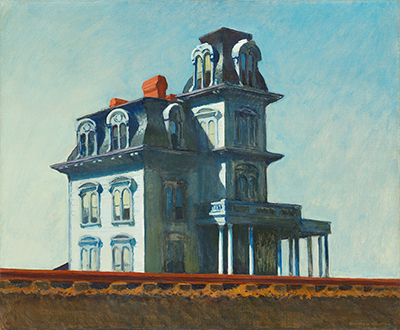
Compare: House by the Railroad, 1925.
A study of the whole arrangement
The Whitney preserves a 1934 composition study in fabricated chalk and charcoal, accession 70.252. It brings together the large gabled house, long porch, steps, poles and tall lamp. [2] The house is already substantial, but the drawing's overlapping strokes make the process of establishing its planes more apparent.
The lamp rises prominently in front of the architecture. Its vertical line cuts across roofs and porch, testing a relationship that remains crucial in the oil. The house does not simply sit behind a neutral open foreground; it is encountered through another upright structure.
The drawing also gives considerable attention to the steps and low wall. Their diagonals establish changes of level before the larger house. Darker strokes gather beneath the porch roof, while lighter paper remains available across the upper roof slopes. The arrangement is being worked through in terms of both line and relative weight.
In the finished painting, colour distinguishes the house surfaces, trim, roofs and nearer objects more clearly. The major relationships remain, but their edges and intervals become more settled. The drawing shows how much the apparent stillness depends on positioning forms against one another.
Watch: Edward Hopper’s Life and Art
Explore Hopper’s paintings and the places behind them in these museum films. Choose a film below.
Details and colour reminders
Another Whitney sheet, accession 70.249, is in graphite pencil. It separates a complete ornamental lamp, an urn and several portions of architecture across the paper, with handwritten colour indications beside some forms. [2]
This is a different kind of preparation from the fuller composition study. The lamp can be examined from base to globe without having to resolve every house behind it. The urn is similarly isolated, allowing its curved body and support to receive concentrated attention.
Elsewhere on the sheet, porch rails, windows, roof edges and ornamental architectural forms are recorded separately. Their dispersal makes the drawing look like a collection of observations to be used, rather than a miniature finished painting. Written reminders supplement what a pencil line can preserve.
Together, the two sheets reveal both local and overall concerns. Hopper studied the character of small objects and the organization of the whole street. The oil draws those kinds of attention into one view, where a large roof, a slender lamp and a small pale urn can each remain distinct.
Weehawken and the year 1934
Weehawken lies across the Hudson from Manhattan. The 2013 catalogue connects Hopper's visits there with the search for architectural ideas for the home and studio he and Jo were preparing in South Truro. [1] The Art Institute's chronology records the completion of that Cape Cod house in July 1934. [3]
The connection gives the street view a particular setting in his working life without turning it into a plan for the Truro building. The painting remains concerned with a New Jersey neighbourhood and its forms. A practical interest in architecture could coexist with the independent demands of composing this canvas.
The year followed his 1933 Museum of Modern Art retrospective. He had already received substantial recognition, yet the ordinary street continued to offer a demanding subject. The many differences among porch, roof, wall and street equipment show how much complexity could be found within a seemingly modest view.
Hopper later expressed a high opinion of the painting. Christie's transmits an April 1952 letter to PAFA director Joseph T. Fraser in which the artist placed it among his best pictures. The catalogue also records his dealer Frank Rehn's enthusiasm at the time of the acquisition. [1] The letters place the museum acquisition alongside the artist's own continuing regard for the work.
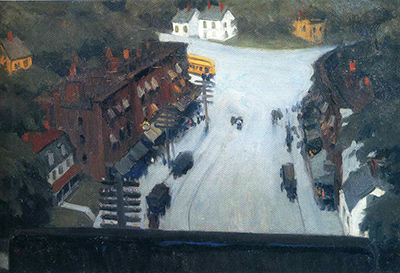
Compare: American Village, 1912.
The PAFA years and the 2013 sale
PAFA's 2012–13 annual report records the painting's loan, together with Apartment Houses, to the Hopper retrospective in Madrid and Paris. [4] The two works represented different periods and subjects within the Academy's Hopper holdings: an intimate urban interior and a more extended architectural street scene.
On 5 December 2013, Christie's sold East Wind over Weehawken as lot 17 in its American Art sale. The official result was $40,485,000 including buyer's premium, and the buyer was listed as anonymous. The auction house described the price as a record for Hopper at that time. [5]
PAFA's following annual report states that the proceeds went into its collections fund, with the income intended to increase future acquisition funding. [6] That institutional account explains the museum's purpose in selling. It also marks the end of the ownership recorded in older PAFA captions.
The sale is one chapter in the painting's public history, rather than a complete account of its present whereabouts.
Architecture at different scales
New York, New Haven and Hartford places buildings beyond a low railway and a dark bank. Its separate house and smaller structure are partly gathered by vegetation. In the Weehawken painting, the street is more densely occupied by architecture, with foreground equipment adding further interruptions.
Manhattan Bridge Loop uses a long wall and paved foreground to give a city view lateral extent. Here, the slope and successive roofs make the eye travel down the street, while poles and the large nearest house continually pull attention back towards the front.
The pale urns and property sign bring that movement to a local conclusion. One supplies ornament, the other information, while the dark porch remains behind both. Hopper gives the street's ordinary objects enough distinct character to make a familiar neighbourhood hold a prolonged, unsettled encounter.
Artworks and studies directory
This researched directory includes finished works and separately identified studies. It is not a complete catalogue raisonné. Linked titles open the articles; unlinked studies are identified by their collection accessions. Watercolours retain their recorded media, and original prints remain distinct from reproductions.
| Name | Date | Medium |
|---|---|---|
| (Bridge and Embankment) (70.1298) | 1906 | Oil on wood |
| (Jo Sketching at Good Harbor Beach) (70.1129) | 1923–1924 | Watercolor and fabricated chalk on paper |
| (Manhattan Bridge) (70.1098) | 1925–1926 | Watercolor and graphite pencil on paper |
| (Rooftops) (70.1114) | 1926 | Watercolor and graphite pencil on paper |
| (Seated Male Model, Bent Over) (70.1277) | c. 1902–1903 | Oil on canvas |
| (Self-Portrait) (70.1254) | 1903–1906 | Oil on canvas |
| (Solitary Figure in a Theater) (70.1418) | c. 1902–1904 | Oil on board |
| 5 A.M. | 1937 | oil on canvas |
| Adam's House | 1928 | watercolour and charcoal on paper |
| American Village | 1912 | Oil on canvas |
| Apartment Houses | 1923 | oil on canvas |
| Approaching a City | 1946 | oil on canvas |
| August in the City | 1945 | oil on canvas |
| Automat | 1927 | oil on canvas |
| Barber Shop | 1931 | oil on canvas |
| Blackwell's Island | 1928 | oil on canvas |
| Bridge on the Seine | 1909 | Oil on canvas |
| Bridle Path | 1939 | oil on canvas |
| Burly Cobb's House South Truro | 1930–1933 | oil on canvas |
| Cape Cod Evening | 1939 | oil on canvas |
| Cape Cod Morning | 1950 | oil on canvas |
| Chair Car | 1965 | oil on canvas |
| Chop Suey | 1929 | oil on canvas |
| City Roofs | 1932 | Oil on canvas |
| Coast Guard Station | 1929 | oil on canvas |
| Compartment C, Car 293 | 1938 | oil on canvas |
| Conference at Night | 1949 | oil on canvas |
| Corn Hill | 1930 | oil on canvas |
| Dawn in Pennsylvania | 1942 | oil on canvas |
| Drug Store | 1927 | oil on canvas |
| Early Sunday Morning | 1930 | Oil on canvas |
| East Side Interior (70.1020) | 1922 | Etching |
| East Wind Over Weehawken | 1934 | oil on canvas |
| El Palacio | 1946 | Watercolor and graphite pencil on paper |
| Eleven A.M. | 1926 | oil on canvas |
| Evening Wind | 1921 | etching |
| Excursion into Philosophy | 1959 | oil on canvas |
| First Row Orchestra | 1951 | oil on canvas |
| Freight Car at Truro | 1931 | watercolour over graphite on paper |
| Gas | 1940 | oil on canvas |
| Girl at a Sewing Machine | c. 1921 | oil on canvas |
| Gloucester Harbor | 1912 | Oil on canvas |
| Ground Swell | 1939 | oil on canvas |
| Haskell's House | 1924 | watercolour over graphite on paperboard |
| High Noon | 1949 | oil on canvas |
| Hill and Houses Cape Elizabeth Maine | 1927 | watercolour over graphite pencil |
| Hills South Truro | 1930 | oil on canvas |
| Hotel by a Railroad | 1952 | oil on canvas |
| Hotel Lobby | 1943 | oil on canvas |
| Hotel Room | 1931 | oil on canvas |
| Hotel Window | 1955 | oil on canvas |
| House by the Railroad | 1925 | oil on canvas |
| House by the Squam River | 1926 | watercolour over graphite on paper |
| Le Bistro or The Wine Shop | 1909 | Oil on canvas |
| Le Pont des Arts | 1907 | Oil on canvas |
| Le Pont Royal | 1909 | Oil on canvas |
| Le Quai des Grands Augustins | 1909 | Oil on canvas |
| Lighthouse and Buildings Portland Head | 1927 | watercolour over graphite pencil on paper |
| Lighthouse Hill | 1927 | oil painting |
| Manhattan Bridge Loop | 1928 | oil on canvas |
| Model Sitting | c. 1902 | oil painting; support not asserted |
| Morning Sun | 1952 | oil on canvas |
| New York Movie | 1939 | oil on canvas |
| New York New Haven and Hartford | 1931 | oil on canvas |
| New York Office | 1962 | oil on canvas |
| New York Pavements | 1924–1925 | oil on canvas |
| New York Restaurant | c. 1922 | oil on canvas |
| Night Windows | 1928 | oil on canvas |
| Nighthawks | 1942 | oil on canvas |
| October on Cape Cod | 1946 | oil on canvas |
| Office at Night | 1940 | oil on canvas |
| Office in a Small City | 1953 | oil on canvas |
| Pennsylvania Coal Town | 1947 | oil on canvas |
| People in the Sun | 1960 | oil on canvas |
| Portrait of Orleans | 1950 | oil on canvas |
| Queensborough Bridge | 1913 | Oil on canvas |
| Railroad Sunset | 1929 | Oil on canvas |
| Railroad Train | 1908 | oil on canvas |
| Road in Maine | 1914 | oil on canvas |
| Room in Brooklyn | 1932 | oil on canvas |
| Room in New York | 1932 | oil on canvas |
| Rooms by the Sea | 1951 | oil on canvas |
| Rooms for Tourists | 1945 | oil on canvas |
| Route 6 Eastham | 1941 | oil on canvas |
| Second Story Sunlight | 1960 | Oil on canvas |
| Self-Portrait | 1925–1930 | Oil on canvas |
| Self-Portrait with Hat (70.1903) | c. 1918, posthumous print | Drypoint |
| Seven A.M. | 1948 | Oil on canvas |
| Soir Bleu | 1914 | oil on canvas |
| South Carolina Morning | 1955 | Oil on canvas |
| Stairway at 48 Rue de Lille Paris | 1906 | Oil on wood |
| Study for 5 A.M. (70.153) | 1937 | Fabricated chalk on paper |
| Study for 5 A.M. (70.429) | 1937 | Fabricated chalk and graphite pencil on paper |
| Study for Approaching a City (70.869) | 1946 | Fabricated chalk and charcoal on paper |
| Study for August in the City (70.158a-b) | 1945 | Fabricated chalk on paper |
| Study for August in the City (70.159) | 1945 | Fabricated chalk on paper |
| Study for Bridle Path (70.220) | 1939 | Fabricated chalk on paper |
| Study for Bridle Path (70.235) | 1939 | Fabricated chalk on paper |
| Study for Compartment C, Car 293 (70.430) | 1938 | Fabricated chalk on paper |
| Study for Compartment C, Car 293 (70.431a-b) | 1938 | Fabricated chalk and charcoal on paper |
| Study for Conference at Night (70.170) | 1949 | Fabricated chalk on paper (recto); Typewriter ink on paper (verso) |
| Study for Conference at Night (70.174) | 1949 | Fabricated chalk on paper ( recto); Typewriter ink on paper (verso) |
| Study for East Wind over Weehawken (70.249) | 1934 | Graphite pencil on paper |
| Study for East Wind over Weehawken (70.252) | 1934 | Fabricated chalk and charcoal on paper |
| Study for Evening Wind (70.343a-b) | 1921 | Fabricated chalk on paper |
| Study for First Row Orchestra (70.841) | 1951 | Fabricated chalk and charcoal on paper |
| Study for Gas (70.263) | 1940 | Fabricated chalk on paper |
| Study for Ground Swell (70.339) | 1939 | Fabricated chalk, charcoal and graphite pencil on paper |
| Study for Hotel by a Railroad (70.199) | 1952 | Fabricated chalk on paper |
| Study for Hotel by a Railroad (70.427) | 1952 | Fabricated chalk on paper |
| Study for Hotel by a Railroad (70.428) | 1952 | Fabricated chalk on paper |
| Study for Hotel Lobby (70.117) | 1942 | Fabricated chalk and graphite pencil on paper |
| Study for Hotel Lobby (70.839) | 1942 | Fabricated chalk and charcoal on paper |
| Study for Hotel Window (70.161) | 1955 | Fabricated chalk, graphite pencil and colored pencil on paper |
| Study for Morning Sun (70.243) | 1952 | Fabricated chalk on paper |
| Study for Morning Sun (70.244) | 1952 | Fabricated chalk on paper |
| Study for Morning Sun (70.290) | 1952 | Fabricated chalk on paper |
| Study for Morning Sun (70.291) | 1952 | Fabricated chalk and graphite pencil on paper |
| Study for New York Movie (70.273) | 1939 | Fabricated chalk on paper |
| Study for New York Movie (70.274a-b) | 1938 or 1939 | Fabricated chalk and charcoal on paper (recto); Fabricated chalk on paper (verso) |
| Study for New York Movie (70.455) | 1939 | Fabricated chalk and charcoal on paper |
| Study for New York Office (70.822) | 1962 | Fabricated chalk on paper |
| Study for Nighthawks (70.192) | 1941 or 1942 | Fabricated chalk on paper |
| Study for Nighthawks (70.193) | 1941 or 1942 | Fabricated chalk on paper |
| Study for Office at Night (70.340) | 1940 | Fabricated chalk and charcoal on paper |
| Study for Office at Night (70.341) | 1940 | Fabricated chalk and graphite pencil on paper |
| Study for Pennsylvania Coal Town (70.198) | 1947 | Fabricated chalk on paper |
| Study for Pennsylvania Coal Town (70.229) | 1947 | Fabricated chalk and charcoal on paper |
| Study for Rooms for Tourists (70.438) | 1945 | Fabricated chalk and charcoal on paper |
| Study for Rooms for Tourists (70.848) | 1945 | Fabricated chalk and charcoal on paper |
| Study for Route 6, Eastham (70.369) | 1941 | Fabricated chalk and graphite pencil on paper |
| Study for Route 6, Eastham (70.854) | 1941 | Fabricated chalk and graphite pencil on paper |
| Study for South Carolina Morning (70.162a-b) | 1955 | Fabricated chalk on paper (recto and verso) |
| Study for The Sheridan Theatre (70.969) | 1937 | Graphite pencil on paper |
| Study for Two on the Aisle (70.128) | 1927 | Fabricated chalk on paper |
| Study for Two on the Aisle (70.129) | 1927 | Fabricated chalk on paper |
| Study for Yawl Riding a Swell (70.439) | 1935 | Fabricated chalk and graphite pencil on paper |
| Summer Evening | 1947 | oil on canvas |
| Summer Interior | 1909 | Oil on canvas |
| Sun in an Empty Room | 1963 | oil on canvas |
| Sunlight in a Cafeteria | 1958 | oil on canvas |
| Sunlight on Brownstones | 1956 | oil on canvas |
| Tables for Ladies | 1930 | oil on canvas |
| The Bootleggers | 1925 | oil on canvas |
| The Camel's Hump | 1931 | oil on canvas |
| The Circle Theatre | 1936 | oil on canvas |
| The City | 1927 | oil on canvas |
| The Lighthouse at Two Lights | 1929 | oil on canvas |
| The Long Leg | 1935 | oil on canvas |
| The Mansard Roof | 1923 | watercolour over graphite on paper |
| The Sheridan Theatre | 1937 | oil on canvas |
| Tramp Steamer | 1908 | oil on canvas |
| Two Comedians | 1966 | oil on canvas |
| Two on the Aisle | 1927 | oil on canvas |
| Valley of the Seine | 1909 | Oil on canvas |
| Western Motel | 1957 | oil on canvas |
Frequently Asked Questions
Edward Hopper made East Wind Over Weehawken in 1934. [1]
The recorded medium is oil on canvas. [1]
A steep-roofed house dominates the right of East Wind over Weehawken. Its long porch faces a street that falls away towards smaller buildings at the left. In front stand a tall lamp, utility poles, pale ornamental urns and a property sign. Edward Hopper gives each a definite place, yet their overlaps make the view difficult to enter as one continuous space. The street leads away, the foreground objects interrupt it, and the shaded porch remains set back from the spectator.
Discussion
Look again at the images and ideas explored in East Wind over Weehawken. These editorial prompts invite your observations.
Reader Insights
Which boundary, gesture or change of light first holds your attention in East Wind Over Weehawken?
Compare House by the Railroad with East Wind Over Weehawken. Which visual difference matters most to your reading?
Which detail would you look at again after reading “Objects between the spectator and the houses”?
Join the Conversation
Share a detail, comparison or question about East Wind over Weehawken below.
References
- Christie's, East Wind Over Weehawken, 1934, sale 2750, lot 17, 5 December 2013; object details, provenance and complete lot essay. The 1952 Hopper and Rehn letters are cited through this catalogue. View source.
- Whitney Museum of American Art, Study for East Wind over Weehawken, 1934, fabricated chalk and charcoal, accession 70.252, and related graphite study, accession 70.249; object records and both drawings. View source 1. View source 2.
- Art Institute of Chicago, Edward Hopper: Selected Chronology, 1933–34, retrospective and completion of the Truro home. View source.
- Pennsylvania Academy of the Fine Arts, Annual Report, Fiscal Year 2012–13, p. 4, selected loans from PAFA. View source.
- Christie's, American Art sale results, New York, 5 December 2013, sale 2750, lot 17; result including buyer's premium and anonymous buyer. View source.
- Pennsylvania Academy of the Fine Arts, Annual Report, 2013–14, p. 5, collections account of the sale proceeds. View source.
- Collection or catalogue record, American Village, 1912; medium and identity as discussed in the linked article. View source.
- Collection or catalogue record, Soir Bleu, 1914; medium and identity as discussed in the linked article. View source.
- Collection or catalogue record, House by the Railroad, 1925; medium and identity as discussed in the linked article. View source.
- Collection or catalogue record, Automat, 1927; medium and identity as discussed in the linked article. View source.
- Collection or catalogue record, Early Sunday Morning, 1930; medium and identity as discussed in the linked article. View source.
- Collection or catalogue record, New York Movie, 1939; medium and identity as discussed in the linked article. View source.
- Collection or catalogue record, Nighthawks, 1942; medium and identity as discussed in the linked article. View source.
- Collection or catalogue record, Morning Sun, 1952; medium and identity as discussed in the linked article. View source.
- Collection or catalogue record, Second Story Sunlight, 1960; medium and identity as discussed in the linked article. View source.
- Collection or catalogue record, Two Comedians, 1966; medium and identity as discussed in the linked article. View source.
- Whitney Museum of American Art, Study for Route 6, Eastham, 1941, accession 70.854; exact object record. View source.
- Whitney Museum of American Art, Study for Conference at Night, 1949, accession 70.170; exact object record. View source.
- Whitney Museum of American Art, Study for First Row Orchestra, 1951, accession 70.841; exact object record. View source.
- Whitney Museum of American Art, (Bridge and Embankment), 1906, accession 70.1298; exact object record. View source.
- Whitney Museum of American Art, (Seated Male Model, Bent Over), c. 1902–1903, accession 70.1277; exact object record. View source.
- Whitney Museum of American Art, Study for Morning Sun, 1952, accession 70.244; exact object record. View source.
- Whitney Museum of American Art, Study for Morning Sun, 1952, accession 70.243; exact object record. View source.
- Whitney Museum of American Art, Study for Two on the Aisle, 1927, accession 70.128; exact object record. View source.
- Whitney Museum of American Art, Study for New York Office, 1962, accession 70.822; exact object record. View source.
- Whitney Museum of American Art, Study for Two on the Aisle, 1927, accession 70.129; exact object record. View source.
- Whitney Museum of American Art, Study for Pennsylvania Coal Town, 1947, accession 70.229; exact object record. View source.
- Whitney Museum of American Art, (Rooftops), 1926, accession 70.1114; exact object record. View source.
- Whitney Museum of American Art, Study for South Carolina Morning, 1955, accession 70.162a-b; exact object record. View source.
- Whitney Museum of American Art, (Self-Portrait), 1903–1906, accession 70.1254; exact object record. View source.
- Whitney Museum of American Art, (Manhattan Bridge), 1925–1926, accession 70.1098; exact object record. View source.
- Whitney Museum of American Art, (Solitary Figure in a Theater), c. 1902–1904, accession 70.1418; exact object record. View source.
- Whitney Museum of American Art, Study for Approaching a City, 1946, accession 70.869; exact object record. View source.
- Whitney Museum of American Art, Study for August in the City, 1945, accession 70.159; exact object record. View source.
- Whitney Museum of American Art, Study for Compartment C, Car 293, 1938, accession 70.430; exact object record. View source.
- Whitney Museum of American Art, Study for Compartment C, Car 293, 1938, accession 70.431a-b; exact object record. View source.
- Whitney Museum of American Art, Study for East Wind over Weehawken, 1934, accession 70.252; exact object record. View source.
- Whitney Museum of American Art, Study for East Wind over Weehawken, 1934, accession 70.249; exact object record. View source.
- Whitney Museum of American Art, Study for Evening Wind, 1921, accession 70.343a-b; exact object record. View source.
- Whitney Museum of American Art, Study for The Sheridan Theatre, 1937, accession 70.969; exact object record. View source.
- Whitney Museum of American Art, Study for New York Movie, 1939, accession 70.455; exact object record. View source.
- Whitney Museum of American Art, Study for New York Movie, 1939, accession 70.273; exact object record. View source.
- Whitney Museum of American Art, Study for New York Movie, 1938 or 1939, accession 70.274a-b; exact object record. View source.
- Whitney Museum of American Art, Study for 5 A.M., 1937, accession 70.153; exact object record. View source.
- Whitney Museum of American Art, Study for 5 A.M., 1937, accession 70.429; exact object record. View source.
- Whitney Museum of American Art, (Jo Sketching at Good Harbor Beach), 1923–1924, accession 70.1129; exact object record. View source.
- Whitney Museum of American Art, Study for August in the City, 1945, accession 70.158a-b; exact object record. View source.
- Whitney Museum of American Art, Study for Morning Sun, 1952, accession 70.291; exact object record. View source.
- Whitney Museum of American Art, Study for Morning Sun, 1952, accession 70.290; exact object record. View source.
- Whitney Museum of American Art, Study for Office at Night, 1940, accession 70.340; exact object record. View source.
- Whitney Museum of American Art, Study for Office at Night, 1940, accession 70.341; exact object record. View source.
- Whitney Museum of American Art, Study for Hotel by a Railroad, 1952, accession 70.427; exact object record. View source.
- Whitney Museum of American Art, Study for Hotel by a Railroad, 1952, accession 70.199; exact object record. View source.
- Whitney Museum of American Art, Study for Hotel by a Railroad, 1952, accession 70.428; exact object record. View source.
- Whitney Museum of American Art, Study for Hotel Lobby, 1942, accession 70.117; exact object record. View source.
- Whitney Museum of American Art, Study for Hotel Lobby, 1942, accession 70.839; exact object record. View source.
- Whitney Museum of American Art, Study for Conference at Night, 1949, accession 70.174; exact object record. View source.
- Whitney Museum of American Art, Study for Hotel Window, 1955, accession 70.161; exact object record. View source.
- Whitney Museum of American Art, Study for Pennsylvania Coal Town, 1947, accession 70.198; exact object record. View source.
- Whitney Museum of American Art, Study for Route 6, Eastham, 1941, accession 70.369; exact object record. View source.
- Whitney Museum of American Art, Study for Bridle Path, 1939, accession 70.220; exact object record. View source.
- Whitney Museum of American Art, Study for Bridle Path, 1939, accession 70.235; exact object record. View source.
- Whitney Museum of American Art, Study for Ground Swell, 1939, accession 70.339; exact object record. View source.
- Whitney Museum of American Art, Study for Yawl Riding a Swell, 1935, accession 70.439; exact object record. View source.
- Whitney Museum of American Art, Study for Rooms for Tourists, 1945, accession 70.848; exact object record. View source.
- Whitney Museum of American Art, Study for Rooms for Tourists, 1945, accession 70.438; exact object record. View source.
- Whitney Museum of American Art, Study for Nighthawks, 1941 or 1942, accession 70.193; exact object record. View source.
- Whitney Museum of American Art, Study for Nighthawks, 1941 or 1942, accession 70.192; exact object record. View source.
- Whitney Museum of American Art, Study for Gas, 1940, accession 70.263; exact object record. View source.
- Whitney Museum of American Art, Self-Portrait with Hat, c. 1918, posthumous print, accession 70.1903; exact object record. View source.
- Whitney Museum of American Art, East Side Interior, 1922, accession 70.1020; exact object record. View source.
- Art Institute of Chicago, Selected Chronology for Edward Hopper; training, travels, exhibitions, New York and Truro chronology. View source.
- Emily C. Burns, Spectral figures: Edward Hopper’s empty Paris, chapter 5 in Empty Spaces: Confronting Emptiness in National, Cultural and Urban Histories, 2019; complete chapter and notes consulted. View source.
- Charles Brock, Regionalism and Folk Art, National Gallery of Art; complete essay and two notes consulted. View source.