 by Tom Gurney
Tom Gurney BSc (Hons) is an art history expert with over 20 years experience
Email: tomgurney1@gmail.com / Phone: +44 7429 011000
Drug Store: Introduction
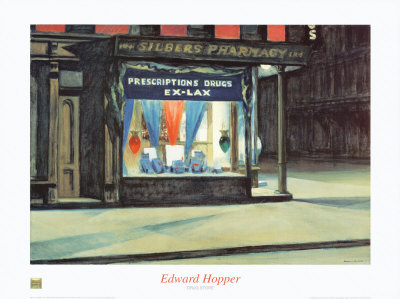
A bright shop window holds red and green globes above a small display of packages and bottles. Large letters advertise prescriptions, drugs and Ex-Lax. Outside, light spreads across an empty pavement, while the street beyond retreats into darkness. Edward Hopper's Drug Store makes a place designed to attract customers conspicuous at an hour when none is visible.
Boston's Museum of Fine Arts holds this 1927 oil on canvas, accession 48.564, as part of the John T. Spaulding bequest. The museum-contributed catalogue records a canvas measuring 29 × 40⅛ inches. [1] Its illuminated frontage brings architecture, advertising and artificial light together within a sharply selected corner of the city.
At a Glance
- ArtistEdward Hopper [1]
- Date1927 [1]
- Mediumoil on canvas [1]
- Collection / recordMuseum of Fine Arts, Boston [1]
- Accession48.564 [1]
This work across Edward Hopper’s career
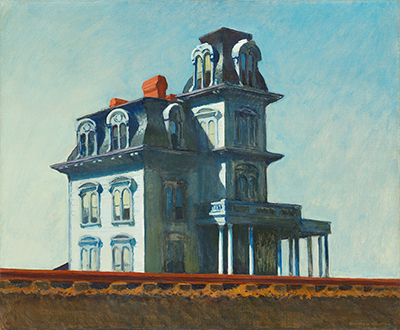
American Village
1912Soir Bleu
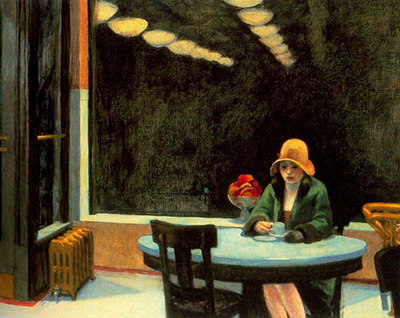
1914Automat
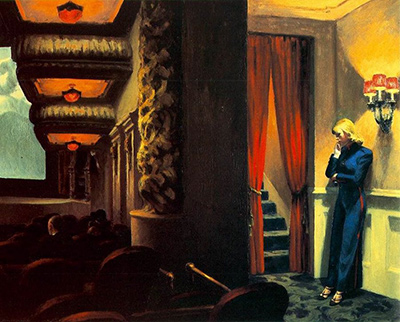
1927New York Movie
1939Nighthawks
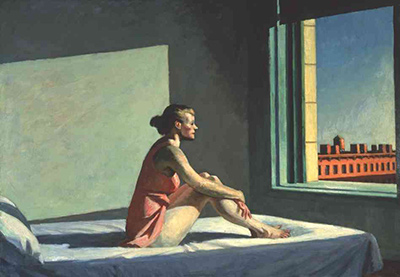
1942Morning Sun
1952Two Comedians
1966Contents
- A named pharmacy without an address
- The window as a small exhibition
- Prescriptions and Ex-Lax
- The entrance turns away
- Several sources of light
- An empty street with signs of use
- Exhibition and collection
- From the pharmacy to other storefronts
A named pharmacy without an address
The painted name, Silber's Pharmacy, gives the building an apparent specificity. It suggests a business that someone might recognize or visit, while the prescriptions sign explains its trade more explicitly than the anonymous displays in some later Hopper pictures.
The Whitney's 2022 exhibition account nevertheless distinguishes the name from a documented address. It relates the architecture to a familiar nineteenth-century corner drugstore type, including a cast-iron column, in Hopper's Greenwich Village surroundings. [2]
Curator Kim Conaty makes the distinction more pointedly in her interview with David Ebony: despite the legible name, her research found no Silber's Pharmacy in the West Village at that time. [3] The lettering can make the shop convincing without establishing that Hopper copied an identified business at one exact location.
This tension is visible in the picture. The shop is closely described where public information matters—its name, trade and advertisement—while the surrounding city remains less definite. The building addresses a potential customer, but the painting does not provide the street sign or numbered doorway needed to turn that address into a map.
The window as a small exhibition
The display has several levels. A broad dark-green panel carries pale lettering above, coloured fabric hangs behind, and smaller objects gather along the bottom. The window is organized to be looked at from the pavement, presenting a collection of shapes within a larger architectural frame.
The red and green suspended vessels are show globes, identified in the Whitney's account as glass containers of coloured liquid associated with the chemist's trade. [2] Their purpose is more specific than that of ordinary bottles placed casually on a shelf.
Their colours remain distinct from the lighter display behind them. The red globe draws attention on one side, while the green supplies a darker counterpart on the other. They help bracket the smaller goods without being arranged as a perfectly matched pair of identical colour.
The fabric introduces longer downward shapes. Red and blue passages narrow towards the display, carrying the eye from the large sign to the small objects beneath. Their looser forms contrast with the window's rigid borders.
The packages are varied in height and tone. At the scale of the reproduction, they do not all yield readable labels, but their clustering is clear. Hopper gives the display enough material presence to suggest a stock of goods while concentrating the most legible language in the larger advertisement.
Prescriptions and Ex-Lax
The words above the display alternate between a general service and a particular branded product. Prescriptions and drugs identify what a pharmacy provides; Ex-Lax names something more specific. The advertisement belongs to the ordinary commercial language of the street.
This detail complicates an idealized view of the bright window. The display may seem carefully composed and almost ceremonial, yet its message includes a laxative. Hopper allows everyday trade to remain particular rather than replacing it with a more decorous invented slogan.
Janet L. Comey, a Museum of Fine Arts curatorial researcher, notes that the Ex-Lax advertisement struck some viewers as indelicate. [4] The reaction helps explain why a small piece of shop lettering could attract attention beyond its role in the composition.
The letters also work as painted shapes. Pale words interrupt a dark field in repeated lines, creating a different rhythm from the irregular packages below. Meaning and design remain closely connected: the sign must be readable as advertising while occupying a carefully defined place in the window.
Compare: Early Sunday Morning, 1930.
The entrance turns away
Beside the display, the corner entrance creates a narrower passage. Its upright support and overhanging elements differ from the broad, flat window, giving the building more than one orientation towards the street.
The oblique viewpoint is important. We can see across the display and towards the entrance at the same time, but neither appears as a wholly frontal diagram. The building's planes turn in relation to one another, making depth visible through short changes of angle.
A lamp near the doorway marks another point of brightness. It belongs to the architecture's invitation to enter, yet the entrance remains empty. The practical possibility of a customer arriving is present without anyone acting it out.
The Whitney identifies a penny scale outside the shop, a convenience available around the clock. [2] That small device extends the pharmacy's usefulness beyond the window display. It suggests an everyday activity that could happen on the pavement even when the scene is unoccupied.
Several sources of light
The picture's illumination does more than make the merchandise visible. Bright and dark shapes cross the pavement at different angles, bringing the empty ground into the composition. The shop's glow spreads into a space otherwise lacking a principal object or figure.
The museum's interpretation distinguishes light from the window, the lamp above the doorway and an unseen street lamp. It relates their combined effect to the geometric shapes on the pavement and the illumination of architectural details. [5]
These overlapping effects prevent the street from becoming one uniform zone of darkness. A pale stretch of pavement can meet a cooler diagonal shadow, while the curb supplies a firmer line nearer the spectator. The ground has its own pattern of divisions.
Warm and cool passages on the ground remain quieter than the concentrated red, green and blue of the display.
The darkness has a constructive role. It allows some surrounding windows and walls to remain only faintly visible, keeping the most emphatic forms near the pharmacy. The city continues beyond the bright corner, but the spectator receives unequal amounts of information about it.
Watch: Edward Hopper’s Life and Art
Explore Hopper’s paintings and the places behind them in these museum films. Choose a film below.
An empty street with signs of use
There are no pedestrians crossing the foreground and no cars drawing the eye down the adjoining street. That absence lets the light, curb and architectural edges determine how we move through the scene.
The place nevertheless contains many traces of human use. Lettering addresses readers, goods await buyers, a lamp marks an entrance and the scale offers a small service. The painting's emptiness is therefore specific: a functioning vocabulary of commerce is present at a moment when its users are out of sight.
This differs from a ruin or an abandoned shop. The brightly arranged display remains an active public face. Hopper does not need to show a transaction to make buying, visiting and passing by part of the scene's possibilities.
The spectator occupies one of those available positions. We stand far enough away to see the corner and its pool of light, looking towards a window designed for that kind of attention. The scene recruits our looking while withholding the immediate social exchange of a customer and shopkeeper.
Compare: Seven A.M., 1948.
Exhibition and collection
The Whitney's account records the painting in a 1929 solo exhibition at Frank K. M. Rehn Galleries, where a critic related Hopper's work to a disappearing local cityscape. [2] That historical response gives the old-fashioned corner pharmacy a place within contemporary discussions of urban change.
The 1933 Museum of Modern Art retrospective listed The Drug Store as catalogue number 3, in John T. Spaulding's Boston collection. [6] The later bequest credit at the Museum of Fine Arts preserves that collector's name in the painting's public identity. [1]
The history does not require the shop's address to be settled. The painting could enter exhibitions and a major collection because its visual and cultural specificity exceeded a simple record of where a pharmacy stood. Its lettering, light and architectural type made a recognizable urban encounter.
From the pharmacy to other storefronts
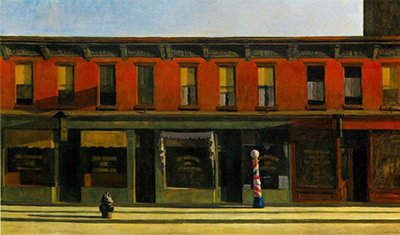
Early Sunday Morning spreads commercial premises across a long, low facade in daylight. Its signs are less readily deciphered, and the individual windows become part of a larger street rhythm. Drug Store concentrates attention on one brightly differentiated display.
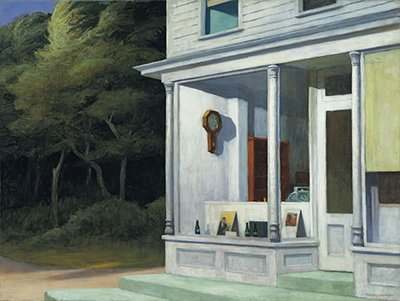
Seven A.M. makes its shop's purpose much harder to establish. There, a clock and a sparse group of objects occupy an otherwise pale frontage. Here, words and coloured globes make the trade explicit, even as the surrounding city remains obscure.
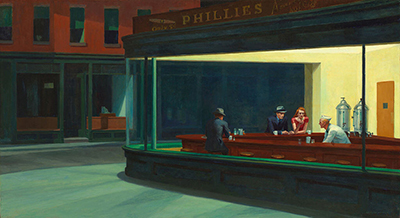
Comey relates the pharmacy to Nighthawks, emphasizing the later painting's comparable use of a glowing commercial corner and dark adjoining streets. [4] The diner adds a group of figures, changing the viewer's relationship with the lighted interior.
In Drug Store, the brightest invitation remains a display of objects and words. Follow the upper sign down to the hanging globes, then out across the pale pavement. The scene's movement belongs to that passage of attention, from a place asking to be noticed into the surrounding night.
Artworks and studies directory
This researched directory includes finished works and separately identified studies. It is not a complete catalogue raisonné. Linked titles open the articles; unlinked studies are identified by their collection accessions. Watercolours retain their recorded media, and original prints remain distinct from reproductions.
| Name | Date | Medium |
|---|---|---|
| (Bridge and Embankment) (70.1298) | 1906 | Oil on wood |
| (Jo Sketching at Good Harbor Beach) (70.1129) | 1923–1924 | Watercolor and fabricated chalk on paper |
| (Manhattan Bridge) (70.1098) | 1925–1926 | Watercolor and graphite pencil on paper |
| (Rooftops) (70.1114) | 1926 | Watercolor and graphite pencil on paper |
| (Seated Male Model, Bent Over) (70.1277) | c. 1902–1903 | Oil on canvas |
| (Self-Portrait) (70.1254) | 1903–1906 | Oil on canvas |
| (Solitary Figure in a Theater) (70.1418) | c. 1902–1904 | Oil on board |
| 5 A.M. | 1937 | oil on canvas |
| Adam's House | 1928 | watercolour and charcoal on paper |
| American Village | 1912 | Oil on canvas |
| Apartment Houses | 1923 | oil on canvas |
| Approaching a City | 1946 | oil on canvas |
| August in the City | 1945 | oil on canvas |
| Automat | 1927 | oil on canvas |
| Barber Shop | 1931 | oil on canvas |
| Blackwell's Island | 1928 | oil on canvas |
| Bridge on the Seine | 1909 | Oil on canvas |
| Bridle Path | 1939 | oil on canvas |
| Burly Cobb's House South Truro | 1930–1933 | oil on canvas |
| Cape Cod Evening | 1939 | oil on canvas |
| Cape Cod Morning | 1950 | oil on canvas |
| Chair Car | 1965 | oil on canvas |
| Chop Suey | 1929 | oil on canvas |
| City Roofs | 1932 | Oil on canvas |
| Coast Guard Station | 1929 | oil on canvas |
| Compartment C, Car 293 | 1938 | oil on canvas |
| Conference at Night | 1949 | oil on canvas |
| Corn Hill | 1930 | oil on canvas |
| Dawn in Pennsylvania | 1942 | oil on canvas |
| Drug Store | 1927 | oil on canvas |
| Early Sunday Morning | 1930 | Oil on canvas |
| East Side Interior (70.1020) | 1922 | Etching |
| East Wind Over Weehawken | 1934 | oil on canvas |
| El Palacio | 1946 | Watercolor and graphite pencil on paper |
| Eleven A.M. | 1926 | oil on canvas |
| Evening Wind | 1921 | etching |
| Excursion into Philosophy | 1959 | oil on canvas |
| First Row Orchestra | 1951 | oil on canvas |
| Freight Car at Truro | 1931 | watercolour over graphite on paper |
| Gas | 1940 | oil on canvas |
| Girl at a Sewing Machine | c. 1921 | oil on canvas |
| Gloucester Harbor | 1912 | Oil on canvas |
| Ground Swell | 1939 | oil on canvas |
| Haskell's House | 1924 | watercolour over graphite on paperboard |
| High Noon | 1949 | oil on canvas |
| Hill and Houses Cape Elizabeth Maine | 1927 | watercolour over graphite pencil |
| Hills South Truro | 1930 | oil on canvas |
| Hotel by a Railroad | 1952 | oil on canvas |
| Hotel Lobby | 1943 | oil on canvas |
| Hotel Room | 1931 | oil on canvas |
| Hotel Window | 1955 | oil on canvas |
| House by the Railroad | 1925 | oil on canvas |
| House by the Squam River | 1926 | watercolour over graphite on paper |
| Le Bistro or The Wine Shop | 1909 | Oil on canvas |
| Le Pont des Arts | 1907 | Oil on canvas |
| Le Pont Royal | 1909 | Oil on canvas |
| Le Quai des Grands Augustins | 1909 | Oil on canvas |
| Lighthouse and Buildings Portland Head | 1927 | watercolour over graphite pencil on paper |
| Lighthouse Hill | 1927 | oil painting |
| Manhattan Bridge Loop | 1928 | oil on canvas |
| Model Sitting | c. 1902 | oil painting; support not asserted |
| Morning Sun | 1952 | oil on canvas |
| New York Movie | 1939 | oil on canvas |
| New York New Haven and Hartford | 1931 | oil on canvas |
| New York Office | 1962 | oil on canvas |
| New York Pavements | 1924–1925 | oil on canvas |
| New York Restaurant | c. 1922 | oil on canvas |
| Night Windows | 1928 | oil on canvas |
| Nighthawks | 1942 | oil on canvas |
| October on Cape Cod | 1946 | oil on canvas |
| Office at Night | 1940 | oil on canvas |
| Office in a Small City | 1953 | oil on canvas |
| Pennsylvania Coal Town | 1947 | oil on canvas |
| People in the Sun | 1960 | oil on canvas |
| Portrait of Orleans | 1950 | oil on canvas |
| Queensborough Bridge | 1913 | Oil on canvas |
| Railroad Sunset | 1929 | Oil on canvas |
| Railroad Train | 1908 | oil on canvas |
| Road in Maine | 1914 | oil on canvas |
| Room in Brooklyn | 1932 | oil on canvas |
| Room in New York | 1932 | oil on canvas |
| Rooms by the Sea | 1951 | oil on canvas |
| Rooms for Tourists | 1945 | oil on canvas |
| Route 6 Eastham | 1941 | oil on canvas |
| Second Story Sunlight | 1960 | Oil on canvas |
| Self-Portrait | 1925–1930 | Oil on canvas |
| Self-Portrait with Hat (70.1903) | c. 1918, posthumous print | Drypoint |
| Seven A.M. | 1948 | Oil on canvas |
| Soir Bleu | 1914 | oil on canvas |
| South Carolina Morning | 1955 | Oil on canvas |
| Stairway at 48 Rue de Lille Paris | 1906 | Oil on wood |
| Study for 5 A.M. (70.153) | 1937 | Fabricated chalk on paper |
| Study for 5 A.M. (70.429) | 1937 | Fabricated chalk and graphite pencil on paper |
| Study for Approaching a City (70.869) | 1946 | Fabricated chalk and charcoal on paper |
| Study for August in the City (70.158a-b) | 1945 | Fabricated chalk on paper |
| Study for August in the City (70.159) | 1945 | Fabricated chalk on paper |
| Study for Bridle Path (70.220) | 1939 | Fabricated chalk on paper |
| Study for Bridle Path (70.235) | 1939 | Fabricated chalk on paper |
| Study for Compartment C, Car 293 (70.430) | 1938 | Fabricated chalk on paper |
| Study for Compartment C, Car 293 (70.431a-b) | 1938 | Fabricated chalk and charcoal on paper |
| Study for Conference at Night (70.170) | 1949 | Fabricated chalk on paper (recto); Typewriter ink on paper (verso) |
| Study for Conference at Night (70.174) | 1949 | Fabricated chalk on paper ( recto); Typewriter ink on paper (verso) |
| Study for East Wind over Weehawken (70.249) | 1934 | Graphite pencil on paper |
| Study for East Wind over Weehawken (70.252) | 1934 | Fabricated chalk and charcoal on paper |
| Study for Evening Wind (70.343a-b) | 1921 | Fabricated chalk on paper |
| Study for First Row Orchestra (70.841) | 1951 | Fabricated chalk and charcoal on paper |
| Study for Gas (70.263) | 1940 | Fabricated chalk on paper |
| Study for Ground Swell (70.339) | 1939 | Fabricated chalk, charcoal and graphite pencil on paper |
| Study for Hotel by a Railroad (70.199) | 1952 | Fabricated chalk on paper |
| Study for Hotel by a Railroad (70.427) | 1952 | Fabricated chalk on paper |
| Study for Hotel by a Railroad (70.428) | 1952 | Fabricated chalk on paper |
| Study for Hotel Lobby (70.117) | 1942 | Fabricated chalk and graphite pencil on paper |
| Study for Hotel Lobby (70.839) | 1942 | Fabricated chalk and charcoal on paper |
| Study for Hotel Window (70.161) | 1955 | Fabricated chalk, graphite pencil and colored pencil on paper |
| Study for Morning Sun (70.243) | 1952 | Fabricated chalk on paper |
| Study for Morning Sun (70.244) | 1952 | Fabricated chalk on paper |
| Study for Morning Sun (70.290) | 1952 | Fabricated chalk on paper |
| Study for Morning Sun (70.291) | 1952 | Fabricated chalk and graphite pencil on paper |
| Study for New York Movie (70.273) | 1939 | Fabricated chalk on paper |
| Study for New York Movie (70.274a-b) | 1938 or 1939 | Fabricated chalk and charcoal on paper (recto); Fabricated chalk on paper (verso) |
| Study for New York Movie (70.455) | 1939 | Fabricated chalk and charcoal on paper |
| Study for New York Office (70.822) | 1962 | Fabricated chalk on paper |
| Study for Nighthawks (70.192) | 1941 or 1942 | Fabricated chalk on paper |
| Study for Nighthawks (70.193) | 1941 or 1942 | Fabricated chalk on paper |
| Study for Office at Night (70.340) | 1940 | Fabricated chalk and charcoal on paper |
| Study for Office at Night (70.341) | 1940 | Fabricated chalk and graphite pencil on paper |
| Study for Pennsylvania Coal Town (70.198) | 1947 | Fabricated chalk on paper |
| Study for Pennsylvania Coal Town (70.229) | 1947 | Fabricated chalk and charcoal on paper |
| Study for Rooms for Tourists (70.438) | 1945 | Fabricated chalk and charcoal on paper |
| Study for Rooms for Tourists (70.848) | 1945 | Fabricated chalk and charcoal on paper |
| Study for Route 6, Eastham (70.369) | 1941 | Fabricated chalk and graphite pencil on paper |
| Study for Route 6, Eastham (70.854) | 1941 | Fabricated chalk and graphite pencil on paper |
| Study for South Carolina Morning (70.162a-b) | 1955 | Fabricated chalk on paper (recto and verso) |
| Study for The Sheridan Theatre (70.969) | 1937 | Graphite pencil on paper |
| Study for Two on the Aisle (70.128) | 1927 | Fabricated chalk on paper |
| Study for Two on the Aisle (70.129) | 1927 | Fabricated chalk on paper |
| Study for Yawl Riding a Swell (70.439) | 1935 | Fabricated chalk and graphite pencil on paper |
| Summer Evening | 1947 | oil on canvas |
| Summer Interior | 1909 | Oil on canvas |
| Sun in an Empty Room | 1963 | oil on canvas |
| Sunlight in a Cafeteria | 1958 | oil on canvas |
| Sunlight on Brownstones | 1956 | oil on canvas |
| Tables for Ladies | 1930 | oil on canvas |
| The Bootleggers | 1925 | oil on canvas |
| The Camel's Hump | 1931 | oil on canvas |
| The Circle Theatre | 1936 | oil on canvas |
| The City | 1927 | oil on canvas |
| The Lighthouse at Two Lights | 1929 | oil on canvas |
| The Long Leg | 1935 | oil on canvas |
| The Mansard Roof | 1923 | watercolour over graphite on paper |
| The Sheridan Theatre | 1937 | oil on canvas |
| Tramp Steamer | 1908 | oil on canvas |
| Two Comedians | 1966 | oil on canvas |
| Two on the Aisle | 1927 | oil on canvas |
| Valley of the Seine | 1909 | Oil on canvas |
| Western Motel | 1957 | oil on canvas |
Frequently Asked Questions
Edward Hopper made Drug Store in 1927. [1]
The recorded medium is oil on canvas. [1]
A bright shop window holds red and green globes above a small display of packages and bottles. Large letters advertise prescriptions, drugs and Ex-Lax. Outside, light spreads across an empty pavement, while the street beyond retreats into darkness. Edward Hopper's Drug Store makes a place designed to attract customers conspicuous at an hour when none is visible.
Discussion
Look again at the images and ideas explored in Drug Store. These editorial prompts invite your observations.
Reader Insights
Which boundary, gesture or change of light first holds your attention in Drug Store?
Compare Early Sunday Morning with Drug Store. Which visual difference matters most to your reading?
Which detail would you look at again after reading “Prescriptions and Ex-Lax”?
Join the Conversation
Share a detail, comparison or question about Drug Store below.
References
- Museum of Fine Arts, Boston, museum-contributed AMICA catalogue, Drug Store, 1927, oil on canvas, accession 48.564, bequest of John T. Spaulding; dimensions 29 × 40⅛ inches. The museum's current Stories Artists Tell gallery page also records the work and bequest. View source 1. View source 2.
- Whitney Museum of American Art, Edward Hopper's New York, exhibition labels, 2022, printed p.15, PDF p.21; pharmacy type, unnamed address, show globes, penny scale and the 1929 Rehn exhibition. View source.
- David Ebony, “Edward Hopper's Public and Private New York”, interview with Kim Conaty, Yale University Press, 17 November 2022; the absence of an identified Silber's Pharmacy in the contemporary West Village. View source.
- Janet L. Comey, “Edward Hopper: Hours of Darkness”, Antiques & Fine Art, Summer 2007, pp.153–157, especially p.156; Ex-Lax reception and comparison with Nighthawks. View source.
- Museum of Fine Arts, Boston, Drug Store, 1927, museum interpretation under “About the Artwork”; combined artificial lighting and pavement geometry. Dimensions of reproductions are not used here. View source.
- Museum of Modern Art, Edward Hopper, 1933, catalogue no. 3, printed p.25; historical Spaulding collection entry. View source.
- Collection or catalogue record, American Village, 1912; medium and identity as discussed in the linked article. View source.
- Collection or catalogue record, Soir Bleu, 1914; medium and identity as discussed in the linked article. View source.
- Collection or catalogue record, House by the Railroad, 1925; medium and identity as discussed in the linked article. View source.
- Collection or catalogue record, Automat, 1927; medium and identity as discussed in the linked article. View source.
- Collection or catalogue record, Early Sunday Morning, 1930; medium and identity as discussed in the linked article. View source.
- Collection or catalogue record, New York Movie, 1939; medium and identity as discussed in the linked article. View source.
- Collection or catalogue record, Nighthawks, 1942; medium and identity as discussed in the linked article. View source.
- Collection or catalogue record, Morning Sun, 1952; medium and identity as discussed in the linked article. View source.
- Collection or catalogue record, Second Story Sunlight, 1960; medium and identity as discussed in the linked article. View source.
- Collection or catalogue record, Two Comedians, 1966; medium and identity as discussed in the linked article. View source.
- Whitney Museum of American Art, Study for Route 6, Eastham, 1941, accession 70.854; exact object record. View source.
- Whitney Museum of American Art, Study for Conference at Night, 1949, accession 70.170; exact object record. View source.
- Whitney Museum of American Art, Study for First Row Orchestra, 1951, accession 70.841; exact object record. View source.
- Whitney Museum of American Art, (Bridge and Embankment), 1906, accession 70.1298; exact object record. View source.
- Whitney Museum of American Art, (Seated Male Model, Bent Over), c. 1902–1903, accession 70.1277; exact object record. View source.
- Whitney Museum of American Art, Study for Morning Sun, 1952, accession 70.244; exact object record. View source.
- Whitney Museum of American Art, Study for Morning Sun, 1952, accession 70.243; exact object record. View source.
- Whitney Museum of American Art, Study for Two on the Aisle, 1927, accession 70.128; exact object record. View source.
- Whitney Museum of American Art, Study for New York Office, 1962, accession 70.822; exact object record. View source.
- Whitney Museum of American Art, Study for Two on the Aisle, 1927, accession 70.129; exact object record. View source.
- Whitney Museum of American Art, Study for Pennsylvania Coal Town, 1947, accession 70.229; exact object record. View source.
- Whitney Museum of American Art, (Rooftops), 1926, accession 70.1114; exact object record. View source.
- Whitney Museum of American Art, Study for South Carolina Morning, 1955, accession 70.162a-b; exact object record. View source.
- Whitney Museum of American Art, (Self-Portrait), 1903–1906, accession 70.1254; exact object record. View source.
- Whitney Museum of American Art, (Manhattan Bridge), 1925–1926, accession 70.1098; exact object record. View source.
- Whitney Museum of American Art, (Solitary Figure in a Theater), c. 1902–1904, accession 70.1418; exact object record. View source.
- Whitney Museum of American Art, Study for Approaching a City, 1946, accession 70.869; exact object record. View source.
- Whitney Museum of American Art, Study for August in the City, 1945, accession 70.159; exact object record. View source.
- Whitney Museum of American Art, Study for Compartment C, Car 293, 1938, accession 70.430; exact object record. View source.
- Whitney Museum of American Art, Study for Compartment C, Car 293, 1938, accession 70.431a-b; exact object record. View source.
- Whitney Museum of American Art, Study for East Wind over Weehawken, 1934, accession 70.252; exact object record. View source.
- Whitney Museum of American Art, Study for East Wind over Weehawken, 1934, accession 70.249; exact object record. View source.
- Whitney Museum of American Art, Study for Evening Wind, 1921, accession 70.343a-b; exact object record. View source.
- Whitney Museum of American Art, Study for The Sheridan Theatre, 1937, accession 70.969; exact object record. View source.
- Whitney Museum of American Art, Study for New York Movie, 1939, accession 70.455; exact object record. View source.
- Whitney Museum of American Art, Study for New York Movie, 1939, accession 70.273; exact object record. View source.
- Whitney Museum of American Art, Study for New York Movie, 1938 or 1939, accession 70.274a-b; exact object record. View source.
- Whitney Museum of American Art, Study for 5 A.M., 1937, accession 70.153; exact object record. View source.
- Whitney Museum of American Art, Study for 5 A.M., 1937, accession 70.429; exact object record. View source.
- Whitney Museum of American Art, (Jo Sketching at Good Harbor Beach), 1923–1924, accession 70.1129; exact object record. View source.
- Whitney Museum of American Art, Study for August in the City, 1945, accession 70.158a-b; exact object record. View source.
- Whitney Museum of American Art, Study for Morning Sun, 1952, accession 70.291; exact object record. View source.
- Whitney Museum of American Art, Study for Morning Sun, 1952, accession 70.290; exact object record. View source.
- Whitney Museum of American Art, Study for Office at Night, 1940, accession 70.340; exact object record. View source.
- Whitney Museum of American Art, Study for Office at Night, 1940, accession 70.341; exact object record. View source.
- Whitney Museum of American Art, Study for Hotel by a Railroad, 1952, accession 70.427; exact object record. View source.
- Whitney Museum of American Art, Study for Hotel by a Railroad, 1952, accession 70.199; exact object record. View source.
- Whitney Museum of American Art, Study for Hotel by a Railroad, 1952, accession 70.428; exact object record. View source.
- Whitney Museum of American Art, Study for Hotel Lobby, 1942, accession 70.117; exact object record. View source.
- Whitney Museum of American Art, Study for Hotel Lobby, 1942, accession 70.839; exact object record. View source.
- Whitney Museum of American Art, Study for Conference at Night, 1949, accession 70.174; exact object record. View source.
- Whitney Museum of American Art, Study for Hotel Window, 1955, accession 70.161; exact object record. View source.
- Whitney Museum of American Art, Study for Pennsylvania Coal Town, 1947, accession 70.198; exact object record. View source.
- Whitney Museum of American Art, Study for Route 6, Eastham, 1941, accession 70.369; exact object record. View source.
- Whitney Museum of American Art, Study for Bridle Path, 1939, accession 70.220; exact object record. View source.
- Whitney Museum of American Art, Study for Bridle Path, 1939, accession 70.235; exact object record. View source.
- Whitney Museum of American Art, Study for Ground Swell, 1939, accession 70.339; exact object record. View source.
- Whitney Museum of American Art, Study for Yawl Riding a Swell, 1935, accession 70.439; exact object record. View source.
- Whitney Museum of American Art, Study for Rooms for Tourists, 1945, accession 70.848; exact object record. View source.
- Whitney Museum of American Art, Study for Rooms for Tourists, 1945, accession 70.438; exact object record. View source.
- Whitney Museum of American Art, Study for Nighthawks, 1941 or 1942, accession 70.193; exact object record. View source.
- Whitney Museum of American Art, Study for Nighthawks, 1941 or 1942, accession 70.192; exact object record. View source.
- Whitney Museum of American Art, Study for Gas, 1940, accession 70.263; exact object record. View source.
- Whitney Museum of American Art, Self-Portrait with Hat, c. 1918, posthumous print, accession 70.1903; exact object record. View source.
- Whitney Museum of American Art, East Side Interior, 1922, accession 70.1020; exact object record. View source.
- Art Institute of Chicago, Selected Chronology for Edward Hopper; training, travels, exhibitions, New York and Truro chronology. View source.
- Emily C. Burns, Spectral figures: Edward Hopper’s empty Paris, chapter 5 in Empty Spaces: Confronting Emptiness in National, Cultural and Urban Histories, 2019; complete chapter and notes consulted. View source.
- Charles Brock, Regionalism and Folk Art, National Gallery of Art; complete essay and two notes consulted. View source.