 by Tom Gurney
Tom Gurney BSc (Hons) is an art history expert with over 20 years experience
Email: tomgurney1@gmail.com / Phone: +44 7429 011000
Pennsylvania Coal Town: Introduction
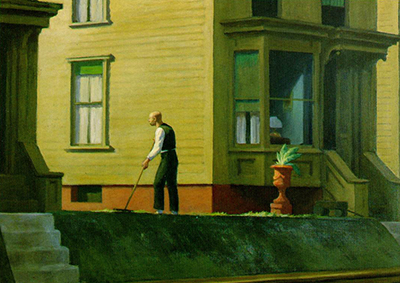
A man holds a rake beside a yellow clapboard house. His head turns to the left while the long handle slopes down towards the grass. Behind him, a window and projecting bay divide the wall; a potted plant stands near the steps at the right. Edward Hopper's Pennsylvania Coal Town gives an ordinary piece of outdoor work a setting defined by sunlight, shade and domestic architecture.
The painting belongs to The Butler Institute of American Art in Youngstown, Ohio. [1] The 2009–10 exhibition records identify it as an oil on canvas of 1947, measuring 71.1 × 101.6 cm, purchased by the museum in 1948. [2] Pennsylvania names the painted setting; Ohio belongs to the work's subsequent collection history.
At a Glance
- ArtistEdward Hopper [1]
- Date1947 [1]
- Mediumoil on canvas [1]
- Collection / recordThe Butler Institute of American Art [1]
This work across Edward Hopper’s career
American Village
1912Soir Bleu
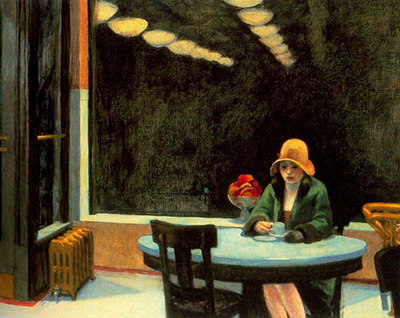
1914Automat
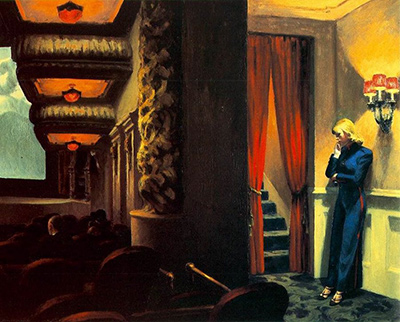
1927New York Movie
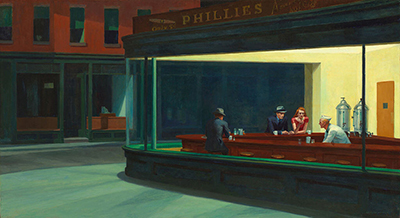
1939Nighthawks
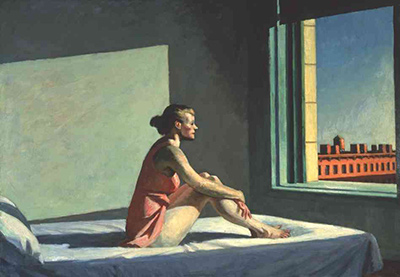
1942Morning Sun
1952Two Comedians
1966Contents
- A narrow place to work
- The rake and the turned head
- Sun across the clapboards
- A bay, a porch and a plant
- Looking across the bank
- The house and figure considered together
- Two smaller arrangements on one sheet
- A Pennsylvania subject in an Ohio collection
- Other buildings and working spaces
A narrow place to work
The man stands on a strip of grass between the house and a darker bank in the foreground. His place is small in relation to the large wall behind him. The cropped building fills most of the upper canvas, leaving little room for a broad landscape or sky.
This arrangement concentrates attention on the immediate surroundings of a home. The lawn, steps, windows and plant are familiar details, but the close framing prevents us from understanding the whole property. We see a selected section rather than an architectural portrait with a complete roof and frontage.
The bank creates another boundary below the figure. Its dark green surface occupies a substantial part of the foreground, separating the spectator from the level on which the man stands. We look towards the lawn from beyond its edge.
The steps at the left offer a visible change of level. Their pale surfaces make the bank's height easier to understand, while their cropping implies that the arrangement continues outside the picture. The foreground is both a barrier and part of an ordinary route between street and house.
The rake and the turned head
The rake gives the figure a recognisable task. Its handle connects his hands with the ground, making a long diagonal against the mostly upright body and the wall's horizontal clapboards.
The tool also makes the turn of his head more noticeable. The hands remain concerned with an implement directed towards the grass, while his face points elsewhere. The body can suggest a pause in work without establishing what has attracted his attention.
His light shirt stands out against darker clothing and the green lawn. The pale arms make the grip legible; the narrow shape of the torso distinguishes him from the much broader architecture. Hopper gives the working body clarity through a few strong contrasts.
The title introduces a coal town, but the painting does not show a mine or identify the man's employment. He may be read within a community shaped by industry, yet the visible action belongs to the care of a small domestic outdoor space. Calling him a particular kind of worker would require information the image does not supply.
The rake, lawn and house establish a specific activity. The turned head makes a small interruption within it, rather than confirming a story about the man's work elsewhere.
Sun across the clapboards
The large yellow wall catches the light. Repeated horizontal seams give it texture and direction, carrying the eye towards the window and figure without turning the entire surface into a detailed pattern.
The window trim adds green verticals to this arrangement. Its colour relates the building to the lawn while its sharper edges make the opening distinct from the clapboard field. The glass and shade keep the room behind it largely inaccessible.
The man's position close to this wall affects how we see him. His outline is easy to follow against a broad illuminated surface, and his comparatively small scale makes the house seem substantial. The building is an active part of the figure's presentation.
At the left, much darker architecture interrupts the sunny frontage. The shadowed edge creates a strong contrast before the eye reaches the pale steps. A neighbouring structure can be suggested through only a fragment when its darkness is so different from the wall beside it.
A bay, a porch and a plant
The projecting section at the right breaks the wall into several planes. Its darker windows and shaded recesses differ from the broader yellow area behind the man. The house acquires depth through these changes of direction and illumination.
Steps and a handrail lead towards the entrance area. They establish a practical connection between the lawn and building, although no one is shown using it. Their diagonal edges answer the rake's sloping handle on a larger scale.
The potted plant introduces a small cultivated form beside the architecture. Its leaves spread above the container, and the raised support brings it closer to the height of the man's lower body. It provides another sign of maintenance within the outdoor setting.
The plant also gives the composition an upright accent that is neither a person nor a building edge. Against the regular trim and clapboards, its leaves have a looser shape. Hopper includes just enough variety to keep the setting from becoming a diagram of rectangles.
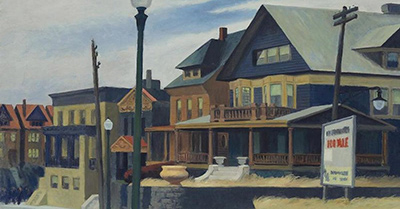
Compare: East Wind Over Weehawken, 1934.
Looking across the bank
The foreground bank makes our position different from the man's. He stands within the small usable area beside the house; we look across a larger dark surface before reaching him. The gap gives the view a distance despite the close architectural crop.
This is one reason the figure feels exposed to observation. The lawn offers little to hide him, while the sunlit wall makes his silhouette clear. Yet the street or path from which we might be looking remains only partly implied at the bottom of the picture.
The house's cropping strengthens that selective view. We are not given the comfortable overview of someone inspecting a complete building. A narrow part of its daily surroundings becomes the whole painted world.
The result combines physical nearness with incomplete knowledge. We can identify the tool and the task, but not the cause of the turned head. The composition makes that ordinary interruption visible without requiring a larger incident to explain it.
Watch: Edward Hopper’s Life and Art
Explore Hopper’s paintings and the places behind them in these museum films. Choose a film below.
The house and figure considered together
The Whitney Museum preserves a substantial Study for Pennsylvania Coal Town, accession 70.229, dated 1947. It uses fabricated chalk and charcoal on paper. [3] The figure, rake, lawn, window, bay, steps and raised plant are already brought into one arrangement.
Repeated lines explore the clapboards and openings, while darker tones mark the foreground and projecting architecture. The man appears less resolved than the final painted figure, but his relationship with the house is central to the sheet.
The drawing shows that the setting was not simply added around a separately conceived portrait. The body and its working area were considered through the scale and position of the building. Moving the man would alter his relation to the window, steps and bank.
The finished painting gives those relationships more decisive colour. Yellow, green, pale clothing and red-brown foundation separate areas that the drawing distinguishes through tone and line. The structural concerns remain visible across the change of medium.
Two smaller arrangements on one sheet
Another Whitney study, accession 70.198, is a vertical sheet with two smaller compositions. The museum dates the fabricated-chalk drawing to 1947. [4] The upper arrangement develops the house and small figure with more detail; the lower one gives a looser account of architecture, steps and ground.
The paired sketches make selection visible. A figure can be considered within a more elaborate setting or reduced to a few marks among larger architectural divisions. The sheet allows Hopper to think about the image at different degrees of resolution.
Its alternatives also caution against treating every visible contour in a drawing as a final decision. Searching lines and simplified shapes can test possibilities that the oil later makes firmer. A study need not be a miniature copy of the completed painting to explain its development.
The surviving sheets share the painting's year. Their comparison establishes a sustained concern with this arrangement of body and house without proving the exact order in which every sketch was made.
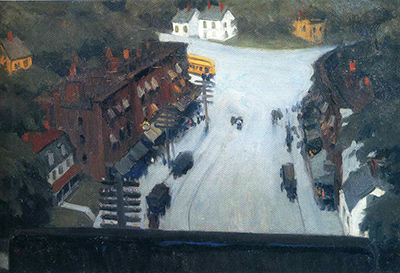
Compare: American Village, 1912.
A Pennsylvania subject in an Ohio collection
The museum's purchase in 1948 followed the painting's completion by a year. [2] That early acquisition gave a regional American scene a place within Butler's wider collection of American art.
The work was listed for the exhibition organised for Milan, Rome and Lausanne in 2009–10, whose records preserve the medium, dimensions and purchase credit. [2] The painting could circulate internationally while retaining its Pennsylvania title and Ohio collection identity.
Neither history identifies a particular street or the man's name. The canvas's documented movements are more precise than the circumstances of the small task it depicts. The distinction is part of what makes it possible to keep looking without reducing the figure to a supplied biography.
Other buildings and working spaces
Sunlight on Brownstones also brings people close to a strongly lit domestic façade. Its steps and seated figures establish a different relation between bodily pause and architecture.
Office in a Small City gives a worker an interior desk and a view across rooftops. Here the work takes place outdoors, but the surrounding building still determines the body's scale and visibility.
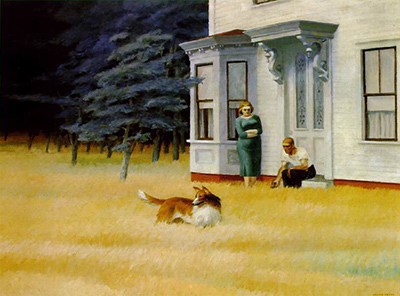
In Cape Cod Morning, a woman looks out from a projecting window. Pennsylvania Coal Town places its figure on the other side of the wall, holding a tool while turning towards something beyond the selected view.
Return to the diagonal rake, then follow the clapboards behind the man's head. A small action and a large illuminated surface meet in a narrow piece of ground. Hopper makes their relationship clear while leaving the interruption to the work unexplained.
Artworks and studies directory
This researched directory includes finished works and separately identified studies. It is not a complete catalogue raisonné. Linked titles open the articles; unlinked studies are identified by their collection accessions. Watercolours retain their recorded media, and original prints remain distinct from reproductions.
| Name | Date | Medium |
|---|---|---|
| (Bridge and Embankment) (70.1298) | 1906 | Oil on wood |
| (Jo Sketching at Good Harbor Beach) (70.1129) | 1923–1924 | Watercolor and fabricated chalk on paper |
| (Manhattan Bridge) (70.1098) | 1925–1926 | Watercolor and graphite pencil on paper |
| (Rooftops) (70.1114) | 1926 | Watercolor and graphite pencil on paper |
| (Seated Male Model, Bent Over) (70.1277) | c. 1902–1903 | Oil on canvas |
| (Self-Portrait) (70.1254) | 1903–1906 | Oil on canvas |
| (Solitary Figure in a Theater) (70.1418) | c. 1902–1904 | Oil on board |
| 5 A.M. | 1937 | oil on canvas |
| Adam's House | 1928 | watercolour and charcoal on paper |
| American Village | 1912 | Oil on canvas |
| Apartment Houses | 1923 | oil on canvas |
| Approaching a City | 1946 | oil on canvas |
| August in the City | 1945 | oil on canvas |
| Automat | 1927 | oil on canvas |
| Barber Shop | 1931 | oil on canvas |
| Blackwell's Island | 1928 | oil on canvas |
| Bridge on the Seine | 1909 | Oil on canvas |
| Bridle Path | 1939 | oil on canvas |
| Burly Cobb's House South Truro | 1930–1933 | oil on canvas |
| Cape Cod Evening | 1939 | oil on canvas |
| Cape Cod Morning | 1950 | oil on canvas |
| Chair Car | 1965 | oil on canvas |
| Chop Suey | 1929 | oil on canvas |
| City Roofs | 1932 | Oil on canvas |
| Coast Guard Station | 1929 | oil on canvas |
| Compartment C, Car 293 | 1938 | oil on canvas |
| Conference at Night | 1949 | oil on canvas |
| Corn Hill | 1930 | oil on canvas |
| Dawn in Pennsylvania | 1942 | oil on canvas |
| Drug Store | 1927 | oil on canvas |
| Early Sunday Morning | 1930 | Oil on canvas |
| East Side Interior (70.1020) | 1922 | Etching |
| East Wind Over Weehawken | 1934 | oil on canvas |
| El Palacio | 1946 | Watercolor and graphite pencil on paper |
| Eleven A.M. | 1926 | oil on canvas |
| Evening Wind | 1921 | etching |
| Excursion into Philosophy | 1959 | oil on canvas |
| First Row Orchestra | 1951 | oil on canvas |
| Freight Car at Truro | 1931 | watercolour over graphite on paper |
| Gas | 1940 | oil on canvas |
| Girl at a Sewing Machine | c. 1921 | oil on canvas |
| Gloucester Harbor | 1912 | Oil on canvas |
| Ground Swell | 1939 | oil on canvas |
| Haskell's House | 1924 | watercolour over graphite on paperboard |
| High Noon | 1949 | oil on canvas |
| Hill and Houses Cape Elizabeth Maine | 1927 | watercolour over graphite pencil |
| Hills South Truro | 1930 | oil on canvas |
| Hotel by a Railroad | 1952 | oil on canvas |
| Hotel Lobby | 1943 | oil on canvas |
| Hotel Room | 1931 | oil on canvas |
| Hotel Window | 1955 | oil on canvas |
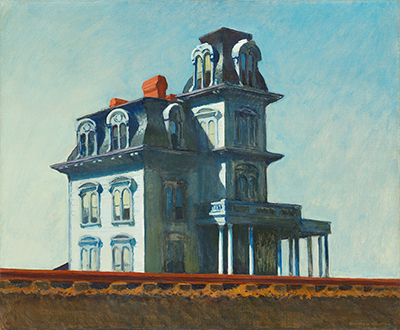
| House by the Railroad | 1925 | oil on canvas |
| House by the Squam River | 1926 | watercolour over graphite on paper |
| Le Bistro or The Wine Shop | 1909 | Oil on canvas |
| Le Pont des Arts | 1907 | Oil on canvas |
| Le Pont Royal | 1909 | Oil on canvas |
| Le Quai des Grands Augustins | 1909 | Oil on canvas |
| Lighthouse and Buildings Portland Head | 1927 | watercolour over graphite pencil on paper |
| Lighthouse Hill | 1927 | oil painting |
| Manhattan Bridge Loop | 1928 | oil on canvas |
| Model Sitting | c. 1902 | oil painting; support not asserted |
| Morning Sun | 1952 | oil on canvas |
| New York Movie | 1939 | oil on canvas |
| New York New Haven and Hartford | 1931 | oil on canvas |
| New York Office | 1962 | oil on canvas |
| New York Pavements | 1924–1925 | oil on canvas |
| New York Restaurant | c. 1922 | oil on canvas |
| Night Windows | 1928 | oil on canvas |
| Nighthawks | 1942 | oil on canvas |
| October on Cape Cod | 1946 | oil on canvas |
| Office at Night | 1940 | oil on canvas |
| Office in a Small City | 1953 | oil on canvas |
| Pennsylvania Coal Town | 1947 | oil on canvas |
| People in the Sun | 1960 | oil on canvas |
| Portrait of Orleans | 1950 | oil on canvas |
| Queensborough Bridge | 1913 | Oil on canvas |
| Railroad Sunset | 1929 | Oil on canvas |
| Railroad Train | 1908 | oil on canvas |
| Road in Maine | 1914 | oil on canvas |
| Room in Brooklyn | 1932 | oil on canvas |
| Room in New York | 1932 | oil on canvas |
| Rooms by the Sea | 1951 | oil on canvas |
| Rooms for Tourists | 1945 | oil on canvas |
| Route 6 Eastham | 1941 | oil on canvas |
| Second Story Sunlight | 1960 | Oil on canvas |
| Self-Portrait | 1925–1930 | Oil on canvas |
| Self-Portrait with Hat (70.1903) | c. 1918, posthumous print | Drypoint |
| Seven A.M. | 1948 | Oil on canvas |
| Soir Bleu | 1914 | oil on canvas |
| South Carolina Morning | 1955 | Oil on canvas |
| Stairway at 48 Rue de Lille Paris | 1906 | Oil on wood |
| Study for 5 A.M. (70.153) | 1937 | Fabricated chalk on paper |
| Study for 5 A.M. (70.429) | 1937 | Fabricated chalk and graphite pencil on paper |
| Study for Approaching a City (70.869) | 1946 | Fabricated chalk and charcoal on paper |
| Study for August in the City (70.158a-b) | 1945 | Fabricated chalk on paper |
| Study for August in the City (70.159) | 1945 | Fabricated chalk on paper |
| Study for Bridle Path (70.220) | 1939 | Fabricated chalk on paper |
| Study for Bridle Path (70.235) | 1939 | Fabricated chalk on paper |
| Study for Compartment C, Car 293 (70.430) | 1938 | Fabricated chalk on paper |
| Study for Compartment C, Car 293 (70.431a-b) | 1938 | Fabricated chalk and charcoal on paper |
| Study for Conference at Night (70.170) | 1949 | Fabricated chalk on paper (recto); Typewriter ink on paper (verso) |
| Study for Conference at Night (70.174) | 1949 | Fabricated chalk on paper ( recto); Typewriter ink on paper (verso) |
| Study for East Wind over Weehawken (70.249) | 1934 | Graphite pencil on paper |
| Study for East Wind over Weehawken (70.252) | 1934 | Fabricated chalk and charcoal on paper |
| Study for Evening Wind (70.343a-b) | 1921 | Fabricated chalk on paper |
| Study for First Row Orchestra (70.841) | 1951 | Fabricated chalk and charcoal on paper |
| Study for Gas (70.263) | 1940 | Fabricated chalk on paper |
| Study for Ground Swell (70.339) | 1939 | Fabricated chalk, charcoal and graphite pencil on paper |
| Study for Hotel by a Railroad (70.199) | 1952 | Fabricated chalk on paper |
| Study for Hotel by a Railroad (70.427) | 1952 | Fabricated chalk on paper |
| Study for Hotel by a Railroad (70.428) | 1952 | Fabricated chalk on paper |
| Study for Hotel Lobby (70.117) | 1942 | Fabricated chalk and graphite pencil on paper |
| Study for Hotel Lobby (70.839) | 1942 | Fabricated chalk and charcoal on paper |
| Study for Hotel Window (70.161) | 1955 | Fabricated chalk, graphite pencil and colored pencil on paper |
| Study for Morning Sun (70.243) | 1952 | Fabricated chalk on paper |
| Study for Morning Sun (70.244) | 1952 | Fabricated chalk on paper |
| Study for Morning Sun (70.290) | 1952 | Fabricated chalk on paper |
| Study for Morning Sun (70.291) | 1952 | Fabricated chalk and graphite pencil on paper |
| Study for New York Movie (70.273) | 1939 | Fabricated chalk on paper |
| Study for New York Movie (70.274a-b) | 1938 or 1939 | Fabricated chalk and charcoal on paper (recto); Fabricated chalk on paper (verso) |
| Study for New York Movie (70.455) | 1939 | Fabricated chalk and charcoal on paper |
| Study for New York Office (70.822) | 1962 | Fabricated chalk on paper |
| Study for Nighthawks (70.192) | 1941 or 1942 | Fabricated chalk on paper |
| Study for Nighthawks (70.193) | 1941 or 1942 | Fabricated chalk on paper |
| Study for Office at Night (70.340) | 1940 | Fabricated chalk and charcoal on paper |
| Study for Office at Night (70.341) | 1940 | Fabricated chalk and graphite pencil on paper |
| Study for Pennsylvania Coal Town (70.198) | 1947 | Fabricated chalk on paper |
| Study for Pennsylvania Coal Town (70.229) | 1947 | Fabricated chalk and charcoal on paper |
| Study for Rooms for Tourists (70.438) | 1945 | Fabricated chalk and charcoal on paper |
| Study for Rooms for Tourists (70.848) | 1945 | Fabricated chalk and charcoal on paper |
| Study for Route 6, Eastham (70.369) | 1941 | Fabricated chalk and graphite pencil on paper |
| Study for Route 6, Eastham (70.854) | 1941 | Fabricated chalk and graphite pencil on paper |
| Study for South Carolina Morning (70.162a-b) | 1955 | Fabricated chalk on paper (recto and verso) |
| Study for The Sheridan Theatre (70.969) | 1937 | Graphite pencil on paper |
| Study for Two on the Aisle (70.128) | 1927 | Fabricated chalk on paper |
| Study for Two on the Aisle (70.129) | 1927 | Fabricated chalk on paper |
| Study for Yawl Riding a Swell (70.439) | 1935 | Fabricated chalk and graphite pencil on paper |
| Summer Evening | 1947 | oil on canvas |
| Summer Interior | 1909 | Oil on canvas |
| Sun in an Empty Room | 1963 | oil on canvas |
| Sunlight in a Cafeteria | 1958 | oil on canvas |
| Sunlight on Brownstones | 1956 | oil on canvas |
| Tables for Ladies | 1930 | oil on canvas |
| The Bootleggers | 1925 | oil on canvas |
| The Camel's Hump | 1931 | oil on canvas |
| The Circle Theatre | 1936 | oil on canvas |
| The City | 1927 | oil on canvas |
| The Lighthouse at Two Lights | 1929 | oil on canvas |
| The Long Leg | 1935 | oil on canvas |
| The Mansard Roof | 1923 | watercolour over graphite on paper |
| The Sheridan Theatre | 1937 | oil on canvas |
| Tramp Steamer | 1908 | oil on canvas |
| Two Comedians | 1966 | oil on canvas |
| Two on the Aisle | 1927 | oil on canvas |
| Valley of the Seine | 1909 | Oil on canvas |
| Western Motel | 1957 | oil on canvas |
Frequently Asked Questions
Edward Hopper made Pennsylvania Coal Town in 1947. [1]
The recorded medium is oil on canvas. [1]
A man holds a rake beside a yellow clapboard house. His head turns to the left while the long handle slopes down towards the grass. Behind him, a window and projecting bay divide the wall; a potted plant stands near the steps at the right. Edward Hopper's Pennsylvania Coal Town gives an ordinary piece of outdoor work a setting defined by sunlight, shade and domestic architecture.
Discussion
Look again at the images and ideas explored in Pennsylvania Coal Town. These editorial prompts invite your observations.
Reader Insights
Which boundary, gesture or change of light first holds your attention in Pennsylvania Coal Town?
Compare East Wind Over Weehawken with Pennsylvania Coal Town. Which visual difference matters most to your reading?
Which detail would you look at again after reading “Sun across the clapboards”?
Join the Conversation
Share a detail, comparison or question about Pennsylvania Coal Town below.
References
- The Butler Institute of American Art, “20th Century” collection, selected works, Pennsylvania Coal Town. View source.
- Edward Hopper: Milano, Roma e Losanna, exhibition press kit, 2009–10, image captions, item 5.46, PDF p. 20; oil on canvas, 1947, Butler museum purchase 1948. View source.
- Whitney Museum of American Art, Study for Pennsylvania Coal Town, 1947, fabricated chalk and charcoal on paper, accession 70.229. View source.
- Whitney Museum of American Art, Study for Pennsylvania Coal Town, 1947, fabricated chalk on paper, accession 70.198. View source.
- Collection or catalogue record, American Village, 1912; medium and identity as discussed in the linked article. View source.
- Collection or catalogue record, Soir Bleu, 1914; medium and identity as discussed in the linked article. View source.
- Collection or catalogue record, House by the Railroad, 1925; medium and identity as discussed in the linked article. View source.
- Collection or catalogue record, Automat, 1927; medium and identity as discussed in the linked article. View source.
- Collection or catalogue record, Early Sunday Morning, 1930; medium and identity as discussed in the linked article. View source.
- Collection or catalogue record, New York Movie, 1939; medium and identity as discussed in the linked article. View source.
- Collection or catalogue record, Nighthawks, 1942; medium and identity as discussed in the linked article. View source.
- Collection or catalogue record, Morning Sun, 1952; medium and identity as discussed in the linked article. View source.
- Collection or catalogue record, Second Story Sunlight, 1960; medium and identity as discussed in the linked article. View source.
- Collection or catalogue record, Two Comedians, 1966; medium and identity as discussed in the linked article. View source.
- Whitney Museum of American Art, Study for Route 6, Eastham, 1941, accession 70.854; exact object record. View source.
- Whitney Museum of American Art, Study for Conference at Night, 1949, accession 70.170; exact object record. View source.
- Whitney Museum of American Art, Study for First Row Orchestra, 1951, accession 70.841; exact object record. View source.
- Whitney Museum of American Art, (Bridge and Embankment), 1906, accession 70.1298; exact object record. View source.
- Whitney Museum of American Art, (Seated Male Model, Bent Over), c. 1902–1903, accession 70.1277; exact object record. View source.
- Whitney Museum of American Art, Study for Morning Sun, 1952, accession 70.244; exact object record. View source.
- Whitney Museum of American Art, Study for Morning Sun, 1952, accession 70.243; exact object record. View source.
- Whitney Museum of American Art, Study for Two on the Aisle, 1927, accession 70.128; exact object record. View source.
- Whitney Museum of American Art, Study for New York Office, 1962, accession 70.822; exact object record. View source.
- Whitney Museum of American Art, Study for Two on the Aisle, 1927, accession 70.129; exact object record. View source.
- Whitney Museum of American Art, Study for Pennsylvania Coal Town, 1947, accession 70.229; exact object record. View source.
- Whitney Museum of American Art, (Rooftops), 1926, accession 70.1114; exact object record. View source.
- Whitney Museum of American Art, Study for South Carolina Morning, 1955, accession 70.162a-b; exact object record. View source.
- Whitney Museum of American Art, (Self-Portrait), 1903–1906, accession 70.1254; exact object record. View source.
- Whitney Museum of American Art, (Manhattan Bridge), 1925–1926, accession 70.1098; exact object record. View source.
- Whitney Museum of American Art, (Solitary Figure in a Theater), c. 1902–1904, accession 70.1418; exact object record. View source.
- Whitney Museum of American Art, Study for Approaching a City, 1946, accession 70.869; exact object record. View source.
- Whitney Museum of American Art, Study for August in the City, 1945, accession 70.159; exact object record. View source.
- Whitney Museum of American Art, Study for Compartment C, Car 293, 1938, accession 70.430; exact object record. View source.
- Whitney Museum of American Art, Study for Compartment C, Car 293, 1938, accession 70.431a-b; exact object record. View source.
- Whitney Museum of American Art, Study for East Wind over Weehawken, 1934, accession 70.252; exact object record. View source.
- Whitney Museum of American Art, Study for East Wind over Weehawken, 1934, accession 70.249; exact object record. View source.
- Whitney Museum of American Art, Study for Evening Wind, 1921, accession 70.343a-b; exact object record. View source.
- Whitney Museum of American Art, Study for The Sheridan Theatre, 1937, accession 70.969; exact object record. View source.
- Whitney Museum of American Art, Study for New York Movie, 1939, accession 70.455; exact object record. View source.
- Whitney Museum of American Art, Study for New York Movie, 1939, accession 70.273; exact object record. View source.
- Whitney Museum of American Art, Study for New York Movie, 1938 or 1939, accession 70.274a-b; exact object record. View source.
- Whitney Museum of American Art, Study for 5 A.M., 1937, accession 70.153; exact object record. View source.
- Whitney Museum of American Art, Study for 5 A.M., 1937, accession 70.429; exact object record. View source.
- Whitney Museum of American Art, (Jo Sketching at Good Harbor Beach), 1923–1924, accession 70.1129; exact object record. View source.
- Whitney Museum of American Art, Study for August in the City, 1945, accession 70.158a-b; exact object record. View source.
- Whitney Museum of American Art, Study for Morning Sun, 1952, accession 70.291; exact object record. View source.
- Whitney Museum of American Art, Study for Morning Sun, 1952, accession 70.290; exact object record. View source.
- Whitney Museum of American Art, Study for Office at Night, 1940, accession 70.340; exact object record. View source.
- Whitney Museum of American Art, Study for Office at Night, 1940, accession 70.341; exact object record. View source.
- Whitney Museum of American Art, Study for Hotel by a Railroad, 1952, accession 70.427; exact object record. View source.
- Whitney Museum of American Art, Study for Hotel by a Railroad, 1952, accession 70.199; exact object record. View source.
- Whitney Museum of American Art, Study for Hotel by a Railroad, 1952, accession 70.428; exact object record. View source.
- Whitney Museum of American Art, Study for Hotel Lobby, 1942, accession 70.117; exact object record. View source.
- Whitney Museum of American Art, Study for Hotel Lobby, 1942, accession 70.839; exact object record. View source.
- Whitney Museum of American Art, Study for Conference at Night, 1949, accession 70.174; exact object record. View source.
- Whitney Museum of American Art, Study for Hotel Window, 1955, accession 70.161; exact object record. View source.
- Whitney Museum of American Art, Study for Pennsylvania Coal Town, 1947, accession 70.198; exact object record. View source.
- Whitney Museum of American Art, Study for Route 6, Eastham, 1941, accession 70.369; exact object record. View source.
- Whitney Museum of American Art, Study for Bridle Path, 1939, accession 70.220; exact object record. View source.
- Whitney Museum of American Art, Study for Bridle Path, 1939, accession 70.235; exact object record. View source.
- Whitney Museum of American Art, Study for Ground Swell, 1939, accession 70.339; exact object record. View source.
- Whitney Museum of American Art, Study for Yawl Riding a Swell, 1935, accession 70.439; exact object record. View source.
- Whitney Museum of American Art, Study for Rooms for Tourists, 1945, accession 70.848; exact object record. View source.
- Whitney Museum of American Art, Study for Rooms for Tourists, 1945, accession 70.438; exact object record. View source.
- Whitney Museum of American Art, Study for Nighthawks, 1941 or 1942, accession 70.193; exact object record. View source.
- Whitney Museum of American Art, Study for Nighthawks, 1941 or 1942, accession 70.192; exact object record. View source.
- Whitney Museum of American Art, Study for Gas, 1940, accession 70.263; exact object record. View source.
- Whitney Museum of American Art, Self-Portrait with Hat, c. 1918, posthumous print, accession 70.1903; exact object record. View source.
- Whitney Museum of American Art, East Side Interior, 1922, accession 70.1020; exact object record. View source.
- Art Institute of Chicago, Selected Chronology for Edward Hopper; training, travels, exhibitions, New York and Truro chronology. View source.
- Emily C. Burns, Spectral figures: Edward Hopper’s empty Paris, chapter 5 in Empty Spaces: Confronting Emptiness in National, Cultural and Urban Histories, 2019; complete chapter and notes consulted. View source.
- Charles Brock, Regionalism and Folk Art, National Gallery of Art; complete essay and two notes consulted. View source.