 by Tom Gurney
Tom Gurney BSc (Hons) is an art history expert with over 20 years experience
Email: tomgurney1@gmail.com / Phone: +44 7429 011000
Tables for Ladies: Introduction
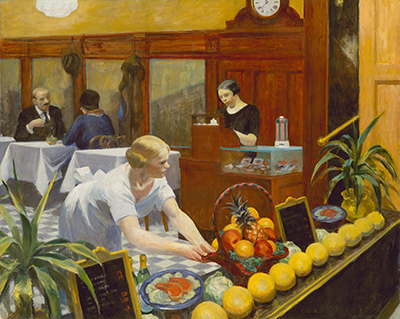
A waitress bends across a display of fruit and prepared dishes while a cashier attends to the register behind her. Farther back, two customers sit at a white-covered table. In Edward Hopper's Tables for Ladies, the restaurant is presented through the work that makes it attractive and usable. Food occupies the foreground, but the people arranging and selling it are just as important.
The painting dates from 1930 and belongs to the Metropolitan Museum of Art, which acquired it through the George A. Hearn Fund in 1931. It is a substantial oil on canvas, measuring 48¼ by 60⅜ inches. [1] Its scale gives an ordinary restaurant display the presence of a large interior scene, with the viewer placed unusually close to the goods at the front.
At a Glance
- ArtistEdward Hopper [1]
- Date1930 [1]
- Mediumoil on canvas [1]
- Collection / recordThe Metropolitan Museum of Art [1]
- Accession31.62 [1]
This work across Edward Hopper’s career
American Village
1912Soir Bleu
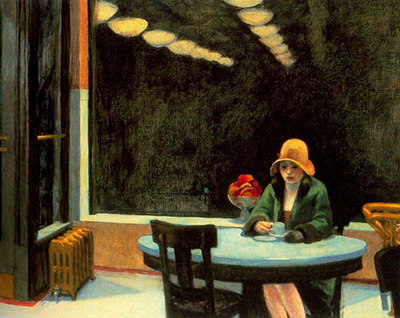
1914Automat
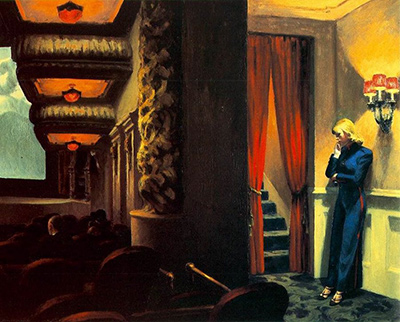
1927New York Movie
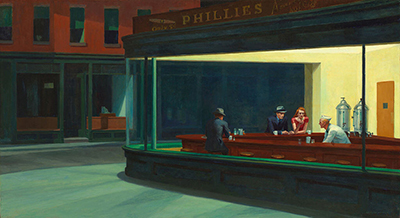
1939Nighthawks
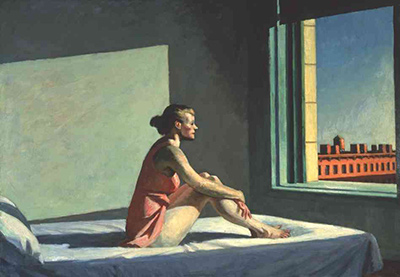
1942Morning Sun
1952Two Comedians
1966Contents
- Food in the foreground
- Grapefruit, raw chops and a commercial still life
- The waitress reaches towards the window
- A cashier behind another surface
- Two directions through the restaurant
- Customers farther inside
- What the title advertised
- Menu cards and the promise of a meal
- Warm wood and repeated rectangles
- The clock, the coats and different intervals
Food in the foreground
A row of round yellow fruit follows the lower edge of the display. The repeated forms establish a rhythm across the painting, interrupted by plates, baskets, cards and the waitress's extended arms. The arrangement is both an invitation to look and a barrier between us and the room beyond.
The fruit is not an undifferentiated heap. Individual shapes catch light, cast shadows and sit against darker leaves or containers. The basket near the centre gathers several colours and textures, including the spiky top of a pineapple. It supplies a more irregular counterpart to the orderly row below.
Prepared dishes introduce flatter shapes beside the rounded fruit. Their pale rims and coloured contents compete for attention, while small upright cards announce that this is a commercial display. The exact menu need not be legible for us to understand its purpose.
The abundance makes this picture a useful corrective to a familiar generalisation about Hopper's restaurants. Food is not always absent from his work. Here it is conspicuous, carefully presented and closely connected to the actions of the people who work in the establishment.
Grapefruit, raw chops and a commercial still life
The display contains food at different stages of use. Fruit can be arranged for inspection in its own skin, while the meat on a plate refers more directly to a meal yet to be prepared. A Metropolitan Museum label reproduced by the painting's later framers identifies grapefruit and two raw chops among the objects described in the Hoppers' record book. [2] The selection is more particular than a general symbol of plenty.
The yellow spheres along the edge are especially effective at giving the display depth. They overlap a dark foreground band, with their lighter upper surfaces set against the room beyond. Each one is simple, but their repetition produces a substantial line leading towards the right side of the painting.
The blue plate nearer the left introduces a flatter oval with a sharply different colour. Its rim separates the food from the darker supporting surface and gives a small object unusual clarity. Beside the fruit, it makes the display a sequence of different materials and possible purchases rather than a decorative garland.
The basket's handle supplies a larger arch above the fruit. Its curve rises into the space occupied by the waitress's arms, connecting the stacked produce with the body's movement. The pineapple's jagged leaves create another, less regular upward shape within that arrangement.
These objects invite attention as things that can be handled, sold and eaten. The blue plate's rim and the grapefruit's rounded surfaces give pictorial force to the restaurant's attempt to attract customers. The waitress works within an arrangement that is already attractive enough to draw our eye.
The waitress reaches towards the window
The waitress wears a pale uniform that catches the restaurant's strong light. Her bent body crosses several of the interior's straight lines, and her arms lead towards the near display. This is a working pose, dependent on a particular surface and task.
Her position also brings her closer to the spectator than the seated customers. We can inspect the angle of her head, the sleeves and the extended forearms in greater detail than the people at the back. The display does not conceal the labour required to maintain it.
The figure's reach is especially important. It connects a body within the room to objects arranged for people outside to see. Her hands occupy the point where a private task becomes part of a public presentation.
The Whitney's 2022 exhibition account reads this overlap between goods meant to be displayed and staff going about their work as a source of tension. The museum also notes how Hopper minimises material evidence of window glass, making the interior seem immediately accessible. [3] We appear able to look closely into a workplace without the usual obstruction of reflections or glare.
A cashier behind another surface
The cashier occupies a more upright position behind the register. Her darker clothing distinguishes her from the bright uniform in front. A light collar provides a small accent near the face, while the counter and register organise the space around her hands.
She is engaged with a different part of the restaurant's operation. The waitress tends the display; the cashier attends to the apparatus of payment. Their separation makes it possible to follow distinct tasks without turning them into a single anonymous idea of service.
The register has its own physical presence. It sits between the cashier and the public side of the room, making another boundary that a transaction could cross. The painting brings the preparation of an inviting display and the handling of money into the same view.
A downward look does not tell us whether either woman is tired, dissatisfied or content. Posture and equipment make their work legible, while giving little access to their thoughts.
Two directions through the restaurant
The line of fruit sweeps across the near display towards the right. The white-covered tables lead the eye in another direction, back towards the seated pair at the left. These movements cross around the bending waitress, giving her activity a central place between the goods and the dining room.
The effect differs from a view in which a single corridor or row of tables takes us directly to a principal figure. Here our attention can travel along the merchandise, turn towards the cashier or continue to the customers. The restaurant's connected functions remain visible through competing routes for the eye.
The waitress's extended forearms answer the display's oblique direction. The cashier's more compact upper body belongs to a firmer arrangement of upright counter, register and wall. Their tasks can consequently be followed through the shapes around them: one opens out across a surface, while the other is concentrated behind a station.
The two customers provide a third kind of grouping. The man's light face and shirt are set against his dark jacket, while his companion's back presents a broader blue shape. Their table is small compared with the near display, but the difference between a face turned towards us and a back turned away makes it easy to recognise an encounter between two people.
This distribution keeps the canvas from becoming simply a portrait of the waitress. She is its most exposed worker, yet the dining pair and cashier draw attention into distinct parts of the establishment. Hopper gives the business a legible arrangement without making any one task contain the whole scene.
Customers farther inside
At the back left, a man and woman sit across a table. Their scale and position differ from the working figures. They occupy the room as customers, with the whiteness of the tablecloth gathering attention around the space between them.
This creates a useful distinction between eating out and providing the conditions for eating out. The customers remain seated; the waitress leans and reaches; the cashier works behind a fixed counter. Different uses of the body make the restaurant's social structure visible.
The tablecloths also add a sequence of pale planes leading into the room. Their angled edges help locate the tables in depth and distinguish them from the warmer wall panelling. The back group does not float in an undefined brown interior.
Coats and wall fittings suggest ordinary use beyond the instant depicted. They belong to a place where people arrive, remove outer clothing, sit down and eventually leave. Hopper selects enough of that practical setting to make it recognisable without recording the entire establishment.
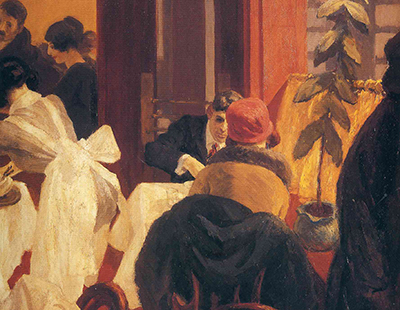
Compare: New York Restaurant, c. 1922.
What the title advertised
The phrase Tables for Ladies refers to a form of restaurant advertising that addressed women as prospective customers. The Whitney places its use within changing patterns of public dining in the 1920s, particularly the search for places where a woman could eat without a male companion or unwelcome assumptions about her presence. [3]
There is period evidence for the wording beyond Hopper's title. The Keene Memorial Library's catalogue describes a photograph of the Baltimore Hotel in Fremont, Nebraska, dated 1925, with a café sign advertising meals and tables for ladies. [4] That record documents the phrase's commercial use; it does not identify the restaurant in Hopper's painting.
The title therefore adds information that is not simply written across the painted scene. It encourages us to consider who is being welcomed into the establishment and under what social expectations. At the same time, the two most conspicuous women are employees rather than customers.
That distinction prevents an oversimplified account of progress. The painting brings women's presence in public life into view through several positions: working at a display, handling payments and sitting at a table. It does not tell us that restaurant employment began in 1930 or that every woman had previously faced the same restrictions everywhere.
Menu cards and the promise of a meal
The small dark cards rise from the food display like miniature signboards. Their pale lettering is enough to suggest information addressed to a prospective customer, even when the words cannot all be read. They belong to a different sort of communication from the downward looks of the working women.
A menu card can speak publicly on behalf of a restaurant. It offers a selection and helps turn food into something that can be ordered. In this painting, the cards make that invitation visible without requiring a waiter to face the spectator or deliver a sales pitch.
Their narrow upright shapes also connect the foreground with the larger panels behind. Each is an organised surface placed among more irregular objects: leaves, fruit, plates and the waitress's reaching hands. Written information is accommodated within a display whose attraction also depends on colour and bodily activity.
The cards are small beside the title's larger social promise. Tables for Ladies announces who may be welcomed, while the display indicates what the establishment provides. Those two kinds of invitation operate at different levels. The painted objects alone do not tell us every rule under which a customer would be received.
Nor does the scene show a woman dining by herself. The visible female customer sits with a man, while the two other women work. The title's relevance therefore reaches beyond a literal inventory of who is seated in the room. It asks us to consider the social use of a setting whose immediate business continues before our eyes.
Warm wood and repeated rectangles
The interior is organised through large areas of warm brown and yellow. Wall panels, the counter and the door behind the cashier establish upright divisions, while tables and display surfaces run across or into the room. Their combination makes the setting feel carefully fitted together.
The clock near the top and the partial light fitting add smaller objects above the figures. They prevent the upper area from becoming merely empty wall, while keeping the principal activity lower in the composition.
Plants create a different sort of line. Their leaves bend, overlap and project beyond the stable outlines of furniture and architecture. At the edges of the display, they soften the transition between objects offered for sale and the enclosing room.
The warmth of the setting does not produce an unambiguously festive scene. Strong illumination makes goods and tasks available for inspection, but the people remain occupied in separate activities. Attraction, work and individual attention coexist in the same room.
Watch: Edward Hopper’s Life and Art
Explore Hopper’s paintings and the places behind them in these museum films. Choose a film below.
The clock, the coats and different intervals
Above the panelling, the clock introduces a measure of time into the restaurant. Its circular face is far smaller than the tabletops and fruit display, yet its elevated position makes it a distinct mark on the wall. The painting does not need a securely readable minute for the object to identify a place where time can be checked.
The hanging coats and hats point towards arrivals that have already taken place. They remain on the wall while the customers sit, adding signs of occupation beyond the bodies at the table. At the front, by contrast, the waitress's reach appears to belong to a brief adjustment that will soon be complete.
These details give the restaurant several overlapping intervals. Customers can stay for a meal; staff can repeat tasks over a longer period; a passing spectator can stop at the window and move on. The canvas holds those possible durations together without narrating their beginnings or ends.
The distinction between dining and working becomes more concrete when considered in this way. Both take place within the same illumination and furnished room, but they organise the body's time differently. The seated pair can remain relatively still while service requires an arm to extend and a display to be maintained.
Looking beside Vermeer
In her 1970 Metropolitan Museum essay How to Look at Art, Jane Norman paired Tables for Ladies with Vermeer's Young Woman with a Water Jug. She directed attention to the way both artists organise an interior through geometric forms, objects and figure gestures. [5] The comparison offers an alternative to beginning every discussion of Hopper with a proposed mood.
In Hopper's painting, the wall panels, tablecloths, counter and upright cards provide repeated rectangles. The waitress's reach crosses those divisions while helping us understand their spatial relationships. A body in motion makes the surrounding structure more legible.
Vermeer's figure similarly belongs to an arrangement of table, window and wall. The domestic activity differs from the restaurant work, but both pictures ask us to consider how a person occupies a room through contact with ordinary things.
Norman's comparison need not become a claim that Hopper copied Vermeer. Its value is a way of looking: follow the corners and edges, then notice how a gesture connects them. In Tables for Ladies, that approach reveals how much organisation lies beneath the inviting abundance of the display.
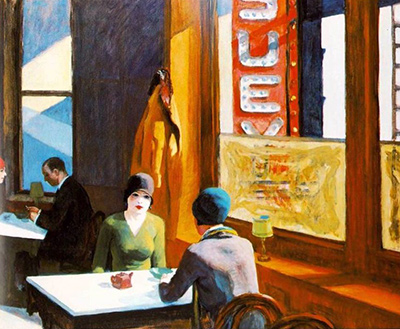
Compare: Chop Suey, 1929.
A window gesture beside a water pitcher
Norman's paired illustrations allow a more exact comparison with Vermeer than the broad claim that both artists painted quiet interiors. In Vermeer's picture, one of the woman's hands reaches towards the open window while the other rests on the pitcher. The body spans two points of contact, with table and window supporting the arrangement on either side.
Hopper's waitress also extends her arms across the objects nearest the window. Her bend is more pronounced, and the hands are directed towards the commercial display. Both figures make their interiors intelligible through contact with things, but the actions belong to different settings and face different kinds of audience.
The Metropolitan Museum now titles Vermeer's painting Young Woman with a Water Pitcher, dating it to about 1662. Its account describes preparations for washing, with linen protecting the woman's hair and dress. [6] Hopper's white uniform serves a public workplace rather than that moment of private preparation.
The framing also changes the comparison. Vermeer shows the window as part of the room's equipment; we see its leaded structure beside the woman. In Hopper, the display occupies the near boundary and we look towards the workers from its public side. A similar attention to an arm's reach has been given a different relationship to the person watching.
Scale reinforces the difference. Vermeer's canvas measures 45.7 × 40.6 cm, whereas Hopper's is more than a metre high and a metre and a half wide. [6] The restaurant's ordinary actions become a large encounter for a standing spectator. The comparison joins the pictures through their construction while preserving the substantial differences in activity, viewing position and physical presence.
Jo's poses and an imagined waitress
The Whitney records that Jo Hopper posed for the painting's female figures. Its account also cites her ledger description giving the waitress an imagined identity, Olga. [3] That name belongs to the Hoppers' character-making process, rather than establishing the identity of a waitress who worked in a securely located restaurant.
Knowing this helps separate three kinds of person: the artist who modelled, the figures given roles within the painting and any real workers Hopper may have observed. The finished canvas combines those possibilities without functioning as a staff photograph.
It also makes the visible differences between the women more interesting. One model could contribute to a bending worker, an upright cashier and a seated customer. Their distinctions emerge through posture, clothing, scale and placement as much as through faces.
A later frame around the restaurant
The object encountered in a museum includes a frame as well as the painted view. Gill & Lagodich record reframing Tables for Ladies for the Metropolitan Museum in 2022. They describe a replica based on the custom model they developed for Nighthawks, with a broad ogee profile, combed gesso, metal-leaf gilding and a coloured patina. [2]
Their published close photograph shows the fine repeated ridges of the frame beside the painted diners and wall panels. The surface has a rhythm of its own, distinct from the canvas's softer modelling and the restaurant woodwork's harder divisions. It makes the painting's edge an active part of the object we stand before.
This is a modern presentation decision. The relationship to the framers' Nighthawks model does not mean Hopper originally chose matching frames for the two paintings or intended them as a pair. It records the subsequent work through which an older canvas is prepared for display.
That distinction is useful when comparing the apparent immediacy of the restaurant with the experience of seeing it in a gallery. The painted window seems to remove a barrier between us and the staff. The physical frame establishes a different boundary, separating the picture from the wall around it and making its size easier to judge.
The 1931 acquisition and the later reframing belong to different stages of the work's public life. One records its early place in the Metropolitan's collection; the other concerns how that collection presents it. Neither changes the waitress's reaching gesture, but both shape the circumstances in which a museum visitor encounters it.
A restaurant seen through its work
In Automat, a single customer sits with a cup at a largely clear table, while the machinery and workers remain outside the view. Tables for Ladies brings service back into the foreground. Its abundance is something people arrange and maintain.
Chop Suey places customers beside a window dominated by exterior signage and daylight. Here the most immediate invitation to a passerby is the display itself. Food and the worker adjusting it share the same exposed edge.
The early acquisition by the Metropolitan Museum placed this 1930 canvas in a public collection the following year. [1] The picture remains distinctive within Hopper's restaurant subjects because it gives such force to visible work. The fruit attracts our eye, the waitress reaches across it, and the cashier attends to a different task behind her. A public invitation to dine becomes an image of the people and arrangements that make hospitality possible.
Artworks and studies directory
This researched directory includes finished works and separately identified studies. It is not a complete catalogue raisonné. Linked titles open the articles; unlinked studies are identified by their collection accessions. Watercolours retain their recorded media, and original prints remain distinct from reproductions.
| Name | Date | Medium |
|---|---|---|
| (Bridge and Embankment) (70.1298) | 1906 | Oil on wood |
| (Jo Sketching at Good Harbor Beach) (70.1129) | 1923–1924 | Watercolor and fabricated chalk on paper |
| (Manhattan Bridge) (70.1098) | 1925–1926 | Watercolor and graphite pencil on paper |
| (Rooftops) (70.1114) | 1926 | Watercolor and graphite pencil on paper |
| (Seated Male Model, Bent Over) (70.1277) | c. 1902–1903 | Oil on canvas |
| (Self-Portrait) (70.1254) | 1903–1906 | Oil on canvas |
| (Solitary Figure in a Theater) (70.1418) | c. 1902–1904 | Oil on board |
| 5 A.M. | 1937 | oil on canvas |
| Adam's House | 1928 | watercolour and charcoal on paper |
| American Village | 1912 | Oil on canvas |
| Apartment Houses | 1923 | oil on canvas |
| Approaching a City | 1946 | oil on canvas |
| August in the City | 1945 | oil on canvas |
| Automat | 1927 | oil on canvas |
| Barber Shop | 1931 | oil on canvas |
| Blackwell's Island | 1928 | oil on canvas |
| Bridge on the Seine | 1909 | Oil on canvas |
| Bridle Path | 1939 | oil on canvas |
| Burly Cobb's House South Truro | 1930–1933 | oil on canvas |
| Cape Cod Evening | 1939 | oil on canvas |
| Cape Cod Morning | 1950 | oil on canvas |
| Chair Car | 1965 | oil on canvas |
| Chop Suey | 1929 | oil on canvas |
| City Roofs | 1932 | Oil on canvas |
| Coast Guard Station | 1929 | oil on canvas |
| Compartment C, Car 293 | 1938 | oil on canvas |
| Conference at Night | 1949 | oil on canvas |
| Corn Hill | 1930 | oil on canvas |
| Dawn in Pennsylvania | 1942 | oil on canvas |
| Drug Store | 1927 | oil on canvas |
| Early Sunday Morning | 1930 | Oil on canvas |
| East Side Interior (70.1020) | 1922 | Etching |
| East Wind Over Weehawken | 1934 | oil on canvas |
| El Palacio | 1946 | Watercolor and graphite pencil on paper |
| Eleven A.M. | 1926 | oil on canvas |
| Evening Wind | 1921 | etching |
| Excursion into Philosophy | 1959 | oil on canvas |
| First Row Orchestra | 1951 | oil on canvas |
| Freight Car at Truro | 1931 | watercolour over graphite on paper |
| Gas | 1940 | oil on canvas |
| Girl at a Sewing Machine | c. 1921 | oil on canvas |
| Gloucester Harbor | 1912 | Oil on canvas |
| Ground Swell | 1939 | oil on canvas |
| Haskell's House | 1924 | watercolour over graphite on paperboard |
| High Noon | 1949 | oil on canvas |
| Hill and Houses Cape Elizabeth Maine | 1927 | watercolour over graphite pencil |
| Hills South Truro | 1930 | oil on canvas |
| Hotel by a Railroad | 1952 | oil on canvas |
| Hotel Lobby | 1943 | oil on canvas |
| Hotel Room | 1931 | oil on canvas |
| Hotel Window | 1955 | oil on canvas |
| House by the Railroad | 1925 | oil on canvas |
| House by the Squam River | 1926 | watercolour over graphite on paper |
| Le Bistro or The Wine Shop | 1909 | Oil on canvas |
| Le Pont des Arts | 1907 | Oil on canvas |
| Le Pont Royal | 1909 | Oil on canvas |
| Le Quai des Grands Augustins | 1909 | Oil on canvas |
| Lighthouse and Buildings Portland Head | 1927 | watercolour over graphite pencil on paper |
| Lighthouse Hill | 1927 | oil painting |
| Manhattan Bridge Loop | 1928 | oil on canvas |
| Model Sitting | c. 1902 | oil painting; support not asserted |
| Morning Sun | 1952 | oil on canvas |
| New York Movie | 1939 | oil on canvas |
| New York New Haven and Hartford | 1931 | oil on canvas |
| New York Office | 1962 | oil on canvas |
| New York Pavements | 1924–1925 | oil on canvas |
| New York Restaurant | c. 1922 | oil on canvas |
| Night Windows | 1928 | oil on canvas |
| Nighthawks | 1942 | oil on canvas |
| October on Cape Cod | 1946 | oil on canvas |
| Office at Night | 1940 | oil on canvas |
| Office in a Small City | 1953 | oil on canvas |
| Pennsylvania Coal Town | 1947 | oil on canvas |
| People in the Sun | 1960 | oil on canvas |
| Portrait of Orleans | 1950 | oil on canvas |
| Queensborough Bridge | 1913 | Oil on canvas |
| Railroad Sunset | 1929 | Oil on canvas |
| Railroad Train | 1908 | oil on canvas |
| Road in Maine | 1914 | oil on canvas |
| Room in Brooklyn | 1932 | oil on canvas |
| Room in New York | 1932 | oil on canvas |
| Rooms by the Sea | 1951 | oil on canvas |
| Rooms for Tourists | 1945 | oil on canvas |
| Route 6 Eastham | 1941 | oil on canvas |
| Second Story Sunlight | 1960 | Oil on canvas |
| Self-Portrait | 1925–1930 | Oil on canvas |
| Self-Portrait with Hat (70.1903) | c. 1918, posthumous print | Drypoint |
| Seven A.M. | 1948 | Oil on canvas |
| Soir Bleu | 1914 | oil on canvas |
| South Carolina Morning | 1955 | Oil on canvas |
| Stairway at 48 Rue de Lille Paris | 1906 | Oil on wood |
| Study for 5 A.M. (70.153) | 1937 | Fabricated chalk on paper |
| Study for 5 A.M. (70.429) | 1937 | Fabricated chalk and graphite pencil on paper |
| Study for Approaching a City (70.869) | 1946 | Fabricated chalk and charcoal on paper |
| Study for August in the City (70.158a-b) | 1945 | Fabricated chalk on paper |
| Study for August in the City (70.159) | 1945 | Fabricated chalk on paper |
| Study for Bridle Path (70.220) | 1939 | Fabricated chalk on paper |
| Study for Bridle Path (70.235) | 1939 | Fabricated chalk on paper |
| Study for Compartment C, Car 293 (70.430) | 1938 | Fabricated chalk on paper |
| Study for Compartment C, Car 293 (70.431a-b) | 1938 | Fabricated chalk and charcoal on paper |
| Study for Conference at Night (70.170) | 1949 | Fabricated chalk on paper (recto); Typewriter ink on paper (verso) |
| Study for Conference at Night (70.174) | 1949 | Fabricated chalk on paper ( recto); Typewriter ink on paper (verso) |
| Study for East Wind over Weehawken (70.249) | 1934 | Graphite pencil on paper |
| Study for East Wind over Weehawken (70.252) | 1934 | Fabricated chalk and charcoal on paper |
| Study for Evening Wind (70.343a-b) | 1921 | Fabricated chalk on paper |
| Study for First Row Orchestra (70.841) | 1951 | Fabricated chalk and charcoal on paper |
| Study for Gas (70.263) | 1940 | Fabricated chalk on paper |
| Study for Ground Swell (70.339) | 1939 | Fabricated chalk, charcoal and graphite pencil on paper |
| Study for Hotel by a Railroad (70.199) | 1952 | Fabricated chalk on paper |
| Study for Hotel by a Railroad (70.427) | 1952 | Fabricated chalk on paper |
| Study for Hotel by a Railroad (70.428) | 1952 | Fabricated chalk on paper |
| Study for Hotel Lobby (70.117) | 1942 | Fabricated chalk and graphite pencil on paper |
| Study for Hotel Lobby (70.839) | 1942 | Fabricated chalk and charcoal on paper |
| Study for Hotel Window (70.161) | 1955 | Fabricated chalk, graphite pencil and colored pencil on paper |
| Study for Morning Sun (70.243) | 1952 | Fabricated chalk on paper |
| Study for Morning Sun (70.244) | 1952 | Fabricated chalk on paper |
| Study for Morning Sun (70.290) | 1952 | Fabricated chalk on paper |
| Study for Morning Sun (70.291) | 1952 | Fabricated chalk and graphite pencil on paper |
| Study for New York Movie (70.273) | 1939 | Fabricated chalk on paper |
| Study for New York Movie (70.274a-b) | 1938 or 1939 | Fabricated chalk and charcoal on paper (recto); Fabricated chalk on paper (verso) |
| Study for New York Movie (70.455) | 1939 | Fabricated chalk and charcoal on paper |
| Study for New York Office (70.822) | 1962 | Fabricated chalk on paper |
| Study for Nighthawks (70.192) | 1941 or 1942 | Fabricated chalk on paper |
| Study for Nighthawks (70.193) | 1941 or 1942 | Fabricated chalk on paper |
| Study for Office at Night (70.340) | 1940 | Fabricated chalk and charcoal on paper |
| Study for Office at Night (70.341) | 1940 | Fabricated chalk and graphite pencil on paper |
| Study for Pennsylvania Coal Town (70.198) | 1947 | Fabricated chalk on paper |
| Study for Pennsylvania Coal Town (70.229) | 1947 | Fabricated chalk and charcoal on paper |
| Study for Rooms for Tourists (70.438) | 1945 | Fabricated chalk and charcoal on paper |
| Study for Rooms for Tourists (70.848) | 1945 | Fabricated chalk and charcoal on paper |
| Study for Route 6, Eastham (70.369) | 1941 | Fabricated chalk and graphite pencil on paper |
| Study for Route 6, Eastham (70.854) | 1941 | Fabricated chalk and graphite pencil on paper |
| Study for South Carolina Morning (70.162a-b) | 1955 | Fabricated chalk on paper (recto and verso) |
| Study for The Sheridan Theatre (70.969) | 1937 | Graphite pencil on paper |
| Study for Two on the Aisle (70.128) | 1927 | Fabricated chalk on paper |
| Study for Two on the Aisle (70.129) | 1927 | Fabricated chalk on paper |
| Study for Yawl Riding a Swell (70.439) | 1935 | Fabricated chalk and graphite pencil on paper |
| Summer Evening | 1947 | oil on canvas |
| Summer Interior | 1909 | Oil on canvas |
| Sun in an Empty Room | 1963 | oil on canvas |
| Sunlight in a Cafeteria | 1958 | oil on canvas |
| Sunlight on Brownstones | 1956 | oil on canvas |
| Tables for Ladies | 1930 | oil on canvas |
| The Bootleggers | 1925 | oil on canvas |
| The Camel's Hump | 1931 | oil on canvas |
| The Circle Theatre | 1936 | oil on canvas |
| The City | 1927 | oil on canvas |
| The Lighthouse at Two Lights | 1929 | oil on canvas |
| The Long Leg | 1935 | oil on canvas |
| The Mansard Roof | 1923 | watercolour over graphite on paper |
| The Sheridan Theatre | 1937 | oil on canvas |
| Tramp Steamer | 1908 | oil on canvas |
| Two Comedians | 1966 | oil on canvas |
| Two on the Aisle | 1927 | oil on canvas |
| Valley of the Seine | 1909 | Oil on canvas |
| Western Motel | 1957 | oil on canvas |
Frequently Asked Questions
Edward Hopper made Tables for Ladies in 1930. [1]
The recorded medium is oil on canvas. [1]
A waitress bends across a display of fruit and prepared dishes while a cashier attends to the register behind her. Farther back, two customers sit at a white-covered table. In Edward Hopper's Tables for Ladies, the restaurant is presented through the work that makes it attractive and usable. Food occupies the foreground, but the people arranging and selling it are just as important.
Discussion
Look again at the images and ideas explored in Tables for Ladies. These editorial prompts invite your observations.
Reader Insights
Which boundary, gesture or change of light first holds your attention in Tables for Ladies?
Compare New York Restaurant with Tables for Ladies. Which visual difference matters most to your reading?
Which detail would you look at again after reading “A cashier behind another surface”?
Join the Conversation
Share a detail, comparison or question about Tables for Ladies below.
References
- The Metropolitan Museum of Art, Tables for Ladies, 1930, accession 31.62, current English object metadata and acquisition credit. View source.
- Gill & Lagodich Gallery, Edward Hopper: notable framing projects, Tables for Ladies subsection: first-hand account of the 2022 frame and published detail photographs; also reproduces Metropolitan Museum label text transmitting the Hoppers’ record-book description. The record-book details are transmitted through the reproduced museum label. View source.
- Whitney Museum of American Art, Edward Hopper's New York exhibition labels, 2022, PDF page 22, Tables for Ladies: workers, window, title and Jo's modelling and ledger description. View source.
- Keene Memorial Library, Nebraska Memories, Baltimore Hotel, 1925, catalogue description of a photograph by L. B. Skoglund, Dodge County Historical Society, Skoglund Glass Plate Negative Collection 95058. View source.
- Jane Norman, How to Look at Art, in The Metropolitan Museum of Art Bulletin, volume 28, number 5, January 1970; paired Vermeer and Hopper discussion on PDF page 13 of the publisher's downloadable issue. View source.
- The Metropolitan Museum of Art, Johannes Vermeer, Young Woman with a Water Pitcher, about 1662, accession 89.15.21; current title, dimensions and account of the action. Full paired reproductions also appear in Norman’s 1970 essay cited above. View source.
- Collection or catalogue record, American Village, 1912; medium and identity as discussed in the linked article. View source.
- Collection or catalogue record, Soir Bleu, 1914; medium and identity as discussed in the linked article. View source.
- Collection or catalogue record, House by the Railroad, 1925; medium and identity as discussed in the linked article. View source.
- Collection or catalogue record, Automat, 1927; medium and identity as discussed in the linked article. View source.
- Collection or catalogue record, Early Sunday Morning, 1930; medium and identity as discussed in the linked article. View source.
- Collection or catalogue record, New York Movie, 1939; medium and identity as discussed in the linked article. View source.
- Collection or catalogue record, Nighthawks, 1942; medium and identity as discussed in the linked article. View source.
- Collection or catalogue record, Morning Sun, 1952; medium and identity as discussed in the linked article. View source.
- Collection or catalogue record, Second Story Sunlight, 1960; medium and identity as discussed in the linked article. View source.
- Collection or catalogue record, Two Comedians, 1966; medium and identity as discussed in the linked article. View source.
- Whitney Museum of American Art, Study for Route 6, Eastham, 1941, accession 70.854; exact object record. View source.
- Whitney Museum of American Art, Study for Conference at Night, 1949, accession 70.170; exact object record. View source.
- Whitney Museum of American Art, Study for First Row Orchestra, 1951, accession 70.841; exact object record. View source.
- Whitney Museum of American Art, (Bridge and Embankment), 1906, accession 70.1298; exact object record. View source.
- Whitney Museum of American Art, (Seated Male Model, Bent Over), c. 1902–1903, accession 70.1277; exact object record. View source.
- Whitney Museum of American Art, Study for Morning Sun, 1952, accession 70.244; exact object record. View source.
- Whitney Museum of American Art, Study for Morning Sun, 1952, accession 70.243; exact object record. View source.
- Whitney Museum of American Art, Study for Two on the Aisle, 1927, accession 70.128; exact object record. View source.
- Whitney Museum of American Art, Study for New York Office, 1962, accession 70.822; exact object record. View source.
- Whitney Museum of American Art, Study for Two on the Aisle, 1927, accession 70.129; exact object record. View source.
- Whitney Museum of American Art, Study for Pennsylvania Coal Town, 1947, accession 70.229; exact object record. View source.
- Whitney Museum of American Art, (Rooftops), 1926, accession 70.1114; exact object record. View source.
- Whitney Museum of American Art, Study for South Carolina Morning, 1955, accession 70.162a-b; exact object record. View source.
- Whitney Museum of American Art, (Self-Portrait), 1903–1906, accession 70.1254; exact object record. View source.
- Whitney Museum of American Art, (Manhattan Bridge), 1925–1926, accession 70.1098; exact object record. View source.
- Whitney Museum of American Art, (Solitary Figure in a Theater), c. 1902–1904, accession 70.1418; exact object record. View source.
- Whitney Museum of American Art, Study for Approaching a City, 1946, accession 70.869; exact object record. View source.
- Whitney Museum of American Art, Study for August in the City, 1945, accession 70.159; exact object record. View source.
- Whitney Museum of American Art, Study for Compartment C, Car 293, 1938, accession 70.430; exact object record. View source.
- Whitney Museum of American Art, Study for Compartment C, Car 293, 1938, accession 70.431a-b; exact object record. View source.
- Whitney Museum of American Art, Study for East Wind over Weehawken, 1934, accession 70.252; exact object record. View source.
- Whitney Museum of American Art, Study for East Wind over Weehawken, 1934, accession 70.249; exact object record. View source.
- Whitney Museum of American Art, Study for Evening Wind, 1921, accession 70.343a-b; exact object record. View source.
- Whitney Museum of American Art, Study for The Sheridan Theatre, 1937, accession 70.969; exact object record. View source.
- Whitney Museum of American Art, Study for New York Movie, 1939, accession 70.455; exact object record. View source.
- Whitney Museum of American Art, Study for New York Movie, 1939, accession 70.273; exact object record. View source.
- Whitney Museum of American Art, Study for New York Movie, 1938 or 1939, accession 70.274a-b; exact object record. View source.
- Whitney Museum of American Art, Study for 5 A.M., 1937, accession 70.153; exact object record. View source.
- Whitney Museum of American Art, Study for 5 A.M., 1937, accession 70.429; exact object record. View source.
- Whitney Museum of American Art, (Jo Sketching at Good Harbor Beach), 1923–1924, accession 70.1129; exact object record. View source.
- Whitney Museum of American Art, Study for August in the City, 1945, accession 70.158a-b; exact object record. View source.
- Whitney Museum of American Art, Study for Morning Sun, 1952, accession 70.291; exact object record. View source.
- Whitney Museum of American Art, Study for Morning Sun, 1952, accession 70.290; exact object record. View source.
- Whitney Museum of American Art, Study for Office at Night, 1940, accession 70.340; exact object record. View source.
- Whitney Museum of American Art, Study for Office at Night, 1940, accession 70.341; exact object record. View source.
- Whitney Museum of American Art, Study for Hotel by a Railroad, 1952, accession 70.427; exact object record. View source.
- Whitney Museum of American Art, Study for Hotel by a Railroad, 1952, accession 70.199; exact object record. View source.
- Whitney Museum of American Art, Study for Hotel by a Railroad, 1952, accession 70.428; exact object record. View source.
- Whitney Museum of American Art, Study for Hotel Lobby, 1942, accession 70.117; exact object record. View source.
- Whitney Museum of American Art, Study for Hotel Lobby, 1942, accession 70.839; exact object record. View source.
- Whitney Museum of American Art, Study for Conference at Night, 1949, accession 70.174; exact object record. View source.
- Whitney Museum of American Art, Study for Hotel Window, 1955, accession 70.161; exact object record. View source.
- Whitney Museum of American Art, Study for Pennsylvania Coal Town, 1947, accession 70.198; exact object record. View source.
- Whitney Museum of American Art, Study for Route 6, Eastham, 1941, accession 70.369; exact object record. View source.
- Whitney Museum of American Art, Study for Bridle Path, 1939, accession 70.220; exact object record. View source.
- Whitney Museum of American Art, Study for Bridle Path, 1939, accession 70.235; exact object record. View source.
- Whitney Museum of American Art, Study for Ground Swell, 1939, accession 70.339; exact object record. View source.
- Whitney Museum of American Art, Study for Yawl Riding a Swell, 1935, accession 70.439; exact object record. View source.
- Whitney Museum of American Art, Study for Rooms for Tourists, 1945, accession 70.848; exact object record. View source.
- Whitney Museum of American Art, Study for Rooms for Tourists, 1945, accession 70.438; exact object record. View source.
- Whitney Museum of American Art, Study for Nighthawks, 1941 or 1942, accession 70.193; exact object record. View source.
- Whitney Museum of American Art, Study for Nighthawks, 1941 or 1942, accession 70.192; exact object record. View source.
- Whitney Museum of American Art, Study for Gas, 1940, accession 70.263; exact object record. View source.
- Whitney Museum of American Art, Self-Portrait with Hat, c. 1918, posthumous print, accession 70.1903; exact object record. View source.
- Whitney Museum of American Art, East Side Interior, 1922, accession 70.1020; exact object record. View source.
- Art Institute of Chicago, Selected Chronology for Edward Hopper; training, travels, exhibitions, New York and Truro chronology. View source.
- Emily C. Burns, Spectral figures: Edward Hopper’s empty Paris, chapter 5 in Empty Spaces: Confronting Emptiness in National, Cultural and Urban Histories, 2019; complete chapter and notes consulted. View source.
- Charles Brock, Regionalism and Folk Art, National Gallery of Art; complete essay and two notes consulted. View source.