 by Tom Gurney
Tom Gurney BSc (Hons) is an art history expert with over 20 years experience
Email: tomgurney1@gmail.com / Phone: +44 7429 011000
New York Office: Introduction
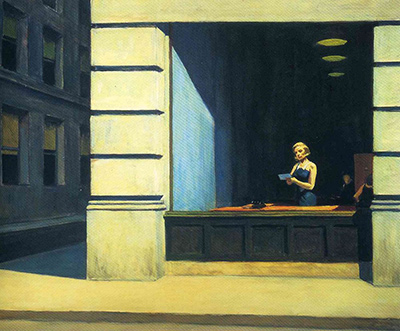
A woman holds a paper behind the long work surface of a brightly framed office window. Her face and arms emerge from a dark interior, while another colleague remains much less conspicuous at the right. Outside, pale masonry and an empty pavement make the building's frontage almost as prominent as the people within it. Edward Hopper's New York Office turns an ordinary view from the street into a sustained act of looking.
The Montgomery Museum of Fine Arts records the painting as an oil on canvas of 1962, measuring 40½ × 55⅛ inches, accession 1989.0002.0024, in The Blount Collection. [1] The title identifies a city and a workplace, while the image withholds the firm's name, the content of the paper and the nature of the business being conducted.
At a Glance
- ArtistEdward Hopper [1]
- Date1962 [1]
- Mediumoil on canvas [1]
- Collection / recordMontgomery Museum of Fine Arts [1]
- Accession1989.0002.0024 [1]
This work across Edward Hopper’s career
American Village
1912Soir Bleu
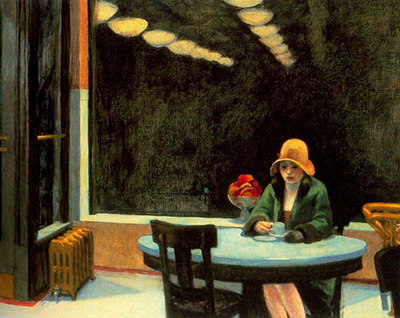
1914Automat
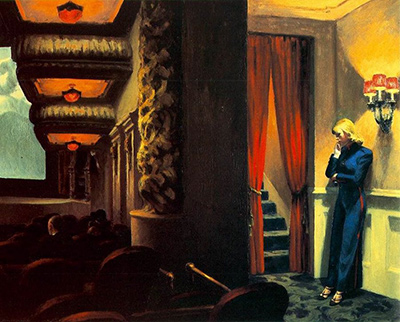
1927New York Movie
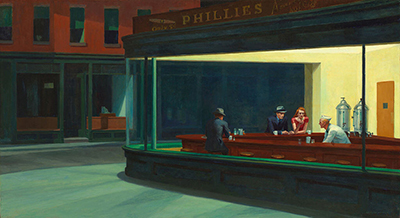
1939Nighthawks
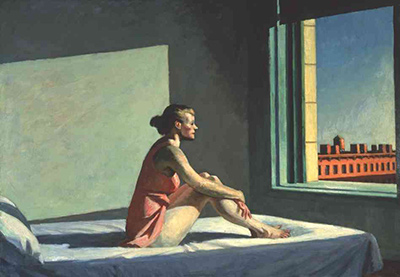
1942Morning Sun
1952Two Comedians
1966Contents
- A large window at street level
- Pale stone and a dark interior
- The woman with the paper
- Two kinds of window
- Considering the frontage in drawing
- A late return to office work
- Privacy at a public frontage
- Looking back at earlier windows
A large window at street level
The central opening gives us an unusually broad view into the office. Its lower edge lies above the pavement, and substantial pale supports frame it on either side. The frontage creates a boundary that is visually open but physically separate from the spectator's position.
The woman stands some distance behind that boundary. She is available to sight without appearing to acknowledge anyone looking in. We can follow the paper and the turn of her head, yet no exchange connects her with the street.
The museum's account places the viewer outside and across from the office, relating that position to Hopper's habit of observing the city during walks and journeys on public transport. [1] The painting makes us occupy the conditions of such looking while allowing much more time than a passing glance.
The empty stretch of pavement is important to this relationship. It keeps the figures from sharing our immediate space. We see the place where someone might walk past, but the foreground contains no passer-by who would establish an encounter at the glass.
Pale stone and a dark interior
The façade's horizontal joints break the pale masonry into large courses. Their darker edges give the wall a measured rhythm, and the strong changes of light reveal the depth around the opening. The building is solid enough to remain a subject even as the window exposes what lies behind it.
A cool blue area cuts diagonally along the left side of the interior. Its angle differs from the façade's regular horizontal and vertical lines. It helps move the eye from the bright external frame towards the darker office and the standing figure.
The long worktop supplies a warmer band below her. Its orange-brown surface separates the occupied interior from the darker panels at the bottom of the window. The woman rises above that band, with the paper held close to her body.
Farther back, a row of oval ceiling lights recedes into darkness. These small repeated shapes provide a different measure of depth from the much larger stone courses outside. The room continues beyond the area receiving the strongest attention.
The effects do not depend on filling the office with objects. A few large shapes establish a frontage, an interior, a working surface and a person. Smaller lights and fragments of furniture then make the space feel used.
The woman with the paper
The woman's pale arms stand out against her darker dress. Her head turns away from a completely frontal position, while the paper creates a light shape between the hands. The pose brings looking and holding into a compact arrangement near the window's centre.
The paper suggests office activity without identifying a specific event. It may be tempting to imagine a message that has surprised or troubled her, but the painted surface offers no readable words. The object's practical role is clearer than its content.
The figure also differs from a formal portrait. The building's large frontage gives her only a small part of the canvas, and no name connects her with a known employee. Her presence belongs to this arrangement of work, light and architecture.
The quieter figure at the right complicates the impression of complete solitude. The main woman is visually isolated by illumination and space, but she is not simply the only person in an empty office. Hopper allows unequal visibility to shape how quickly we notice different occupants.
A person can seem withdrawn or separate within a shared workplace. The painting does not need to remove every colleague in order to make the central figure's situation feel detached from the spectator.
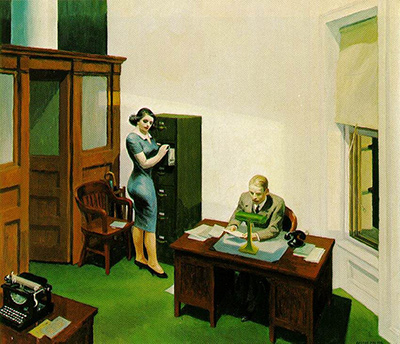
Compare: Office at Night, 1940.
Two kinds of window
At the left, the neighbouring building presents smaller, repeated openings within a much darker façade. These windows contrast with the office's large, illuminated frontage. We can see a particular person in one opening while the others remain comparatively anonymous.
The difference gives the city a varied pattern of exposure. One broad window appears to offer access to a working interior; rows of smaller windows suggest other rooms whose activities are withheld. Hopper makes visibility uneven across adjoining architecture.
The narrow side street or gap between buildings adds another recession. It carries the eye away from the main frontage without becoming a busy urban scene of its own. The absence of crowds or traffic leaves the architectural contrast unusually clear.
Gail Levin discusses this juxtaposition of the large office opening and the anonymous window rows in her study of office imagery. [2] Her interpretation connects the composition with the impersonality of the workplace. The contrast of scale and visibility provides the painting's concrete basis for that reading.
Considering the frontage in drawing
The Whitney Museum's Study for New York Office, accession 70.822, dates to 1962. It is a fabricated-chalk drawing on an irregular sheet of paper. [3] Its arrangement already includes the large opening, the pale supports, the woman near the desk and the darker building at the left.
The sheet makes the building's outline an active concern. Repeated lines test the window frame and the horizontal bands of the façade. The work surface and the figures are placed within that broader construction rather than developed independently of it.
The standing woman's position is legible without the finished canvas's sharp colour differences. A smaller outlined presence at the right also forms part of the developing office. Both figures belong to a frontage whose architecture receives more of the sheet than either body.
The final painting gives the architecture a firmer surface. Pale masonry, warm worktop, cool angled plane and dark interior become distinct areas of colour. What remains loose and searching on paper becomes a more decisive distribution of light across the frontage.
The comparison also clarifies the spectator's distance. Even in the drawing, the office is conceived through its exterior opening and the strip of ground below. The viewpoint from outside is built into the subject's development.
Watch: Edward Hopper’s Life and Art
Explore Hopper’s paintings and the places behind them in these museum films. Choose a film below.
A late return to office work
Hopper had painted offices well before 1962. The setting offered desks, papers, lamps, partitions and windows through which bodies could be placed in relation to work and to the city. New York Office returns to those possibilities through a particularly large street-facing opening.
The Montgomery museum's essay stresses this continuity between a late painting and interests present much earlier in his career. [1] The work's date does not make the office a newly discovered subject. It gives a familiar kind of place another arrangement.
Its scale of visibility is distinctive. The architecture offers the woman to a spectator across the street, while the depth and darkness of the room prevent an equally clear account of everyone and everything inside. The picture's openness therefore has limits that are visible within the composition itself.
The paper, worktop and window make a recognisable workplace without identifying its business. The title supplies New York, while the painted frontage gives it a particular appearance.
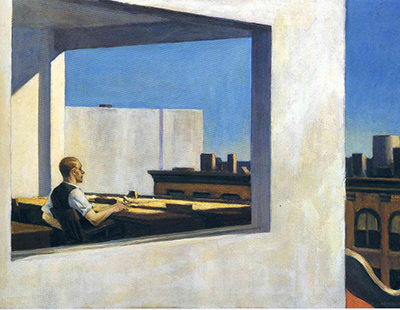
Compare: Office in a Small City, 1953.
Privacy at a public frontage
The museum's interpretation considers the intrusion involved in looking at people who do not appear aware of the spectator. [1] That question arises directly from the painting's viewpoint. The street is publicly accessible, while the activity behind the glass belongs to a workplace occupied by others.
The image lets us look without giving the woman a reciprocal response. Her attention may be elsewhere, but we cannot establish her thoughts. The distance between visible posture and private experience becomes part of what the window exposes.
Levin's essay offers a more explicitly gendered interpretation of the figure and her co-workers. [2] Such criticism demonstrates how social assumptions enter the view. The dress, paper and outward turn can provoke a narrative, although they do not establish a sexual role or a particular relationship among the staff.
The painting remains compelling because its visual access is so generous and its practical information so limited. We can spend time with the figure and the façade without becoming acquainted with the person at work.
Looking back at earlier windows
In Office at Night, a man and woman occupy a more densely furnished room seen from an elevated angle. The spectator looks down into their working environment. Here the pavement and façade make the position in the street more immediate.
Office in a Small City places one seated worker within a large architectural opening above neighbouring roofs. Its white wall dominates the foreground in a different way, emphasising the man's small scale within the structure.
Night Windows exposes only a fragment of a private interior. New York Office offers a broader working space, but the visible window still cannot disclose everything about the people it reveals.
Return to the dark window rows at the left, then to the woman's paper and the warm worktop. The city gives some rooms a clear frontage and leaves others obscure. Hopper makes one such difference an occasion for looking closely at how much a window can show.
Artworks and studies directory
This researched directory includes finished works and separately identified studies. It is not a complete catalogue raisonné. Linked titles open the articles; unlinked studies are identified by their collection accessions. Watercolours retain their recorded media, and original prints remain distinct from reproductions.
| Name | Date | Medium |
|---|---|---|
| (Bridge and Embankment) (70.1298) | 1906 | Oil on wood |
| (Jo Sketching at Good Harbor Beach) (70.1129) | 1923–1924 | Watercolor and fabricated chalk on paper |
| (Manhattan Bridge) (70.1098) | 1925–1926 | Watercolor and graphite pencil on paper |
| (Rooftops) (70.1114) | 1926 | Watercolor and graphite pencil on paper |
| (Seated Male Model, Bent Over) (70.1277) | c. 1902–1903 | Oil on canvas |
| (Self-Portrait) (70.1254) | 1903–1906 | Oil on canvas |
| (Solitary Figure in a Theater) (70.1418) | c. 1902–1904 | Oil on board |
| 5 A.M. | 1937 | oil on canvas |
| Adam's House | 1928 | watercolour and charcoal on paper |
| American Village | 1912 | Oil on canvas |
| Apartment Houses | 1923 | oil on canvas |
| Approaching a City | 1946 | oil on canvas |
| August in the City | 1945 | oil on canvas |
| Automat | 1927 | oil on canvas |
| Barber Shop | 1931 | oil on canvas |
| Blackwell's Island | 1928 | oil on canvas |
| Bridge on the Seine | 1909 | Oil on canvas |
| Bridle Path | 1939 | oil on canvas |
| Burly Cobb's House South Truro | 1930–1933 | oil on canvas |
| Cape Cod Evening | 1939 | oil on canvas |
| Cape Cod Morning | 1950 | oil on canvas |
| Chair Car | 1965 | oil on canvas |
| Chop Suey | 1929 | oil on canvas |
| City Roofs | 1932 | Oil on canvas |
| Coast Guard Station | 1929 | oil on canvas |
| Compartment C, Car 293 | 1938 | oil on canvas |
| Conference at Night | 1949 | oil on canvas |
| Corn Hill | 1930 | oil on canvas |
| Dawn in Pennsylvania | 1942 | oil on canvas |
| Drug Store | 1927 | oil on canvas |
| Early Sunday Morning | 1930 | Oil on canvas |
| East Side Interior (70.1020) | 1922 | Etching |
| East Wind Over Weehawken | 1934 | oil on canvas |
| El Palacio | 1946 | Watercolor and graphite pencil on paper |
| Eleven A.M. | 1926 | oil on canvas |
| Evening Wind | 1921 | etching |
| Excursion into Philosophy | 1959 | oil on canvas |
| First Row Orchestra | 1951 | oil on canvas |
| Freight Car at Truro | 1931 | watercolour over graphite on paper |
| Gas | 1940 | oil on canvas |
| Girl at a Sewing Machine | c. 1921 | oil on canvas |
| Gloucester Harbor | 1912 | Oil on canvas |
| Ground Swell | 1939 | oil on canvas |
| Haskell's House | 1924 | watercolour over graphite on paperboard |
| High Noon | 1949 | oil on canvas |
| Hill and Houses Cape Elizabeth Maine | 1927 | watercolour over graphite pencil |
| Hills South Truro | 1930 | oil on canvas |
| Hotel by a Railroad | 1952 | oil on canvas |
| Hotel Lobby | 1943 | oil on canvas |
| Hotel Room | 1931 | oil on canvas |
| Hotel Window | 1955 | oil on canvas |
| House by the Railroad | 1925 | oil on canvas |
| House by the Squam River | 1926 | watercolour over graphite on paper |
| Le Bistro or The Wine Shop | 1909 | Oil on canvas |
| Le Pont des Arts | 1907 | Oil on canvas |
| Le Pont Royal | 1909 | Oil on canvas |
| Le Quai des Grands Augustins | 1909 | Oil on canvas |
| Lighthouse and Buildings Portland Head | 1927 | watercolour over graphite pencil on paper |
| Lighthouse Hill | 1927 | oil painting |
| Manhattan Bridge Loop | 1928 | oil on canvas |
| Model Sitting | c. 1902 | oil painting; support not asserted |
| Morning Sun | 1952 | oil on canvas |
| New York Movie | 1939 | oil on canvas |
| New York New Haven and Hartford | 1931 | oil on canvas |
| New York Office | 1962 | oil on canvas |
| New York Pavements | 1924–1925 | oil on canvas |
| New York Restaurant | c. 1922 | oil on canvas |
| Night Windows | 1928 | oil on canvas |
| Nighthawks | 1942 | oil on canvas |
| October on Cape Cod | 1946 | oil on canvas |
| Office at Night | 1940 | oil on canvas |
| Office in a Small City | 1953 | oil on canvas |
| Pennsylvania Coal Town | 1947 | oil on canvas |
| People in the Sun | 1960 | oil on canvas |
| Portrait of Orleans | 1950 | oil on canvas |
| Queensborough Bridge | 1913 | Oil on canvas |
| Railroad Sunset | 1929 | Oil on canvas |
| Railroad Train | 1908 | oil on canvas |
| Road in Maine | 1914 | oil on canvas |
| Room in Brooklyn | 1932 | oil on canvas |
| Room in New York | 1932 | oil on canvas |
| Rooms by the Sea | 1951 | oil on canvas |
| Rooms for Tourists | 1945 | oil on canvas |
| Route 6 Eastham | 1941 | oil on canvas |
| Second Story Sunlight | 1960 | Oil on canvas |
| Self-Portrait | 1925–1930 | Oil on canvas |
| Self-Portrait with Hat (70.1903) | c. 1918, posthumous print | Drypoint |
| Seven A.M. | 1948 | Oil on canvas |
| Soir Bleu | 1914 | oil on canvas |
| South Carolina Morning | 1955 | Oil on canvas |
| Stairway at 48 Rue de Lille Paris | 1906 | Oil on wood |
| Study for 5 A.M. (70.153) | 1937 | Fabricated chalk on paper |
| Study for 5 A.M. (70.429) | 1937 | Fabricated chalk and graphite pencil on paper |
| Study for Approaching a City (70.869) | 1946 | Fabricated chalk and charcoal on paper |
| Study for August in the City (70.158a-b) | 1945 | Fabricated chalk on paper |
| Study for August in the City (70.159) | 1945 | Fabricated chalk on paper |
| Study for Bridle Path (70.220) | 1939 | Fabricated chalk on paper |
| Study for Bridle Path (70.235) | 1939 | Fabricated chalk on paper |
| Study for Compartment C, Car 293 (70.430) | 1938 | Fabricated chalk on paper |
| Study for Compartment C, Car 293 (70.431a-b) | 1938 | Fabricated chalk and charcoal on paper |
| Study for Conference at Night (70.170) | 1949 | Fabricated chalk on paper (recto); Typewriter ink on paper (verso) |
| Study for Conference at Night (70.174) | 1949 | Fabricated chalk on paper ( recto); Typewriter ink on paper (verso) |
| Study for East Wind over Weehawken (70.249) | 1934 | Graphite pencil on paper |
| Study for East Wind over Weehawken (70.252) | 1934 | Fabricated chalk and charcoal on paper |
| Study for Evening Wind (70.343a-b) | 1921 | Fabricated chalk on paper |
| Study for First Row Orchestra (70.841) | 1951 | Fabricated chalk and charcoal on paper |
| Study for Gas (70.263) | 1940 | Fabricated chalk on paper |
| Study for Ground Swell (70.339) | 1939 | Fabricated chalk, charcoal and graphite pencil on paper |
| Study for Hotel by a Railroad (70.199) | 1952 | Fabricated chalk on paper |
| Study for Hotel by a Railroad (70.427) | 1952 | Fabricated chalk on paper |
| Study for Hotel by a Railroad (70.428) | 1952 | Fabricated chalk on paper |
| Study for Hotel Lobby (70.117) | 1942 | Fabricated chalk and graphite pencil on paper |
| Study for Hotel Lobby (70.839) | 1942 | Fabricated chalk and charcoal on paper |
| Study for Hotel Window (70.161) | 1955 | Fabricated chalk, graphite pencil and colored pencil on paper |
| Study for Morning Sun (70.243) | 1952 | Fabricated chalk on paper |
| Study for Morning Sun (70.244) | 1952 | Fabricated chalk on paper |
| Study for Morning Sun (70.290) | 1952 | Fabricated chalk on paper |
| Study for Morning Sun (70.291) | 1952 | Fabricated chalk and graphite pencil on paper |
| Study for New York Movie (70.273) | 1939 | Fabricated chalk on paper |
| Study for New York Movie (70.274a-b) | 1938 or 1939 | Fabricated chalk and charcoal on paper (recto); Fabricated chalk on paper (verso) |
| Study for New York Movie (70.455) | 1939 | Fabricated chalk and charcoal on paper |
| Study for New York Office (70.822) | 1962 | Fabricated chalk on paper |
| Study for Nighthawks (70.192) | 1941 or 1942 | Fabricated chalk on paper |
| Study for Nighthawks (70.193) | 1941 or 1942 | Fabricated chalk on paper |
| Study for Office at Night (70.340) | 1940 | Fabricated chalk and charcoal on paper |
| Study for Office at Night (70.341) | 1940 | Fabricated chalk and graphite pencil on paper |
| Study for Pennsylvania Coal Town (70.198) | 1947 | Fabricated chalk on paper |
| Study for Pennsylvania Coal Town (70.229) | 1947 | Fabricated chalk and charcoal on paper |
| Study for Rooms for Tourists (70.438) | 1945 | Fabricated chalk and charcoal on paper |
| Study for Rooms for Tourists (70.848) | 1945 | Fabricated chalk and charcoal on paper |
| Study for Route 6, Eastham (70.369) | 1941 | Fabricated chalk and graphite pencil on paper |
| Study for Route 6, Eastham (70.854) | 1941 | Fabricated chalk and graphite pencil on paper |
| Study for South Carolina Morning (70.162a-b) | 1955 | Fabricated chalk on paper (recto and verso) |
| Study for The Sheridan Theatre (70.969) | 1937 | Graphite pencil on paper |
| Study for Two on the Aisle (70.128) | 1927 | Fabricated chalk on paper |
| Study for Two on the Aisle (70.129) | 1927 | Fabricated chalk on paper |
| Study for Yawl Riding a Swell (70.439) | 1935 | Fabricated chalk and graphite pencil on paper |
| Summer Evening | 1947 | oil on canvas |
| Summer Interior | 1909 | Oil on canvas |
| Sun in an Empty Room | 1963 | oil on canvas |
| Sunlight in a Cafeteria | 1958 | oil on canvas |
| Sunlight on Brownstones | 1956 | oil on canvas |
| Tables for Ladies | 1930 | oil on canvas |
| The Bootleggers | 1925 | oil on canvas |
| The Camel's Hump | 1931 | oil on canvas |
| The Circle Theatre | 1936 | oil on canvas |
| The City | 1927 | oil on canvas |
| The Lighthouse at Two Lights | 1929 | oil on canvas |
| The Long Leg | 1935 | oil on canvas |
| The Mansard Roof | 1923 | watercolour over graphite on paper |
| The Sheridan Theatre | 1937 | oil on canvas |
| Tramp Steamer | 1908 | oil on canvas |
| Two Comedians | 1966 | oil on canvas |
| Two on the Aisle | 1927 | oil on canvas |
| Valley of the Seine | 1909 | Oil on canvas |
| Western Motel | 1957 | oil on canvas |
Frequently Asked Questions
Edward Hopper made New York Office in 1962. [1]
The recorded medium is oil on canvas. [1]
A woman holds a paper behind the long work surface of a brightly framed office window. Her face and arms emerge from a dark interior, while another colleague remains much less conspicuous at the right. Outside, pale masonry and an empty pavement make the building's frontage almost as prominent as the people within it. Edward Hopper's New York Office turns an ordinary view from the street into a sustained act of looking.
Discussion
Look again at the images and ideas explored in New York Office. These editorial prompts invite your observations.
Reader Insights
Which boundary, gesture or change of light first holds your attention in New York Office?
Compare Office at Night with New York Office. Which visual difference matters most to your reading?
Which detail would you look at again after reading “The woman with the paper”?
Join the Conversation
Share a detail, comparison or question about New York Office below.
References
- Montgomery Museum of Fine Arts, New York Office, 1962, accession 1989.0002.0024, The Blount Collection; collection essay from American Paintings from the Montgomery Museum of Fine Arts, 2006, cat. 63, p. 158. View source.
- Gail Levin, “The Office Image in the Visual Arts,” Arts Magazine, September 1984, pp. 98–103, especially p. 102.
- Whitney Museum of American Art, Study for New York Office, 1962, fabricated chalk on paper, accession 70.822. View source.
- Collection or catalogue record, American Village, 1912; medium and identity as discussed in the linked article. View source.
- Collection or catalogue record, Soir Bleu, 1914; medium and identity as discussed in the linked article. View source.
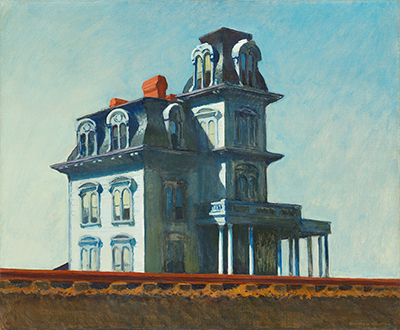
- Collection or catalogue record, House by the Railroad, 1925; medium and identity as discussed in the linked article. View source.
- Collection or catalogue record, Automat, 1927; medium and identity as discussed in the linked article. View source.
- Collection or catalogue record, Early Sunday Morning, 1930; medium and identity as discussed in the linked article. View source.
- Collection or catalogue record, New York Movie, 1939; medium and identity as discussed in the linked article. View source.
- Collection or catalogue record, Nighthawks, 1942; medium and identity as discussed in the linked article. View source.
- Collection or catalogue record, Morning Sun, 1952; medium and identity as discussed in the linked article. View source.
- Collection or catalogue record, Second Story Sunlight, 1960; medium and identity as discussed in the linked article. View source.
- Collection or catalogue record, Two Comedians, 1966; medium and identity as discussed in the linked article. View source.
- Whitney Museum of American Art, Study for Route 6, Eastham, 1941, accession 70.854; exact object record. View source.
- Whitney Museum of American Art, Study for Conference at Night, 1949, accession 70.170; exact object record. View source.
- Whitney Museum of American Art, Study for First Row Orchestra, 1951, accession 70.841; exact object record. View source.
- Whitney Museum of American Art, (Bridge and Embankment), 1906, accession 70.1298; exact object record. View source.
- Whitney Museum of American Art, (Seated Male Model, Bent Over), c. 1902–1903, accession 70.1277; exact object record. View source.
- Whitney Museum of American Art, Study for Morning Sun, 1952, accession 70.244; exact object record. View source.
- Whitney Museum of American Art, Study for Morning Sun, 1952, accession 70.243; exact object record. View source.
- Whitney Museum of American Art, Study for Two on the Aisle, 1927, accession 70.128; exact object record. View source.
- Whitney Museum of American Art, Study for New York Office, 1962, accession 70.822; exact object record. View source.
- Whitney Museum of American Art, Study for Two on the Aisle, 1927, accession 70.129; exact object record. View source.
- Whitney Museum of American Art, Study for Pennsylvania Coal Town, 1947, accession 70.229; exact object record. View source.
- Whitney Museum of American Art, (Rooftops), 1926, accession 70.1114; exact object record. View source.
- Whitney Museum of American Art, Study for South Carolina Morning, 1955, accession 70.162a-b; exact object record. View source.
- Whitney Museum of American Art, (Self-Portrait), 1903–1906, accession 70.1254; exact object record. View source.
- Whitney Museum of American Art, (Manhattan Bridge), 1925–1926, accession 70.1098; exact object record. View source.
- Whitney Museum of American Art, (Solitary Figure in a Theater), c. 1902–1904, accession 70.1418; exact object record. View source.
- Whitney Museum of American Art, Study for Approaching a City, 1946, accession 70.869; exact object record. View source.
- Whitney Museum of American Art, Study for August in the City, 1945, accession 70.159; exact object record. View source.
- Whitney Museum of American Art, Study for Compartment C, Car 293, 1938, accession 70.430; exact object record. View source.
- Whitney Museum of American Art, Study for Compartment C, Car 293, 1938, accession 70.431a-b; exact object record. View source.
- Whitney Museum of American Art, Study for East Wind over Weehawken, 1934, accession 70.252; exact object record. View source.
- Whitney Museum of American Art, Study for East Wind over Weehawken, 1934, accession 70.249; exact object record. View source.
- Whitney Museum of American Art, Study for Evening Wind, 1921, accession 70.343a-b; exact object record. View source.
- Whitney Museum of American Art, Study for The Sheridan Theatre, 1937, accession 70.969; exact object record. View source.
- Whitney Museum of American Art, Study for New York Movie, 1939, accession 70.455; exact object record. View source.
- Whitney Museum of American Art, Study for New York Movie, 1939, accession 70.273; exact object record. View source.
- Whitney Museum of American Art, Study for New York Movie, 1938 or 1939, accession 70.274a-b; exact object record. View source.
- Whitney Museum of American Art, Study for 5 A.M., 1937, accession 70.153; exact object record. View source.
- Whitney Museum of American Art, Study for 5 A.M., 1937, accession 70.429; exact object record. View source.
- Whitney Museum of American Art, (Jo Sketching at Good Harbor Beach), 1923–1924, accession 70.1129; exact object record. View source.
- Whitney Museum of American Art, Study for August in the City, 1945, accession 70.158a-b; exact object record. View source.
- Whitney Museum of American Art, Study for Morning Sun, 1952, accession 70.291; exact object record. View source.
- Whitney Museum of American Art, Study for Morning Sun, 1952, accession 70.290; exact object record. View source.
- Whitney Museum of American Art, Study for Office at Night, 1940, accession 70.340; exact object record. View source.
- Whitney Museum of American Art, Study for Office at Night, 1940, accession 70.341; exact object record. View source.
- Whitney Museum of American Art, Study for Hotel by a Railroad, 1952, accession 70.427; exact object record. View source.
- Whitney Museum of American Art, Study for Hotel by a Railroad, 1952, accession 70.199; exact object record. View source.
- Whitney Museum of American Art, Study for Hotel by a Railroad, 1952, accession 70.428; exact object record. View source.
- Whitney Museum of American Art, Study for Hotel Lobby, 1942, accession 70.117; exact object record. View source.
- Whitney Museum of American Art, Study for Hotel Lobby, 1942, accession 70.839; exact object record. View source.
- Whitney Museum of American Art, Study for Conference at Night, 1949, accession 70.174; exact object record. View source.
- Whitney Museum of American Art, Study for Hotel Window, 1955, accession 70.161; exact object record. View source.
- Whitney Museum of American Art, Study for Pennsylvania Coal Town, 1947, accession 70.198; exact object record. View source.
- Whitney Museum of American Art, Study for Route 6, Eastham, 1941, accession 70.369; exact object record. View source.
- Whitney Museum of American Art, Study for Bridle Path, 1939, accession 70.220; exact object record. View source.
- Whitney Museum of American Art, Study for Bridle Path, 1939, accession 70.235; exact object record. View source.
- Whitney Museum of American Art, Study for Ground Swell, 1939, accession 70.339; exact object record. View source.
- Whitney Museum of American Art, Study for Yawl Riding a Swell, 1935, accession 70.439; exact object record. View source.
- Whitney Museum of American Art, Study for Rooms for Tourists, 1945, accession 70.848; exact object record. View source.
- Whitney Museum of American Art, Study for Rooms for Tourists, 1945, accession 70.438; exact object record. View source.
- Whitney Museum of American Art, Study for Nighthawks, 1941 or 1942, accession 70.193; exact object record. View source.
- Whitney Museum of American Art, Study for Nighthawks, 1941 or 1942, accession 70.192; exact object record. View source.
- Whitney Museum of American Art, Study for Gas, 1940, accession 70.263; exact object record. View source.
- Whitney Museum of American Art, Self-Portrait with Hat, c. 1918, posthumous print, accession 70.1903; exact object record. View source.
- Whitney Museum of American Art, East Side Interior, 1922, accession 70.1020; exact object record. View source.
- Art Institute of Chicago, Selected Chronology for Edward Hopper; training, travels, exhibitions, New York and Truro chronology. View source.
- Emily C. Burns, Spectral figures: Edward Hopper’s empty Paris, chapter 5 in Empty Spaces: Confronting Emptiness in National, Cultural and Urban Histories, 2019; complete chapter and notes consulted. View source.
- Charles Brock, Regionalism and Folk Art, National Gallery of Art; complete essay and two notes consulted. View source.