by Tom Gurney
Tom Gurney BSc (Hons) is an art history expert with over 20 years experience
Email: tomgurney1@gmail.com / Phone: +44 7429 011000
Josephine Nivison Hopper: Introduction
Josephine Nivison Hopper was a painter, illustrator, actor and teacher before she married Edward Hopper. During their marriage she continued to make art while modelling, corresponding with museums and dealers, and recording the work leaving their studio. Those activities belong to one life, but they should not be collapsed into the single role of a famous artist's wife.
Her surviving pictures make that distinction tangible. A flower-filled still life and a watercolour portrait offer forms, colours and kinds of attention that can be examined on their own. Her written records do something different: they preserve the practical and imaginative work of a household in which two people painted, with markedly unequal public recognition.
At a Glance
Contents
- Education, teaching and an independent beginning
- Gloucester and the Brooklyn exhibition
- Making pictures within a shared life
- A model who helped stage scenes
- The work of keeping records
- Two Cape Cod maps
- Looking at Obituary
- A portrait in watercolour and graphite
- A tree brought close to the viewer
- Marriage, frustration and differing interpretations
Education, teaching and an independent beginning
Born in New York in 1883, Jo Nivison attended the Normal College of New York, later Hunter College, from 1900 to 1904. Gail Levin's account of researching her life identifies college drawings, theatrical activity and the training that supported her work as a schoolteacher. Nivison subsequently studied art with Robert Henri and travelled to Europe in 1907. In 1918 she returned to France for government work involving wounded and disabled soldiers. [1]
These experiences establish a career that did not originate in marriage. Teaching provided a profession; drawing and painting supplied another field of work; acting connected her with performance. Her interests were broader than the narrow supporting identity through which she was later often remembered.
Levin's 1980 study documents her participation in the Daniel Gallery's 1914 Modern Painters exhibition alongside artists including Stuart Davis and Charles Demuth. It also identifies her illustration for John Reed in The Masses and performances with the Washington Square Players. [2] Such work places her within the artistic and theatrical networks of New York before Hopper's mature fame.
The range matters: Nivison was producing images, exhibiting and performing within several overlapping artistic circles. A group-show appearance and a supporting stage role are concrete forms of participation, without establishing a particular political affiliation.
Gloucester and the Brooklyn exhibition
The relationship with Edward developed during the summer of 1923 in Gloucester, Massachusetts. They had known one another earlier through the New York art world. Levin's account describes Jo encouraging his watercolour work and recommending it to the organisers of a Brooklyn Museum exhibition in which she had been invited to participate. [2]
Both showed six watercolours. Brooklyn purchased Edward's The Mansard Roof for $100; Jo sold none. Her later recollection of arranging his inclusion survives through an interview quoted by Levin. [2] This was a consequential act of advocacy by an artist whose own work was present in the same exhibition.
Jo and Edward married on 9 July 1924, as recorded in the Art Institute of Chicago's chronology. [3] Marriage joined two already active artistic lives.
The Brooklyn episode also resists a simple story of one artist discovering another's talent. Jo helped create an opportunity through her own exhibition connection. What followed was an unequal public result, with Edward's watercolours receiving a degree of recognition her pictures did not share.
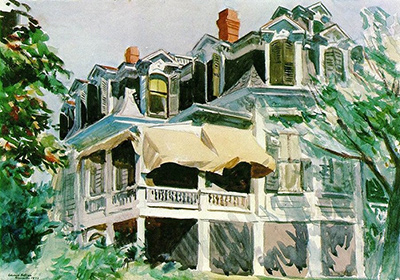
The Mansard Roof, 1923 — Edward Hopper.
Making pictures within a shared life
The Gloucester episode joined two artists who had already developed interests and habits of their own. Sharing a destination did not make their professional situations equal, nor did it make the work produced there interchangeable. Jo's earlier exhibiting and teaching remain part of her history when Edward's growing recognition enters the account.
That distinction becomes especially useful when we encounter a surviving work by Jo. A flower arrangement, a portrait or a tree is an opportunity to examine her choices of subject and handling. It does not have to function as evidence about an Edward Hopper painting before it deserves attention.
The practical conditions of marriage nevertheless mattered. Modelling, maintaining records and managing a career took time. A history that acknowledges those activities can also ask what room remained for the model and administrator's own painting. The question concerns the distribution of work as much as the feelings of the couple.
Their surviving art offers a further complication. Images of the same region can differ greatly in distance, density and colour. A shared place supplies common surroundings; it does not dictate a shared way of organising a page.
A model who helped stage scenes
Jo became central to Edward's figure studies. The Whitney's account of the working process describes her active participation in dressing and posing as different characters. Early studies can retain her individual features, while later compositional drawings generalise them into the people who occupy the paintings. [4]
Her training as an actor offers a practical context for that work. A pose involves more than staying still. The angle of a head, distribution of weight or placement of a hand can help make an imagined role physically convincing. A costume changes the body's outline and its relation to a room.
The drawings for New York Movie make this participation especially clear. The development of a standing figure includes attention to clothing, feet and posture. The finished usher belongs to a constructed theatre scene, rather than becoming a straightforward portrait of Jo at a particular moment.
This distinction protects both people from a misleading simplification. Jo's participation deserves recognition without turning every painted woman into a literal account of her feelings. A model can help create a character whose age, situation and apparent thoughts differ from her own.
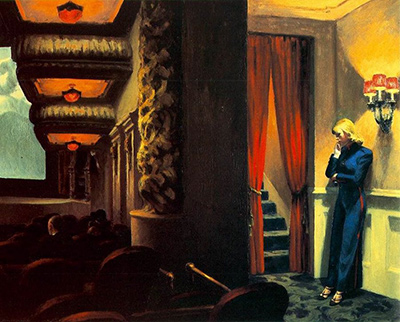
New York Movie, 1939 — Edward Hopper.
The work of keeping records
The ledger books were another joint undertaking. The Whitney explains that Edward made small sketches of completed works, while Jo supplied descriptions and business information: dates, exhibitions, sales and buyers. Its current record credits Artist's Ledger—Book III to both artists. [5]
Record-keeping made an otherwise dispersing body of work traceable. Paintings could leave the studio for exhibitions or collections while a description and miniature image remained. The records preserved information useful to the couple's business and, later, to scholars reconstructing the works' histories.
The entries also contain imaginative material. Naming a character or describing a possible temperament shows how the Hoppers talked about a painting. It does not automatically identify an actual sitter or disclose the one story a canvas was intended to tell.
Jo's writing should therefore be read with attention to its different purposes. A transaction, a description of colour and a fictional name can occupy the same record while answering different questions. Her liveliness as a writer is part of the archive's value, not a reason to treat every sentence as the same kind of evidence.
Two Cape Cod maps
Jo also drew maps that join observation, lettering and personal knowledge of a place. The public preview for the Edward Hopper House's 2026 Susan Chen catalogue reproduces two works identified as Cape Cod Bay Map and South Truro Map, approximately dated to 1936. The checklist locates the originals in the Edward Root Bequest at Pratt Munson and identifies the exhibited examples as facsimiles associated with the Truro Historical Society. The approximate date should not be mistaken for an exact year written on each sheet. [6]
The Cape Cod Bay Map distributes names and routes across a long, narrow surface. A red main road runs through a web of lighter roads, waterways and settlement names. Railway lines and station indications belong to the same account of the area as the coast and the Pamet River. Small drawn structures make particular places more immediately recognisable.
This is not simply a landscape reduced to outlines. Words are central to how the map works. A named river can be followed across the sheet; a station has a place within a route; the lighthouse has both a drawn form and an identity. Looking and reading continually support one another.
The South Truro Map brings a more personal group of landmarks into that system. It names the Hoppers' house near the shore and the Camel's Hump, joins nearby houses and roads, and includes a small representation of the old church. A sun with radiating strokes makes one part of the coastal setting particularly vivid. A warning about dogs introduces the sort of local knowledge that a traveller learns through use rather than a distant survey.
The map does not need to be assessed as an engineering plan to be revealing. It shows a place organised through routes, recognisable features and encounters. A road is significant because it leads somewhere; a house matters because someone lives there or because it anchors a memory of the surrounding land.
These sheets also widen the range of activities included in Jo's artistic record. Drawing can guide, name, amuse and remember as well as prepare a canvas. Her ability to keep records takes a distinctly visual form here, but the maps should not be reduced to paperwork for Edward's career.
They offer a different kind of proximity from a view across an open field. We encounter the region through a resident's accumulation of names and practical distinctions. The coastline becomes a place one can move through, with destinations and small cautions along the way.
Looking at Obituary
Obituary brings us directly to Jo's painting. The Whitney identifies it as an undated oil on canvas, measuring 61.3 × 50.6 cm, from her bequest. [7] Its blue vase supports an expansive mass of flower heads, grasses and stems before a window. A small cat appears at the left edge, while buildings and green land can be seen beyond the flowers.
The arrangement does not separate interior and landscape as firmly as a heavily modelled still life might. Stems cross the view, pale forms merge and separate, and the outside remains visible through intervals around the bouquet. The vase provides a more solid lower centre beneath this busy, comparatively airy upper area.
The different flower heads give the picture a varied rhythm. Broad pale petals interrupt finer stalks, while browns, muted reds and yellows gather around the blue. The mass feels abundant without every part becoming equally dense.
The cat introduces another direction of attention. Its small face meets us from beside the curtain rather than occupying the central place a portrait sitter might command. The detail connects a domestic presence with the larger still-life arrangement without explaining it through a completed anecdote.
The title invites a response to drying flowers and change. It need not make the canvas an illustrated confession about the marriage. The painting can be examined through its actual colour, crowded surface and layered view before any biographical interpretation is proposed.
A portrait in watercolour and graphite
Jo's Bertram Hartman, Painter offers a different encounter. The Whitney dates this watercolour and graphite work to about the 1950s. Its visible sheet measures 52.1 × 35.6 cm. [8] A large head faces out from a broad area of pale paper, with the shoulders and shirt indicated more lightly below.
The blue eyes are conspicuous within a face built from restrained changes of colour. Warm passages in the hair and skin sit beside cooler marks around the brows and cheeks. The head has a concentrated presence even where the surrounding clothing is loosely described.
The shirt does not become a heavy block closing the lower image. Broken marks and open paper allow it to remain lighter than the face. A small cat sketch near the bottom right introduces a second, much more abbreviated image on the same sheet.
This difference in finish is part of the work's interest. The carefully attended face and the lighter surroundings coexist rather than being forced into a uniformly completed surface. Jo could make a likeness through selective concentration, leaving substantial parts of the paper open.
The portrait is particularly useful in considering her range. It asks for close attention to a person, while Obituary distributes it through flowers, a window and an exterior. Neither needs to resemble Edward's handling of a figure or building to provide evidence of sustained artistic work.
Watch: Edward Hopper’s Life and Art
Explore Hopper’s paintings and the places behind them in these museum films. Choose a film below.
A tree brought close to the viewer
An undated watercolour in the Edward Hopper House's Sanborn collection, Tree in Woods, Bluish Bark, demonstrates another aspect of Jo's practice. Its central trunk is large enough to dominate the upright sheet. Blue-grey colour gives the bark a cool presence, interrupted by darker knots and warmer marks. A substantial branch turns diagonally towards the left. [9]
The background is comparatively open. Thin trunks and branches recede into pale intervals of paper, so that the central tree seems close without requiring a heavily filled surrounding forest. The image lets us recognise depth through differences in the weight and concentration of marks.
The lower edge has its own activity. Orange-brown passages suggest the ground around spreading roots. Their broken handling gives the tree a place to stand while allowing the surface of the sheet to remain visible. The warm base also changes how the cooler trunk is experienced.
Jo does not describe every part of the wood with equal force. The large tree receives sustained attention; the others can remain narrower and more abbreviated. This distribution of finish is a compositional decision, comparable in principle to the concentration on the face in the Hartman portrait, although the subjects and colours differ.
The tree's scale is important. We are not surveying a whole wooded landscape from a distant position. The nearest trunk fills our field of view and continues beyond it through branches cropped by the paper. The painting makes closeness to a particular natural form its subject.
It would be tempting to turn the tree into a symbol of endurance or frustrated growth. Such a reading may be meaningful to an individual viewer, but the watercolour offers ample interest before a biographical allegory is imposed. Its blue bark, broad limbs and lighter background are choices that can be examined directly.
Marriage, frustration and differing interpretations
The long marriage contained shared interests and serious inequalities. In her 2022 interview with Sarah Cascone, scholar Elizabeth Thompson Colleary describes its volatility and Jo's frustrations, while emphasising the couple's affection and common interests in literature, theatre, film and art. She also acknowledges records of Edward's disparaging remarks about Jo's work and women artists. [10]
These observations should not be simplified into either a uniformly happy partnership or a claim that Jo ceased to have an artistic identity. The surviving work and exhibition history show continued activity. The administrative and modelling demands also show how much time and energy supported Edward's career.
Levin's scholarship places greater emphasis on the professional and institutional power that restricted Jo's recognition. Her 2010 essay argues that the handling of Jo's work cannot be explained solely through changing aesthetic fashion. [11] This is a historical argument about authority and value, rather than a reason to infer a private quarrel from every painted couple.
The records deserve to be taken seriously as accounts of frustration, practical work and unequal opportunity. They should also retain their voices and contexts. A diary entry, an interviewer's interpretation and a painting do not give identical access to a relationship.
The bequest and the uneven survival of her art
Jo died in 1968, having left both her own work and Edward's to the Whitney. Levin's account documents the dispersal of many framed works by Jo, including gifts to hospitals whose later whereabouts were uncertain. It distinguishes these losses from smaller works on paper and panels that survived. [11]
That distinction remains essential. The survival of watercolours does not demonstrate that all the larger canvases were preserved. Equally, a history of lost paintings should not be expanded into the claim that none of Jo's art remains. The current Whitney records for Obituary and the Hartman watercolour provide specific objects against which broad statements can be checked.
Other groups survived through different routes. PAAM records a 2016 gift containing 69 drawings and watercolours by Jo, alongside 96 drawings by Edward and 22 diaries covering 1933–1956. The Edward Hopper House's 2021–22 exhibition account describes watercolours preserved through the Reverend Arthayer Sanborn and follows its earlier 2014 presentation of her work. [12]
The surviving sheets and canvases allow her decisions to be examined directly, alongside written descriptions of missing works and Edward’s depictions of her painting.
A new exhibition conversation in 2026
The Edward Hopper House's exhibition Memory, Trees & Shadows, held from May to October 2026, placed Jo's tree studies in a conversation with Edward's drawings and new work by James Prosek. The museum's account emphasised Jo's expressive treatment of trees and the relation between direct observation and the marks through which artists describe nature. [9]
One Prosek installation brought a bronze stump together with a spreading cut-steel shadow. In photographs of the installation, the stump occupies the wooden floor as a small, solid object, while the branching shape extends across a much larger area. A visitor has to look down and move around it, encountering the image at the scale of the room.
The relation to Jo's watercolour is productive because the objects differ so much. Her trunk remains standing within a vertically organised sheet. The installation's absent tree is suggested by an extended silhouette on the floor. Both direct attention towards the relation between a tree's physical presence and the form an artist makes from it.
This kind of exhibition also changes the role assigned to Jo. Her work can initiate a formal conversation with a contemporary artist instead of appearing only as a supplement to a famous husband's biography. The comparison asks what a particular watercolour makes visible and what another medium can do with a related question.
The museum included Sarah Sockbeson's work in the broader exhibition conversation. That setting should not make the separate artists' methods or histories collapse into one account of nature. Its value lies in the possibility of looking from one distinct practice to another.
Recent visibility does not recover every work that disappeared after Jo's death. It does make a more varied surviving practice available for attention: maps, portraits, flowers, trees and other works on paper. Those objects can sustain an account of her art that includes the marriage without making it the subject of every image.
Reading the two artists together
Looking at Jo's work beside Edward's is useful when the comparison asks specific questions. How is a room framed? How much paper remains open? Where does a face become more precise than its surroundings? Which objects carry the strongest colour?
Such comparisons can reveal exchanges without reducing her pictures to sources borrowed by a more famous painter. Shared places and materials do not produce identical works. Her bouquet and watercolour portrait offer different distributions of detail, space and attention from many of Edward's familiar compositions.
Her archive also changes how his art is understood. Modelling, scene staging, correspondence and records become visible as work required around the canvas. Recognising those contributions makes the account of his production more complete while leaving room to examine her independent painting.
Jo's blue vase, open paper and carefully observed faces deserve that room. They give the artist behind the written name a visible body of work, one whose surviving parts can be encountered through looking as well as through the history of its neglect.
Artworks and studies directory
This researched directory includes finished works and separately identified studies. It is not a complete catalogue raisonné. Linked titles open the articles; unlinked studies are identified by their collection accessions. Watercolours retain their recorded media, and original prints remain distinct from reproductions.
| Name | Date | Medium |
|---|---|---|
| (Bridge and Embankment) (70.1298) | 1906 | Oil on wood |
| (Jo Sketching at Good Harbor Beach) (70.1129) | 1923–1924 | Watercolor and fabricated chalk on paper |
| (Manhattan Bridge) (70.1098) | 1925–1926 | Watercolor and graphite pencil on paper |
| (Rooftops) (70.1114) | 1926 | Watercolor and graphite pencil on paper |
| (Seated Male Model, Bent Over) (70.1277) | c. 1902–1903 | Oil on canvas |
| (Self-Portrait) (70.1254) | 1903–1906 | Oil on canvas |
| (Solitary Figure in a Theater) (70.1418) | c. 1902–1904 | Oil on board |
| 5 A.M. | 1937 | oil on canvas |
| Adam's House | 1928 | watercolour and charcoal on paper |
| American Village | 1912 | Oil on canvas |
| Apartment Houses | 1923 | oil on canvas |
| Approaching a City | 1946 | oil on canvas |
| August in the City | 1945 | oil on canvas |
| Automat | 1927 | oil on canvas |
| Barber Shop | 1931 | oil on canvas |
| Blackwell's Island | 1928 | oil on canvas |
| Bridge on the Seine | 1909 | Oil on canvas |
| Bridle Path | 1939 | oil on canvas |
| Burly Cobb's House South Truro | 1930–1933 | oil on canvas |
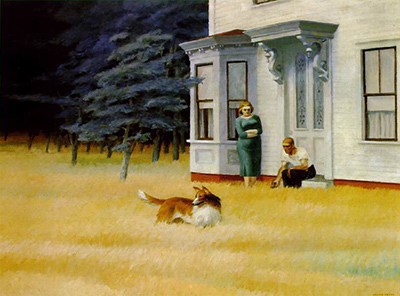
| Cape Cod Evening | 1939 | oil on canvas |
| Cape Cod Morning | 1950 | oil on canvas |
| Chair Car | 1965 | oil on canvas |
| Chop Suey | 1929 | oil on canvas |
| City Roofs | 1932 | Oil on canvas |
| Coast Guard Station | 1929 | oil on canvas |
| Compartment C, Car 293 | 1938 | oil on canvas |
| Conference at Night | 1949 | oil on canvas |
| Corn Hill | 1930 | oil on canvas |
| Dawn in Pennsylvania | 1942 | oil on canvas |
| Drug Store | 1927 | oil on canvas |
| Early Sunday Morning | 1930 | Oil on canvas |
| East Side Interior (70.1020) | 1922 | Etching |
| East Wind Over Weehawken | 1934 | oil on canvas |
| El Palacio | 1946 | Watercolor and graphite pencil on paper |
| Eleven A.M. | 1926 | oil on canvas |
| Evening Wind | 1921 | etching |
| Excursion into Philosophy | 1959 | oil on canvas |
| First Row Orchestra | 1951 | oil on canvas |
| Freight Car at Truro | 1931 | watercolour over graphite on paper |
| Gas | 1940 | oil on canvas |
| Girl at a Sewing Machine | c. 1921 | oil on canvas |
| Gloucester Harbor | 1912 | Oil on canvas |
| Ground Swell | 1939 | oil on canvas |
| Haskell's House | 1924 | watercolour over graphite on paperboard |
| High Noon | 1949 | oil on canvas |
| Hill and Houses Cape Elizabeth Maine | 1927 | watercolour over graphite pencil |
| Hills South Truro | 1930 | oil on canvas |
| Hotel by a Railroad | 1952 | oil on canvas |
| Hotel Lobby | 1943 | oil on canvas |
| Hotel Room | 1931 | oil on canvas |
| Hotel Window | 1955 | oil on canvas |
| House by the Railroad | 1925 | oil on canvas |
| House by the Squam River | 1926 | watercolour over graphite on paper |
| Le Bistro or The Wine Shop | 1909 | Oil on canvas |
| Le Pont des Arts | 1907 | Oil on canvas |
| Le Pont Royal | 1909 | Oil on canvas |
| Le Quai des Grands Augustins | 1909 | Oil on canvas |
| Lighthouse and Buildings Portland Head | 1927 | watercolour over graphite pencil on paper |
| Lighthouse Hill | 1927 | oil painting |
| Manhattan Bridge Loop | 1928 | oil on canvas |
| Model Sitting | c. 1902 | oil painting; support not asserted |
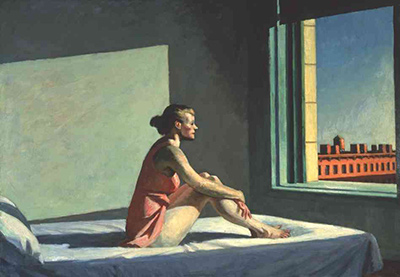
| Morning Sun | 1952 | oil on canvas |
| New York Movie | 1939 | oil on canvas |
| New York New Haven and Hartford | 1931 | oil on canvas |
| New York Office | 1962 | oil on canvas |
| New York Pavements | 1924–1925 | oil on canvas |
| New York Restaurant | c. 1922 | oil on canvas |
| Night Windows | 1928 | oil on canvas |
| Nighthawks | 1942 | oil on canvas |
| October on Cape Cod | 1946 | oil on canvas |
| Office at Night | 1940 | oil on canvas |
| Office in a Small City | 1953 | oil on canvas |
| Pennsylvania Coal Town | 1947 | oil on canvas |
| People in the Sun | 1960 | oil on canvas |
| Portrait of Orleans | 1950 | oil on canvas |
| Queensborough Bridge | 1913 | Oil on canvas |
| Railroad Sunset | 1929 | Oil on canvas |
| Railroad Train | 1908 | oil on canvas |
| Road in Maine | 1914 | oil on canvas |
| Room in Brooklyn | 1932 | oil on canvas |
| Room in New York | 1932 | oil on canvas |
| Rooms by the Sea | 1951 | oil on canvas |
| Rooms for Tourists | 1945 | oil on canvas |
| Route 6 Eastham | 1941 | oil on canvas |
| Second Story Sunlight | 1960 | Oil on canvas |
| Self-Portrait | 1925–1930 | Oil on canvas |
| Self-Portrait with Hat (70.1903) | c. 1918, posthumous print | Drypoint |
| Seven A.M. | 1948 | Oil on canvas |
| Soir Bleu | 1914 | oil on canvas |
| South Carolina Morning | 1955 | Oil on canvas |
| Stairway at 48 Rue de Lille Paris | 1906 | Oil on wood |
| Study for 5 A.M. (70.153) | 1937 | Fabricated chalk on paper |
| Study for 5 A.M. (70.429) | 1937 | Fabricated chalk and graphite pencil on paper |
| Study for Approaching a City (70.869) | 1946 | Fabricated chalk and charcoal on paper |
| Study for August in the City (70.158a-b) | 1945 | Fabricated chalk on paper |
| Study for August in the City (70.159) | 1945 | Fabricated chalk on paper |
| Study for Bridle Path (70.220) | 1939 | Fabricated chalk on paper |
| Study for Bridle Path (70.235) | 1939 | Fabricated chalk on paper |
| Study for Compartment C, Car 293 (70.430) | 1938 | Fabricated chalk on paper |
| Study for Compartment C, Car 293 (70.431a-b) | 1938 | Fabricated chalk and charcoal on paper |
| Study for Conference at Night (70.170) | 1949 | Fabricated chalk on paper (recto); Typewriter ink on paper (verso) |
| Study for Conference at Night (70.174) | 1949 | Fabricated chalk on paper ( recto); Typewriter ink on paper (verso) |
| Study for East Wind over Weehawken (70.249) | 1934 | Graphite pencil on paper |
| Study for East Wind over Weehawken (70.252) | 1934 | Fabricated chalk and charcoal on paper |
| Study for Evening Wind (70.343a-b) | 1921 | Fabricated chalk on paper |
| Study for First Row Orchestra (70.841) | 1951 | Fabricated chalk and charcoal on paper |
| Study for Gas (70.263) | 1940 | Fabricated chalk on paper |
| Study for Ground Swell (70.339) | 1939 | Fabricated chalk, charcoal and graphite pencil on paper |
| Study for Hotel by a Railroad (70.199) | 1952 | Fabricated chalk on paper |
| Study for Hotel by a Railroad (70.427) | 1952 | Fabricated chalk on paper |
| Study for Hotel by a Railroad (70.428) | 1952 | Fabricated chalk on paper |
| Study for Hotel Lobby (70.117) | 1942 | Fabricated chalk and graphite pencil on paper |
| Study for Hotel Lobby (70.839) | 1942 | Fabricated chalk and charcoal on paper |
| Study for Hotel Window (70.161) | 1955 | Fabricated chalk, graphite pencil and colored pencil on paper |
| Study for Morning Sun (70.243) | 1952 | Fabricated chalk on paper |
| Study for Morning Sun (70.244) | 1952 | Fabricated chalk on paper |
| Study for Morning Sun (70.290) | 1952 | Fabricated chalk on paper |
| Study for Morning Sun (70.291) | 1952 | Fabricated chalk and graphite pencil on paper |
| Study for New York Movie (70.273) | 1939 | Fabricated chalk on paper |
| Study for New York Movie (70.274a-b) | 1938 or 1939 | Fabricated chalk and charcoal on paper (recto); Fabricated chalk on paper (verso) |
| Study for New York Movie (70.455) | 1939 | Fabricated chalk and charcoal on paper |
| Study for New York Office (70.822) | 1962 | Fabricated chalk on paper |
| Study for Nighthawks (70.192) | 1941 or 1942 | Fabricated chalk on paper |
| Study for Nighthawks (70.193) | 1941 or 1942 | Fabricated chalk on paper |
| Study for Office at Night (70.340) | 1940 | Fabricated chalk and charcoal on paper |
| Study for Office at Night (70.341) | 1940 | Fabricated chalk and graphite pencil on paper |
| Study for Pennsylvania Coal Town (70.198) | 1947 | Fabricated chalk on paper |
| Study for Pennsylvania Coal Town (70.229) | 1947 | Fabricated chalk and charcoal on paper |
| Study for Rooms for Tourists (70.438) | 1945 | Fabricated chalk and charcoal on paper |
| Study for Rooms for Tourists (70.848) | 1945 | Fabricated chalk and charcoal on paper |
| Study for Route 6, Eastham (70.369) | 1941 | Fabricated chalk and graphite pencil on paper |
| Study for Route 6, Eastham (70.854) | 1941 | Fabricated chalk and graphite pencil on paper |
| Study for South Carolina Morning (70.162a-b) | 1955 | Fabricated chalk on paper (recto and verso) |
| Study for The Sheridan Theatre (70.969) | 1937 | Graphite pencil on paper |
| Study for Two on the Aisle (70.128) | 1927 | Fabricated chalk on paper |
| Study for Two on the Aisle (70.129) | 1927 | Fabricated chalk on paper |
| Study for Yawl Riding a Swell (70.439) | 1935 | Fabricated chalk and graphite pencil on paper |
| Summer Evening | 1947 | oil on canvas |
| Summer Interior | 1909 | Oil on canvas |
| Sun in an Empty Room | 1963 | oil on canvas |
| Sunlight in a Cafeteria | 1958 | oil on canvas |
| Sunlight on Brownstones | 1956 | oil on canvas |
| Tables for Ladies | 1930 | oil on canvas |
| The Bootleggers | 1925 | oil on canvas |
| The Camel's Hump | 1931 | oil on canvas |
| The Circle Theatre | 1936 | oil on canvas |
| The City | 1927 | oil on canvas |
| The Lighthouse at Two Lights | 1929 | oil on canvas |
| The Long Leg | 1935 | oil on canvas |
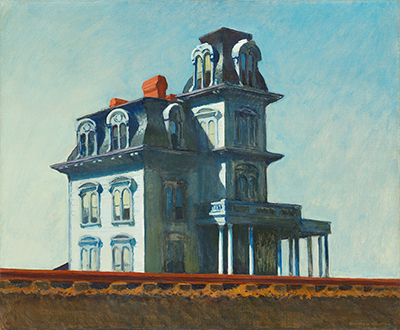
| The Mansard Roof | 1923 | watercolour over graphite on paper |
| The Sheridan Theatre | 1937 | oil on canvas |
| Tramp Steamer | 1908 | oil on canvas |
| Two Comedians | 1966 | oil on canvas |
| Two on the Aisle | 1927 | oil on canvas |
| Valley of the Seine | 1909 | Oil on canvas |
| Western Motel | 1957 | oil on canvas |
Frequently Asked Questions
Born in New York in 1883, Jo Nivison attended the Normal College of New York, later Hunter College, from 1900 to 1904. Gail Levin's account of researching her life identifies college drawings, theatrical activity and the training that supported her work as a schoolteacher. Nivison subsequently studied art with Robert Henri and travelled to Europe in 1907. In 1918 she returned to France for government work involving wounded and disabled soldiers. [1]
The ledger books were another joint undertaking. The Whitney explains that Edward made small sketches of completed works, while Jo supplied descriptions and business information: dates, exhibitions, sales and buyers. Its current record credits Artist's Ledger—Book III to both artists. [5]
Jo died in 1968, having left both her own work and Edward's to the Whitney. Levin's account documents the dispersal of many framed works by Jo, including gifts to hospitals whose later whereabouts were uncertain. It distinguishes these losses from smaller works on paper and panels that survived. [11]
Discussion
Look again at the images and ideas explored in Josephine Nivison Hopper. These editorial prompts invite your observations.
Reader Insights
What changes when Jo’s own paintings are considered alongside her work as a model and record-keeper?
Compare The Mansard Roof with New York Movie. How do these pictures illuminate different aspects of Jo’s involvement in Edward’s work?
Which detail would you look at again after reading “A model who helped stage scenes”?
Join the Conversation
Share a detail, comparison or question about Josephine Nivison Hopper below.
References
- Gail Levin, “Tracing an Erased Artist in Multiple Archives: Josephine Verstille Nivison Hopper”, Brooklyn Rail, October 2015, complete three-page author-posted copy. College, teaching, travel and archival reconstruction; the underlying institutional files were not independently consulted. View source.
- Gail Levin, “Josephine Verstille Nivison Hopper”, Woman's Art Journal 1, no. 1, Spring–Summer 1980, pp. 28–32 and notes 1–30. Early exhibitions, illustration, acting and the Brooklyn episode; the 1966 interview is transmitted through Levin. View source.
- Art Institute of Chicago, selected Hopper chronology, 1923–1924 entries, including the marriage on 9 July 1924. View source.
- Whitney Museum of American Art, Edward Hopper's New York, exhibition labels, 2022, PDF pp. 57 and 60; Study for New York Movie, 70.455 and 70.273. Active modelling, costume and transformation into invented characters. View source 1. View source 2. View source 3.
- Whitney Museum of American Art, Edward Hopper and Josephine Nivison Hopper, Artist's Ledger—Book III, 1924–1967, accession 96.210. Complete current account of the retrospective drawings and business records; individual leaves are not all claimed as independently read. View source.
- Edward Hopper House Museum & Study Center, Susan Chen: Rooms by the Sea catalogue preview, 2026, actual map spread PDF p. 6, printed pp. 6–7, and selected checklist spreads, PDF pp. 28–30. Approximate dates, facsimile/original distinction and credit lines checked; this is not a claim to have read the full catalogue. View source.
- Whitney Museum of American Art, Josephine Nivison Hopper, Obituary, n.d., accession 70.1216.31. Current undated record, medium, dimensions and complete painting image inspected. View source.
- Whitney Museum of American Art, Josephine Nivison Hopper, Bertram Hartman, Painter, c. 1950s, accession 70.1216.86. Current record and complete image; this watercolour is distinct from the oil portrait discussed among lost works in older scholarship. View source.
- Edward Hopper House Museum & Study Center, Memory, Trees & Shadows: A Visual Conversation with Josephine Nivison Hopper, Edward Hopper, and Sarah Sockbeson, 8 May–4 October 2026. Complete public exhibition account, actual reproduction and collection caption for Jo’s undated Tree in Woods, Bluish Bark, and two actual Prosek installation photographs inspected. The exhibition’s separate 52-page catalogue was not read. View source.
- Sarah Cascone, interview with Elizabeth Thompson Colleary on Jo Nivison Hopper, Artnet News, 20 March 2022, complete published Q&A. Interpretations of the working partnership and marriage are attributed to Colleary; the introduction's incorrect marriage ages are not followed. View source.
- Gail Levin, “Art World Power and Women's Incognito Work: The Case of Edward and Jo Hopper”, in Amy K. Levin, ed., Gender, Sexuality, and Museums: A Routledge Reader, 2010, pp. 93–104 including notes 1–60. Complete chapter read; the historical account of losses is distinguished from current object records. View source.
- Provincetown Art Association and Museum, The Hoppers, complete collection account; Edward Hopper House Museum & Study Center, Josephine Nivison Hopper: Edward's Muse, 23 October 2021–20 March 2022, complete exhibition description. Collection gift and surviving Sanborn watercolours; linked diary transcripts and exhibition catalogue were not independently read. View source 1. View source 2.
- Whitney Museum of American Art, Study for Route 6, Eastham, 1941, accession 70.854; exact object record. View source.
- Whitney Museum of American Art, Study for Conference at Night, 1949, accession 70.170; exact object record. View source.
- Whitney Museum of American Art, Study for First Row Orchestra, 1951, accession 70.841; exact object record. View source.
- Whitney Museum of American Art, (Bridge and Embankment), 1906, accession 70.1298; exact object record. View source.
- Whitney Museum of American Art, (Seated Male Model, Bent Over), c. 1902–1903, accession 70.1277; exact object record. View source.
- Whitney Museum of American Art, Study for Morning Sun, 1952, accession 70.244; exact object record. View source.
- Whitney Museum of American Art, Study for Morning Sun, 1952, accession 70.243; exact object record. View source.
- Whitney Museum of American Art, Study for Two on the Aisle, 1927, accession 70.128; exact object record. View source.
- Whitney Museum of American Art, Study for New York Office, 1962, accession 70.822; exact object record. View source.
- Whitney Museum of American Art, Study for Two on the Aisle, 1927, accession 70.129; exact object record. View source.
- Whitney Museum of American Art, Study for Pennsylvania Coal Town, 1947, accession 70.229; exact object record. View source.
- Whitney Museum of American Art, (Rooftops), 1926, accession 70.1114; exact object record. View source.
- Whitney Museum of American Art, Study for South Carolina Morning, 1955, accession 70.162a-b; exact object record. View source.
- Whitney Museum of American Art, (Self-Portrait), 1903–1906, accession 70.1254; exact object record. View source.
- Whitney Museum of American Art, (Manhattan Bridge), 1925–1926, accession 70.1098; exact object record. View source.
- Whitney Museum of American Art, (Solitary Figure in a Theater), c. 1902–1904, accession 70.1418; exact object record. View source.
- Whitney Museum of American Art, Study for Approaching a City, 1946, accession 70.869; exact object record. View source.
- Whitney Museum of American Art, Study for August in the City, 1945, accession 70.159; exact object record. View source.
- Whitney Museum of American Art, Study for Compartment C, Car 293, 1938, accession 70.430; exact object record. View source.
- Whitney Museum of American Art, Study for Compartment C, Car 293, 1938, accession 70.431a-b; exact object record. View source.
- Whitney Museum of American Art, Study for East Wind over Weehawken, 1934, accession 70.252; exact object record. View source.
- Whitney Museum of American Art, Study for East Wind over Weehawken, 1934, accession 70.249; exact object record. View source.
- Whitney Museum of American Art, Study for Evening Wind, 1921, accession 70.343a-b; exact object record. View source.
- Whitney Museum of American Art, Study for The Sheridan Theatre, 1937, accession 70.969; exact object record. View source.
- Whitney Museum of American Art, Study for New York Movie, 1939, accession 70.455; exact object record. View source.
- Whitney Museum of American Art, Study for New York Movie, 1939, accession 70.273; exact object record. View source.
- Whitney Museum of American Art, Study for New York Movie, 1938 or 1939, accession 70.274a-b; exact object record. View source.
- Whitney Museum of American Art, Study for 5 A.M., 1937, accession 70.153; exact object record. View source.
- Whitney Museum of American Art, Study for 5 A.M., 1937, accession 70.429; exact object record. View source.
- Whitney Museum of American Art, (Jo Sketching at Good Harbor Beach), 1923–1924, accession 70.1129; exact object record. View source.
- Whitney Museum of American Art, Study for August in the City, 1945, accession 70.158a-b; exact object record. View source.
- Whitney Museum of American Art, Study for Morning Sun, 1952, accession 70.291; exact object record. View source.
- Whitney Museum of American Art, Study for Morning Sun, 1952, accession 70.290; exact object record. View source.
- Whitney Museum of American Art, Study for Office at Night, 1940, accession 70.340; exact object record. View source.
- Whitney Museum of American Art, Study for Office at Night, 1940, accession 70.341; exact object record. View source.
- Whitney Museum of American Art, Study for Hotel by a Railroad, 1952, accession 70.427; exact object record. View source.
- Whitney Museum of American Art, Study for Hotel by a Railroad, 1952, accession 70.199; exact object record. View source.
- Whitney Museum of American Art, Study for Hotel by a Railroad, 1952, accession 70.428; exact object record. View source.
- Whitney Museum of American Art, Study for Hotel Lobby, 1942, accession 70.117; exact object record. View source.
- Whitney Museum of American Art, Study for Hotel Lobby, 1942, accession 70.839; exact object record. View source.
- Whitney Museum of American Art, Study for Conference at Night, 1949, accession 70.174; exact object record. View source.
- Whitney Museum of American Art, Study for Hotel Window, 1955, accession 70.161; exact object record. View source.
- Whitney Museum of American Art, Study for Pennsylvania Coal Town, 1947, accession 70.198; exact object record. View source.
- Whitney Museum of American Art, Study for Route 6, Eastham, 1941, accession 70.369; exact object record. View source.
- Whitney Museum of American Art, Study for Bridle Path, 1939, accession 70.220; exact object record. View source.
- Whitney Museum of American Art, Study for Bridle Path, 1939, accession 70.235; exact object record. View source.
- Whitney Museum of American Art, Study for Ground Swell, 1939, accession 70.339; exact object record. View source.
- Whitney Museum of American Art, Study for Yawl Riding a Swell, 1935, accession 70.439; exact object record. View source.
- Whitney Museum of American Art, Study for Rooms for Tourists, 1945, accession 70.848; exact object record. View source.
- Whitney Museum of American Art, Study for Rooms for Tourists, 1945, accession 70.438; exact object record. View source.
- Whitney Museum of American Art, Study for Nighthawks, 1941 or 1942, accession 70.193; exact object record. View source.
- Whitney Museum of American Art, Study for Nighthawks, 1941 or 1942, accession 70.192; exact object record. View source.
- Whitney Museum of American Art, Study for Gas, 1940, accession 70.263; exact object record. View source.
- Whitney Museum of American Art, Self-Portrait with Hat, c. 1918, posthumous print, accession 70.1903; exact object record. View source.
- Whitney Museum of American Art, East Side Interior, 1922, accession 70.1020; exact object record. View source.
- Art Institute of Chicago, Selected Chronology for Edward Hopper; training, travels, exhibitions, New York and Truro chronology. View source.
- Emily C. Burns, Spectral figures: Edward Hopper’s empty Paris, chapter 5 in Empty Spaces: Confronting Emptiness in National, Cultural and Urban Histories, 2019; complete chapter and notes consulted. View source.
- Charles Brock, Regionalism and Folk Art, National Gallery of Art; complete essay and two notes consulted. View source.
- Collection or catalogue record, American Village, 1912; medium and identity as discussed in the linked article. View source.
- Collection or catalogue record, Soir Bleu, 1914; medium and identity as discussed in the linked article. View source.
- Collection or catalogue record, House by the Railroad, 1925; medium and identity as discussed in the linked article. View source.
- Collection or catalogue record, Automat, 1927; medium and identity as discussed in the linked article. View source.
- Collection or catalogue record, Early Sunday Morning, 1930; medium and identity as discussed in the linked article. View source.
- Collection or catalogue record, New York Movie, 1939; medium and identity as discussed in the linked article. View source.
- Collection or catalogue record, Nighthawks, 1942; medium and identity as discussed in the linked article. View source.
- Collection or catalogue record, Morning Sun, 1952; medium and identity as discussed in the linked article. View source.
- Collection or catalogue record, Second Story Sunlight, 1960; medium and identity as discussed in the linked article. View source.
- Collection or catalogue record, Two Comedians, 1966; medium and identity as discussed in the linked article. View source.