by Tom Gurney
Tom Gurney BSc (Hons) is an art history expert with over 20 years experience
Email: tomgurney1@gmail.com / Phone: +44 7429 011000
Two Comedians: Introduction
Two performers in white stand near the front of a stage. Their inner hands meet, their outer arms gesture towards one another, and a large dark backdrop extends around them. Edward Hopper's Two Comedians makes the relationship between a small human group and an extensive, uncertain space unusually direct. We occupy the place from which their appearance would be watched.
The oil on canvas dates from 1966 and measures 29 by 40 inches. Sotheby's identifies it as Hopper's final painting. [1] That place at the end of his career gives the scene particular resonance, but its effect also depends on decisions visible within the canvas: the joined hands, white costumes, curved stage edge and darkness that refuses to become a clearly described room.
At a Glance
- ArtistEdward Hopper [1]
- Date1966 [1]
- Mediumoil on canvas [1]
- Collection / recordPrivate collection reported in 2022; present owner not asserted [1]
This work across Edward Hopper’s career
American Village
1912Soir Bleu
1914Automat
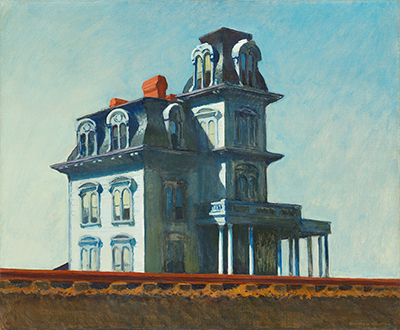
1927New York Movie
1939Nighthawks
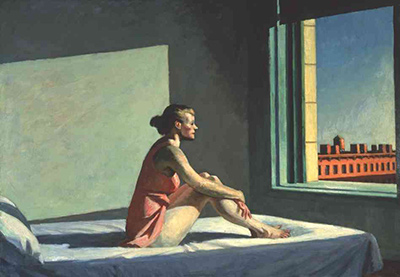
1942Morning Sun
1952Contents
- Two figures in a broad space
- Why the pair stands to the left
- White costumes and small distinctions
- The joined hands
- The free hands direct attention between them
- A stage edge close to the spectator
- Darkness with traces of scenery
- Painted scenery and the actual edge of the canvas
- Theatre as a sustained interest
- From one Pierrot to two performers
Two figures in a broad space
The performers stand a little left of centre. They occupy only part of the canvas, leaving substantial space above and beside them. Their proximity makes them a distinct pair rather than two isolated figures distributed across a setting.
The woman at the left wears a long white costume and a close-fitting head covering. The man at the right is taller, with white trousers, a conspicuous collar and a hat. Their clothing gives each a separate silhouette within the shared brightness.
The space between their upper bodies remains visible. Their linked hands bridge that gap without making the two figures merge. We can follow the gesture from one person to the other, then return to the differences in height, stance and costume.
Their feet hold them close to the front of the platform. The bodies do not stride through the scene or disappear towards its rear. Whatever movement may have brought them here, Hopper presents a moment in which the pair face outward and make themselves available to an audience.
Why the pair stands to the left
The figures occupy a position left of the canvas's centre. The broad dark area continues beyond them towards the scenery at the right, leaving much more space on that side than a tightly balanced double portrait would need. Their joined presence does not eliminate the emptiness around them.
This placement makes the picture's horizontal reach conspicuous. Our attention can begin with the faces and hands, then move over a stretch of dark paint before finding the green, tree-like forms near the wing. The separation gives those forms an uncertain scale. They belong to a theatrical setting without providing a complete view of its construction.
The figures' upright bodies are small in relation to that interval. The woman is lower and narrower; the man rises beside her, with a darker head covering. Their different heights give the pair a recognisable bodily relationship even before we consider their identification with the Hoppers.
Hopper has also kept them close enough to form a single group. The dark gap separating parts of the white costumes never becomes the major open space of the picture. Joined hands and inclined arms carry the eye across it. The much larger empty area lies beyond their shared action.
White costumes and small distinctions
The costumes are bright without being uniformly blank. Cooler shadows articulate folds and separate arms from torsos. Small changes of tone give the bodies substance while preserving the striking contrast with the background.
The woman's longer garment creates a more continuous vertical shape. The man's separated legs make two narrower uprights. Together, these forms provide a varied rhythm that would be lost if both wore identical silhouettes.
The collars and headwear add a theatrical character to what might otherwise look like pale everyday clothing. Yet the picture does not illustrate a joke, a recognisable comic routine or a specific play. Its title supplies the idea of performers without requiring us to reconstruct their act.
This makes the outward-facing poses especially interesting. The figures appear to acknowledge someone beyond the canvas, but the response they receive is unavailable. There is no painted applause, no visible row of spectators and no accompanying speech to establish the mood of their appearance.
The joined hands
The connection between the pair is small in area but central to their relationship. Their inner arms reach across the interval, while the other gestures turn attention back towards the partnership. They seem to present one another as well as themselves.
This can suggest mutual recognition or affection, but those impressions arise from a staged arrangement. We do not need to convert the gesture into proof of an uncomplicated private relationship. An acknowledgement before an audience leaves much of the lives behind it unspoken.
The gesture also affects how we move through the picture. The brightness first attracts attention to the figures; the hands then make us travel between them. The dark space around the group gives that small movement room to register.
There is a difference between two people standing side by side and two people visibly linked. Hopper preserves both the distinction between their bodies and the action that brings them together. The pair remain separate individuals within a common performance.
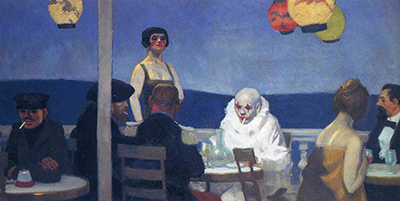
Compare: Soir Bleu, 1914.
The free hands direct attention between them
The clasp is only part of the exchange. Each figure also has a free hand, and those hands turn the action back towards the partnership. The taller figure's bent arm appears to present or acknowledge the companion beside him. The woman's free hand is held near her own body, rather than stretched out in a broad appeal to an unseen audience.
These small gestures give the painting a different emphasis from an image of two performers independently displaying themselves. The figures share the public surface of the stage, while the direction of their arms also makes them attentive to one another. The spectator is offered a relationship as well as a performance.
The white costumes help us read those movements against the dark ground. Elbows, cuffs and sleeves create a sequence of changes in direction. Where the two bodies approach, the joined hands form a warmer, less geometrically simple link between larger areas of fabric.
None of these details requires a precise point in a theatrical routine. The stillness can suggest an acknowledgement, an arrival, a pause or a leave-taking. What remains visually definite is that Hopper has made a restrained exchange of gestures carry the action of a very wide stage.
A stage edge close to the spectator
The broad pale front of the stage sweeps across the foreground. A darker line follows its upper boundary, while rectangular panels below establish a constructed surface. This is a physical edge between performers and audience, even though the audience remains outside the view.
Its curve complicates the otherwise upright figures. They stand against a largely vertical background, but the foreground bends across our position. The stage seems close enough to dominate the lower picture rather than receding into a distant theatrical interior.
That proximity reverses the arrangement of First Row Orchestra, where looking at spectators becomes part of the subject. Here the spectators' place is supplied by our own viewpoint. The performers look into a space we occupy but cannot see pictured.
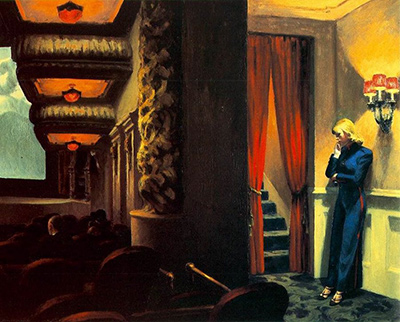
In New York Movie, attention is divided between a screening space and an attendant beside it. Two Comedians removes much of that architectural complication. The act of appearing before someone becomes the central encounter.
Darkness with traces of scenery
The backdrop is not an evenly filled black rectangle. Green, blue and near-black areas shift across it. At the right, warmer, irregular forms and a narrow vertical border suggest another edge to the setting.
Those hints are enough to imply theatrical scenery without defining a location. The performers could belong to a stage world, but we are not given a convincing landscape in which to place them. The background is both a setting and a conspicuous absence of information.
In his commentary for the Whitney's 2022 exhibition, artist Kambui Olujimi emphasised this instability. He described the foreground as seeming almost sandy and landscape-like, and found that the dark greens could make the apparent curtain feel like a field. These are responses to the painting's visual ambiguity, rather than identifications of literal sand or an outdoor location. [2]
The reading is useful because the picture gives a few clear theatrical signs while leaving much of the surrounding space unresolved. The stage edge and costumes locate a performance; colour and darkness make its environment less secure. The two effects coexist rather than cancel one another.
Painted scenery and the actual edge of the canvas
The greenery at the right does not open into a continuous landscape. It meets a tall pale upright and the edge of the picture. Its irregular outline gives one side of the stage the suggestion of foliage, while the dark expanse behind the pair offers little corresponding detail.
The pale stage floor has a different kind of breadth. It stretches under both figures and continues towards the right, with a darker front edge marking the change from the performing surface to the panelled face below. The floor is consequently a platform we can understand more readily than the space behind it.
The lower panels make that platform materially substantial. Their shallow rectangles connect the scene with the ordinary construction of a theatre, even while the empty backdrop encourages a more symbolic reading. A picture concerned with an ending still includes a built surface on which people have to stand.
The signature near the lower left belongs to the painted object rather than the fictional performance. From this position it sits well below the faces, close to the stage's architectural front. Looking from signature to panels to performers reveals several different ways the canvas addresses us: as an authored painting, a constructed setting and an encounter between figures.
Watch: Edward Hopper’s Life and Art
Explore Hopper’s paintings and the places behind them in these museum films. Choose a film below.
Theatre as a sustained interest
The subject also belongs to a documented part of Edward and Jo Hopper's shared life. The Whitney's Sanborn Hopper Archive preserves hundreds of theatre ticket stubs. Its guide explains that Jo had acted with the Washington Square Players before their marriage and that the couple continued attending performances. The surviving tickets also record a preference for balcony seats. [3]
This history helps place the painting within a sustained interest in theatrical space. Stages involve bodies, lighting, deliberate gestures and an audience watching from a defined position. Those elements could matter to a painter independently of a production's written plot.
The low, direct viewpoint here differs from the elevated positions often associated with a balcony. Hopper did not simply reproduce a habitual seat. He chose a relation between performer and spectator suited to this particular image.
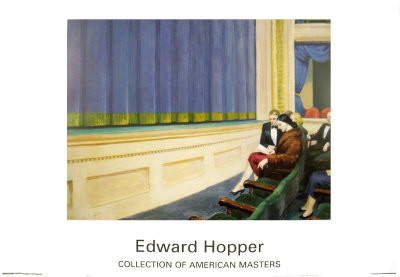
Compare: First Row Orchestra, 1951.
From one Pierrot to two performers
The white-clad figure in Soir Bleu provides a comparison within Hopper's own career. There, a conspicuous costume occupies a café shared with people dressed very differently. In Two Comedians, the two principal figures belong to the same world of theatrical dress. The contrast has shifted from one performer among other social types to a partnership before a largely empty setting.
Watteau's Pierrot, now dated about 1718–1719 by the Louvre, offers another way of testing what a white costume can do. Watteau's principal figure faces front with arms hanging down. Smaller characters and an animal occupy the lower space behind him. His large pale body dominates the vertical painting. [4]
Hopper's arrangement has nearly the reverse proportions. The two pale bodies are relatively small within a wide canvas, and their arms create a connection. Neither the historical costume nor the dark setting makes the emotional meaning identical. The comparison helps us see how much depends on scale, direction and the relation between the performers.
The familiar label of the melancholy clown can obscure those differences. It may guide us towards a history of performers as vulnerable or isolated figures, but it does not explain the offered hand, the asymmetry of the pair or the large interval at their right. Those decisions belong to this particular painting.
The two figures can also be understood as appearing together before viewers who remain beyond the painted edge. Their awareness of being seen distinguishes the scene from many Hopper interiors, where a person seems occupied elsewhere. Here the performance openly acknowledges the public situation of a picture.
A final arrangement, reached through alternatives
The 2018 Sotheby's catalogue reports that preparatory studies explored more active arrangements, including the pair dancing farther back and a version with the man entering the stage while the woman climbed up. [1] That account describes alternatives considered during the work's development; it does not make them earlier episodes in a continuous performance.
The completed canvas is comparatively still. The people have reached a position where they can stand together near the front. Their shared appearance depends on small gestures and the relation to the spectator, rather than on an elaborate action.
This reduction gives the surrounding space greater force. With fewer movements to follow, we attend more closely to where the figures stop, how they are linked and what lies beyond them. The image holds an acknowledgement open without showing its conclusion.
The painting's audience after Hopper
The work's later history has carried this private identification into new public settings. In April 2022 the Bruce Museum announced a promised bequest of seventy works from an anonymous Greenwich couple, explicitly including Two Comedians, which its release dates to 1966. The announcement described loans planned for the expanded museum before the gift's eventual fulfilment. A promised bequest and a completed accession are different events. [5]
This institutional history gives the idea of a final performance another dimension. A painting that came at the end of an artist's working life can continue to gain audiences through exhibitions, collecting and museum interpretation. Its apparent farewell does not close its history as an object.
For a viewer who does know the Hoppers' history, the clasp need not settle every difficulty of their marriage. The painted act has its own economy. It gives Jo and Edward a position together, makes their unequal heights visible and connects their differently poised bodies through a small meeting of hands.
That is why the farewell interpretation can remain persuasive without becoming a prediction. The finality belongs partly to what happened after the canvas was made. The painted relationship remains present tense: two performers stand before us, with the next movement still to come.
The Hoppers and the farewell reading
Sotheby's presents the performers as Edward and Jo, drawing on Gail Levin's interpretation of the painting as an acknowledgement of Jo's partnership. Its provenance also records the painting in the collection of Frank and Barbara Sinatra from 1972, followed by another ownership change around 1995. Those are historical entries, rather than a statement of present ownership. [1]
Reading the figures as the Hoppers makes the linked hands particularly affecting. Jo's place beside Edward becomes part of the public appearance rather than remaining behind the image. Yet the identification and the idea of a farewell should retain their status as interpretations. A final painting is not automatically a recorded declaration that its maker knew it would be the last.
The canvas supports a less predetermined experience as well. Before knowing its date or the proposed identities, a viewer can recognise two people taking their place together before an unseen audience. The historical context deepens that encounter, but does not replace it. Hopper leaves the pair visible against a space that remains uncertain, their partnership expressed through a gesture small enough to miss and strong enough to organise the whole scene.
Artworks and studies directory
This researched directory includes finished works and separately identified studies. It is not a complete catalogue raisonné. Linked titles open the articles; unlinked studies are identified by their collection accessions. Watercolours retain their recorded media, and original prints remain distinct from reproductions.
| Name | Date | Medium |
|---|---|---|
| (Bridge and Embankment) (70.1298) | 1906 | Oil on wood |
| (Jo Sketching at Good Harbor Beach) (70.1129) | 1923–1924 | Watercolor and fabricated chalk on paper |
| (Manhattan Bridge) (70.1098) | 1925–1926 | Watercolor and graphite pencil on paper |
| (Rooftops) (70.1114) | 1926 | Watercolor and graphite pencil on paper |
| (Seated Male Model, Bent Over) (70.1277) | c. 1902–1903 | Oil on canvas |
| (Self-Portrait) (70.1254) | 1903–1906 | Oil on canvas |
| (Solitary Figure in a Theater) (70.1418) | c. 1902–1904 | Oil on board |
| 5 A.M. | 1937 | oil on canvas |
| Adam's House | 1928 | watercolour and charcoal on paper |
| American Village | 1912 | Oil on canvas |
| Apartment Houses | 1923 | oil on canvas |
| Approaching a City | 1946 | oil on canvas |
| August in the City | 1945 | oil on canvas |
| Automat | 1927 | oil on canvas |
| Barber Shop | 1931 | oil on canvas |
| Blackwell's Island | 1928 | oil on canvas |
| Bridge on the Seine | 1909 | Oil on canvas |
| Bridle Path | 1939 | oil on canvas |
| Burly Cobb's House South Truro | 1930–1933 | oil on canvas |
| Cape Cod Evening | 1939 | oil on canvas |
| Cape Cod Morning | 1950 | oil on canvas |
| Chair Car | 1965 | oil on canvas |
| Chop Suey | 1929 | oil on canvas |
| City Roofs | 1932 | Oil on canvas |
| Coast Guard Station | 1929 | oil on canvas |
| Compartment C, Car 293 | 1938 | oil on canvas |
| Conference at Night | 1949 | oil on canvas |
| Corn Hill | 1930 | oil on canvas |
| Dawn in Pennsylvania | 1942 | oil on canvas |
| Drug Store | 1927 | oil on canvas |
| Early Sunday Morning | 1930 | Oil on canvas |
| East Side Interior (70.1020) | 1922 | Etching |
| East Wind Over Weehawken | 1934 | oil on canvas |
| El Palacio | 1946 | Watercolor and graphite pencil on paper |
| Eleven A.M. | 1926 | oil on canvas |
| Evening Wind | 1921 | etching |
| Excursion into Philosophy | 1959 | oil on canvas |
| First Row Orchestra | 1951 | oil on canvas |
| Freight Car at Truro | 1931 | watercolour over graphite on paper |
| Gas | 1940 | oil on canvas |
| Girl at a Sewing Machine | c. 1921 | oil on canvas |
| Gloucester Harbor | 1912 | Oil on canvas |
| Ground Swell | 1939 | oil on canvas |
| Haskell's House | 1924 | watercolour over graphite on paperboard |
| High Noon | 1949 | oil on canvas |
| Hill and Houses Cape Elizabeth Maine | 1927 | watercolour over graphite pencil |
| Hills South Truro | 1930 | oil on canvas |
| Hotel by a Railroad | 1952 | oil on canvas |
| Hotel Lobby | 1943 | oil on canvas |
| Hotel Room | 1931 | oil on canvas |
| Hotel Window | 1955 | oil on canvas |
| House by the Railroad | 1925 | oil on canvas |
| House by the Squam River | 1926 | watercolour over graphite on paper |
| Le Bistro or The Wine Shop | 1909 | Oil on canvas |
| Le Pont des Arts | 1907 | Oil on canvas |
| Le Pont Royal | 1909 | Oil on canvas |
| Le Quai des Grands Augustins | 1909 | Oil on canvas |
| Lighthouse and Buildings Portland Head | 1927 | watercolour over graphite pencil on paper |
| Lighthouse Hill | 1927 | oil painting |
| Manhattan Bridge Loop | 1928 | oil on canvas |
| Model Sitting | c. 1902 | oil painting; support not asserted |
| Morning Sun | 1952 | oil on canvas |
| New York Movie | 1939 | oil on canvas |
| New York New Haven and Hartford | 1931 | oil on canvas |
| New York Office | 1962 | oil on canvas |
| New York Pavements | 1924–1925 | oil on canvas |
| New York Restaurant | c. 1922 | oil on canvas |
| Night Windows | 1928 | oil on canvas |
| Nighthawks | 1942 | oil on canvas |
| October on Cape Cod | 1946 | oil on canvas |
| Office at Night | 1940 | oil on canvas |
| Office in a Small City | 1953 | oil on canvas |
| Pennsylvania Coal Town | 1947 | oil on canvas |
| People in the Sun | 1960 | oil on canvas |
| Portrait of Orleans | 1950 | oil on canvas |
| Queensborough Bridge | 1913 | Oil on canvas |
| Railroad Sunset | 1929 | Oil on canvas |
| Railroad Train | 1908 | oil on canvas |
| Road in Maine | 1914 | oil on canvas |
| Room in Brooklyn | 1932 | oil on canvas |
| Room in New York | 1932 | oil on canvas |
| Rooms by the Sea | 1951 | oil on canvas |
| Rooms for Tourists | 1945 | oil on canvas |
| Route 6 Eastham | 1941 | oil on canvas |
| Second Story Sunlight | 1960 | Oil on canvas |
| Self-Portrait | 1925–1930 | Oil on canvas |
| Self-Portrait with Hat (70.1903) | c. 1918, posthumous print | Drypoint |
| Seven A.M. | 1948 | Oil on canvas |
| Soir Bleu | 1914 | oil on canvas |
| South Carolina Morning | 1955 | Oil on canvas |
| Stairway at 48 Rue de Lille Paris | 1906 | Oil on wood |
| Study for 5 A.M. (70.153) | 1937 | Fabricated chalk on paper |
| Study for 5 A.M. (70.429) | 1937 | Fabricated chalk and graphite pencil on paper |
| Study for Approaching a City (70.869) | 1946 | Fabricated chalk and charcoal on paper |
| Study for August in the City (70.158a-b) | 1945 | Fabricated chalk on paper |
| Study for August in the City (70.159) | 1945 | Fabricated chalk on paper |
| Study for Bridle Path (70.220) | 1939 | Fabricated chalk on paper |
| Study for Bridle Path (70.235) | 1939 | Fabricated chalk on paper |
| Study for Compartment C, Car 293 (70.430) | 1938 | Fabricated chalk on paper |
| Study for Compartment C, Car 293 (70.431a-b) | 1938 | Fabricated chalk and charcoal on paper |
| Study for Conference at Night (70.170) | 1949 | Fabricated chalk on paper (recto); Typewriter ink on paper (verso) |
| Study for Conference at Night (70.174) | 1949 | Fabricated chalk on paper ( recto); Typewriter ink on paper (verso) |
| Study for East Wind over Weehawken (70.249) | 1934 | Graphite pencil on paper |
| Study for East Wind over Weehawken (70.252) | 1934 | Fabricated chalk and charcoal on paper |
| Study for Evening Wind (70.343a-b) | 1921 | Fabricated chalk on paper |
| Study for First Row Orchestra (70.841) | 1951 | Fabricated chalk and charcoal on paper |
| Study for Gas (70.263) | 1940 | Fabricated chalk on paper |
| Study for Ground Swell (70.339) | 1939 | Fabricated chalk, charcoal and graphite pencil on paper |
| Study for Hotel by a Railroad (70.199) | 1952 | Fabricated chalk on paper |
| Study for Hotel by a Railroad (70.427) | 1952 | Fabricated chalk on paper |
| Study for Hotel by a Railroad (70.428) | 1952 | Fabricated chalk on paper |
| Study for Hotel Lobby (70.117) | 1942 | Fabricated chalk and graphite pencil on paper |
| Study for Hotel Lobby (70.839) | 1942 | Fabricated chalk and charcoal on paper |
| Study for Hotel Window (70.161) | 1955 | Fabricated chalk, graphite pencil and colored pencil on paper |
| Study for Morning Sun (70.243) | 1952 | Fabricated chalk on paper |
| Study for Morning Sun (70.244) | 1952 | Fabricated chalk on paper |
| Study for Morning Sun (70.290) | 1952 | Fabricated chalk on paper |
| Study for Morning Sun (70.291) | 1952 | Fabricated chalk and graphite pencil on paper |
| Study for New York Movie (70.273) | 1939 | Fabricated chalk on paper |
| Study for New York Movie (70.274a-b) | 1938 or 1939 | Fabricated chalk and charcoal on paper (recto); Fabricated chalk on paper (verso) |
| Study for New York Movie (70.455) | 1939 | Fabricated chalk and charcoal on paper |
| Study for New York Office (70.822) | 1962 | Fabricated chalk on paper |
| Study for Nighthawks (70.192) | 1941 or 1942 | Fabricated chalk on paper |
| Study for Nighthawks (70.193) | 1941 or 1942 | Fabricated chalk on paper |
| Study for Office at Night (70.340) | 1940 | Fabricated chalk and charcoal on paper |
| Study for Office at Night (70.341) | 1940 | Fabricated chalk and graphite pencil on paper |
| Study for Pennsylvania Coal Town (70.198) | 1947 | Fabricated chalk on paper |
| Study for Pennsylvania Coal Town (70.229) | 1947 | Fabricated chalk and charcoal on paper |
| Study for Rooms for Tourists (70.438) | 1945 | Fabricated chalk and charcoal on paper |
| Study for Rooms for Tourists (70.848) | 1945 | Fabricated chalk and charcoal on paper |
| Study for Route 6, Eastham (70.369) | 1941 | Fabricated chalk and graphite pencil on paper |
| Study for Route 6, Eastham (70.854) | 1941 | Fabricated chalk and graphite pencil on paper |
| Study for South Carolina Morning (70.162a-b) | 1955 | Fabricated chalk on paper (recto and verso) |
| Study for The Sheridan Theatre (70.969) | 1937 | Graphite pencil on paper |
| Study for Two on the Aisle (70.128) | 1927 | Fabricated chalk on paper |
| Study for Two on the Aisle (70.129) | 1927 | Fabricated chalk on paper |
| Study for Yawl Riding a Swell (70.439) | 1935 | Fabricated chalk and graphite pencil on paper |
| Summer Evening | 1947 | oil on canvas |
| Summer Interior | 1909 | Oil on canvas |
| Sun in an Empty Room | 1963 | oil on canvas |
| Sunlight in a Cafeteria | 1958 | oil on canvas |
| Sunlight on Brownstones | 1956 | oil on canvas |
| Tables for Ladies | 1930 | oil on canvas |
| The Bootleggers | 1925 | oil on canvas |
| The Camel's Hump | 1931 | oil on canvas |
| The Circle Theatre | 1936 | oil on canvas |
| The City | 1927 | oil on canvas |
| The Lighthouse at Two Lights | 1929 | oil on canvas |
| The Long Leg | 1935 | oil on canvas |
| The Mansard Roof | 1923 | watercolour over graphite on paper |
| The Sheridan Theatre | 1937 | oil on canvas |
| Tramp Steamer | 1908 | oil on canvas |
| Two Comedians | 1966 | oil on canvas |
| Two on the Aisle | 1927 | oil on canvas |
| Valley of the Seine | 1909 | Oil on canvas |
| Western Motel | 1957 | oil on canvas |
Frequently Asked Questions
Edward Hopper made Two Comedians in 1966. [1]
The recorded medium is oil on canvas. [1]
Two performers in white stand near the front of a stage. Their inner hands meet, their outer arms gesture towards one another, and a large dark backdrop extends around them. Edward Hopper's Two Comedians makes the relationship between a small human group and an extensive, uncertain space unusually direct. We occupy the place from which their appearance would be watched.
Discussion
Look again at the images and ideas explored in Two Comedians. These editorial prompts invite your observations.
Reader Insights
Which boundary, gesture or change of light first holds your attention in Two Comedians?
Compare Soir Bleu with Two Comedians. Which visual difference matters most to your reading?
Which detail would you look at again after reading “The joined hands”?
Join the Conversation
Share a detail, comparison or question about Two Comedians below.
References
- Sotheby's, Two Comedians, American Art, 16 November 2018, lot 15, object metadata, provenance and catalogue note; interpretation of Edward and Jo transmitted through Gail Levin's work. View source.
- Whitney Museum of American Art, Two Comedians, 1966: Kambui Olujimi commentary, published transcript, 2 October 2022; accompanying exhibition guide identifies the work as 1966. View source.
- Whitney Museum of American Art, Edward Hopper's New York, guide stop 511: Performances, narrator and David Crane on the Hoppers' theatre-going and surviving ticket stubs. View source.
- Musée du Louvre, Jean-Antoine Watteau, Pierrot, formerly known as Gilles, c. 1718–1719, MI 1121; 2024 exhibition press dossier, pp. 1–6 and restored painting reproduced on PDF p. 3. Selected text and actual reproduction inspected; not a claim to have read the whole dossier. View source 1. View source 2.
- Bruce Museum, “Bruce Museum to Receive Promised Gift of a Major Collection of European and American Art”, 13 April 2022, complete four-page release, especially p. 2. The source describes a promised bequest and planned initial loans; it does not establish a completed current accession. View source.
- Collection or catalogue record, American Village, 1912; medium and identity as discussed in the linked article. View source.
- Collection or catalogue record, Soir Bleu, 1914; medium and identity as discussed in the linked article. View source.
- Collection or catalogue record, House by the Railroad, 1925; medium and identity as discussed in the linked article. View source.
- Collection or catalogue record, Automat, 1927; medium and identity as discussed in the linked article. View source.
- Collection or catalogue record, Early Sunday Morning, 1930; medium and identity as discussed in the linked article. View source.
- Collection or catalogue record, New York Movie, 1939; medium and identity as discussed in the linked article. View source.
- Collection or catalogue record, Nighthawks, 1942; medium and identity as discussed in the linked article. View source.
- Collection or catalogue record, Morning Sun, 1952; medium and identity as discussed in the linked article. View source.
- Collection or catalogue record, Second Story Sunlight, 1960; medium and identity as discussed in the linked article. View source.
- Collection or catalogue record, Two Comedians, 1966; medium and identity as discussed in the linked article. View source.
- Whitney Museum of American Art, Study for Route 6, Eastham, 1941, accession 70.854; exact object record. View source.
- Whitney Museum of American Art, Study for Conference at Night, 1949, accession 70.170; exact object record. View source.
- Whitney Museum of American Art, Study for First Row Orchestra, 1951, accession 70.841; exact object record. View source.
- Whitney Museum of American Art, (Bridge and Embankment), 1906, accession 70.1298; exact object record. View source.
- Whitney Museum of American Art, (Seated Male Model, Bent Over), c. 1902–1903, accession 70.1277; exact object record. View source.
- Whitney Museum of American Art, Study for Morning Sun, 1952, accession 70.244; exact object record. View source.
- Whitney Museum of American Art, Study for Morning Sun, 1952, accession 70.243; exact object record. View source.
- Whitney Museum of American Art, Study for Two on the Aisle, 1927, accession 70.128; exact object record. View source.
- Whitney Museum of American Art, Study for New York Office, 1962, accession 70.822; exact object record. View source.
- Whitney Museum of American Art, Study for Two on the Aisle, 1927, accession 70.129; exact object record. View source.
- Whitney Museum of American Art, Study for Pennsylvania Coal Town, 1947, accession 70.229; exact object record. View source.
- Whitney Museum of American Art, (Rooftops), 1926, accession 70.1114; exact object record. View source.
- Whitney Museum of American Art, Study for South Carolina Morning, 1955, accession 70.162a-b; exact object record. View source.
- Whitney Museum of American Art, (Self-Portrait), 1903–1906, accession 70.1254; exact object record. View source.
- Whitney Museum of American Art, (Manhattan Bridge), 1925–1926, accession 70.1098; exact object record. View source.
- Whitney Museum of American Art, (Solitary Figure in a Theater), c. 1902–1904, accession 70.1418; exact object record. View source.
- Whitney Museum of American Art, Study for Approaching a City, 1946, accession 70.869; exact object record. View source.
- Whitney Museum of American Art, Study for August in the City, 1945, accession 70.159; exact object record. View source.
- Whitney Museum of American Art, Study for Compartment C, Car 293, 1938, accession 70.430; exact object record. View source.
- Whitney Museum of American Art, Study for Compartment C, Car 293, 1938, accession 70.431a-b; exact object record. View source.
- Whitney Museum of American Art, Study for East Wind over Weehawken, 1934, accession 70.252; exact object record. View source.
- Whitney Museum of American Art, Study for East Wind over Weehawken, 1934, accession 70.249; exact object record. View source.
- Whitney Museum of American Art, Study for Evening Wind, 1921, accession 70.343a-b; exact object record. View source.
- Whitney Museum of American Art, Study for The Sheridan Theatre, 1937, accession 70.969; exact object record. View source.
- Whitney Museum of American Art, Study for New York Movie, 1939, accession 70.455; exact object record. View source.
- Whitney Museum of American Art, Study for New York Movie, 1939, accession 70.273; exact object record. View source.
- Whitney Museum of American Art, Study for New York Movie, 1938 or 1939, accession 70.274a-b; exact object record. View source.
- Whitney Museum of American Art, Study for 5 A.M., 1937, accession 70.153; exact object record. View source.
- Whitney Museum of American Art, Study for 5 A.M., 1937, accession 70.429; exact object record. View source.
- Whitney Museum of American Art, (Jo Sketching at Good Harbor Beach), 1923–1924, accession 70.1129; exact object record. View source.
- Whitney Museum of American Art, Study for August in the City, 1945, accession 70.158a-b; exact object record. View source.
- Whitney Museum of American Art, Study for Morning Sun, 1952, accession 70.291; exact object record. View source.
- Whitney Museum of American Art, Study for Morning Sun, 1952, accession 70.290; exact object record. View source.
- Whitney Museum of American Art, Study for Office at Night, 1940, accession 70.340; exact object record. View source.
- Whitney Museum of American Art, Study for Office at Night, 1940, accession 70.341; exact object record. View source.
- Whitney Museum of American Art, Study for Hotel by a Railroad, 1952, accession 70.427; exact object record. View source.
- Whitney Museum of American Art, Study for Hotel by a Railroad, 1952, accession 70.199; exact object record. View source.
- Whitney Museum of American Art, Study for Hotel by a Railroad, 1952, accession 70.428; exact object record. View source.
- Whitney Museum of American Art, Study for Hotel Lobby, 1942, accession 70.117; exact object record. View source.
- Whitney Museum of American Art, Study for Hotel Lobby, 1942, accession 70.839; exact object record. View source.
- Whitney Museum of American Art, Study for Conference at Night, 1949, accession 70.174; exact object record. View source.
- Whitney Museum of American Art, Study for Hotel Window, 1955, accession 70.161; exact object record. View source.
- Whitney Museum of American Art, Study for Pennsylvania Coal Town, 1947, accession 70.198; exact object record. View source.
- Whitney Museum of American Art, Study for Route 6, Eastham, 1941, accession 70.369; exact object record. View source.
- Whitney Museum of American Art, Study for Bridle Path, 1939, accession 70.220; exact object record. View source.
- Whitney Museum of American Art, Study for Bridle Path, 1939, accession 70.235; exact object record. View source.
- Whitney Museum of American Art, Study for Ground Swell, 1939, accession 70.339; exact object record. View source.
- Whitney Museum of American Art, Study for Yawl Riding a Swell, 1935, accession 70.439; exact object record. View source.
- Whitney Museum of American Art, Study for Rooms for Tourists, 1945, accession 70.848; exact object record. View source.
- Whitney Museum of American Art, Study for Rooms for Tourists, 1945, accession 70.438; exact object record. View source.
- Whitney Museum of American Art, Study for Nighthawks, 1941 or 1942, accession 70.193; exact object record. View source.
- Whitney Museum of American Art, Study for Nighthawks, 1941 or 1942, accession 70.192; exact object record. View source.
- Whitney Museum of American Art, Study for Gas, 1940, accession 70.263; exact object record. View source.
- Whitney Museum of American Art, Self-Portrait with Hat, c. 1918, posthumous print, accession 70.1903; exact object record. View source.
- Whitney Museum of American Art, East Side Interior, 1922, accession 70.1020; exact object record. View source.
- Art Institute of Chicago, Selected Chronology for Edward Hopper; training, travels, exhibitions, New York and Truro chronology. View source.
- Emily C. Burns, Spectral figures: Edward Hopper’s empty Paris, chapter 5 in Empty Spaces: Confronting Emptiness in National, Cultural and Urban Histories, 2019; complete chapter and notes consulted. View source.
- Charles Brock, Regionalism and Folk Art, National Gallery of Art; complete essay and two notes consulted. View source.