 by Tom Gurney
Tom Gurney BSc (Hons) is an art history expert with over 20 years experience
Email: tomgurney1@gmail.com / Phone: +44 7429 011000
Edward Hopper's New England Landscapes: Introduction
New England gave Edward Hopper more than a summer alternative to New York. Its towns, rocky shores, inland valleys and roads offered different ways to place a building or a person within a landscape. A Gloucester house could fill a sheet with ornamental complexity. A lighthouse could rise beyond an almost bare hill. In Vermont, slopes and trees could become the principal subjects.
The places belong to different phases of his work. Gloucester was central to the success of his watercolours in the 1920s. Maine offered successive coastal settings, from Ogunquit to Monhegan and Cape Elizabeth. Vermont supplied repeated inland journeys. From 1930, Truro on Cape Cod became a recurring base; the Hoppers bought land there in 1933 and completed their house in July 1934. [1]
Looking across those locations reveals changes in both subject and method. Some works respond closely to a place in front of the painter. Others assemble remembered buildings, vegetation and figures into a scene that never existed in quite that form. The region is a source of particular things to see, and a setting in which those things can be transformed.
For the larger national context, explore the guide to famous American artists and compare different approaches to the American landscape.
At a Glance
Contents
- Gloucester brought houses into the foreground
- The houses belong to a changing region
- Maine was several different kinds of coast
- Lighthouses are buildings in uneven terrain
- Two Lights was a working site before it became a park view
- Vermont redirected attention inland
- A roadside position changes what can be painted
- Truro became a place to return to
- Cape Cod's open land has a history
- Fieldwork could lead to an invented scene
Gloucester brought houses into the foreground
In the summer of 1923, Hopper and Jo Nivison painted in Gloucester. Jo encouraged his work in watercolour and helped bring it to the attention of the Brooklyn Museum. The museum included six of his watercolours in an exhibition and bought The Mansard Roof. Gail Levin's study of Jo documents her role in that important change in Edward's fortunes. [2]
The Mansard Roof gives architecture an unusually animated surface. Roofs, dormers, verandas and foliage compete for space. Sunlit passages break against dark openings, while the repeated changes of direction prevent the house from settling into a single simple block.
The subject is local, but the painting is also a demanding exercise in selection. Each piece of ornament could invite further description. Hopper has to make the larger relations remain legible: the upper roof against the sky, the verandas projecting forwards, and the trees interrupting the building's outline.
Haskell's House offers another way to organise domestic architecture. Its roof and walls have a strong presence within the surrounding ground. The small figure near the lower edge introduces a human scale without becoming the principal subject. Light gives the house weight through the difference between its bright and shaded faces.
These works reward looking beyond the idea of a picturesque old home. Their interest includes awkward viewpoints, interruptions and the question of how much paper to leave around a building. The house matters as something inhabited, but also as a complex form that a painter must construct through colour.
The houses belong to a changing region
Gloucester's architecture has a different character from an unoccupied wilderness. Houses, roads, porches and utility structures record successive uses of the land. Even when a person is almost invisible in a painting, the built setting supplies evidence of habitation and work.
The choice of an ordinary house can also change the expected coastal view. Rather than offering a harbour panorama, Hopper can let a complicated roof occupy much of the sheet. A verandah may conceal the entrance; trees can interrupt the upper outline; sloping ground may make the position from which the artist looks seem awkward.
Those interruptions distinguish a painting from a catalogue elevation of a building. The eye encounters parts in an uneven order. A bright roof may attract attention before a dark doorway, while a patch of foliage can become a stronger accent than a window. The local structure has been turned into a selected visual encounter.
The watercolour medium gives that encounter another kind of specificity. Fine drawn indications can coexist with broad areas of wash. The painter does not need to give lawn, ornamental trim and sky the same density of marks. Their different treatment makes the architecture seem both solid and responsive to light.
Gloucester is consequently more than the place where Hopper achieved an early success. Its varied domestic buildings provided sustained problems of scale, position and surface. Returning to those problems could produce new pictures without requiring an entirely new class of subject.
Maine was several different kinds of coast
Hopper's Maine subjects developed through a series of locations. Bowdoin College Museum of Art's guide places him in Ogunquit in 1914–15, on Monhegan for four consecutive summers beginning in 1916, in Rockland in 1926, and around Cape Elizabeth in 1927 and 1929. Its account distinguishes rocky coastal studies, houses, working waterfronts and lighthouse subjects. [3]
That range makes a single description of his coastal work inadequate. A mass of rock close to the viewer raises different problems from a house across an open field. The first can be built through abrupt changes of plane and thick, directional marks. The second may depend on a few precise edges separated by broad areas of light.
Road in Maine directs attention through a land route rather than towards a famous seaside destination. A road gives the eye somewhere to go, but its turns also decide what remains concealed. The landscape can feel extensive even when only a short stretch of it is visible.
In the architectural pictures, cropping is equally important. Showing a portion of a large building can make its scale more strongly felt than presenting every wall. A corner, an upper roof or a steeply angled façade can turn the viewer's position into part of the subject.
The different locations therefore offered more than a succession of attractive views. They allowed Hopper to vary the relation between a near object and a distant horizon, between an engineered structure and uneven ground, and between a route through the landscape and a view that stops short.
Lighthouses are buildings in uneven terrain
Bowdoin's guide identifies the Two Lights area of Cape Elizabeth as a recurring source for Hopper's paintings in 1927 and 1929. [3] A lighthouse brings an immediately recognisable structure into a coastal picture, but Hopper's different treatments place considerable weight on what surrounds it.
In Lighthouse Hill, a broad, dark slope occupies the foreground. The tower stands beyond it, near the crest, with the keeper's house holding another position along the ridge. The building's height is made visible through the amount of land between it and the viewer.
The painting does not need to explain the lighthouse through a busy harbour or a dramatic rescue. The tower's vertical shape contrasts with the irregular rise of the hill. The house adds a more domestic geometry, while the dark ground gives both buildings a bright, distant presence.
Lighthouse and Buildings shifts attention towards the group of structures. Roofs, walls and the tower can be compared as parts of a working site. The composition asks how those forms sit beside one another, rather than using the lighthouse solely as an isolated emblem.
The distinction helps keep a familiar motif open. A viewer may associate lighthouses with guidance or safety, but their meaning in a particular painting also depends on size, light and viewpoint. The ground can be as consequential as the lamp at the top.
Two Lights was a working site before it became a park view
The name Two Lights refers to the paired lighthouse site at Cape Elizabeth. Maine's tourism account dates its first twin lights to 1828 and records the western light's deactivation in 1924. The state park opened much later, in 1961. These are different stages of the place's history, and the park should not be projected backwards onto Hopper's visits of the 1920s. [4]
That history makes the buildings more than isolated symbols. They belonged to a system of navigation and coastal occupation. The tower visible in a painting can have a formal role as a pale upright while also being part of a site with keepers' accommodation and other practical structures.
Lighthouse Village, the 1929 watercolour now in Cleveland, gives those accompanying houses unusual weight. A nearer row of buildings stands below the lighthouse group. Their pale walls have different temperatures, and their dark roofs form a sequence across the page. The tall light rises behind them rather than replacing them as the only subject. [5]
Looking between that view and Lighthouse Hill changes the apparent character of the site. A broad foreground slope can make the tower seem withdrawn and difficult to approach. A row of houses can make the same class of structure part of a settlement. Neither relationship is a necessary consequence of the lighthouse's practical function.
The difference also guards against an overly fixed symbolic reading. Guidance, safety and separation are associations viewers may bring to a lighthouse. Hopper's selection of neighbouring roofs, empty ground and the point of view determines which of those associations a particular image is likely to encourage.
Vermont redirected attention inland
The car the Hoppers bought in 1927 increased their freedom to seek subjects away from a fixed summer address. Middlebury College Museum of Art's account of his Vermont work describes repeated journeys through the late 1920s and 1930s, including painting from the car and a later concentration on the White River near South Royalton. [6]
That account emphasises a shift towards modest roadsides, hills, meadows and river views. It places the series within an extended search for subjects, rather than treating each visit as an interchangeable holiday. The museum's 2013 exhibition brought together drawings and watercolours made during those explorations. [6]
Its reproduction of Vermont Sugar House, dated 1938, shows how a rural building could organise such a setting. A large gable and a roof-mounted ventilator give the timber structure a stepped outline. A lower roof stretches far to the right, while a pale grassy rise cuts across the foreground.
The roofs have a different character from the green hillside behind them. Their boards and straight edges establish a built order within a much less regular field of foliage. The wood's grey and brown tones also make a quieter contrast than a brilliant white lighthouse would against the same vegetation.
The building is neither a distant accent nor a complete architectural diagram. Parts are hidden by the slope, darkness gathers in openings, and the extended roof draws attention out towards the edge. The scene makes a working structure and its terrain mutually dependent: each changes the way the other is seen.
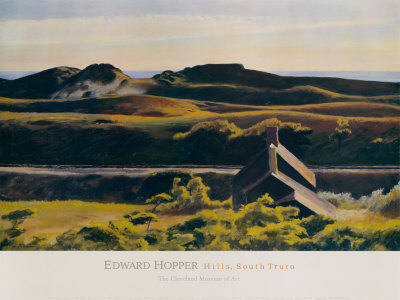
Compare: Hills South Truro, 1930.
A roadside position changes what can be painted
The car enlarged the Hoppers' available range, but it also provided a particular way of encountering a landscape. A road brings a succession of views to the traveller, each briefly framed by a turn, rise or opening. Stopping selects one of those views and gives it a duration it did not have during the journey.
Inland subjects make that process especially apparent. A sugar house can stand against a hillside without being a recognised scenic destination. The roof's awkward extension or the way the ground conceals its lower wall may become the reason to paint it. Attention is directed towards a working structure encountered along a route.
The position also establishes limits. From one side of the road, a slope may hide the bottom of a building. From another, a roof can obscure much of the land beyond. The painting's composition begins with these practical restrictions, even if the artist later adjusts what they provide.
Vermont's hills create a different sequence from a sea horizon. Their overlapping slopes let land rise behind land, while trees and buildings interrupt the transition. The eye cannot settle on one continuous line dividing earth from sky. It has to follow changes of inclination through the image.
The contrast helps explain why inland work deserves a place beside the more famous coastal pictures. It gives Hopper another way to make distance, one in which a roof, a meadow and a wooded rise are parts of the same irregular terrain.
Truro became a place to return to
The first Truro summer in 1930 began a more sustained relationship with Cape Cod. The purchase of land in October 1933 and the completion of a house the following July gave Edward and Jo a recurring place to live and work outside New York. [1]
The continuity did not produce a single repeated subject. Hills, South Truro, painted in 1930 and now in the Cleveland Museum of Art, gives a low house, roofline and undulating land a broad field. [7] The building provides one measure of scale within terrain that extends much further.
In The Camel's Hump, the rounded hill and the hollow before it carry more of the composition. Light distinguishes separate folds of ground. A road crosses the scene without becoming its only direction of movement.
Looking between the two makes topography feel active. The land rises, dips and conceals. Its forms can overlap a house or interrupt a route just as decisively as the walls and windows of a city painting.
A repeated base also makes small changes worth noticing. A new angle can set the same kind of house against a different slope; a shift in light can join separate patches of grass or divide a continuous field. The interest of returning lies partly in the possibility that familiarity makes those differences more visible.
Cape Cod's open land has a history
The open ground in Hopper's Cape Cod paintings should not automatically be imagined as an unchanged natural condition. The National Park Service describes extensive deforestation by European settlers between the seventeenth and nineteenth centuries, followed by substantial regrowth of upland woodland during the twentieth century. The account concerns the broader outer Cape landscape, rather than identifying the precise history of every painted field. [8]
This context makes a difference when a present-day visitor looks for a view. A hillside can acquire trees, vegetation can conceal a building, and a once-readable route can become harder to follow. Finding that a site looks different does not in itself establish that Hopper invented all its features.
Identifying a real hill also leaves the painting’s compositional choices to be examined. The selected height of the horizon, the amount of foreground and the angle of a road determine the encounter. A changing physical landscape and a constructed painted image are separate sources of difference.
In Hills, South Truro, the undulations give the low building a place within a much larger surface. In The Camel's Hump, the hill's own contour supplies a central event. The land does work that a group of people might perform in another composition: it directs attention, establishes scale and changes the relation between near and far.
The regional context also complicates a contrast between nature and construction. Roads, houses and fields can all belong to a long history of human alteration. The absence of a person in a painting does not remove that history from the place.
What remains distinctive is Hopper's use of the available ground. He can let an empty interval expand until it becomes more prominent than a house, or allow one roof to measure the scale of a broad slope. The same region offers both architectural concentration and unusually extensive open space.
Watch: Edward Hopper’s Life and Art
Explore Hopper’s paintings and the places behind them in these museum films. Choose a film below.
Fieldwork could lead to an invented scene
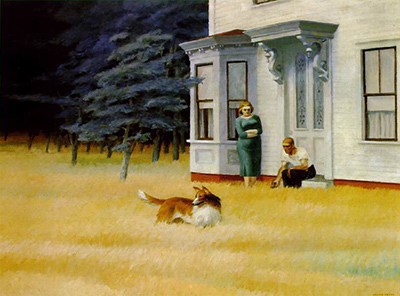
The research for Cape Cod Evening gives an unusually clear account of how local observations could be combined. Robert Torchia's National Gallery of Art study reproduces Hopper's explanation: the doorway came from Orleans, the trees from nearby sketches, and the grass could be seen from his studio. The figures were made largely without models. [9]
The result has the coherence of a place without being the transcription of one view. House, field, grove, people and dog form a compact set of relations. The man's hand reaches towards the collie; the dog's attention extends elsewhere; the woman stands closer to the house. Architecture and vegetation provide a setting for these different directions.
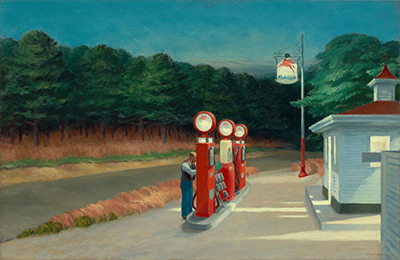
The distinction between observed ingredient and completed arrangement is particularly useful in Gas. MoMA describes its roadside station as a composite of several stations Hopper had seen. [10] The red pumps, white building, road and dense trees have been brought into a clear relationship that does not require an exact address.
Both paintings make the edge between built and natural spaces conspicuous. A field reaches towards a house; a dark band of trees stands beyond an illuminated forecourt. The familiar objects give the scene plausibility, while their arrangement can produce a more concentrated encounter than an ordinary roadside view.
This is why identifying a local source is often a beginning rather than a complete explanation. Knowing where a doorway stood can clarify the material available to the painter. It does not account for the other elements he chose, their scale on the canvas or the light connecting them.
Jo's maps organise the region through routes and names
Josephine Nivison Hopper's two narrow Cape Cod maps offer a useful alternative to a view bounded by the edge of a canvas. Reproduced in the Edward Hopper House's 2026 catalogue preview and approximately dated to 1936, they identify roads, railway connections, waterways, houses and other landmarks. The checklist distinguishes the originals from the facsimiles used for exhibition. [11]
A painted view normally gives us one position. A map can connect places that cannot all be seen together. Jo's lettering lets a reader follow a route, recognise a destination and place one house in relation to another. The act of naming becomes as consequential as the drawn outline.
This offers a valuable companion to Edward's invented landscapes. A doorway from one town and trees studied elsewhere can be combined on a canvas. On a map, their different locations are precisely what a reader needs to preserve. The two kinds of image use local knowledge for different purposes.
The maps also bring residence into the regional story. The Hoppers' house belongs among named neighbouring places, rather than appearing as an isolated studio beyond social life. Travelling to paint and living among routes and neighbours are overlapping experiences, each leaving different kinds of records.
Seeing Jo's work in this setting broadens the account of artistic activity on Cape Cod. Record-making can itself be inventive and visually engaging. Her contribution to the region's artistic history includes ways of drawing and understanding a place that need not become preparatory material for Edward's oils.
Sailing brings small human actions into view
Hopper's marine paintings turn from stationary buildings towards movement. A sail can show the action of wind through its shape. A boat's angle can make the surface of the water feel consequential even in a composition whose larger design remains very clear.
The Long Leg places a pale sail across broad areas of blue sea and sky. A small sailor occupies the boat. The Huntington's 2024 conservation account explains how treatment made that figure more legible, correcting the easy impression that the vessel is empty. [12]
The human presence changes the balance of the scene. From a distance, sail and hull may register as a strong diagonal moving across coloured bands. Looking closely, the small figure gives that movement a practical activity. Someone is travelling through the conditions that the larger design makes visible.
In Ground Swell, a group of sailors is more conspicuous, gathered in relation to a bell buoy. The boat, water and buoy establish different kinds of movement and stability. The figures' attention makes the object in the sea a centre of interest without explaining every thought it provokes.
These pictures broaden the regional work beyond empty houses. They involve bodies negotiating an environment, and they ask the viewer to move between the clarity of a large composition and the small signs of occupation within it.
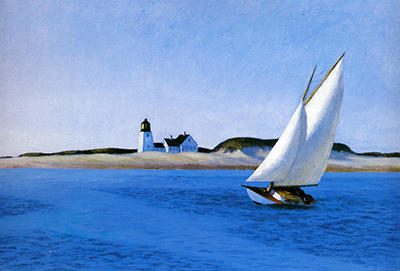
Compare: The Long Leg, 1935.
The studio could make the coast unfamiliar again
Rooms by the Sea brings the coastal setting into a startling interior. Yale University Art Gallery's account connects the picture with Hopper's Truro studio while explaining the transformations involved in its development. [13] The painting's persuasive room does not make its doorway a literal record of a safe route to the water.
The open door gives the sea an abrupt edge against the interior. Light crosses the wall and floor in definite shapes, while the water offers a differently textured surface beyond. The picture makes distance difficult to judge because it removes many of the ordinary transitions between a room and a shore.
That effect can be compared with the early coastal paintings without making them identical. A dark hill can withhold the ground immediately before a lighthouse; an open doorway can make a familiar sea appear uncomfortably close. In each case, the portion left out changes the portion we can see.
The contrast with a town watercolour is equally revealing. In Gloucester, architectural complexity can generate an abundance of information. Here, a few pared-down surfaces produce a strong uncertainty. The regional work contains both an appetite for architectural detail and a willingness to simplify it drastically.
Water changes the scale of a coastal painting
The sea can remove much of the land-based structure through which distance is usually judged. A road supplies converging edges; a house supplies familiar dimensions; open water may give only a boat, a buoy and a distant shore. Their relative positions carry a large amount of information.
In The Long Leg, the sail's diagonal interrupts broad areas of colour. The small human presence belongs to the boat's practical use, while the much larger sail makes wind available as a visible shape. A vessel is both something someone handles and one of the main forms through which the canvas is organised.
Ground Swell brings the human group nearer and gives their attention a shared object. The buoy's position becomes important because several bodies appear oriented towards it. This is a different use of the marine setting from a view dominated by a distant lighthouse or a strip of coastline.
Rooms by the Sea changes the relation again. The viewer encounters water across a threshold instead of travelling on it. Removing the usual stretch of shore makes the opening difficult to understand as an ordinary route out of a room. Familiar coastal elements become unfamiliar through their proximity.
These differences show why a regional label can only begin the discussion. Cape Cod supplies a base, routes, weather and recognisable features. The paintings decide how those things meet within a rectangle, whether through a distant sail, a broad hill or an abruptly exposed sea.
A region seen through several kinds of work
The importance of these places has become clearer through exhibitions focused on particular bodies of work. Cape Ann Museum's 2023 exhibition brought together more than sixty works, including paintings, drawings, prints and work by Jo Nivison Hopper. Its account treated the region's changing social and economic conditions as part of the setting for their art. [14]
Such a grouping can prevent a familiar masterpiece from standing alone as a complete account of the coast. A watercolour of a house, an oil of a road and a drawing made while searching for a composition belong to different activities. Seen together, they reveal repeated choices about where to look and what to carry into another medium.
Jo's work also changes the scope of the story. The two artists could travel together and choose different views. Their shared presence in a place does not make their pictures interchangeable, just as her contribution as Edward's model does not encompass her own artistic practice.
These differences give the regional work its range. A town could supply a complicated façade, an inland road a changing sequence of slopes, and the sea a boat whose tiny occupant rewarded a second look. The paintings give those specific encounters lasting form while leaving the larger landscape to continue beyond their edges.
Artworks and studies directory
This researched directory includes finished works and separately identified studies. It is not a complete catalogue raisonné. Linked titles open the articles; unlinked studies are identified by their collection accessions. Watercolours retain their recorded media, and original prints remain distinct from reproductions.
| Name | Date | Medium |
|---|---|---|
| (Bridge and Embankment) (70.1298) | 1906 | Oil on wood |
| (Jo Sketching at Good Harbor Beach) (70.1129) | 1923–1924 | Watercolor and fabricated chalk on paper |
| (Manhattan Bridge) (70.1098) | 1925–1926 | Watercolor and graphite pencil on paper |
| (Rooftops) (70.1114) | 1926 | Watercolor and graphite pencil on paper |
| (Seated Male Model, Bent Over) (70.1277) | c. 1902–1903 | Oil on canvas |
| (Self-Portrait) (70.1254) | 1903–1906 | Oil on canvas |
| (Solitary Figure in a Theater) (70.1418) | c. 1902–1904 | Oil on board |
| 5 A.M. | 1937 | oil on canvas |
| Adam's House | 1928 | watercolour and charcoal on paper |
| American Village | 1912 | Oil on canvas |
| Apartment Houses | 1923 | oil on canvas |
| Approaching a City | 1946 | oil on canvas |
| August in the City | 1945 | oil on canvas |
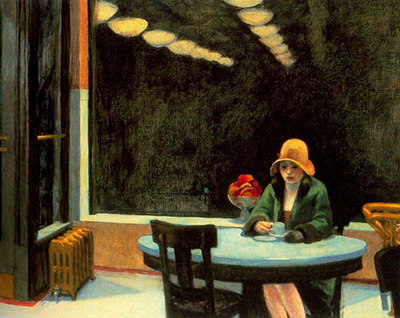
| Automat | 1927 | oil on canvas |
| Barber Shop | 1931 | oil on canvas |
| Blackwell's Island | 1928 | oil on canvas |
| Bridge on the Seine | 1909 | Oil on canvas |
| Bridle Path | 1939 | oil on canvas |
| Burly Cobb's House South Truro | 1930–1933 | oil on canvas |
| Cape Cod Evening | 1939 | oil on canvas |
| Cape Cod Morning | 1950 | oil on canvas |
| Chair Car | 1965 | oil on canvas |
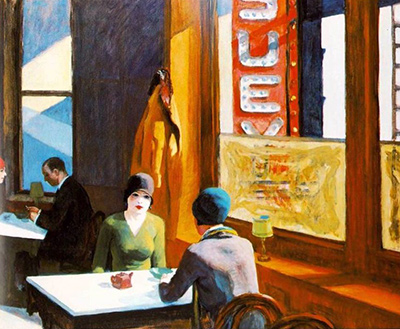
| Chop Suey | 1929 | oil on canvas |
| City Roofs | 1932 | Oil on canvas |
| Coast Guard Station | 1929 | oil on canvas |
| Compartment C, Car 293 | 1938 | oil on canvas |
| Conference at Night | 1949 | oil on canvas |
| Corn Hill | 1930 | oil on canvas |
| Dawn in Pennsylvania | 1942 | oil on canvas |
| Drug Store | 1927 | oil on canvas |
| Early Sunday Morning | 1930 | Oil on canvas |
| East Side Interior (70.1020) | 1922 | Etching |
| East Wind Over Weehawken | 1934 | oil on canvas |
| El Palacio | 1946 | Watercolor and graphite pencil on paper |
| Eleven A.M. | 1926 | oil on canvas |
| Evening Wind | 1921 | etching |
| Excursion into Philosophy | 1959 | oil on canvas |
| First Row Orchestra | 1951 | oil on canvas |
| Freight Car at Truro | 1931 | watercolour over graphite on paper |
| Gas | 1940 | oil on canvas |
| Girl at a Sewing Machine | c. 1921 | oil on canvas |
| Gloucester Harbor | 1912 | Oil on canvas |
| Ground Swell | 1939 | oil on canvas |
| Haskell's House | 1924 | watercolour over graphite on paperboard |
| High Noon | 1949 | oil on canvas |
| Hill and Houses Cape Elizabeth Maine | 1927 | watercolour over graphite pencil |
| Hills South Truro | 1930 | oil on canvas |
| Hotel by a Railroad | 1952 | oil on canvas |
| Hotel Lobby | 1943 | oil on canvas |
| Hotel Room | 1931 | oil on canvas |
| Hotel Window | 1955 | oil on canvas |
| House by the Railroad | 1925 | oil on canvas |
| House by the Squam River | 1926 | watercolour over graphite on paper |
| Le Bistro or The Wine Shop | 1909 | Oil on canvas |
| Le Pont des Arts | 1907 | Oil on canvas |
| Le Pont Royal | 1909 | Oil on canvas |
| Le Quai des Grands Augustins | 1909 | Oil on canvas |
| Lighthouse and Buildings Portland Head | 1927 | watercolour over graphite pencil on paper |
| Lighthouse Hill | 1927 | oil painting |
| Manhattan Bridge Loop | 1928 | oil on canvas |
| Model Sitting | c. 1902 | oil painting; support not asserted |
| Morning Sun | 1952 | oil on canvas |
| New York Movie | 1939 | oil on canvas |
| New York New Haven and Hartford | 1931 | oil on canvas |
| New York Office | 1962 | oil on canvas |
| New York Pavements | 1924–1925 | oil on canvas |
| New York Restaurant | c. 1922 | oil on canvas |
| Night Windows | 1928 | oil on canvas |
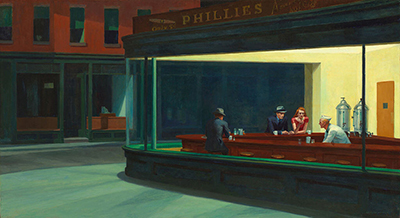
| Nighthawks | 1942 | oil on canvas |
| October on Cape Cod | 1946 | oil on canvas |
| Office at Night | 1940 | oil on canvas |
| Office in a Small City | 1953 | oil on canvas |
| Pennsylvania Coal Town | 1947 | oil on canvas |
| People in the Sun | 1960 | oil on canvas |
| Portrait of Orleans | 1950 | oil on canvas |
| Queensborough Bridge | 1913 | Oil on canvas |
| Railroad Sunset | 1929 | Oil on canvas |
| Railroad Train | 1908 | oil on canvas |
| Road in Maine | 1914 | oil on canvas |
| Room in Brooklyn | 1932 | oil on canvas |
| Room in New York | 1932 | oil on canvas |
| Rooms by the Sea | 1951 | oil on canvas |
| Rooms for Tourists | 1945 | oil on canvas |
| Route 6 Eastham | 1941 | oil on canvas |
| Second Story Sunlight | 1960 | Oil on canvas |
| Self-Portrait | 1925–1930 | Oil on canvas |
| Self-Portrait with Hat (70.1903) | c. 1918, posthumous print | Drypoint |
| Seven A.M. | 1948 | Oil on canvas |
| Soir Bleu | 1914 | oil on canvas |
| South Carolina Morning | 1955 | Oil on canvas |
| Stairway at 48 Rue de Lille Paris | 1906 | Oil on wood |
| Study for 5 A.M. (70.153) | 1937 | Fabricated chalk on paper |
| Study for 5 A.M. (70.429) | 1937 | Fabricated chalk and graphite pencil on paper |
| Study for Approaching a City (70.869) | 1946 | Fabricated chalk and charcoal on paper |
| Study for August in the City (70.158a-b) | 1945 | Fabricated chalk on paper |
| Study for August in the City (70.159) | 1945 | Fabricated chalk on paper |
| Study for Bridle Path (70.220) | 1939 | Fabricated chalk on paper |
| Study for Bridle Path (70.235) | 1939 | Fabricated chalk on paper |
| Study for Compartment C, Car 293 (70.430) | 1938 | Fabricated chalk on paper |
| Study for Compartment C, Car 293 (70.431a-b) | 1938 | Fabricated chalk and charcoal on paper |
| Study for Conference at Night (70.170) | 1949 | Fabricated chalk on paper (recto); Typewriter ink on paper (verso) |
| Study for Conference at Night (70.174) | 1949 | Fabricated chalk on paper ( recto); Typewriter ink on paper (verso) |
| Study for East Wind over Weehawken (70.249) | 1934 | Graphite pencil on paper |
| Study for East Wind over Weehawken (70.252) | 1934 | Fabricated chalk and charcoal on paper |
| Study for Evening Wind (70.343a-b) | 1921 | Fabricated chalk on paper |
| Study for First Row Orchestra (70.841) | 1951 | Fabricated chalk and charcoal on paper |
| Study for Gas (70.263) | 1940 | Fabricated chalk on paper |
| Study for Ground Swell (70.339) | 1939 | Fabricated chalk, charcoal and graphite pencil on paper |
| Study for Hotel by a Railroad (70.199) | 1952 | Fabricated chalk on paper |
| Study for Hotel by a Railroad (70.427) | 1952 | Fabricated chalk on paper |
| Study for Hotel by a Railroad (70.428) | 1952 | Fabricated chalk on paper |
| Study for Hotel Lobby (70.117) | 1942 | Fabricated chalk and graphite pencil on paper |
| Study for Hotel Lobby (70.839) | 1942 | Fabricated chalk and charcoal on paper |
| Study for Hotel Window (70.161) | 1955 | Fabricated chalk, graphite pencil and colored pencil on paper |
| Study for Morning Sun (70.243) | 1952 | Fabricated chalk on paper |
| Study for Morning Sun (70.244) | 1952 | Fabricated chalk on paper |
| Study for Morning Sun (70.290) | 1952 | Fabricated chalk on paper |
| Study for Morning Sun (70.291) | 1952 | Fabricated chalk and graphite pencil on paper |
| Study for New York Movie (70.273) | 1939 | Fabricated chalk on paper |
| Study for New York Movie (70.274a-b) | 1938 or 1939 | Fabricated chalk and charcoal on paper (recto); Fabricated chalk on paper (verso) |
| Study for New York Movie (70.455) | 1939 | Fabricated chalk and charcoal on paper |
| Study for New York Office (70.822) | 1962 | Fabricated chalk on paper |
| Study for Nighthawks (70.192) | 1941 or 1942 | Fabricated chalk on paper |
| Study for Nighthawks (70.193) | 1941 or 1942 | Fabricated chalk on paper |
| Study for Office at Night (70.340) | 1940 | Fabricated chalk and charcoal on paper |
| Study for Office at Night (70.341) | 1940 | Fabricated chalk and graphite pencil on paper |
| Study for Pennsylvania Coal Town (70.198) | 1947 | Fabricated chalk on paper |
| Study for Pennsylvania Coal Town (70.229) | 1947 | Fabricated chalk and charcoal on paper |
| Study for Rooms for Tourists (70.438) | 1945 | Fabricated chalk and charcoal on paper |
| Study for Rooms for Tourists (70.848) | 1945 | Fabricated chalk and charcoal on paper |
| Study for Route 6, Eastham (70.369) | 1941 | Fabricated chalk and graphite pencil on paper |
| Study for Route 6, Eastham (70.854) | 1941 | Fabricated chalk and graphite pencil on paper |
| Study for South Carolina Morning (70.162a-b) | 1955 | Fabricated chalk on paper (recto and verso) |
| Study for The Sheridan Theatre (70.969) | 1937 | Graphite pencil on paper |
| Study for Two on the Aisle (70.128) | 1927 | Fabricated chalk on paper |
| Study for Two on the Aisle (70.129) | 1927 | Fabricated chalk on paper |
| Study for Yawl Riding a Swell (70.439) | 1935 | Fabricated chalk and graphite pencil on paper |
| Summer Evening | 1947 | oil on canvas |
| Summer Interior | 1909 | Oil on canvas |
| Sun in an Empty Room | 1963 | oil on canvas |
| Sunlight in a Cafeteria | 1958 | oil on canvas |
| Sunlight on Brownstones | 1956 | oil on canvas |
| Tables for Ladies | 1930 | oil on canvas |
| The Bootleggers | 1925 | oil on canvas |
| The Camel's Hump | 1931 | oil on canvas |
| The Circle Theatre | 1936 | oil on canvas |
| The City | 1927 | oil on canvas |
| The Lighthouse at Two Lights | 1929 | oil on canvas |
| The Long Leg | 1935 | oil on canvas |
| The Mansard Roof | 1923 | watercolour over graphite on paper |
| The Sheridan Theatre | 1937 | oil on canvas |
| Tramp Steamer | 1908 | oil on canvas |
| Two Comedians | 1966 | oil on canvas |
| Two on the Aisle | 1927 | oil on canvas |
| Valley of the Seine | 1909 | Oil on canvas |
| Western Motel | 1957 | oil on canvas |
Frequently Asked Questions
In the summer of 1923, Hopper and Jo Nivison painted in Gloucester. Jo encouraged his work in watercolour and helped bring it to the attention of the Brooklyn Museum. The museum included six of his watercolours in an exhibition and bought The Mansard Roof. Gail Levin's study of Jo documents her role in that important change in Edward's fortunes. [2]
Bowdoin's guide identifies the Two Lights area of Cape Elizabeth as a recurring source for Hopper's paintings in 1927 and 1929. [3] A lighthouse brings an immediately recognisable structure into a coastal picture, but Hopper's different treatments place considerable weight on what surrounds it.
Rooms by the Sea brings the coastal setting into a startling interior. Yale University Art Gallery's account connects the picture with Hopper's Truro studio while explaining the transformations involved in its development. [13] The painting's persuasive room does not make its doorway a literal record of a safe route to the water.
Discussion
Look again at the images and ideas explored in Edward Hopper's New England Landscapes. These editorial prompts invite your observations.
Reader Insights
Which relationship between a building and its surrounding terrain do you find most distinctive?
Compare Hills South Truro with The Long Leg. Which visual difference matters most to your reading?
Which detail would you look at again after reading “Lighthouses are buildings in uneven terrain”?
Join the Conversation
Share a detail, comparison or question about Edward Hopper's New England Landscapes below.
References
- Art Institute of Chicago, Selected Chronology for Edward Hopper, regional journeys,1927 car,1930 Truro visit,1933 land purchase and1934 house completion. View source.
- Gail Levin, Josephine Verstille Nivison Hopper, Woman's Art Journal1,no.1,1980, pp.28–32 and notes: Gloucester watercolours and the Brooklyn Museum. View source.
- Bowdoin College Museum of Art, A Guide to Hopper's Maine: locations,2011, six regional accounts, including Ogunquit,Monhegan,Rockland and Cape Elizabeth. View source.
- Maine Office of Tourism, Two Lights State Park, complete public account distinguishing the lighthouse site’s 1828 origins, the western light’s 1924 deactivation and the park’s 1961 opening. These dates do not identify every building depicted by Hopper. View source.
- Cleveland Museum of Art, Lighthouse Village (also known as Cape Elizabeth), 1929, accession 1930.851. Current description and actual full painting image inspected. View source.
- Middlebury College Museum of Art, Edward Hopper in Vermont,2013, exhibition account and reproduction of Vermont Sugar House,1938. View source.
- Cleveland Museum of Art, Hills, South Truro,1930, accession1931.2647. View source.
- National Park Service, Cape Cod National Seashore, Environmental Factors, updated 28 October 2024, complete article, especially historical deforestation and woodland regrowth. Regional environmental context, not a site-specific vegetation reconstruction of any Hopper painting. View source.
- Robert Torchia, Cape Cod Evening,1939, National Gallery of Art,2016, complete scholarly entry, technical summary and notes; Hopper's account is transmitted from Grace Pagano,1945. View source.
- Museum of Modern Art, Gas,1940, accession577.1943, collection account and interpretive labels. View source.
- Edward Hopper House Museum & Study Center, Susan Chen: Rooms by the Sea, public catalogue preview, 2026, actual Jo map spread, PDF p. 6, and checklist PDF p. 30. Selected pages consulted; original maps and exhibited facsimiles distinguished. View source.
- The Huntington, The Long Leg,1935, accession83.8.25; Christina M. O'Connell and Kevin Durkin, New Conservation Discoveries: Edward Hopper's The Long Leg,16 January2024. View source 1. View source 2.
- Yale University Art Gallery, Rooms by the Sea,1951, accession1961.18.29, collection record and interpretive account. View source.
- Cape Ann Museum, Edward Hopper & Cape Ann: Illuminating an American Landscape,22 July–16 October2023, exhibition overview. View source.
- Whitney Museum of American Art, Study for Route 6, Eastham, 1941, accession 70.854; exact object record. View source.
- Whitney Museum of American Art, Study for Conference at Night, 1949, accession 70.170; exact object record. View source.
- Whitney Museum of American Art, Study for First Row Orchestra, 1951, accession 70.841; exact object record. View source.
- Whitney Museum of American Art, (Bridge and Embankment), 1906, accession 70.1298; exact object record. View source.
- Whitney Museum of American Art, (Seated Male Model, Bent Over), c. 1902–1903, accession 70.1277; exact object record. View source.
- Whitney Museum of American Art, Study for Morning Sun, 1952, accession 70.244; exact object record. View source.
- Whitney Museum of American Art, Study for Morning Sun, 1952, accession 70.243; exact object record. View source.
- Whitney Museum of American Art, Study for Two on the Aisle, 1927, accession 70.128; exact object record. View source.
- Whitney Museum of American Art, Study for New York Office, 1962, accession 70.822; exact object record. View source.
- Whitney Museum of American Art, Study for Two on the Aisle, 1927, accession 70.129; exact object record. View source.
- Whitney Museum of American Art, Study for Pennsylvania Coal Town, 1947, accession 70.229; exact object record. View source.
- Whitney Museum of American Art, (Rooftops), 1926, accession 70.1114; exact object record. View source.
- Whitney Museum of American Art, Study for South Carolina Morning, 1955, accession 70.162a-b; exact object record. View source.
- Whitney Museum of American Art, (Self-Portrait), 1903–1906, accession 70.1254; exact object record. View source.
- Whitney Museum of American Art, (Manhattan Bridge), 1925–1926, accession 70.1098; exact object record. View source.
- Whitney Museum of American Art, (Solitary Figure in a Theater), c. 1902–1904, accession 70.1418; exact object record. View source.
- Whitney Museum of American Art, Study for Approaching a City, 1946, accession 70.869; exact object record. View source.
- Whitney Museum of American Art, Study for August in the City, 1945, accession 70.159; exact object record. View source.
- Whitney Museum of American Art, Study for Compartment C, Car 293, 1938, accession 70.430; exact object record. View source.
- Whitney Museum of American Art, Study for Compartment C, Car 293, 1938, accession 70.431a-b; exact object record. View source.
- Whitney Museum of American Art, Study for East Wind over Weehawken, 1934, accession 70.252; exact object record. View source.
- Whitney Museum of American Art, Study for East Wind over Weehawken, 1934, accession 70.249; exact object record. View source.
- Whitney Museum of American Art, Study for Evening Wind, 1921, accession 70.343a-b; exact object record. View source.
- Whitney Museum of American Art, Study for The Sheridan Theatre, 1937, accession 70.969; exact object record. View source.
- Whitney Museum of American Art, Study for New York Movie, 1939, accession 70.455; exact object record. View source.
- Whitney Museum of American Art, Study for New York Movie, 1939, accession 70.273; exact object record. View source.
- Whitney Museum of American Art, Study for New York Movie, 1938 or 1939, accession 70.274a-b; exact object record. View source.
- Whitney Museum of American Art, Study for 5 A.M., 1937, accession 70.153; exact object record. View source.
- Whitney Museum of American Art, Study for 5 A.M., 1937, accession 70.429; exact object record. View source.
- Whitney Museum of American Art, (Jo Sketching at Good Harbor Beach), 1923–1924, accession 70.1129; exact object record. View source.
- Whitney Museum of American Art, Study for August in the City, 1945, accession 70.158a-b; exact object record. View source.
- Whitney Museum of American Art, Study for Morning Sun, 1952, accession 70.291; exact object record. View source.
- Whitney Museum of American Art, Study for Morning Sun, 1952, accession 70.290; exact object record. View source.
- Whitney Museum of American Art, Study for Office at Night, 1940, accession 70.340; exact object record. View source.
- Whitney Museum of American Art, Study for Office at Night, 1940, accession 70.341; exact object record. View source.
- Whitney Museum of American Art, Study for Hotel by a Railroad, 1952, accession 70.427; exact object record. View source.
- Whitney Museum of American Art, Study for Hotel by a Railroad, 1952, accession 70.199; exact object record. View source.
- Whitney Museum of American Art, Study for Hotel by a Railroad, 1952, accession 70.428; exact object record. View source.
- Whitney Museum of American Art, Study for Hotel Lobby, 1942, accession 70.117; exact object record. View source.
- Whitney Museum of American Art, Study for Hotel Lobby, 1942, accession 70.839; exact object record. View source.
- Whitney Museum of American Art, Study for Conference at Night, 1949, accession 70.174; exact object record. View source.
- Whitney Museum of American Art, Study for Hotel Window, 1955, accession 70.161; exact object record. View source.
- Whitney Museum of American Art, Study for Pennsylvania Coal Town, 1947, accession 70.198; exact object record. View source.
- Whitney Museum of American Art, Study for Route 6, Eastham, 1941, accession 70.369; exact object record. View source.
- Whitney Museum of American Art, Study for Bridle Path, 1939, accession 70.220; exact object record. View source.
- Whitney Museum of American Art, Study for Bridle Path, 1939, accession 70.235; exact object record. View source.
- Whitney Museum of American Art, Study for Ground Swell, 1939, accession 70.339; exact object record. View source.
- Whitney Museum of American Art, Study for Yawl Riding a Swell, 1935, accession 70.439; exact object record. View source.
- Whitney Museum of American Art, Study for Rooms for Tourists, 1945, accession 70.848; exact object record. View source.
- Whitney Museum of American Art, Study for Rooms for Tourists, 1945, accession 70.438; exact object record. View source.
- Whitney Museum of American Art, Study for Nighthawks, 1941 or 1942, accession 70.193; exact object record. View source.
- Whitney Museum of American Art, Study for Nighthawks, 1941 or 1942, accession 70.192; exact object record. View source.
- Whitney Museum of American Art, Study for Gas, 1940, accession 70.263; exact object record. View source.
- Whitney Museum of American Art, Self-Portrait with Hat, c. 1918, posthumous print, accession 70.1903; exact object record. View source.
- Whitney Museum of American Art, East Side Interior, 1922, accession 70.1020; exact object record. View source.
- Art Institute of Chicago, Selected Chronology for Edward Hopper; training, travels, exhibitions, New York and Truro chronology. View source.
- Emily C. Burns, Spectral figures: Edward Hopper’s empty Paris, chapter 5 in Empty Spaces: Confronting Emptiness in National, Cultural and Urban Histories, 2019; complete chapter and notes consulted. View source.
- Charles Brock, Regionalism and Folk Art, National Gallery of Art; complete essay and two notes consulted. View source.
- Collection or catalogue record, American Village, 1912; medium and identity as discussed in the linked article. View source.
- Collection or catalogue record, Soir Bleu, 1914; medium and identity as discussed in the linked article. View source.
- Collection or catalogue record, House by the Railroad, 1925; medium and identity as discussed in the linked article. View source.
- Collection or catalogue record, Automat, 1927; medium and identity as discussed in the linked article. View source.
- Collection or catalogue record, Early Sunday Morning, 1930; medium and identity as discussed in the linked article. View source.
- Collection or catalogue record, New York Movie, 1939; medium and identity as discussed in the linked article. View source.
- Collection or catalogue record, Nighthawks, 1942; medium and identity as discussed in the linked article. View source.
- Collection or catalogue record, Morning Sun, 1952; medium and identity as discussed in the linked article. View source.
- Collection or catalogue record, Second Story Sunlight, 1960; medium and identity as discussed in the linked article. View source.
- Collection or catalogue record, Two Comedians, 1966; medium and identity as discussed in the linked article. View source.