 by Tom Gurney
Tom Gurney BSc (Hons) is an art history expert with over 20 years experience
Email: tomgurney1@gmail.com / Phone: +44 7429 011000
Model in Towel Sitting on Box: Introduction
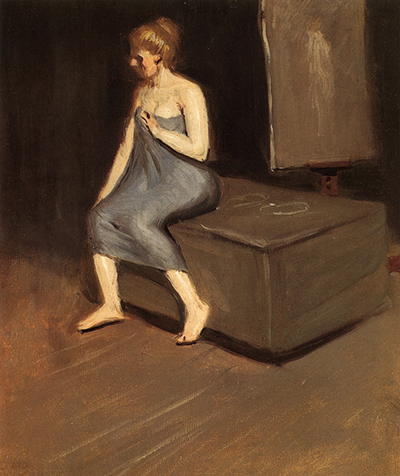
The small action that holds this painting together is the model's hand gathering a grey cloth against her chest. From that point, the fabric falls across her lap, her other arm slopes towards her knee, and her bare feet meet the floor at different angles. Edward Hopper gives the seated body a convincing weight, then surrounds it with the simplest of studio arrangements: a box, a cushion, a dark background and a large upright panel. The fuller catalogue title, Model in Towel Sitting on Box, is more revealing than the shortened Model Sitting. Dated about 1902, the early oil belongs to the years when Hopper was learning to make a figure occupy painted space. [1]
There is much to see before attaching a story to the woman. Her head turns away from the broad, illuminated front of her body. One foot extends into the open floor, while the other sits closer to the box. The cloth both reveals and interrupts the body's outline. These are the practical ingredients of a sustained pose, and Hopper makes their relationships the subject of the picture.
At a Glance
- ArtistEdward Hopper [1]
- Datec. 1902 [1]
- Mediumoil painting; support not asserted [1]
- Collection / recordNot asserted [1]
- AccessionO-17 [1]
This work across Edward Hopper’s career
American Village
1912Soir Bleu
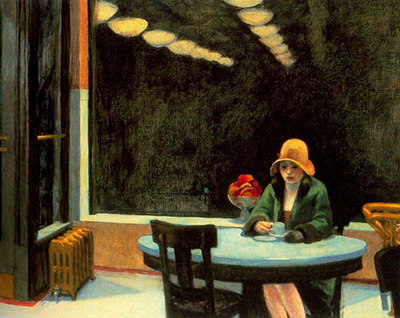
1914Automat
1927New York Movie
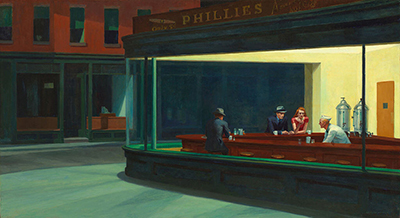
1939Nighthawks
1942Morning Sun
1952Two Comedians
1966Contents
- The balance of the pose
- Cloth, skin and the movement of light
- A studio described through a few objects
- Hopper's years of figure study
- An early model and the later painted figure
- Following the painting through its details
The balance of the pose
The model sits near the front corner of a substantial rectangular platform. Its broad side carries her weight across the right half of the painting, while her bent legs open a less regular shape towards the left. The contrast gives the composition its stability. The box reads as something solid and difficult to move; the body can turn, lean and shift within the place it provides.
Hopper avoids setting the figure squarely before us. Her head, shoulders, bent knees and feet lead in related but different directions. Following the outline from the crown of her head down towards the forward foot produces a series of changes in angle. Following the far side instead brings the eye back towards the cushion and the long edge of the platform. The two routes make the pose feel held together through pressure and adjustment.
The descending arm is especially useful. It draws a long diagonal between the brighter upper body and the lower part of the picture. Its relatively straight passage sets off the curves and folds beside it. Meanwhile, the hand at the chest gives the other arm a compact task. One arm helps open the pose; the other gathers it inward.
Her feet matter as much as her face to this arrangement. They meet the floor at unequal angles, extending the body beyond the platform rather than leaving it as a self-contained shape above the ground. The lighter flesh separates from the warmer floor, making those points of contact easy to find. They help us understand where the model's weight is supported, even though the setting supplies few other measurements.
The turned head lends the figure a direction without giving us an object for her attention. We can see where she faces, but the dark space beside her does little to explain why. That small imbalance between a definite gesture and an unspecified destination gives the pose room to breathe.
Cloth, skin and the movement of light
The grey covering is a major part of the composition. Held high at the chest and drawn over the seated body, it creates a continuous middle tone between the illuminated skin and the dark surroundings. Its outline helps unite the torso and legs, while its changing folds describe a body that is partly concealed.
Where the cloth crosses the lap, it broadens into a relatively quiet area. Lower down, the shifting edges and folds bring movement back into the picture. The eye can alternate between reading a piece of fabric spread over the figure and reading the bent forms beneath it. This double function makes the cloth more than an accessory: it gives Hopper another way to establish the pose.
The exposed skin is brighter, particularly around the shoulder, forearm and lower legs. These passages carry the light across the figure in separate steps. Because the cloth interrupts them, the illumination never becomes one large, uniform silhouette. It breaks into connected areas that the viewer has to assemble.
The face is treated differently. Its angle and surrounding shadow make it less immediately available than the bright arm or foot. Looking at the painting therefore involves a useful change of pace. The body can be grasped quickly through its larger contrasts, while the turned head asks for a more attentive look.
Hopper also keeps the setting close to the colour of the figure. The floor and platform contain warm browns that soften the transition from flesh into surrounding space. Against them, the grey cloth introduces a cooler passage. The result is a restrained colour relationship in which a relatively small difference can carry considerable force.
Reducing the image to three broad values makes its construction easier to follow: the dark background, the middle tones of cloth and platform, and the lighter body. Restoring the colour reveals how much happens within those groups. The picture depends on these smaller transitions as well as its first, clear contrast.
A studio described through a few objects
The setting has enough information to suggest the work of posing, yet much remains indistinct. The cushion separates the model from the harder edge beneath her. The large box makes an improvised seat. Behind it, an upright rectangular panel rises into the upper right, providing another broad surface against which to judge the figure.
Those rectangles are placed at different angles. The platform recedes away from the viewer, while the upright panel sets up a separate plane behind it. Between them, the body provides a changing sequence of rounded forms. Their interaction helps the room feel inhabited even though its boundaries are only loosely described.
The dark area at the upper left has a different role. It offers little detail to compete with the head and shoulder. The figure's turn therefore leads towards a quieter part of the painting, while the larger objects accumulate on the other side. The composition balances a relatively open darkness against a more firmly furnished space.
Across the bottom, broad diagonal marks give the floor direction. They carry the eye towards the model and help prevent the foreground from becoming an inert brown strip. The treatment is more open than the description of the lit limbs. That difference keeps the setting subordinate while allowing the painted surface to remain visible.
The scene can be understood without identifying every object. The crucial relationships are already clear: a seated body, a support beneath it, a floor extending towards us and a background that limits the space. Hopper's selection makes the mechanics of the pose legible without supplying a detailed account of the room.
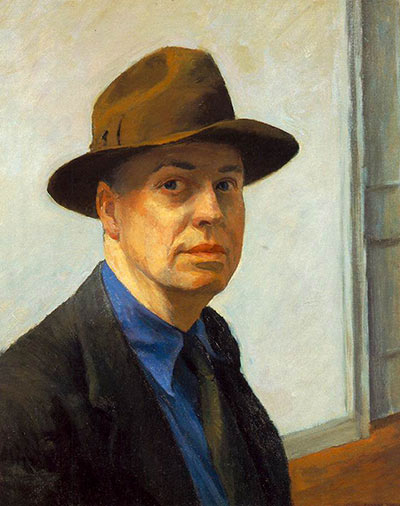
Compare: Self-Portrait, 1925–1930.
Watch: Edward Hopper’s Life and Art
Explore Hopper’s paintings and the places behind them in these museum films. Choose a film below.
Hopper's years of figure study
The approximate date places the painting within Hopper's attendance at the New York School of Art from 1900 to 1905. The Art Institute of Chicago's chronology records his study of illustration with Frank Vincent DuMond and Arthur I. Keller, and painting with William Merritt Chase, Robert Henri and Kenneth Hayes Miller. That mixture of instruction matters for an early picture concerned with the body, a simple setting and a controlled distribution of attention. [2]
A posed figure offers a demanding combination of problems. The painter has to convey the body's structure while keeping it integrated with the seat and surrounding space. Skin, fabric and furniture must feel different without splitting into unrelated studies. The duration of the sitting also calls for a pose that can be maintained. In this painting, the cushion, bent limbs and gathering hand all contribute to that sense of sustained work.
The woman is visibly performing the role named in the title. Attending to that role makes the picture more specific. The cloth is being held; the body has been arranged; the seat has been made to serve a purpose. These practical actions deserve attention before the scene is used as an illustration of a general mood.
Other surviving student works show Hopper addressing related problems through different bodies and viewpoints. The Whitney's Seated Male Model, Bent Over, dated about 1902–03, is a separate oil on canvas in which the folded pose offers another way to explore the figure's weight. Its museum identity should be kept distinct from that of the woman seated on the box. Together, such works allow a reader to see the breadth of Hopper's early engagement with posed figures. [3]
The useful comparison lies in what the poses ask of the painter. A body bent forward gathers its forms tightly; the woman here opens the composition through her extended arm and angled feet. Each arrangement makes different demands on the surrounding space. Looking across the studies reveals learning as a series of visual decisions, rather than a straightforward march towards a familiar later style.
An early model and the later painted figure
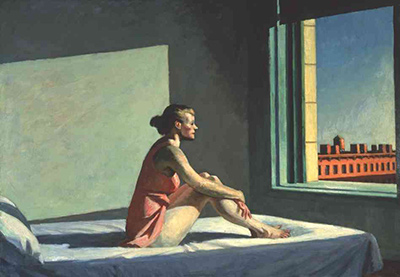
The painting invites comparison with Hopper's later images of seated women, particularly Morning Sun. In that 1952 canvas, a woman sits on a bed beside a large window, and a strong field of light connects her body to the room. The Columbus Museum of Art identifies Hopper's wife, Josephine, as the model. The earlier woman on the box remains unidentified. [4]
The comparison is most rewarding when it stays close to the pictures. In Model in Towel Sitting on Box, the cloth, cushion and changes of value make the body's occupation of a small space immediately tangible. In Morning Sun, the wider room and window give the seated figure a more extensive relationship with the world beyond. Both involve a pose held within a spare setting, but the distribution of space changes the encounter.
It is tempting to let the later painting dictate how we read the earlier one. The turned head can then become a ready-made sign of solitude, and the dark background an emotional explanation. The early work offers a more particular experience when its practical studio conditions remain in view. We are watching Hopper coordinate a model, a support and the light that makes them visible.
That distinction also helps preserve the difference between a model and a painted character. A person can lend a body and a pose to an image without lending a documented life story. Here, the woman's visible actions are clear enough to sustain close looking. Her thoughts and personal circumstances remain outside the picture's evidence.
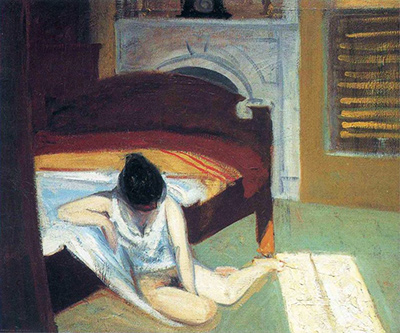
Compare: Summer Interior, 1909.
Following the painting through its details
The work has a later documentary trace in an auction record. Artsy lists Model in towel sitting on box, dated 1902, at Sotheby's New York on 5 December 1996, lot 169 in American Paintings, Drawings & Sculpture. That record preserves the fuller title, though the catalogue's approximate dating remains the more careful way to describe the early painting. [5]
The fuller title brings attention back to a particular task: a model sustaining a pose, holding a cloth and resting on an improvised seat. The painting makes those ordinary practical relationships absorbing. Its lasting interest lies in the attention through which a body acquires weight and presence within a few painted surroundings.
Artworks and studies directory
This researched directory includes finished works and separately identified studies. It is not a complete catalogue raisonné. Linked titles open the articles; unlinked studies are identified by their collection accessions. Watercolours retain their recorded media, and original prints remain distinct from reproductions.
| Name | Date | Medium |
|---|---|---|
| (Bridge and Embankment) (70.1298) | 1906 | Oil on wood |
| (Jo Sketching at Good Harbor Beach) (70.1129) | 1923–1924 | Watercolor and fabricated chalk on paper |
| (Manhattan Bridge) (70.1098) | 1925–1926 | Watercolor and graphite pencil on paper |
| (Rooftops) (70.1114) | 1926 | Watercolor and graphite pencil on paper |
| (Seated Male Model, Bent Over) (70.1277) | c. 1902–1903 | Oil on canvas |
| (Self-Portrait) (70.1254) | 1903–1906 | Oil on canvas |
| (Solitary Figure in a Theater) (70.1418) | c. 1902–1904 | Oil on board |
| 5 A.M. | 1937 | oil on canvas |
| Adam's House | 1928 | watercolour and charcoal on paper |
| American Village | 1912 | Oil on canvas |
| Apartment Houses | 1923 | oil on canvas |
| Approaching a City | 1946 | oil on canvas |
| August in the City | 1945 | oil on canvas |
| Automat | 1927 | oil on canvas |
| Barber Shop | 1931 | oil on canvas |
| Blackwell's Island | 1928 | oil on canvas |
| Bridge on the Seine | 1909 | Oil on canvas |
| Bridle Path | 1939 | oil on canvas |
| Burly Cobb's House South Truro | 1930–1933 | oil on canvas |
| Cape Cod Evening | 1939 | oil on canvas |
| Cape Cod Morning | 1950 | oil on canvas |
| Chair Car | 1965 | oil on canvas |
| Chop Suey | 1929 | oil on canvas |
| City Roofs | 1932 | Oil on canvas |
| Coast Guard Station | 1929 | oil on canvas |
| Compartment C, Car 293 | 1938 | oil on canvas |
| Conference at Night | 1949 | oil on canvas |
| Corn Hill | 1930 | oil on canvas |
| Dawn in Pennsylvania | 1942 | oil on canvas |
| Drug Store | 1927 | oil on canvas |
| Early Sunday Morning | 1930 | Oil on canvas |
| East Side Interior (70.1020) | 1922 | Etching |
| East Wind Over Weehawken | 1934 | oil on canvas |
| El Palacio | 1946 | Watercolor and graphite pencil on paper |
| Eleven A.M. | 1926 | oil on canvas |
| Evening Wind | 1921 | etching |
| Excursion into Philosophy | 1959 | oil on canvas |
| First Row Orchestra | 1951 | oil on canvas |
| Freight Car at Truro | 1931 | watercolour over graphite on paper |
| Gas | 1940 | oil on canvas |
| Girl at a Sewing Machine | c. 1921 | oil on canvas |
| Gloucester Harbor | 1912 | Oil on canvas |
| Ground Swell | 1939 | oil on canvas |
| Haskell's House | 1924 | watercolour over graphite on paperboard |
| High Noon | 1949 | oil on canvas |
| Hill and Houses Cape Elizabeth Maine | 1927 | watercolour over graphite pencil |
| Hills South Truro | 1930 | oil on canvas |
| Hotel by a Railroad | 1952 | oil on canvas |
| Hotel Lobby | 1943 | oil on canvas |
| Hotel Room | 1931 | oil on canvas |
| Hotel Window | 1955 | oil on canvas |
| House by the Railroad | 1925 | oil on canvas |
| House by the Squam River | 1926 | watercolour over graphite on paper |
| Le Bistro or The Wine Shop | 1909 | Oil on canvas |
| Le Pont des Arts | 1907 | Oil on canvas |
| Le Pont Royal | 1909 | Oil on canvas |
| Le Quai des Grands Augustins | 1909 | Oil on canvas |
| Lighthouse and Buildings Portland Head | 1927 | watercolour over graphite pencil on paper |
| Lighthouse Hill | 1927 | oil painting |
| Manhattan Bridge Loop | 1928 | oil on canvas |
| Model Sitting | c. 1902 | oil painting; support not asserted |
| Morning Sun | 1952 | oil on canvas |
| New York Movie | 1939 | oil on canvas |
| New York New Haven and Hartford | 1931 | oil on canvas |
| New York Office | 1962 | oil on canvas |
| New York Pavements | 1924–1925 | oil on canvas |
| New York Restaurant | c. 1922 | oil on canvas |
| Night Windows | 1928 | oil on canvas |
| Nighthawks | 1942 | oil on canvas |
| October on Cape Cod | 1946 | oil on canvas |
| Office at Night | 1940 | oil on canvas |
| Office in a Small City | 1953 | oil on canvas |
| Pennsylvania Coal Town | 1947 | oil on canvas |
| People in the Sun | 1960 | oil on canvas |
| Portrait of Orleans | 1950 | oil on canvas |
| Queensborough Bridge | 1913 | Oil on canvas |
| Railroad Sunset | 1929 | Oil on canvas |
| Railroad Train | 1908 | oil on canvas |
| Road in Maine | 1914 | oil on canvas |
| Room in Brooklyn | 1932 | oil on canvas |
| Room in New York | 1932 | oil on canvas |
| Rooms by the Sea | 1951 | oil on canvas |
| Rooms for Tourists | 1945 | oil on canvas |
| Route 6 Eastham | 1941 | oil on canvas |
| Second Story Sunlight | 1960 | Oil on canvas |
| Self-Portrait | 1925–1930 | Oil on canvas |
| Self-Portrait with Hat (70.1903) | c. 1918, posthumous print | Drypoint |
| Seven A.M. | 1948 | Oil on canvas |
| Soir Bleu | 1914 | oil on canvas |
| South Carolina Morning | 1955 | Oil on canvas |
| Stairway at 48 Rue de Lille Paris | 1906 | Oil on wood |
| Study for 5 A.M. (70.153) | 1937 | Fabricated chalk on paper |
| Study for 5 A.M. (70.429) | 1937 | Fabricated chalk and graphite pencil on paper |
| Study for Approaching a City (70.869) | 1946 | Fabricated chalk and charcoal on paper |
| Study for August in the City (70.158a-b) | 1945 | Fabricated chalk on paper |
| Study for August in the City (70.159) | 1945 | Fabricated chalk on paper |
| Study for Bridle Path (70.220) | 1939 | Fabricated chalk on paper |
| Study for Bridle Path (70.235) | 1939 | Fabricated chalk on paper |
| Study for Compartment C, Car 293 (70.430) | 1938 | Fabricated chalk on paper |
| Study for Compartment C, Car 293 (70.431a-b) | 1938 | Fabricated chalk and charcoal on paper |
| Study for Conference at Night (70.170) | 1949 | Fabricated chalk on paper (recto); Typewriter ink on paper (verso) |
| Study for Conference at Night (70.174) | 1949 | Fabricated chalk on paper ( recto); Typewriter ink on paper (verso) |
| Study for East Wind over Weehawken (70.249) | 1934 | Graphite pencil on paper |
| Study for East Wind over Weehawken (70.252) | 1934 | Fabricated chalk and charcoal on paper |
| Study for Evening Wind (70.343a-b) | 1921 | Fabricated chalk on paper |
| Study for First Row Orchestra (70.841) | 1951 | Fabricated chalk and charcoal on paper |
| Study for Gas (70.263) | 1940 | Fabricated chalk on paper |
| Study for Ground Swell (70.339) | 1939 | Fabricated chalk, charcoal and graphite pencil on paper |
| Study for Hotel by a Railroad (70.199) | 1952 | Fabricated chalk on paper |
| Study for Hotel by a Railroad (70.427) | 1952 | Fabricated chalk on paper |
| Study for Hotel by a Railroad (70.428) | 1952 | Fabricated chalk on paper |
| Study for Hotel Lobby (70.117) | 1942 | Fabricated chalk and graphite pencil on paper |
| Study for Hotel Lobby (70.839) | 1942 | Fabricated chalk and charcoal on paper |
| Study for Hotel Window (70.161) | 1955 | Fabricated chalk, graphite pencil and colored pencil on paper |
| Study for Morning Sun (70.243) | 1952 | Fabricated chalk on paper |
| Study for Morning Sun (70.244) | 1952 | Fabricated chalk on paper |
| Study for Morning Sun (70.290) | 1952 | Fabricated chalk on paper |
| Study for Morning Sun (70.291) | 1952 | Fabricated chalk and graphite pencil on paper |
| Study for New York Movie (70.273) | 1939 | Fabricated chalk on paper |
| Study for New York Movie (70.274a-b) | 1938 or 1939 | Fabricated chalk and charcoal on paper (recto); Fabricated chalk on paper (verso) |
| Study for New York Movie (70.455) | 1939 | Fabricated chalk and charcoal on paper |
| Study for New York Office (70.822) | 1962 | Fabricated chalk on paper |
| Study for Nighthawks (70.192) | 1941 or 1942 | Fabricated chalk on paper |
| Study for Nighthawks (70.193) | 1941 or 1942 | Fabricated chalk on paper |
| Study for Office at Night (70.340) | 1940 | Fabricated chalk and charcoal on paper |
| Study for Office at Night (70.341) | 1940 | Fabricated chalk and graphite pencil on paper |
| Study for Pennsylvania Coal Town (70.198) | 1947 | Fabricated chalk on paper |
| Study for Pennsylvania Coal Town (70.229) | 1947 | Fabricated chalk and charcoal on paper |
| Study for Rooms for Tourists (70.438) | 1945 | Fabricated chalk and charcoal on paper |
| Study for Rooms for Tourists (70.848) | 1945 | Fabricated chalk and charcoal on paper |
| Study for Route 6, Eastham (70.369) | 1941 | Fabricated chalk and graphite pencil on paper |
| Study for Route 6, Eastham (70.854) | 1941 | Fabricated chalk and graphite pencil on paper |
| Study for South Carolina Morning (70.162a-b) | 1955 | Fabricated chalk on paper (recto and verso) |
| Study for The Sheridan Theatre (70.969) | 1937 | Graphite pencil on paper |
| Study for Two on the Aisle (70.128) | 1927 | Fabricated chalk on paper |
| Study for Two on the Aisle (70.129) | 1927 | Fabricated chalk on paper |
| Study for Yawl Riding a Swell (70.439) | 1935 | Fabricated chalk and graphite pencil on paper |
| Summer Evening | 1947 | oil on canvas |
| Summer Interior | 1909 | Oil on canvas |
| Sun in an Empty Room | 1963 | oil on canvas |
| Sunlight in a Cafeteria | 1958 | oil on canvas |
| Sunlight on Brownstones | 1956 | oil on canvas |
| Tables for Ladies | 1930 | oil on canvas |
| The Bootleggers | 1925 | oil on canvas |
| The Camel's Hump | 1931 | oil on canvas |
| The Circle Theatre | 1936 | oil on canvas |
| The City | 1927 | oil on canvas |
| The Lighthouse at Two Lights | 1929 | oil on canvas |
| The Long Leg | 1935 | oil on canvas |
| The Mansard Roof | 1923 | watercolour over graphite on paper |
| The Sheridan Theatre | 1937 | oil on canvas |
| Tramp Steamer | 1908 | oil on canvas |
| Two Comedians | 1966 | oil on canvas |
| Two on the Aisle | 1927 | oil on canvas |
| Valley of the Seine | 1909 | Oil on canvas |
| Western Motel | 1957 | oil on canvas |
Frequently Asked Questions
Edward Hopper made Model Sitting in c. 1902. [1]
The recorded medium is oil painting; support not asserted. [1]
The small action that holds this painting together is the model's hand gathering a grey cloth against her chest. From that point, the fabric falls across her lap, her other arm slopes towards her knee, and her bare feet meet the floor at different angles. Edward Hopper gives the seated body a convincing weight, then surrounds it with the simplest of studio arrangements: a box, a cushion, a dark background and a large upright panel. The fuller catalogue title, Model in Towel Sitting on Box, is more revealing than the shortened Model Sitting. Dated about 1902, the early oil belongs to the years when Hopper was learning to make a figure occupy painted space. [1]
Discussion
Look again at the images and ideas explored in Model in Towel Sitting on Box. These editorial prompts invite your observations.
Reader Insights
Which boundary, gesture or change of light first holds your attention in Model Sitting?
Compare Self-Portrait with Model Sitting. Which visual difference matters most to your reading?
Which detail would you look at again after reading “A studio described through a few objects”?
Join the Conversation
Share a detail, comparison or question about Model in Towel Sitting on Box below.
References
- Gail Levin, Edward Hopper: A Catalogue Raisonné, vol. III, Oils (Whitney Museum of American Art in association with W. W. Norton, 1995), title index, p. 384, O-17, [Model in Towel Sitting on Box], c. 1902. Title-page and index scan. View source.
- The Art Institute of Chicago, “Selected Chronology for Edward Hopper (1882–1967)”, entry for 1900–1905. View source.
- Whitney Museum of American Art, Seated Male Model, Bent Over, c. 1902–1903, accession 70.1277. View source.
- David Stark, “Pocketguide to CMA: Edward Hopper's Morning Sun”, Columbus Museum of Art, 12 May 2020. View source.
- Artsy, auction result for Model in towel sitting on box, reporting Sotheby's, New York, 5 December 1996, lot 169, American Paintings, Drawings & Sculpture. View source.
- Collection or catalogue record, American Village, 1912; medium and identity as discussed in the linked article. View source.
- Collection or catalogue record, Soir Bleu, 1914; medium and identity as discussed in the linked article. View source.
- Collection or catalogue record, House by the Railroad, 1925; medium and identity as discussed in the linked article. View source.
- Collection or catalogue record, Automat, 1927; medium and identity as discussed in the linked article. View source.
- Collection or catalogue record, Early Sunday Morning, 1930; medium and identity as discussed in the linked article. View source.
- Collection or catalogue record, New York Movie, 1939; medium and identity as discussed in the linked article. View source.
- Collection or catalogue record, Nighthawks, 1942; medium and identity as discussed in the linked article. View source.
- Collection or catalogue record, Morning Sun, 1952; medium and identity as discussed in the linked article. View source.
- Collection or catalogue record, Second Story Sunlight, 1960; medium and identity as discussed in the linked article. View source.
- Collection or catalogue record, Two Comedians, 1966; medium and identity as discussed in the linked article. View source.
- Whitney Museum of American Art, Study for Route 6, Eastham, 1941, accession 70.854; exact object record. View source.
- Whitney Museum of American Art, Study for Conference at Night, 1949, accession 70.170; exact object record. View source.
- Whitney Museum of American Art, Study for First Row Orchestra, 1951, accession 70.841; exact object record. View source.
- Whitney Museum of American Art, (Bridge and Embankment), 1906, accession 70.1298; exact object record. View source.
- Whitney Museum of American Art, (Seated Male Model, Bent Over), c. 1902–1903, accession 70.1277; exact object record. View source.
- Whitney Museum of American Art, Study for Morning Sun, 1952, accession 70.244; exact object record. View source.
- Whitney Museum of American Art, Study for Morning Sun, 1952, accession 70.243; exact object record. View source.
- Whitney Museum of American Art, Study for Two on the Aisle, 1927, accession 70.128; exact object record. View source.
- Whitney Museum of American Art, Study for New York Office, 1962, accession 70.822; exact object record. View source.
- Whitney Museum of American Art, Study for Two on the Aisle, 1927, accession 70.129; exact object record. View source.
- Whitney Museum of American Art, Study for Pennsylvania Coal Town, 1947, accession 70.229; exact object record. View source.
- Whitney Museum of American Art, (Rooftops), 1926, accession 70.1114; exact object record. View source.
- Whitney Museum of American Art, Study for South Carolina Morning, 1955, accession 70.162a-b; exact object record. View source.
- Whitney Museum of American Art, (Self-Portrait), 1903–1906, accession 70.1254; exact object record. View source.
- Whitney Museum of American Art, (Manhattan Bridge), 1925–1926, accession 70.1098; exact object record. View source.
- Whitney Museum of American Art, (Solitary Figure in a Theater), c. 1902–1904, accession 70.1418; exact object record. View source.
- Whitney Museum of American Art, Study for Approaching a City, 1946, accession 70.869; exact object record. View source.
- Whitney Museum of American Art, Study for August in the City, 1945, accession 70.159; exact object record. View source.
- Whitney Museum of American Art, Study for Compartment C, Car 293, 1938, accession 70.430; exact object record. View source.
- Whitney Museum of American Art, Study for Compartment C, Car 293, 1938, accession 70.431a-b; exact object record. View source.
- Whitney Museum of American Art, Study for East Wind over Weehawken, 1934, accession 70.252; exact object record. View source.
- Whitney Museum of American Art, Study for East Wind over Weehawken, 1934, accession 70.249; exact object record. View source.
- Whitney Museum of American Art, Study for Evening Wind, 1921, accession 70.343a-b; exact object record. View source.
- Whitney Museum of American Art, Study for The Sheridan Theatre, 1937, accession 70.969; exact object record. View source.
- Whitney Museum of American Art, Study for New York Movie, 1939, accession 70.455; exact object record. View source.
- Whitney Museum of American Art, Study for New York Movie, 1939, accession 70.273; exact object record. View source.
- Whitney Museum of American Art, Study for New York Movie, 1938 or 1939, accession 70.274a-b; exact object record. View source.
- Whitney Museum of American Art, Study for 5 A.M., 1937, accession 70.153; exact object record. View source.
- Whitney Museum of American Art, Study for 5 A.M., 1937, accession 70.429; exact object record. View source.
- Whitney Museum of American Art, (Jo Sketching at Good Harbor Beach), 1923–1924, accession 70.1129; exact object record. View source.
- Whitney Museum of American Art, Study for August in the City, 1945, accession 70.158a-b; exact object record. View source.
- Whitney Museum of American Art, Study for Morning Sun, 1952, accession 70.291; exact object record. View source.
- Whitney Museum of American Art, Study for Morning Sun, 1952, accession 70.290; exact object record. View source.
- Whitney Museum of American Art, Study for Office at Night, 1940, accession 70.340; exact object record. View source.
- Whitney Museum of American Art, Study for Office at Night, 1940, accession 70.341; exact object record. View source.
- Whitney Museum of American Art, Study for Hotel by a Railroad, 1952, accession 70.427; exact object record. View source.
- Whitney Museum of American Art, Study for Hotel by a Railroad, 1952, accession 70.199; exact object record. View source.
- Whitney Museum of American Art, Study for Hotel by a Railroad, 1952, accession 70.428; exact object record. View source.
- Whitney Museum of American Art, Study for Hotel Lobby, 1942, accession 70.117; exact object record. View source.
- Whitney Museum of American Art, Study for Hotel Lobby, 1942, accession 70.839; exact object record. View source.
- Whitney Museum of American Art, Study for Conference at Night, 1949, accession 70.174; exact object record. View source.
- Whitney Museum of American Art, Study for Hotel Window, 1955, accession 70.161; exact object record. View source.
- Whitney Museum of American Art, Study for Pennsylvania Coal Town, 1947, accession 70.198; exact object record. View source.
- Whitney Museum of American Art, Study for Route 6, Eastham, 1941, accession 70.369; exact object record. View source.
- Whitney Museum of American Art, Study for Bridle Path, 1939, accession 70.220; exact object record. View source.
- Whitney Museum of American Art, Study for Bridle Path, 1939, accession 70.235; exact object record. View source.
- Whitney Museum of American Art, Study for Ground Swell, 1939, accession 70.339; exact object record. View source.
- Whitney Museum of American Art, Study for Yawl Riding a Swell, 1935, accession 70.439; exact object record. View source.
- Whitney Museum of American Art, Study for Rooms for Tourists, 1945, accession 70.848; exact object record. View source.
- Whitney Museum of American Art, Study for Rooms for Tourists, 1945, accession 70.438; exact object record. View source.
- Whitney Museum of American Art, Study for Nighthawks, 1941 or 1942, accession 70.193; exact object record. View source.
- Whitney Museum of American Art, Study for Nighthawks, 1941 or 1942, accession 70.192; exact object record. View source.
- Whitney Museum of American Art, Study for Gas, 1940, accession 70.263; exact object record. View source.
- Whitney Museum of American Art, Self-Portrait with Hat, c. 1918, posthumous print, accession 70.1903; exact object record. View source.
- Whitney Museum of American Art, East Side Interior, 1922, accession 70.1020; exact object record. View source.
- Art Institute of Chicago, Selected Chronology for Edward Hopper; training, travels, exhibitions, New York and Truro chronology. View source.
- Emily C. Burns, Spectral figures: Edward Hopper’s empty Paris, chapter 5 in Empty Spaces: Confronting Emptiness in National, Cultural and Urban Histories, 2019; complete chapter and notes consulted. View source.
- Charles Brock, Regionalism and Folk Art, National Gallery of Art; complete essay and two notes consulted. View source.