 by Tom Gurney
Tom Gurney BSc (Hons) is an art history expert with over 20 years experience
Email: tomgurney1@gmail.com / Phone: +44 7429 011000
Bridle Path: Introduction
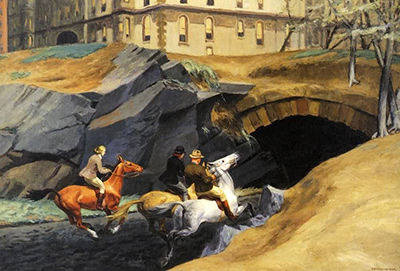
Three riders approach a dark arch between large rock formations. A pale horse raises its head in the foreground, while the buildings above the park remain substantial and still. Edward Hopper's Bridle Path brings animal movement into a landscape whose rocks, slopes and architecture can seem just as forceful as the people passing through it.
Hopper painted the oil on canvas in 1939. The setting combines Central Park's Riftstone Arch with the Dakota building beyond. [1] A recognisable part of New York becomes a place where open-air recreation, rough terrain and a dark passage meet within a tightly organised view.
At a Glance
- ArtistEdward Hopper [1]
- Date1939 [1]
- Mediumoil on canvas [1]
- Collection / recordPrivate collection reported in2022; present owner not asserted [1]
This work across Edward Hopper’s career
American Village
1912Soir Bleu
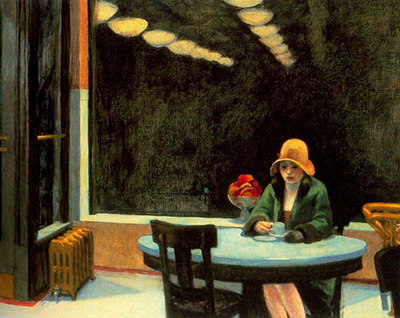
1914Automat
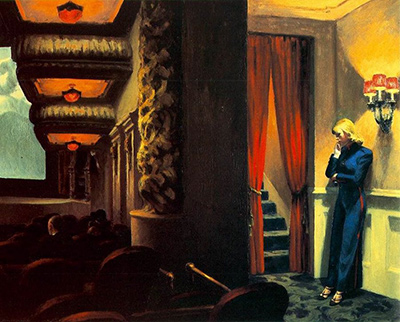
1927New York Movie
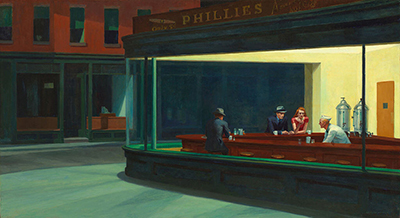
1939Nighthawks
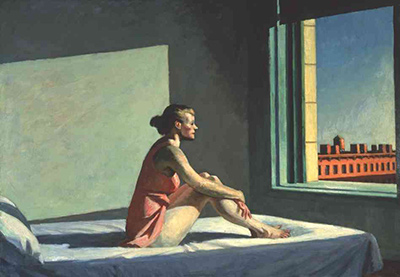
1942Morning Sun
1952Two Comedians
1966Contents
- A path below the city
- Rock planes in the foreground
- The dark arch
- Three riders, unequal movements
- Buildings and bare branches
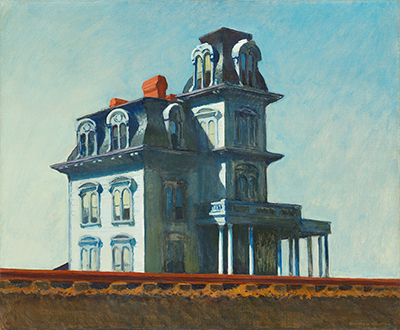
- Studying the rock rather than the rider
- A lamp considered for the setting
- Horses developed in the studio
- Possible stories at the tunnel
- From SFMOMA to auction
A path below the city
The riders occupy the lower part of the canvas. Above them, a large building rises behind a strip of parkland, making the city a close presence rather than a distant skyline. The park offers a different kind of space within the metropolis without removing the buildings around it.
The path runs among rock outcrops and towards the arch. Its direction gives the figures a possible route, but the painting does not show what happens once they reach the darkness. A passage designed for movement becomes a strong visual limit.
The difference of levels is important. The architecture occupies higher ground, the riders pass below, and the rocks connect those levels through slopes and abrupt edges. Hopper makes the park feel constructed from several kinds of surface and height.
The scene is therefore more than an equestrian group against a decorative backdrop. The terrain determines where the horses can move and how their bodies appear. The city and the path remain part of the same compact setting.
Rock planes in the foreground
The rocks are cut into broad angled shapes. Pale grey planes alternate with darker fissures and shadows, giving them a weight quite different from the smoother dirt path beside them.
Their edges also create repeated diagonals. These lines lead the eye towards the riders and arch while preventing the lower part of the composition from settling into a level horizontal strip. The ground itself appears active.
Some rock faces catch more light, while others turn sharply away. Their variation gives the setting depth without requiring a distant panorama. We can understand the terrain through adjacent planes close to the figures.
The darker crevices differ from the tunnel's larger black opening. One kind of darkness belongs to uneven natural surfaces; the other is held within a built arch. Hopper brings them together without making them identical.
The dark arch
The masonry curves over the opening in a sequence of blocks. Their warmer colour distinguishes the constructed passage from the cooler rock around it. The arch's regularity remains clear even where the tunnel beyond becomes difficult to inspect.
That opening draws attention because it interrupts the lit terrain. The path appears to lead towards a space whose continuation cannot be seen. The spectator can follow a route without being given a clear destination.
The dark area also changes how we see the pale horse before it. The animal's head, neck and body become more prominent against the surrounding contrasts. A route through the park becomes part of the presentation of a moving body.
The painting does not require the arch to be a literal threat. Its obscurity is enough to complicate the riders' approach. A viewer may read hesitation into the foreground horse and rider without knowing what either will do next.
Three riders, unequal movements
The group is compressed rather than spread evenly along the path. Bodies overlap, horses turn at different angles, and the pale animal in the foreground makes a particularly conspicuous shape.
Its raised head and the rider's handling of the reins introduce an interruption to straightforward forward movement. The posture differs from the more lateral profile of the chestnut horse at the left. The group seems caught at a point when several movements need to be considered together.
Clothing gives the riders distinct silhouettes. Hats, lighter and darker coats, and the angles of arms make them readable above the animals, even though the faces do not become detailed portraits.
The horses also change the scale of the surrounding terrain. A rock face that might seem like a small irregularity in an unoccupied view becomes substantial beside an animal and mounted person. The figures make the park's physical dimensions tangible.
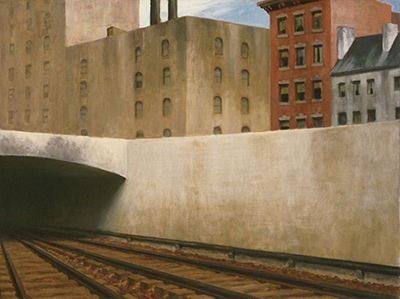
Compare: Approaching a City, 1946.
Buildings and bare branches
The Dakota supplies an ordered counterpart to the rocks below. Repeated windows and a long façade establish an architectural rhythm, while the cropped upper edge implies more building beyond the selected view.
The park's grass and earth rise towards that urban boundary. They do not conceal it. A rider's route and a large residential building coexist within one sightline, giving the scene a distinctly city-park character.
Bare trunks and branches add finer lines at the right. Their uneven forms differ from the building's repeated openings and the arch's regular masonry. Several systems of line occupy the same canvas: branches, rock edges, construction and reins.
This accumulation makes the scene busier than many of Hopper's interiors, but its parts remain strongly grouped. Rocks occupy a broad foreground mass, riders gather near the path, and architecture establishes the upper boundary.
Studying the rock rather than the rider
A Whitney Museum drawing, accession 70.220, records a study for Bridle Path in fabricated chalk on paper, dated 1939. The sheet concentrates on the rock formations, their sloping planes and the smaller uprights above them. Colour notes appear among the drawn forms. [2]
The drawing gives the terrain sustained attention. Shaded planes and repeated contours test how the rock's edges fit together. The sheet contains no mounted group to supply a ready narrative.
Its relation to the painting helps explain why the landscape feels so substantial. The rocks were not incidental shapes placed behind a completed equestrian scene. They were studied as forms whose directions and surfaces could organise the image.
The notes add another kind of information. Words about colour supplement the changes of tone, preserving distinctions that chalk alone would not reproduce in the same way as the final oil. Observation could be stored through writing as well as through drawing.
Watch: Edward Hopper’s Life and Art
Explore Hopper’s paintings and the places behind them in these museum films. Choose a film below.
A lamp considered for the setting
Another Whitney sheet, accession 70.235, studies an ornate street lamp beside rock contours. It also dates to 1939 and uses fabricated chalk on paper. [3] A piece of park equipment receives careful attention separately from the larger scene.
The lamp has a different kind of upright from the nearby trunks. Its base, narrow shaft and shaped upper section make a regular manufactured object against the irregular ground. The sheet suggests how many kinds of detail could enter Hopper's construction of the park.
The Whitney's account of the painting notes that a lamp originally occupied an area later given to the riders. [4] The change demonstrates that the final balance between objects and figures developed through alternatives.
It also makes the absence of the lamp meaningful. The finished image does not retain every object Hopper studied at the site. The rocks and path could remain while a strong vertical gave way to the more complex shapes of horses and people.
Horses developed in the studio
Whitney curator Melinda Lang describes Hopper making repeated visits to study the site and its rock formations. Although he observed riders, he did not draw them in those field studies; in the studio he consulted magazine photographs of horses and a book on horse anatomy. [4]
The account separates two kinds of preparation. Direct observation of a place and the construction of moving animals could draw on different materials. The sources could be combined into an instant that had not been witnessed in that form.
Lang also discusses the unusual quality of the horses' movement in relation to the more assuredly described surroundings. [4] Her reading makes the contrast part of the painting's interest rather than treating the figures as the only elements worth attending to.
The final canvas joins those different sources in one passage through the park. What appears to be a moment of movement also contains a history of selected landscape details, omitted equipment and figures worked out elsewhere.
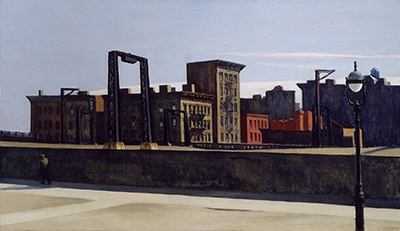
Compare: Manhattan Bridge Loop, 1928.
Possible stories at the tunnel
The dark passage and foreground reins can encourage a story of uncertainty before entering an unseen space. The auction essay goes further, proposing possible connections with the anxieties of the late 1930s. [1]
Such a reading belongs to the painting's interpretation. The canvas contains no document identifying a particular political event, and the riders' identities are not established by their clothes. A specific historical narrative should not displace the more immediate relationship between bodies, route and obscured view.
The scene's force does not depend on settling that narrative. The path can lead onwards while the spectator remains before the arch. Horse, rider and dark opening are enough to make the next movement an active question.
From SFMOMA to auction
The historical provenance includes Frank K. M. Rehn Gallery, William E. Leistner around 1960, and an anonymous gift to the museum in 1976. [1] Those records belong to a period when Bridle Path formed part of the San Francisco Museum of Modern Art's collection.
In March 2012, SFMOMA announced its acquisition of Hopper's Intermission and the deaccession of Bridle Path, then awaiting a Sotheby's sale. [5] The auction followed on 17 May 2012. [1]
A later museum announcement confirmed the sale when discussing its collection history. [6] SFMOMA is therefore an important former owner, rather than a secure description of the painting's present home. Whitney's 2022 presentation identified a private collection without naming the owner. [4]
Other routes through the city
Approaching a City leads a railway towards a dark opening among buildings. Bridle Path places people and animals nearer the passage, letting their bodies make the approach more immediate.
New York Pavements also selects an oblique view in which urban construction determines how a small human presence is seen. Here the city's architecture shares that role with the park's rocks and path.
Look again at the angled stone surfaces before following the pale horse's raised head. The built and natural setting is as deliberately prepared as the figures passing through it. Hopper brings those different forms of attention together at the edge of a dark route onwards.
Artworks and studies directory
This researched directory includes finished works and separately identified studies. It is not a complete catalogue raisonné. Linked titles open the articles; unlinked studies are identified by their collection accessions. Watercolours retain their recorded media, and original prints remain distinct from reproductions.
| Name | Date | Medium |
|---|---|---|
| (Bridge and Embankment) (70.1298) | 1906 | Oil on wood |
| (Jo Sketching at Good Harbor Beach) (70.1129) | 1923–1924 | Watercolor and fabricated chalk on paper |
| (Manhattan Bridge) (70.1098) | 1925–1926 | Watercolor and graphite pencil on paper |
| (Rooftops) (70.1114) | 1926 | Watercolor and graphite pencil on paper |
| (Seated Male Model, Bent Over) (70.1277) | c. 1902–1903 | Oil on canvas |
| (Self-Portrait) (70.1254) | 1903–1906 | Oil on canvas |
| (Solitary Figure in a Theater) (70.1418) | c. 1902–1904 | Oil on board |
| 5 A.M. | 1937 | oil on canvas |
| Adam's House | 1928 | watercolour and charcoal on paper |
| American Village | 1912 | Oil on canvas |
| Apartment Houses | 1923 | oil on canvas |
| Approaching a City | 1946 | oil on canvas |
| August in the City | 1945 | oil on canvas |
| Automat | 1927 | oil on canvas |
| Barber Shop | 1931 | oil on canvas |
| Blackwell's Island | 1928 | oil on canvas |
| Bridge on the Seine | 1909 | Oil on canvas |
| Bridle Path | 1939 | oil on canvas |
| Burly Cobb's House South Truro | 1930–1933 | oil on canvas |
| Cape Cod Evening | 1939 | oil on canvas |
| Cape Cod Morning | 1950 | oil on canvas |
| Chair Car | 1965 | oil on canvas |
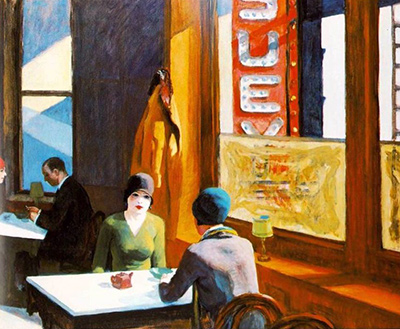
| Chop Suey | 1929 | oil on canvas |
| City Roofs | 1932 | Oil on canvas |
| Coast Guard Station | 1929 | oil on canvas |
| Compartment C, Car 293 | 1938 | oil on canvas |
| Conference at Night | 1949 | oil on canvas |
| Corn Hill | 1930 | oil on canvas |
| Dawn in Pennsylvania | 1942 | oil on canvas |
| Drug Store | 1927 | oil on canvas |
| Early Sunday Morning | 1930 | Oil on canvas |
| East Side Interior (70.1020) | 1922 | Etching |
| East Wind Over Weehawken | 1934 | oil on canvas |
| El Palacio | 1946 | Watercolor and graphite pencil on paper |
| Eleven A.M. | 1926 | oil on canvas |
| Evening Wind | 1921 | etching |
| Excursion into Philosophy | 1959 | oil on canvas |
| First Row Orchestra | 1951 | oil on canvas |
| Freight Car at Truro | 1931 | watercolour over graphite on paper |
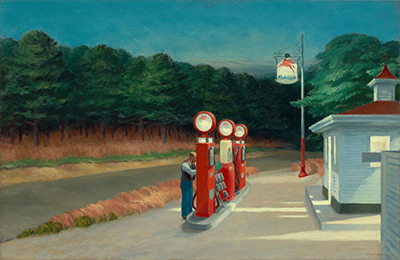
| Gas | 1940 | oil on canvas |
| Girl at a Sewing Machine | c. 1921 | oil on canvas |
| Gloucester Harbor | 1912 | Oil on canvas |
| Ground Swell | 1939 | oil on canvas |
| Haskell's House | 1924 | watercolour over graphite on paperboard |
| High Noon | 1949 | oil on canvas |
| Hill and Houses Cape Elizabeth Maine | 1927 | watercolour over graphite pencil |
| Hills South Truro | 1930 | oil on canvas |
| Hotel by a Railroad | 1952 | oil on canvas |
| Hotel Lobby | 1943 | oil on canvas |
| Hotel Room | 1931 | oil on canvas |
| Hotel Window | 1955 | oil on canvas |
| House by the Railroad | 1925 | oil on canvas |
| House by the Squam River | 1926 | watercolour over graphite on paper |
| Le Bistro or The Wine Shop | 1909 | Oil on canvas |
| Le Pont des Arts | 1907 | Oil on canvas |
| Le Pont Royal | 1909 | Oil on canvas |
| Le Quai des Grands Augustins | 1909 | Oil on canvas |
| Lighthouse and Buildings Portland Head | 1927 | watercolour over graphite pencil on paper |
| Lighthouse Hill | 1927 | oil painting |
| Manhattan Bridge Loop | 1928 | oil on canvas |
| Model Sitting | c. 1902 | oil painting; support not asserted |
| Morning Sun | 1952 | oil on canvas |
| New York Movie | 1939 | oil on canvas |
| New York New Haven and Hartford | 1931 | oil on canvas |
| New York Office | 1962 | oil on canvas |
| New York Pavements | 1924–1925 | oil on canvas |
| New York Restaurant | c. 1922 | oil on canvas |
| Night Windows | 1928 | oil on canvas |
| Nighthawks | 1942 | oil on canvas |
| October on Cape Cod | 1946 | oil on canvas |
| Office at Night | 1940 | oil on canvas |
| Office in a Small City | 1953 | oil on canvas |
| Pennsylvania Coal Town | 1947 | oil on canvas |
| People in the Sun | 1960 | oil on canvas |
| Portrait of Orleans | 1950 | oil on canvas |
| Queensborough Bridge | 1913 | Oil on canvas |
| Railroad Sunset | 1929 | Oil on canvas |
| Railroad Train | 1908 | oil on canvas |
| Road in Maine | 1914 | oil on canvas |
| Room in Brooklyn | 1932 | oil on canvas |
| Room in New York | 1932 | oil on canvas |
| Rooms by the Sea | 1951 | oil on canvas |
| Rooms for Tourists | 1945 | oil on canvas |
| Route 6 Eastham | 1941 | oil on canvas |
| Second Story Sunlight | 1960 | Oil on canvas |
| Self-Portrait | 1925–1930 | Oil on canvas |
| Self-Portrait with Hat (70.1903) | c. 1918, posthumous print | Drypoint |
| Seven A.M. | 1948 | Oil on canvas |
| Soir Bleu | 1914 | oil on canvas |
| South Carolina Morning | 1955 | Oil on canvas |
| Stairway at 48 Rue de Lille Paris | 1906 | Oil on wood |
| Study for 5 A.M. (70.153) | 1937 | Fabricated chalk on paper |
| Study for 5 A.M. (70.429) | 1937 | Fabricated chalk and graphite pencil on paper |
| Study for Approaching a City (70.869) | 1946 | Fabricated chalk and charcoal on paper |
| Study for August in the City (70.158a-b) | 1945 | Fabricated chalk on paper |
| Study for August in the City (70.159) | 1945 | Fabricated chalk on paper |
| Study for Bridle Path (70.220) | 1939 | Fabricated chalk on paper |
| Study for Bridle Path (70.235) | 1939 | Fabricated chalk on paper |
| Study for Compartment C, Car 293 (70.430) | 1938 | Fabricated chalk on paper |
| Study for Compartment C, Car 293 (70.431a-b) | 1938 | Fabricated chalk and charcoal on paper |
| Study for Conference at Night (70.170) | 1949 | Fabricated chalk on paper (recto); Typewriter ink on paper (verso) |
| Study for Conference at Night (70.174) | 1949 | Fabricated chalk on paper ( recto); Typewriter ink on paper (verso) |
| Study for East Wind over Weehawken (70.249) | 1934 | Graphite pencil on paper |
| Study for East Wind over Weehawken (70.252) | 1934 | Fabricated chalk and charcoal on paper |
| Study for Evening Wind (70.343a-b) | 1921 | Fabricated chalk on paper |
| Study for First Row Orchestra (70.841) | 1951 | Fabricated chalk and charcoal on paper |
| Study for Gas (70.263) | 1940 | Fabricated chalk on paper |
| Study for Ground Swell (70.339) | 1939 | Fabricated chalk, charcoal and graphite pencil on paper |
| Study for Hotel by a Railroad (70.199) | 1952 | Fabricated chalk on paper |
| Study for Hotel by a Railroad (70.427) | 1952 | Fabricated chalk on paper |
| Study for Hotel by a Railroad (70.428) | 1952 | Fabricated chalk on paper |
| Study for Hotel Lobby (70.117) | 1942 | Fabricated chalk and graphite pencil on paper |
| Study for Hotel Lobby (70.839) | 1942 | Fabricated chalk and charcoal on paper |
| Study for Hotel Window (70.161) | 1955 | Fabricated chalk, graphite pencil and colored pencil on paper |
| Study for Morning Sun (70.243) | 1952 | Fabricated chalk on paper |
| Study for Morning Sun (70.244) | 1952 | Fabricated chalk on paper |
| Study for Morning Sun (70.290) | 1952 | Fabricated chalk on paper |
| Study for Morning Sun (70.291) | 1952 | Fabricated chalk and graphite pencil on paper |
| Study for New York Movie (70.273) | 1939 | Fabricated chalk on paper |
| Study for New York Movie (70.274a-b) | 1938 or 1939 | Fabricated chalk and charcoal on paper (recto); Fabricated chalk on paper (verso) |
| Study for New York Movie (70.455) | 1939 | Fabricated chalk and charcoal on paper |
| Study for New York Office (70.822) | 1962 | Fabricated chalk on paper |
| Study for Nighthawks (70.192) | 1941 or 1942 | Fabricated chalk on paper |
| Study for Nighthawks (70.193) | 1941 or 1942 | Fabricated chalk on paper |
| Study for Office at Night (70.340) | 1940 | Fabricated chalk and charcoal on paper |
| Study for Office at Night (70.341) | 1940 | Fabricated chalk and graphite pencil on paper |
| Study for Pennsylvania Coal Town (70.198) | 1947 | Fabricated chalk on paper |
| Study for Pennsylvania Coal Town (70.229) | 1947 | Fabricated chalk and charcoal on paper |
| Study for Rooms for Tourists (70.438) | 1945 | Fabricated chalk and charcoal on paper |
| Study for Rooms for Tourists (70.848) | 1945 | Fabricated chalk and charcoal on paper |
| Study for Route 6, Eastham (70.369) | 1941 | Fabricated chalk and graphite pencil on paper |
| Study for Route 6, Eastham (70.854) | 1941 | Fabricated chalk and graphite pencil on paper |
| Study for South Carolina Morning (70.162a-b) | 1955 | Fabricated chalk on paper (recto and verso) |
| Study for The Sheridan Theatre (70.969) | 1937 | Graphite pencil on paper |
| Study for Two on the Aisle (70.128) | 1927 | Fabricated chalk on paper |
| Study for Two on the Aisle (70.129) | 1927 | Fabricated chalk on paper |
| Study for Yawl Riding a Swell (70.439) | 1935 | Fabricated chalk and graphite pencil on paper |
| Summer Evening | 1947 | oil on canvas |
| Summer Interior | 1909 | Oil on canvas |
| Sun in an Empty Room | 1963 | oil on canvas |
| Sunlight in a Cafeteria | 1958 | oil on canvas |
| Sunlight on Brownstones | 1956 | oil on canvas |
| Tables for Ladies | 1930 | oil on canvas |
| The Bootleggers | 1925 | oil on canvas |
| The Camel's Hump | 1931 | oil on canvas |
| The Circle Theatre | 1936 | oil on canvas |
| The City | 1927 | oil on canvas |
| The Lighthouse at Two Lights | 1929 | oil on canvas |
| The Long Leg | 1935 | oil on canvas |
| The Mansard Roof | 1923 | watercolour over graphite on paper |
| The Sheridan Theatre | 1937 | oil on canvas |
| Tramp Steamer | 1908 | oil on canvas |
| Two Comedians | 1966 | oil on canvas |
| Two on the Aisle | 1927 | oil on canvas |
| Valley of the Seine | 1909 | Oil on canvas |
| Western Motel | 1957 | oil on canvas |
Frequently Asked Questions
Edward Hopper made Bridle Path in 1939. [1]
The recorded medium is oil on canvas. [1]
Three riders approach a dark arch between large rock formations. A pale horse raises its head in the foreground, while the buildings above the park remain substantial and still. Edward Hopper's Bridle Path brings animal movement into a landscape whose rocks, slopes and architecture can seem just as forceful as the people passing through it.
Discussion
Look again at the images and ideas explored in Bridle Path. These editorial prompts invite your observations.
Reader Insights
Which boundary, gesture or change of light first holds your attention in Bridle Path?
Compare Approaching a City with Bridle Path. Which visual difference matters most to your reading?
Which detail would you look at again after reading “The dark arch”?
Join the Conversation
Share a detail, comparison or question about Bridle Path below.
References
- Sotheby's, Edward Hopper, Bridle Path, lot 10, American Paintings, 17 May 2012, metadata, provenance and catalogue essay. View source.
- Whitney Museum of American Art, Study for Bridle Path, 1939, fabricated chalk on paper, accession 70.220. View source.
- Whitney Museum of American Art, Study for Bridle Path, 1939, fabricated chalk on paper, accession 70.235. View source.
- Whitney Museum of American Art, Edward Hopper's New York, guide stop 520, Bridle Path, 2022, published transcript with Melinda Lang and painting caption. View source.
- SFMOMA, “SFMOMA Acquires Major Edward Hopper Painting”, 22 March 2012, acquisition and deaccession announcement. View source.
- SFMOMA, “SFMOMA Announces Deaccession to Benefit the Acquisitions Fund and Strategically Diversify the Collection”, 2019, paragraph reviewing the 2012 sales. View source.
- Collection or catalogue record, American Village, 1912; medium and identity as discussed in the linked article. View source.
- Collection or catalogue record, Soir Bleu, 1914; medium and identity as discussed in the linked article. View source.
- Collection or catalogue record, House by the Railroad, 1925; medium and identity as discussed in the linked article. View source.
- Collection or catalogue record, Automat, 1927; medium and identity as discussed in the linked article. View source.
- Collection or catalogue record, Early Sunday Morning, 1930; medium and identity as discussed in the linked article. View source.
- Collection or catalogue record, New York Movie, 1939; medium and identity as discussed in the linked article. View source.
- Collection or catalogue record, Nighthawks, 1942; medium and identity as discussed in the linked article. View source.
- Collection or catalogue record, Morning Sun, 1952; medium and identity as discussed in the linked article. View source.
- Collection or catalogue record, Second Story Sunlight, 1960; medium and identity as discussed in the linked article. View source.
- Collection or catalogue record, Two Comedians, 1966; medium and identity as discussed in the linked article. View source.
- Whitney Museum of American Art, Study for Route 6, Eastham, 1941, accession 70.854; exact object record. View source.
- Whitney Museum of American Art, Study for Conference at Night, 1949, accession 70.170; exact object record. View source.
- Whitney Museum of American Art, Study for First Row Orchestra, 1951, accession 70.841; exact object record. View source.
- Whitney Museum of American Art, (Bridge and Embankment), 1906, accession 70.1298; exact object record. View source.
- Whitney Museum of American Art, (Seated Male Model, Bent Over), c. 1902–1903, accession 70.1277; exact object record. View source.
- Whitney Museum of American Art, Study for Morning Sun, 1952, accession 70.244; exact object record. View source.
- Whitney Museum of American Art, Study for Morning Sun, 1952, accession 70.243; exact object record. View source.
- Whitney Museum of American Art, Study for Two on the Aisle, 1927, accession 70.128; exact object record. View source.
- Whitney Museum of American Art, Study for New York Office, 1962, accession 70.822; exact object record. View source.
- Whitney Museum of American Art, Study for Two on the Aisle, 1927, accession 70.129; exact object record. View source.
- Whitney Museum of American Art, Study for Pennsylvania Coal Town, 1947, accession 70.229; exact object record. View source.
- Whitney Museum of American Art, (Rooftops), 1926, accession 70.1114; exact object record. View source.
- Whitney Museum of American Art, Study for South Carolina Morning, 1955, accession 70.162a-b; exact object record. View source.
- Whitney Museum of American Art, (Self-Portrait), 1903–1906, accession 70.1254; exact object record. View source.
- Whitney Museum of American Art, (Manhattan Bridge), 1925–1926, accession 70.1098; exact object record. View source.
- Whitney Museum of American Art, (Solitary Figure in a Theater), c. 1902–1904, accession 70.1418; exact object record. View source.
- Whitney Museum of American Art, Study for Approaching a City, 1946, accession 70.869; exact object record. View source.
- Whitney Museum of American Art, Study for August in the City, 1945, accession 70.159; exact object record. View source.
- Whitney Museum of American Art, Study for Compartment C, Car 293, 1938, accession 70.430; exact object record. View source.
- Whitney Museum of American Art, Study for Compartment C, Car 293, 1938, accession 70.431a-b; exact object record. View source.
- Whitney Museum of American Art, Study for East Wind over Weehawken, 1934, accession 70.252; exact object record. View source.
- Whitney Museum of American Art, Study for East Wind over Weehawken, 1934, accession 70.249; exact object record. View source.
- Whitney Museum of American Art, Study for Evening Wind, 1921, accession 70.343a-b; exact object record. View source.
- Whitney Museum of American Art, Study for The Sheridan Theatre, 1937, accession 70.969; exact object record. View source.
- Whitney Museum of American Art, Study for New York Movie, 1939, accession 70.455; exact object record. View source.
- Whitney Museum of American Art, Study for New York Movie, 1939, accession 70.273; exact object record. View source.
- Whitney Museum of American Art, Study for New York Movie, 1938 or 1939, accession 70.274a-b; exact object record. View source.
- Whitney Museum of American Art, Study for 5 A.M., 1937, accession 70.153; exact object record. View source.
- Whitney Museum of American Art, Study for 5 A.M., 1937, accession 70.429; exact object record. View source.
- Whitney Museum of American Art, (Jo Sketching at Good Harbor Beach), 1923–1924, accession 70.1129; exact object record. View source.
- Whitney Museum of American Art, Study for August in the City, 1945, accession 70.158a-b; exact object record. View source.
- Whitney Museum of American Art, Study for Morning Sun, 1952, accession 70.291; exact object record. View source.
- Whitney Museum of American Art, Study for Morning Sun, 1952, accession 70.290; exact object record. View source.
- Whitney Museum of American Art, Study for Office at Night, 1940, accession 70.340; exact object record. View source.
- Whitney Museum of American Art, Study for Office at Night, 1940, accession 70.341; exact object record. View source.
- Whitney Museum of American Art, Study for Hotel by a Railroad, 1952, accession 70.427; exact object record. View source.
- Whitney Museum of American Art, Study for Hotel by a Railroad, 1952, accession 70.199; exact object record. View source.
- Whitney Museum of American Art, Study for Hotel by a Railroad, 1952, accession 70.428; exact object record. View source.
- Whitney Museum of American Art, Study for Hotel Lobby, 1942, accession 70.117; exact object record. View source.
- Whitney Museum of American Art, Study for Hotel Lobby, 1942, accession 70.839; exact object record. View source.
- Whitney Museum of American Art, Study for Conference at Night, 1949, accession 70.174; exact object record. View source.
- Whitney Museum of American Art, Study for Hotel Window, 1955, accession 70.161; exact object record. View source.
- Whitney Museum of American Art, Study for Pennsylvania Coal Town, 1947, accession 70.198; exact object record. View source.
- Whitney Museum of American Art, Study for Route 6, Eastham, 1941, accession 70.369; exact object record. View source.
- Whitney Museum of American Art, Study for Bridle Path, 1939, accession 70.220; exact object record. View source.
- Whitney Museum of American Art, Study for Bridle Path, 1939, accession 70.235; exact object record. View source.
- Whitney Museum of American Art, Study for Ground Swell, 1939, accession 70.339; exact object record. View source.
- Whitney Museum of American Art, Study for Yawl Riding a Swell, 1935, accession 70.439; exact object record. View source.
- Whitney Museum of American Art, Study for Rooms for Tourists, 1945, accession 70.848; exact object record. View source.
- Whitney Museum of American Art, Study for Rooms for Tourists, 1945, accession 70.438; exact object record. View source.
- Whitney Museum of American Art, Study for Nighthawks, 1941 or 1942, accession 70.193; exact object record. View source.
- Whitney Museum of American Art, Study for Nighthawks, 1941 or 1942, accession 70.192; exact object record. View source.
- Whitney Museum of American Art, Study for Gas, 1940, accession 70.263; exact object record. View source.
- Whitney Museum of American Art, Self-Portrait with Hat, c. 1918, posthumous print, accession 70.1903; exact object record. View source.
- Whitney Museum of American Art, East Side Interior, 1922, accession 70.1020; exact object record. View source.
- Art Institute of Chicago, Selected Chronology for Edward Hopper; training, travels, exhibitions, New York and Truro chronology. View source.
- Emily C. Burns, Spectral figures: Edward Hopper’s empty Paris, chapter 5 in Empty Spaces: Confronting Emptiness in National, Cultural and Urban Histories, 2019; complete chapter and notes consulted. View source.
- Charles Brock, Regionalism and Folk Art, National Gallery of Art; complete essay and two notes consulted. View source.