 by Tom Gurney
Tom Gurney BSc (Hons) is an art history expert with over 20 years experience
Email: tomgurney1@gmail.com / Phone: +44 7429 011000
Two on the Aisle: Introduction
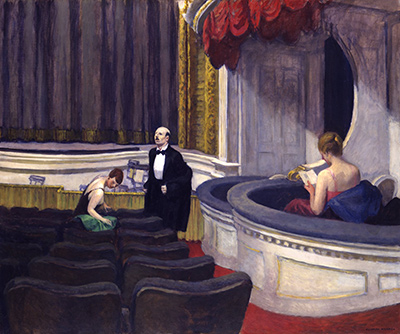
Three people have arrived in a theatre whose main event remains concealed. A man stands in the aisle, a woman bends towards a seat beside him, and another woman reads a programme in a curved box at the right. Above and around them are heavy curtains, gilded decoration and rows of dark chairs. Edward Hopper's Two on the Aisle makes the audience's small actions the performance we can actually see.
The Toledo Museum of Art dates the oil on canvas to 1927. Its current catalogue gives the painting's dimensions as 101.9 × 122.6 cm and identifies accession 1935.49, purchased with funds from the Libbey Endowment, gift of Edward Drummond Libbey. [1] The work's broad format accommodates an auditorium that feels much larger than its few visible occupants.
At a Glance
- ArtistEdward Hopper [1]
- Date1927 [1]
- Mediumoil on canvas [1]
- Collection / recordToledo Museum of Art [1]
- Accession1935.49 [1]
This work across Edward Hopper’s career
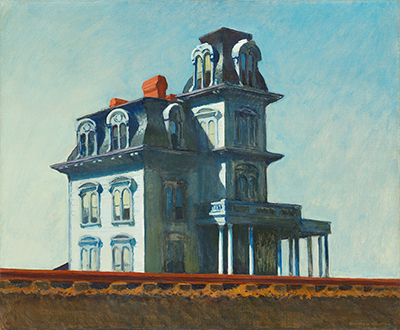
American Village
1912Soir Bleu
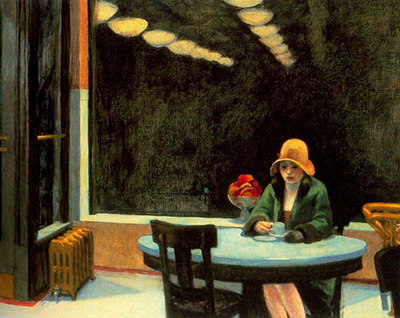
1914Automat
1927New York Movie
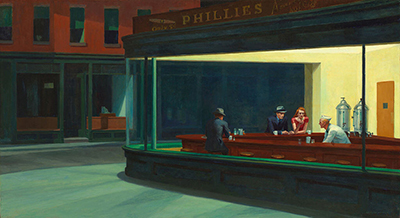
1939Nighthawks
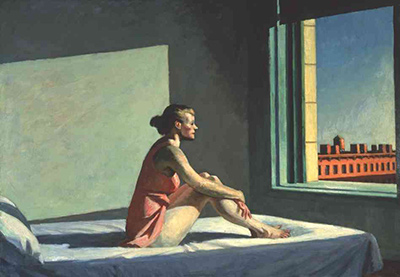
1942Morning Sun
1952Two Comedians
1966Contents
- Arriving before the main event
- The reader in the box
- Empty seats in the foreground
- Curtains and gilded edges
- Turning the auditorium into a set
- Two small preparatory sheets
- Early exhibition and Toledo ownership
- Waiting in other theatre pictures
Arriving before the main event
The man stands upright near the centre, his pale shirt front sharply defined within a dark evening coat. His head rises above the surrounding seats, making him conspicuous despite the much larger architectural forms overhead. The woman's bent posture beside him introduces a different direction, taking attention down towards the seating.
The museum reads the pair as recent arrivals: the gentleman removes his overcoat while his companion puts hers across the seat back. The other patron is already occupied with a playbill. [1] These activities place the scene before the expected spectacle without requiring a clock or a named production.
The difference between standing and bending gives the central pair a modest rhythm of adjustment. They are not arranged as a formal double portrait. One occupies the aisle's vertical space while the other reaches into the lower pattern of seats, making the transition from arrival to sitting visible.
Their clothing also belongs to the theatre's social presentation. The man's black-and-white evening dress and his companion's exposed shoulders stand out among the muted chairs. Hopper gives them enough specificity to establish an occasion, while leaving their relationship and conversation unstated.
No performer meets their attention. The great curtain remains closed, and the open foreground contains empty seats. The painting holds the preparations around an event rather than the event itself.
The reader in the box
The woman at the right is separated from the arriving pair by a substantial curved barrier. Her bare upper back catches the light, while a pale programme is held near her face. A dark blue wrap lies over the seating beside her, making a cooler mass beneath the warmer flesh.
Her position gives us a back view with a limited profile. The lowered head and raised paper identify a practical direction of attention. We can understand what she is looking at more easily than how she feels about the evening.
The curved box makes her a distinct presence. Its broad upper rail runs in front of the body, establishing a small enclosure within the larger auditorium. She is close to the other people in the image, yet occupies a different architectural compartment.
The pale programme matters because the rest of the theatre is so substantial. Its thin, handheld surface belongs to the audience's immediate experience; the surrounding stone-like panels, upholstery and draperies belong to a much larger public setting. The reader connects those different scales through an ordinary action.
The box also gives her a different relationship with the stage. While the arriving couple negotiate seats and aisle, she is already settled beside the opening. The painting contains several stages of preparation at once, without turning them into a continuous story about who arrived first.
Empty seats in the foreground
Rows of dark chairs occupy much of the lower left. Their backs repeat in shallow arcs, each partly concealing the seat behind. The pattern creates depth while keeping a considerable amount of the auditorium visibly unoccupied.
The repetition is irregular enough to remain spatial. Some backs are larger or more strongly lit, while others disappear into the darker interior. Hopper makes a seating system rather than a decorative grid: the chairs recede, turn and overlap as they approach the central figures.
The red aisle is a narrow interruption within that pattern. It gives the standing man a clear place to occupy and helps distinguish the arriving pair from the rows around them. The brighter floor also answers the red fabric high above the box, linking two distant parts of the image through colour.
From our position, the nearest chair backs obstruct a straightforward route towards the people. We look across seats rather than standing in a completely open space before them. That obstruction gives the view a recognizable audience perspective, with nearby furniture partly intervening.
The emptiness has more than one effect. It makes the three people conspicuous, but it also allows the theatre's arrangement to become legible. We can follow the rows, curved box and aisle because the crowd that might normally occupy them is absent from this selected moment.
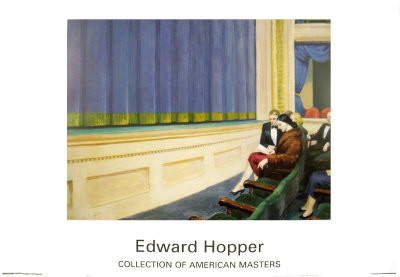
Compare: First Row Orchestra, 1951.
Curtains and gilded edges
A broad purple curtain closes the stage area at the upper left. Its long folds provide a heavy vertical rhythm above the smaller curves of the seats. Near the bottom, a warmer fringe marks the point where hanging cloth meets the pale construction below.
At the right, gilded trim rises beside the opening and red fabric gathers into a swag overhead. The richer colours make this part of the theatre more ornate than the dark foreground. Their concentration also frames the reader's comparatively small exposed back and pale programme.
The fabric changes character across the picture. The stage curtain hangs in more regular folds, while the red swag gathers into deeper, less even curves. Those differences give the theatre several kinds of material weight without requiring a densely populated scene.
A dark arched opening appears behind the box. Its depth contrasts with the pale surrounding wall and the bright edge of the drapery. It remains another area that the painting withholds from inspection, reinforcing the difference between the richly visible fittings and the spaces beyond them.
Watch: Edward Hopper’s Life and Art
Explore Hopper’s paintings and the places behind them in these museum films. Choose a film below.
Turning the auditorium into a set
The Whitney's 2022 exhibition identified Two on the Aisle as Hopper's first major painting of a theatre interior. Its label interprets his attention to the almost empty auditorium as a way of turning the theatre itself into a set, and treats the proscenium as a boundary between real and fictive worlds. [2]
That reading begins with a visible exchange. The architecture normally frames the performers, but here it frames the spectators. Closed curtains, the box and the repeated seats give the three people a setting as carefully organized as a stage arrangement.
The arriving couple produce a different effect. Their practical adjustments have the modest scale of everyday behaviour, yet their bright clothing and central placement make those movements the picture's clearest action. Hopper finds an alternative drama in preparation, seating and attention.
Two small preparatory sheets
The Whitney holds two 1927 studies in fabricated chalk on paper, accessions 70.128 and 70.129. Each is a narrow upright sheet, approximately 18.4 × 11.3 cm, much smaller than the finished canvas. [3] They investigate selected relationships rather than reproducing the whole painting in miniature.
The sheet numbered 70.128 groups several roughly indicated figures among seating forms. Dark vertical marks rise behind them, while the foreground is crossed by stronger curves and sloping lines. Bodies, furniture and surrounding fabric are considered together in a compact area.
The other study gives more room to architecture. A broad arch, a receding rail, a vertical support and hanging folds establish the enclosure, with chair curves entering below. Its open paper and vigorous shading make the construction especially easy to follow.
Placed beside the oil, the drawings show how much the finished image depends on connections between small human forms and large architectural ones. The painting expands those relations across a wider format and distinguishes them through colour. The studies need not be arranged into a guessed sequence to make that process useful to understand.
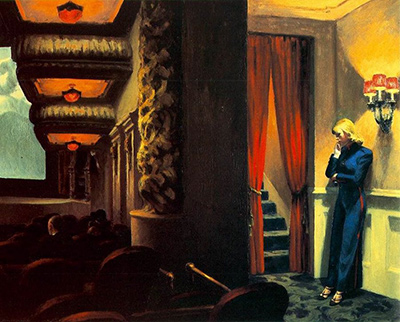
Compare: New York Movie, 1939.
Early exhibition and Toledo ownership
The Museum of Modern Art included Two on the Aisle as catalogue number 4 in its 1933 Hopper retrospective. The catalogue identifies H. C. Bentley of Boston as the collection at that time. [4] This historical entry predates the painting's Toledo accession and should be read as one stage of its public history.
Toledo's present record also lists appearances in the Carnegie Institute's 1928 international exhibition and in later major Hopper exhibitions. [1] The theatre picture was already circulating publicly near the beginning of the artist's wider museum recognition.
The museum notes a resemblance between the central couple and Edward and Josephine Hopper, while also acknowledging Jo's role as a model. [1] Resemblance and modelling do not make the finished scene a verified record of one evening in their lives. The painting's people remain part of a constructed theatre encounter.
Waiting in other theatre pictures
First Row Orchestra, painted in 1951, gives a large closed curtain and pale stage front even more space beside a small seated group. A programme again occupies someone's attention, but the movement of arrival has largely given way to people settled in their places.
New York Movie opens a different division. Film spectators occupy the dark left side while a brightly lit usher stands near the stairs at the right. In that picture, the work of attending to an audience becomes separate from the audience's own looking.
Two on the Aisle keeps its attention on the interval before the main event. The man standing between the seats, the woman bending beside him and the reader enclosed in the box give that interval distinct forms. The curtain can remain closed because the painting has already found its subject in the people on this side of it.
Artworks and studies directory
This researched directory includes finished works and separately identified studies. It is not a complete catalogue raisonné. Linked titles open the articles; unlinked studies are identified by their collection accessions. Watercolours retain their recorded media, and original prints remain distinct from reproductions.
| Name | Date | Medium |
|---|---|---|
| (Bridge and Embankment) (70.1298) | 1906 | Oil on wood |
| (Jo Sketching at Good Harbor Beach) (70.1129) | 1923–1924 | Watercolor and fabricated chalk on paper |
| (Manhattan Bridge) (70.1098) | 1925–1926 | Watercolor and graphite pencil on paper |
| (Rooftops) (70.1114) | 1926 | Watercolor and graphite pencil on paper |
| (Seated Male Model, Bent Over) (70.1277) | c. 1902–1903 | Oil on canvas |
| (Self-Portrait) (70.1254) | 1903–1906 | Oil on canvas |
| (Solitary Figure in a Theater) (70.1418) | c. 1902–1904 | Oil on board |
| 5 A.M. | 1937 | oil on canvas |
| Adam's House | 1928 | watercolour and charcoal on paper |
| American Village | 1912 | Oil on canvas |
| Apartment Houses | 1923 | oil on canvas |
| Approaching a City | 1946 | oil on canvas |
| August in the City | 1945 | oil on canvas |
| Automat | 1927 | oil on canvas |
| Barber Shop | 1931 | oil on canvas |
| Blackwell's Island | 1928 | oil on canvas |
| Bridge on the Seine | 1909 | Oil on canvas |
| Bridle Path | 1939 | oil on canvas |
| Burly Cobb's House South Truro | 1930–1933 | oil on canvas |
| Cape Cod Evening | 1939 | oil on canvas |
| Cape Cod Morning | 1950 | oil on canvas |
| Chair Car | 1965 | oil on canvas |
| Chop Suey | 1929 | oil on canvas |
| City Roofs | 1932 | Oil on canvas |
| Coast Guard Station | 1929 | oil on canvas |
| Compartment C, Car 293 | 1938 | oil on canvas |
| Conference at Night | 1949 | oil on canvas |
| Corn Hill | 1930 | oil on canvas |
| Dawn in Pennsylvania | 1942 | oil on canvas |
| Drug Store | 1927 | oil on canvas |
| Early Sunday Morning | 1930 | Oil on canvas |
| East Side Interior (70.1020) | 1922 | Etching |
| East Wind Over Weehawken | 1934 | oil on canvas |
| El Palacio | 1946 | Watercolor and graphite pencil on paper |
| Eleven A.M. | 1926 | oil on canvas |
| Evening Wind | 1921 | etching |
| Excursion into Philosophy | 1959 | oil on canvas |
| First Row Orchestra | 1951 | oil on canvas |
| Freight Car at Truro | 1931 | watercolour over graphite on paper |
| Gas | 1940 | oil on canvas |
| Girl at a Sewing Machine | c. 1921 | oil on canvas |
| Gloucester Harbor | 1912 | Oil on canvas |
| Ground Swell | 1939 | oil on canvas |
| Haskell's House | 1924 | watercolour over graphite on paperboard |
| High Noon | 1949 | oil on canvas |
| Hill and Houses Cape Elizabeth Maine | 1927 | watercolour over graphite pencil |
| Hills South Truro | 1930 | oil on canvas |
| Hotel by a Railroad | 1952 | oil on canvas |
| Hotel Lobby | 1943 | oil on canvas |
| Hotel Room | 1931 | oil on canvas |
| Hotel Window | 1955 | oil on canvas |
| House by the Railroad | 1925 | oil on canvas |
| House by the Squam River | 1926 | watercolour over graphite on paper |
| Le Bistro or The Wine Shop | 1909 | Oil on canvas |
| Le Pont des Arts | 1907 | Oil on canvas |
| Le Pont Royal | 1909 | Oil on canvas |
| Le Quai des Grands Augustins | 1909 | Oil on canvas |
| Lighthouse and Buildings Portland Head | 1927 | watercolour over graphite pencil on paper |
| Lighthouse Hill | 1927 | oil painting |
| Manhattan Bridge Loop | 1928 | oil on canvas |
| Model Sitting | c. 1902 | oil painting; support not asserted |
| Morning Sun | 1952 | oil on canvas |
| New York Movie | 1939 | oil on canvas |
| New York New Haven and Hartford | 1931 | oil on canvas |
| New York Office | 1962 | oil on canvas |
| New York Pavements | 1924–1925 | oil on canvas |
| New York Restaurant | c. 1922 | oil on canvas |
| Night Windows | 1928 | oil on canvas |
| Nighthawks | 1942 | oil on canvas |
| October on Cape Cod | 1946 | oil on canvas |
| Office at Night | 1940 | oil on canvas |
| Office in a Small City | 1953 | oil on canvas |
| Pennsylvania Coal Town | 1947 | oil on canvas |
| People in the Sun | 1960 | oil on canvas |
| Portrait of Orleans | 1950 | oil on canvas |
| Queensborough Bridge | 1913 | Oil on canvas |
| Railroad Sunset | 1929 | Oil on canvas |
| Railroad Train | 1908 | oil on canvas |
| Road in Maine | 1914 | oil on canvas |
| Room in Brooklyn | 1932 | oil on canvas |
| Room in New York | 1932 | oil on canvas |
| Rooms by the Sea | 1951 | oil on canvas |
| Rooms for Tourists | 1945 | oil on canvas |
| Route 6 Eastham | 1941 | oil on canvas |
| Second Story Sunlight | 1960 | Oil on canvas |
| Self-Portrait | 1925–1930 | Oil on canvas |
| Self-Portrait with Hat (70.1903) | c. 1918, posthumous print | Drypoint |
| Seven A.M. | 1948 | Oil on canvas |
| Soir Bleu | 1914 | oil on canvas |
| South Carolina Morning | 1955 | Oil on canvas |
| Stairway at 48 Rue de Lille Paris | 1906 | Oil on wood |
| Study for 5 A.M. (70.153) | 1937 | Fabricated chalk on paper |
| Study for 5 A.M. (70.429) | 1937 | Fabricated chalk and graphite pencil on paper |
| Study for Approaching a City (70.869) | 1946 | Fabricated chalk and charcoal on paper |
| Study for August in the City (70.158a-b) | 1945 | Fabricated chalk on paper |
| Study for August in the City (70.159) | 1945 | Fabricated chalk on paper |
| Study for Bridle Path (70.220) | 1939 | Fabricated chalk on paper |
| Study for Bridle Path (70.235) | 1939 | Fabricated chalk on paper |
| Study for Compartment C, Car 293 (70.430) | 1938 | Fabricated chalk on paper |
| Study for Compartment C, Car 293 (70.431a-b) | 1938 | Fabricated chalk and charcoal on paper |
| Study for Conference at Night (70.170) | 1949 | Fabricated chalk on paper (recto); Typewriter ink on paper (verso) |
| Study for Conference at Night (70.174) | 1949 | Fabricated chalk on paper ( recto); Typewriter ink on paper (verso) |
| Study for East Wind over Weehawken (70.249) | 1934 | Graphite pencil on paper |
| Study for East Wind over Weehawken (70.252) | 1934 | Fabricated chalk and charcoal on paper |
| Study for Evening Wind (70.343a-b) | 1921 | Fabricated chalk on paper |
| Study for First Row Orchestra (70.841) | 1951 | Fabricated chalk and charcoal on paper |
| Study for Gas (70.263) | 1940 | Fabricated chalk on paper |
| Study for Ground Swell (70.339) | 1939 | Fabricated chalk, charcoal and graphite pencil on paper |
| Study for Hotel by a Railroad (70.199) | 1952 | Fabricated chalk on paper |
| Study for Hotel by a Railroad (70.427) | 1952 | Fabricated chalk on paper |
| Study for Hotel by a Railroad (70.428) | 1952 | Fabricated chalk on paper |
| Study for Hotel Lobby (70.117) | 1942 | Fabricated chalk and graphite pencil on paper |
| Study for Hotel Lobby (70.839) | 1942 | Fabricated chalk and charcoal on paper |
| Study for Hotel Window (70.161) | 1955 | Fabricated chalk, graphite pencil and colored pencil on paper |
| Study for Morning Sun (70.243) | 1952 | Fabricated chalk on paper |
| Study for Morning Sun (70.244) | 1952 | Fabricated chalk on paper |
| Study for Morning Sun (70.290) | 1952 | Fabricated chalk on paper |
| Study for Morning Sun (70.291) | 1952 | Fabricated chalk and graphite pencil on paper |
| Study for New York Movie (70.273) | 1939 | Fabricated chalk on paper |
| Study for New York Movie (70.274a-b) | 1938 or 1939 | Fabricated chalk and charcoal on paper (recto); Fabricated chalk on paper (verso) |
| Study for New York Movie (70.455) | 1939 | Fabricated chalk and charcoal on paper |
| Study for New York Office (70.822) | 1962 | Fabricated chalk on paper |
| Study for Nighthawks (70.192) | 1941 or 1942 | Fabricated chalk on paper |
| Study for Nighthawks (70.193) | 1941 or 1942 | Fabricated chalk on paper |
| Study for Office at Night (70.340) | 1940 | Fabricated chalk and charcoal on paper |
| Study for Office at Night (70.341) | 1940 | Fabricated chalk and graphite pencil on paper |
| Study for Pennsylvania Coal Town (70.198) | 1947 | Fabricated chalk on paper |
| Study for Pennsylvania Coal Town (70.229) | 1947 | Fabricated chalk and charcoal on paper |
| Study for Rooms for Tourists (70.438) | 1945 | Fabricated chalk and charcoal on paper |
| Study for Rooms for Tourists (70.848) | 1945 | Fabricated chalk and charcoal on paper |
| Study for Route 6, Eastham (70.369) | 1941 | Fabricated chalk and graphite pencil on paper |
| Study for Route 6, Eastham (70.854) | 1941 | Fabricated chalk and graphite pencil on paper |
| Study for South Carolina Morning (70.162a-b) | 1955 | Fabricated chalk on paper (recto and verso) |
| Study for The Sheridan Theatre (70.969) | 1937 | Graphite pencil on paper |
| Study for Two on the Aisle (70.128) | 1927 | Fabricated chalk on paper |
| Study for Two on the Aisle (70.129) | 1927 | Fabricated chalk on paper |
| Study for Yawl Riding a Swell (70.439) | 1935 | Fabricated chalk and graphite pencil on paper |
| Summer Evening | 1947 | oil on canvas |
| Summer Interior | 1909 | Oil on canvas |
| Sun in an Empty Room | 1963 | oil on canvas |
| Sunlight in a Cafeteria | 1958 | oil on canvas |
| Sunlight on Brownstones | 1956 | oil on canvas |
| Tables for Ladies | 1930 | oil on canvas |
| The Bootleggers | 1925 | oil on canvas |
| The Camel's Hump | 1931 | oil on canvas |
| The Circle Theatre | 1936 | oil on canvas |
| The City | 1927 | oil on canvas |
| The Lighthouse at Two Lights | 1929 | oil on canvas |
| The Long Leg | 1935 | oil on canvas |
| The Mansard Roof | 1923 | watercolour over graphite on paper |
| The Sheridan Theatre | 1937 | oil on canvas |
| Tramp Steamer | 1908 | oil on canvas |
| Two Comedians | 1966 | oil on canvas |
| Two on the Aisle | 1927 | oil on canvas |
| Valley of the Seine | 1909 | Oil on canvas |
| Western Motel | 1957 | oil on canvas |
Frequently Asked Questions
Edward Hopper made Two on the Aisle in 1927. [1]
The recorded medium is oil on canvas. [1]
Three people have arrived in a theatre whose main event remains concealed. A man stands in the aisle, a woman bends towards a seat beside him, and another woman reads a programme in a curved box at the right. Above and around them are heavy curtains, gilded decoration and rows of dark chairs. Edward Hopper's Two on the Aisle makes the audience's small actions the performance we can actually see.
Discussion
Look again at the images and ideas explored in Two on the Aisle. These editorial prompts invite your observations.
Reader Insights
Which boundary, gesture or change of light first holds your attention in Two on the Aisle?
Compare First Row Orchestra with Two on the Aisle. Which visual difference matters most to your reading?
Which detail would you look at again after reading “Empty seats in the foreground”?
Join the Conversation
Share a detail, comparison or question about Two on the Aisle below.
References
- Toledo Museum of Art, Two on the Aisle, 1927, accession 1935.49; current painting dimensions, purchase credit, interpretation and exhibition history. View source.
- Whitney Museum of American Art, Edward Hopper's New York, exhibition labels, 2022, PDF p. 53, printed label 37; the theatre as a set and the proscenium interpretation. View source.
- Whitney Museum of American Art, Study for Two on the Aisle, 70.128 and Study for Two on the Aisle, 70.129, 1927; fabricated chalk on paper, Josephine N. Hopper Bequest; object records and drawings. View source 1. View source 2.
- Museum of Modern Art, Edward Hopper, 1933, catalogue no. 4, printed p. 25; historical Bentley collection reference. View source.
- Collection or catalogue record, American Village, 1912; medium and identity as discussed in the linked article. View source.
- Collection or catalogue record, Soir Bleu, 1914; medium and identity as discussed in the linked article. View source.
- Collection or catalogue record, House by the Railroad, 1925; medium and identity as discussed in the linked article. View source.
- Collection or catalogue record, Automat, 1927; medium and identity as discussed in the linked article. View source.
- Collection or catalogue record, Early Sunday Morning, 1930; medium and identity as discussed in the linked article. View source.
- Collection or catalogue record, New York Movie, 1939; medium and identity as discussed in the linked article. View source.
- Collection or catalogue record, Nighthawks, 1942; medium and identity as discussed in the linked article. View source.
- Collection or catalogue record, Morning Sun, 1952; medium and identity as discussed in the linked article. View source.
- Collection or catalogue record, Second Story Sunlight, 1960; medium and identity as discussed in the linked article. View source.
- Collection or catalogue record, Two Comedians, 1966; medium and identity as discussed in the linked article. View source.
- Whitney Museum of American Art, Study for Route 6, Eastham, 1941, accession 70.854; exact object record. View source.
- Whitney Museum of American Art, Study for Conference at Night, 1949, accession 70.170; exact object record. View source.
- Whitney Museum of American Art, Study for First Row Orchestra, 1951, accession 70.841; exact object record. View source.
- Whitney Museum of American Art, (Bridge and Embankment), 1906, accession 70.1298; exact object record. View source.
- Whitney Museum of American Art, (Seated Male Model, Bent Over), c. 1902–1903, accession 70.1277; exact object record. View source.
- Whitney Museum of American Art, Study for Morning Sun, 1952, accession 70.244; exact object record. View source.
- Whitney Museum of American Art, Study for Morning Sun, 1952, accession 70.243; exact object record. View source.
- Whitney Museum of American Art, Study for Two on the Aisle, 1927, accession 70.128; exact object record. View source.
- Whitney Museum of American Art, Study for New York Office, 1962, accession 70.822; exact object record. View source.
- Whitney Museum of American Art, Study for Two on the Aisle, 1927, accession 70.129; exact object record. View source.
- Whitney Museum of American Art, Study for Pennsylvania Coal Town, 1947, accession 70.229; exact object record. View source.
- Whitney Museum of American Art, (Rooftops), 1926, accession 70.1114; exact object record. View source.
- Whitney Museum of American Art, Study for South Carolina Morning, 1955, accession 70.162a-b; exact object record. View source.
- Whitney Museum of American Art, (Self-Portrait), 1903–1906, accession 70.1254; exact object record. View source.
- Whitney Museum of American Art, (Manhattan Bridge), 1925–1926, accession 70.1098; exact object record. View source.
- Whitney Museum of American Art, (Solitary Figure in a Theater), c. 1902–1904, accession 70.1418; exact object record. View source.
- Whitney Museum of American Art, Study for Approaching a City, 1946, accession 70.869; exact object record. View source.
- Whitney Museum of American Art, Study for August in the City, 1945, accession 70.159; exact object record. View source.
- Whitney Museum of American Art, Study for Compartment C, Car 293, 1938, accession 70.430; exact object record. View source.
- Whitney Museum of American Art, Study for Compartment C, Car 293, 1938, accession 70.431a-b; exact object record. View source.
- Whitney Museum of American Art, Study for East Wind over Weehawken, 1934, accession 70.252; exact object record. View source.
- Whitney Museum of American Art, Study for East Wind over Weehawken, 1934, accession 70.249; exact object record. View source.
- Whitney Museum of American Art, Study for Evening Wind, 1921, accession 70.343a-b; exact object record. View source.
- Whitney Museum of American Art, Study for The Sheridan Theatre, 1937, accession 70.969; exact object record. View source.
- Whitney Museum of American Art, Study for New York Movie, 1939, accession 70.455; exact object record. View source.
- Whitney Museum of American Art, Study for New York Movie, 1939, accession 70.273; exact object record. View source.
- Whitney Museum of American Art, Study for New York Movie, 1938 or 1939, accession 70.274a-b; exact object record. View source.
- Whitney Museum of American Art, Study for 5 A.M., 1937, accession 70.153; exact object record. View source.
- Whitney Museum of American Art, Study for 5 A.M., 1937, accession 70.429; exact object record. View source.
- Whitney Museum of American Art, (Jo Sketching at Good Harbor Beach), 1923–1924, accession 70.1129; exact object record. View source.
- Whitney Museum of American Art, Study for August in the City, 1945, accession 70.158a-b; exact object record. View source.
- Whitney Museum of American Art, Study for Morning Sun, 1952, accession 70.291; exact object record. View source.
- Whitney Museum of American Art, Study for Morning Sun, 1952, accession 70.290; exact object record. View source.
- Whitney Museum of American Art, Study for Office at Night, 1940, accession 70.340; exact object record. View source.
- Whitney Museum of American Art, Study for Office at Night, 1940, accession 70.341; exact object record. View source.
- Whitney Museum of American Art, Study for Hotel by a Railroad, 1952, accession 70.427; exact object record. View source.
- Whitney Museum of American Art, Study for Hotel by a Railroad, 1952, accession 70.199; exact object record. View source.
- Whitney Museum of American Art, Study for Hotel by a Railroad, 1952, accession 70.428; exact object record. View source.
- Whitney Museum of American Art, Study for Hotel Lobby, 1942, accession 70.117; exact object record. View source.
- Whitney Museum of American Art, Study for Hotel Lobby, 1942, accession 70.839; exact object record. View source.
- Whitney Museum of American Art, Study for Conference at Night, 1949, accession 70.174; exact object record. View source.
- Whitney Museum of American Art, Study for Hotel Window, 1955, accession 70.161; exact object record. View source.
- Whitney Museum of American Art, Study for Pennsylvania Coal Town, 1947, accession 70.198; exact object record. View source.
- Whitney Museum of American Art, Study for Route 6, Eastham, 1941, accession 70.369; exact object record. View source.
- Whitney Museum of American Art, Study for Bridle Path, 1939, accession 70.220; exact object record. View source.
- Whitney Museum of American Art, Study for Bridle Path, 1939, accession 70.235; exact object record. View source.
- Whitney Museum of American Art, Study for Ground Swell, 1939, accession 70.339; exact object record. View source.
- Whitney Museum of American Art, Study for Yawl Riding a Swell, 1935, accession 70.439; exact object record. View source.
- Whitney Museum of American Art, Study for Rooms for Tourists, 1945, accession 70.848; exact object record. View source.
- Whitney Museum of American Art, Study for Rooms for Tourists, 1945, accession 70.438; exact object record. View source.
- Whitney Museum of American Art, Study for Nighthawks, 1941 or 1942, accession 70.193; exact object record. View source.
- Whitney Museum of American Art, Study for Nighthawks, 1941 or 1942, accession 70.192; exact object record. View source.
- Whitney Museum of American Art, Study for Gas, 1940, accession 70.263; exact object record. View source.
- Whitney Museum of American Art, Self-Portrait with Hat, c. 1918, posthumous print, accession 70.1903; exact object record. View source.
- Whitney Museum of American Art, East Side Interior, 1922, accession 70.1020; exact object record. View source.
- Art Institute of Chicago, Selected Chronology for Edward Hopper; training, travels, exhibitions, New York and Truro chronology. View source.
- Emily C. Burns, Spectral figures: Edward Hopper’s empty Paris, chapter 5 in Empty Spaces: Confronting Emptiness in National, Cultural and Urban Histories, 2019; complete chapter and notes consulted. View source.
- Charles Brock, Regionalism and Folk Art, National Gallery of Art; complete essay and two notes consulted. View source.