 by Tom Gurney
Tom Gurney BSc (Hons) is an art history expert with over 20 years experience
Email: tomgurney1@gmail.com / Phone: +44 7429 011000
Portrait of Orleans: Introduction
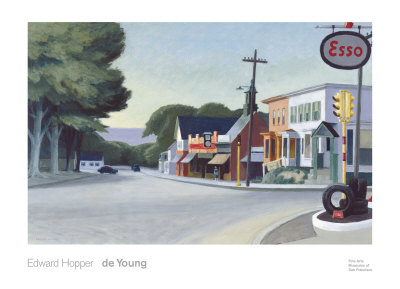
A broad intersection opens before a row of small shops. Trees line the left side, cars sit farther down the street, and a woman stands close to a shop window. At the right, an Esso sign rises above a display of tyres. Edward Hopper's Portrait of Orleans gives a town's streets, buildings and commercial signs the attention normally associated with a portrait sitter.
The Fine Arts Museums of San Francisco records the painting as an oil on canvas of 1950, measuring 66 × 101.6 cm, accession 1991.32, gift of Jerrold and June Kingsley. [1] Its Orleans is the town on Cape Cod in Massachusetts. The intersection, rather than an individual sitter, supplies the town's likeness.
At a Glance
- ArtistEdward Hopper [1]
- Date1950 [1]
- Mediumoil on canvas [1]
- Collection / recordFine Arts Museums of San Francisco, de Young [1]
- Accession1991.32 [1]
This work across Edward Hopper’s career
American Village
1912Soir Bleu
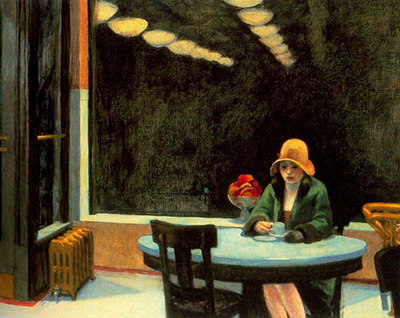
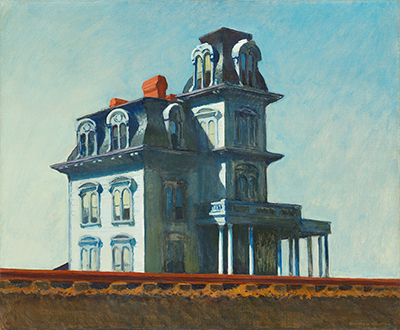
1914Automat
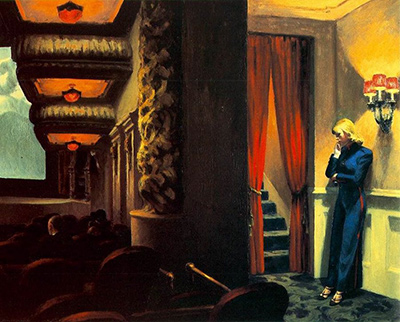
1927New York Movie
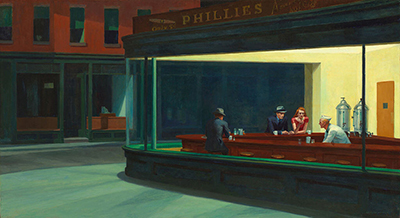
1939Nighthawks
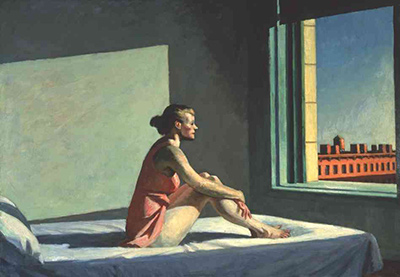
1942Morning Sun
1952Two Comedians
1966Contents
- A portrait made from an intersection
- The Esso sign at the right
- Small façades and changing rhythms
- Trees on the other side
- A small person beside a large road
- A pole without its network
- An overall view on paper
- Entrances, signs and standing figures
- A particular place, selectively described
- Roads and services elsewhere
A portrait made from an intersection
The road takes up a large part of the foreground. It gives the spectator an open approach to the town while holding the main row of buildings at a distance. The broad pale surface is an important shape, rather than simply a gap waiting for traffic.
The intersection divides that approach. The eye can follow the street deeper between the trees and shops, or turn with the curved edge at the right. Hopper makes the viewer consider more than one direction through the same small setting.
The museum describes the viewpoint as that of a driver choosing between continuing onto Main Street and turning towards Route 6A. [1] This interpretation gives the open foreground a practical role: it is a place from which a traveller must decide where to go.
A painted view does not require us to make that decision. We can remain before the junction, examining the signs and façades while the possible movement is held in suspension. The road's openness and the image's stillness work together.
The Esso sign at the right
The oval Esso sign is among the most legible details in the scene. Its red lettering and border stand out against the paler sky and nearby architecture. A brand name becomes a conspicuous part of the town's appearance.
Below it, the tyres connect the sign with a specific kind of roadside business. They make the filling station more than an abstract symbol of travel: the forecourt contains things intended for the maintenance and use of cars.
The sign's high position also changes the balance of the picture. The viewer can recognise it before closely inspecting the smaller shopfronts. Its rounded form contrasts with their pitched roofs, rectangular windows and straight cornices.
The museum reads this commercial presence in relation to the expansion of post-war car culture and corporate business. [1] The familiar petrol brand gives that broad historical reading a concrete point of reference within the image.
The filling station belongs to the same street as the older-looking shops. Hopper does not separate modern motoring into a different landscape. Its equipment and sign sit directly beside the town's existing architecture.
Small façades and changing rhythms
The buildings at the right make a sequence of different fronts. Roof pitches, awnings, window arrangements and projecting entrances prevent the row from becoming one uniform block. The town's character emerges through these modest variations.
Some surfaces catch more light than others. Pale fronts are interrupted by warmer or darker sections, while shadows give entrances and awnings a greater depth. The row can be read from a distance without every shop requiring a fully legible name.
The low roofs also keep the scale manageable. The scene has the structure of a town centre rather than a metropolitan canyon. Trees remain substantial presences, and the sky continues above the buildings without being squeezed into a narrow strip.
The shop row leads the eye towards the street's recession. The nearer buildings offer more distinct openings and edges; farther forms compress together. Hopper lets differences of detail help create distance within an otherwise quite restrained view.
Trees on the other side
The large trees at the left give the street a softer boundary. Their foliage forms broad irregular masses above a sequence of narrower trunks. They contrast with the signs and façades without removing the sense of an organised roadside.
The nearest tree is cropped by the frame. Its mass seems to continue outside the selected view, making the town feel part of a larger setting rather than a complete model placed before us.
Farther down the street, trees and buildings become less individually distinct. The recession offers a continuation, but no particular destination. The eye can travel into it without discovering a landmark that explains the entire town.
The balance between trees and shopfronts helps the road remain central. One side is shaded and irregular, the other more varied in its constructed edges. The street holds those different kinds of boundary apart.
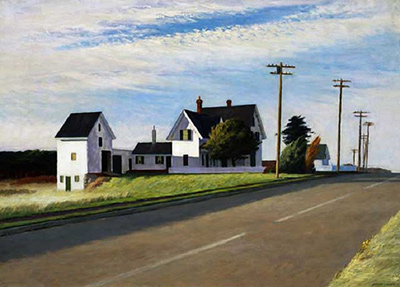
Compare: Route 6 Eastham, 1941.
A small person beside a large road
The woman at the shop window is easy to overlook on a first viewing. She occupies only a small part of the canvas, close to a façade whose details are much larger than her body. The road and Esso sign can attract attention before she does.
Once noticed, the figure gives the buildings another scale. A window becomes something a person can look into; the pavement becomes a place where someone can stop. An apparently empty town view acquires a small, specific human activity.
The distant cars perform a related function. They establish use of the street without turning the scene into a flow of traffic. Their comparatively small size leaves the foreground open and the intersection unoccupied.
The museum's interpretation connects these stilled elements with the impression that time has paused. [1] The effect is made from visible choices: a person standing, parked or stationary-looking vehicles, and a road on which no near movement is shown.
A pole without its network
A utility pole rises near the shop row. Its vertical form and crosspiece stand out against the sky, yet the usual web of wires does not spread across the painting. The pole remains a strong mark without the network that would ordinarily connect it to other structures.
This selective treatment helps the composition stay clear. The pole can interrupt the skyline and relate to the upright signs without filling the upper canvas with additional diagonals.
The museum draws a symbolic comparison between its unwired form and a cross. [1] That is an interpretation of the shape and its position at a junction, rather than evidence that the visible object has ceased to be roadside equipment.
The sign, pole and traffic light make different kinds of information visible. One names a business, another suggests a utility system, and another regulates movement. Together they give the town's public space a structure beyond the buildings themselves.
Watch: Edward Hopper’s Life and Art
Explore Hopper’s paintings and the places behind them in these museum films. Choose a film below.
An overall view on paper
Three drawings published in Jill Newhouse Gallery's 2025 exhibition catalogue provide unusually specific comparisons. The gallery identifies each as a 1950 study for Portrait of Orleans, in pencil on bond paper. [2]
The first gives an overall arrangement of the intersection. Shopfronts recede beside trees, while the Esso sign and tyres occupy the right. A much larger pole stands close to the foreground, cutting across the view in a position absent from the finished painting.
That difference changes the spectator's access to the street. The drawing lets a near vertical obstruct more of the scene; the painting clears that part of the approach. The town's open foreground is therefore a compositional decision, rather than an unavoidable feature of the subject.
Repeated lines around the roofs, sign and tree masses keep the drawing visibly exploratory. It establishes relationships that the oil can simplify, colour and adjust. The final image's apparent ease rests on the positioning of quite different kinds of object.
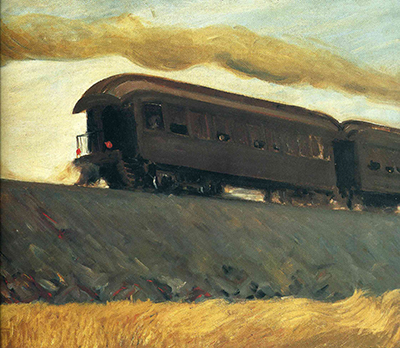
Compare: Railroad Train, 1908.
Entrances, signs and standing figures
A second published sheet concentrates on separate architectural details. An entrance, parts of the shop row, roof forms and another doorway occupy different areas of the paper. They are not yet joined into a complete street view. [2]
The sheet shows the value of small distinguishing features. A pediment or projecting doorway can give one frontage a different character from the next. Such details become part of the town's likeness even when their size in the final composition is modest.
The third sheet includes signs and architectural fragments alongside larger studies of a standing figure seen from different directions. [2] The tiny person in the painting thus belongs to a process of observation and adjustment, rather than merely filling an empty pavement.
The three sheets all carry the painting's year in the catalogue. Their published order does not establish a complete sequence of making. Together they demonstrate attention to the overall view, the town's smaller structures and the body that gives them human scale.
A particular place, selectively described
The title makes Orleans a subject with an identity. The painting does not need a famous monument to achieve that identity: the intersection, business sign, trees and varied fronts supply a recognisable kind of townscape.
At the same time, the drawings show that particularity does not require an unchanged transcription. A foreground obstruction could be removed, details could be studied apart, and a figure could be developed at a scale much larger than its eventual place in the street.
The Kingsleys' gift brought the canvas into the Fine Arts Museums of San Francisco in 1991. [1] A Massachusetts town consequently became part of a public collection on the other side of the country, while the image continued to preserve its local name.
Roads and services elsewhere
Route 6 Eastham gives a road a longer diagonal stretch beside houses and utility poles. Its approach leads towards a more distant horizon; Portrait of Orleans brings movement to a junction within a town.
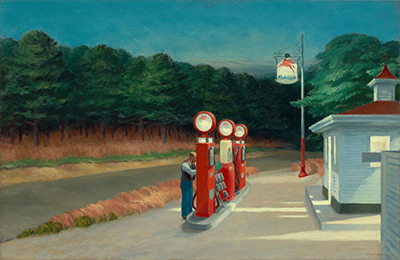
Gas concentrates on a filling station beside a darker stretch of road. Here the petrol business belongs to a broader group of shops, with its branded sign becoming one feature of a town portrait.
In Early Sunday Morning, a continuous row of urban fronts occupies the view more directly. Orleans leaves a much larger road surface between the spectator and the buildings.
Follow that road towards the smaller shops, then return to the red Esso lettering. The town is presented through things people pass, use and occasionally stop beside. Hopper makes their arrangement distinctive enough to carry a portrait without a central sitter.
Artworks and studies directory
This researched directory includes finished works and separately identified studies. It is not a complete catalogue raisonné. Linked titles open the articles; unlinked studies are identified by their collection accessions. Watercolours retain their recorded media, and original prints remain distinct from reproductions.
| Name | Date | Medium |
|---|---|---|
| (Bridge and Embankment) (70.1298) | 1906 | Oil on wood |
| (Jo Sketching at Good Harbor Beach) (70.1129) | 1923–1924 | Watercolor and fabricated chalk on paper |
| (Manhattan Bridge) (70.1098) | 1925–1926 | Watercolor and graphite pencil on paper |
| (Rooftops) (70.1114) | 1926 | Watercolor and graphite pencil on paper |
| (Seated Male Model, Bent Over) (70.1277) | c. 1902–1903 | Oil on canvas |
| (Self-Portrait) (70.1254) | 1903–1906 | Oil on canvas |
| (Solitary Figure in a Theater) (70.1418) | c. 1902–1904 | Oil on board |
| 5 A.M. | 1937 | oil on canvas |
| Adam's House | 1928 | watercolour and charcoal on paper |
| American Village | 1912 | Oil on canvas |
| Apartment Houses | 1923 | oil on canvas |
| Approaching a City | 1946 | oil on canvas |
| August in the City | 1945 | oil on canvas |
| Automat | 1927 | oil on canvas |
| Barber Shop | 1931 | oil on canvas |
| Blackwell's Island | 1928 | oil on canvas |
| Bridge on the Seine | 1909 | Oil on canvas |
| Bridle Path | 1939 | oil on canvas |
| Burly Cobb's House South Truro | 1930–1933 | oil on canvas |
| Cape Cod Evening | 1939 | oil on canvas |
| Cape Cod Morning | 1950 | oil on canvas |
| Chair Car | 1965 | oil on canvas |
| Chop Suey | 1929 | oil on canvas |
| City Roofs | 1932 | Oil on canvas |
| Coast Guard Station | 1929 | oil on canvas |
| Compartment C, Car 293 | 1938 | oil on canvas |
| Conference at Night | 1949 | oil on canvas |
| Corn Hill | 1930 | oil on canvas |
| Dawn in Pennsylvania | 1942 | oil on canvas |
| Drug Store | 1927 | oil on canvas |
| Early Sunday Morning | 1930 | Oil on canvas |
| East Side Interior (70.1020) | 1922 | Etching |
| East Wind Over Weehawken | 1934 | oil on canvas |
| El Palacio | 1946 | Watercolor and graphite pencil on paper |
| Eleven A.M. | 1926 | oil on canvas |
| Evening Wind | 1921 | etching |
| Excursion into Philosophy | 1959 | oil on canvas |
| First Row Orchestra | 1951 | oil on canvas |
| Freight Car at Truro | 1931 | watercolour over graphite on paper |
| Gas | 1940 | oil on canvas |
| Girl at a Sewing Machine | c. 1921 | oil on canvas |
| Gloucester Harbor | 1912 | Oil on canvas |
| Ground Swell | 1939 | oil on canvas |
| Haskell's House | 1924 | watercolour over graphite on paperboard |
| High Noon | 1949 | oil on canvas |
| Hill and Houses Cape Elizabeth Maine | 1927 | watercolour over graphite pencil |
| Hills South Truro | 1930 | oil on canvas |
| Hotel by a Railroad | 1952 | oil on canvas |
| Hotel Lobby | 1943 | oil on canvas |
| Hotel Room | 1931 | oil on canvas |
| Hotel Window | 1955 | oil on canvas |
| House by the Railroad | 1925 | oil on canvas |
| House by the Squam River | 1926 | watercolour over graphite on paper |
| Le Bistro or The Wine Shop | 1909 | Oil on canvas |
| Le Pont des Arts | 1907 | Oil on canvas |
| Le Pont Royal | 1909 | Oil on canvas |
| Le Quai des Grands Augustins | 1909 | Oil on canvas |
| Lighthouse and Buildings Portland Head | 1927 | watercolour over graphite pencil on paper |
| Lighthouse Hill | 1927 | oil painting |
| Manhattan Bridge Loop | 1928 | oil on canvas |
| Model Sitting | c. 1902 | oil painting; support not asserted |
| Morning Sun | 1952 | oil on canvas |
| New York Movie | 1939 | oil on canvas |
| New York New Haven and Hartford | 1931 | oil on canvas |
| New York Office | 1962 | oil on canvas |
| New York Pavements | 1924–1925 | oil on canvas |
| New York Restaurant | c. 1922 | oil on canvas |
| Night Windows | 1928 | oil on canvas |
| Nighthawks | 1942 | oil on canvas |
| October on Cape Cod | 1946 | oil on canvas |
| Office at Night | 1940 | oil on canvas |
| Office in a Small City | 1953 | oil on canvas |
| Pennsylvania Coal Town | 1947 | oil on canvas |
| People in the Sun | 1960 | oil on canvas |
| Portrait of Orleans | 1950 | oil on canvas |
| Queensborough Bridge | 1913 | Oil on canvas |
| Railroad Sunset | 1929 | Oil on canvas |
| Railroad Train | 1908 | oil on canvas |
| Road in Maine | 1914 | oil on canvas |
| Room in Brooklyn | 1932 | oil on canvas |
| Room in New York | 1932 | oil on canvas |
| Rooms by the Sea | 1951 | oil on canvas |
| Rooms for Tourists | 1945 | oil on canvas |
| Route 6 Eastham | 1941 | oil on canvas |
| Second Story Sunlight | 1960 | Oil on canvas |
| Self-Portrait | 1925–1930 | Oil on canvas |
| Self-Portrait with Hat (70.1903) | c. 1918, posthumous print | Drypoint |
| Seven A.M. | 1948 | Oil on canvas |
| Soir Bleu | 1914 | oil on canvas |
| South Carolina Morning | 1955 | Oil on canvas |
| Stairway at 48 Rue de Lille Paris | 1906 | Oil on wood |
| Study for 5 A.M. (70.153) | 1937 | Fabricated chalk on paper |
| Study for 5 A.M. (70.429) | 1937 | Fabricated chalk and graphite pencil on paper |
| Study for Approaching a City (70.869) | 1946 | Fabricated chalk and charcoal on paper |
| Study for August in the City (70.158a-b) | 1945 | Fabricated chalk on paper |
| Study for August in the City (70.159) | 1945 | Fabricated chalk on paper |
| Study for Bridle Path (70.220) | 1939 | Fabricated chalk on paper |
| Study for Bridle Path (70.235) | 1939 | Fabricated chalk on paper |
| Study for Compartment C, Car 293 (70.430) | 1938 | Fabricated chalk on paper |
| Study for Compartment C, Car 293 (70.431a-b) | 1938 | Fabricated chalk and charcoal on paper |
| Study for Conference at Night (70.170) | 1949 | Fabricated chalk on paper (recto); Typewriter ink on paper (verso) |
| Study for Conference at Night (70.174) | 1949 | Fabricated chalk on paper ( recto); Typewriter ink on paper (verso) |
| Study for East Wind over Weehawken (70.249) | 1934 | Graphite pencil on paper |
| Study for East Wind over Weehawken (70.252) | 1934 | Fabricated chalk and charcoal on paper |
| Study for Evening Wind (70.343a-b) | 1921 | Fabricated chalk on paper |
| Study for First Row Orchestra (70.841) | 1951 | Fabricated chalk and charcoal on paper |
| Study for Gas (70.263) | 1940 | Fabricated chalk on paper |
| Study for Ground Swell (70.339) | 1939 | Fabricated chalk, charcoal and graphite pencil on paper |
| Study for Hotel by a Railroad (70.199) | 1952 | Fabricated chalk on paper |
| Study for Hotel by a Railroad (70.427) | 1952 | Fabricated chalk on paper |
| Study for Hotel by a Railroad (70.428) | 1952 | Fabricated chalk on paper |
| Study for Hotel Lobby (70.117) | 1942 | Fabricated chalk and graphite pencil on paper |
| Study for Hotel Lobby (70.839) | 1942 | Fabricated chalk and charcoal on paper |
| Study for Hotel Window (70.161) | 1955 | Fabricated chalk, graphite pencil and colored pencil on paper |
| Study for Morning Sun (70.243) | 1952 | Fabricated chalk on paper |
| Study for Morning Sun (70.244) | 1952 | Fabricated chalk on paper |
| Study for Morning Sun (70.290) | 1952 | Fabricated chalk on paper |
| Study for Morning Sun (70.291) | 1952 | Fabricated chalk and graphite pencil on paper |
| Study for New York Movie (70.273) | 1939 | Fabricated chalk on paper |
| Study for New York Movie (70.274a-b) | 1938 or 1939 | Fabricated chalk and charcoal on paper (recto); Fabricated chalk on paper (verso) |
| Study for New York Movie (70.455) | 1939 | Fabricated chalk and charcoal on paper |
| Study for New York Office (70.822) | 1962 | Fabricated chalk on paper |
| Study for Nighthawks (70.192) | 1941 or 1942 | Fabricated chalk on paper |
| Study for Nighthawks (70.193) | 1941 or 1942 | Fabricated chalk on paper |
| Study for Office at Night (70.340) | 1940 | Fabricated chalk and charcoal on paper |
| Study for Office at Night (70.341) | 1940 | Fabricated chalk and graphite pencil on paper |
| Study for Pennsylvania Coal Town (70.198) | 1947 | Fabricated chalk on paper |
| Study for Pennsylvania Coal Town (70.229) | 1947 | Fabricated chalk and charcoal on paper |
| Study for Rooms for Tourists (70.438) | 1945 | Fabricated chalk and charcoal on paper |
| Study for Rooms for Tourists (70.848) | 1945 | Fabricated chalk and charcoal on paper |
| Study for Route 6, Eastham (70.369) | 1941 | Fabricated chalk and graphite pencil on paper |
| Study for Route 6, Eastham (70.854) | 1941 | Fabricated chalk and graphite pencil on paper |
| Study for South Carolina Morning (70.162a-b) | 1955 | Fabricated chalk on paper (recto and verso) |
| Study for The Sheridan Theatre (70.969) | 1937 | Graphite pencil on paper |
| Study for Two on the Aisle (70.128) | 1927 | Fabricated chalk on paper |
| Study for Two on the Aisle (70.129) | 1927 | Fabricated chalk on paper |
| Study for Yawl Riding a Swell (70.439) | 1935 | Fabricated chalk and graphite pencil on paper |
| Summer Evening | 1947 | oil on canvas |
| Summer Interior | 1909 | Oil on canvas |
| Sun in an Empty Room | 1963 | oil on canvas |
| Sunlight in a Cafeteria | 1958 | oil on canvas |
| Sunlight on Brownstones | 1956 | oil on canvas |
| Tables for Ladies | 1930 | oil on canvas |
| The Bootleggers | 1925 | oil on canvas |
| The Camel's Hump | 1931 | oil on canvas |
| The Circle Theatre | 1936 | oil on canvas |
| The City | 1927 | oil on canvas |
| The Lighthouse at Two Lights | 1929 | oil on canvas |
| The Long Leg | 1935 | oil on canvas |
| The Mansard Roof | 1923 | watercolour over graphite on paper |
| The Sheridan Theatre | 1937 | oil on canvas |
| Tramp Steamer | 1908 | oil on canvas |
| Two Comedians | 1966 | oil on canvas |
| Two on the Aisle | 1927 | oil on canvas |
| Valley of the Seine | 1909 | Oil on canvas |
| Western Motel | 1957 | oil on canvas |
Frequently Asked Questions
Edward Hopper made Portrait of Orleans in 1950. [1]
The recorded medium is oil on canvas. [1]
A broad intersection opens before a row of small shops. Trees line the left side, cars sit farther down the street, and a woman stands close to a shop window. At the right, an Esso sign rises above a display of tyres. Edward Hopper's Portrait of Orleans gives a town's streets, buildings and commercial signs the attention normally associated with a portrait sitter.
Discussion
Look again at the images and ideas explored in Portrait of Orleans. These editorial prompts invite your observations.
Reader Insights
Which boundary, gesture or change of light first holds your attention in Portrait of Orleans?
Compare Route 6 Eastham with Portrait of Orleans. Which visual difference matters most to your reading?
Which detail would you look at again after reading “Small façades and changing rhythms”?
Join the Conversation
Share a detail, comparison or question about Portrait of Orleans below.
References
- Fine Arts Museums of San Francisco, Portrait of Orleans, 1950, “About the Artwork”, collection metadata and museum interpretation, accession 1991.32. View source.
- Jill Newhouse Gallery, Edward Hopper: Drawings of New York and Cape Cod, exhibition catalogue, 5–30 May 2025, entries 5–7, pp. 16–23; published images and captions for the three 1950 studies. View source.
- Collection or catalogue record, American Village, 1912; medium and identity as discussed in the linked article. View source.
- Collection or catalogue record, Soir Bleu, 1914; medium and identity as discussed in the linked article. View source.
- Collection or catalogue record, House by the Railroad, 1925; medium and identity as discussed in the linked article. View source.
- Collection or catalogue record, Automat, 1927; medium and identity as discussed in the linked article. View source.
- Collection or catalogue record, Early Sunday Morning, 1930; medium and identity as discussed in the linked article. View source.
- Collection or catalogue record, New York Movie, 1939; medium and identity as discussed in the linked article. View source.
- Collection or catalogue record, Nighthawks, 1942; medium and identity as discussed in the linked article. View source.
- Collection or catalogue record, Morning Sun, 1952; medium and identity as discussed in the linked article. View source.
- Collection or catalogue record, Second Story Sunlight, 1960; medium and identity as discussed in the linked article. View source.
- Collection or catalogue record, Two Comedians, 1966; medium and identity as discussed in the linked article. View source.
- Whitney Museum of American Art, Study for Route 6, Eastham, 1941, accession 70.854; exact object record. View source.
- Whitney Museum of American Art, Study for Conference at Night, 1949, accession 70.170; exact object record. View source.
- Whitney Museum of American Art, Study for First Row Orchestra, 1951, accession 70.841; exact object record. View source.
- Whitney Museum of American Art, (Bridge and Embankment), 1906, accession 70.1298; exact object record. View source.
- Whitney Museum of American Art, (Seated Male Model, Bent Over), c. 1902–1903, accession 70.1277; exact object record. View source.
- Whitney Museum of American Art, Study for Morning Sun, 1952, accession 70.244; exact object record. View source.
- Whitney Museum of American Art, Study for Morning Sun, 1952, accession 70.243; exact object record. View source.
- Whitney Museum of American Art, Study for Two on the Aisle, 1927, accession 70.128; exact object record. View source.
- Whitney Museum of American Art, Study for New York Office, 1962, accession 70.822; exact object record. View source.
- Whitney Museum of American Art, Study for Two on the Aisle, 1927, accession 70.129; exact object record. View source.
- Whitney Museum of American Art, Study for Pennsylvania Coal Town, 1947, accession 70.229; exact object record. View source.
- Whitney Museum of American Art, (Rooftops), 1926, accession 70.1114; exact object record. View source.
- Whitney Museum of American Art, Study for South Carolina Morning, 1955, accession 70.162a-b; exact object record. View source.
- Whitney Museum of American Art, (Self-Portrait), 1903–1906, accession 70.1254; exact object record. View source.
- Whitney Museum of American Art, (Manhattan Bridge), 1925–1926, accession 70.1098; exact object record. View source.
- Whitney Museum of American Art, (Solitary Figure in a Theater), c. 1902–1904, accession 70.1418; exact object record. View source.
- Whitney Museum of American Art, Study for Approaching a City, 1946, accession 70.869; exact object record. View source.
- Whitney Museum of American Art, Study for August in the City, 1945, accession 70.159; exact object record. View source.
- Whitney Museum of American Art, Study for Compartment C, Car 293, 1938, accession 70.430; exact object record. View source.
- Whitney Museum of American Art, Study for Compartment C, Car 293, 1938, accession 70.431a-b; exact object record. View source.
- Whitney Museum of American Art, Study for East Wind over Weehawken, 1934, accession 70.252; exact object record. View source.
- Whitney Museum of American Art, Study for East Wind over Weehawken, 1934, accession 70.249; exact object record. View source.
- Whitney Museum of American Art, Study for Evening Wind, 1921, accession 70.343a-b; exact object record. View source.
- Whitney Museum of American Art, Study for The Sheridan Theatre, 1937, accession 70.969; exact object record. View source.
- Whitney Museum of American Art, Study for New York Movie, 1939, accession 70.455; exact object record. View source.
- Whitney Museum of American Art, Study for New York Movie, 1939, accession 70.273; exact object record. View source.
- Whitney Museum of American Art, Study for New York Movie, 1938 or 1939, accession 70.274a-b; exact object record. View source.
- Whitney Museum of American Art, Study for 5 A.M., 1937, accession 70.153; exact object record. View source.
- Whitney Museum of American Art, Study for 5 A.M., 1937, accession 70.429; exact object record. View source.
- Whitney Museum of American Art, (Jo Sketching at Good Harbor Beach), 1923–1924, accession 70.1129; exact object record. View source.
- Whitney Museum of American Art, Study for August in the City, 1945, accession 70.158a-b; exact object record. View source.
- Whitney Museum of American Art, Study for Morning Sun, 1952, accession 70.291; exact object record. View source.
- Whitney Museum of American Art, Study for Morning Sun, 1952, accession 70.290; exact object record. View source.
- Whitney Museum of American Art, Study for Office at Night, 1940, accession 70.340; exact object record. View source.
- Whitney Museum of American Art, Study for Office at Night, 1940, accession 70.341; exact object record. View source.
- Whitney Museum of American Art, Study for Hotel by a Railroad, 1952, accession 70.427; exact object record. View source.
- Whitney Museum of American Art, Study for Hotel by a Railroad, 1952, accession 70.199; exact object record. View source.
- Whitney Museum of American Art, Study for Hotel by a Railroad, 1952, accession 70.428; exact object record. View source.
- Whitney Museum of American Art, Study for Hotel Lobby, 1942, accession 70.117; exact object record. View source.
- Whitney Museum of American Art, Study for Hotel Lobby, 1942, accession 70.839; exact object record. View source.
- Whitney Museum of American Art, Study for Conference at Night, 1949, accession 70.174; exact object record. View source.
- Whitney Museum of American Art, Study for Hotel Window, 1955, accession 70.161; exact object record. View source.
- Whitney Museum of American Art, Study for Pennsylvania Coal Town, 1947, accession 70.198; exact object record. View source.
- Whitney Museum of American Art, Study for Route 6, Eastham, 1941, accession 70.369; exact object record. View source.
- Whitney Museum of American Art, Study for Bridle Path, 1939, accession 70.220; exact object record. View source.
- Whitney Museum of American Art, Study for Bridle Path, 1939, accession 70.235; exact object record. View source.
- Whitney Museum of American Art, Study for Ground Swell, 1939, accession 70.339; exact object record. View source.
- Whitney Museum of American Art, Study for Yawl Riding a Swell, 1935, accession 70.439; exact object record. View source.
- Whitney Museum of American Art, Study for Rooms for Tourists, 1945, accession 70.848; exact object record. View source.
- Whitney Museum of American Art, Study for Rooms for Tourists, 1945, accession 70.438; exact object record. View source.
- Whitney Museum of American Art, Study for Nighthawks, 1941 or 1942, accession 70.193; exact object record. View source.
- Whitney Museum of American Art, Study for Nighthawks, 1941 or 1942, accession 70.192; exact object record. View source.
- Whitney Museum of American Art, Study for Gas, 1940, accession 70.263; exact object record. View source.
- Whitney Museum of American Art, Self-Portrait with Hat, c. 1918, posthumous print, accession 70.1903; exact object record. View source.
- Whitney Museum of American Art, East Side Interior, 1922, accession 70.1020; exact object record. View source.
- Art Institute of Chicago, Selected Chronology for Edward Hopper; training, travels, exhibitions, New York and Truro chronology. View source.
- Emily C. Burns, Spectral figures: Edward Hopper’s empty Paris, chapter 5 in Empty Spaces: Confronting Emptiness in National, Cultural and Urban Histories, 2019; complete chapter and notes consulted. View source.
- Charles Brock, Regionalism and Folk Art, National Gallery of Art; complete essay and two notes consulted. View source.