 by Tom Gurney
Tom Gurney BSc (Hons) is an art history expert with over 20 years experience
Email: tomgurney1@gmail.com / Phone: +44 7429 011000
Hotel Window: Introduction
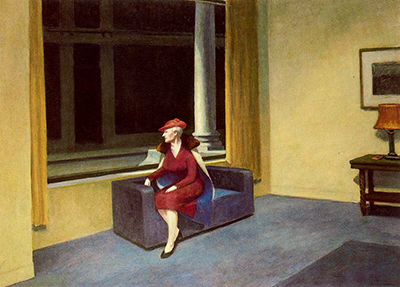
A grey-haired woman in a red hat sits on a blue sofa, her head turned towards a large window. Beyond the glass, a pale column stands against the dark façade opposite. A lamp and framed picture occupy the other side of the room, while a wide stretch of carpet remains empty before her. Edward Hopper's Hotel Window makes one person's attention the centre of a sparsely occupied public interior.
The Sotheby's catalogue records an oil on canvas painted in 1955, measuring 40 × 55 inches. [1] The title establishes the kind of setting. Its principal action is smaller and less easily explained: a seated woman looks towards something the spectator cannot clearly identify.
At a Glance
- ArtistEdward Hopper [1]
- Date1955 [1]
- Mediumoil on canvas [1]
- Collection / recordNot asserted [1]
- AccessionO-352 [1]
This work across Edward Hopper’s career
American Village
1912Soir Bleu
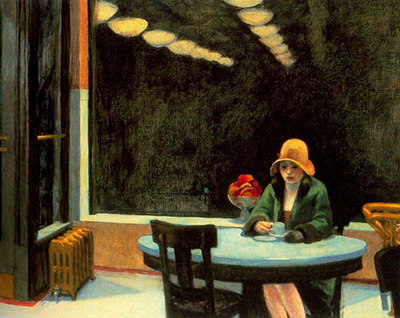
1914Automat
1927New York Movie
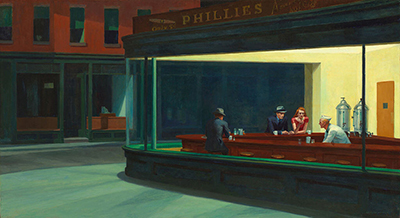
1939Nighthawks
1942Morning Sun
1952Two Comedians
1966Contents
- A person turned towards the glass
- The window and the column outside
- A room with few distractions
- Warmth beside darkness
- A man removed from the composition
- Accumulated impressions of hotels
- A comparison with film
- Ownership and a dated sale
- Other hotel interiors
A person turned towards the glass
The woman's body belongs to the sofa, but her attention moves towards the left. Her head and shoulders turn away from a straightforward seated position, giving the figure a slight twist within the furniture's firmer rectangle.
The red hat and burgundy dress connect her upper and lower body through related warm colours. A paler face and hands interrupt those areas, while the coat around her shoulders introduces cooler passages. Clothing gives the figure a layered appearance without establishing an occasion for being there.
The sofa is compact beside the large window. Its blue upholstery separates the woman from the paler wall and floor, providing a small enclosed place within the much broader room. She does not fill the available space.
Her feet reach towards the carpet, giving the seated posture a physical end below the dress. The body seems poised to remain where it is, yet the turn of the head keeps its attention active. Hopper sets a small directional gesture within an otherwise steady arrangement.
The window and the column outside
The large opening occupies much of the left-hand wall. Its dark exterior view contrasts with the pale room, making the boundary between inside and outside one of the painting's strongest divisions.
A column catches the light across the street. Its base and vertical shaft give the exterior one sharply legible feature, while the building around it remains dark. We can recognise architecture without gaining a broad understanding of the city beyond.
The woman's view and ours do not coincide completely. Her turned head directs attention towards the left, whereas the canvas shows only the selected portion of the street framed by the window. The source of her interest can lie beyond that field.
This difference keeps the window from functioning as a complete explanation. It gives her somewhere to look and gives us part of what may be visible, but it does not identify a person arriving, a vehicle approaching or any other event that would settle the scene.
A room with few distractions
At the right, a table supports a lamp beneath a framed picture. These objects provide the familiar equipment of a furnished lobby. They also balance the much larger window without introducing another person into the final scene.
The lamp's warmer shade differs from the pale wall and cool blue-green floor. Its smaller scale makes it a domestic-looking detail within a room that remains broadly anonymous. The picture above it adds another frame, only partly available within Hopper's crop.
The empty carpet occupies a substantial area between the spectator and the woman. It keeps her at a distance even though the room's contents are easy to inspect. The foreground is available for movement, yet nobody crosses it.
A darker rug introduces another rectangle close to us. Its edge answers the sofa and the window's lower divisions, giving the lower part of the painting an order that does not depend on additional furniture.
Floor, sofa, wall, lamp and opening all contribute a distinct area to the spare setting. Hopper lets the relationships among them carry the room's atmosphere.
Warmth beside darkness
The woman's reds attract the eye against the cooler seating and carpet. This makes her the strongest warm presence near the centre-left, although she remains small within the full canvas.
The pale wall gives her another kind of prominence. It extends around the body without competing through elaborate ornament or a detailed pattern. The red hat becomes a compact accent against a much larger, quieter surface.
Outside, the illuminated column repeats the verticality of the window frame and adjoining wall. Its pale colour links the street to the room, while the surrounding darkness prevents the two spaces from merging.
The painting's night depends on this contrast. The room is clear enough for the furniture and figure to be seen, but its window opens towards a much darker world. Hopper makes the boundary active through differences of colour and illumination.
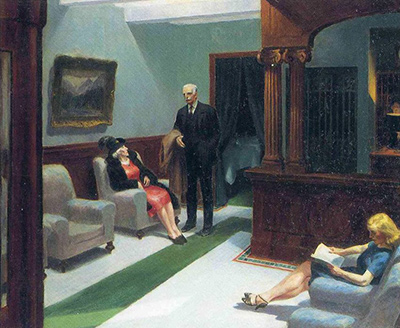
Compare: Hotel Lobby, 1943.
A man removed from the composition
The Whitney Museum preserves a Study for Hotel Window, dated 1955, accession 70.161. It combines fabricated chalk, graphite pencil and coloured pencil on paper. Alongside the woman near the window, a hatted man sits at the right reading a newspaper. [2]
The drawing makes the finished painting's solitary figure a choice rather than an inevitable starting point. A second occupant could share the room while attending to a separate activity. His newspaper would give the right-hand side a human concentration to balance the woman's outward look.
In the oil, the table and lamp remain on that side without an accompanying reader. The empty space becomes more pronounced, and the woman no longer participates in a two-person arrangement whose relationship we might try to explain.
The drawing also gives the opening a more searching appearance. Repeated lines establish the curtain, window frame and furniture, while diagonal shading darkens the exterior area. The basic relation of seated figure to large window is present before the painting's distinctive colour relationships are fixed.
Comparing the two works draws attention to what removal can accomplish. The final room has fewer people, but its remaining body must carry more of our interest. The woman, window and empty floor become a more concentrated set of relationships.
Watch: Edward Hopper’s Life and Art
Explore Hopper’s paintings and the places behind them in these museum films. Choose a film below.
Accumulated impressions of hotels
In the catalogue essay, Gail Levin transmits Hopper's explanation that the lobby combined impressions of small Manhattan hotels rather than recording one particular place. [1] The setting could be specific in its furnishings without being an identifiable address.
Levin also draws on Jo Hopper's record-book description, which places the woman's interest beyond the canvas at the left. [1] The written account confirms the direction of attention without naming what holds it.
These sources help separate the picture's construction from a story attached to it. An observed kind of lobby, a posed figure and a selected exterior view could be brought together without documenting one traveller's actual evening.
The general title contributes to that effect. A hotel window is both an architectural feature and a place from which a temporary occupant can look towards the city. It offers a position without supplying an identity.
A comparison with film
Levin proposes a compositional comparison with Fritz Lang's The Woman in the Window of 1944. [1] The suggestion concerns the arrangement of architecture, a window and the space around it; it remains an interpretation of a possible relationship.
It is useful to distinguish such a comparison from a confirmed account of making the painting. A resemblance to a film can sharpen our attention to a frame or viewpoint without proving that Hopper deliberately adapted one scene.
The canvas also sustains a different pace from an unfolding film. There is no subsequent shot to identify what the woman sees. The spectator remains with a look directed beyond the frame and a room whose empty spaces cannot be filled by the next scene.
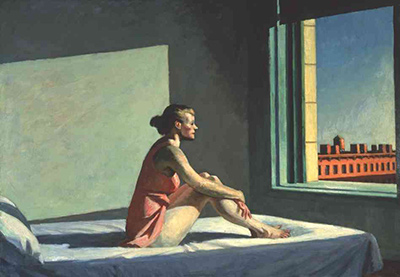
Compare: Morning Sun, 1952.
Ownership and a dated sale
The auction catalogue traces earlier ownership through the Thyssen-Bornemisza collection in Lugano and the Forbes collection, and records a 2001 exhibition within Steve Martin's collection. [1] Those are stages in the painting's history, rather than a statement of its present location.
For the Sotheby's New York sale of 29 November 2006, Artprice lists a hammer price of $24 million. [3] The hammer figure excludes the buyer's premium; it describes that historical transaction rather than a current valuation.
The documented object and its anonymous occupant have different kinds of history. The canvas can move through named collections and recorded auctions while the woman continues to sit before a window without a supplied biography.
Other hotel interiors
Hotel Lobby places three guests and a partly concealed clerk within a more elaborate public space. The reception desk and floor stripe organise possible movement. Here the broad window and single sofa make looking out the dominant relationship.
Hotel by a Railroad gives a seated reader a companion standing beside a window. The drawing for Hotel Window briefly offers a comparable possibility of different activities within one room, before the final oil removes the newspaper reader.
Western Motel opens an interior towards a car and a broad landscape in daylight. Hotel Window keeps its outward view narrower and darker, making the illuminated column a conspicuous limit to what the spectator can see.
Look again at the woman's turned head, then follow the window towards the left edge. The painting makes the direction clear and the destination elusive. A few furnishings and a stretch of empty floor give that ordinary act enough room to hold our attention.
Artworks and studies directory
This researched directory includes finished works and separately identified studies. It is not a complete catalogue raisonné. Linked titles open the articles; unlinked studies are identified by their collection accessions. Watercolours retain their recorded media, and original prints remain distinct from reproductions.
| Name | Date | Medium |
|---|---|---|
| (Bridge and Embankment) (70.1298) | 1906 | Oil on wood |
| (Jo Sketching at Good Harbor Beach) (70.1129) | 1923–1924 | Watercolor and fabricated chalk on paper |
| (Manhattan Bridge) (70.1098) | 1925–1926 | Watercolor and graphite pencil on paper |
| (Rooftops) (70.1114) | 1926 | Watercolor and graphite pencil on paper |
| (Seated Male Model, Bent Over) (70.1277) | c. 1902–1903 | Oil on canvas |
| (Self-Portrait) (70.1254) | 1903–1906 | Oil on canvas |
| (Solitary Figure in a Theater) (70.1418) | c. 1902–1904 | Oil on board |
| 5 A.M. | 1937 | oil on canvas |
| Adam's House | 1928 | watercolour and charcoal on paper |
| American Village | 1912 | Oil on canvas |
| Apartment Houses | 1923 | oil on canvas |
| Approaching a City | 1946 | oil on canvas |
| August in the City | 1945 | oil on canvas |
| Automat | 1927 | oil on canvas |
| Barber Shop | 1931 | oil on canvas |
| Blackwell's Island | 1928 | oil on canvas |
| Bridge on the Seine | 1909 | Oil on canvas |
| Bridle Path | 1939 | oil on canvas |
| Burly Cobb's House South Truro | 1930–1933 | oil on canvas |
| Cape Cod Evening | 1939 | oil on canvas |
| Cape Cod Morning | 1950 | oil on canvas |
| Chair Car | 1965 | oil on canvas |
| Chop Suey | 1929 | oil on canvas |
| City Roofs | 1932 | Oil on canvas |
| Coast Guard Station | 1929 | oil on canvas |
| Compartment C, Car 293 | 1938 | oil on canvas |
| Conference at Night | 1949 | oil on canvas |
| Corn Hill | 1930 | oil on canvas |
| Dawn in Pennsylvania | 1942 | oil on canvas |
| Drug Store | 1927 | oil on canvas |
| Early Sunday Morning | 1930 | Oil on canvas |
| East Side Interior (70.1020) | 1922 | Etching |
| East Wind Over Weehawken | 1934 | oil on canvas |
| El Palacio | 1946 | Watercolor and graphite pencil on paper |
| Eleven A.M. | 1926 | oil on canvas |
| Evening Wind | 1921 | etching |
| Excursion into Philosophy | 1959 | oil on canvas |
| First Row Orchestra | 1951 | oil on canvas |
| Freight Car at Truro | 1931 | watercolour over graphite on paper |
| Gas | 1940 | oil on canvas |
| Girl at a Sewing Machine | c. 1921 | oil on canvas |
| Gloucester Harbor | 1912 | Oil on canvas |
| Ground Swell | 1939 | oil on canvas |
| Haskell's House | 1924 | watercolour over graphite on paperboard |
| High Noon | 1949 | oil on canvas |
| Hill and Houses Cape Elizabeth Maine | 1927 | watercolour over graphite pencil |
| Hills South Truro | 1930 | oil on canvas |
| Hotel by a Railroad | 1952 | oil on canvas |
| Hotel Lobby | 1943 | oil on canvas |
| Hotel Room | 1931 | oil on canvas |
| Hotel Window | 1955 | oil on canvas |
| House by the Railroad | 1925 | oil on canvas |
| House by the Squam River | 1926 | watercolour over graphite on paper |
| Le Bistro or The Wine Shop | 1909 | Oil on canvas |
| Le Pont des Arts | 1907 | Oil on canvas |
| Le Pont Royal | 1909 | Oil on canvas |
| Le Quai des Grands Augustins | 1909 | Oil on canvas |
| Lighthouse and Buildings Portland Head | 1927 | watercolour over graphite pencil on paper |
| Lighthouse Hill | 1927 | oil painting |
| Manhattan Bridge Loop | 1928 | oil on canvas |
| Model Sitting | c. 1902 | oil painting; support not asserted |
| Morning Sun | 1952 | oil on canvas |
| New York Movie | 1939 | oil on canvas |
| New York New Haven and Hartford | 1931 | oil on canvas |
| New York Office | 1962 | oil on canvas |
| New York Pavements | 1924–1925 | oil on canvas |
| New York Restaurant | c. 1922 | oil on canvas |
| Night Windows | 1928 | oil on canvas |
| Nighthawks | 1942 | oil on canvas |
| October on Cape Cod | 1946 | oil on canvas |
| Office at Night | 1940 | oil on canvas |
| Office in a Small City | 1953 | oil on canvas |
| Pennsylvania Coal Town | 1947 | oil on canvas |
| People in the Sun | 1960 | oil on canvas |
| Portrait of Orleans | 1950 | oil on canvas |
| Queensborough Bridge | 1913 | Oil on canvas |
| Railroad Sunset | 1929 | Oil on canvas |
| Railroad Train | 1908 | oil on canvas |
| Road in Maine | 1914 | oil on canvas |
| Room in Brooklyn | 1932 | oil on canvas |
| Room in New York | 1932 | oil on canvas |
| Rooms by the Sea | 1951 | oil on canvas |
| Rooms for Tourists | 1945 | oil on canvas |
| Route 6 Eastham | 1941 | oil on canvas |
| Second Story Sunlight | 1960 | Oil on canvas |
| Self-Portrait | 1925–1930 | Oil on canvas |
| Self-Portrait with Hat (70.1903) | c. 1918, posthumous print | Drypoint |
| Seven A.M. | 1948 | Oil on canvas |
| Soir Bleu | 1914 | oil on canvas |
| South Carolina Morning | 1955 | Oil on canvas |
| Stairway at 48 Rue de Lille Paris | 1906 | Oil on wood |
| Study for 5 A.M. (70.153) | 1937 | Fabricated chalk on paper |
| Study for 5 A.M. (70.429) | 1937 | Fabricated chalk and graphite pencil on paper |
| Study for Approaching a City (70.869) | 1946 | Fabricated chalk and charcoal on paper |
| Study for August in the City (70.158a-b) | 1945 | Fabricated chalk on paper |
| Study for August in the City (70.159) | 1945 | Fabricated chalk on paper |
| Study for Bridle Path (70.220) | 1939 | Fabricated chalk on paper |
| Study for Bridle Path (70.235) | 1939 | Fabricated chalk on paper |
| Study for Compartment C, Car 293 (70.430) | 1938 | Fabricated chalk on paper |
| Study for Compartment C, Car 293 (70.431a-b) | 1938 | Fabricated chalk and charcoal on paper |
| Study for Conference at Night (70.170) | 1949 | Fabricated chalk on paper (recto); Typewriter ink on paper (verso) |
| Study for Conference at Night (70.174) | 1949 | Fabricated chalk on paper ( recto); Typewriter ink on paper (verso) |
| Study for East Wind over Weehawken (70.249) | 1934 | Graphite pencil on paper |
| Study for East Wind over Weehawken (70.252) | 1934 | Fabricated chalk and charcoal on paper |
| Study for Evening Wind (70.343a-b) | 1921 | Fabricated chalk on paper |
| Study for First Row Orchestra (70.841) | 1951 | Fabricated chalk and charcoal on paper |
| Study for Gas (70.263) | 1940 | Fabricated chalk on paper |
| Study for Ground Swell (70.339) | 1939 | Fabricated chalk, charcoal and graphite pencil on paper |
| Study for Hotel by a Railroad (70.199) | 1952 | Fabricated chalk on paper |
| Study for Hotel by a Railroad (70.427) | 1952 | Fabricated chalk on paper |
| Study for Hotel by a Railroad (70.428) | 1952 | Fabricated chalk on paper |
| Study for Hotel Lobby (70.117) | 1942 | Fabricated chalk and graphite pencil on paper |
| Study for Hotel Lobby (70.839) | 1942 | Fabricated chalk and charcoal on paper |
| Study for Hotel Window (70.161) | 1955 | Fabricated chalk, graphite pencil and colored pencil on paper |
| Study for Morning Sun (70.243) | 1952 | Fabricated chalk on paper |
| Study for Morning Sun (70.244) | 1952 | Fabricated chalk on paper |
| Study for Morning Sun (70.290) | 1952 | Fabricated chalk on paper |
| Study for Morning Sun (70.291) | 1952 | Fabricated chalk and graphite pencil on paper |
| Study for New York Movie (70.273) | 1939 | Fabricated chalk on paper |
| Study for New York Movie (70.274a-b) | 1938 or 1939 | Fabricated chalk and charcoal on paper (recto); Fabricated chalk on paper (verso) |
| Study for New York Movie (70.455) | 1939 | Fabricated chalk and charcoal on paper |
| Study for New York Office (70.822) | 1962 | Fabricated chalk on paper |
| Study for Nighthawks (70.192) | 1941 or 1942 | Fabricated chalk on paper |
| Study for Nighthawks (70.193) | 1941 or 1942 | Fabricated chalk on paper |
| Study for Office at Night (70.340) | 1940 | Fabricated chalk and charcoal on paper |
| Study for Office at Night (70.341) | 1940 | Fabricated chalk and graphite pencil on paper |
| Study for Pennsylvania Coal Town (70.198) | 1947 | Fabricated chalk on paper |
| Study for Pennsylvania Coal Town (70.229) | 1947 | Fabricated chalk and charcoal on paper |
| Study for Rooms for Tourists (70.438) | 1945 | Fabricated chalk and charcoal on paper |
| Study for Rooms for Tourists (70.848) | 1945 | Fabricated chalk and charcoal on paper |
| Study for Route 6, Eastham (70.369) | 1941 | Fabricated chalk and graphite pencil on paper |
| Study for Route 6, Eastham (70.854) | 1941 | Fabricated chalk and graphite pencil on paper |
| Study for South Carolina Morning (70.162a-b) | 1955 | Fabricated chalk on paper (recto and verso) |
| Study for The Sheridan Theatre (70.969) | 1937 | Graphite pencil on paper |
| Study for Two on the Aisle (70.128) | 1927 | Fabricated chalk on paper |
| Study for Two on the Aisle (70.129) | 1927 | Fabricated chalk on paper |
| Study for Yawl Riding a Swell (70.439) | 1935 | Fabricated chalk and graphite pencil on paper |
| Summer Evening | 1947 | oil on canvas |
| Summer Interior | 1909 | Oil on canvas |
| Sun in an Empty Room | 1963 | oil on canvas |
| Sunlight in a Cafeteria | 1958 | oil on canvas |
| Sunlight on Brownstones | 1956 | oil on canvas |
| Tables for Ladies | 1930 | oil on canvas |
| The Bootleggers | 1925 | oil on canvas |
| The Camel's Hump | 1931 | oil on canvas |
| The Circle Theatre | 1936 | oil on canvas |
| The City | 1927 | oil on canvas |
| The Lighthouse at Two Lights | 1929 | oil on canvas |
| The Long Leg | 1935 | oil on canvas |
| The Mansard Roof | 1923 | watercolour over graphite on paper |
| The Sheridan Theatre | 1937 | oil on canvas |
| Tramp Steamer | 1908 | oil on canvas |
| Two Comedians | 1966 | oil on canvas |
| Two on the Aisle | 1927 | oil on canvas |
| Valley of the Seine | 1909 | Oil on canvas |
| Western Motel | 1957 | oil on canvas |
Frequently Asked Questions
Edward Hopper made Hotel Window in 1955. [1]
The recorded medium is oil on canvas. [1]
A grey-haired woman in a red hat sits on a blue sofa, her head turned towards a large window. Beyond the glass, a pale column stands against the dark façade opposite. A lamp and framed picture occupy the other side of the room, while a wide stretch of carpet remains empty before her. Edward Hopper's Hotel Window makes one person's attention the centre of a sparsely occupied public interior.
Discussion
Look again at the images and ideas explored in Hotel Window. These editorial prompts invite your observations.
Reader Insights
Which boundary, gesture or change of light first holds your attention in Hotel Window?
Compare Hotel Lobby with Hotel Window. Which visual difference matters most to your reading?
Which detail would you look at again after reading “A room with few distractions”?
Join the Conversation
Share a detail, comparison or question about Hotel Window below.
References
- Sotheby's, Edward Hopper, Hotel Window, lot 34, American Paintings, 2006, object details, provenance and exhibitions; catalogue essay credited to Gail Levin, including transmitted record-book and artist-statement evidence. View source.
- Whitney Museum of American Art, Study for Hotel Window, 1955, accession 70.161. View source.
- Artprice, Art Market Trends 2006, “Top 100 Auction Records 2006,” row 15, PDF p. 14, table explicitly headed “Hammer price / Title / Sale.” View source.
- Collection or catalogue record, American Village, 1912; medium and identity as discussed in the linked article. View source.
- Collection or catalogue record, Soir Bleu, 1914; medium and identity as discussed in the linked article. View source.
- Collection or catalogue record, House by the Railroad, 1925; medium and identity as discussed in the linked article. View source.
- Collection or catalogue record, Automat, 1927; medium and identity as discussed in the linked article. View source.
- Collection or catalogue record, Early Sunday Morning, 1930; medium and identity as discussed in the linked article. View source.
- Collection or catalogue record, New York Movie, 1939; medium and identity as discussed in the linked article. View source.
- Collection or catalogue record, Nighthawks, 1942; medium and identity as discussed in the linked article. View source.
- Collection or catalogue record, Morning Sun, 1952; medium and identity as discussed in the linked article. View source.
- Collection or catalogue record, Second Story Sunlight, 1960; medium and identity as discussed in the linked article. View source.
- Collection or catalogue record, Two Comedians, 1966; medium and identity as discussed in the linked article. View source.
- Whitney Museum of American Art, Study for Route 6, Eastham, 1941, accession 70.854; exact object record. View source.
- Whitney Museum of American Art, Study for Conference at Night, 1949, accession 70.170; exact object record. View source.
- Whitney Museum of American Art, Study for First Row Orchestra, 1951, accession 70.841; exact object record. View source.
- Whitney Museum of American Art, (Bridge and Embankment), 1906, accession 70.1298; exact object record. View source.
- Whitney Museum of American Art, (Seated Male Model, Bent Over), c. 1902–1903, accession 70.1277; exact object record. View source.
- Whitney Museum of American Art, Study for Morning Sun, 1952, accession 70.244; exact object record. View source.
- Whitney Museum of American Art, Study for Morning Sun, 1952, accession 70.243; exact object record. View source.
- Whitney Museum of American Art, Study for Two on the Aisle, 1927, accession 70.128; exact object record. View source.
- Whitney Museum of American Art, Study for New York Office, 1962, accession 70.822; exact object record. View source.
- Whitney Museum of American Art, Study for Two on the Aisle, 1927, accession 70.129; exact object record. View source.
- Whitney Museum of American Art, Study for Pennsylvania Coal Town, 1947, accession 70.229; exact object record. View source.
- Whitney Museum of American Art, (Rooftops), 1926, accession 70.1114; exact object record. View source.
- Whitney Museum of American Art, Study for South Carolina Morning, 1955, accession 70.162a-b; exact object record. View source.
- Whitney Museum of American Art, (Self-Portrait), 1903–1906, accession 70.1254; exact object record. View source.
- Whitney Museum of American Art, (Manhattan Bridge), 1925–1926, accession 70.1098; exact object record. View source.
- Whitney Museum of American Art, (Solitary Figure in a Theater), c. 1902–1904, accession 70.1418; exact object record. View source.
- Whitney Museum of American Art, Study for Approaching a City, 1946, accession 70.869; exact object record. View source.
- Whitney Museum of American Art, Study for August in the City, 1945, accession 70.159; exact object record. View source.
- Whitney Museum of American Art, Study for Compartment C, Car 293, 1938, accession 70.430; exact object record. View source.
- Whitney Museum of American Art, Study for Compartment C, Car 293, 1938, accession 70.431a-b; exact object record. View source.
- Whitney Museum of American Art, Study for East Wind over Weehawken, 1934, accession 70.252; exact object record. View source.
- Whitney Museum of American Art, Study for East Wind over Weehawken, 1934, accession 70.249; exact object record. View source.
- Whitney Museum of American Art, Study for Evening Wind, 1921, accession 70.343a-b; exact object record. View source.
- Whitney Museum of American Art, Study for The Sheridan Theatre, 1937, accession 70.969; exact object record. View source.
- Whitney Museum of American Art, Study for New York Movie, 1939, accession 70.455; exact object record. View source.
- Whitney Museum of American Art, Study for New York Movie, 1939, accession 70.273; exact object record. View source.
- Whitney Museum of American Art, Study for New York Movie, 1938 or 1939, accession 70.274a-b; exact object record. View source.
- Whitney Museum of American Art, Study for 5 A.M., 1937, accession 70.153; exact object record. View source.
- Whitney Museum of American Art, Study for 5 A.M., 1937, accession 70.429; exact object record. View source.
- Whitney Museum of American Art, (Jo Sketching at Good Harbor Beach), 1923–1924, accession 70.1129; exact object record. View source.
- Whitney Museum of American Art, Study for August in the City, 1945, accession 70.158a-b; exact object record. View source.
- Whitney Museum of American Art, Study for Morning Sun, 1952, accession 70.291; exact object record. View source.
- Whitney Museum of American Art, Study for Morning Sun, 1952, accession 70.290; exact object record. View source.
- Whitney Museum of American Art, Study for Office at Night, 1940, accession 70.340; exact object record. View source.
- Whitney Museum of American Art, Study for Office at Night, 1940, accession 70.341; exact object record. View source.
- Whitney Museum of American Art, Study for Hotel by a Railroad, 1952, accession 70.427; exact object record. View source.
- Whitney Museum of American Art, Study for Hotel by a Railroad, 1952, accession 70.199; exact object record. View source.
- Whitney Museum of American Art, Study for Hotel by a Railroad, 1952, accession 70.428; exact object record. View source.
- Whitney Museum of American Art, Study for Hotel Lobby, 1942, accession 70.117; exact object record. View source.
- Whitney Museum of American Art, Study for Hotel Lobby, 1942, accession 70.839; exact object record. View source.
- Whitney Museum of American Art, Study for Conference at Night, 1949, accession 70.174; exact object record. View source.
- Whitney Museum of American Art, Study for Hotel Window, 1955, accession 70.161; exact object record. View source.
- Whitney Museum of American Art, Study for Pennsylvania Coal Town, 1947, accession 70.198; exact object record. View source.
- Whitney Museum of American Art, Study for Route 6, Eastham, 1941, accession 70.369; exact object record. View source.
- Whitney Museum of American Art, Study for Bridle Path, 1939, accession 70.220; exact object record. View source.
- Whitney Museum of American Art, Study for Bridle Path, 1939, accession 70.235; exact object record. View source.
- Whitney Museum of American Art, Study for Ground Swell, 1939, accession 70.339; exact object record. View source.
- Whitney Museum of American Art, Study for Yawl Riding a Swell, 1935, accession 70.439; exact object record. View source.
- Whitney Museum of American Art, Study for Rooms for Tourists, 1945, accession 70.848; exact object record. View source.
- Whitney Museum of American Art, Study for Rooms for Tourists, 1945, accession 70.438; exact object record. View source.
- Whitney Museum of American Art, Study for Nighthawks, 1941 or 1942, accession 70.193; exact object record. View source.
- Whitney Museum of American Art, Study for Nighthawks, 1941 or 1942, accession 70.192; exact object record. View source.
- Whitney Museum of American Art, Study for Gas, 1940, accession 70.263; exact object record. View source.
- Whitney Museum of American Art, Self-Portrait with Hat, c. 1918, posthumous print, accession 70.1903; exact object record. View source.
- Whitney Museum of American Art, East Side Interior, 1922, accession 70.1020; exact object record. View source.
- Art Institute of Chicago, Selected Chronology for Edward Hopper; training, travels, exhibitions, New York and Truro chronology. View source.
- Emily C. Burns, Spectral figures: Edward Hopper’s empty Paris, chapter 5 in Empty Spaces: Confronting Emptiness in National, Cultural and Urban Histories, 2019; complete chapter and notes consulted. View source.
- Charles Brock, Regionalism and Folk Art, National Gallery of Art; complete essay and two notes consulted. View source.