 by Tom Gurney
Tom Gurney BSc (Hons) is an art history expert with over 20 years experience
Email: tomgurney1@gmail.com / Phone: +44 7429 011000
Self-Portrait: Introduction
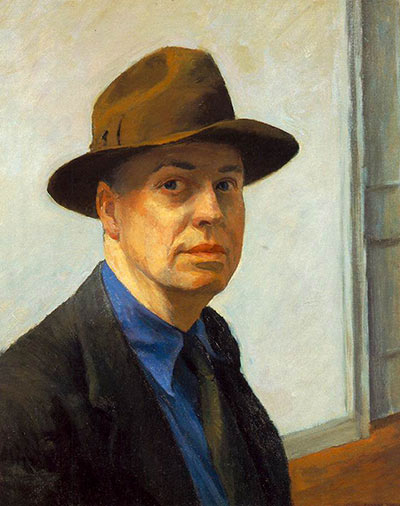
Edward Hopper wears a brown hat, dark jacket, blue shirt and tie. His body turns to one side while his head brings the face back towards us. There is no palette, brush or easel in view. The painting presents a recognisable individual without surrounding him with the customary tools of a painter's profession.
The Whitney Museum of American Art dates this Self-Portrait to 1925–1930. It is an oil on canvas measuring 64.5 × 51.8 cm, or 25⅜ × 20⅜ inches, and belongs to the Josephine N. Hopper Bequest. [1] The date range should remain a range: the museum does not assign the portrait to one securely documented year within it.
The work's direct encounter differs from the more distant human figures familiar in Hopper's interiors. Here a face can occupy sustained attention. Even so, the image gives us a carefully arranged appearance rather than an explanation of the person looking out.
At a Glance
- ArtistEdward Hopper [1]
- Date1925–1930 [1]
- MediumOil on canvas [1]
- Collection / recordWhitney Museum of American Art [1]
- Accession70.1165 [1]
This work across Edward Hopper’s career
American Village
1912Soir Bleu
1914Self-Portrait (current article)
1925–1930Automat
1927New York Movie
1939Nighthawks
1942Morning Sun
1952Two Comedians
1966Contents
- The turn of the body and head
- What the hat does
- Blue against the face
- A room that says little about its occupant
- An earlier image in drypoint
- The date range and a changing career
- A likeness alongside invented figures
The turn of the body and head
The shoulders establish an oblique position. One side of the jacket fills a large part of the foreground, while the other recedes towards the pale background. This turn gives the figure depth before the face supplies its more detailed modelling.
The head does not simply continue the direction of the torso. Its return towards the viewer creates a small tension between bodily placement and the apparent address of the eyes. Hopper appears neither fully frontal nor wholly absorbed in something beyond the picture.
The crop removes the hands and lower body. We receive no gesture of painting, holding a book or adjusting a coat that would specify an action. Instead, shoulders, collar, chin and hat give the upper figure enough variety to remain active within a relatively restricted format.
The return of the head across the angled shoulders gives the gaze its particular address. A similar look in a fully frontal body would produce a different encounter, with less of the suggestion that someone has turned towards us from another position.
What the hat does
The hat is a substantial shape. Its crown rises above the head and its brim spreads horizontally, making the upper silhouette wider than the face. Its brown tones relate to the warmth of the skin while standing out against the much paler background.
The underside of the brim introduces a dark band above the forehead and eyes. This shade gives the face a boundary different from the more softly changing tones of cheek and jaw. The hat therefore helps construct the light as well as identifying an item of dress.
Its brim also prevents the head from reading as an isolated oval. The small asymmetries of the crown and the different lengths of the visible edges make the headwear respond to the turn of the head. A familiar object becomes part of the portrait's spatial construction.
The Whitney's interpretation suggests that the hat can imply a moment of transition, as though the wearer might be on his way elsewhere. [1] That is a possible narrative prompted by the clothing. The painting does not show a destination, a coat being put on or a completed departure.
Blue against the face
The shirt is a concentrated area of blue within the dark clothing. It runs downwards from the collar, giving the lower half of the portrait a colour that remains distinct from both the jacket and the warm skin above.
The face is built from differences of light rather than an even flesh tint. The forehead, nose and cheek receive different degrees of brightness. Cooler passages around the eyes and beneath the cheek complicate the warmer parts, allowing the head to turn without losing its solidity.
The mouth remains closed. Its shape is sufficiently definite to contribute to the likeness, but it does not establish a statement or an attitude on its own. A viewer can experience the face as guarded, thoughtful or simply attentive without any of those responses becoming a documented diagnosis.
The jacket provides a quieter field around these changes. Its lapels form dark angular divisions, while the blue collar and tie keep the clothing legible inside that darkness. The face is emphatic because the surrounding areas differ from it, not because the rest of the canvas has been left unresolved.
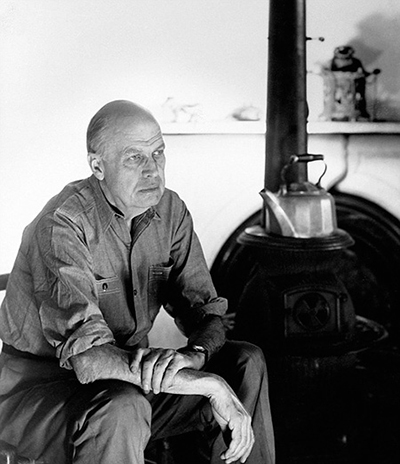
Edward Hopper in a photographic portrait.
A room that says little about its occupant
The background is pale and only lightly specified. A vertical division at the right and a warmer lower ledge suggest an interior, but there is no detailed studio display. We cannot use the room to identify a particular day's work or a collection of personal possessions.
That restraint gives the figure a clear outline. The dark jacket and brown brim stand against relatively unbroken light areas. The background has enough variation to remain a painted surface within a room, while avoiding a second centre of descriptive interest.
The absence of professional equipment is notable. A self-portrait with brushes could identify the sitter through an activity; this one relies on a face and ordinary clothing. The Whitney reads the suit and tie as a contrast to the conventional image of the bohemian artist. [1] The portrait can be considered as self-presentation without assuming that every garment encodes a declared artistic programme.
Nor does ordinary dress make the picture neutral. Hopper chose a particular hat, a strong shirt colour, a turned pose and a direct encounter. The relative simplicity of the setting makes those choices more conspicuous.
Watch: Edward Hopper’s Life and Art
Explore Hopper’s paintings and the places behind them in these museum films. Choose a film below.
An earlier image in drypoint
The Whitney relates the pose to Hopper's earlier Self-Portrait with Hat. Its current record dates the plate to about 1918 and identifies the surviving object as a posthumous print in drypoint. The plate measures only 12.4 × 9.8 cm. [2] The date of the design and the later printing of this particular impression are separate parts of its history.
In that small black-and-white image, the hat, turned head and dark upper clothing already provide a strong arrangement. The face remains comparatively light against the darker coat and brim. Much of the surrounding paper is empty, making the compact portrait especially noticeable.
The oil painting expands those concerns through colour and a larger surface. Brown hat, blue shirt and warm face can be differentiated in ways the monochrome print does not attempt. The comparison shows continuity of presentation without reducing the canvas to a coloured enlargement of a printed image.
The different media also alter how the likeness is encountered. The drypoint's small scale draws attention towards concentrated marks. The canvas allows the head and shoulders to establish a larger physical presence. Similar choices of pose can operate differently when their material and dimensions change.
The museum’s precise term drypoint identifies the process more accurately than a generic etching caption. Its posthumous designation also matters: this sheet was not personally printed by Hopper around 1918.
The date range and a changing career
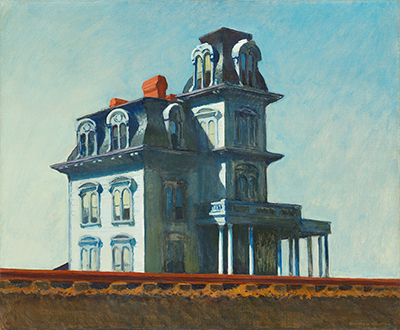
The years 1925–1930 fall within a period of growing public recognition. Hopper's watercolours had attracted museum attention earlier in the decade; he stopped taking illustration work in 1925; and MoMA acquired House by the Railroad in 1930. These developments are recorded in the Art Institute of Chicago's selected chronology. [3]
They provide context, but the range does not let us connect the self-portrait to one particular success. We cannot say it was made to celebrate the end of illustration work or anticipate a museum acquisition. The painting's clothed, deliberate presentation can be considered beside a changing career without turning chronology into an account of motive.
Its ownership through Jo Hopper's bequest is more definite. The canvas was preserved as part of a body of work that entered the Whitney through her estate. [1] The portrait's later public life therefore belongs to the collection history through which much of Hopper's art became available for comparison.
A likeness alongside invented figures
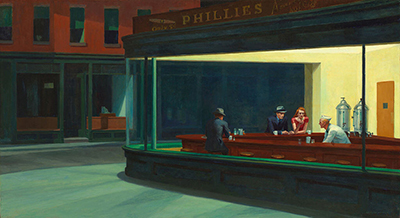
This is a useful painting to set beside Hopper's more numerous scenes of unnamed people. In the portrait, the sitter's identity is established. In Nighthawks, a model can contribute a body or pose without making the diner scene a literal portrait of the Hoppers' lives.
That difference helps resist the temptation to identify every hat-wearing man as the artist. Clothing and physical resemblance can contribute to an interpretation, but the explicitly self-portraying canvas provides a firmer kind of identification than an imagined character within a larger setting.
The portrait still leaves much unstated. Knowing the name does not tell us what has just happened, where the sitter will go or what he thinks of the spectator. Hopper allows identity to be clear while keeping the surrounding narrative slight.
The brown brim extends into the pale background; the blue shirt descends between dark lapels; the face returns across the angle of the shoulders. These relationships sustain the encounter. We can look closely at the painter without expecting the likeness to explain all the paintings he made.
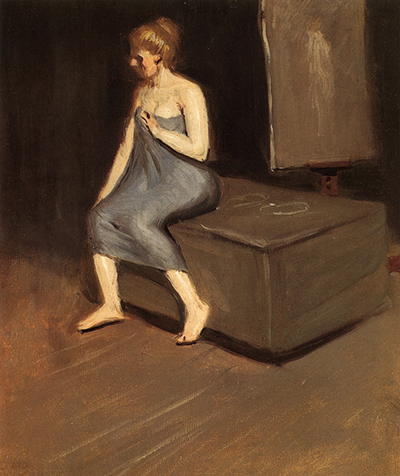
Compare: Model Sitting, c. 1902.
Artworks and studies directory
This researched directory includes finished works and separately identified studies. It is not a complete catalogue raisonné. Linked titles open the articles; unlinked studies are identified by their collection accessions. Watercolours retain their recorded media, and original prints remain distinct from reproductions.
| Name | Date | Medium |
|---|---|---|
| (Bridge and Embankment) (70.1298) | 1906 | Oil on wood |
| (Jo Sketching at Good Harbor Beach) (70.1129) | 1923–1924 | Watercolor and fabricated chalk on paper |
| (Manhattan Bridge) (70.1098) | 1925–1926 | Watercolor and graphite pencil on paper |
| (Rooftops) (70.1114) | 1926 | Watercolor and graphite pencil on paper |
| (Seated Male Model, Bent Over) (70.1277) | c. 1902–1903 | Oil on canvas |
| (Self-Portrait) (70.1254) | 1903–1906 | Oil on canvas |
| (Solitary Figure in a Theater) (70.1418) | c. 1902–1904 | Oil on board |
| 5 A.M. | 1937 | oil on canvas |
| Adam's House | 1928 | watercolour and charcoal on paper |
| American Village | 1912 | Oil on canvas |
| Apartment Houses | 1923 | oil on canvas |
| Approaching a City | 1946 | oil on canvas |
| August in the City | 1945 | oil on canvas |
| Automat | 1927 | oil on canvas |
| Barber Shop | 1931 | oil on canvas |
| Blackwell's Island | 1928 | oil on canvas |
| Bridge on the Seine | 1909 | Oil on canvas |
| Bridle Path | 1939 | oil on canvas |
| Burly Cobb's House South Truro | 1930–1933 | oil on canvas |
| Cape Cod Evening | 1939 | oil on canvas |
| Cape Cod Morning | 1950 | oil on canvas |
| Chair Car | 1965 | oil on canvas |
| Chop Suey | 1929 | oil on canvas |
| City Roofs | 1932 | Oil on canvas |
| Coast Guard Station | 1929 | oil on canvas |
| Compartment C, Car 293 | 1938 | oil on canvas |
| Conference at Night | 1949 | oil on canvas |
| Corn Hill | 1930 | oil on canvas |
| Dawn in Pennsylvania | 1942 | oil on canvas |
| Drug Store | 1927 | oil on canvas |
| Early Sunday Morning | 1930 | Oil on canvas |
| East Side Interior (70.1020) | 1922 | Etching |
| East Wind Over Weehawken | 1934 | oil on canvas |
| El Palacio | 1946 | Watercolor and graphite pencil on paper |
| Eleven A.M. | 1926 | oil on canvas |
| Evening Wind | 1921 | etching |
| Excursion into Philosophy | 1959 | oil on canvas |
| First Row Orchestra | 1951 | oil on canvas |
| Freight Car at Truro | 1931 | watercolour over graphite on paper |
| Gas | 1940 | oil on canvas |
| Girl at a Sewing Machine | c. 1921 | oil on canvas |
| Gloucester Harbor | 1912 | Oil on canvas |
| Ground Swell | 1939 | oil on canvas |
| Haskell's House | 1924 | watercolour over graphite on paperboard |
| High Noon | 1949 | oil on canvas |
| Hill and Houses Cape Elizabeth Maine | 1927 | watercolour over graphite pencil |
| Hills South Truro | 1930 | oil on canvas |
| Hotel by a Railroad | 1952 | oil on canvas |
| Hotel Lobby | 1943 | oil on canvas |
| Hotel Room | 1931 | oil on canvas |
| Hotel Window | 1955 | oil on canvas |
| House by the Railroad | 1925 | oil on canvas |
| House by the Squam River | 1926 | watercolour over graphite on paper |
| Le Bistro or The Wine Shop | 1909 | Oil on canvas |
| Le Pont des Arts | 1907 | Oil on canvas |
| Le Pont Royal | 1909 | Oil on canvas |
| Le Quai des Grands Augustins | 1909 | Oil on canvas |
| Lighthouse and Buildings Portland Head | 1927 | watercolour over graphite pencil on paper |
| Lighthouse Hill | 1927 | oil painting |
| Manhattan Bridge Loop | 1928 | oil on canvas |
| Model Sitting | c. 1902 | oil painting; support not asserted |
| Morning Sun | 1952 | oil on canvas |
| New York Movie | 1939 | oil on canvas |
| New York New Haven and Hartford | 1931 | oil on canvas |
| New York Office | 1962 | oil on canvas |
| New York Pavements | 1924–1925 | oil on canvas |
| New York Restaurant | c. 1922 | oil on canvas |
| Night Windows | 1928 | oil on canvas |
| Nighthawks | 1942 | oil on canvas |
| October on Cape Cod | 1946 | oil on canvas |
| Office at Night | 1940 | oil on canvas |
| Office in a Small City | 1953 | oil on canvas |
| Pennsylvania Coal Town | 1947 | oil on canvas |
| People in the Sun | 1960 | oil on canvas |
| Portrait of Orleans | 1950 | oil on canvas |
| Queensborough Bridge | 1913 | Oil on canvas |
| Railroad Sunset | 1929 | Oil on canvas |
| Railroad Train | 1908 | oil on canvas |
| Road in Maine | 1914 | oil on canvas |
| Room in Brooklyn | 1932 | oil on canvas |
| Room in New York | 1932 | oil on canvas |
| Rooms by the Sea | 1951 | oil on canvas |
| Rooms for Tourists | 1945 | oil on canvas |
| Route 6 Eastham | 1941 | oil on canvas |
| Second Story Sunlight | 1960 | Oil on canvas |
| Self-Portrait | 1925–1930 | Oil on canvas |
| Self-Portrait with Hat (70.1903) | c. 1918, posthumous print | Drypoint |
| Seven A.M. | 1948 | Oil on canvas |
| Soir Bleu | 1914 | oil on canvas |
| South Carolina Morning | 1955 | Oil on canvas |
| Stairway at 48 Rue de Lille Paris | 1906 | Oil on wood |
| Study for 5 A.M. (70.153) | 1937 | Fabricated chalk on paper |
| Study for 5 A.M. (70.429) | 1937 | Fabricated chalk and graphite pencil on paper |
| Study for Approaching a City (70.869) | 1946 | Fabricated chalk and charcoal on paper |
| Study for August in the City (70.158a-b) | 1945 | Fabricated chalk on paper |
| Study for August in the City (70.159) | 1945 | Fabricated chalk on paper |
| Study for Bridle Path (70.220) | 1939 | Fabricated chalk on paper |
| Study for Bridle Path (70.235) | 1939 | Fabricated chalk on paper |
| Study for Compartment C, Car 293 (70.430) | 1938 | Fabricated chalk on paper |
| Study for Compartment C, Car 293 (70.431a-b) | 1938 | Fabricated chalk and charcoal on paper |
| Study for Conference at Night (70.170) | 1949 | Fabricated chalk on paper (recto); Typewriter ink on paper (verso) |
| Study for Conference at Night (70.174) | 1949 | Fabricated chalk on paper ( recto); Typewriter ink on paper (verso) |
| Study for East Wind over Weehawken (70.249) | 1934 | Graphite pencil on paper |
| Study for East Wind over Weehawken (70.252) | 1934 | Fabricated chalk and charcoal on paper |
| Study for Evening Wind (70.343a-b) | 1921 | Fabricated chalk on paper |
| Study for First Row Orchestra (70.841) | 1951 | Fabricated chalk and charcoal on paper |
| Study for Gas (70.263) | 1940 | Fabricated chalk on paper |
| Study for Ground Swell (70.339) | 1939 | Fabricated chalk, charcoal and graphite pencil on paper |
| Study for Hotel by a Railroad (70.199) | 1952 | Fabricated chalk on paper |
| Study for Hotel by a Railroad (70.427) | 1952 | Fabricated chalk on paper |
| Study for Hotel by a Railroad (70.428) | 1952 | Fabricated chalk on paper |
| Study for Hotel Lobby (70.117) | 1942 | Fabricated chalk and graphite pencil on paper |
| Study for Hotel Lobby (70.839) | 1942 | Fabricated chalk and charcoal on paper |
| Study for Hotel Window (70.161) | 1955 | Fabricated chalk, graphite pencil and colored pencil on paper |
| Study for Morning Sun (70.243) | 1952 | Fabricated chalk on paper |
| Study for Morning Sun (70.244) | 1952 | Fabricated chalk on paper |
| Study for Morning Sun (70.290) | 1952 | Fabricated chalk on paper |
| Study for Morning Sun (70.291) | 1952 | Fabricated chalk and graphite pencil on paper |
| Study for New York Movie (70.273) | 1939 | Fabricated chalk on paper |
| Study for New York Movie (70.274a-b) | 1938 or 1939 | Fabricated chalk and charcoal on paper (recto); Fabricated chalk on paper (verso) |
| Study for New York Movie (70.455) | 1939 | Fabricated chalk and charcoal on paper |
| Study for New York Office (70.822) | 1962 | Fabricated chalk on paper |
| Study for Nighthawks (70.192) | 1941 or 1942 | Fabricated chalk on paper |
| Study for Nighthawks (70.193) | 1941 or 1942 | Fabricated chalk on paper |
| Study for Office at Night (70.340) | 1940 | Fabricated chalk and charcoal on paper |
| Study for Office at Night (70.341) | 1940 | Fabricated chalk and graphite pencil on paper |
| Study for Pennsylvania Coal Town (70.198) | 1947 | Fabricated chalk on paper |
| Study for Pennsylvania Coal Town (70.229) | 1947 | Fabricated chalk and charcoal on paper |
| Study for Rooms for Tourists (70.438) | 1945 | Fabricated chalk and charcoal on paper |
| Study for Rooms for Tourists (70.848) | 1945 | Fabricated chalk and charcoal on paper |
| Study for Route 6, Eastham (70.369) | 1941 | Fabricated chalk and graphite pencil on paper |
| Study for Route 6, Eastham (70.854) | 1941 | Fabricated chalk and graphite pencil on paper |
| Study for South Carolina Morning (70.162a-b) | 1955 | Fabricated chalk on paper (recto and verso) |
| Study for The Sheridan Theatre (70.969) | 1937 | Graphite pencil on paper |
| Study for Two on the Aisle (70.128) | 1927 | Fabricated chalk on paper |
| Study for Two on the Aisle (70.129) | 1927 | Fabricated chalk on paper |
| Study for Yawl Riding a Swell (70.439) | 1935 | Fabricated chalk and graphite pencil on paper |
| Summer Evening | 1947 | oil on canvas |
| Summer Interior | 1909 | Oil on canvas |
| Sun in an Empty Room | 1963 | oil on canvas |
| Sunlight in a Cafeteria | 1958 | oil on canvas |
| Sunlight on Brownstones | 1956 | oil on canvas |
| Tables for Ladies | 1930 | oil on canvas |
| The Bootleggers | 1925 | oil on canvas |
| The Camel's Hump | 1931 | oil on canvas |
| The Circle Theatre | 1936 | oil on canvas |
| The City | 1927 | oil on canvas |
| The Lighthouse at Two Lights | 1929 | oil on canvas |
| The Long Leg | 1935 | oil on canvas |
| The Mansard Roof | 1923 | watercolour over graphite on paper |
| The Sheridan Theatre | 1937 | oil on canvas |
| Tramp Steamer | 1908 | oil on canvas |
| Two Comedians | 1966 | oil on canvas |
| Two on the Aisle | 1927 | oil on canvas |
| Valley of the Seine | 1909 | Oil on canvas |
| Western Motel | 1957 | oil on canvas |
Frequently Asked Questions
Edward Hopper made Self-Portrait in 1925–1930. [1]
The recorded medium is Oil on canvas. [1]
Edward Hopper wears a brown hat, dark jacket, blue shirt and tie. His body turns to one side while his head brings the face back towards us. There is no palette, brush or easel in view. The painting presents a recognisable individual without surrounding him with the customary tools of a painter's profession.
Discussion
Look again at the images and ideas explored in Self-Portrait. These editorial prompts invite your observations.
Reader Insights
Which boundary, gesture or change of light first holds your attention in Self-Portrait?
Compare the painted self-portrait with the photographic portrait reproduced here. How does each image present the artist?
Which detail would you look at again after reading “Blue against the face”?
Join the Conversation
Share a detail, comparison or question about Self-Portrait below.
References
- Whitney Museum of American Art, (Self-Portrait), 1925–1930, accession 70.1165. Complete current object entry and interpretation; medium, dimensions, date range and Josephine N. Hopper Bequest. View source.
- Whitney Museum of American Art, Self-Portrait with Hat, c. 1918, posthumous print, accession 70.1903. Complete current record and image; drypoint, plate and sheet dimensions, and posthumous status of the impression. View source.
- Art Institute of Chicago, selected chronology for Edward Hopper, especially 1923–1930. Career context, distinguished from any unverified reason for making this portrait. View source.
- Collection or catalogue record, American Village, 1912; medium and identity as discussed in the linked article. View source.
- Collection or catalogue record, Soir Bleu, 1914; medium and identity as discussed in the linked article. View source.
- Collection or catalogue record, House by the Railroad, 1925; medium and identity as discussed in the linked article. View source.
- Collection or catalogue record, Automat, 1927; medium and identity as discussed in the linked article. View source.
- Collection or catalogue record, Early Sunday Morning, 1930; medium and identity as discussed in the linked article. View source.
- Collection or catalogue record, New York Movie, 1939; medium and identity as discussed in the linked article. View source.
- Collection or catalogue record, Nighthawks, 1942; medium and identity as discussed in the linked article. View source.
- Collection or catalogue record, Morning Sun, 1952; medium and identity as discussed in the linked article. View source.
- Collection or catalogue record, Second Story Sunlight, 1960; medium and identity as discussed in the linked article. View source.
- Collection or catalogue record, Two Comedians, 1966; medium and identity as discussed in the linked article. View source.
- Whitney Museum of American Art, Study for Route 6, Eastham, 1941, accession 70.854; exact object record. View source.
- Whitney Museum of American Art, Study for Conference at Night, 1949, accession 70.170; exact object record. View source.
- Whitney Museum of American Art, Study for First Row Orchestra, 1951, accession 70.841; exact object record. View source.
- Whitney Museum of American Art, (Bridge and Embankment), 1906, accession 70.1298; exact object record. View source.
- Whitney Museum of American Art, (Seated Male Model, Bent Over), c. 1902–1903, accession 70.1277; exact object record. View source.
- Whitney Museum of American Art, Study for Morning Sun, 1952, accession 70.244; exact object record. View source.
- Whitney Museum of American Art, Study for Morning Sun, 1952, accession 70.243; exact object record. View source.
- Whitney Museum of American Art, Study for Two on the Aisle, 1927, accession 70.128; exact object record. View source.
- Whitney Museum of American Art, Study for New York Office, 1962, accession 70.822; exact object record. View source.
- Whitney Museum of American Art, Study for Two on the Aisle, 1927, accession 70.129; exact object record. View source.
- Whitney Museum of American Art, Study for Pennsylvania Coal Town, 1947, accession 70.229; exact object record. View source.
- Whitney Museum of American Art, (Rooftops), 1926, accession 70.1114; exact object record. View source.
- Whitney Museum of American Art, Study for South Carolina Morning, 1955, accession 70.162a-b; exact object record. View source.
- Whitney Museum of American Art, (Self-Portrait), 1903–1906, accession 70.1254; exact object record. View source.
- Whitney Museum of American Art, (Manhattan Bridge), 1925–1926, accession 70.1098; exact object record. View source.
- Whitney Museum of American Art, (Solitary Figure in a Theater), c. 1902–1904, accession 70.1418; exact object record. View source.
- Whitney Museum of American Art, Study for Approaching a City, 1946, accession 70.869; exact object record. View source.
- Whitney Museum of American Art, Study for August in the City, 1945, accession 70.159; exact object record. View source.
- Whitney Museum of American Art, Study for Compartment C, Car 293, 1938, accession 70.430; exact object record. View source.
- Whitney Museum of American Art, Study for Compartment C, Car 293, 1938, accession 70.431a-b; exact object record. View source.
- Whitney Museum of American Art, Study for East Wind over Weehawken, 1934, accession 70.252; exact object record. View source.
- Whitney Museum of American Art, Study for East Wind over Weehawken, 1934, accession 70.249; exact object record. View source.
- Whitney Museum of American Art, Study for Evening Wind, 1921, accession 70.343a-b; exact object record. View source.
- Whitney Museum of American Art, Study for The Sheridan Theatre, 1937, accession 70.969; exact object record. View source.
- Whitney Museum of American Art, Study for New York Movie, 1939, accession 70.455; exact object record. View source.
- Whitney Museum of American Art, Study for New York Movie, 1939, accession 70.273; exact object record. View source.
- Whitney Museum of American Art, Study for New York Movie, 1938 or 1939, accession 70.274a-b; exact object record. View source.
- Whitney Museum of American Art, Study for 5 A.M., 1937, accession 70.153; exact object record. View source.
- Whitney Museum of American Art, Study for 5 A.M., 1937, accession 70.429; exact object record. View source.
- Whitney Museum of American Art, (Jo Sketching at Good Harbor Beach), 1923–1924, accession 70.1129; exact object record. View source.
- Whitney Museum of American Art, Study for August in the City, 1945, accession 70.158a-b; exact object record. View source.
- Whitney Museum of American Art, Study for Morning Sun, 1952, accession 70.291; exact object record. View source.
- Whitney Museum of American Art, Study for Morning Sun, 1952, accession 70.290; exact object record. View source.
- Whitney Museum of American Art, Study for Office at Night, 1940, accession 70.340; exact object record. View source.
- Whitney Museum of American Art, Study for Office at Night, 1940, accession 70.341; exact object record. View source.
- Whitney Museum of American Art, Study for Hotel by a Railroad, 1952, accession 70.427; exact object record. View source.
- Whitney Museum of American Art, Study for Hotel by a Railroad, 1952, accession 70.199; exact object record. View source.
- Whitney Museum of American Art, Study for Hotel by a Railroad, 1952, accession 70.428; exact object record. View source.
- Whitney Museum of American Art, Study for Hotel Lobby, 1942, accession 70.117; exact object record. View source.
- Whitney Museum of American Art, Study for Hotel Lobby, 1942, accession 70.839; exact object record. View source.
- Whitney Museum of American Art, Study for Conference at Night, 1949, accession 70.174; exact object record. View source.
- Whitney Museum of American Art, Study for Hotel Window, 1955, accession 70.161; exact object record. View source.
- Whitney Museum of American Art, Study for Pennsylvania Coal Town, 1947, accession 70.198; exact object record. View source.
- Whitney Museum of American Art, Study for Route 6, Eastham, 1941, accession 70.369; exact object record. View source.
- Whitney Museum of American Art, Study for Bridle Path, 1939, accession 70.220; exact object record. View source.
- Whitney Museum of American Art, Study for Bridle Path, 1939, accession 70.235; exact object record. View source.
- Whitney Museum of American Art, Study for Ground Swell, 1939, accession 70.339; exact object record. View source.
- Whitney Museum of American Art, Study for Yawl Riding a Swell, 1935, accession 70.439; exact object record. View source.
- Whitney Museum of American Art, Study for Rooms for Tourists, 1945, accession 70.848; exact object record. View source.
- Whitney Museum of American Art, Study for Rooms for Tourists, 1945, accession 70.438; exact object record. View source.
- Whitney Museum of American Art, Study for Nighthawks, 1941 or 1942, accession 70.193; exact object record. View source.
- Whitney Museum of American Art, Study for Nighthawks, 1941 or 1942, accession 70.192; exact object record. View source.
- Whitney Museum of American Art, Study for Gas, 1940, accession 70.263; exact object record. View source.
- Whitney Museum of American Art, Self-Portrait with Hat, c. 1918, posthumous print, accession 70.1903; exact object record. View source.
- Whitney Museum of American Art, East Side Interior, 1922, accession 70.1020; exact object record. View source.
- Art Institute of Chicago, Selected Chronology for Edward Hopper; training, travels, exhibitions, New York and Truro chronology. View source.
- Emily C. Burns, Spectral figures: Edward Hopper’s empty Paris, chapter 5 in Empty Spaces: Confronting Emptiness in National, Cultural and Urban Histories, 2019; complete chapter and notes consulted. View source.
- Charles Brock, Regionalism and Folk Art, National Gallery of Art; complete essay and two notes consulted. View source.