 by Tom Gurney
Tom Gurney BSc (Hons) is an art history expert with over 20 years experience
Email: tomgurney1@gmail.com / Phone: +44 7429 011000
Seven A.M.: Introduction
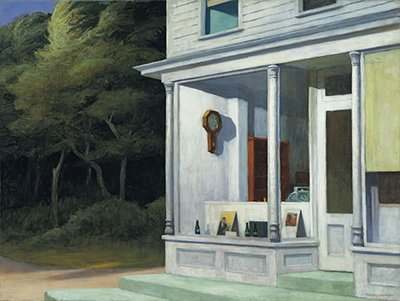
A wall clock hangs above a shop window containing a few bottles and small framed objects. Pale steps lead towards the entrance, and white posts hold up the shallow overhang. Alongside this orderly frontage, trees crowd together in a dark mass. Edward Hopper's Seven A.M. brings the exactness of a named hour into contact with a place whose purpose remains uncertain.
Painted in 1948, the oil on canvas belongs to the Whitney Museum of American Art, accession 50.8, with the credit line purchase and exchange. It measures 76.7 × 101.9 cm. [1] The building appears sufficiently particular to invite recognition, yet its sparse display withholds the information that might turn a street view into an account of everyday trade.
At a Glance
- ArtistEdward Hopper [1]
- Date1948 [1]
- MediumOil on canvas [1]
- Collection / recordWhitney Museum of American Art [1]
- Accession50.8 [1]
This work across Edward Hopper’s career
American Village
1912Soir Bleu
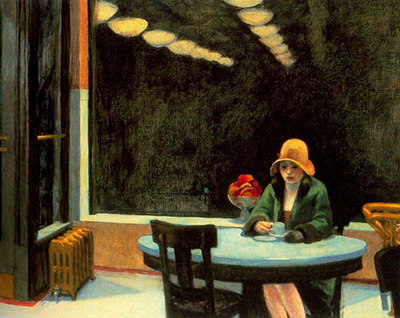
1914Automat
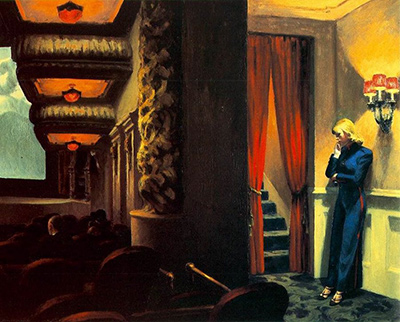
1927New York Movie
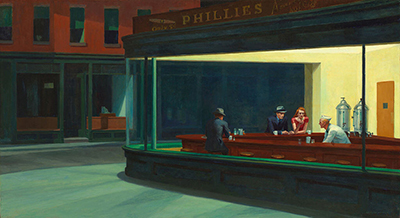
1939Nighthawks
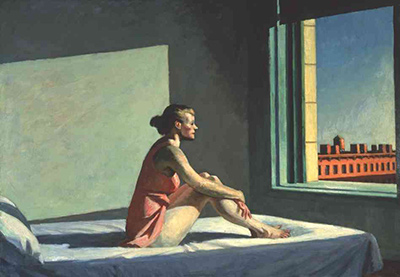
1942Morning Sun
1952Two Comedians
1966Contents
- A frontage built from pale divisions
- Looking into the window
- The clock and its shadow
- Trees beside the shop
- Steps, posts and an unoccupied entrance
- An upstairs figure considered and removed
- Suspicion and the limits of a story
A frontage built from pale divisions
The shop occupies the right-hand portion of the canvas. Its projecting lower window, upright supports and long band beneath the upper storey form an interlocking arrangement of horizontal and vertical elements. These edges give the building a clear structure before we identify anything for sale.
The white surfaces vary considerably. Clapboards retain narrow lines between their courses, the posts have firmer upright accents, and the lower panels hold broader, quieter rectangles. A continuous light colour therefore describes several kinds of construction rather than flattening them into one blank wall.
The display projects slightly towards the spectator. Its base and angled return help establish a shallow space in front of the main wall, while the neighbouring doorway recedes. Hopper makes the frontage legible through these small changes in depth, even though relatively little of the building is visible.
Cropping adds to the effect. The roof and much of the upper storey fall beyond the canvas, and the frontage continues out to the right. We encounter a selected portion of a building rather than an architectural portrait with every elevation explained. The shop seems to extend beyond what the painting permits us to inspect.
Looking into the window
The objects along the bottom of the display are separated by conspicuous intervals. A few bottle-like forms stand among small light and dark rectangles, including objects that resemble framed pictures. Their uneven heights create a modest rhythm within the much larger window opening.
The display is difficult to classify. It lacks the plentiful goods, labels and repeated packages that would make a shop's trade immediately recognizable. The Whitney's account emphasizes this uncertainty, identifying the building as an anonymous storefront rather than supplying a name or business. [1]
That uncertainty changes how we look. Instead of quickly reading the window as a sign for a familiar trade, we examine the relation of one item to the next. An ordinary bottle or pale rectangle receives attention partly because so much space remains around it.
The glass itself does not become a conspicuous reflective barrier. We can look towards the items and the dimmer space beyond, but the view provides only limited depth. The brightly exposed front and less accessible interior remain close together, with no person present to explain their relationship.
This is a display designed to face a passer-by, and the painting places us in that passer-by's position. Yet the invitation to inspect does not become an invitation to understand everything. Hopper retains the outward-facing arrangement of a commercial window while reducing its power to communicate a clear offer.
The clock and its shadow
The clock sits high on the pale wall inside the frontage. Its warm brown casing and compact round face make it conspicuous against the larger cool surfaces. It is small relative to the building, but its isolation allows it to act as an organizing detail.
A shadow extends beside the casing. Together, object and shadow give the wall more depth than its pale colour might initially suggest. The clock belongs to a physical surface crossed by light, rather than appearing as a label suspended outside the scene.
The title supplies seven in the morning, while the clock confirms the subject's concern with time. [1] But a clock and a distribution of light describe time differently. One offers a numbered position; the other reveals the changing conditions under which a building becomes visible.
Hopper brings those two measures together without filling the scene with morning activity. There is no delivery, customer or shopkeeper to establish a workday routine. The pale facade and shadows suggest an hour, while the absence of immediate transactions leaves the spectator free to linger over its appearance.
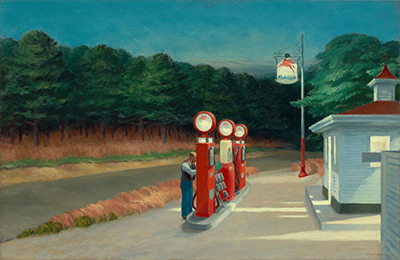
Compare: Gas, 1940.
Trees beside the shop
The dark woodland at the left changes the painting's scale and texture. Branches, trunks and foliage overlap closely, with fewer clear openings than the architectural side provides. The irregular growth presses against a frontage made from measured lines and repeated panels.
The transition is abrupt. There is no broad garden or long suburban street to mediate between trees and commercial building. Their proximity makes the shop's neat construction seem especially exposed, while the woods acquire density through contrast with the white wall.
The trees are nevertheless varied. Lighter green passages break the upper foliage into several overlapping areas, and thinner trunks become visible nearer the ground. Looking into the woodland requires a slower adjustment than reading the shop's pale outline.
Ground beside the trees meets the approach to the steps, keeping these different zones in one continuous setting.
This makes the painting more complex than a view of an isolated shop. The storefront addresses an implied street or route outside the frame, while the trees suggest a less regulated depth immediately beside it. We can understand the frontage's construction more easily than we can see what lies behind either its doorway or the wooded edge.
Watch: Edward Hopper’s Life and Art
Explore Hopper’s paintings and the places behind them in these museum films. Choose a film below.
Steps, posts and an unoccupied entrance
The shallow steps at the base form broad greenish planes. Their long edges lead towards the building, giving the spectator an approach even though no figure makes the journey. They are among the clearest indications that the frontage belongs to a space people could enter.
The posts establish another threshold. Their spacing divides the view into narrow upright compartments, and their bases give the shop a firmer connection to the steps. Looking past them means passing visually through one layer of construction before reaching the window or door.
The doorway is comparatively dark, with pale framing around its opening. This contrast gives it depth without allowing a full view inside. It remains a possible route through the building rather than an explained room.
Above, a cropped window carries the suggestion of another interior. Its position extends the building vertically, but it supplies no visible inhabitant. The two levels therefore offer different degrees of access: a ground-floor display presented to the street and a higher opening that belongs to a more distant space.
The absence of people has a specific architectural effect. Posts, windows and steps remain potential points of contact, but none is occupied. The painting holds those available positions open instead of assigning each one a character or action.
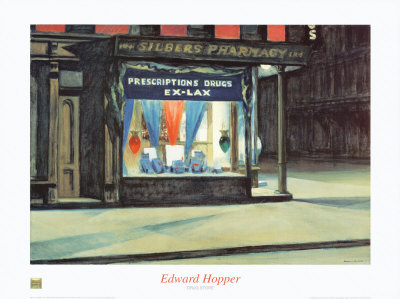
Compare: Drug Store, 1927.
An upstairs figure considered and removed
A drawing reproduced in Gail Levin's study of Hopper's working methods shows a related frontage beside trees. Strong upright supports organize the lower portion, while a small figure appears in the upper window. The published caption identifies it as a 1948 study for the painting. [2]
The sketch is much rougher than the painting. Repeated lines explore the building's divisions, and quick marks establish the mass of the trees. The display has less of the finished canvas's carefully differentiated colour and small objects.
The figure would have changed the upper window's role. An occupied opening draws attention towards a possible observer inside the building; the painted window leaves that relationship unresolved. Removing the person makes the architecture carry more of the scene's human implication.
The Whitney also records that Hopper considered a different time of day during preparation. [1] The painting's precise hour was therefore part of a developing composition. Its apparent immediacy does not mean that every detail arrived together in one unchanged observation.
Jo Hopper's diary, as quoted by the museum, records the completed canvas on 22 September 1948 and a sixteen-day period beginning with its stretching on Labor Day, 6 September. [1] That account gives a useful measure of the painting's execution, while the drawing reveals choices behind its finished stillness.
Suspicion and the limits of a story
The museum reports Jo's description of the storefront as a blind pig, suggesting a concealed illicit operation. [1] Her characterization adds a contemporary response to the building's uninformative display. It does not establish the existence of a particular criminal business at an identified address.
The painting can sustain unease without requiring that explanation. The windows disclose little, the entrance remains empty, and the trees make an unusually dense neighbour. These visible relationships give the scene an uncertain atmosphere before a spectator supplies any plot.
Other Hopper shop paintings organize commerce differently. In Drug Store, lettering and a bright window make the shop's public address more explicit. Seven A.M. leaves its trade obscure, allowing the clock and individual objects to take on greater prominence.
Gas also places a place of business beside trees, but its pumps and attendant establish a more definite practical activity. Here, the unoccupied approach leaves the white frontage available for inspection without resolving what happens behind it.
In Early Sunday Morning, a long run of facades produces a different rhythm of closed or quiet commercial premises. Seven A.M. concentrates that attention on one sharply cropped frontage. The clock gives the hour, the steps provide an approach, and the thin display continues to invite a closer look.
Artworks and studies directory
This researched directory includes finished works and separately identified studies. It is not a complete catalogue raisonné. Linked titles open the articles; unlinked studies are identified by their collection accessions. Watercolours retain their recorded media, and original prints remain distinct from reproductions.
| Name | Date | Medium |
|---|---|---|
| (Bridge and Embankment) (70.1298) | 1906 | Oil on wood |
| (Jo Sketching at Good Harbor Beach) (70.1129) | 1923–1924 | Watercolor and fabricated chalk on paper |
| (Manhattan Bridge) (70.1098) | 1925–1926 | Watercolor and graphite pencil on paper |
| (Rooftops) (70.1114) | 1926 | Watercolor and graphite pencil on paper |
| (Seated Male Model, Bent Over) (70.1277) | c. 1902–1903 | Oil on canvas |
| (Self-Portrait) (70.1254) | 1903–1906 | Oil on canvas |
| (Solitary Figure in a Theater) (70.1418) | c. 1902–1904 | Oil on board |
| 5 A.M. | 1937 | oil on canvas |
| Adam's House | 1928 | watercolour and charcoal on paper |
| American Village | 1912 | Oil on canvas |
| Apartment Houses | 1923 | oil on canvas |
| Approaching a City | 1946 | oil on canvas |
| August in the City | 1945 | oil on canvas |
| Automat | 1927 | oil on canvas |
| Barber Shop | 1931 | oil on canvas |
| Blackwell's Island | 1928 | oil on canvas |
| Bridge on the Seine | 1909 | Oil on canvas |
| Bridle Path | 1939 | oil on canvas |
| Burly Cobb's House South Truro | 1930–1933 | oil on canvas |
| Cape Cod Evening | 1939 | oil on canvas |
| Cape Cod Morning | 1950 | oil on canvas |
| Chair Car | 1965 | oil on canvas |
| Chop Suey | 1929 | oil on canvas |
| City Roofs | 1932 | Oil on canvas |
| Coast Guard Station | 1929 | oil on canvas |
| Compartment C, Car 293 | 1938 | oil on canvas |
| Conference at Night | 1949 | oil on canvas |
| Corn Hill | 1930 | oil on canvas |
| Dawn in Pennsylvania | 1942 | oil on canvas |
| Drug Store | 1927 | oil on canvas |
| Early Sunday Morning | 1930 | Oil on canvas |
| East Side Interior (70.1020) | 1922 | Etching |
| East Wind Over Weehawken | 1934 | oil on canvas |
| El Palacio | 1946 | Watercolor and graphite pencil on paper |
| Eleven A.M. | 1926 | oil on canvas |
| Evening Wind | 1921 | etching |
| Excursion into Philosophy | 1959 | oil on canvas |
| First Row Orchestra | 1951 | oil on canvas |
| Freight Car at Truro | 1931 | watercolour over graphite on paper |
| Gas | 1940 | oil on canvas |
| Girl at a Sewing Machine | c. 1921 | oil on canvas |
| Gloucester Harbor | 1912 | Oil on canvas |
| Ground Swell | 1939 | oil on canvas |
| Haskell's House | 1924 | watercolour over graphite on paperboard |
| High Noon | 1949 | oil on canvas |
| Hill and Houses Cape Elizabeth Maine | 1927 | watercolour over graphite pencil |
| Hills South Truro | 1930 | oil on canvas |
| Hotel by a Railroad | 1952 | oil on canvas |
| Hotel Lobby | 1943 | oil on canvas |
| Hotel Room | 1931 | oil on canvas |
| Hotel Window | 1955 | oil on canvas |
| House by the Railroad | 1925 | oil on canvas |
| House by the Squam River | 1926 | watercolour over graphite on paper |
| Le Bistro or The Wine Shop | 1909 | Oil on canvas |
| Le Pont des Arts | 1907 | Oil on canvas |
| Le Pont Royal | 1909 | Oil on canvas |
| Le Quai des Grands Augustins | 1909 | Oil on canvas |
| Lighthouse and Buildings Portland Head | 1927 | watercolour over graphite pencil on paper |
| Lighthouse Hill | 1927 | oil painting |
| Manhattan Bridge Loop | 1928 | oil on canvas |
| Model Sitting | c. 1902 | oil painting; support not asserted |
| Morning Sun | 1952 | oil on canvas |
| New York Movie | 1939 | oil on canvas |
| New York New Haven and Hartford | 1931 | oil on canvas |
| New York Office | 1962 | oil on canvas |
| New York Pavements | 1924–1925 | oil on canvas |
| New York Restaurant | c. 1922 | oil on canvas |
| Night Windows | 1928 | oil on canvas |
| Nighthawks | 1942 | oil on canvas |
| October on Cape Cod | 1946 | oil on canvas |
| Office at Night | 1940 | oil on canvas |
| Office in a Small City | 1953 | oil on canvas |
| Pennsylvania Coal Town | 1947 | oil on canvas |
| People in the Sun | 1960 | oil on canvas |
| Portrait of Orleans | 1950 | oil on canvas |
| Queensborough Bridge | 1913 | Oil on canvas |
| Railroad Sunset | 1929 | Oil on canvas |
| Railroad Train | 1908 | oil on canvas |
| Road in Maine | 1914 | oil on canvas |
| Room in Brooklyn | 1932 | oil on canvas |
| Room in New York | 1932 | oil on canvas |
| Rooms by the Sea | 1951 | oil on canvas |
| Rooms for Tourists | 1945 | oil on canvas |
| Route 6 Eastham | 1941 | oil on canvas |
| Second Story Sunlight | 1960 | Oil on canvas |
| Self-Portrait | 1925–1930 | Oil on canvas |
| Self-Portrait with Hat (70.1903) | c. 1918, posthumous print | Drypoint |
| Seven A.M. | 1948 | Oil on canvas |
| Soir Bleu | 1914 | oil on canvas |
| South Carolina Morning | 1955 | Oil on canvas |
| Stairway at 48 Rue de Lille Paris | 1906 | Oil on wood |
| Study for 5 A.M. (70.153) | 1937 | Fabricated chalk on paper |
| Study for 5 A.M. (70.429) | 1937 | Fabricated chalk and graphite pencil on paper |
| Study for Approaching a City (70.869) | 1946 | Fabricated chalk and charcoal on paper |
| Study for August in the City (70.158a-b) | 1945 | Fabricated chalk on paper |
| Study for August in the City (70.159) | 1945 | Fabricated chalk on paper |
| Study for Bridle Path (70.220) | 1939 | Fabricated chalk on paper |
| Study for Bridle Path (70.235) | 1939 | Fabricated chalk on paper |
| Study for Compartment C, Car 293 (70.430) | 1938 | Fabricated chalk on paper |
| Study for Compartment C, Car 293 (70.431a-b) | 1938 | Fabricated chalk and charcoal on paper |
| Study for Conference at Night (70.170) | 1949 | Fabricated chalk on paper (recto); Typewriter ink on paper (verso) |
| Study for Conference at Night (70.174) | 1949 | Fabricated chalk on paper ( recto); Typewriter ink on paper (verso) |
| Study for East Wind over Weehawken (70.249) | 1934 | Graphite pencil on paper |
| Study for East Wind over Weehawken (70.252) | 1934 | Fabricated chalk and charcoal on paper |
| Study for Evening Wind (70.343a-b) | 1921 | Fabricated chalk on paper |
| Study for First Row Orchestra (70.841) | 1951 | Fabricated chalk and charcoal on paper |
| Study for Gas (70.263) | 1940 | Fabricated chalk on paper |
| Study for Ground Swell (70.339) | 1939 | Fabricated chalk, charcoal and graphite pencil on paper |
| Study for Hotel by a Railroad (70.199) | 1952 | Fabricated chalk on paper |
| Study for Hotel by a Railroad (70.427) | 1952 | Fabricated chalk on paper |
| Study for Hotel by a Railroad (70.428) | 1952 | Fabricated chalk on paper |
| Study for Hotel Lobby (70.117) | 1942 | Fabricated chalk and graphite pencil on paper |
| Study for Hotel Lobby (70.839) | 1942 | Fabricated chalk and charcoal on paper |
| Study for Hotel Window (70.161) | 1955 | Fabricated chalk, graphite pencil and colored pencil on paper |
| Study for Morning Sun (70.243) | 1952 | Fabricated chalk on paper |
| Study for Morning Sun (70.244) | 1952 | Fabricated chalk on paper |
| Study for Morning Sun (70.290) | 1952 | Fabricated chalk on paper |
| Study for Morning Sun (70.291) | 1952 | Fabricated chalk and graphite pencil on paper |
| Study for New York Movie (70.273) | 1939 | Fabricated chalk on paper |
| Study for New York Movie (70.274a-b) | 1938 or 1939 | Fabricated chalk and charcoal on paper (recto); Fabricated chalk on paper (verso) |
| Study for New York Movie (70.455) | 1939 | Fabricated chalk and charcoal on paper |
| Study for New York Office (70.822) | 1962 | Fabricated chalk on paper |
| Study for Nighthawks (70.192) | 1941 or 1942 | Fabricated chalk on paper |
| Study for Nighthawks (70.193) | 1941 or 1942 | Fabricated chalk on paper |
| Study for Office at Night (70.340) | 1940 | Fabricated chalk and charcoal on paper |
| Study for Office at Night (70.341) | 1940 | Fabricated chalk and graphite pencil on paper |
| Study for Pennsylvania Coal Town (70.198) | 1947 | Fabricated chalk on paper |
| Study for Pennsylvania Coal Town (70.229) | 1947 | Fabricated chalk and charcoal on paper |
| Study for Rooms for Tourists (70.438) | 1945 | Fabricated chalk and charcoal on paper |
| Study for Rooms for Tourists (70.848) | 1945 | Fabricated chalk and charcoal on paper |
| Study for Route 6, Eastham (70.369) | 1941 | Fabricated chalk and graphite pencil on paper |
| Study for Route 6, Eastham (70.854) | 1941 | Fabricated chalk and graphite pencil on paper |
| Study for South Carolina Morning (70.162a-b) | 1955 | Fabricated chalk on paper (recto and verso) |
| Study for The Sheridan Theatre (70.969) | 1937 | Graphite pencil on paper |
| Study for Two on the Aisle (70.128) | 1927 | Fabricated chalk on paper |
| Study for Two on the Aisle (70.129) | 1927 | Fabricated chalk on paper |
| Study for Yawl Riding a Swell (70.439) | 1935 | Fabricated chalk and graphite pencil on paper |
| Summer Evening | 1947 | oil on canvas |
| Summer Interior | 1909 | Oil on canvas |
| Sun in an Empty Room | 1963 | oil on canvas |
| Sunlight in a Cafeteria | 1958 | oil on canvas |
| Sunlight on Brownstones | 1956 | oil on canvas |
| Tables for Ladies | 1930 | oil on canvas |
| The Bootleggers | 1925 | oil on canvas |
| The Camel's Hump | 1931 | oil on canvas |
| The Circle Theatre | 1936 | oil on canvas |
| The City | 1927 | oil on canvas |
| The Lighthouse at Two Lights | 1929 | oil on canvas |
| The Long Leg | 1935 | oil on canvas |
| The Mansard Roof | 1923 | watercolour over graphite on paper |
| The Sheridan Theatre | 1937 | oil on canvas |
| Tramp Steamer | 1908 | oil on canvas |
| Two Comedians | 1966 | oil on canvas |
| Two on the Aisle | 1927 | oil on canvas |
| Valley of the Seine | 1909 | Oil on canvas |
| Western Motel | 1957 | oil on canvas |
Frequently Asked Questions
Edward Hopper made Seven A.M. in 1948. [1]
The recorded medium is Oil on canvas. [1]
A wall clock hangs above a shop window containing a few bottles and small framed objects. Pale steps lead towards the entrance, and white posts hold up the shallow overhang. Alongside this orderly frontage, trees crowd together in a dark mass. Edward Hopper's Seven A.M. brings the exactness of a named hour into contact with a place whose purpose remains uncertain.
Discussion
Look again at the images and ideas explored in Seven A.M.. These editorial prompts invite your observations.
Reader Insights
Which boundary, gesture or change of light first holds your attention in Seven A.M.?
Compare Gas with Seven A.M.. Which visual difference matters most to your reading?
Which detail would you look at again after reading “The clock and its shadow”?
Join the Conversation
Share a detail, comparison or question about Seven A.M. below.
References
- Whitney Museum of American Art, Seven A.M., 1948, oil on canvas, accession 50.8; current object metadata and museum interpretation, including Jo Hopper's diary entry of 22 September 1948, preparatory changes and her characterization of the shop. View source.
- Gail Levin, “The Role of Drawing in the Art of Edward Hopper”, ©1991, reprinted in A Window into the World of Edward and Josephine Hopper, Pilgrim Monument and Provincetown Museum, 1996, pp.14–25, especially the reproduced Study for Seven AM, 1948, p.19. View source.
- Collection or catalogue record, American Village, 1912; medium and identity as discussed in the linked article. View source.
- Collection or catalogue record, Soir Bleu, 1914; medium and identity as discussed in the linked article. View source.
- Collection or catalogue record, House by the Railroad, 1925; medium and identity as discussed in the linked article. View source.
- Collection or catalogue record, Automat, 1927; medium and identity as discussed in the linked article. View source.
- Collection or catalogue record, Early Sunday Morning, 1930; medium and identity as discussed in the linked article. View source.
- Collection or catalogue record, New York Movie, 1939; medium and identity as discussed in the linked article. View source.
- Collection or catalogue record, Nighthawks, 1942; medium and identity as discussed in the linked article. View source.
- Collection or catalogue record, Morning Sun, 1952; medium and identity as discussed in the linked article. View source.
- Collection or catalogue record, Second Story Sunlight, 1960; medium and identity as discussed in the linked article. View source.
- Collection or catalogue record, Two Comedians, 1966; medium and identity as discussed in the linked article. View source.
- Whitney Museum of American Art, Study for Route 6, Eastham, 1941, accession 70.854; exact object record. View source.
- Whitney Museum of American Art, Study for Conference at Night, 1949, accession 70.170; exact object record. View source.
- Whitney Museum of American Art, Study for First Row Orchestra, 1951, accession 70.841; exact object record. View source.
- Whitney Museum of American Art, (Bridge and Embankment), 1906, accession 70.1298; exact object record. View source.
- Whitney Museum of American Art, (Seated Male Model, Bent Over), c. 1902–1903, accession 70.1277; exact object record. View source.
- Whitney Museum of American Art, Study for Morning Sun, 1952, accession 70.244; exact object record. View source.
- Whitney Museum of American Art, Study for Morning Sun, 1952, accession 70.243; exact object record. View source.
- Whitney Museum of American Art, Study for Two on the Aisle, 1927, accession 70.128; exact object record. View source.
- Whitney Museum of American Art, Study for New York Office, 1962, accession 70.822; exact object record. View source.
- Whitney Museum of American Art, Study for Two on the Aisle, 1927, accession 70.129; exact object record. View source.
- Whitney Museum of American Art, Study for Pennsylvania Coal Town, 1947, accession 70.229; exact object record. View source.
- Whitney Museum of American Art, (Rooftops), 1926, accession 70.1114; exact object record. View source.
- Whitney Museum of American Art, Study for South Carolina Morning, 1955, accession 70.162a-b; exact object record. View source.
- Whitney Museum of American Art, (Self-Portrait), 1903–1906, accession 70.1254; exact object record. View source.
- Whitney Museum of American Art, (Manhattan Bridge), 1925–1926, accession 70.1098; exact object record. View source.
- Whitney Museum of American Art, (Solitary Figure in a Theater), c. 1902–1904, accession 70.1418; exact object record. View source.
- Whitney Museum of American Art, Study for Approaching a City, 1946, accession 70.869; exact object record. View source.
- Whitney Museum of American Art, Study for August in the City, 1945, accession 70.159; exact object record. View source.
- Whitney Museum of American Art, Study for Compartment C, Car 293, 1938, accession 70.430; exact object record. View source.
- Whitney Museum of American Art, Study for Compartment C, Car 293, 1938, accession 70.431a-b; exact object record. View source.
- Whitney Museum of American Art, Study for East Wind over Weehawken, 1934, accession 70.252; exact object record. View source.
- Whitney Museum of American Art, Study for East Wind over Weehawken, 1934, accession 70.249; exact object record. View source.
- Whitney Museum of American Art, Study for Evening Wind, 1921, accession 70.343a-b; exact object record. View source.
- Whitney Museum of American Art, Study for The Sheridan Theatre, 1937, accession 70.969; exact object record. View source.
- Whitney Museum of American Art, Study for New York Movie, 1939, accession 70.455; exact object record. View source.
- Whitney Museum of American Art, Study for New York Movie, 1939, accession 70.273; exact object record. View source.
- Whitney Museum of American Art, Study for New York Movie, 1938 or 1939, accession 70.274a-b; exact object record. View source.
- Whitney Museum of American Art, Study for 5 A.M., 1937, accession 70.153; exact object record. View source.
- Whitney Museum of American Art, Study for 5 A.M., 1937, accession 70.429; exact object record. View source.
- Whitney Museum of American Art, (Jo Sketching at Good Harbor Beach), 1923–1924, accession 70.1129; exact object record. View source.
- Whitney Museum of American Art, Study for August in the City, 1945, accession 70.158a-b; exact object record. View source.
- Whitney Museum of American Art, Study for Morning Sun, 1952, accession 70.291; exact object record. View source.
- Whitney Museum of American Art, Study for Morning Sun, 1952, accession 70.290; exact object record. View source.
- Whitney Museum of American Art, Study for Office at Night, 1940, accession 70.340; exact object record. View source.
- Whitney Museum of American Art, Study for Office at Night, 1940, accession 70.341; exact object record. View source.
- Whitney Museum of American Art, Study for Hotel by a Railroad, 1952, accession 70.427; exact object record. View source.
- Whitney Museum of American Art, Study for Hotel by a Railroad, 1952, accession 70.199; exact object record. View source.
- Whitney Museum of American Art, Study for Hotel by a Railroad, 1952, accession 70.428; exact object record. View source.
- Whitney Museum of American Art, Study for Hotel Lobby, 1942, accession 70.117; exact object record. View source.
- Whitney Museum of American Art, Study for Hotel Lobby, 1942, accession 70.839; exact object record. View source.
- Whitney Museum of American Art, Study for Conference at Night, 1949, accession 70.174; exact object record. View source.
- Whitney Museum of American Art, Study for Hotel Window, 1955, accession 70.161; exact object record. View source.
- Whitney Museum of American Art, Study for Pennsylvania Coal Town, 1947, accession 70.198; exact object record. View source.
- Whitney Museum of American Art, Study for Route 6, Eastham, 1941, accession 70.369; exact object record. View source.
- Whitney Museum of American Art, Study for Bridle Path, 1939, accession 70.220; exact object record. View source.
- Whitney Museum of American Art, Study for Bridle Path, 1939, accession 70.235; exact object record. View source.
- Whitney Museum of American Art, Study for Ground Swell, 1939, accession 70.339; exact object record. View source.
- Whitney Museum of American Art, Study for Yawl Riding a Swell, 1935, accession 70.439; exact object record. View source.
- Whitney Museum of American Art, Study for Rooms for Tourists, 1945, accession 70.848; exact object record. View source.
- Whitney Museum of American Art, Study for Rooms for Tourists, 1945, accession 70.438; exact object record. View source.
- Whitney Museum of American Art, Study for Nighthawks, 1941 or 1942, accession 70.193; exact object record. View source.
- Whitney Museum of American Art, Study for Nighthawks, 1941 or 1942, accession 70.192; exact object record. View source.
- Whitney Museum of American Art, Study for Gas, 1940, accession 70.263; exact object record. View source.
- Whitney Museum of American Art, Self-Portrait with Hat, c. 1918, posthumous print, accession 70.1903; exact object record. View source.
- Whitney Museum of American Art, East Side Interior, 1922, accession 70.1020; exact object record. View source.
- Art Institute of Chicago, Selected Chronology for Edward Hopper; training, travels, exhibitions, New York and Truro chronology. View source.
- Emily C. Burns, Spectral figures: Edward Hopper’s empty Paris, chapter 5 in Empty Spaces: Confronting Emptiness in National, Cultural and Urban Histories, 2019; complete chapter and notes consulted. View source.
- Charles Brock, Regionalism and Folk Art, National Gallery of Art; complete essay and two notes consulted. View source.