


 by Tom Gurney
Tom Gurney BSc (Hons) is an art history expert with over 20 years experience
Email: tomgurney1@gmail.com / Phone: +44 7429 011000
Edward Hopper's Watercolours: Introduction
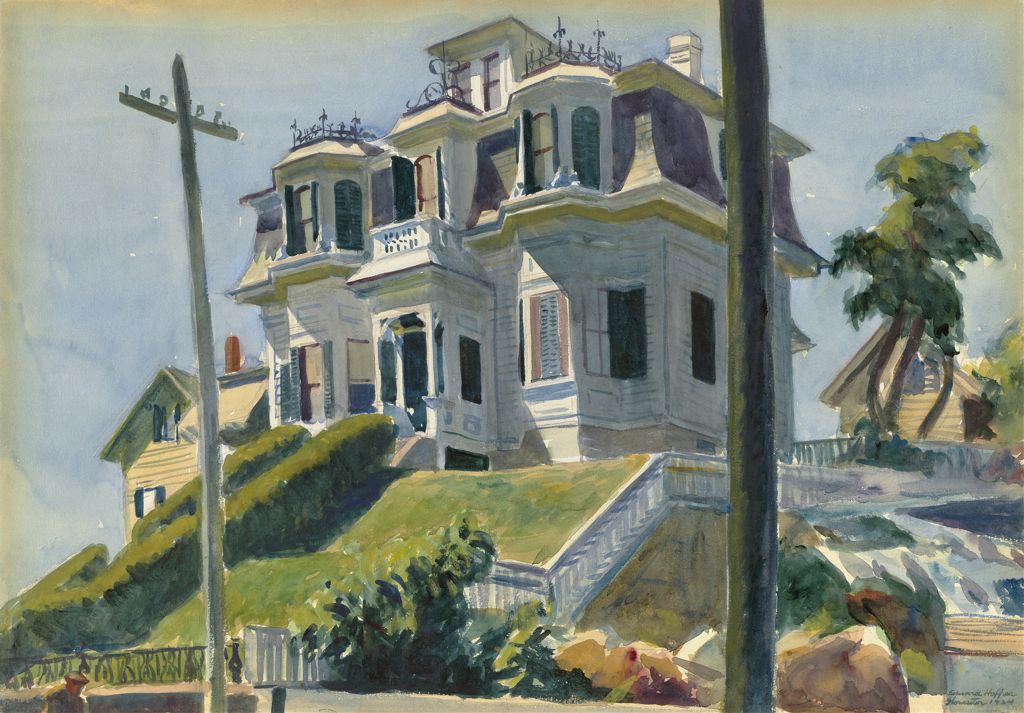
A pale awning lifts away from a dark roof. A utility pole crosses the view of a hillside house. In Mexico, a cinema sign rises among ochre walls beneath distant mountains. Edward Hopper's watercolours bring architecture into contact with changing light, allowing broad washes and small drawn accents to describe places encountered on his travels.
Watercolour was central to his public recognition in the 1920s and remained an important part of his work long afterwards. It offered a way to paint outside New York, to explore particular buildings and to make light visible through the relation of colour to a pale support. These pictures deserve attention as works with their own subjects and material character.
At a Glance
Contents
- Before the Gloucester breakthrough
- Jo Nivison and a shared artistic summer
- Jo at work on the beach
- What the medium makes possible
- Paper, board and drawing materials
- A light mark is not always untouched paper
- Houses seen from changing positions
- Three houses and a lighthouse
- Buildings within the surrounding land
- Drawing carries the structure, colour changes the weight
Before the Gloucester breakthrough
The important summer of 1923 was not Hopper's first encounter with the medium. The Art Institute of Chicago's chronology records a solo exhibition at the Whitney Studio Club in October 1922 containing ten watercolours and a group of prints. In Gloucester the following summer, he painted more than seventeen watercolours. [1] The distinction matters: an existing practice became a major opportunity rather than appearing suddenly from nothing.
Gloucester offered more than a picturesque waterfront. Houses rose on irregular ground, roofs overlapped and roads introduced changing viewpoints. These subjects allowed Hopper to connect a building's structure with the conditions surrounding it: sunlight on a wall, vegetation near a porch or a dark opening beneath a roof.
The pictures often make the spectator aware of where the painter has chosen to stand. A house may rise above the eye, appear across a street or be partly concealed by another form. That selected position is as important as the building's identity. It determines which surfaces catch the light and which features become hidden.
Architecture also provides a framework for colour. A wall can hold a broad wash; a window can supply a concentrated dark; a roof edge can separate two adjacent tones. These ordinary elements give Hopper ways to construct a picture without turning every part of the scene into equally detailed description.
Watercolours to explore


Jo Nivison and a shared artistic summer
Josephine Nivison was already an exhibiting painter when she encouraged Hopper's watercolour work. Gail Levin's study of Jo describes their Gloucester summer and her advocacy when the Brooklyn Museum invited her to participate in its 1923 watercolour exhibition. Edward's work was included alongside hers, with six pictures by each artist. [2]
The museum bought The Mansard Roof for $100. Jo sold none of her exhibited works. Levin relates those different outcomes to the subsequent imbalance in the artists' recognition, drawing partly on a joint interview recorded in 1966. [2] Jo's intervention belongs to her activity as an artist with professional connections, as well as to the history of Edward's career.
The following year brought a solo exhibition, Recent Watercolors by Edward Hopper, at the Frank K. M. Rehn Galleries. The Art Institute dates it to October 1924 and records eleven works, including Haskell's House, purchased by George Bellows. [1] The exhibition helped turn the Gloucester achievement into a continuing relationship with a dealer and buyers.
The sequence gives watercolour a concrete place in Hopper's development. An artist who had struggled for recognition found an audience for views of buildings and places outside the metropolitan subjects most closely associated with his name today.
Jo at work on the beach
Hopper also made watercolours of Jo working. The Whitney's Jo Sketching at Good Harbor Beach, dated 1923–1924, records watercolour and fabricated chalk on paper, accession 70.1129, Josephine N. Hopper Bequest. [3] The additional drawing material is a reminder that his works on paper do not all have an identical medium description.
Jo sits on pale sand in a broad-brimmed hat, with a board or pad across her lap. Her blue clothing forms a substantial mass against the beach, while her extended legs and the slant of the shore carry the eye towards the left. Behind her, blue water separates the sand from a green headland with buildings.
The pale foreground has considerable space around the figure. A few cooler marks suggest disturbed sand and shadow, but much remains open. The blue of the clothing and the sea therefore gains strength through its relation to lighter surrounding areas.
The picture shows an artist engaged in looking and working within a coastal setting. It also gives Jo a different role from that of an anonymous figure in an interior. Her activity belongs directly to the artistic summer in which both painters were making work.
What the medium makes possible
Watercolour combines pigment with a water-soluble binder, commonly gum arabic. Applied in relatively transparent washes, it allows the lightness of the support to contribute to the effect of colour. The Metropolitan Museum of Art's account explains how damp surfaces encourage softer spreading edges, while drier applications can produce firmer boundaries. [4]
Those general properties help explain the range visible in Hopper's pictures. A broad sky can remain relatively open while a window is sharply accented. Colour can gather along one edge and become thinner elsewhere, giving a wall variation without modelling it as densely as an oil-painted surface.
The difference between an edge and an area is especially useful. A short mark can establish a roofline, while a wash gives the adjoining roof its extent. A darker stroke can suggest a post or shutter, leaving the spectator to understand its place within a larger, more lightly described structure.
Brightness does not depend only on applying a conspicuous light colour. A pale area can gain force through the darker shapes beside it. Awnings, walls and skies can therefore appear luminous through their relationships across the sheet.
A reproduction, however, does not establish exactly how every pale passage was made. Unpainted support, thin paint and later handling can have different appearances. Looking closely at the visible result is more useful than assigning an unsupported technical explanation to each small light mark.

Compare: The Mansard Roof, 1923.
Paper, board and drawing materials
The materials vary from work to work. The National Gallery of Art records Haskell's House as watercolour and graphite on paperboard. [5] The relatively specific support description distinguishes it from the many works catalogued simply as watercolour on paper.
Wichita Art Museum identifies charcoal, rather than graphite, alongside watercolour in Adam's House. [6] These distinctions affect how we understand the meeting of line and colour. A dark drawn accent need not have been made by the same implement in every picture.
Graphite appears in the Museum of Fine Arts, Boston's records for House by the Squam River and Hill and Houses, Cape Elizabeth, Maine. [7] Drawing and watercolour were compatible parts of Hopper's practice: an underlying structure could coexist with washes that varied considerably in density and freedom.
The material descriptions also help separate a finished watercolour from a preparatory drawing for an oil. Both may involve paper and a drawing implement, but that shared support does not make them interchangeable. The purpose and visual completeness of the particular work remain important.
A light mark is not always untouched paper
The Cleveland Museum of Art's Lighthouse Village, also known as Cape Elizabeth, gives a particularly useful material example. Its current record identifies watercolour with graphite and scraping on cream wove paper. The work dates from 1929, and the sheet measures 40.5 × 63.3 cm. Scraping is part of the documented medium, alongside the more familiar application of colour. [8]
This matters when we describe the luminosity of Hopper's watercolours. Some bright areas may depend on paper that has received little colour. Others can be produced or modified by working on a surface already painted. A reproduction lets us examine the distribution of light, but it does not necessarily allow every pale fleck to be assigned to one procedure.
The distinction also changes the idea of watercolour as a medium permitting no revision. Removing or disturbing colour can be part of its handling, as can returning with another wash or a drawn mark. The available choices differ from those of oil paint, but they do not reduce painting on paper to one irreversible encounter.
In Lighthouse Village, narrow pale accents give parts of the roofs and buildings a crisp presence within a much softer environment. We can describe that visible contrast without pretending to identify, from a small reproduction, every place where Hopper scraped the sheet. The object record supplies secure evidence of the technique; the image shows the larger organisation in which it operates.
Houses seen from changing positions
The Mansard Roof gives architectural ornament an unusually animated setting. Dormers, shutters and chimneys rise above pale awnings, while foliage crosses the building at either side. The roof is understood through many interruptions, and the curved fabric brings a softer rhythm beneath its angular forms.
Haskell's House places the building above rising ground. Utility poles intervene in the view, introducing narrow uprights that belong to the surrounding street. They complicate the house's outline and prevent it from appearing as an isolated specimen of architecture.
Adam's House opens the scene towards a street corner and more distant buildings. The main house becomes part of an urban arrangement, with neighbouring roofs and open ground helping establish scale.
These views show how much variety Hopper found in a shared subject. The interest is not simply that three houses look different. Each picture establishes a different relationship between the spectator, the building and the space around it.
One house may loom, another may turn away, and another may be interrupted by poles or foliage. Watercolour gives those changing relationships a visible economy: a broad surface, an accented edge and a carefully placed dark can carry a considerable amount of spatial information.
Three houses and a lighthouse
The same Cleveland watercolour can be read from the bottom of the sheet upwards. A broad foreground of yellowish and green land comes first. Beyond it stand three low houses, followed by a rising green area and the taller lighthouse group. The arrangement makes distance through successive bands of differently occupied ground.
The houses are related but not interchangeable. Their pale walls differ in temperature, from cooler off-white to yellow and pink. Dark roof planes join these separate colours into a more continuous rhythm. Chimneys introduce small warm uprights above that rhythm, while porches and windows break up the wall surfaces below.
The lighthouse rises behind rather than beside the nearer row. Its narrow, pale shaft reaches into the sky and ends in a darker lantern. This tall form gives a focus to a scene otherwise dominated by low buildings and horizontal ground. The adjacent structure is partly held within the green slope, making the tower's height especially conspicuous.
The museum connects the buildings with the people who worked there: lighthouse keepers and coast guard families. Their different functions help explain why this is a group of occupied structures rather than a picturesque collection of unrelated forms. [8] The painting does not need to show a person at every doorway to make the settlement legible.
Foreground colour has a different kind of freedom. Broader horizontal passages describe land without accounting for each stem or clump. Their variation keeps the lower part of the picture active, yet the houses retain the more decisive edges. Hopper distributes precision according to the needs of the composition.
The sky is not simply a blank strip left above the roofs. Pale changes and cloud-like passages give it a different texture from the field. Across the whole sheet, land, architecture and atmosphere are described at different levels of detail. Their differences make them belong together.
Buildings within the surrounding land
The New England watercolours also connect architecture to larger terrain. In House by the Squam River, the structure is seen in relation to the land and water around it. The setting gives the house a particular place rather than leaving it suspended against an undifferentiated backdrop.
Hill and Houses, Cape Elizabeth, Maine makes the slope itself a major part of the picture. Architecture punctuates the terrain, while open areas allow the rise and fall of the land to remain visible.
Such pictures reward attention to the intervals between buildings. A stretch of ground, a gap in vegetation or a band of sky can determine how far one form seems from another. Hopper's economy is often most apparent in these quieter passages, where relatively few marks establish a useful amount of space.
The same approach allows practical structures to participate in a landscape. A road, pole or railway line can change the direction of looking and bring a different human use into the view. The relationship between building and terrain need not depend on a person being visible.
Drawing carries the structure, colour changes the weight
In the architectural watercolours, a gable or roof can remain understandable through relatively few lines. This allows colour to do more than fill a diagram. A cool passage can set one wall back, while a warm one brings the adjacent face forward. The junction between them may establish a corner more effectively than a heavy outline.
At other points, a dark stroke carries both structure and emphasis. A window can be a physical opening, an interruption in a light wall and one of several accents distributed across the page. Its role depends on its relationship to the surrounding washes. Adding equal detail to every window would change that balance.
The graphite or charcoal identified in individual records should therefore be considered as part of the image's thinking. Drawing can survive within a finished watercolour without being a preliminary scaffolding that the painter failed to conceal. Its finer lines can remain useful beside much broader passages of the brush.
The support contributes another scale of variation. A sheet has edges and a surface that can remain visible between marks. The contrast between worked and lightly touched areas becomes part of the picture's rhythm, especially where a building meets open sky or where a foreground is described with a few broad strokes.
These effects do not all point towards speed. An abbreviated passage may be a deliberate conclusion reached after sustained attention. A more densely worked one may preserve an early choice or a later adjustment. Appearance alone cannot turn the entire sheet into a timed record of a single outdoor session.
Watch: Edward Hopper’s Life and Art
Explore Hopper’s paintings and the places behind them in these museum films. Choose a film below.
Working outside did not always mean working quickly
Hopper described a distinction between his oil-painting preparations and his watercolours in a 1960 interview with Katharine Kuh, as transmitted by Gail Levin. Drawings could be assembled into a painting, whereas he associated his watercolours with direct work outdoors from nature. Levin also notes the pencil outlines sometimes visible beneath the colour. [9]
Direct outdoor work still allowed difficulty, return visits and selection. Franklin Kelly's catalogue entry for Cottages at North Truro describes its repeated sessions in autumn 1938. Jo's diary entries for 2, 6 and 9 November, quoted through Levin's catalogue raisonné, record the continuing search for a satisfactory sky. [10]
That account changes the familiar image of a watercolour completed in one effortless burst. Hopper could work from a place while waiting for conditions that suited the picture. The sky was part of an evolving arrangement, requiring judgment after other portions were already underway.
Kelly places the work before a gap in Hopper's watercolour production lasting until summer 1941. [10] The medium's importance therefore did not imply an uninterrupted annual routine. Its use belonged to the changing rhythms of travel, health and work.

Compare: El Palacio, 1946.
Jo's blue-barked tree offers another kind of watercolour
Josephine Nivison Hopper's undated Tree in Woods, Bluish Bark, preserved in the Edward Hopper House's Sanborn collection, offers a valuable companion to Edward's architectural subjects. A broad blue-grey trunk fills most of its upright sheet. Branches turn outwards near the upper edge and a strong diagonal limb reaches towards the left. Finer, paler trunks continue behind it. [11]
The blue is striking because it belongs to an object we would usually name through browns and greys. Jo varies it with darker and warmer interruptions, allowing knots, scars and turns in the bark to remain visible. The trunk has volume without being uniformly modelled from one side to the other.
Behind it, the trees are narrower and less heavily worked. Their verticals can be followed through a pale field that stays open between the marks. Thin lateral branches give that field a delicate structure, contrasting with the weight of the principal trunk.
The ground introduces warmer orange-brown passages at the tree's base. Their broken edges and open intervals make a different kind of surface from the bark. The roots spread into this area, joining the central upright to the lower corners of the sheet.
This is a useful comparison with Lighthouse Village because both works establish a dominant upright among supporting forms. Their actual choices differ. Edward places a narrow tower above a low settlement; Jo brings the main tree close enough to fill and partly exceed the boundaries of the page. One picture asks us to see a group across open ground, the other to confront a trunk within a wood.
Jo's handling also demonstrates why the couple's shared use of watercolour should not be reduced to a story in which she merely encouraged his discovery of the medium. Her surviving sheet makes independent decisions about colour, proximity and the amount of surrounding space a subject needs. The two practices can be compared through what their pictures actually do.
Mexico and a different architectural setting
Mexico extended the geography of the watercolours. The Art Institute's chronology records the Hoppers' 1943 journey by train during wartime petrol restrictions and their return in 1946. [1] These travels brought mountain cities and different architectural forms into a practice already established through New England subjects.
El Palacio, painted in 1946, is catalogued by the Whitney as watercolour and graphite pencil on paper. [12] A vertical cinema sign interrupts pale and ochre buildings, while overlapping mountain profiles extend behind the roofs.
The arrangement carries some familiar interests into a new location. Large walls catch the light, dark openings punctuate them, and the spectator sees one structure through the partial obstruction of another. The mountains introduce a more extensive surrounding field, but the city remains a sequence of particular surfaces.
The work also broadens the association between Hopper and cinema. A theatre could be a destination named by a sign, a large architectural mass and part of a city's skyline. Painting it outside allows the entertainment building to participate in the landscape without depicting a performance or audience.
Revisiting the Gloucester houses through photography
Hopper's watercolours have also provided starting points for later artists. In Hopper Redux, exhibited in 2012, Gail Albert Halaban returned to the Gloucester locations associated with his paintings of the 1920s. The gallery's release describes carefully staged photographs using lighting, people, props and work after the exposure. [13]
Such a project makes a distinction between a building that survives and an image that can be repeated. A later photograph can revisit a house, but its light, occupation and visible surroundings belong to another occasion. The watercolour remains an arrangement of marks made on a particular support.
The shift of medium also changes what counts as selection. Hopper could abbreviate a lawn through a wash, omit a detail or make an adjoining wall a broader plane. A staged photograph can organise people and objects before the camera, then adjust the resulting image. Both require decisions, although those decisions operate through different materials and procedures.
Halaban's project therefore offers a useful way of returning to the earlier pictures. The buildings are neither imaginary in every respect nor merely neutral containers for a supposed Hopper mood. They supplied subjects from which an artist made images; another artist can encounter those subjects and produce a different account.
Looking again at a watercolour after such a comparison, a small change of viewpoint becomes consequential. A roof may meet the horizon differently, a side wall may become more or less visible, and the amount of foreground may expand. The recognisable house remains, while the relations that make the picture are transformed.
A continuing place in exhibitions
Watercolours remained visible alongside Hopper's oils as his reputation developed. The Art Institute's chronology records thirty-seven in his 1933 Museum of Modern Art retrospective, alongside twenty-five oils and eleven etchings. In 1945, Lloyd Goodrich's American Watercolor and Winslow Homer at the Walker Art Center included nine works by Hopper; he and John Marin had the largest representation among living artists. [1]
These exhibitions show the medium's continuing public importance. The Gloucester success was an early turning point, but watercolour was also part of how museums presented Hopper's achievement during his mature career.
It offers a useful route into the breadth of that achievement today. Houses, coastal buildings, open ground and Mexican streets complicate an account based mainly on diners and city interiors. They reveal an artist repeatedly testing what a selected position and a changing distribution of light could do with a particular place.
Exhibition scale and the intimate work of a sheet
The watercolours can appear especially direct beside Hopper's large, constructed oils. Yet their relatively intimate scale has its own demands. Fine changes of colour and a short drawn edge can bear more attention when a viewer stands close to a work on paper than they might in a larger canvas seen across a room.
This helps explain why a subject such as a row of houses can sustain a substantial image without a conspicuous human episode. Differences in wall colour, roof angle and spacing become events in their own right. The painter's decisions determine which of them attracts the eye first and which remains available on a slower inspection.
The relation with oil painting is consequently more varied than a contrast between spontaneous studies and finished masterpieces. Some watercolours establish complete compositions. Some drawings prepare oils. Some subjects, materials and habits recur across both, but the finished works have to be considered through the particular support and scale on which they operate.
A productive comparison begins with one visible problem: how a white building receives shade, how a tall form rises above lower ones, or how much open ground should precede a house. Following that problem across media reveals a continuing practice without making one medium the servant of the other.
Looking between the watercolours and oils
Comparing the two media can sharpen attention without making one a standard against which to judge the other. A watercolour may leave broad areas lightly described, while an oil gives a wall a more continuous opaque surface. Both can make architecture emphatic through a small number of carefully related shapes.
The subject alone does not determine that process. A lighthouse painted in oil and a coastal building painted in watercolour may belong to similar places while asking different things of their materials. Close comparison begins with what is visible in each work: its edges, intervals, marks and treatment of a pale surface.
For a first route through Hopper's watercolours, begin with the awnings and dormers of The Mansard Roof, then move to the interrupted hillside view of Haskell's House. Adam's House opens the scene towards a street, while House by the Squam River places the building within a broader landscape. El Palacio carries those questions of architecture, viewpoint and light into Mexico.
Across these different subjects, the pleasure lies in the changing decisions. A wash spreads, an edge becomes firm, a dark opening establishes depth, and a pale wall catches the eye. Hopper's watercolours make those acts of looking and construction unusually available to the spectator.
Artworks and studies directory
This researched directory includes finished works and separately identified studies. It is not a complete catalogue raisonné. Linked titles open the articles; unlinked studies are identified by their collection accessions. Watercolours retain their recorded media, and original prints remain distinct from reproductions.
| Name | Date | Medium |
|---|---|---|
| (Bridge and Embankment) (70.1298) | 1906 | Oil on wood |
| (Jo Sketching at Good Harbor Beach) (70.1129) | 1923–1924 | Watercolor and fabricated chalk on paper |
| (Manhattan Bridge) (70.1098) | 1925–1926 | Watercolor and graphite pencil on paper |
| (Rooftops) (70.1114) | 1926 | Watercolor and graphite pencil on paper |
| (Seated Male Model, Bent Over) (70.1277) | c. 1902–1903 | Oil on canvas |
| (Self-Portrait) (70.1254) | 1903–1906 | Oil on canvas |
| (Solitary Figure in a Theater) (70.1418) | c. 1902–1904 | Oil on board |
| 5 A.M. | 1937 | oil on canvas |
| Adam's House | 1928 | watercolour and charcoal on paper |
| American Village | 1912 | Oil on canvas |
| Apartment Houses | 1923 | oil on canvas |
| Approaching a City | 1946 | oil on canvas |
| August in the City | 1945 | oil on canvas |
| Automat | 1927 | oil on canvas |
| Barber Shop | 1931 | oil on canvas |
| Blackwell's Island | 1928 | oil on canvas |
| Bridge on the Seine | 1909 | Oil on canvas |
| Bridle Path | 1939 | oil on canvas |
| Burly Cobb's House South Truro | 1930–1933 | oil on canvas |
| Cape Cod Evening | 1939 | oil on canvas |
| Cape Cod Morning | 1950 | oil on canvas |
| Chair Car | 1965 | oil on canvas |
| Chop Suey | 1929 | oil on canvas |
| City Roofs | 1932 | Oil on canvas |
| Coast Guard Station | 1929 | oil on canvas |
| Compartment C, Car 293 | 1938 | oil on canvas |
| Conference at Night | 1949 | oil on canvas |
| Corn Hill | 1930 | oil on canvas |
| Dawn in Pennsylvania | 1942 | oil on canvas |
| Drug Store | 1927 | oil on canvas |
| Early Sunday Morning | 1930 | Oil on canvas |
| East Side Interior (70.1020) | 1922 | Etching |
| East Wind Over Weehawken | 1934 | oil on canvas |
| El Palacio | 1946 | Watercolor and graphite pencil on paper |
| Eleven A.M. | 1926 | oil on canvas |
| Evening Wind | 1921 | etching |
| Excursion into Philosophy | 1959 | oil on canvas |
| First Row Orchestra | 1951 | oil on canvas |
| Freight Car at Truro | 1931 | watercolour over graphite on paper |
| Gas | 1940 | oil on canvas |
| Girl at a Sewing Machine | c. 1921 | oil on canvas |
| Gloucester Harbor | 1912 | Oil on canvas |
| Ground Swell | 1939 | oil on canvas |
| Haskell's House | 1924 | watercolour over graphite on paperboard |
| High Noon | 1949 | oil on canvas |
| Hill and Houses Cape Elizabeth Maine | 1927 | watercolour over graphite pencil |
| Hills South Truro | 1930 | oil on canvas |
| Hotel by a Railroad | 1952 | oil on canvas |
| Hotel Lobby | 1943 | oil on canvas |
| Hotel Room | 1931 | oil on canvas |
| Hotel Window | 1955 | oil on canvas |
| House by the Railroad | 1925 | oil on canvas |
| House by the Squam River | 1926 | watercolour over graphite on paper |
| Le Bistro or The Wine Shop | 1909 | Oil on canvas |
| Le Pont des Arts | 1907 | Oil on canvas |
| Le Pont Royal | 1909 | Oil on canvas |
| Le Quai des Grands Augustins | 1909 | Oil on canvas |
| Lighthouse and Buildings Portland Head | 1927 | watercolour over graphite pencil on paper |
| Lighthouse Hill | 1927 | oil painting |
| Manhattan Bridge Loop | 1928 | oil on canvas |
| Model Sitting | c. 1902 | oil painting; support not asserted |
| Morning Sun | 1952 | oil on canvas |
| New York Movie | 1939 | oil on canvas |
| New York New Haven and Hartford | 1931 | oil on canvas |
| New York Office | 1962 | oil on canvas |
| New York Pavements | 1924–1925 | oil on canvas |
| New York Restaurant | c. 1922 | oil on canvas |
| Night Windows | 1928 | oil on canvas |
| Nighthawks | 1942 | oil on canvas |
| October on Cape Cod | 1946 | oil on canvas |
| Office at Night | 1940 | oil on canvas |
| Office in a Small City | 1953 | oil on canvas |
| Pennsylvania Coal Town | 1947 | oil on canvas |
| People in the Sun | 1960 | oil on canvas |
| Portrait of Orleans | 1950 | oil on canvas |
| Queensborough Bridge | 1913 | Oil on canvas |
| Railroad Sunset | 1929 | Oil on canvas |
| Railroad Train | 1908 | oil on canvas |
| Road in Maine | 1914 | oil on canvas |
| Room in Brooklyn | 1932 | oil on canvas |
| Room in New York | 1932 | oil on canvas |
| Rooms by the Sea | 1951 | oil on canvas |
| Rooms for Tourists | 1945 | oil on canvas |
| Route 6 Eastham | 1941 | oil on canvas |
| Second Story Sunlight | 1960 | Oil on canvas |
| Self-Portrait | 1925–1930 | Oil on canvas |
| Self-Portrait with Hat (70.1903) | c. 1918, posthumous print | Drypoint |
| Seven A.M. | 1948 | Oil on canvas |
| Soir Bleu | 1914 | oil on canvas |
| South Carolina Morning | 1955 | Oil on canvas |
| Stairway at 48 Rue de Lille Paris | 1906 | Oil on wood |
| Study for 5 A.M. (70.153) | 1937 | Fabricated chalk on paper |
| Study for 5 A.M. (70.429) | 1937 | Fabricated chalk and graphite pencil on paper |
| Study for Approaching a City (70.869) | 1946 | Fabricated chalk and charcoal on paper |
| Study for August in the City (70.158a-b) | 1945 | Fabricated chalk on paper |
| Study for August in the City (70.159) | 1945 | Fabricated chalk on paper |
| Study for Bridle Path (70.220) | 1939 | Fabricated chalk on paper |
| Study for Bridle Path (70.235) | 1939 | Fabricated chalk on paper |
| Study for Compartment C, Car 293 (70.430) | 1938 | Fabricated chalk on paper |
| Study for Compartment C, Car 293 (70.431a-b) | 1938 | Fabricated chalk and charcoal on paper |
| Study for Conference at Night (70.170) | 1949 | Fabricated chalk on paper (recto); Typewriter ink on paper (verso) |
| Study for Conference at Night (70.174) | 1949 | Fabricated chalk on paper ( recto); Typewriter ink on paper (verso) |
| Study for East Wind over Weehawken (70.249) | 1934 | Graphite pencil on paper |
| Study for East Wind over Weehawken (70.252) | 1934 | Fabricated chalk and charcoal on paper |
| Study for Evening Wind (70.343a-b) | 1921 | Fabricated chalk on paper |
| Study for First Row Orchestra (70.841) | 1951 | Fabricated chalk and charcoal on paper |
| Study for Gas (70.263) | 1940 | Fabricated chalk on paper |
| Study for Ground Swell (70.339) | 1939 | Fabricated chalk, charcoal and graphite pencil on paper |
| Study for Hotel by a Railroad (70.199) | 1952 | Fabricated chalk on paper |
| Study for Hotel by a Railroad (70.427) | 1952 | Fabricated chalk on paper |
| Study for Hotel by a Railroad (70.428) | 1952 | Fabricated chalk on paper |
| Study for Hotel Lobby (70.117) | 1942 | Fabricated chalk and graphite pencil on paper |
| Study for Hotel Lobby (70.839) | 1942 | Fabricated chalk and charcoal on paper |
| Study for Hotel Window (70.161) | 1955 | Fabricated chalk, graphite pencil and colored pencil on paper |
| Study for Morning Sun (70.243) | 1952 | Fabricated chalk on paper |
| Study for Morning Sun (70.244) | 1952 | Fabricated chalk on paper |
| Study for Morning Sun (70.290) | 1952 | Fabricated chalk on paper |
| Study for Morning Sun (70.291) | 1952 | Fabricated chalk and graphite pencil on paper |
| Study for New York Movie (70.273) | 1939 | Fabricated chalk on paper |
| Study for New York Movie (70.274a-b) | 1938 or 1939 | Fabricated chalk and charcoal on paper (recto); Fabricated chalk on paper (verso) |
| Study for New York Movie (70.455) | 1939 | Fabricated chalk and charcoal on paper |
| Study for New York Office (70.822) | 1962 | Fabricated chalk on paper |
| Study for Nighthawks (70.192) | 1941 or 1942 | Fabricated chalk on paper |
| Study for Nighthawks (70.193) | 1941 or 1942 | Fabricated chalk on paper |
| Study for Office at Night (70.340) | 1940 | Fabricated chalk and charcoal on paper |
| Study for Office at Night (70.341) | 1940 | Fabricated chalk and graphite pencil on paper |
| Study for Pennsylvania Coal Town (70.198) | 1947 | Fabricated chalk on paper |
| Study for Pennsylvania Coal Town (70.229) | 1947 | Fabricated chalk and charcoal on paper |
| Study for Rooms for Tourists (70.438) | 1945 | Fabricated chalk and charcoal on paper |
| Study for Rooms for Tourists (70.848) | 1945 | Fabricated chalk and charcoal on paper |
| Study for Route 6, Eastham (70.369) | 1941 | Fabricated chalk and graphite pencil on paper |
| Study for Route 6, Eastham (70.854) | 1941 | Fabricated chalk and graphite pencil on paper |
| Study for South Carolina Morning (70.162a-b) | 1955 | Fabricated chalk on paper (recto and verso) |
| Study for The Sheridan Theatre (70.969) | 1937 | Graphite pencil on paper |
| Study for Two on the Aisle (70.128) | 1927 | Fabricated chalk on paper |
| Study for Two on the Aisle (70.129) | 1927 | Fabricated chalk on paper |
| Study for Yawl Riding a Swell (70.439) | 1935 | Fabricated chalk and graphite pencil on paper |
| Summer Evening | 1947 | oil on canvas |
| Summer Interior | 1909 | Oil on canvas |
| Sun in an Empty Room | 1963 | oil on canvas |
| Sunlight in a Cafeteria | 1958 | oil on canvas |
| Sunlight on Brownstones | 1956 | oil on canvas |
| Tables for Ladies | 1930 | oil on canvas |
| The Bootleggers | 1925 | oil on canvas |
| The Camel's Hump | 1931 | oil on canvas |
| The Circle Theatre | 1936 | oil on canvas |
| The City | 1927 | oil on canvas |
| The Lighthouse at Two Lights | 1929 | oil on canvas |
| The Long Leg | 1935 | oil on canvas |
| The Mansard Roof | 1923 | watercolour over graphite on paper |
| The Sheridan Theatre | 1937 | oil on canvas |
| Tramp Steamer | 1908 | oil on canvas |
| Two Comedians | 1966 | oil on canvas |
| Two on the Aisle | 1927 | oil on canvas |
| Valley of the Seine | 1909 | Oil on canvas |
| Western Motel | 1957 | oil on canvas |
Frequently Asked Questions
The important summer of 1923 was not Hopper's first encounter with the medium. The Art Institute of Chicago's chronology records a solo exhibition at the Whitney Studio Club in October 1922 containing ten watercolours and a group of prints. In Gloucester the following summer, he painted more than seventeen watercolours. [1] The distinction matters: an existing practice became a major opportunity rather than appearing suddenly from nothing.
Hopper also made watercolours of Jo working. The Whitney's Jo Sketching at Good Harbor Beach, dated 1923–1924, records watercolour and fabricated chalk on paper, accession 70.1129, Josephine N. Hopper Bequest. [3] The additional drawing material is a reminder that his works on paper do not all have an identical medium description.
Hopper described a distinction between his oil-painting preparations and his watercolours in a 1960 interview with Katharine Kuh, as transmitted by Gail Levin. Drawings could be assembled into a painting, whereas he associated his watercolours with direct work outdoors from nature. Levin also notes the pencil outlines sometimes visible beneath the colour. [9]
Discussion
Look again at the images and ideas explored in Edward Hopper's Watercolours. These editorial prompts invite your observations.
Reader Insights
Where does the paper’s lightness play the strongest part in one of these watercolours?
Compare The Mansard Roof with El Palacio. Which visual difference matters most to your reading?
Which detail would you look at again after reading “Jo at work on the beach”?
Join the Conversation
Share a detail, comparison or question about Edward Hopper's Watercolours below.
References
- Art Institute of Chicago, Edward Hopper: Selected Chronology, entries for 1922–1924, 1933, 1943, 1945 and 1946. View source.
- Gail Levin, “Josephine Verstille Nivison Hopper”, Woman's Art Journal 1, no.1 (Spring–Summer 1980), pp.28–32, especially p.29 and notes13–16; the 1966 Arlene Jacobowitz interview is cited through Levin. View source.
- Whitney Museum of American Art, (Jo Sketching at Good Harbor Beach), 1923–1924, watercolour and fabricated chalk on paper, accession70.1129, Josephine N. Hopper Bequest; current metadata and image. View source.
- Metropolitan Museum of Art, “Watercolor”, Materials and Techniques, 1 May2020; general account of the medium, support and effects of wet and dry application. View source.
- National Gallery of Art, Haskell's House, 1924, watercolour and graphite on paperboard, accession1996.130.2. Current object medium is cited here. View source.
- Wichita Art Museum, Adam's House, 1928, watercolour and charcoal on paper, accessionM122.54, Roland P. Murdock Collection. View source.
- Museum of Fine Arts, Boston, House by the Squam River, 1926, accession48.719, and Hill and Houses, Cape Elizabeth, Maine, 1927, accession48.721, Spaulding Collection; museum-contributed AMICA records, with watercolour and graphite confirmed in the National Gallery of Art 2007 Hopper exhibition checklist, cats.28 and39. View source 1. View source 2. View source 3.
- Cleveland Museum of Art, Lighthouse Village (also known as Cape Elizabeth), 1929, accession 1930.851, Hinman B. Hurlbut Collection. Complete current description, medium, support and dimensions, and actual full painting reproduction inspected. The recorded medium is watercolour with graphite and scraping; the generated image description’s addition of gouache is not followed. View source.
- Gail Levin, “The Role of Drawing in the Art of Edward Hopper”, ©1991, reprinted in A Window into the World of Edward and Josephine Hopper, Pilgrim Monument and Provincetown Museum, 1996, pp.14–25, especially p.25; Hopper's 1960 interview with Katharine Kuh is cited through Levin. View source.
- Franklin Kelly, “Cottages at North Truro,” in Twentieth-Century American Art: The Ebsworth Collection, National Gallery of Art, Washington,2000, cat.32, pp.144–146 and notes1–7; Jo Hopper's November1938 diary entries are cited through Kelly and Gail Levin's catalogue raisonné. View source.
- Edward Hopper House Museum & Study Center, Memory, Trees & Shadows, 8 May–4 October 2026, collection caption and complete reproduction of Josephine Nivison Hopper’s undated Tree in Woods, Bluish Bark, watercolour on paper, Sanborn Josephine Nivison Hopper Collection. View source.
- Whitney Museum of American Art, (El Palacio), 1946, watercolour and graphite pencil on paper, accession50.2, exchange. View source.
- Edwynn Houk Gallery, Gail Albert Halaban, Hopper Redux, exhibition release, 8 November–22 December 2012. Complete one-page release consulted; the discussion concerns the stated project and process rather than an uninspected individual photograph. View source.
- Whitney Museum of American Art, Study for Route 6, Eastham, 1941, accession 70.854; exact object record. View source.
- Whitney Museum of American Art, Study for Conference at Night, 1949, accession 70.170; exact object record. View source.
- Whitney Museum of American Art, Study for First Row Orchestra, 1951, accession 70.841; exact object record. View source.
- Whitney Museum of American Art, (Bridge and Embankment), 1906, accession 70.1298; exact object record. View source.
- Whitney Museum of American Art, (Seated Male Model, Bent Over), c. 1902–1903, accession 70.1277; exact object record. View source.
- Whitney Museum of American Art, Study for Morning Sun, 1952, accession 70.244; exact object record. View source.
- Whitney Museum of American Art, Study for Morning Sun, 1952, accession 70.243; exact object record. View source.
- Whitney Museum of American Art, Study for Two on the Aisle, 1927, accession 70.128; exact object record. View source.
- Whitney Museum of American Art, Study for New York Office, 1962, accession 70.822; exact object record. View source.
- Whitney Museum of American Art, Study for Two on the Aisle, 1927, accession 70.129; exact object record. View source.
- Whitney Museum of American Art, Study for Pennsylvania Coal Town, 1947, accession 70.229; exact object record. View source.
- Whitney Museum of American Art, (Rooftops), 1926, accession 70.1114; exact object record. View source.
- Whitney Museum of American Art, Study for South Carolina Morning, 1955, accession 70.162a-b; exact object record. View source.
- Whitney Museum of American Art, (Self-Portrait), 1903–1906, accession 70.1254; exact object record. View source.
- Whitney Museum of American Art, (Manhattan Bridge), 1925–1926, accession 70.1098; exact object record. View source.
- Whitney Museum of American Art, (Solitary Figure in a Theater), c. 1902–1904, accession 70.1418; exact object record. View source.
- Whitney Museum of American Art, Study for Approaching a City, 1946, accession 70.869; exact object record. View source.
- Whitney Museum of American Art, Study for August in the City, 1945, accession 70.159; exact object record. View source.
- Whitney Museum of American Art, Study for Compartment C, Car 293, 1938, accession 70.430; exact object record. View source.
- Whitney Museum of American Art, Study for Compartment C, Car 293, 1938, accession 70.431a-b; exact object record. View source.
- Whitney Museum of American Art, Study for East Wind over Weehawken, 1934, accession 70.252; exact object record. View source.
- Whitney Museum of American Art, Study for East Wind over Weehawken, 1934, accession 70.249; exact object record. View source.
- Whitney Museum of American Art, Study for Evening Wind, 1921, accession 70.343a-b; exact object record. View source.
- Whitney Museum of American Art, Study for The Sheridan Theatre, 1937, accession 70.969; exact object record. View source.
- Whitney Museum of American Art, Study for New York Movie, 1939, accession 70.455; exact object record. View source.
- Whitney Museum of American Art, Study for New York Movie, 1939, accession 70.273; exact object record. View source.
- Whitney Museum of American Art, Study for New York Movie, 1938 or 1939, accession 70.274a-b; exact object record. View source.
- Whitney Museum of American Art, Study for 5 A.M., 1937, accession 70.153; exact object record. View source.
- Whitney Museum of American Art, Study for 5 A.M., 1937, accession 70.429; exact object record. View source.
- Whitney Museum of American Art, (Jo Sketching at Good Harbor Beach), 1923–1924, accession 70.1129; exact object record. View source.
- Whitney Museum of American Art, Study for August in the City, 1945, accession 70.158a-b; exact object record. View source.
- Whitney Museum of American Art, Study for Morning Sun, 1952, accession 70.291; exact object record. View source.
- Whitney Museum of American Art, Study for Morning Sun, 1952, accession 70.290; exact object record. View source.
- Whitney Museum of American Art, Study for Office at Night, 1940, accession 70.340; exact object record. View source.
- Whitney Museum of American Art, Study for Office at Night, 1940, accession 70.341; exact object record. View source.
- Whitney Museum of American Art, Study for Hotel by a Railroad, 1952, accession 70.427; exact object record. View source.
- Whitney Museum of American Art, Study for Hotel by a Railroad, 1952, accession 70.199; exact object record. View source.
- Whitney Museum of American Art, Study for Hotel by a Railroad, 1952, accession 70.428; exact object record. View source.
- Whitney Museum of American Art, Study for Hotel Lobby, 1942, accession 70.117; exact object record. View source.
- Whitney Museum of American Art, Study for Hotel Lobby, 1942, accession 70.839; exact object record. View source.
- Whitney Museum of American Art, Study for Conference at Night, 1949, accession 70.174; exact object record. View source.
- Whitney Museum of American Art, Study for Hotel Window, 1955, accession 70.161; exact object record. View source.
- Whitney Museum of American Art, Study for Pennsylvania Coal Town, 1947, accession 70.198; exact object record. View source.
- Whitney Museum of American Art, Study for Route 6, Eastham, 1941, accession 70.369; exact object record. View source.
- Whitney Museum of American Art, Study for Bridle Path, 1939, accession 70.220; exact object record. View source.
- Whitney Museum of American Art, Study for Bridle Path, 1939, accession 70.235; exact object record. View source.
- Whitney Museum of American Art, Study for Ground Swell, 1939, accession 70.339; exact object record. View source.
- Whitney Museum of American Art, Study for Yawl Riding a Swell, 1935, accession 70.439; exact object record. View source.
- Whitney Museum of American Art, Study for Rooms for Tourists, 1945, accession 70.848; exact object record. View source.
- Whitney Museum of American Art, Study for Rooms for Tourists, 1945, accession 70.438; exact object record. View source.
- Whitney Museum of American Art, Study for Nighthawks, 1941 or 1942, accession 70.193; exact object record. View source.
- Whitney Museum of American Art, Study for Nighthawks, 1941 or 1942, accession 70.192; exact object record. View source.
- Whitney Museum of American Art, Study for Gas, 1940, accession 70.263; exact object record. View source.
- Whitney Museum of American Art, Self-Portrait with Hat, c. 1918, posthumous print, accession 70.1903; exact object record. View source.
- Whitney Museum of American Art, East Side Interior, 1922, accession 70.1020; exact object record. View source.
- Art Institute of Chicago, Selected Chronology for Edward Hopper; training, travels, exhibitions, New York and Truro chronology. View source.
- Emily C. Burns, Spectral figures: Edward Hopper’s empty Paris, chapter 5 in Empty Spaces: Confronting Emptiness in National, Cultural and Urban Histories, 2019; complete chapter and notes consulted. View source.
- Charles Brock, Regionalism and Folk Art, National Gallery of Art; complete essay and two notes consulted. View source.
- Collection or catalogue record, American Village, 1912; medium and identity as discussed in the linked article. View source.
- Collection or catalogue record, Soir Bleu, 1914; medium and identity as discussed in the linked article. View source.
- Collection or catalogue record, House by the Railroad, 1925; medium and identity as discussed in the linked article. View source.
- Collection or catalogue record, Automat, 1927; medium and identity as discussed in the linked article. View source.
- Collection or catalogue record, Early Sunday Morning, 1930; medium and identity as discussed in the linked article. View source.
- Collection or catalogue record, New York Movie, 1939; medium and identity as discussed in the linked article. View source.
- Collection or catalogue record, Nighthawks, 1942; medium and identity as discussed in the linked article. View source.
- Collection or catalogue record, Morning Sun, 1952; medium and identity as discussed in the linked article. View source.
- Collection or catalogue record, Second Story Sunlight, 1960; medium and identity as discussed in the linked article. View source.
- Collection or catalogue record, Two Comedians, 1966; medium and identity as discussed in the linked article. View source.


