 by Tom Gurney
Tom Gurney BSc (Hons) is an art history expert with over 20 years experience
Email: tomgurney1@gmail.com / Phone: +44 7429 011000
High Noon: Introduction
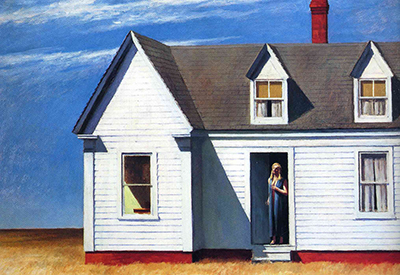
A woman stands in the dark doorway of a white house. Her blue robe forms a narrow upright beneath two dormer windows, while a large gabled projection casts a sharp shadow across the facade. Red appears in the chimney and along the building's base. Edward Hopper's High Noon makes a small figure part of an emphatic arrangement of roof, wall, opening and sunlight.
The Dayton Art Institute dates the oil on canvas to 1949 and records 69.9 × 100.3 cm, accession 1971.7, gift of Mr. and Mrs. Anthony Haswell. [1] The house stands close to the spectator, with little surrounding detail to distract from the contrasts across its surfaces.
At a Glance
- ArtistEdward Hopper [1]
- Date1949 [1]
- Mediumoil on canvas [1]
- Collection / recordDayton Art Institute [1]
- Accession1971.7 [1]
This work across Edward Hopper’s career
American Village
1912Soir Bleu
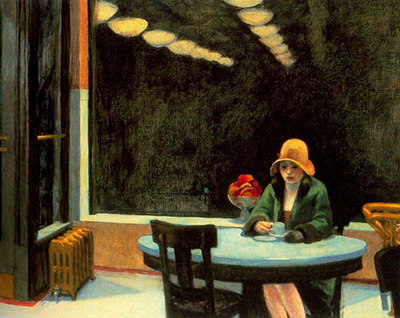
1914Automat
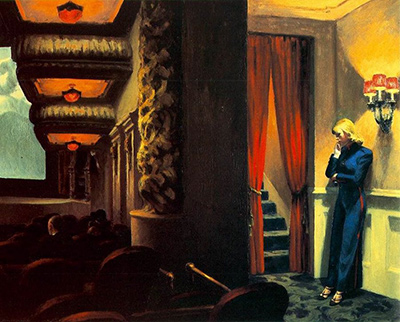
1927New York Movie
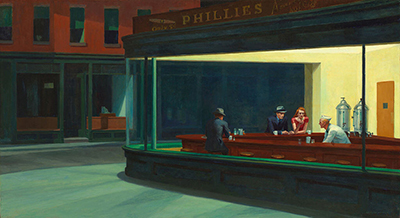
1939Nighthawks
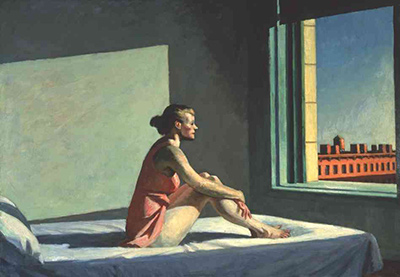
1942Morning Sun
1952Two Comedians
1966Contents
- A house built from unequal parts
- A shadow across the corner
- The figure in the doorway
- A smaller room through the window
- Dormers and pale curtains
- Sparse ground around a substantial building
- A paper house for studying light
- A drawing with an extra window
- Drawing beneath the paint
- Other thresholds in strong light
A house built from unequal parts
The projecting gable at the left is larger than the two dormers set into the main roof. It gives the building an uneven silhouette, with a substantial triangular form anchoring one side and smaller repetitions continuing towards the right.
The roof slopes have different orientations. Their grey-brown surfaces meet at ridges and edges that help explain the house's volume. Hopper makes those changes legible without describing each shingle as a separate object.
Below, horizontal clapboard lines cross the white walls. Their repetition provides a finer rhythm within the larger shapes, keeping the bright facade from becoming a completely blank plane. The building is both strongly simplified and materially recognizable.
The doorway and windows interrupt these bands. Dark vertical rectangles appear beneath the roof's diagonals, creating different kinds of division within the white surface. The house's visual structure depends on those changes of direction.
The red base gives the building a narrow lower boundary. Above it, a red chimney rises through the roof, carrying the warm colour to a distant point within the same architectural mass. These accents make a small but forceful link between ground and skyline.
A shadow across the corner
The strongest shadow falls beside the projecting gable. Its diagonal edge descends across the facade, converting a cast effect into one of the picture's major shapes. The wall is divided by light as well as by its physical construction.
The shaded area remains recognizably part of the same white building. Cooler blue-grey passages distinguish it from the brighter clapboards, while the horizontal seams continue across changes of tone. Illumination alters the wall without destroying its continuity.
That relationship gives the house its particular firmness. A projecting architectural part can be understood through the shadow it casts on an adjoining surface. Hopper allows one form to describe another.
The shadow also approaches the doorway. The woman stands near the junction of several strongly divided areas: bright wall, darker interior and the diagonal cast shadow. Her narrow figure does not need to dominate the canvas in size to occupy a consequential position.
The title supplies a named hour, while the selected contrasts of bright and shaded planes give the modest building its pictorial structure.
The figure in the doorway
The woman's robe is a cool blue against the pale facade and dark opening. A narrow area of warmer skin appears above and within its edges. The contrast makes her legible while keeping her closely connected to the doorway's vertical shape.
Her body remains comparatively small. Most of the canvas is given to architecture, sky and ground, and the house's divisions continue around her. The figure gives the building a human scale without turning every architectural detail into a background for a portrait.
The opening also limits what we can know. We see a woman at a threshold, but little of the room behind her. The interior's darkness supplies depth rather than an explanation of her occupation or reason for standing there.
Dayton's account transmits Jo Hopper's description of a blond woman in an open blue kimono, with uncertainty about the body beneath it. [1] The qualification matters: the record describes an appearance, while the painting itself leaves much concealed.
There is no visitor, exchange or visible event to establish a story. The threshold is enough to place the figure between the enclosed house and the open setting outside.
A smaller room through the window
The lower window in the projecting section offers a different view inward. A few angular forms suggest a small table and chair, identified in the museum's interpretation. [1] The room is sparsely disclosed, with only enough information to distinguish it from the darker doorway.
The window's divisions establish another scale of light and shadow. Pale framing surrounds a darker opening, and a lighter interior shape crosses part of it. The eye can read a small arrangement within the larger arrangement of the facade.
This glimpse complicates the apparent simplicity of the house. The building contains separate spaces with different degrees of visibility. One opening holds a figure; another reveals a little furniture; upper windows are partly screened by shades and curtains.
The interiors do not join into a complete floor plan. Their separation keeps the spectator outside, working from fragments. The house feels available to inspection on its illuminated surfaces while retaining less accessible spaces behind them.
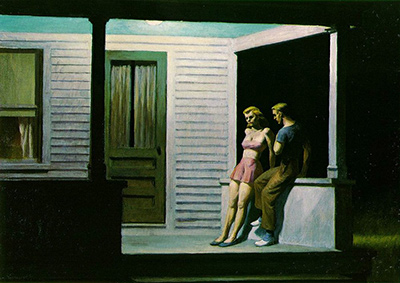
Compare: Summer Evening, 1947.
Dormers and pale curtains
The two dormers repeat the main gable's triangular form on a smaller scale. Each has a pale front, dark roof edges and a rectangular window. Their relation to the larger roof makes them seem both attached to it and individually distinct.
The window coverings introduce variations within that repetition. Light yellow shades and paler curtains partly obstruct the openings, producing a different balance of bright and dark in each. Domestic fittings interrupt the larger architectural geometry.
The dormers also keep attention above the woman. A viewer can move from the doorway to the two upper openings and then towards the chimney. The figure belongs to a vertically extended building rather than an isolated rectangle of dark space.
The sky provides a strong blue field behind the roof. Long white cloud streaks pass above it, giving the setting a horizontal movement that differs from the sharper roof slopes. The house's silhouette remains clear against that broader atmosphere.
Sparse ground around a substantial building
The surrounding land is comparatively open. Warm yellow-brown ground stretches past the house, with little immediately adjacent vegetation or street furniture. Its relative simplicity makes the building's white walls more emphatic.
The low distant band does not supply a detailed neighbourhood. No sequence of houses explains the road, property boundaries or local community. Hopper lets the selected structure occupy an extensive but only lightly specified setting.
The foreground similarly gives the spectator few intervening objects. We can look directly towards the doorway and lower windows, making the house feel close even though the wider land remains difficult to map.
This economy increases the importance of the architectural parts. The red base, dark entrance and diagonal shadow have room to act without competing with an accumulation of nearby detail.
Watch: Edward Hopper’s Life and Art
Explore Hopper’s paintings and the places behind them in these museum films. Choose a film below.
A paper house for studying light
Jo's account, published by the Dayton museum, records Hopper making a small house from heavy white paper to examine how light would fall across its corner. [1] This gives a particularly concrete insight into the painting's preparation.
The model allowed illumination to be considered in relation to a three-dimensional form. A projecting section and adjoining wall could produce a visible cast effect before those relationships were translated into paint.
The record does not turn the finished canvas into a mechanically copied demonstration. Hopper still had to decide how the house would occupy the rectangle, how much ground and sky to include, and where the figure would stand. A practical experiment could supply information within a larger pictorial construction.
The paper supplied a relatively simple pale surface; the canvas brings that lighting problem into a wider arrangement of colour, architecture and a human figure.
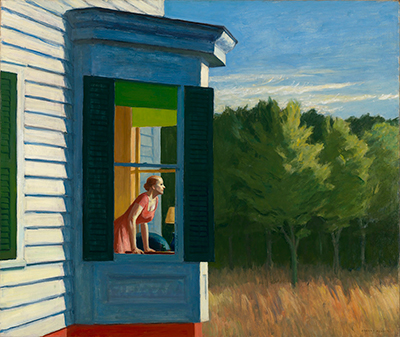
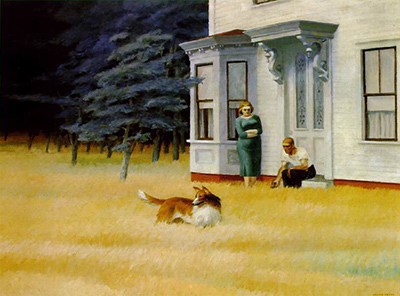
Compare: Cape Cod Morning, 1950.
A drawing with an extra window
The Provincetown Art Association and Museum holds an undated graphite drawing catalogued as Study for High Noon, no. 1 of 3, object 2532.E010.D16. [2] Its lightly worked facade already brings together the large projecting gable, smaller dormers and a diagonal area of shade.
The study includes a small rectangular window high in the large left gable. The finished painting leaves that upper wall closed and pale. Removing the opening gives the triangular surface greater continuity and reduces the number of dark interruptions near the roof.
A small figure is roughly marked near the entrance, while repeated lines explore the building's edges. The drawing concentrates on the relationship between architectural divisions and the person at its lower level, leaving many surface details unresolved.
Its catalogue number within a group does not establish a complete chronological sequence. The useful comparison is visible: the house's broad arrangement is related to the canvas, but individual openings and accents remained available for revision.
Drawing beneath the paint
Technical investigation adds another kind of evidence. Queen's University's 2014 conservation newsletter records George Bevan and Ian Longo examining the Dayton painting with infrared imaging. Longo's conference abstract reports charcoal drawing beneath the paint of the original High Noon. [3]
That reported finding places drawn preparation within the canvas itself, alongside the separate paper studies and model. It concerns an earlier stage of making the Dayton painting, rather than something visible in an ordinary reproduction of its finished surface.
The different evidence supports a more active view of Hopper's stillness. Looking, drawing and testing light could all contribute to a scene that finally appears spare and controlled.
Other thresholds in strong light
Cape Cod Morning frames a woman within a projecting bay, giving her forward lean a more conspicuous direction. In High Noon, the full building commands greater attention, with the figure held within a narrower entrance.
Morning Sun brings the spectator inside a room, where light across a wall and seated body becomes the principal arrangement. The Dayton painting makes a comparable interest visible from outside, through the meeting of surfaces on a house.
Second Story Sunlight places two women beneath larger roof triangles and beside dense trees. High Noon opens the land around its building and gives the corner shadow a particularly sharp role.
Look from the red chimney down towards the woman, then across to the shaded wall and small side window. The route joins details of very different sizes within one building. Hopper's preparation makes the house convincing, while his selection of openings and light keeps it from becoming an exhaustive account of a place.
Artworks and studies directory
This researched directory includes finished works and separately identified studies. It is not a complete catalogue raisonné. Linked titles open the articles; unlinked studies are identified by their collection accessions. Watercolours retain their recorded media, and original prints remain distinct from reproductions.
| Name | Date | Medium |
|---|---|---|
| (Bridge and Embankment) (70.1298) | 1906 | Oil on wood |
| (Jo Sketching at Good Harbor Beach) (70.1129) | 1923–1924 | Watercolor and fabricated chalk on paper |
| (Manhattan Bridge) (70.1098) | 1925–1926 | Watercolor and graphite pencil on paper |
| (Rooftops) (70.1114) | 1926 | Watercolor and graphite pencil on paper |
| (Seated Male Model, Bent Over) (70.1277) | c. 1902–1903 | Oil on canvas |
| (Self-Portrait) (70.1254) | 1903–1906 | Oil on canvas |
| (Solitary Figure in a Theater) (70.1418) | c. 1902–1904 | Oil on board |
| 5 A.M. | 1937 | oil on canvas |
| Adam's House | 1928 | watercolour and charcoal on paper |
| American Village | 1912 | Oil on canvas |
| Apartment Houses | 1923 | oil on canvas |
| Approaching a City | 1946 | oil on canvas |
| August in the City | 1945 | oil on canvas |
| Automat | 1927 | oil on canvas |
| Barber Shop | 1931 | oil on canvas |
| Blackwell's Island | 1928 | oil on canvas |
| Bridge on the Seine | 1909 | Oil on canvas |
| Bridle Path | 1939 | oil on canvas |
| Burly Cobb's House South Truro | 1930–1933 | oil on canvas |
| Cape Cod Evening | 1939 | oil on canvas |
| Cape Cod Morning | 1950 | oil on canvas |
| Chair Car | 1965 | oil on canvas |
| Chop Suey | 1929 | oil on canvas |
| City Roofs | 1932 | Oil on canvas |
| Coast Guard Station | 1929 | oil on canvas |
| Compartment C, Car 293 | 1938 | oil on canvas |
| Conference at Night | 1949 | oil on canvas |
| Corn Hill | 1930 | oil on canvas |
| Dawn in Pennsylvania | 1942 | oil on canvas |
| Drug Store | 1927 | oil on canvas |
| Early Sunday Morning | 1930 | Oil on canvas |
| East Side Interior (70.1020) | 1922 | Etching |
| East Wind Over Weehawken | 1934 | oil on canvas |
| El Palacio | 1946 | Watercolor and graphite pencil on paper |
| Eleven A.M. | 1926 | oil on canvas |
| Evening Wind | 1921 | etching |
| Excursion into Philosophy | 1959 | oil on canvas |
| First Row Orchestra | 1951 | oil on canvas |
| Freight Car at Truro | 1931 | watercolour over graphite on paper |
| Gas | 1940 | oil on canvas |
| Girl at a Sewing Machine | c. 1921 | oil on canvas |
| Gloucester Harbor | 1912 | Oil on canvas |
| Ground Swell | 1939 | oil on canvas |
| Haskell's House | 1924 | watercolour over graphite on paperboard |
| High Noon | 1949 | oil on canvas |
| Hill and Houses Cape Elizabeth Maine | 1927 | watercolour over graphite pencil |
| Hills South Truro | 1930 | oil on canvas |
| Hotel by a Railroad | 1952 | oil on canvas |
| Hotel Lobby | 1943 | oil on canvas |
| Hotel Room | 1931 | oil on canvas |
| Hotel Window | 1955 | oil on canvas |
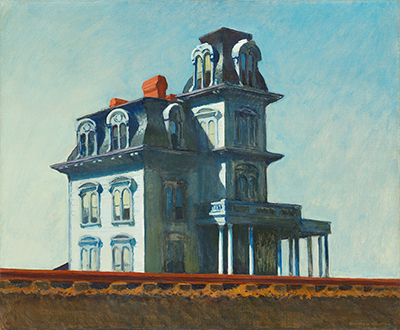
| House by the Railroad | 1925 | oil on canvas |
| House by the Squam River | 1926 | watercolour over graphite on paper |
| Le Bistro or The Wine Shop | 1909 | Oil on canvas |
| Le Pont des Arts | 1907 | Oil on canvas |
| Le Pont Royal | 1909 | Oil on canvas |
| Le Quai des Grands Augustins | 1909 | Oil on canvas |
| Lighthouse and Buildings Portland Head | 1927 | watercolour over graphite pencil on paper |
| Lighthouse Hill | 1927 | oil painting |
| Manhattan Bridge Loop | 1928 | oil on canvas |
| Model Sitting | c. 1902 | oil painting; support not asserted |
| Morning Sun | 1952 | oil on canvas |
| New York Movie | 1939 | oil on canvas |
| New York New Haven and Hartford | 1931 | oil on canvas |
| New York Office | 1962 | oil on canvas |
| New York Pavements | 1924–1925 | oil on canvas |
| New York Restaurant | c. 1922 | oil on canvas |
| Night Windows | 1928 | oil on canvas |
| Nighthawks | 1942 | oil on canvas |
| October on Cape Cod | 1946 | oil on canvas |
| Office at Night | 1940 | oil on canvas |
| Office in a Small City | 1953 | oil on canvas |
| Pennsylvania Coal Town | 1947 | oil on canvas |
| People in the Sun | 1960 | oil on canvas |
| Portrait of Orleans | 1950 | oil on canvas |
| Queensborough Bridge | 1913 | Oil on canvas |
| Railroad Sunset | 1929 | Oil on canvas |
| Railroad Train | 1908 | oil on canvas |
| Road in Maine | 1914 | oil on canvas |
| Room in Brooklyn | 1932 | oil on canvas |
| Room in New York | 1932 | oil on canvas |
| Rooms by the Sea | 1951 | oil on canvas |
| Rooms for Tourists | 1945 | oil on canvas |
| Route 6 Eastham | 1941 | oil on canvas |
| Second Story Sunlight | 1960 | Oil on canvas |
| Self-Portrait | 1925–1930 | Oil on canvas |
| Self-Portrait with Hat (70.1903) | c. 1918, posthumous print | Drypoint |
| Seven A.M. | 1948 | Oil on canvas |
| Soir Bleu | 1914 | oil on canvas |
| South Carolina Morning | 1955 | Oil on canvas |
| Stairway at 48 Rue de Lille Paris | 1906 | Oil on wood |
| Study for 5 A.M. (70.153) | 1937 | Fabricated chalk on paper |
| Study for 5 A.M. (70.429) | 1937 | Fabricated chalk and graphite pencil on paper |
| Study for Approaching a City (70.869) | 1946 | Fabricated chalk and charcoal on paper |
| Study for August in the City (70.158a-b) | 1945 | Fabricated chalk on paper |
| Study for August in the City (70.159) | 1945 | Fabricated chalk on paper |
| Study for Bridle Path (70.220) | 1939 | Fabricated chalk on paper |
| Study for Bridle Path (70.235) | 1939 | Fabricated chalk on paper |
| Study for Compartment C, Car 293 (70.430) | 1938 | Fabricated chalk on paper |
| Study for Compartment C, Car 293 (70.431a-b) | 1938 | Fabricated chalk and charcoal on paper |
| Study for Conference at Night (70.170) | 1949 | Fabricated chalk on paper (recto); Typewriter ink on paper (verso) |
| Study for Conference at Night (70.174) | 1949 | Fabricated chalk on paper ( recto); Typewriter ink on paper (verso) |
| Study for East Wind over Weehawken (70.249) | 1934 | Graphite pencil on paper |
| Study for East Wind over Weehawken (70.252) | 1934 | Fabricated chalk and charcoal on paper |
| Study for Evening Wind (70.343a-b) | 1921 | Fabricated chalk on paper |
| Study for First Row Orchestra (70.841) | 1951 | Fabricated chalk and charcoal on paper |
| Study for Gas (70.263) | 1940 | Fabricated chalk on paper |
| Study for Ground Swell (70.339) | 1939 | Fabricated chalk, charcoal and graphite pencil on paper |
| Study for Hotel by a Railroad (70.199) | 1952 | Fabricated chalk on paper |
| Study for Hotel by a Railroad (70.427) | 1952 | Fabricated chalk on paper |
| Study for Hotel by a Railroad (70.428) | 1952 | Fabricated chalk on paper |
| Study for Hotel Lobby (70.117) | 1942 | Fabricated chalk and graphite pencil on paper |
| Study for Hotel Lobby (70.839) | 1942 | Fabricated chalk and charcoal on paper |
| Study for Hotel Window (70.161) | 1955 | Fabricated chalk, graphite pencil and colored pencil on paper |
| Study for Morning Sun (70.243) | 1952 | Fabricated chalk on paper |
| Study for Morning Sun (70.244) | 1952 | Fabricated chalk on paper |
| Study for Morning Sun (70.290) | 1952 | Fabricated chalk on paper |
| Study for Morning Sun (70.291) | 1952 | Fabricated chalk and graphite pencil on paper |
| Study for New York Movie (70.273) | 1939 | Fabricated chalk on paper |
| Study for New York Movie (70.274a-b) | 1938 or 1939 | Fabricated chalk and charcoal on paper (recto); Fabricated chalk on paper (verso) |
| Study for New York Movie (70.455) | 1939 | Fabricated chalk and charcoal on paper |
| Study for New York Office (70.822) | 1962 | Fabricated chalk on paper |
| Study for Nighthawks (70.192) | 1941 or 1942 | Fabricated chalk on paper |
| Study for Nighthawks (70.193) | 1941 or 1942 | Fabricated chalk on paper |
| Study for Office at Night (70.340) | 1940 | Fabricated chalk and charcoal on paper |
| Study for Office at Night (70.341) | 1940 | Fabricated chalk and graphite pencil on paper |
| Study for Pennsylvania Coal Town (70.198) | 1947 | Fabricated chalk on paper |
| Study for Pennsylvania Coal Town (70.229) | 1947 | Fabricated chalk and charcoal on paper |
| Study for Rooms for Tourists (70.438) | 1945 | Fabricated chalk and charcoal on paper |
| Study for Rooms for Tourists (70.848) | 1945 | Fabricated chalk and charcoal on paper |
| Study for Route 6, Eastham (70.369) | 1941 | Fabricated chalk and graphite pencil on paper |
| Study for Route 6, Eastham (70.854) | 1941 | Fabricated chalk and graphite pencil on paper |
| Study for South Carolina Morning (70.162a-b) | 1955 | Fabricated chalk on paper (recto and verso) |
| Study for The Sheridan Theatre (70.969) | 1937 | Graphite pencil on paper |
| Study for Two on the Aisle (70.128) | 1927 | Fabricated chalk on paper |
| Study for Two on the Aisle (70.129) | 1927 | Fabricated chalk on paper |
| Study for Yawl Riding a Swell (70.439) | 1935 | Fabricated chalk and graphite pencil on paper |
| Summer Evening | 1947 | oil on canvas |
| Summer Interior | 1909 | Oil on canvas |
| Sun in an Empty Room | 1963 | oil on canvas |
| Sunlight in a Cafeteria | 1958 | oil on canvas |
| Sunlight on Brownstones | 1956 | oil on canvas |
| Tables for Ladies | 1930 | oil on canvas |
| The Bootleggers | 1925 | oil on canvas |
| The Camel's Hump | 1931 | oil on canvas |
| The Circle Theatre | 1936 | oil on canvas |
| The City | 1927 | oil on canvas |
| The Lighthouse at Two Lights | 1929 | oil on canvas |
| The Long Leg | 1935 | oil on canvas |
| The Mansard Roof | 1923 | watercolour over graphite on paper |
| The Sheridan Theatre | 1937 | oil on canvas |
| Tramp Steamer | 1908 | oil on canvas |
| Two Comedians | 1966 | oil on canvas |
| Two on the Aisle | 1927 | oil on canvas |
| Valley of the Seine | 1909 | Oil on canvas |
| Western Motel | 1957 | oil on canvas |
Frequently Asked Questions
Edward Hopper made High Noon in 1949. [1]
The recorded medium is oil on canvas. [1]
A woman stands in the dark doorway of a white house. Her blue robe forms a narrow upright beneath two dormer windows, while a large gabled projection casts a sharp shadow across the facade. Red appears in the chimney and along the building's base. Edward Hopper's High Noon makes a small figure part of an emphatic arrangement of roof, wall, opening and sunlight.
Discussion
Look again at the images and ideas explored in High Noon. These editorial prompts invite your observations.
Reader Insights
Which boundary, gesture or change of light first holds your attention in High Noon?
Compare Summer Evening with High Noon. Which visual difference matters most to your reading?
Which detail would you look at again after reading “The figure in the doorway”?
Join the Conversation
Share a detail, comparison or question about High Noon below.
References
- Dayton Art Institute, High Noon, 1949, oil on canvas, accession 1971.7, gift of Mr. and Mrs. Anthony Haswell; current dimensions, interpretation and Jo Hopper's record of the figure, colours and paper model, transmitted by the museum. View source.
- Provincetown Art Association and Museum, Study for High Noon, no. 1 of 3, undated, graphite on paper, 7½ × 10¼ inches, object 2532.E010.D16; gift of Laurence C. and J. Anton Schiffenhaus in memory of Mary Schiffenhaus, and two anonymous donors, 2016. Current record and complete published image. View source.
- Queen's University, Art Conservation Alumni & Friends Newsletter, 2014, p.3, George Bevan faculty update; Ian Longo, “An Infrared Examination of Edward Hopper's High Noon,” Inquiry@Queen's Undergraduate Conference programme, 2014, p.11, abstract, faculty supporter George Bevan. The abstract concerns both the Dayton original and a separate purported copy; its reported underdrawing in the original does not authenticate that copy. View source 1. View source 2.
- Collection or catalogue record, American Village, 1912; medium and identity as discussed in the linked article. View source.
- Collection or catalogue record, Soir Bleu, 1914; medium and identity as discussed in the linked article. View source.
- Collection or catalogue record, House by the Railroad, 1925; medium and identity as discussed in the linked article. View source.
- Collection or catalogue record, Automat, 1927; medium and identity as discussed in the linked article. View source.
- Collection or catalogue record, Early Sunday Morning, 1930; medium and identity as discussed in the linked article. View source.
- Collection or catalogue record, New York Movie, 1939; medium and identity as discussed in the linked article. View source.
- Collection or catalogue record, Nighthawks, 1942; medium and identity as discussed in the linked article. View source.
- Collection or catalogue record, Morning Sun, 1952; medium and identity as discussed in the linked article. View source.
- Collection or catalogue record, Second Story Sunlight, 1960; medium and identity as discussed in the linked article. View source.
- Collection or catalogue record, Two Comedians, 1966; medium and identity as discussed in the linked article. View source.
- Whitney Museum of American Art, Study for Route 6, Eastham, 1941, accession 70.854; exact object record. View source.
- Whitney Museum of American Art, Study for Conference at Night, 1949, accession 70.170; exact object record. View source.
- Whitney Museum of American Art, Study for First Row Orchestra, 1951, accession 70.841; exact object record. View source.
- Whitney Museum of American Art, (Bridge and Embankment), 1906, accession 70.1298; exact object record. View source.
- Whitney Museum of American Art, (Seated Male Model, Bent Over), c. 1902–1903, accession 70.1277; exact object record. View source.
- Whitney Museum of American Art, Study for Morning Sun, 1952, accession 70.244; exact object record. View source.
- Whitney Museum of American Art, Study for Morning Sun, 1952, accession 70.243; exact object record. View source.
- Whitney Museum of American Art, Study for Two on the Aisle, 1927, accession 70.128; exact object record. View source.
- Whitney Museum of American Art, Study for New York Office, 1962, accession 70.822; exact object record. View source.
- Whitney Museum of American Art, Study for Two on the Aisle, 1927, accession 70.129; exact object record. View source.
- Whitney Museum of American Art, Study for Pennsylvania Coal Town, 1947, accession 70.229; exact object record. View source.
- Whitney Museum of American Art, (Rooftops), 1926, accession 70.1114; exact object record. View source.
- Whitney Museum of American Art, Study for South Carolina Morning, 1955, accession 70.162a-b; exact object record. View source.
- Whitney Museum of American Art, (Self-Portrait), 1903–1906, accession 70.1254; exact object record. View source.
- Whitney Museum of American Art, (Manhattan Bridge), 1925–1926, accession 70.1098; exact object record. View source.
- Whitney Museum of American Art, (Solitary Figure in a Theater), c. 1902–1904, accession 70.1418; exact object record. View source.
- Whitney Museum of American Art, Study for Approaching a City, 1946, accession 70.869; exact object record. View source.
- Whitney Museum of American Art, Study for August in the City, 1945, accession 70.159; exact object record. View source.
- Whitney Museum of American Art, Study for Compartment C, Car 293, 1938, accession 70.430; exact object record. View source.
- Whitney Museum of American Art, Study for Compartment C, Car 293, 1938, accession 70.431a-b; exact object record. View source.
- Whitney Museum of American Art, Study for East Wind over Weehawken, 1934, accession 70.252; exact object record. View source.
- Whitney Museum of American Art, Study for East Wind over Weehawken, 1934, accession 70.249; exact object record. View source.
- Whitney Museum of American Art, Study for Evening Wind, 1921, accession 70.343a-b; exact object record. View source.
- Whitney Museum of American Art, Study for The Sheridan Theatre, 1937, accession 70.969; exact object record. View source.
- Whitney Museum of American Art, Study for New York Movie, 1939, accession 70.455; exact object record. View source.
- Whitney Museum of American Art, Study for New York Movie, 1939, accession 70.273; exact object record. View source.
- Whitney Museum of American Art, Study for New York Movie, 1938 or 1939, accession 70.274a-b; exact object record. View source.
- Whitney Museum of American Art, Study for 5 A.M., 1937, accession 70.153; exact object record. View source.
- Whitney Museum of American Art, Study for 5 A.M., 1937, accession 70.429; exact object record. View source.
- Whitney Museum of American Art, (Jo Sketching at Good Harbor Beach), 1923–1924, accession 70.1129; exact object record. View source.
- Whitney Museum of American Art, Study for August in the City, 1945, accession 70.158a-b; exact object record. View source.
- Whitney Museum of American Art, Study for Morning Sun, 1952, accession 70.291; exact object record. View source.
- Whitney Museum of American Art, Study for Morning Sun, 1952, accession 70.290; exact object record. View source.
- Whitney Museum of American Art, Study for Office at Night, 1940, accession 70.340; exact object record. View source.
- Whitney Museum of American Art, Study for Office at Night, 1940, accession 70.341; exact object record. View source.
- Whitney Museum of American Art, Study for Hotel by a Railroad, 1952, accession 70.427; exact object record. View source.
- Whitney Museum of American Art, Study for Hotel by a Railroad, 1952, accession 70.199; exact object record. View source.
- Whitney Museum of American Art, Study for Hotel by a Railroad, 1952, accession 70.428; exact object record. View source.
- Whitney Museum of American Art, Study for Hotel Lobby, 1942, accession 70.117; exact object record. View source.
- Whitney Museum of American Art, Study for Hotel Lobby, 1942, accession 70.839; exact object record. View source.
- Whitney Museum of American Art, Study for Conference at Night, 1949, accession 70.174; exact object record. View source.
- Whitney Museum of American Art, Study for Hotel Window, 1955, accession 70.161; exact object record. View source.
- Whitney Museum of American Art, Study for Pennsylvania Coal Town, 1947, accession 70.198; exact object record. View source.
- Whitney Museum of American Art, Study for Route 6, Eastham, 1941, accession 70.369; exact object record. View source.
- Whitney Museum of American Art, Study for Bridle Path, 1939, accession 70.220; exact object record. View source.
- Whitney Museum of American Art, Study for Bridle Path, 1939, accession 70.235; exact object record. View source.
- Whitney Museum of American Art, Study for Ground Swell, 1939, accession 70.339; exact object record. View source.
- Whitney Museum of American Art, Study for Yawl Riding a Swell, 1935, accession 70.439; exact object record. View source.
- Whitney Museum of American Art, Study for Rooms for Tourists, 1945, accession 70.848; exact object record. View source.
- Whitney Museum of American Art, Study for Rooms for Tourists, 1945, accession 70.438; exact object record. View source.
- Whitney Museum of American Art, Study for Nighthawks, 1941 or 1942, accession 70.193; exact object record. View source.
- Whitney Museum of American Art, Study for Nighthawks, 1941 or 1942, accession 70.192; exact object record. View source.
- Whitney Museum of American Art, Study for Gas, 1940, accession 70.263; exact object record. View source.
- Whitney Museum of American Art, Self-Portrait with Hat, c. 1918, posthumous print, accession 70.1903; exact object record. View source.
- Whitney Museum of American Art, East Side Interior, 1922, accession 70.1020; exact object record. View source.
- Art Institute of Chicago, Selected Chronology for Edward Hopper; training, travels, exhibitions, New York and Truro chronology. View source.
- Emily C. Burns, Spectral figures: Edward Hopper’s empty Paris, chapter 5 in Empty Spaces: Confronting Emptiness in National, Cultural and Urban Histories, 2019; complete chapter and notes consulted. View source.
- Charles Brock, Regionalism and Folk Art, National Gallery of Art; complete essay and two notes consulted. View source.