by Tom Gurney
Tom Gurney BSc (Hons) is an art history expert with over 20 years experience
Email: tomgurney1@gmail.com / Phone: +44 7429 011000
Edward Hopper's New York: Introduction
Edward Hopper's New York can be entered through a lit window, a row of closed shops or the dark mouth of a railway tunnel. Its buildings are familiar kinds of buildings, yet their spaces rarely settle into a complete map. A stretch of pavement offers no crowd to join. An office is exposed to view without explaining its occupants. The city is recognisable while a particular encounter remains difficult to place.
New York was Hopper's home from 1908 until his death in 1967. The Whitney Museum's exhibition Edward Hopper's New York emphasised the selective character of that long relationship: his work often gives prominence to ordinary structures and overlooked corners within a rapidly changing metropolis. [1]
The selection is essential. Hopper's city is one painter's sustained response to the place, shaped through observation, memory and invention. Its quietness belongs to the pictures. Hopper and Jo worked, attended the theatre and campaigned to preserve their neighbourhood throughout the years these pictures were being made.
The wider guide to famous American artists offers useful comparisons with other painters of American cities, people and landscapes.
At a Glance
Contents
- Washington Square was a working home
- The city above the rooms
- Transit supplied a way of seeing
- A city could extend sideways
- Street frontage and the seated figure in Sunday
- Windows connect people without explaining them
- Workplaces have their own visual order
- Who works while someone else pauses?
- Restaurants create temporary places in public
- Theatre shaped the relationship between room and spectator
Washington Square was a working home
In 1913 Hopper moved to the top floor of 3 Washington Square North. Jo Nivison joined him after their marriage in 1924. In 1932 they moved across the hall to a larger apartment overlooking the park, making substantial room for their separate artistic work. [2]
A home high above the street gives the city several different distances. The nearest view can be an opposite wall or a roof with its practical equipment. Beyond it, buildings overlap into a skyline. Looking down changes the scale of pedestrians and turns the pavement into a conspicuous shape.
Those differences help explain why a familiar address could provide new material. Daily repetition does not mean seeing exactly the same picture. Light changes the hierarchy of a roofline; a neighbouring building interrupts another; a window frames a different portion of an otherwise continuous view.
Jo's work adds another account of that home. Her subjects included the stairwell and the stove and fireplace, while Edward often turned towards the city beyond the windows. The Whitney's Washington Square presentation brings these interests together without treating her paintings as mere records of his studio. [2]
The contrast is useful when approaching the larger body of work. A lived room can supply a painter with material without every later interior being that room. Domestic observation, a model's pose and an invented arrangement of walls can each enter a painting through different routes.
The city above the rooms
City Roofs, painted in 1932 and now at the Whitney, gives the buildings' upper surfaces an unusually substantial presence. Red and orange structures occupy the nearer space, with flues, skylights and low parapets arranged across a pale roof. Beyond them rises a much taller building, its windowed face set beside a largely blank side wall. [3]
The picture makes a distinction between a façade seen from the street and the equipment needed above it. The skylights are low, angled openings. Chimneys and pipes rise independently, without the repeated floors of a conventional elevation. Their unequal heights give the roof a varied silhouette.
These features also carry light differently. A sloping glass panel can take a cool reflection; a red wall presents a broader, warmer area; a projecting chimney casts a narrow dark shape. The practical construction provides a complex group of forms without requiring an ornamental monument.
The tall building behind them changes the scale of the scene. Its numerous windows repeat across a pale face, while the adjacent dark wall offers far fewer subdivisions. The contrast is not simply between old and new. It is also between a nearby collection of individual rooftop objects and a distant mass whose repetition can be grasped at once.
The orange form at the right comes particularly close. Its sloping edge cuts across much of the foreground and partly restricts access to what lies beyond. The roofscape is therefore not laid out as a convenient model for inspection. We see it from a position among overlapping structures.
This makes the work a useful companion to the window paintings. Many of their inhabitants look towards a city we see only in fragments. City Roofs gives sustained attention to the sort of upper-level environment that can exist beyond such a window, while remaining a complete composition with its own chosen boundaries.
Transit supplied a way of seeing
The elevated railway offered more than transport. In the Whitney's exhibition introduction, curator Kim Conaty describes the raised viewpoint it gave passengers: a position above the pavement and close enough to register windows, offices and fragments of private life. She connects that experience with Hopper's recurring position outside a scene, often looking slightly down into it. [4]
Such a viewpoint changes the shape of the city. At street level a façade may tower above us. Seen from a passing train, an upper window can become a near, rectangular opening, while the street drops away below. The view arrives in pieces and is gone before all its details can be understood.
New York Pavements makes the discrepancy of scale unusually clear. A figure with a carriage occupies a small part of a large field of pavement and architecture. The body supplies an activity, but the larger angles determine how that activity is seen.
In Night Windows, the wall and openings bring us close to a private interior while withholding the whole room. Light allows us to see inward; cropping prevents a comprehensive view. Proximity and knowledge remain separate.
The train connection should not be turned into a claim that each painting records one identifiable journey. It provides a way to understand the available visual experience: brief, elevated, partial and difficult to recover exactly. A painted composition can then prolong that glimpse and rearrange its elements.
A city could extend sideways
Hopper's New York does not depend on a skyline of celebrated towers. The Whitney groups five panoramic canvases from 1928–35 under the idea of a horizontal city, including Manhattan Bridge Loop and Early Sunday Morning. Their related formats place particular emphasis on lateral extension. [5]
In Manhattan Bridge Loop, the long span of wall and the roadway carry attention towards the picture's edges. A small person can be read against an extensive built environment. The scale makes the structures seem to possess a continuity beyond the individual's immediate passage through them.
Early Sunday Morning organises that extension differently. Its shopfronts and upper windows face us across a narrow strip of street. Repeated openings establish a rhythm, while curtains, shades and changes of colour prevent the row from becoming uniform.
The Whitney's object account notes that Hopper reduced the street's details and that its long shadows do not correspond to the actual orientation of Seventh Avenue. [6] The light is part of an arrangement rather than a reliable aid to reconstructing a street on a particular morning.
Looking between these two paintings, width becomes more than a choice of canvas. In one, a long structure emphasises movement alongside and beyond it. In the other, a frontal row holds the eye across a sequence of separate interiors. Both allow a city to feel extensive without requiring a view from above its tallest building.
Street frontage and the seated figure in Sunday
The Phillips Collection's Sunday, dated 1926, offers a different relation between person and building. A man sits on a curb before a row of wooden storefronts. His pale shirt and dark suspenders give his body a clear presence against the lower wall, while the upper windows receive much less human information. The collection acquired the painting in the year it was made. [7]
The setting should not be treated as a securely identified New York address. It is useful beside Hopper's city views because it makes an ordinary frontage bear much of the image's weight. A dark cornice, vertical boards and repeated upper openings establish an extended built surface behind one compact body.
A boardwalk separates that surface from the curb. Its pale planks change direction as they recede, giving the foreground a narrow interval of depth. The man sits at the interval's outside edge, close enough to the street that his shoes interrupt its broad open area.
His forearms gather near his knees. A cigar extends from his mouth, and the head turns slightly towards us without developing into a formal portrait address. The pose supplies a small action and a clear distribution of weight. It cannot establish whether he owns a shop, awaits a customer or has lost work.
The title encourages a sense of time apart from a working week, but boarded or shaded windows do not prove that every business is permanently closed. This is especially worth remembering for a painting made before the financial crash of 1929. Its historical setting and its later associations with economic distress should remain distinct.
Beside Early Sunday Morning, the solitary sitter changes the frontage's function. The later painting leaves human occupancy largely behind curtains and doors. Here a body comes out to the street edge. One work makes the absence of visible occupants conspicuous; the other gives one person a position within an extensive wall of buildings.
Windows connect people without explaining them
A window can make a room visible and preserve its privacy at the same time. Hopper repeatedly uses that contradiction. We can identify a person, furniture and a source of light while remaining uncertain about what has happened or what will happen next.
In Room in New York, a man reads while a woman sits at a piano. The red of her dress gives her a strong visual presence. Their different directions of attention make the room feel divided even though neither person is far from the other.
The view from outside does not establish their relationship. It supplies enough detail to invite a story, but it cannot prove a marriage, a quarrel or a prolonged silence. The division may be emotionally suggestive because it is so easy to recognise the ordinary experience of sharing a room while attending to different things.
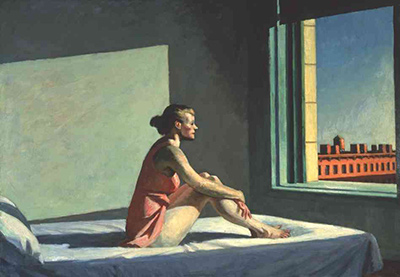
Morning Sun reverses the direction of attention. A seated woman looks out, while light entering the room creates a clear field across the interior. We see her looking, but cannot share her exact view or know her thoughts. The window provides the possibility of contact with the city rather than a completed exchange.
Both pictures make the observer's position consequential. Looking into one room can encourage speculation about two people. Looking at a person who faces away can make us aware of a world she sees and we do not. The city becomes a network of adjacent spaces whose occupants remain only partly available to one another.
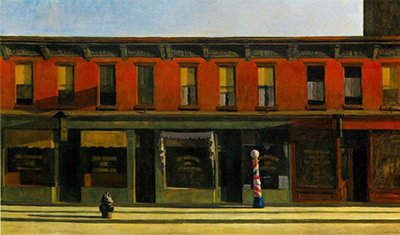
Compare: Early Sunday Morning, 1930.
Workplaces have their own visual order
An office brings a different set of relations into view. Desks, partitions, machines and files distribute work through space. Even before a viewer imagines a conversation, furniture can establish unequal positions and competing areas of attention.
In Office at Night, the man bends over his desk while the woman stands near a filing cabinet. The floor tilts towards the viewer, making a small dropped sheet of paper unusually conspicuous. Its light shape draws attention to the interval between the two working areas.
Hopper's 1948 explanation to Walker Art Center curator Norman Geske connected the picture with memories of illuminated offices glimpsed from elevated trains. He also described the painting's three sources of light and the challenge of balancing bright passages within the room. [8]
That account gives the human encounter a material setting. The room's tension depends partly on where the figures stand and how light separates them from wall, desk and cabinet. A story about attraction or unease is one response to the picture, but the arrangement remains visible even when the story is undecided.
Office subjects also belonged to Hopper's commercial career. The Whitney's exhibition labels place his later office paintings alongside earlier illustrations for System, a business magazine whose readership and ambitions shaped those commissioned images. [9] The workplace was therefore a subject he knew through more than casual looking.
Putting the commercial and independent work beside each other raises a useful distinction. An illustration can direct attention towards an argument made by a text. A painting such as Office at Night allows the arrangement to remain unresolved. The same partitions and professional clothing can serve very different purposes.
Who works while someone else pauses?
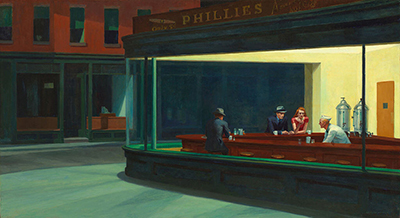
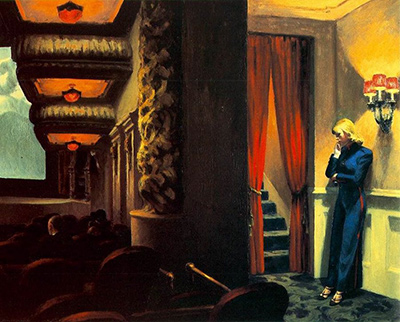
Several city pictures become more specific when we attend to work. The usher in New York Movie occupies the same establishment as the audience but has a different reason to be there. The server in Nighthawks bends towards customers whose bodies are supported by stools. In Tables for Ladies, people carrying out service help organise the entrance and dining room.
These differences can remain visible even where a painting provides no exact job description. A counter separates serving from being served. A filing cabinet belongs to a different sequence of tasks from a restaurant table. Clothing and furniture make roles available to interpretation without supplying a full biography.
The distinction is also temporal. Leisure for one person may occupy another's working hours. A bright café at night is not simply a refuge for everyone inside it; it is an establishment somebody staffs. The illumination that offers shelter to a customer also makes a workplace visible from outside.
This does not turn the pictures into a single social argument. Hopper's arrangements differ, and the relationships within them are often uncertain. It does make their human variety harder to overlook. A worker standing, a customer seated and an audience member watching have different bodily relations to the room.
The offices add another kind of apparent pause. A person can look away from a desk without leaving work, just as someone can lower her head without ceasing to supervise an aisle. What appears motionless in a painting can still belong to an active task.
Watch: Edward Hopper’s Life and Art
Explore Hopper’s paintings and the places behind them in these museum films. Choose a film below.
Restaurants create temporary places in public
A café or restaurant offers a person a place to sit without becoming a home. A chair, a cup and a small table give that temporary occupation a definite shape. Surrounding windows and neighbouring tables connect it to a larger public setting.
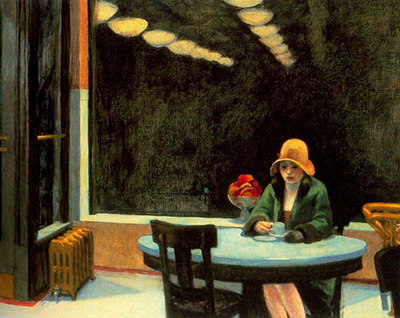
In Automat, the woman's cup and tabletop form a close area of attention against the broad dark window. Reflected lights stretch away above her. The glass makes the room appear larger while giving little information about the street beyond it.
Tables for Ladies places service and customers within a busier arrangement. The Whitney's exhibition account explains the title through restaurants advertising places where women could dine alone without unwelcome attention. It situates that invitation within the expansion of women's professional employment. [10]
Looking between the pictures makes it harder to reduce every restaurant scene to the same kind of isolation. One concentrates on a single customer and the space around her. The other distributes attention among an entrance, workers, food and diners. Each gives public eating a different organisation.
Nighthawks presents a further variation. Its customers occupy stools along a bright counter, separated from the viewer by glass. The Art Institute identifies a Greenwich Avenue restaurant as a starting point while emphasising Hopper's enlargement and simplification of the setting. [11]
The city outside is integral to that arrangement. Dark pavement extends around the illuminated enclosure, so that the diner seems both exposed and difficult to enter. Its familiarity can prompt a search for an exact surviving address, but its concentrated effect depends on choices that exceed the original site.
Theatre shaped the relationship between room and spectator
The Hoppers attended theatre regularly. The Whitney's exhibition drew on surviving ticket stubs and Jo's notebooks, recording their frequent preference for balcony seats. Those materials give an everyday basis to Hopper's sustained interest in spectators, elevated views and staged space. [9]
Yet a painted theatre does not simply show a performance. New York Movie directs much of its attention away from the screen. The usher stands beside a lit wall and a staircase, while the audience occupies a darker area to the left. The museum's guide describes a composition developed from several theatre interiors and numerous preparatory drawings. [12]
The room has two distinct kinds of attention. Customers look towards a film that we can barely inspect. The usher, visible in another pool of light, does not join their collective orientation. The division can suggest the different experiences of leisure and work within the same establishment.
Hopper's architectural choices make that distinction legible. A substantial wall almost divides the painting, while the staircase gives the usher's side another possible route. The viewer must look across several areas rather than settle comfortably into the audience's position.
Theatre is consequently useful as a comparison for his city pictures beyond their subject matter. It draws attention to how a scene is framed, where a spectator is placed and which parts remain outside the visible action. In Hopper, the setting can do as much interpretive work as a gesture.
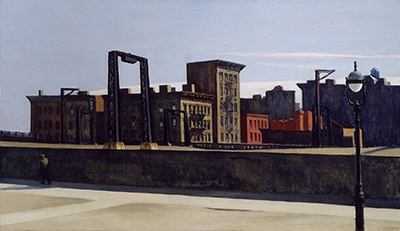
Compare: Manhattan Bridge Loop, 1928.
City light has more than one job
Artificial illumination in Hopper's New York can advertise an establishment, support a task and make a person conspicuous. Those functions may coincide in one bright area. The diner needs light so that people can work and eat, yet its brightness also becomes a public presence in the street.
Windows complicate that presence. During the day, they can frame a view outward; after dark, they can expose an interior or return a reflection. In Automat, reflected fixtures give the dark glass a depth that the outside street does not provide. In Night Windows, the lit room becomes available across an otherwise dark façade.
The same material boundary can therefore join and divide in different ways. Transparency is never the whole explanation. The angle of view, relative light levels and the objects immediately beyond the glass determine what we can actually make out.
The theatre pictures add light controlled for a performance. A stage can remain concealed behind a curtain, while decorative lamps and side passages make the waiting audience or an employee visible. The image of cinema begins outside the projected film's own light.
Daylight creates another set of distinctions. A roof receives it from above, a bedroom admits it through a restricted opening, and a shopfront can lie partly within a long shadow. The city provides many related surfaces on which Hopper could test how light changes the relative importance of things.
The defence of Washington Square was practical
The quiet of these painted settings should not conceal the Hoppers' active involvement in their neighbourhood. The Whitney's archival guide records that New York University acquired their building in 1946 and attempted to evict its tenants the following year. Edward and Jo joined neighbours in opposition. [13]
Their concern involved affordable places to live and work, as well as the future character of Washington Square. They sought support from Parks Commissioner Robert Moses, who declined to intervene in what he regarded as a private matter. The attempted eviction nevertheless failed. [13]
A surviving letter gives Edward's position particular clarity. On 17 March 1950 he wrote to Nathaniel M. Elias of the Washington Square Committee, opposing further development by the university or large commercial interests. He argued for the preservation of the buildings north of the square and against additional tall buildings there. [14]
The letter is evidence of a stated civic position. It does not make every painted wall a coded protest against redevelopment. Placing it beside the pictures is more useful when the two forms of activity retain their differences: one addresses a named recipient about a particular place; the other selects and alters a visual experience.
Together they show that an attachment to ordinary buildings could have practical consequences. A row house was not only a shape in sunlight. It could also be a studio, a tenancy and part of a neighbourhood that artists feared losing.
A neighbourhood is larger than the view from a window
The Washington Square records and the paintings answer different questions about the same long residence. The letter concerning development names an addressee and a practical problem. A rooftop painting selects a portion of the surroundings. Each has boundaries, but those boundaries belong to different kinds of work.
That difference helps prevent a retrospective simplification. A painter defending a tenancy could also invent an interior whose plan cannot be matched to the apartment. A person attached to older buildings could paint new infrastructure. A neighbour active in a local campaign could make a canvas with no visible gathering.
The home itself also contained more than one artist's view. Jo's attention to interior equipment and Edward's outward-looking urban scenes offer distinct ways of using a shared address. Their differences are part of the city's history as lived and made into art.
The pictures' selectivity is particularly apparent when we move from one to another. A roofscape gives us the buildings' practical upper surfaces. A restaurant concentrates occupation behind glass. A street frontage can hide rooms above a line of shops. No single canvas has to contain all these relations.
Their cumulative force comes from recurrence with change. An upright window can frame a distant city in one work and hide a face in another. A long horizontal structure can carry traffic, hold shops or support a stage. Hopper repeatedly found different uses for the city's familiar forms.
Following those changes gives New York more substance than a label such as loneliness can provide. The buildings are places for work, residence, movement and entertainment. Their painted organisation makes those functions visible in selected pieces, allowing the city to feel continuous beyond the portion we can see.
A remembered city is necessarily selective
Hopper's paintings preserve some aspects of urban life and leave others largely absent. Their small groups of figures cannot represent the full variety of people who lived and worked in New York. Recognising the selectivity allows the pictures to be considered as powerful individual constructions without mistaking them for comprehensive social records.
The omissions also affect the way viewers supply stories. A nearly empty pavement may seem desolate, peaceful or expectant. An occupied room may suggest intimacy or separation. These responses are shaped by what Hopper has made visible, but they are not interchangeable with documented statements of his intention.
Kim Conaty's published essay places that process of selection within a long relationship with the city. She describes Approaching a City as a synthesis of observed infrastructure and invented buildings, a picture rooted in New York that deliberately keeps its title open. [15]
The tunnel, retaining wall and buildings make entry into a city feel substantial without functioning as an exact architectural survey. Their arrangement gives the viewer an experience of approaching: a route, an obstruction and a dark opening whose continuation is hidden.
That combination persists across very different subjects. Shopfronts leave the domestic rooms above them hidden; windows cut off parts of an interior; a theatre aisle separates the people who share an auditorium. Looking at how those parts have been selected is a way to appreciate Hopper's New York as both intensely observed and continuously remade in painting.
Artworks and studies directory
This researched directory includes finished works and separately identified studies. It is not a complete catalogue raisonné. Linked titles open the articles; unlinked studies are identified by their collection accessions. Watercolours retain their recorded media, and original prints remain distinct from reproductions.
| Name | Date | Medium |
|---|---|---|
| (Bridge and Embankment) (70.1298) | 1906 | Oil on wood |
| (Jo Sketching at Good Harbor Beach) (70.1129) | 1923–1924 | Watercolor and fabricated chalk on paper |
| (Manhattan Bridge) (70.1098) | 1925–1926 | Watercolor and graphite pencil on paper |
| (Rooftops) (70.1114) | 1926 | Watercolor and graphite pencil on paper |
| (Seated Male Model, Bent Over) (70.1277) | c. 1902–1903 | Oil on canvas |
| (Self-Portrait) (70.1254) | 1903–1906 | Oil on canvas |
| (Solitary Figure in a Theater) (70.1418) | c. 1902–1904 | Oil on board |
| 5 A.M. | 1937 | oil on canvas |
| Adam's House | 1928 | watercolour and charcoal on paper |
| American Village | 1912 | Oil on canvas |
| Apartment Houses | 1923 | oil on canvas |
| Approaching a City | 1946 | oil on canvas |
| August in the City | 1945 | oil on canvas |
| Automat | 1927 | oil on canvas |
| Barber Shop | 1931 | oil on canvas |
| Blackwell's Island | 1928 | oil on canvas |
| Bridge on the Seine | 1909 | Oil on canvas |
| Bridle Path | 1939 | oil on canvas |
| Burly Cobb's House South Truro | 1930–1933 | oil on canvas |
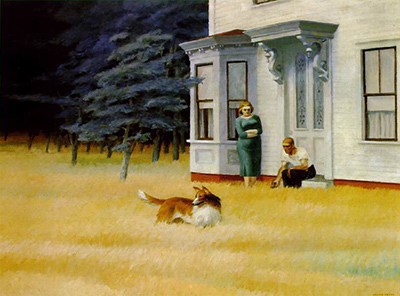
| Cape Cod Evening | 1939 | oil on canvas |
| Cape Cod Morning | 1950 | oil on canvas |
| Chair Car | 1965 | oil on canvas |
| Chop Suey | 1929 | oil on canvas |
| City Roofs | 1932 | Oil on canvas |
| Coast Guard Station | 1929 | oil on canvas |
| Compartment C, Car 293 | 1938 | oil on canvas |
| Conference at Night | 1949 | oil on canvas |
| Corn Hill | 1930 | oil on canvas |
| Dawn in Pennsylvania | 1942 | oil on canvas |
| Drug Store | 1927 | oil on canvas |
| Early Sunday Morning | 1930 | Oil on canvas |
| East Side Interior (70.1020) | 1922 | Etching |
| East Wind Over Weehawken | 1934 | oil on canvas |
| El Palacio | 1946 | Watercolor and graphite pencil on paper |
| Eleven A.M. | 1926 | oil on canvas |
| Evening Wind | 1921 | etching |
| Excursion into Philosophy | 1959 | oil on canvas |
| First Row Orchestra | 1951 | oil on canvas |
| Freight Car at Truro | 1931 | watercolour over graphite on paper |
| Gas | 1940 | oil on canvas |
| Girl at a Sewing Machine | c. 1921 | oil on canvas |
| Gloucester Harbor | 1912 | Oil on canvas |
| Ground Swell | 1939 | oil on canvas |
| Haskell's House | 1924 | watercolour over graphite on paperboard |
| High Noon | 1949 | oil on canvas |
| Hill and Houses Cape Elizabeth Maine | 1927 | watercolour over graphite pencil |
| Hills South Truro | 1930 | oil on canvas |
| Hotel by a Railroad | 1952 | oil on canvas |
| Hotel Lobby | 1943 | oil on canvas |
| Hotel Room | 1931 | oil on canvas |
| Hotel Window | 1955 | oil on canvas |
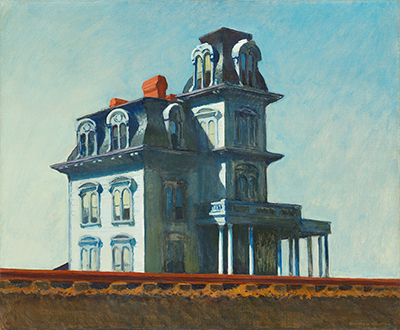
| House by the Railroad | 1925 | oil on canvas |
| House by the Squam River | 1926 | watercolour over graphite on paper |
| Le Bistro or The Wine Shop | 1909 | Oil on canvas |
| Le Pont des Arts | 1907 | Oil on canvas |
| Le Pont Royal | 1909 | Oil on canvas |
| Le Quai des Grands Augustins | 1909 | Oil on canvas |
| Lighthouse and Buildings Portland Head | 1927 | watercolour over graphite pencil on paper |
| Lighthouse Hill | 1927 | oil painting |
| Manhattan Bridge Loop | 1928 | oil on canvas |
| Model Sitting | c. 1902 | oil painting; support not asserted |
| Morning Sun | 1952 | oil on canvas |
| New York Movie | 1939 | oil on canvas |
| New York New Haven and Hartford | 1931 | oil on canvas |
| New York Office | 1962 | oil on canvas |
| New York Pavements | 1924–1925 | oil on canvas |
| New York Restaurant | c. 1922 | oil on canvas |
| Night Windows | 1928 | oil on canvas |
| Nighthawks | 1942 | oil on canvas |
| October on Cape Cod | 1946 | oil on canvas |
| Office at Night | 1940 | oil on canvas |
| Office in a Small City | 1953 | oil on canvas |
| Pennsylvania Coal Town | 1947 | oil on canvas |
| People in the Sun | 1960 | oil on canvas |
| Portrait of Orleans | 1950 | oil on canvas |
| Queensborough Bridge | 1913 | Oil on canvas |
| Railroad Sunset | 1929 | Oil on canvas |
| Railroad Train | 1908 | oil on canvas |
| Road in Maine | 1914 | oil on canvas |
| Room in Brooklyn | 1932 | oil on canvas |
| Room in New York | 1932 | oil on canvas |
| Rooms by the Sea | 1951 | oil on canvas |
| Rooms for Tourists | 1945 | oil on canvas |
| Route 6 Eastham | 1941 | oil on canvas |
| Second Story Sunlight | 1960 | Oil on canvas |
| Self-Portrait | 1925–1930 | Oil on canvas |
| Self-Portrait with Hat (70.1903) | c. 1918, posthumous print | Drypoint |
| Seven A.M. | 1948 | Oil on canvas |
| Soir Bleu | 1914 | oil on canvas |
| South Carolina Morning | 1955 | Oil on canvas |
| Stairway at 48 Rue de Lille Paris | 1906 | Oil on wood |
| Study for 5 A.M. (70.153) | 1937 | Fabricated chalk on paper |
| Study for 5 A.M. (70.429) | 1937 | Fabricated chalk and graphite pencil on paper |
| Study for Approaching a City (70.869) | 1946 | Fabricated chalk and charcoal on paper |
| Study for August in the City (70.158a-b) | 1945 | Fabricated chalk on paper |
| Study for August in the City (70.159) | 1945 | Fabricated chalk on paper |
| Study for Bridle Path (70.220) | 1939 | Fabricated chalk on paper |
| Study for Bridle Path (70.235) | 1939 | Fabricated chalk on paper |
| Study for Compartment C, Car 293 (70.430) | 1938 | Fabricated chalk on paper |
| Study for Compartment C, Car 293 (70.431a-b) | 1938 | Fabricated chalk and charcoal on paper |
| Study for Conference at Night (70.170) | 1949 | Fabricated chalk on paper (recto); Typewriter ink on paper (verso) |
| Study for Conference at Night (70.174) | 1949 | Fabricated chalk on paper ( recto); Typewriter ink on paper (verso) |
| Study for East Wind over Weehawken (70.249) | 1934 | Graphite pencil on paper |
| Study for East Wind over Weehawken (70.252) | 1934 | Fabricated chalk and charcoal on paper |
| Study for Evening Wind (70.343a-b) | 1921 | Fabricated chalk on paper |
| Study for First Row Orchestra (70.841) | 1951 | Fabricated chalk and charcoal on paper |
| Study for Gas (70.263) | 1940 | Fabricated chalk on paper |
| Study for Ground Swell (70.339) | 1939 | Fabricated chalk, charcoal and graphite pencil on paper |
| Study for Hotel by a Railroad (70.199) | 1952 | Fabricated chalk on paper |
| Study for Hotel by a Railroad (70.427) | 1952 | Fabricated chalk on paper |
| Study for Hotel by a Railroad (70.428) | 1952 | Fabricated chalk on paper |
| Study for Hotel Lobby (70.117) | 1942 | Fabricated chalk and graphite pencil on paper |
| Study for Hotel Lobby (70.839) | 1942 | Fabricated chalk and charcoal on paper |
| Study for Hotel Window (70.161) | 1955 | Fabricated chalk, graphite pencil and colored pencil on paper |
| Study for Morning Sun (70.243) | 1952 | Fabricated chalk on paper |
| Study for Morning Sun (70.244) | 1952 | Fabricated chalk on paper |
| Study for Morning Sun (70.290) | 1952 | Fabricated chalk on paper |
| Study for Morning Sun (70.291) | 1952 | Fabricated chalk and graphite pencil on paper |
| Study for New York Movie (70.273) | 1939 | Fabricated chalk on paper |
| Study for New York Movie (70.274a-b) | 1938 or 1939 | Fabricated chalk and charcoal on paper (recto); Fabricated chalk on paper (verso) |
| Study for New York Movie (70.455) | 1939 | Fabricated chalk and charcoal on paper |
| Study for New York Office (70.822) | 1962 | Fabricated chalk on paper |
| Study for Nighthawks (70.192) | 1941 or 1942 | Fabricated chalk on paper |
| Study for Nighthawks (70.193) | 1941 or 1942 | Fabricated chalk on paper |
| Study for Office at Night (70.340) | 1940 | Fabricated chalk and charcoal on paper |
| Study for Office at Night (70.341) | 1940 | Fabricated chalk and graphite pencil on paper |
| Study for Pennsylvania Coal Town (70.198) | 1947 | Fabricated chalk on paper |
| Study for Pennsylvania Coal Town (70.229) | 1947 | Fabricated chalk and charcoal on paper |
| Study for Rooms for Tourists (70.438) | 1945 | Fabricated chalk and charcoal on paper |
| Study for Rooms for Tourists (70.848) | 1945 | Fabricated chalk and charcoal on paper |
| Study for Route 6, Eastham (70.369) | 1941 | Fabricated chalk and graphite pencil on paper |
| Study for Route 6, Eastham (70.854) | 1941 | Fabricated chalk and graphite pencil on paper |
| Study for South Carolina Morning (70.162a-b) | 1955 | Fabricated chalk on paper (recto and verso) |
| Study for The Sheridan Theatre (70.969) | 1937 | Graphite pencil on paper |
| Study for Two on the Aisle (70.128) | 1927 | Fabricated chalk on paper |
| Study for Two on the Aisle (70.129) | 1927 | Fabricated chalk on paper |
| Study for Yawl Riding a Swell (70.439) | 1935 | Fabricated chalk and graphite pencil on paper |
| Summer Evening | 1947 | oil on canvas |
| Summer Interior | 1909 | Oil on canvas |
| Sun in an Empty Room | 1963 | oil on canvas |
| Sunlight in a Cafeteria | 1958 | oil on canvas |
| Sunlight on Brownstones | 1956 | oil on canvas |
| Tables for Ladies | 1930 | oil on canvas |
| The Bootleggers | 1925 | oil on canvas |
| The Camel's Hump | 1931 | oil on canvas |
| The Circle Theatre | 1936 | oil on canvas |
| The City | 1927 | oil on canvas |
| The Lighthouse at Two Lights | 1929 | oil on canvas |
| The Long Leg | 1935 | oil on canvas |
| The Mansard Roof | 1923 | watercolour over graphite on paper |
| The Sheridan Theatre | 1937 | oil on canvas |
| Tramp Steamer | 1908 | oil on canvas |
| Two Comedians | 1966 | oil on canvas |
| Two on the Aisle | 1927 | oil on canvas |
| Valley of the Seine | 1909 | Oil on canvas |
| Western Motel | 1957 | oil on canvas |
Frequently Asked Questions
In 1913 Hopper moved to the top floor of 3 Washington Square North. Jo Nivison joined him after their marriage in 1924. In 1932 they moved across the hall to a larger apartment overlooking the park, making substantial room for their separate artistic work. [2]
A window can make a room visible and preserve its privacy at the same time. Hopper repeatedly uses that contradiction. We can identify a person, furniture and a source of light while remaining uncertain about what has happened or what will happen next.
The quiet of these painted settings should not conceal the Hoppers' active involvement in their neighbourhood. The Whitney's archival guide records that New York University acquired their building in 1946 and attempted to evict its tenants the following year. Edward and Jo joined neighbours in opposition. [13]
Discussion
Look again at the images and ideas explored in Edward Hopper's New York. These editorial prompts invite your observations.
Reader Insights
Which window, street or room gives you the strongest sense of a spectator’s position?
Compare Early Sunday Morning with Manhattan Bridge Loop. Which visual difference matters most to your reading?
Which detail would you look at again after reading “A city could extend sideways”?
Join the Conversation
Share a detail, comparison or question about Edward Hopper's New York below.
References
- Whitney Museum of American Art, Edward Hopper's New York, 2022–23, exhibition overview. View source.
- Whitney Museum of American Art, Washington Square, exhibition section: residence,1932 move and the work of Edward and Josephine Hopper. View source.
- Whitney Museum of American Art, City Roofs, 1932, accession 2022.98, bequest of Carol Franc Buck. Current identification and actual complete painting reproduction inspected; no unverified claims about its earlier ownership are made here. View source.
- Kim Conaty, Introduction, Whitney Museum exhibition guide,2 October2022, written transcript. View source.
- Whitney Museum of American Art, The Horizontal City, exhibition section and selected paintings. View source.
- Whitney Museum of American Art, Early Sunday Morning,1930, accession31.426, collection account of the painting's simplifications and light. View source.
- The Phillips Collection, Sunday, 1926, object 0925, acquired 1926. Complete current account and actual full painting inspected. Its erroneous claim that 1926 was already part of the Great Depression is not followed; neither the sitter’s occupation nor an exact New York address is established by the record. View source.
- Gail Levin, The Office Image in the Visual Arts, Arts Magazine, September1984, pp.98–103; Jill Vuchetich, Inside Edward Hopper's Office at Night, Walker Art Center,29 April2025. Hopper's25 August1948 letter is discussed and excerpted through these sources. View source 1. View source 2.
- Whitney Museum of American Art, Edward Hopper's New York: exhibition labels,2022, PDF pp.14–15 and60–61: office illustration and theatregoing. View source.
- Whitney Museum of American Art, Edward Hopper's New York: exhibition labels,2022, PDF p.22, title and dining context; Metropolitan Museum of Art, Tables for Ladies,1930, accession31.62, current object record. View source 1. View source 2.
- Art Institute of Chicago, Nighthawks,1942, accession1942.51, thematic essay and the transformation of its Greenwich Avenue starting point. View source.
- Whitney Museum of American Art, New York Movie, exhibition guide,2022, stop512, written transcript with Kim Conaty and Melinda Lang. View source.
- Jennie Goldstein, The Hoppers' Advocacy, Whitney Museum exhibition guide,2 October2022, written transcript. View source.
- Edward Hopper, letter to Nathaniel M. Elias,17 March1950, The Sanborn Hopper Archive, Whitney Museum of American Art, EJHA.2072, reproduced with Kim Conaty's catalogue essay. Complete reproduced letter consulted. View source.
- Kim Conaty, Approaching a City: Hopper and New York,2022, published catalogue excerpt, including its discussion of the1946 painting. View source.
- Whitney Museum of American Art, Study for Route 6, Eastham, 1941, accession 70.854; exact object record. View source.
- Whitney Museum of American Art, Study for Conference at Night, 1949, accession 70.170; exact object record. View source.
- Whitney Museum of American Art, Study for First Row Orchestra, 1951, accession 70.841; exact object record. View source.
- Whitney Museum of American Art, (Bridge and Embankment), 1906, accession 70.1298; exact object record. View source.
- Whitney Museum of American Art, (Seated Male Model, Bent Over), c. 1902–1903, accession 70.1277; exact object record. View source.
- Whitney Museum of American Art, Study for Morning Sun, 1952, accession 70.244; exact object record. View source.
- Whitney Museum of American Art, Study for Morning Sun, 1952, accession 70.243; exact object record. View source.
- Whitney Museum of American Art, Study for Two on the Aisle, 1927, accession 70.128; exact object record. View source.
- Whitney Museum of American Art, Study for New York Office, 1962, accession 70.822; exact object record. View source.
- Whitney Museum of American Art, Study for Two on the Aisle, 1927, accession 70.129; exact object record. View source.
- Whitney Museum of American Art, Study for Pennsylvania Coal Town, 1947, accession 70.229; exact object record. View source.
- Whitney Museum of American Art, (Rooftops), 1926, accession 70.1114; exact object record. View source.
- Whitney Museum of American Art, Study for South Carolina Morning, 1955, accession 70.162a-b; exact object record. View source.
- Whitney Museum of American Art, (Self-Portrait), 1903–1906, accession 70.1254; exact object record. View source.
- Whitney Museum of American Art, (Manhattan Bridge), 1925–1926, accession 70.1098; exact object record. View source.
- Whitney Museum of American Art, (Solitary Figure in a Theater), c. 1902–1904, accession 70.1418; exact object record. View source.
- Whitney Museum of American Art, Study for Approaching a City, 1946, accession 70.869; exact object record. View source.
- Whitney Museum of American Art, Study for August in the City, 1945, accession 70.159; exact object record. View source.
- Whitney Museum of American Art, Study for Compartment C, Car 293, 1938, accession 70.430; exact object record. View source.
- Whitney Museum of American Art, Study for Compartment C, Car 293, 1938, accession 70.431a-b; exact object record. View source.
- Whitney Museum of American Art, Study for East Wind over Weehawken, 1934, accession 70.252; exact object record. View source.
- Whitney Museum of American Art, Study for East Wind over Weehawken, 1934, accession 70.249; exact object record. View source.
- Whitney Museum of American Art, Study for Evening Wind, 1921, accession 70.343a-b; exact object record. View source.
- Whitney Museum of American Art, Study for The Sheridan Theatre, 1937, accession 70.969; exact object record. View source.
- Whitney Museum of American Art, Study for New York Movie, 1939, accession 70.455; exact object record. View source.
- Whitney Museum of American Art, Study for New York Movie, 1939, accession 70.273; exact object record. View source.
- Whitney Museum of American Art, Study for New York Movie, 1938 or 1939, accession 70.274a-b; exact object record. View source.
- Whitney Museum of American Art, Study for 5 A.M., 1937, accession 70.153; exact object record. View source.
- Whitney Museum of American Art, Study for 5 A.M., 1937, accession 70.429; exact object record. View source.
- Whitney Museum of American Art, (Jo Sketching at Good Harbor Beach), 1923–1924, accession 70.1129; exact object record. View source.
- Whitney Museum of American Art, Study for August in the City, 1945, accession 70.158a-b; exact object record. View source.
- Whitney Museum of American Art, Study for Morning Sun, 1952, accession 70.291; exact object record. View source.
- Whitney Museum of American Art, Study for Morning Sun, 1952, accession 70.290; exact object record. View source.
- Whitney Museum of American Art, Study for Office at Night, 1940, accession 70.340; exact object record. View source.
- Whitney Museum of American Art, Study for Office at Night, 1940, accession 70.341; exact object record. View source.
- Whitney Museum of American Art, Study for Hotel by a Railroad, 1952, accession 70.427; exact object record. View source.
- Whitney Museum of American Art, Study for Hotel by a Railroad, 1952, accession 70.199; exact object record. View source.
- Whitney Museum of American Art, Study for Hotel by a Railroad, 1952, accession 70.428; exact object record. View source.
- Whitney Museum of American Art, Study for Hotel Lobby, 1942, accession 70.117; exact object record. View source.
- Whitney Museum of American Art, Study for Hotel Lobby, 1942, accession 70.839; exact object record. View source.
- Whitney Museum of American Art, Study for Conference at Night, 1949, accession 70.174; exact object record. View source.
- Whitney Museum of American Art, Study for Hotel Window, 1955, accession 70.161; exact object record. View source.
- Whitney Museum of American Art, Study for Pennsylvania Coal Town, 1947, accession 70.198; exact object record. View source.
- Whitney Museum of American Art, Study for Route 6, Eastham, 1941, accession 70.369; exact object record. View source.
- Whitney Museum of American Art, Study for Bridle Path, 1939, accession 70.220; exact object record. View source.
- Whitney Museum of American Art, Study for Bridle Path, 1939, accession 70.235; exact object record. View source.
- Whitney Museum of American Art, Study for Ground Swell, 1939, accession 70.339; exact object record. View source.
- Whitney Museum of American Art, Study for Yawl Riding a Swell, 1935, accession 70.439; exact object record. View source.
- Whitney Museum of American Art, Study for Rooms for Tourists, 1945, accession 70.848; exact object record. View source.
- Whitney Museum of American Art, Study for Rooms for Tourists, 1945, accession 70.438; exact object record. View source.
- Whitney Museum of American Art, Study for Nighthawks, 1941 or 1942, accession 70.193; exact object record. View source.
- Whitney Museum of American Art, Study for Nighthawks, 1941 or 1942, accession 70.192; exact object record. View source.
- Whitney Museum of American Art, Study for Gas, 1940, accession 70.263; exact object record. View source.
- Whitney Museum of American Art, Self-Portrait with Hat, c. 1918, posthumous print, accession 70.1903; exact object record. View source.
- Whitney Museum of American Art, East Side Interior, 1922, accession 70.1020; exact object record. View source.
- Art Institute of Chicago, Selected Chronology for Edward Hopper; training, travels, exhibitions, New York and Truro chronology. View source.
- Emily C. Burns, Spectral figures: Edward Hopper’s empty Paris, chapter 5 in Empty Spaces: Confronting Emptiness in National, Cultural and Urban Histories, 2019; complete chapter and notes consulted. View source.
- Charles Brock, Regionalism and Folk Art, National Gallery of Art; complete essay and two notes consulted. View source.
- Collection or catalogue record, American Village, 1912; medium and identity as discussed in the linked article. View source.
- Collection or catalogue record, Soir Bleu, 1914; medium and identity as discussed in the linked article. View source.
- Collection or catalogue record, House by the Railroad, 1925; medium and identity as discussed in the linked article. View source.
- Collection or catalogue record, Automat, 1927; medium and identity as discussed in the linked article. View source.
- Collection or catalogue record, Early Sunday Morning, 1930; medium and identity as discussed in the linked article. View source.
- Collection or catalogue record, New York Movie, 1939; medium and identity as discussed in the linked article. View source.
- Collection or catalogue record, Nighthawks, 1942; medium and identity as discussed in the linked article. View source.
- Collection or catalogue record, Morning Sun, 1952; medium and identity as discussed in the linked article. View source.
- Collection or catalogue record, Second Story Sunlight, 1960; medium and identity as discussed in the linked article. View source.
- Collection or catalogue record, Two Comedians, 1966; medium and identity as discussed in the linked article. View source.