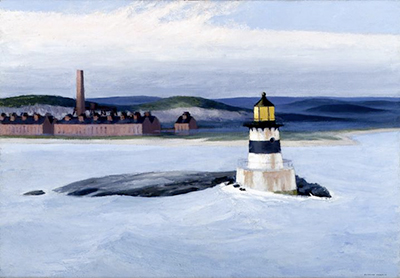
 by Tom Gurney
Tom Gurney BSc (Hons) is an art history expert with over 20 years experience
Email: tomgurney1@gmail.com / Phone: +44 7429 011000
5 A.M.: Introduction
A striped lighthouse stands on a low rock surrounded by pale water. Across the channel, a brick factory and tall chimney occupy the distant shore. Blue hills and long cloud bands stretch behind them, giving the small tower an unexpectedly extensive setting. Edward Hopper's 5 A.M. makes an early hour visible through the relationship between water, coast and two different kinds of built landmark.
The Wichita Art Museum dates the painting to 1937 and records oil on canvas, 63.8 × 91.8 cm, accession M4.39, Roland P. Murdock Collection. [1] Its title specifies a time, but the scene is a constructed coastal synthesis rather than a straightforward map of one harbour.
At a Glance
- ArtistEdward Hopper [1]
- Date1937 [1]
- Mediumoil on canvas [1]
- Collection / recordWichita Art Museum [1]
- AccessionM4.39 [1]
This work across Edward Hopper’s career
American Village
1912Soir Bleu
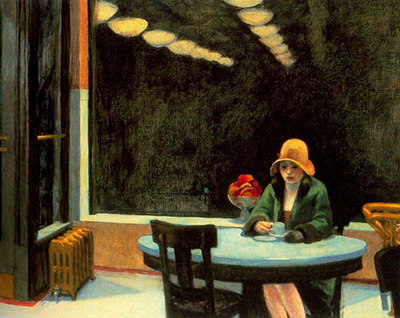
1914Automat
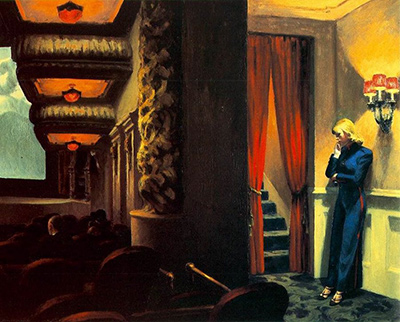
1927New York Movie
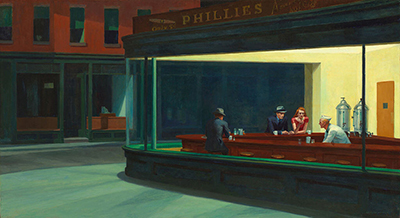
1939Nighthawks
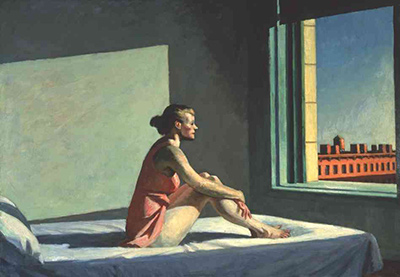
1942Morning Sun
1952Two Comedians
1966Contents
- A lighthouse close to the water
- Rock and pale water
- The factory across the channel
- Bands of hills and sky
- A scene assembled from memory
- Two different kinds of study
- Wichita and other coastal views
A lighthouse close to the water
The tower rises near the right of the foreground island. Its broad white base meets the dark rock through a pale plinth, while a black horizontal band interrupts the lighter cylindrical body above. Higher up, warm yellow passages mark the lantern beneath a dark cap.
These divisions make the small building legible against a much paler surrounding field. White, black and yellow establish a compact sequence, allowing the lighthouse to remain distinct from water and sky without occupying a large share of the canvas.
Its cylindrical shape also contrasts with the rock. The tower has a comparatively regular upright body; the island spreads unevenly towards the left in darker, flatter forms. The two are closely joined, but their edges describe different kinds of structure.
The position near the water is crucial. There is little adjoining land to give the building an ordinary village setting. Instead, its base seems exposed on almost every side, making the relation between a fixed structure and a moving surface unusually direct.
The painting does not show a keeper, a vessel asking for guidance or a dramatic incident at sea. The lighthouse's practical purpose remains implicit in its form and placement. Hopper gives the building enough specificity to establish orientation while leaving the surrounding activity quiet.
Rock and pale water
The rock occupies a narrow strip rather than a substantial foreground shore. Its dark planes run out towards the left, with selected lighter edges helping distinguish their uneven surfaces. The island gives the lighthouse a physical foundation while remaining low enough for water to dominate the lower half.
Around it, broad pale passages curve and overlap. Their softer edges differ from the tower's sharply separated bands, making the sea feel less stable than the structure. Blue-grey and cream tones suggest variations across the surface without describing each small wave separately.
The water continues between the island and distant factory. That open interval establishes the tower's separation from the larger shore, while allowing the spectator to look past it towards the buildings and hills. Foreground and distance remain connected by a continuous surface.
The horizon is not one single emphatic line. Shore, low hills and bands of colour create several adjoining limits. This layering gives the water an extensive setting without requiring a dramatic open-ocean view.
The pale foreground is also an important colour area. It makes the island dark and the tower conspicuous, but it holds attention in its own right through the shallow movement of its marks. The sea is the painting's largest immediate surface, rather than a neutral gap between buildings.
The factory across the channel
The industrial buildings stretch along the left-hand shore. Their low reddish forms have a different scale from the lighthouse's compact body, while the tall chimney rises well above their roofs. Smaller uprights add a second rhythm nearer the building line.
The factory is distant, yet its warm colour keeps it visually present. Muted brick and pinkish highlights differ from the cooler hill bands and water. Hopper gives the industrial shore a degree of warmth that complicates any easy division between an attractive natural setting and an intrusive building.
The chimney's narrow vertical is especially effective. The lighthouse is nearer and broader, but the distant stack reaches higher into the sky. Their different proportions allow two uprights to remain distinct across the width and depth of the painting.
The buildings also give the coastal scene more than one kind of human purpose. A lighthouse helps organize movement by water; a factory belongs to production on the shore. Their actual activities are largely outside the image, but their shapes bring those uses into the same setting.
The Fondation Beyeler's 2020 guide reads the work through an encounter between nature and civilization, emphasizing the lighthouse, water and industrial chimney. [2] The visible relationship supports that interpretation without requiring a fixed symbolic meaning for every building.
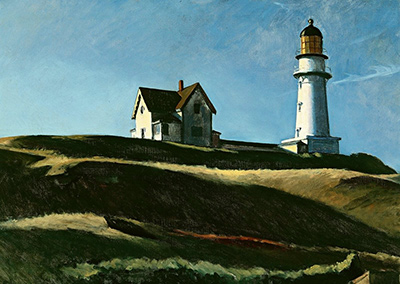
Compare: Lighthouse Hill, 1927.
Bands of hills and sky
Beyond the factory, low blue hills stretch across the horizon. Their overlapping profiles create a gradual recession, with darker and lighter strips distinguishing one distance from another. They remain relatively simple forms beside the more particular lighthouse and chimney.
The sky has a similar layered character. Long cloud passages extend horizontally, varying in density and brightness. These broad directions keep the eye moving across the canvas, while the two main uprights interrupt them at different points.
The title encourages us to read this light as early morning. The painting itself gives a selected distribution of cool water, blue distance and warmer architecture. It does not require the spectator to reconstruct a measured weather report in order to recognize the effect of an hour before the coast has become fully busy.
The sky's scale also matters to the lighthouse. A small dark roof and a few yellow lantern windows are set against a much larger changing field. The structure remains readable because Hopper gives it a firm outline, while the surrounding atmosphere has less definite boundaries.
Watch: Edward Hopper’s Life and Art
Explore Hopper’s paintings and the places behind them in these museum films. Choose a film below.
A scene assembled from memory
The Wichita museum publishes an account from a 1939 letter in which Hopper described a long-held idea prompted by boat journeys between Boston and New York through Long Island Sound. He called the result a synthesis of a New England harbour entrance and related the lighthouse loosely to one near Staten Island. [1] His explanation allows several remembered places to contribute to one painted coast.
This makes the geography more flexible than the title's precision might suggest. An exact hour can accompany buildings and landforms selected from different observations. The scene's coherence depends on how those elements are brought together, rather than on the spectator finding one position from which every feature could be seen.
The near tower and distant chimney make that construction particularly clear. They balance one another across the water, each entering the horizontal landscape through a distinct upright. The relationship is convincing as a harbour view while remaining a deliberate pictorial arrangement.
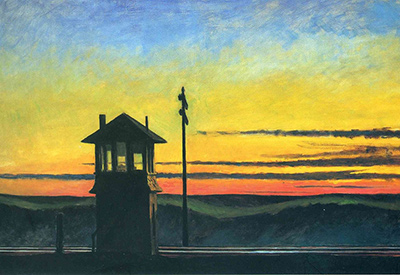
Compare: Railroad Sunset, 1929.
Two different kinds of study
The Whitney Museum of American Art holds a 1937 sheet containing a small coastal design and additional sparse marks, accession 70.153, in fabricated chalk on paper. [3] The upper design gives the tower a low rocky setting beneath broad sky lines. Below it is a second, much sparser group of marks, with less information about a complete setting.
The upper rectangle isolates the coastal scene within the larger upright sheet. A few marks are enough to establish the relationship between tower, island and horizon, leaving most surface details unresolved.
Another study, accession 70.429, uses fabricated chalk and graphite on a wider sheet. It establishes a strongly striped tower, dark island, distant industrial shore and broad areas of sea and cloud. [3] Its principal relationships are close enough to the canvas to make comparison useful.
The factory's distant uprights are relatively subdued in that drawing. In the painting, the tall chimney has a clearer independent presence against the sky. Colour also separates warm brick, cool water and the yellow lantern more decisively than the drawing's tonal structure can.
The studies show more than the preparation of one building. They consider the setting around it: how far the island extends, how much sky remains above, and how the opposite shore joins the tower across the channel. Those relationships give the lighthouse its particular force in the finished work.
Wichita and other coastal views
The museum acquired 5 A.M. in 1939 and records a visit by Edward and Jo Hopper in 1941. [1] The painting's early collection history brought this remembered Atlantic coast into a museum far inland, where its maritime setting could be encountered through the artist's constructed view.
Lighthouse Hill gives its tower a substantial grassy slope and nearby house. 5 A.M. reduces the immediate land to a low rock, making water and distance more important to the building's setting.
In The Lighthouse at Two Lights, the white tower rises from a closer, more solid architectural grouping. Here, the warm industrial shore remains across the channel, giving the lighthouse a counterpart rather than a neighbouring domestic enclosure.
Railroad Sunset also places built markers against broad bands of changing sky. The earlier oil's railway setting gives those horizontals a land-based structure; 5 A.M. lets pale water carry them towards the island. The distant chimney and nearer lantern remain upright within a coast made from remembered journeys, selected forms and the light of a named hour.
Artworks and studies directory
This researched directory includes finished works and separately identified studies. It is not a complete catalogue raisonné. Linked titles open the articles; unlinked studies are identified by their collection accessions. Watercolours retain their recorded media, and original prints remain distinct from reproductions.
| Name | Date | Medium |
|---|---|---|
| (Bridge and Embankment) (70.1298) | 1906 | Oil on wood |
| (Jo Sketching at Good Harbor Beach) (70.1129) | 1923–1924 | Watercolor and fabricated chalk on paper |
| (Manhattan Bridge) (70.1098) | 1925–1926 | Watercolor and graphite pencil on paper |
| (Rooftops) (70.1114) | 1926 | Watercolor and graphite pencil on paper |
| (Seated Male Model, Bent Over) (70.1277) | c. 1902–1903 | Oil on canvas |
| (Self-Portrait) (70.1254) | 1903–1906 | Oil on canvas |
| (Solitary Figure in a Theater) (70.1418) | c. 1902–1904 | Oil on board |
| 5 A.M. | 1937 | oil on canvas |
| Adam's House | 1928 | watercolour and charcoal on paper |
| American Village | 1912 | Oil on canvas |
| Apartment Houses | 1923 | oil on canvas |
| Approaching a City | 1946 | oil on canvas |
| August in the City | 1945 | oil on canvas |
| Automat | 1927 | oil on canvas |
| Barber Shop | 1931 | oil on canvas |
| Blackwell's Island | 1928 | oil on canvas |
| Bridge on the Seine | 1909 | Oil on canvas |
| Bridle Path | 1939 | oil on canvas |
| Burly Cobb's House South Truro | 1930–1933 | oil on canvas |
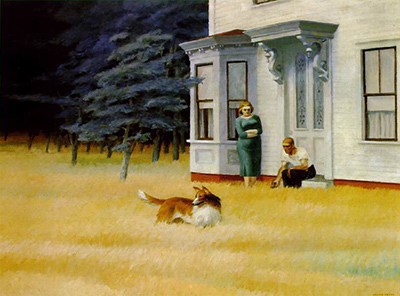
| Cape Cod Evening | 1939 | oil on canvas |
| Cape Cod Morning | 1950 | oil on canvas |
| Chair Car | 1965 | oil on canvas |
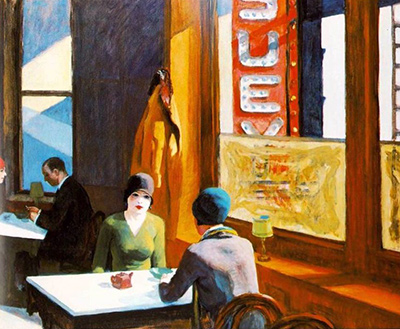
| Chop Suey | 1929 | oil on canvas |
| City Roofs | 1932 | Oil on canvas |
| Coast Guard Station | 1929 | oil on canvas |
| Compartment C, Car 293 | 1938 | oil on canvas |
| Conference at Night | 1949 | oil on canvas |
| Corn Hill | 1930 | oil on canvas |
| Dawn in Pennsylvania | 1942 | oil on canvas |
| Drug Store | 1927 | oil on canvas |
| Early Sunday Morning | 1930 | Oil on canvas |
| East Side Interior (70.1020) | 1922 | Etching |
| East Wind Over Weehawken | 1934 | oil on canvas |
| El Palacio | 1946 | Watercolor and graphite pencil on paper |
| Eleven A.M. | 1926 | oil on canvas |
| Evening Wind | 1921 | etching |
| Excursion into Philosophy | 1959 | oil on canvas |
| First Row Orchestra | 1951 | oil on canvas |
| Freight Car at Truro | 1931 | watercolour over graphite on paper |
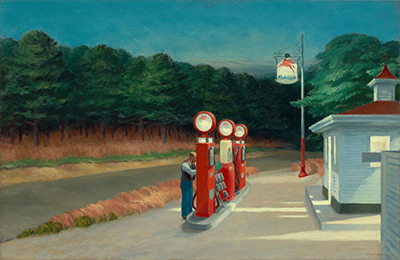
| Gas | 1940 | oil on canvas |
| Girl at a Sewing Machine | c. 1921 | oil on canvas |
| Gloucester Harbor | 1912 | Oil on canvas |
| Ground Swell | 1939 | oil on canvas |
| Haskell's House | 1924 | watercolour over graphite on paperboard |
| High Noon | 1949 | oil on canvas |
| Hill and Houses Cape Elizabeth Maine | 1927 | watercolour over graphite pencil |
| Hills South Truro | 1930 | oil on canvas |
| Hotel by a Railroad | 1952 | oil on canvas |
| Hotel Lobby | 1943 | oil on canvas |
| Hotel Room | 1931 | oil on canvas |
| Hotel Window | 1955 | oil on canvas |
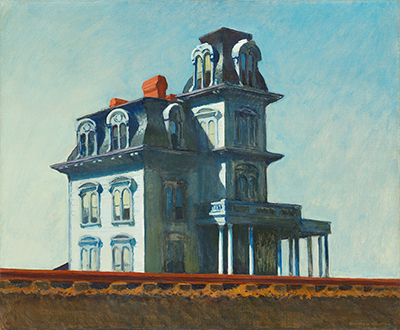
| House by the Railroad | 1925 | oil on canvas |
| House by the Squam River | 1926 | watercolour over graphite on paper |
| Le Bistro or The Wine Shop | 1909 | Oil on canvas |
| Le Pont des Arts | 1907 | Oil on canvas |
| Le Pont Royal | 1909 | Oil on canvas |
| Le Quai des Grands Augustins | 1909 | Oil on canvas |
| Lighthouse and Buildings Portland Head | 1927 | watercolour over graphite pencil on paper |
| Lighthouse Hill | 1927 | oil painting |
| Manhattan Bridge Loop | 1928 | oil on canvas |
| Model Sitting | c. 1902 | oil painting; support not asserted |
| Morning Sun | 1952 | oil on canvas |
| New York Movie | 1939 | oil on canvas |
| New York New Haven and Hartford | 1931 | oil on canvas |
| New York Office | 1962 | oil on canvas |
| New York Pavements | 1924–1925 | oil on canvas |
| New York Restaurant | c. 1922 | oil on canvas |
| Night Windows | 1928 | oil on canvas |
| Nighthawks | 1942 | oil on canvas |
| October on Cape Cod | 1946 | oil on canvas |
| Office at Night | 1940 | oil on canvas |
| Office in a Small City | 1953 | oil on canvas |
| Pennsylvania Coal Town | 1947 | oil on canvas |
| People in the Sun | 1960 | oil on canvas |
| Portrait of Orleans | 1950 | oil on canvas |
| Queensborough Bridge | 1913 | Oil on canvas |
| Railroad Sunset | 1929 | Oil on canvas |
| Railroad Train | 1908 | oil on canvas |
| Road in Maine | 1914 | oil on canvas |
| Room in Brooklyn | 1932 | oil on canvas |
| Room in New York | 1932 | oil on canvas |
| Rooms by the Sea | 1951 | oil on canvas |
| Rooms for Tourists | 1945 | oil on canvas |
| Route 6 Eastham | 1941 | oil on canvas |
| Second Story Sunlight | 1960 | Oil on canvas |
| Self-Portrait | 1925–1930 | Oil on canvas |
| Self-Portrait with Hat (70.1903) | c. 1918, posthumous print | Drypoint |
| Seven A.M. | 1948 | Oil on canvas |
| Soir Bleu | 1914 | oil on canvas |
| South Carolina Morning | 1955 | Oil on canvas |
| Stairway at 48 Rue de Lille Paris | 1906 | Oil on wood |
| Study for 5 A.M. (70.153) | 1937 | Fabricated chalk on paper |
| Study for 5 A.M. (70.429) | 1937 | Fabricated chalk and graphite pencil on paper |
| Study for Approaching a City (70.869) | 1946 | Fabricated chalk and charcoal on paper |
| Study for August in the City (70.158a-b) | 1945 | Fabricated chalk on paper |
| Study for August in the City (70.159) | 1945 | Fabricated chalk on paper |
| Study for Bridle Path (70.220) | 1939 | Fabricated chalk on paper |
| Study for Bridle Path (70.235) | 1939 | Fabricated chalk on paper |
| Study for Compartment C, Car 293 (70.430) | 1938 | Fabricated chalk on paper |
| Study for Compartment C, Car 293 (70.431a-b) | 1938 | Fabricated chalk and charcoal on paper |
| Study for Conference at Night (70.170) | 1949 | Fabricated chalk on paper (recto); Typewriter ink on paper (verso) |
| Study for Conference at Night (70.174) | 1949 | Fabricated chalk on paper ( recto); Typewriter ink on paper (verso) |
| Study for East Wind over Weehawken (70.249) | 1934 | Graphite pencil on paper |
| Study for East Wind over Weehawken (70.252) | 1934 | Fabricated chalk and charcoal on paper |
| Study for Evening Wind (70.343a-b) | 1921 | Fabricated chalk on paper |
| Study for First Row Orchestra (70.841) | 1951 | Fabricated chalk and charcoal on paper |
| Study for Gas (70.263) | 1940 | Fabricated chalk on paper |
| Study for Ground Swell (70.339) | 1939 | Fabricated chalk, charcoal and graphite pencil on paper |
| Study for Hotel by a Railroad (70.199) | 1952 | Fabricated chalk on paper |
| Study for Hotel by a Railroad (70.427) | 1952 | Fabricated chalk on paper |
| Study for Hotel by a Railroad (70.428) | 1952 | Fabricated chalk on paper |
| Study for Hotel Lobby (70.117) | 1942 | Fabricated chalk and graphite pencil on paper |
| Study for Hotel Lobby (70.839) | 1942 | Fabricated chalk and charcoal on paper |
| Study for Hotel Window (70.161) | 1955 | Fabricated chalk, graphite pencil and colored pencil on paper |
| Study for Morning Sun (70.243) | 1952 | Fabricated chalk on paper |
| Study for Morning Sun (70.244) | 1952 | Fabricated chalk on paper |
| Study for Morning Sun (70.290) | 1952 | Fabricated chalk on paper |
| Study for Morning Sun (70.291) | 1952 | Fabricated chalk and graphite pencil on paper |
| Study for New York Movie (70.273) | 1939 | Fabricated chalk on paper |
| Study for New York Movie (70.274a-b) | 1938 or 1939 | Fabricated chalk and charcoal on paper (recto); Fabricated chalk on paper (verso) |
| Study for New York Movie (70.455) | 1939 | Fabricated chalk and charcoal on paper |
| Study for New York Office (70.822) | 1962 | Fabricated chalk on paper |
| Study for Nighthawks (70.192) | 1941 or 1942 | Fabricated chalk on paper |
| Study for Nighthawks (70.193) | 1941 or 1942 | Fabricated chalk on paper |
| Study for Office at Night (70.340) | 1940 | Fabricated chalk and charcoal on paper |
| Study for Office at Night (70.341) | 1940 | Fabricated chalk and graphite pencil on paper |
| Study for Pennsylvania Coal Town (70.198) | 1947 | Fabricated chalk on paper |
| Study for Pennsylvania Coal Town (70.229) | 1947 | Fabricated chalk and charcoal on paper |
| Study for Rooms for Tourists (70.438) | 1945 | Fabricated chalk and charcoal on paper |
| Study for Rooms for Tourists (70.848) | 1945 | Fabricated chalk and charcoal on paper |
| Study for Route 6, Eastham (70.369) | 1941 | Fabricated chalk and graphite pencil on paper |
| Study for Route 6, Eastham (70.854) | 1941 | Fabricated chalk and graphite pencil on paper |
| Study for South Carolina Morning (70.162a-b) | 1955 | Fabricated chalk on paper (recto and verso) |
| Study for The Sheridan Theatre (70.969) | 1937 | Graphite pencil on paper |
| Study for Two on the Aisle (70.128) | 1927 | Fabricated chalk on paper |
| Study for Two on the Aisle (70.129) | 1927 | Fabricated chalk on paper |
| Study for Yawl Riding a Swell (70.439) | 1935 | Fabricated chalk and graphite pencil on paper |
| Summer Evening | 1947 | oil on canvas |
| Summer Interior | 1909 | Oil on canvas |
| Sun in an Empty Room | 1963 | oil on canvas |
| Sunlight in a Cafeteria | 1958 | oil on canvas |
| Sunlight on Brownstones | 1956 | oil on canvas |
| Tables for Ladies | 1930 | oil on canvas |
| The Bootleggers | 1925 | oil on canvas |
| The Camel's Hump | 1931 | oil on canvas |
| The Circle Theatre | 1936 | oil on canvas |
| The City | 1927 | oil on canvas |
| The Lighthouse at Two Lights | 1929 | oil on canvas |
| The Long Leg | 1935 | oil on canvas |
| The Mansard Roof | 1923 | watercolour over graphite on paper |
| The Sheridan Theatre | 1937 | oil on canvas |
| Tramp Steamer | 1908 | oil on canvas |
| Two Comedians | 1966 | oil on canvas |
| Two on the Aisle | 1927 | oil on canvas |
| Valley of the Seine | 1909 | Oil on canvas |
| Western Motel | 1957 | oil on canvas |
Frequently Asked Questions
Edward Hopper made 5 A.M. in 1937. [1]
The recorded medium is oil on canvas. [1]
A striped lighthouse stands on a low rock surrounded by pale water. Across the channel, a brick factory and tall chimney occupy the distant shore. Blue hills and long cloud bands stretch behind them, giving the small tower an unexpectedly extensive setting. Edward Hopper's 5 A.M. makes an early hour visible through the relationship between water, coast and two different kinds of built landmark.
Discussion
Look again at the images and ideas explored in 5 A.M.. These editorial prompts invite your observations.
Reader Insights
Which boundary, gesture or change of light first holds your attention in 5 A.M.?
Compare Lighthouse Hill with 5 A.M.. Which visual difference matters most to your reading?
Which detail would you look at again after reading “The factory across the channel”?
Join the Conversation
Share a detail, comparison or question about 5 A.M. below.
References
- Wichita Art Museum, 5 A. M., 1937, accession M4.39, Roland P. Murdock Collection; current metadata and museum essay, including Hopper's 1939 letter to Mrs. Navas as transmitted by the museum, the 1939 acquisition and 1941 visit. View source.
- Fondation Beyeler, Edward Hopper, English exhibition guide, 2020, Room 4, entry 6; the lighthouse, industrial shore and nature–civilization interpretation. View source.
- Whitney Museum of American Art, Study for 5 A.M., 70.153 and Study for 5 A.M., 70.429, 1937; current object records and the two-design sheet and wider compositional drawing. View source 1. View source 2.
- Collection or catalogue record, American Village, 1912; medium and identity as discussed in the linked article. View source.
- Collection or catalogue record, Soir Bleu, 1914; medium and identity as discussed in the linked article. View source.
- Collection or catalogue record, House by the Railroad, 1925; medium and identity as discussed in the linked article. View source.
- Collection or catalogue record, Automat, 1927; medium and identity as discussed in the linked article. View source.
- Collection or catalogue record, Early Sunday Morning, 1930; medium and identity as discussed in the linked article. View source.
- Collection or catalogue record, New York Movie, 1939; medium and identity as discussed in the linked article. View source.
- Collection or catalogue record, Nighthawks, 1942; medium and identity as discussed in the linked article. View source.
- Collection or catalogue record, Morning Sun, 1952; medium and identity as discussed in the linked article. View source.
- Collection or catalogue record, Second Story Sunlight, 1960; medium and identity as discussed in the linked article. View source.
- Collection or catalogue record, Two Comedians, 1966; medium and identity as discussed in the linked article. View source.
- Whitney Museum of American Art, Study for Route 6, Eastham, 1941, accession 70.854; exact object record. View source.
- Whitney Museum of American Art, Study for Conference at Night, 1949, accession 70.170; exact object record. View source.
- Whitney Museum of American Art, Study for First Row Orchestra, 1951, accession 70.841; exact object record. View source.
- Whitney Museum of American Art, (Bridge and Embankment), 1906, accession 70.1298; exact object record. View source.
- Whitney Museum of American Art, (Seated Male Model, Bent Over), c. 1902–1903, accession 70.1277; exact object record. View source.
- Whitney Museum of American Art, Study for Morning Sun, 1952, accession 70.244; exact object record. View source.
- Whitney Museum of American Art, Study for Morning Sun, 1952, accession 70.243; exact object record. View source.
- Whitney Museum of American Art, Study for Two on the Aisle, 1927, accession 70.128; exact object record. View source.
- Whitney Museum of American Art, Study for New York Office, 1962, accession 70.822; exact object record. View source.
- Whitney Museum of American Art, Study for Two on the Aisle, 1927, accession 70.129; exact object record. View source.
- Whitney Museum of American Art, Study for Pennsylvania Coal Town, 1947, accession 70.229; exact object record. View source.
- Whitney Museum of American Art, (Rooftops), 1926, accession 70.1114; exact object record. View source.
- Whitney Museum of American Art, Study for South Carolina Morning, 1955, accession 70.162a-b; exact object record. View source.
- Whitney Museum of American Art, (Self-Portrait), 1903–1906, accession 70.1254; exact object record. View source.
- Whitney Museum of American Art, (Manhattan Bridge), 1925–1926, accession 70.1098; exact object record. View source.
- Whitney Museum of American Art, (Solitary Figure in a Theater), c. 1902–1904, accession 70.1418; exact object record. View source.
- Whitney Museum of American Art, Study for Approaching a City, 1946, accession 70.869; exact object record. View source.
- Whitney Museum of American Art, Study for August in the City, 1945, accession 70.159; exact object record. View source.
- Whitney Museum of American Art, Study for Compartment C, Car 293, 1938, accession 70.430; exact object record. View source.
- Whitney Museum of American Art, Study for Compartment C, Car 293, 1938, accession 70.431a-b; exact object record. View source.
- Whitney Museum of American Art, Study for East Wind over Weehawken, 1934, accession 70.252; exact object record. View source.
- Whitney Museum of American Art, Study for East Wind over Weehawken, 1934, accession 70.249; exact object record. View source.
- Whitney Museum of American Art, Study for Evening Wind, 1921, accession 70.343a-b; exact object record. View source.
- Whitney Museum of American Art, Study for The Sheridan Theatre, 1937, accession 70.969; exact object record. View source.
- Whitney Museum of American Art, Study for New York Movie, 1939, accession 70.455; exact object record. View source.
- Whitney Museum of American Art, Study for New York Movie, 1939, accession 70.273; exact object record. View source.
- Whitney Museum of American Art, Study for New York Movie, 1938 or 1939, accession 70.274a-b; exact object record. View source.
- Whitney Museum of American Art, Study for 5 A.M., 1937, accession 70.153; exact object record. View source.
- Whitney Museum of American Art, Study for 5 A.M., 1937, accession 70.429; exact object record. View source.
- Whitney Museum of American Art, (Jo Sketching at Good Harbor Beach), 1923–1924, accession 70.1129; exact object record. View source.
- Whitney Museum of American Art, Study for August in the City, 1945, accession 70.158a-b; exact object record. View source.
- Whitney Museum of American Art, Study for Morning Sun, 1952, accession 70.291; exact object record. View source.
- Whitney Museum of American Art, Study for Morning Sun, 1952, accession 70.290; exact object record. View source.
- Whitney Museum of American Art, Study for Office at Night, 1940, accession 70.340; exact object record. View source.
- Whitney Museum of American Art, Study for Office at Night, 1940, accession 70.341; exact object record. View source.
- Whitney Museum of American Art, Study for Hotel by a Railroad, 1952, accession 70.427; exact object record. View source.
- Whitney Museum of American Art, Study for Hotel by a Railroad, 1952, accession 70.199; exact object record. View source.
- Whitney Museum of American Art, Study for Hotel by a Railroad, 1952, accession 70.428; exact object record. View source.
- Whitney Museum of American Art, Study for Hotel Lobby, 1942, accession 70.117; exact object record. View source.
- Whitney Museum of American Art, Study for Hotel Lobby, 1942, accession 70.839; exact object record. View source.
- Whitney Museum of American Art, Study for Conference at Night, 1949, accession 70.174; exact object record. View source.
- Whitney Museum of American Art, Study for Hotel Window, 1955, accession 70.161; exact object record. View source.
- Whitney Museum of American Art, Study for Pennsylvania Coal Town, 1947, accession 70.198; exact object record. View source.
- Whitney Museum of American Art, Study for Route 6, Eastham, 1941, accession 70.369; exact object record. View source.
- Whitney Museum of American Art, Study for Bridle Path, 1939, accession 70.220; exact object record. View source.
- Whitney Museum of American Art, Study for Bridle Path, 1939, accession 70.235; exact object record. View source.
- Whitney Museum of American Art, Study for Ground Swell, 1939, accession 70.339; exact object record. View source.
- Whitney Museum of American Art, Study for Yawl Riding a Swell, 1935, accession 70.439; exact object record. View source.
- Whitney Museum of American Art, Study for Rooms for Tourists, 1945, accession 70.848; exact object record. View source.
- Whitney Museum of American Art, Study for Rooms for Tourists, 1945, accession 70.438; exact object record. View source.
- Whitney Museum of American Art, Study for Nighthawks, 1941 or 1942, accession 70.193; exact object record. View source.
- Whitney Museum of American Art, Study for Nighthawks, 1941 or 1942, accession 70.192; exact object record. View source.
- Whitney Museum of American Art, Study for Gas, 1940, accession 70.263; exact object record. View source.
- Whitney Museum of American Art, Self-Portrait with Hat, c. 1918, posthumous print, accession 70.1903; exact object record. View source.
- Whitney Museum of American Art, East Side Interior, 1922, accession 70.1020; exact object record. View source.
- Art Institute of Chicago, Selected Chronology for Edward Hopper; training, travels, exhibitions, New York and Truro chronology. View source.
- Emily C. Burns, Spectral figures: Edward Hopper’s empty Paris, chapter 5 in Empty Spaces: Confronting Emptiness in National, Cultural and Urban Histories, 2019; complete chapter and notes consulted. View source.
- Charles Brock, Regionalism and Folk Art, National Gallery of Art; complete essay and two notes consulted. View source.