


 by Tom Gurney
Tom Gurney BSc (Hons) is an art history expert with over 20 years experience
Published on June 19, 2020 / Updated on November 6, 2025
Email: tomgurney1@gmail.com / Phone: +44 7429 011000
The Head of the Virgin
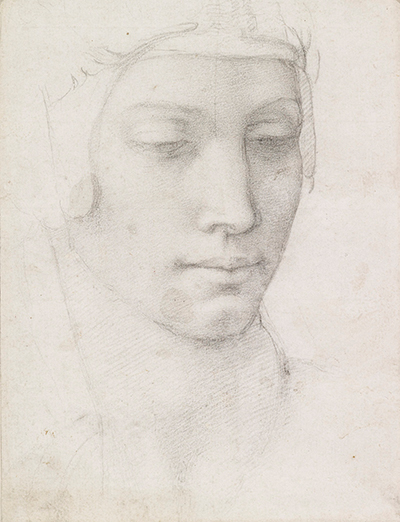
Michelangelo's small black-chalk Head of the Virgin makes sacred identity depend on very little: the inclination of a face, lowered attention and cloth gathered around the head. No Christ Child, angel or architectural setting is required.
The Royal Collection preserves the drawing as RCIN 912764. It measures 21.2 × 14.2 centimetres.[1] The title identifies the Virgin, but the sheet remains a study of a head rather than a complete Madonna composition.
Its concentration is its strength. Michelangelo tests how an ideal female face can carry humility, foreknowledge and inward attention without theatrical expression.
At a Glance
- ArtistMichelangelo Buonarroti
- TitleThe Head of the Virgin
- MediumBlack chalk on paper
- Dimensions21.2 × 14.2 centimetres
- CollectionRoyal Collection
- Royal Collection numberRCIN 912764
- SubjectThe Virgin Mary, represented through head and headdress
- Object typeHead study rather than full narrative composition
- Project statusNo single finished Madonna or altarpiece should be asserted without a secure figure match
- Central qualitiesInclination, lowered attention, idealisation and the contrast between face and lightly resolved cloth
Contents
- A Sacred Identity Without Attributes
- The Inclined Face
- Ideal Beauty and Particular Observation
- Black Chalk
- Face and Headdress
- A Head Study, Not a Portrait
- Michelangelo's “Divine Heads”
- Comparisons with Leonardo and Raphael
- The Missing Composition
- Emotion Without Narrative Excess
- Private Devotion and Sustained Looking
- Collection and Survival
- How to Look at the Head
- Why the Head of the Virgin Matters
A Sacred Identity Without Attributes
Mary is usually recognised through context: the Christ Child, Gabriel at the Annunciation, the dead Christ in a Pietà, or blue mantle and halo.
In an isolated head, those identifiers disappear. Expression and headdress must do more work.
The title reflects scholarly identification, but viewers should still distinguish what is visible from what is inferred. We see a young woman with covered hair and a contemplative inclination.
Those features are compatible with the Virgin across many scenes. They do not specify whether she reads, adores, listens or mourns.
The drawing therefore condenses Marian type without fixing narrative time.
The Inclined Face
A slight tilt can transform an ideal head. Upright frontality may suggest command; an inclination produces responsiveness and reserve.
Michelangelo aligns the face so that the eyes and mouth do not confront the viewer directly. Attention seems directed toward something outside the surviving field.
That unseen object could be the Christ Child, a book, Gabriel or an inward thought. The drawing preserves the relation without supplying its partner.
The result is active rather than blank. Mary's stillness contains orientation.
This is how an isolated study can imply a larger composition: gaze creates space beyond the paper.
Ideal Beauty and Particular Observation
Michelangelo's female heads often combine smooth, regular features with evidence of a living model.
Idealisation does not mean that every face was invented from a formula. An observed turn, eyelid or pressure of cloth can be selected and refined toward a sacred type.
The Virgin's beauty is not presented as seductive display. Restraint redirects attention toward thought and spiritual role.
Subtle asymmetry keeps the head from becoming a mask. One side recedes, and the turn changes how cheek, brow and jaw receive light.
Michelangelo's achievement lies in making selection feel inevitable while leaving traces of study.
Black Chalk
Black chalk supports both decisive contour and soft tonal modelling. A pointed edge can articulate eyelid or profile; broader contact can shade cheek and neck.
Unlike pen, chalk permits reinforcement, rubbing and gradation. The artist can approach an edge through several faint lines before choosing one.
The medium is especially suited to a head whose force depends on transitions rather than sharp outline alone.
Dark accents attract the eye toward features, while lighter passages let parts of the face merge with paper.
Reproduction often increases contrast. The original sheet's quieter marks may carry important evidence of correction and sequence.
Face and Headdress
The cloth around Mary's head is more than costume. It frames the face, controls silhouette and helps establish modesty.
Michelangelo does not need to describe every fold equally. Some passages can remain rough while the features are resolved.
This difference in finish creates hierarchy. The garment locates the sacred type; the face carries psychological attention.
Cloth also converts head into volume. Folds tell us where skull and hair continue behind the visible cheek.
The headdress is therefore both symbolic and structural, even when lightly drawn.
A Head Study, Not a Portrait
Portraiture seeks a particular person's recognisable identity. This drawing pursues a role that can exceed one model.
That distinction should not erase individuality. Michelangelo may have drawn from life, but he transformed observed features toward the Virgin.
Renaissance workshop practice often used ideal heads as transferable resources. A face could guide a painting by another artist or remain a finished devotional image.
Without a securely matched final work, function remains open. The drawing can be preparatory without belonging to a named commission.
It can also have been valued independently for the beauty and authority of Michelangelo's hand.
Michelangelo's “Divine Heads”
Vasari admired Michelangelo's highly finished head drawings and called some teste divine. Several elaborate examples were gifts to friends, designed for sustained looking.[2]
RCIN 912764 should not automatically be placed in that gift group; recipient and function are not established merely by quality.
Yet the comparison explains why an isolated head could be complete enough to collect. Renaissance viewers prized the capacity to embody ideal character through drawing alone.
Head studies also served teaching. Pupils copied eyes, profiles and skulls, learning how parts build expression.[3]
The Virgin's head sits between these possibilities: sacred image, model and valued graphic object.
Comparisons with Leonardo and Raphael
Leonardo's Virgin studies often dissolve contours through layered black, red and white chalk, investigating how light and atmosphere make form recede.[4]
Raphael's Marian heads frequently support balanced multi-figure compositions and gentle exchanges of gaze.
Michelangelo's approach tends toward concentrated volume. Even a small head feels constructed, with face and cloth pressed into a compact sculptural unit.
These differences are tendencies, not absolute rules. All three artists observed, idealised and adapted heads to function.
Comparison helps identify Michelangelo's force without turning Renaissance style into caricature.
The Missing Composition
It is tempting to match the head with every Madonna design from the same broad period. Similar tilt and headdress are not enough.
A secure identification would require agreement of orientation, scale, lighting, neckline and relation to surrounding figures.
Michelangelo's ideas migrated. A successful head type could recur without direct tracing.
The absence of a named destination is therefore not a gap to fill imaginatively. It preserves the drawing's independent evidence.
RCIN 912764 tells us how Michelangelo conceived the Virgin even if it does not tell us where he intended her to appear.
Emotion Without Narrative Excess
Marian imagery must often hold apparently opposed states: humility and authority, maternal tenderness and knowledge of future suffering, immediate attention and timeless ideality.
Michelangelo does not resolve those tensions through overt tears or smile. The inclined head lets several emotions remain possible.
Lowered attention can signify obedience at the Annunciation, adoration before the Child or grief beside the dead Christ. The same physical vocabulary changes through surrounding context.
This reserve prevents expression from becoming generic melodrama. A viewer must complete the relationship implied by gaze.
The drawing's emotional range is therefore a form of precision. Michelangelo defines orientation closely enough to be meaningful while leaving narrative cause open.
Private Devotion and Sustained Looking
A small head can function devotionally without depicting an entire sacred episode. Its scale suits close, repeated viewing rather than public spectacle.
The beholder may attend to Mary's inwardness and use it as a model of contemplation. The absence of narrative detail removes distraction.
That possibility does not prove the sheet was made as a devotional gift. Working studies and private images can look similar once separated from their original circumstances.
Still, Renaissance collecting changed function. Even if RCIN 912764 began as preparation, preservation and display allowed the study itself to become an object of sustained meditation.
The transition is not a corruption of purpose. It demonstrates how concentrated drawing can support more than one kind of looking.
Collection and Survival
The Royal Collection contains an important group of Michelangelo drawings alongside major holdings by Leonardo and Raphael.[5]
Many arrived through early collecting routes that are incompletely documented. Later cataloguing separated originals, copies and school works through close comparison.
An isolated head is especially vulnerable to false attribution because followers imitated admired types.
Inventory number, physical examination and publication keep this specific sheet distinct from related heads.
Its modest dimensions also remind us that survival does not correlate with original public scale. A small private study can outlast an altarpiece.
How to Look at the Head
Begin with direction of gaze and imagine the space it creates outside the sheet.
Trace the turn from forehead through nose, mouth and chin.
Compare the degree of finish in features and headdress.
Look for reinforced chalk where Michelangelo selected an edge.
Then remove the title mentally: ask which visual qualities make the woman legible as the Virgin.
Finally resist attaching her to a named painting unless the whole configuration agrees.
Why the Head of the Virgin Matters
The drawing matters because it shows sacred character produced through restraint. Michelangelo needs neither narrative crowd nor emphatic gesture.
It also reveals how an ideal head remains bodily. Cloth has weight, a skull turns beneath it, and attention projects beyond the paper.
Most of all, RCIN 912764 preserves a threshold between study and image. A face being worked out becomes an object of contemplation in its own right.
That conversion depends on no later completion. The sheet's unresolved cloth and concentrated features invite viewers to experience selection itself: the moment at which a model's head becomes Mary through direction, restraint and attention.
Its smallness intensifies rather than diminishes that change, bringing sacred idealisation within the reach of a hand and an attentive eye.
Close scale also makes every withheld mark consequential. The drawing asks viewers to notice not only what Michelangelo states, but where he allows paper to preserve silence around the face.
Frequently Asked Questions
Discussion
What details, sources or comparisons stand out to you in The Head of the Virgin?
Reader Insights
Which formal detail changes how the work reads?
Which documented source or collection history feels most useful?
Which related Michelangelo work should readers compare next?
Join the Conversation
Add a source-led observation, comparison or question for other readers.
References
- Royal Collection Trust, The Art of Italy in the Royal Collection: Renaissance and Baroque, catalogue entry 17:, View source.
- Royal Collection Trust, Michelangelo's Presentation Drawings”:, View source.
- Metropolitan Museum of Art, The Teacher of Drawing,” Michelangelo: Divine Draftsman and Designer:, View source.
- Metropolitan Museum of Art, Leonardo, The Head of the Virgin in Three-Quarter View:, View source.
- Royal Collection Trust, Drawings, Watercolours, and Prints”:, View source.