


 by Tom Gurney
Tom Gurney BSc (Hons) is an art history expert with over 20 years experience
Published on June 19, 2020 / Updated on November 6, 2025
Email: tomgurney1@gmail.com / Phone: +44 7429 011000
Annunciation to the Virgin
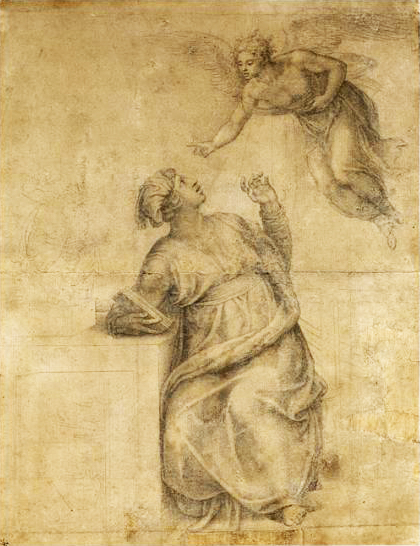
Michelangelo's Virgin does not receive the angel in serene stillness. Interrupted while reading, she turns sharply over her shoulder and raises one hand as if surprise has become a physical shield. Gabriel enters with such scale and force that the domestic room seems unable to contain him.
The Morgan Library & Museum preserves this black-chalk design as IV, 7. It measures 38.3 × 29.7 centimetres, and its outlines were incised with a stylus.[1] The Morgan labels the sheet “Attributed to Michelangelo Buonarroti,” while also presenting it as his design for an altarpiece painted by Marcello Venusti around 1547 for the Cesi family chapel in Santa Maria della Pace, Rome.[2]
That dual wording is essential. The drawing's attribution has a scholarly history, and the lost painting's execution belonged to Venusti. Michelangelo supplied the invention; he did not paint the altarpiece.
At a Glance
- TitleAnnunciation to the Virgin
- AttributionAttributed to Michelangelo Buonarroti by the Morgan; often discussed as his design
- DateAbout 1547
- MediumBlack chalk, with some stumping; outlines indented or traced with a stylus
- Dimensions38.3 × 29.7 centimetres
- CollectionMorgan Library & Museum, New York
- InventoryIV, 7
- CommissionCesi Chapel, Santa Maria della Pace, Rome
- Painted executionMarcello Venusti; original altarpiece lost
- Subject sourceLuke 1:26–38
- Historic responseVasari called the invention a cosa nuova, a “new thing”
Contents
- The Annunciation Story
- The Turning Virgin
- Gabriel's Monumental Arrival
- A Domestic Interior with Moses
- Chalk and Incision
- Michelangelo and Marcello Venusti
- The Cesi Chapel
- Patronage Through Tommaso de' Cavalieri
- From Sheet to Altarpiece
- A Lost Painting Known Through Repetition
- Another Annunciation and a Roman Family of Designs
- Vasari's “New Thing”
- Interior, Threshold and Incarnation
- After Raphael, Beyond Raphael
- Attribution and Responsible Naming
- Provenance and the Morgan
- How to Look at the Drawing
- Why the Annunciation Matters
The Annunciation Story
The Gospel of Luke tells how Gabriel was sent to Mary in Nazareth and announced that she would conceive Jesus. Mary asked how this could be; the angel explained the action of the Holy Spirit, and she consented: “Let it be with me according to your word.”[3]
Artists often show the meeting through recognisable signs: Mary's book, Gabriel's lily, the descending dove, a bedchamber or enclosed garden.
Michelangelo concentrates on interruption. The Virgin has been reading when Gabriel appears. Her twisting body converts theological shock into movement.
The raised hand can register fear, self-protection and dawning attention at once. It is not a refusal. Consent belongs to a sequence, and the drawing captures the instant before calm acceptance.
This temporal precision makes a familiar sacred subject newly human without reducing its mystery.
The Turning Virgin
Mary sits with her body directed away from the angel, then turns head and shoulders back. The pose creates torque through her torso and compresses drapery around the waist.
Michelangelo had long used twisting figures to make thought visible. Here physical reversal corresponds to a life redirected by divine address.
Her hand rises between face and Gabriel. The gesture marks distance, but its open palm also receives light and speech.
The book anchors what has been interrupted. Christian interpretation commonly understood Mary's reading as engagement with prophecy, sometimes Isaiah's promise that a virgin would conceive.
She therefore moves from written word to embodied fulfilment. The room becomes the threshold where text becomes flesh.
Gabriel's Monumental Arrival
Gabriel is not a decorative visitor hovering politely at the margin. The angel advances as a large, active body.
His scale creates asymmetry. Mary is seated and turning; Gabriel presses forward. The annunciation is an event entering ordinary space from outside it.
Michelangelo's late angels often rely upon bodily power rather than ornamental sweetness. Drapery and gesture signal supernatural movement without making the figure weightless.
The contrast with the Virgin is expressive rather than hierarchical. Gabriel bears a message; Mary bears the consequence. His forward energy meets her inward decision.
Venusti's painted translation would have added colour, light and altar-scale presence, but the chalk drawing already resolves the central encounter.
A Domestic Interior with Moses
The setting is lightly outlined compared with the dense figures. A cabinet contains or supports a basket, book and pitcher, while a small statue of Moses appears above.[2]
These objects make the room inhabited. The pitcher and basket belong to daily life; books connect study with revelation.
Moses introduces the older covenant into the moment when Christians believed a new covenant began. His law and prophecy stand behind Mary's assent.
The scale difference is striking. Gabriel and Mary are fully modelled presences; furniture and sculpture remain almost notational.
This hierarchy guides Venusti. Michelangelo gives sufficient architecture to locate and interpret the scene without turning the design into a complete tonal painting.
Chalk and Incision
Layers of delicate black-chalk strokes build the two figures. Stumping softens some passages, creating shadow and volume.[2]
The outlines were indented with a stylus. Such pressure could transfer or reinforce the design for another stage, connecting an intimate sheet with a painted altarpiece.
Incision also changes the object. Even where chalk fades, a physical groove can retain a chosen boundary.
The contrast between richly worked bodies and light interior marks reflects division of labour. Michelangelo resolved the invention most crucial to him; Venusti could elaborate colour, setting and finish.
The drawing is therefore both autonomous enough to command attention and functional enough to direct another artist.
Michelangelo and Marcello Venusti
Venusti worked in Rome in the 1540s after experience in Perino del Vaga's circle. Through Michelangelo's Roman network, including Tommaso de' Cavalieri, he gained access to designs by the older master.[4]
Michelangelo supplied him with drawings for several sacred compositions, including Annunciations and the Purification of the Temple.[5]
This relationship was not simple copying. Venusti translated Michelangelo's black-chalk concepts into coloured paintings suited to patrons and chapels.
The phrase “after Michelangelo” can obscure that creative negotiation. Conversely, calling the lost altarpiece a Michelangelo painting erases Venusti's labour.
“Multiple authorship” is the most accurate framework: invention and execution remain distinguishable but cooperate in one work.[6]
The Cesi Chapel
The Cesi family chapel stood in Santa Maria della Pace, close to Raphael's celebrated Chigi Chapel. Its long development involved architecture, sculpture and painting by several Roman artists.[7]
Around the mid-1540s, the Annunciation altarpiece was commissioned for this setting. Michelangelo's design brought his authority into a space already defined by comparisons among major masters.
The lost Venusti painting was later replaced. Its disappearance makes the Morgan sheet especially important: the originating conception survives even when the intended altar object does not.
Small replicas and workshop variants preserve aspects of the painted result. They show the design's success while complicating reconstruction, since repetitions may alter colour, details and scale.
The chapel context reminds us that the drawing originally anticipated worship, architecture and liturgical sightlines, not museum isolation.
Patronage Through Tommaso de' Cavalieri
Evidence surrounding the commission gives Cavalieri an important intermediary role. By the 1540s he was not only the recipient of Michelangelo's famous presentation drawings but a mature Roman nobleman capable of connecting patrons, designers and executants.[4]
The arrangement suited Michelangelo's late career. He could provide a commanding invention without undertaking the physical labour of a painted altarpiece while his architectural responsibilities expanded.
For the Cesi patrons, Michelangelo's design conferred prestige even though Venusti executed the picture. For Venusti, the collaboration supplied an invention demanding interpretation rather than mere enlargement.
Such networks complicate the modern habit of assigning one artwork to one isolated genius. Patron, intermediary, designer and painter each enabled the object.
The lost altarpiece's authorship was therefore layered from the outset, not confused only by later scholars.
From Sheet to Altarpiece
The incised contours are material evidence that the Morgan drawing participated in transfer.[1] Yet a 38-centimetre sheet could not simply be pressed one-to-one onto an altar-scale support.
An intermediate enlargement—perhaps a larger cartoon or gridded/redrawn version—would have translated proportions. Venusti then had to determine colour, paint texture, secondary detail and the spatial atmosphere around Michelangelo's figures.
The light cabinet marks offered latitude. They direct the setting without specifying every edge, surface or reflection.
The figures constrain more strongly. Their relation is the invention's core, and a substantial change to Mary's turn or Gabriel's advance would alter its theology.
Transfer is therefore selective fidelity. Some contours must survive; other aspects exist only when a painter resolves them.
A Lost Painting Known Through Repetition
The Cesi Chapel altarpiece no longer survives. Seventeenth-century changes replaced it, but numerous smaller replicas and workshop versions retain the composition.[4]
Repetition testifies to fame. Patrons wanted the “new thing” in formats that could leave the chapel.
It also introduces uncertainty. A copy may preserve the lost painting's colour, or may substitute a later palette. Background objects can be simplified, and proportions adjusted for a domestic panel.
No single replica should be treated as a transparent photograph of Venusti's altarpiece. Reconstruction gains reliability where several independent witnesses agree.
The Morgan sheet remains primary for design; copies remain indispensable for painted afterlife.
Another Annunciation and a Roman Family of Designs
Venusti also painted an Annunciation for San Giovanni in Laterano from a Michelangelo-related design. Surviving charcoal fragments and later prints connect the commissions while indicating alternative solutions.[5][8]
The existence of two altarpieces warns against merging them. Similar Virgin, angel or domestic motifs can migrate between projects.
Michelangelo did not treat sacred invention as a single fixed template. He reconsidered gesture and spacing for different architectural settings.
Venusti's role likewise developed across versions. Repetition gave him practical knowledge of how Michelangelo's compressed chalk bodies could be made legible in paint.
The Morgan Annunciation is consequently one exceptional node in a collaborative Roman series, not the only possible image behind every related work.
Vasari's “New Thing”
Giorgio Vasari described the Annunciation as a cosa nuova. The phrase does not mean the subject was unprecedented; Annunciations were ubiquitous.[2]
The novelty lay in conception. Mary's defensive turn, Gabriel's bodily force and the charged domestic interruption reshaped a familiar formula.
Vasari also valued disegno as both drawing and intellectual design. Michelangelo could therefore be praised for an altarpiece painted by Venusti because its governing invention was legible.
“New” should not be reduced to theatricality. The scene makes Mary's freedom and astonishment central, allowing consent to emerge through an initially unsettled body.
Its influence survived through Venusti's repetitions and later prints even after the original painting vanished.
Interior, Threshold and Incarnation
Annunciation interiors often function as metaphors for Mary's enclosed purity. Doors, beds and cabinets establish a protected domestic order into which Gabriel enters.
Michelangelo's room is not described with Netherlandish abundance, yet its few objects make the theological event materially local. A pitcher has volume; a basket holds things; a book has been opened by hands.
The angel's arrival does not abolish that world. Incarnation means divine action entering it.
Mary's turn makes her body another threshold. She is physically between reading and listening, prior expectation and new knowledge.
The lightness of the architectural lines allows the figures to exceed their room without floating free of ordinary life. Monumental bodies and modest furnishings remain deliberately unequal but inseparable.
After Raphael, Beyond Raphael
Santa Maria della Pace already carried the authority of Raphael through the Chigi Chapel and its Sibyls. Any new altarpiece in the church entered an environment of comparison.[6]
Raphael's Annunciation solutions often organise the meeting through gracious lateral movement and lucid architectural distance. Michelangelo's Cesi design compresses the encounter and makes Mary's recoil unusually forceful.
This contrast is not a verdict about greater spirituality. It shows how Roman sacred art after Raphael could honour his clarity while seeking a different emotional voltage.
Venusti stood inside that artistic inheritance. Translating Michelangelo's invention required him to reconcile muscular form with an altarpiece's need for colour, clarity and devotional approachability.
The result Vasari praised as new was therefore also an argument within Roman tradition.
The comparison also explains the drawing's disciplined selectivity. Michelangelo did not need to redesign the Annunciation's entire iconographic language. He changed the relationship at its centre so decisively that familiar book, room and messenger acquired renewed urgency. Innovation works through pressure on inherited form, not through novelty detached from memory.
That pressure reaches the viewer through Mary's hand. It interrupts the smooth path from prophecy to fulfilment and insists that the Incarnation entered human experience as astonishment before it became familiar doctrine. Michelangelo's design restores the difficulty of hearing what sacred history has made inevitable.
Gabriel's answering advance ensures that the pause never becomes paralysis. Message and recipient remain locked in a composition whose energy depends on both, allowing sacred obedience to appear alert and freely responsive rather than mechanically predetermined.
Attribution and Responsible Naming
The Morgan's object page uses “Attributed to Michelangelo” and lists Marcello Venusti as a possible attribution in its catalogue data.[1]
Elsewhere the institution discusses the sheet directly as Michelangelo's design.[2] These positions reflect the difference between cautious database status and interpretive consensus.
Public writing should preserve both. Certainty should not be increased merely because the associated story is compelling.
The stylus transfer, relationship to Venusti's lost altarpiece, quality of conception and early documentation all support the Michelangelo design context.
Yet the maker line remains an institutional judgement open to revision. “Attributed to” is information, not an inconvenience.
Provenance and the Morgan
An inscription records the Lawrence–Woodburn collection and a later J. C. Robinson association. A mount note links the sheet to the 1895 Guildhall exhibition and describes the Venusti painting as made from Michelangelo's designs.[1]
The note also claims a history in Charles I's collection, a statement that belongs to provenance tradition and should be tested against inventories.
J. Pierpont Morgan purchased the drawing in 1909. Its route into a modern institutional collection transformed a transferable altarpiece design into a major independent object.
Watermark evidence—a ladder in a circle, perhaps surmounted by a star—helps situate the paper within types used in Italy during the period.[1]
Material, inscription and ownership all contribute to identity alongside style.
How to Look at the Drawing
Begin with Mary's shoulders. Follow the turn from seated body to lifted face.
Read the raised palm as a moment in time, not a permanent refusal.
Compare Gabriel's advance with the lightness of the room's outlines.
Find the small Moses and consider law, prophecy and fulfilment.
Look for incised contours where the design was prepared for transfer.
Finally remember the lost colour: the sheet preserves Michelangelo's invention, not Venusti's entire painted contribution.
Why the Annunciation Matters
The drawing matters because it reimagines consent as an embodied process. Mary startles, protects herself, turns and listens.
It also provides a model of precise shared authorship. Michelangelo's design and Venusti's lost painting are historically bound but not interchangeable.
Most of all, the sheet demonstrates how a “new thing” can emerge inside an ancient story. Chalk makes divine announcement feel sudden again.
Frequently Asked Questions
Discussion
What details, sources or comparisons stand out to you in The Annunciation?
Reader Insights
Which formal detail changes how the work reads?
Which documented source or collection history feels most useful?
Which related Michelangelo work should readers compare next?
Join the Conversation
Add a source-led observation, comparison or question for other readers.
References
- Morgan Library & Museum, Annunciation to the Virgin,” IV, 7:, View source.
- Morgan Library & Museum, Michelangelo collection feature for IV, 7:, View source.
- Bible Gateway, Luke 1:26–38, NRSVUE:, View source.
- Treccani, Dizionario Biografico degli Italiani, “Marcello Venusti”:, View source.
- National Gallery, London, “Marcello Venusti: The Purification of the Temple”:, View source.
- Morgan Library & Museum, Rome After Raphael, Michelangelo and followers:, View source.
- Bollettino d'Arte, The protracted realisation of the Cesi Chapel”:, View source.
- Italian Ministry of Culture catalogue, print after Venusti's Annunciation:, View source.