


 by Tom Gurney
Tom Gurney BSc (Hons) is an art history expert with over 20 years experience
Published on June 19, 2020 / Updated on November 6, 2025
Email: tomgurney1@gmail.com / Phone: +44 7429 011000
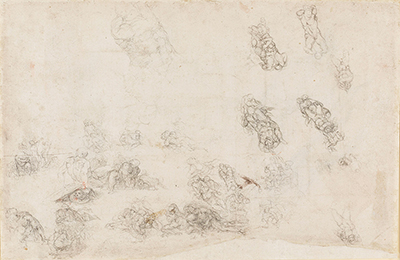
Studies for Figures in the Last Judgement
Michelangelo's Last Judgement seems to suspend an entire human world in motion. Bodies rise, fall, fly, recoil and strain through a space with few stable landmarks. A remarkable double-sided sheet in the British Museum shows that this apparent torrent was built through disciplined study.
Made in 1534, the black-chalk drawing is 40.4 × 27 centimetres and bears the museum number 1860,0616.5. Its principal figure is a foreshortened angel seen largely from the back, his body pitched through space. Smaller trials on both sides pursue that action and other poses.[1]
The sheet is not a miniature version of the altar wall. It is a laboratory for the bodily grammar from which Michelangelo assembled the fresco.
At a Glance
- ArtistMichelangelo Buonarroti
- TitleStudies for the Last Judgement: a Flying Angel and Other Figures
- Date1534
- MediumHard, sharply pointed black chalk on the recto; black chalk on the verso
- Dimensions40.4 × 27 centimetres
- CollectionBritish Museum, London
- Museum number1860,0616.5
- Principal connectionAngel above the column among the bearers of the Instruments of the Passion, upper-right lunette of the Last Judgement
- Other contentsRepeated flying-figure trials, arm studies and figures with raised or extended arms
- Fresco dateDesigned from 1534; painted 1536–1541
- StatusAccepted by the British Museum as by Michelangelo, following a substantial history of disagreement
Contents
- The Commission Begins on Paper
- A Flying Angel Without Wings
- Repetition Across Recto and Verso
- Foreshortening as Narrative
- A Wall Without the Ceiling's Architecture
- Model, Memory and Invention
- The Instruments of the Passion
- Chalk, Hatching and the Body's Surface
- Other Motions on the Sheet
- From Study to Wall
- A Family of British Museum Sheets
- The Attribution Debate
- Provenance and the Price of a Study
- How to Look at the Sheet
- Why the Studies Matter
The Commission Begins on Paper
Pope Clement VII asked Michelangelo to paint the altar wall of the Sistine Chapel shortly before the pope died in September 1534. Paul III retained the project. Michelangelo had left Florence for Rome that year and would never return permanently to his native city.[2]
Painting did not begin immediately. The wall had to be prepared, the existing Perugino frescoes and earlier Michelangelo lunettes removed, and an unprecedented population organised.
The British Museum sheet belongs to this opening phase. Its 1534 date makes it evidence of conception rather than a record made after the fresco.
The commission also forced Michelangelo to answer his younger self. More than twenty years had passed since he completed the chapel ceiling. The altar wall required a different solution: not framed Genesis scenes arranged within fictive architecture, but one continuous event in which every body responds to judgement.
A Flying Angel Without Wings
The dominant study prepares an angel in the upper-right lunette, above the column carried as an Instrument of the Passion. Michelangelo's angels have no feathered wings. Their supernatural action must be carried entirely by anatomy, drapery, direction and the surrounding group.[1]
The body is seen from the back and side. Its mass projects through depth, so the artist cannot rely on a clear standing silhouette. Shoulder blades, spine, ribcage and pelvis establish direction.
The model's support has disappeared from the imagined result. On paper, however, somebody or something had to hold the pose. One scholar proposed that a live model balanced on a small portion of his body; another noted that the broad modelling and unusual mechanics could indicate a small sculptural model.[1]
Neither possibility diminishes observation. If a wax or clay figure helped establish the impossible suspension, Michelangelo still translated its volumes into a body that feels muscular and alive.
The head is scarcely developed. This is characteristic economy, not neglect. By withholding its volume, Michelangelo can inspect the shoulder structure that a fully described head would obscure. Lines of the spine enter the area reserved for it.[1]
Repetition Across Recto and Verso
Three earlier trials for the same flying figure appear on the verso, with the paper inverted relative to the recto. They are faster and more vigorously hatched.[1]
The sequence reveals a movement from broad possibility toward a more resolved body. Michelangelo does not merely copy a pose at increasing finish. He changes balance, reach and the relation of limbs.
On the recto, a separate study of the right arm appears at a slightly larger scale. Its position indicates that an earlier torso already occupied the upper left. Paper space preserves order: a later solution must negotiate what was drawn first.
The hand's fingers are omitted because neighbouring drapery would hide them in the group. This is a small but decisive sign that Michelangelo was thinking beyond the isolated model. He knew where another angel would overlap.
Repetition therefore has two functions. It improves an individual body and locates that body within a collective action.
Foreshortening as Narrative
Foreshortening compresses a form pointed toward or away from the viewer. In the fresco, it is more than a display of skill. It creates moral direction.
The saved ascend; the damned are dragged or tumble; angels move with the objects that testify to Christ's Passion. Bodies make invisible judgement spatially intelligible.
The main drawing studies descent or forward flight. Back and torso carry the action before facial expression can explain it.
Michelangelo corrects the left arm and lightly revises the buttocks. Such pentimenti show that believable motion depends upon exact relations. A small change in the arm alters the whole body's centre of gravity.
The final fresco simplifies many of the drawn forms. Seen from the chapel floor, a dense anatomical description could become visual noise. Drawing discovers the structure; painting retains what monumental distance needs.
A Wall Without the Ceiling's Architecture
The Sistine ceiling sorts figures through painted cornices, thrones, medallions and architectural ribs. On the altar wall, Michelangelo largely removed that organising fiction.
Christ stands near the centre within a turning company of saints. Above are the Passion-bearing angels; below, the dead rise at the left while the damned are driven toward hell at the right. Charon's boat introduces imagery from Dante into the Christian apocalypse.
This structure gives direction without conventional horizontal tiers. The drawing of a flying angel belongs to that new spatial language. Its body does not occupy a box; it becomes a vector within a circulating field.
The lack of painted architecture also increases the burden on figure groups. Overlaps, glances and gestures must establish distance where columns or floors do not.
Michelangelo's preparatory sheets are therefore local and systemic at once. A single arm can determine whether the viewer understands one angel passing behind another and, through that overlap, the depth of an entire upper zone.
Model, Memory and Invention
Michelangelo's impossible bodies were grounded in several kinds of evidence. He could draw a living assistant, manipulate a small model and recall poses studied decades earlier.
The alternatives proposed for the principal flying angel should not be reduced to a contest with one winner. A sculptural model might establish the body's unsupported rotation; life study could refine how muscle behaves; memory could provide a familiar reach.
The sheet itself records a hybrid procedure. Some passages are carefully modelled, others abbreviated, and the head is strategically suppressed. Michelangelo does not copy all visible information from one source.
He selects what the final function demands. That is why anatomical credibility can survive a pose no living person could sustain in open air.
The distinction also guards against the romantic myth that every figure was drawn directly from a model in exactly the painted posture. Naturalism is constructed from knowledge, not guaranteed by one sitting.
The Instruments of the Passion
The two upper lunettes contain angels carrying the cross, column, crown of thorns and other instruments associated with Christ's suffering. These objects explain why the judging Christ bears wounds: redemption and judgement are joined.
The British Museum angel moves in the group around the column. Earlier verso studies suggest Michelangelo once imagined the figure holding the Crown of Thorns.[1]
Changing the object changes the action. A crown demands careful presentation; a massive column requires collective transport and bodily force. Michelangelo revised figure and group together.
The corresponding angel in the left lunette reverses aspects of the pose. Reversal helps bind the corners while avoiding literal duplication.
The lunettes were among the first zones painted. Their broad legibility established the visual pressure that would descend as scaffolding was lowered.
Chalk, Hatching and the Body's Surface
The recto uses unusually hard, sharply pointed black chalk. Short curved strokes model the muscles of the back and side of the chest.[1]
Elsewhere the hatching appears parallel or almost mechanical. That quality contributed to disagreement about authorship: some scholars found the handling too broken or mannered for Michelangelo.
Yet the material itself matters. A hard point produces a different line from soft chalk. Dense curved strokes can describe volume while retaining an abrasive, searching surface.
The verso is freer. Vigorous uncrossed hatching allows poses to be tested rapidly. The contrast between faces of the sheet is functional, not necessarily evidence of different hands.
Chalk also enables correction without erasing the record entirely. Reinforced contours and abandoned edges let modern viewers follow decisions that fresco plaster conceals.
Other Motions on the Sheet
Not every figure maps as precisely as the principal angel. On the verso, two upper bodies extend or raise their arms. The pose has distant precedents in Michelangelo's Florentine Bathers and in God the Father on the Sistine ceiling, while a variant appears near Christ in the Last Judgement.[1]
This recurrence is not self-copying in a narrow sense. Michelangelo retained bodily problems—an arm extended from a turning trunk, a back compressed by reach—and reactivated them under new meanings.
One pose can belong to martial alarm, divine creation or final judgement because gesture is transformed by context.
The sheet thus sits within a long memory of drawing. Earlier inventions remain available, but none enters the new fresco unchanged.
From Study to Wall
The principal figure changed during enlargement and painting. Its anatomy was simplified, and some absent limb description remained deliberately unresolved within the group.[1]
This warns against treating a study as a contract. Between small sheet and wall came composition drawings, enlargement, cartoons or other transfer stages, plaster divisions and final revision.
The Last Judgement was painted in sections as scaffolding descended. Vertical sequence mattered: upper groups were resolved before lower zones could be completed.
A drawing made early might therefore preserve an idea later adjusted in response to figures painted months or years afterwards.
The result is coherent without being mechanically predetermined. Paper gave Michelangelo a store of tested bodies flexible enough to meet the wall.
A Family of British Museum Sheets
The museum identifies this as the second in its sequence of five Michelangelo sheets connected with the altar wall.[1] Read together, they range from clustered compositional ideas to close studies of particular resurrected, damned and saintly bodies.
One dense sheet, 1895,0915.518, tests falling groups and individual figures, including the controversial pairing of Saints Blaise and Catherine. Another, acquired only in 1980, studies a figure associated with the Deadly Sins and a body rising from the tomb.[5][6]
The variety matters. Michelangelo did not proceed through one uniform series of cartoons. He shifted scale according to the problem: a crowd might require a knot of shorthand forms, while one foreshortened back demanded sustained modelling.
The five-sheet sequence also reveals survival bias. These are remnants of a much larger body of preparation. They should not be mistaken for a complete visual diary.
What survives is enough to refute spontaneity as the whole explanation, but not enough to reconstruct every intermediate decision.
The Attribution Debate
The sheet has not always been unanimously accepted. Early and twentieth-century scholars variously judged parts autograph, called them copies or connected their nervous line with Battista Franco.[1]
Johannes Wilde defended the drawing through its sequence. The gradual realisation across both sides, he argued, is too internally purposeful for a copyist merely reproducing finished models.
Later scholars continued to disagree, while the British Museum now catalogues Michelangelo as draughtsman. The debate is valuable because famous names should not silence scrutiny.
Attribution considers more than surface resemblance. It asks whether materials, corrections, order, project knowledge and bodily development form a credible act of invention.
Here the hidden fingers, adjusted overlaps and progression from verso trials to recto resolution are especially strong process evidence.
Provenance and the Price of a Study
The sheet passed from Casa Buonarroti through the collections of Jean-Baptiste Wicar and Sir Thomas Lawrence, then through the dealer Samuel Woodburn.[1]
The British Museum acquired it at Christie's in 1860 for £14 3s 6d. The sale description already singled out the descending or flying figure and called the black-chalk study carefully finished.[1]
That modest historic price now feels startling, but monetary value and scholarly certainty are not identical. The sheet's status grew through comparison, publication and exhibition.
Its collection history also explains survival. A working page that might have been discarded became an object protected, mounted and debated.
How to Look at the Sheet
Begin with the principal back and ask where weight would rest if the model were physically posed.
Follow corrections in the left arm and buttocks. Then notice how lightly the head is stated.
Move to the enlarged arm and identify the fingers deliberately withheld for an overlap.
Turn to the verso and compare the three earlier flying trials. Read speed before finish.
Finally locate the painted angel above the column. Look for structural continuity rather than an exact traced duplicate.
Why the Studies Matter
The drawing matters because it restores effort to a fresco famous for overwhelming immediacy. Flight was not improvised. It was balanced, revised and tested through a material body.
It also shows that anatomy and composition were inseparable. Michelangelo omits a head to understand a shoulder and omits fingers because another angel's drapery will cover them.
Most of all, the sheet preserves how the impossible becomes credible. Chalk converts a supported model into a wingless messenger suspended at the edge of the world's end.
Its incompleteness is part of that achievement. The absent fingers, lightly stated head and rejected contours are not deficits awaiting restoration. They are exactly the information Michelangelo no longer needed to repeat. What remains visible is the selective intelligence of preparation: finish intensifies where a problem persists and falls away where group, overlap or distance has already supplied an answer.
That economy is as important as virtuosity. It reveals an artist directing attention, time and material toward decisions that would still matter when a forty-centimetre body became part of an immense public wall.
The transformation also works in reverse for today's viewer. The fresco makes the angel one participant among hundreds; the sheet restores his bodily problem to full attention. Neither version is more “real.” Wall and paper answer different scales of looking, and comparison lets each recover information the other suppresses.
Frequently Asked Questions
Discussion
What details, sources or comparisons stand out to you in Studies for Figures in the Last Judgement?
Reader Insights
Which formal detail changes how the work reads?
Which documented source or collection history feels most useful?
Which related Michelangelo work should readers compare next?
Join the Conversation
Add a source-led observation, comparison or question for other readers.
References
- British Museum, Studies for the Last Judgement: a flying angel and other figures,” 1860,0616.5:, View source.
- British Museum, Michelangelo: The Last Decades, large-print guide:, View source.
- Vatican Museums, The Last Judgement”:, View source.
- British Museum, press release for Michelangelo: The Last Decades:, View source.
- British Museum, Studies for the Last Judgement: groups of falling figures and studies for individuals,” 1895,0915.518:, View source.
- British Museum, Last Judgement study, 1980,1011.46:, View source.