


 by Tom Gurney
Tom Gurney BSc (Hons) is an art history expert with over 20 years experience
Published on June 19, 2020 / Updated on November 6, 2025
Email: tomgurney1@gmail.com / Phone: +44 7429 011000
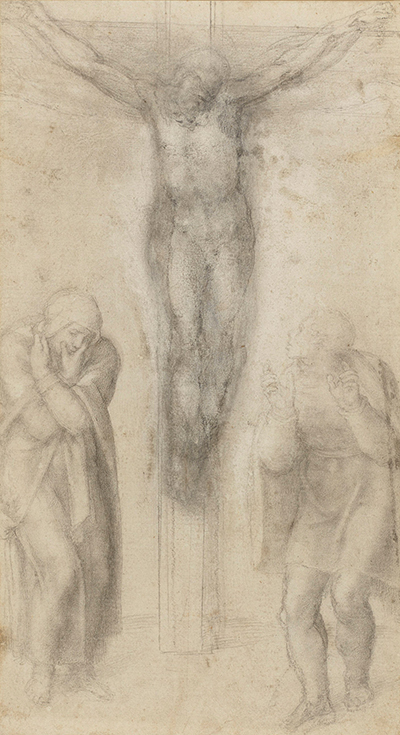
Christ on the Cross between the Virgin and Saint John
Christ hangs high on the cross while the Virgin and Saint John remain below, separated from it and from one another. Mary folds inward, arms crossed tightly against her body. John opens his hands in prayer and astonishment. Michelangelo turns the same death toward two distinct human responses: grief contained and grief released.
The Royal Collection preserves the drawing as RCIN 912775. The British Museum dates it broadly to about 1555–63 and describes its materials as black chalk and lead white on paper.[1] Older image records often give the title Christ on the Cross between the Virgin and St John and a slightly later range, about 1560–64.[2] The word “between” usefully describes the arrangement, but the Royal Collection's current title is Christ on the Cross with the Virgin and St John.
This is one of several Crucifixions Michelangelo drew during his final decade. It is not interchangeable with Royal Collection RCIN 912761, which adds a faint Mary Magdalene and places the cross awkwardly around a body drawn first. Inventory number, subsidiary figures and the mourners' relationship to the cross keep the sheets distinct.
At a Glance
- Controlled titleChrist on the Cross with the Virgin and St John
- Alternative descriptive titleChrist on the Cross between the Virgin and Saint John
- ArtistMichelangelo Buonarroti
- DateAbout 1555–63; also catalogued around 1560–64
- MediumBlack chalk and lead white on paper
- CollectionRoyal Collection
- InventoryRCIN 912775
- FiguresChrist, the Virgin Mary and Saint John the Evangelist
- Key distinctionMary and John stand at a distance from the cross
- FunctionGenerally understood within Michelangelo's late graphic meditations; an altarpiece proposal remains debated
Contents
- The Crucifixion Reduced to Three Figures
- Christ Above the Mourners
- A Head Reworked Beyond Certainty
- The Virgin's Crossed Arms
- Saint John's Open Hands
- Distance from the Cross
- “Behold Your Son”
- Black Chalk and Lead White
- An Old Artist's Unsteady Hand
- A Series Without a Single Final Version
- From Vittoria Colonna to the Final Decade
- Copies and the Y-Shaped Cross
- Poetry, Mortality and Grace
- How to Look at the Drawing
- Why This Crucifixion Matters
The Crucifixion Reduced to Three Figures
The Gospels place soldiers, bystanders and followers at Golgotha. Large Renaissance Crucifixions could include crowds, horses, thieves, angels and a landscape darkened by eclipse.
Michelangelo removes almost everything. The cross, Christ and two witnesses are sufficient.
Reduction changes the image from public execution to private confrontation. There is little narrative distraction and no need to identify successive episodes. The viewer faces the death itself and the problem of responding to it.
Mary and John represent more than two historical witnesses. They become models of lamentation, contemplation and prayer. Their different gestures allow viewers to recognise emotional states without a crowded story.
The blank paper magnifies silence. Empty space between the figures is not unfinished background; it is the distance grief cannot cross.
Christ Above the Mourners
Christ's vertical placement dominates the sheet. His extended arms establish a horizontal measure while his body descends through the upright.
Michelangelo does not emphasise wounds, blood or the physical machinery of execution. The body remains the carrier of suffering.
Weight is crucial. Unlike some triumphant Crucifixions in which Christ appears to stand against the cross, late Michelangelo allows the torso and head to sag. Salvation is expressed through an exhausted human body rather than escape from one.
The figure's relative isolation also separates divine sacrifice from human reaction. Mary and John cannot support him physically. Their gestures take place beneath an event already accomplished.
That helplessness gives the page its severity. The witnesses possess love but no remedy.
A Head Reworked Beyond Certainty
The British Museum notes that Michelangelo heavily reworked Christ's head, making it unclear whether he looks toward the Virgin or Saint John.[1]
This ambiguity was made, not merely caused by damage. Repeated chalk marks preserve alternatives around the smallest and most spiritually charged part of the figure.
A turn toward Mary could intensify the exchange between dying son and mother. A turn toward John could recall Christ's words from the cross, entrusting Mary to the beloved disciple. A downward, indeterminate fall could emphasise death rather than communication.
Michelangelo does not resolve those possibilities cleanly. The head remains an area where relation itself is uncertain.
Late style here is not vagueness without purpose. Reworking allows several devotional readings to coexist. The viewer must move between them as Michelangelo's chalk moved across the paper.
The Virgin's Crossed Arms
Mary huddles into herself, crossing her arms tightly. The gesture can suggest self-support: the body braces against what it sees.
Crossed arms also have a devotional history. They can signify humility, submission or inward prayer. At the Annunciation, Mary sometimes crosses her hands as she accepts the divine will. At the Crucifixion, similar enclosure acquires the cost of that consent.
Her pose does not turn grief into elegant decorum. Compression conveys turbulence precisely because movement has been held in.
Michelangelo may also have drawn upon a much earlier visual memory. A nude man shivering in Masaccio's Baptism of the Neophytes in the Brancacci Chapel crosses his arms over his chest. A drawing after that figure remained available to Michelangelo, and scholars have connected its posture with mourners in the late Crucifixions.[3]
The transformation is profound: a body reacting to cold becomes a mother containing spiritual agony.
Saint John's Open Hands
John offers the compositional opposite. His arms rise and his hands open.
The British Museum describes the pose as an ancient gesture of prayer and wonder.[1] In early Christian and classical imagery, the orans figure prays with hands raised, making the body itself an address to heaven.
John's gesture can therefore contain lament, appeal and recognition. He does not simply throw his hands up in theatrical despair.
Placed opposite the enclosed Virgin, he creates an emotional spectrum. Mary draws pain inward; John lets it travel upward.
The two gestures keep the image from prescribing one correct response. Faith at the cross may be silent endurance or astonished prayer.
Christ's uncertain gaze connects them. Because his head does not clearly choose one witness, neither response is privileged.
Distance from the Cross
In another late Crucifixion at the British Museum, the Virgin presses her cheek to Christ's leg while John stands close and looks upward.[1] RCIN 912775 keeps both witnesses away.
Distance makes each figure isolated. The cross occupies the centre, but no hand reaches it.
This can be read psychologically: overwhelming grief freezes approach. It can also be compositional, allowing the three bodies to remain distinct emblems within the page.
The separation produces a wide field of paper around the cross. That emptiness resembles the inward space of prayer more than the geography of Calvary.
Comparing versions shows Michelangelo varying not the doctrine but the human access to it. In one sheet, touch is possible; in another, loss is measured by the inability to touch.
“Behold Your Son”
John's Gospel places Mary and the beloved disciple beside the cross. Christ addresses them in turn, entrusting each to the other: woman, behold your son; behold your mother.[6]
That episode made the Virgin and John a new spiritual family formed at the moment of Christ's death. Their presence is therefore not merely conventional symmetry beneath the cross.
RCIN 912775 gives the relationship an unresolved character. Mary and John do not turn toward one another. Each responds to Christ separately, and the uncertain direction of his head leaves the act of address open.
The blank interval between them can consequently signify more than loneliness. A bond has been spoken, but grief has not yet allowed it to become bodily contact.
Michelangelo's reduction lets a Gospel exchange remain present without literalising speech. Gesture and gaze carry words the drawing does not write.
Black Chalk and Lead White
Black chalk constructs bodies through line and shadow. Lead white restores highlights or covers earlier marks, allowing Michelangelo to revise as well as illuminate.[1]
Lead white can discolour over time. Passages intended to be light may darken, changing the balance of the sheet and making corrections more visible.
This matters when interpreting late drawings. Their present appearance is the result of both Michelangelo's hand and material ageing.
White is especially important around a body understood as the source of salvation. Yet it should not be reduced to spiritual symbolism. It is also a practical drawing material used to clarify form and alter decisions.
The combination makes the sheet additive and subtractive. Michelangelo darkens with chalk, lightens with white and repeatedly renegotiates the body.
An Old Artist's Unsteady Hand
Michelangelo was in his eighties during much of the period assigned to the drawing. The British Museum's late-years research emphasises how rulers could help his increasingly unsteady hand establish straight architectural or cruciform lines.[1]
Physical difficulty should not be mistaken for intellectual decline. The late Crucifixions are concentrated, variable and deeply considered.
Their tremor can intensify vulnerability. Lines do not seal the sacred body inside polished perfection; they search, double and weaken.
Michelangelo had spent a lifetime making bodies appear superhumanly controlled. In these sheets, loss of manual certainty becomes compatible with a theology of dependence upon grace.
The drawing does not simply document age. It turns the conditions of ageing into expressive means.
A Series Without a Single Final Version
Michelangelo returned to the Crucifixion across sheets now in Windsor, London, Paris and Oxford. Christ may hang alone or appear with mourners; companions approach or withdraw; cross and body shift relation.
The group does not behave like a conventional sequence steadily resolving one commissioned picture. No surviving final painting gathers all the studies into an authoritative endpoint.
Scholars have proposed that Michelangelo contemplated a large Crucifixion, perhaps even an altarpiece for the Pauline Chapel to be executed by an associate such as Marcello Venusti.[4] The proposal is worth discussing, but it remains a hypothesis.
The drawings can also be understood as self-contained spiritual exercises. Repetition was the purpose: each sheet reopened rather than closed the subject.
RCIN 912775 should consequently be read as a complete meditation and one member of a changing family.
From Vittoria Colonna to the Final Decade
Michelangelo had made a celebrated Crucifixion drawing for Vittoria Colonna around 1540. That presentation design shows Christ alive, looking upward, with no Virgin or John beneath him.[5]
The late series changes the emotional register. Bodies hang more heavily, and witnesses become central to the act of looking.
Colonna died in 1547, but the spiritual concerns they shared continued to shape Michelangelo's poetry and sacred imagery. Both were associated with reform-minded Catholic circles that emphasised faith, grace and Christ's sacrifice.
It would be too simple to claim every late Crucifixion was “for” Colonna. The documented gift and the later sheets differ in date, format and function.
Her importance lies in the longer devotional conversation through which Michelangelo had learned to make drawing an instrument of religious thought.
Copies and the Y-Shaped Cross
A drawing by an artist in Michelangelo's close circle copies RCIN 912775. Christie's notes that the copy was probably made shortly after the original and has a watermark used in Rome around 1566.[4]
The copyist introduced a Y-shaped cross not present in Michelangelo's sheet. That archaic form was known to Michelangelo through a crucifix at Santa Croce, according to Ascanio Condivi, but its appearance in the copy must not be retroactively assigned to RCIN 912775.[4]
The difference demonstrates how transmission works. A close follower can preserve principal figures while changing a structurally important object.
Copies are valuable evidence for early admiration and access. They are not neutral duplicates.
Their variations help reconstruct the composition's reception and warn against identifying every repeated feature as Michelangelo's own decision.
Poetry, Mortality and Grace
Michelangelo's late poems increasingly turn from earthly achievement toward salvation. In a sonnet sent to Giorgio Vasari, he describes worldly art and love as insufficient at the approach of death and places hope in Christ.[1]
The Crucifixion sheets make a related movement without illustrating a specific poem. Art no longer advertises mastery alone; it becomes a means of confronting what mastery cannot secure.
Mary and John embody the human condition beneath the cross. Their gestures do not earn redemption. They receive, endure and appeal.
Michelangelo's repeated revisions correspond to spiritual searching. The image is returned to because no single arrangement exhausts it.
The connection between poetry and drawing is therefore thematic and procedural, not a simple caption-to-image equation.
How to Look at the Drawing
Start with the distance between the mourners and the cross. Treat the paper separating them as meaningful.
Compare Mary's crossed arms with John's lifted hands.
Then examine Christ's head and allow its direction to remain unresolved.
Look for pale passages of lead white and consider how ageing may have changed them.
Finally, compare the inventory number before consulting another late Crucifixion. Similar titles conceal different figures, gestures and stages of making.
Why This Crucifixion Matters
RCIN 912775 matters because Michelangelo gives grief two bodies and refuses to reconcile them. Mary closes around pain; John opens toward mystery.
Christ's reworked head holds both within an uncertain final relation. Chalk and lead white make the sacred scene vulnerable to revision and time.
Far from a diminished repetition by an elderly artist, the sheet is a rigorous spiritual experiment. It asks not only what the Crucifixion looked like, but what a human body can do when confronted by it.
Frequently Asked Questions
Discussion
What details, sources or comparisons stand out to you in Christ on the Cross between the Virgin and St John?
Reader Insights
Which formal detail changes how the work reads?
Which documented source or collection history feels most useful?
Which related Michelangelo work should readers compare next?
Join the Conversation
Add a source-led observation, comparison or question for other readers.
References
- British Museum, Michelangelo: The Last Decades, large-print guide, entry for RCIN 912775 and the late Crucifixion group, View source.
- Royal Collection Trust, Christ on the Cross with the Virgin and St John, RCIN 912775, View source.
- Christie's, Michelangelo, A Nude Man (after Masaccio) and Two Figures Behind Him, discussion of the early study's reuse in RCIN 912761 and 912775, View source.
- Christie's, Circle of Michelangelo, Christ on the Cross between the Virgin Mary and Saint John, early copy after RCIN 912775, View source.
- British Museum, Michelangelo's presentation drawing of Christ on the Cross for Vittoria Colonna, 1895,0915.504, View source.
- John 19:25–27, New Revised Standard Version Updated Edition, View source.