


 by Tom Gurney
Tom Gurney BSc (Hons) is an art history expert with over 20 years experience
Published on June 19, 2020 / Updated on November 6, 2025
Email: tomgurney1@gmail.com / Phone: +44 7429 011000
Christ on the Cross with the Virgin and Saint John
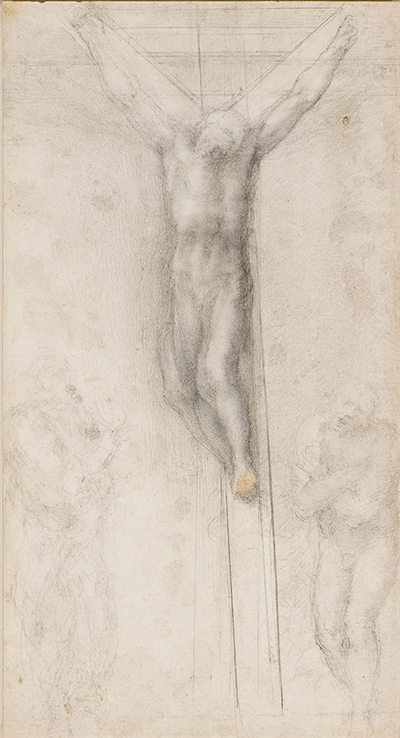
Michelangelo began with Christ. Only afterward did he add the cross, the Virgin, Saint John and the faintest suggestion of Mary Magdalene. That order of making gives this late Crucifixion its peculiar tension: the instrument of execution has to accommodate a body that already exists.
The Royal Collection preserves the sheet as RCIN 912761. The British Museum dates it to 1555–63 and identifies black chalk, white heightening and touches of red chalk on paper.[1] A study of a leg appears on the verso.[2]
The composition is often titled Christ on the Cross with the Virgin and St John, but the apparently three-figure name is incomplete as description. A barely visible Magdalene kneels to embrace the cross. Recognising her helps distinguish RCIN 912761 from the related Windsor sheet RCIN 912775, where Mary and John stand at a greater distance and respond through crossed versus raised arms.
At a Glance
- TitleChrist on the Cross with the Virgin and St John
- ArtistMichelangelo Buonarroti
- DateAbout 1555–63; sometimes narrowed to about 1560–64
- MediumBlack chalk and white heightening, with touches of red chalk
- CollectionRoyal Collection
- InventoryRCIN 912761
- RectoCrucified Christ with the Virgin, Saint John the Evangelist and a faint Mary Magdalene
- VersoStudy of a leg
- Sequence of makingChrist's body first; cross and companions added later
- Technical aidA ruler helped establish the cross
Contents
- The Body Before the Cross
- Christ's Weight
- The Cross at an Angle
- The Virgin and Saint John
- The Almost Invisible Magdalene
- Three Forms of Nearness
- A Leg on the Verso
- Black, Red and White
- The Late Crucifixion Family
- Was Michelangelo Preparing an Altarpiece?
- Crucifixion and Michelangelo's Poetry
- Memory of Earlier Art
- The Difference from RCIN 912775
- A Body Drawn Near Death
- How to Look at the Drawing
- Why This Crucifixion Matters
The Body Before the Cross
Most artists designing a Crucifixion could begin with the cross as a stable armature. Its upright and transverse beam organise every other element.
Michelangelo reversed that logic. According to the British Museum's close study, he drew Christ's body before adding the cross.[1]
This makes the body conceptually primary. The cross is not a grid upon which anatomy is displayed; it arrives as the object required by the body's pose.
The feet forced an adjustment. To meet their existing position, the upright had to be set at an awkward angle.[1] The slight mismatch remains visible as evidence of process.
What might look like clumsiness is one of the sheet's most revealing features. Michelangelo did not erase the body and restart from perfect geometry. He made the structure answer to embodied suffering.
Christ's Weight
The body hangs rather than stands. Chest, abdomen and legs descend through the page with the accumulated weight characteristic of Michelangelo's final Crucifixions.
Earlier Renaissance images sometimes present Christ as serenely victorious, arms extended with little strain. Michelangelo's late figure retains dignity but does not escape gravity.
The head slumps. Repeated marks around torso and limbs make the body feel difficult to sustain, as though drawing itself were labouring against collapse.
There is little emphasis on blood. Suffering is communicated through structure: shoulders pulled by extended arms, torso lengthened, legs gathered and head yielding.
The result is both physical and theological. Christian salvation depends upon a real death; Michelangelo refuses to make the body merely a diagram of doctrine.
The Cross at an Angle
Because the cross was added after Christ, its upright is not comfortably centred. Michelangelo used a ruler, likely to steady an ageing hand and create the long straight line.[1]
The mechanical aid did not eliminate irregularity. Instead, exactness and adjustment coexist.
The ruler is poignant because Michelangelo had spent decades drawing architecture and carving enormous stones with formidable control. In his eighties, a simple tool helped him make one line dependable.
This should not be romanticised as pure decline. Renaissance artists routinely used straightedges, compasses and styluses. What is unusual is how visibly the cross negotiates with a freehand body.
Its lean can make the scene feel unstable, but it also records priority: the sacred figure was imagined before the instrument around him.
The Virgin and Saint John
Mary and John stand near the foot of the cross, their forms more lightly established than Christ's.
Their proximity draws the Crucifixion toward the devotional type in which the two principal witnesses flank the saviour. Yet they do not form rigid symmetrical supports.
Mary's body conveys maternal mourning while John looks toward Christ. Their gestures are less self-contained than those in RCIN 912775, where distance from the cross becomes the governing fact.
The lighter drawing can suggest that they arrived as thoughts after the central body. This is materially true of their making and spiritually apt: witnesses gather around an event they did not control.
Their incompleteness also protects Christ's dominance. The page is not a group portrait of equal figures; it is a meditation expanding outward from the crucified body.
The Almost Invisible Magdalene
A very faint Mary Magdalene kneels near the cross and embraces it.[1]
Her presence is easy to miss in reproduction and absent from the usual short title. Yet she changes the emotional architecture.
The Magdalene is traditionally associated with penitence, faithful presence and physical devotion at Christ's Passion. While Mary and John stand, she descends toward the base of the cross and makes contact.
Her faintness may indicate a late, tentative addition rather than a fully resolved member of the group. Michelangelo tested the possibility without giving her equal graphic weight.
The figure also demonstrates why a title cannot substitute for looking. “With the Virgin and Saint John” identifies the principal companions but not every mark on the sheet.
For accurate object identity, the Magdalene is one of RCIN 912761's defining clues.
Three Forms of Nearness
The companions organise three different distances from Christ. Mary stands within the sacred group as mother; John stands as beloved disciple and future son entrusted to her; the Magdalene lowers herself to the wood.
Her embrace gives the cross a tactile reality absent from the title. It is not merely the sign behind Christ but an object that can be grasped.
Medieval and Renaissance devotion often imagined physical closeness to the instruments of the Passion. Relics of the True Cross, meditations on Christ's wounds and images of the Magdalene at the foot of Calvary helped believers approach an event they knew only through scripture and worship.
Michelangelo gives that impulse the lightest possible body. The kneeling figure is almost a thought of touch.
Her faintness keeps the sheet from becoming a four-figure narrative, yet her action completes its emotional range: Mary mourns, John witnesses, and Magdalene clings.
A Leg on the Verso
The reverse carries a study of a leg, dated with the Crucifixion to Michelangelo's final years.[2]
The presence of an isolated limb returns attention from sacred narrative to bodily problem. Even in an intensely devotional series, salvation is drawn through anatomy.
Recto and verso also reveal the economy of paper. Michelangelo used both faces rather than treating the sheet as a pristine support for one polished image.
The leg should not automatically be assigned to the recto Christ without detailed correspondence. It may be related experimentation or an independent late study.
Its value lies in the conversation it creates: the front shows a body under spiritual and gravitational burden; the back isolates one of the structures that carries that burden.
Black, Red and White
Black chalk provides the principal figures. Touches of red chalk introduce another stage or notation, while white heightening modifies the toned field and reclaims light.[1]
The materials allow correction without complete erasure. White can cover or redirect a contour; black can return over it; red can preserve a subsidiary thought.
Some white heightening has partially discoloured in Michelangelo's late drawings. Material change may make intended highlights appear darker or more emphatic than they once were.
The sheet is therefore not transparent evidence. We see Michelangelo's revisions through five centuries of chemical and physical ageing.
This complexity suits a work whose meaning depends upon reworking. Body, cross and companions were not conceived all at once, and their materials still disclose the sequence.
The Late Crucifixion Family
During roughly the last decade of his life, Michelangelo drew the Crucifixion repeatedly. Important sheets survive in the Royal Collection, British Museum, Louvre, Ashmolean and Courtauld.
The configurations vary. Christ can appear alone; Mary and John may press against the cross or stand away; the Magdalene may be added almost invisibly; the cross may be firm, faint or adjusted.
No single sheet cancels the others. Repetition allowed Michelangelo to test distinct emotional and theological relations.
RCIN 912761 is especially concerned with emergence. The body generates the cross, then draws witnesses around itself.
That makes it different from a preparatory chain marching toward a fixed composition. The series resembles sustained prayer, where returning to the same words does not make each utterance redundant.
Was Michelangelo Preparing an Altarpiece?
One scholarly proposal connects the late Crucifixion group with a possible altarpiece for the Pauline Chapel, perhaps to be painted by Marcello Venusti or another associate.[3]
Michelangelo had used this collaborative method for the Annunciation, Cleansing of the Temple and other late sacred designs. An unrealised painted destination is therefore plausible.
It is not proved. No surviving contract, finished altarpiece or definitive cartoon establishes RCIN 912761 as a formal stage in that project.
The sheet's process can even support the alternative view that it was a private graphic meditation. Figures accumulate freely, and the cross adapts awkwardly rather than being engineered for transfer.
The strongest account preserves both possibilities: collaborative ambition may have existed, while devotional drawing remains the most evident activity.
Crucifixion and Michelangelo's Poetry
Michelangelo's late sonnets increasingly confront death, judgement and the insufficiency of worldly achievement. Christ's sacrifice becomes the ground of hope.
The drawings and poems share an economy of return. Lines are revised; phrases are rewritten; the artist tests how to turn personal fear toward grace.
RCIN 912761 does not illustrate one named sonnet. Its affinity with the poetry lies in the priority it gives Christ's body over artistic display.
The awkward cross is especially resonant. It refuses an image of faultless making just when Michelangelo's verse questions the ultimate value of art.
The sheet remains a work of immense skill, but its skill serves dependence rather than self-celebration.
Memory of Earlier Art
The late mourners draw upon a lifetime of visual memory. Scholars have connected certain folded or distressed poses in the Crucifixion series with a shivering neophyte in Masaccio's Brancacci Chapel frescoes, copied by the young Michelangelo.[4]
Such reuse bridges the beginning and end of his career. A bodily reaction studied in Florence around 1490 could reappear in Rome more than sixty years later as sacred grief.
Michelangelo did not reproduce the source mechanically. He transformed its emotional function.
The process helps explain why the late sheets are spare but not simple. Each mark can carry decades of stored bodies—from Masaccio, antiquity, Michelangelo's own frescoes and sculpture.
Old age narrows the cast while deepening memory.
The Difference from RCIN 912775
The two Windsor sheets are easily confused because their titles name the same central trio and their dates overlap.
RCIN 912775 places Mary and John at a distance. Mary crosses her arms; John raises his hands. Christ's head is heavily reworked, leaving its gaze uncertain.
RCIN 912761, the present sheet, was built from Christ outward. The cross was added at an angle, a faint Magdalene kneels at its base, and a leg study appears on the verso.
These are not alternate photographs or front and back of one object. They are separate papers with separate inventory numbers.
The distinction matters because Michelangelo's late practice depends upon variation. Merging the sheets destroys the very process the series preserves.
A Body Drawn Near Death
Michelangelo worked on these images when his own mortality was no abstraction. He died in February 1564 at eighty-eight.
It is tempting to read every wavering contour as autobiography. Such direct equivalence would be simplistic: the Crucifixion was a central Christian subject, and an artist's physical age does not turn every sacred body into a self-portrait.
Still, the convergence of late poetry, repeated Crucifixions and the Rondanini Pietà makes mortality an unavoidable context.
Michelangelo no longer approached Christ only as the perfect nude or supreme anatomical challenge. The hanging body became the image through which artistic labour, bodily weakness and hope beyond death could meet.
RCIN 912761 is moving because its corrections do not hide that meeting.
How to Look at the Drawing
Begin with Christ rather than the cross. Try to see the body as it existed before the straight lines were added.
Follow the upright and notice its uneasy accommodation to the feet.
Find Mary and John, then search for the much fainter kneeling Magdalene at the base.
Look for changes of material: black construction, touches of red and white correction.
Finally, remember the reverse. The isolated leg belongs to the same physical paper, even when display allows only one face to be seen.
Why This Crucifixion Matters
RCIN 912761 exposes the order of Michelangelo's thought. He imagined the sacrificed body, built the cross around it and gradually admitted witnesses into the field.
The resulting irregularity is not a failure of composition. It is the page's central truth: salvation is not subordinated to perfect geometry.
The faint Magdalene, ageing white and reverse leg keep the object open. It is at once a sacred image, a worked sheet and a record of an elderly hand repeatedly returning to the body on which his hope depended.
Frequently Asked Questions
Discussion
What details, sources or comparisons stand out to you in Christ on the Cross with the Virgin and St John?
Reader Insights
Which formal detail changes how the work reads?
Which documented source or collection history feels most useful?
Which related Michelangelo work should readers compare next?
Join the Conversation
Add a source-led observation, comparison or question for other readers.
References
- British Museum, Michelangelo: The Last Decades, large-print guide, entry for RCIN 912761 and the late Crucifixion group, View source.
- Royal Collection Trust image record, Verso: Study of a Leg,” RCIN 912761, reproduced through Wikimedia Commons, View source.
- Christie's, Circle of Michelangelo, Christ on the Cross between the Virgin Mary and Saint John, discussion of the Pauline Chapel proposal and late series, View source.
- Christie's, Michelangelo, A Nude Man (after Masaccio) and Two Figures Behind Him, discussion of its survival and reuse in the late Crucifixions, View source.
- Royal Collection Trust, Christ on the Cross with the Virgin and St John, RCIN 912761, View source.