


 by Tom Gurney
Tom Gurney BSc (Hons) is an art history expert with over 20 years experience
Published on June 19, 2020 / Updated on November 6, 2025
Email: tomgurney1@gmail.com / Phone: +44 7429 011000
Madonna del Silenzio
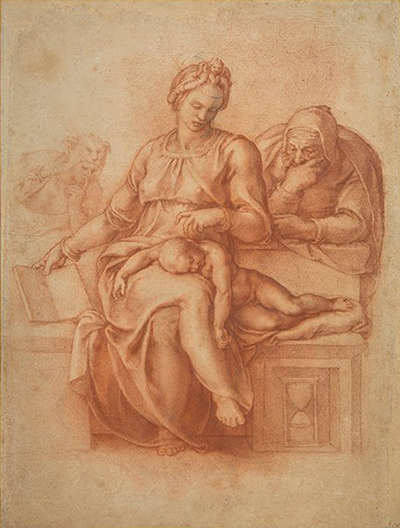
The infant Christ sleeps across his mother's lap. Mary lifts a transparent veil while reading an open book. Joseph watches from behind, and the young Saint John raises one finger to his lips. The gesture gives the design its enduring name: Madonna del Silenzio, the Madonna of Silence.
Michelangelo drew the composition in red chalk around 1538–40. The original belongs to the Portland Collection at Welbeck, where the Harley Foundation identifies it as one of his presentation drawings.[1] It is the beginning, not the end, of the work's history. Marcello Venusti and his circle produced many painted versions; Giulio Bonasone engraved the design in 1561; other prints, copies and adaptations carried it far beyond the original sheet.[2][3]
That afterlife can easily blur authorship. Michelangelo made the governing drawing. He did not personally paint every Silenzio panel or cut every print plate. Each derivative object requires its own maker, date, material and direction to be named.
At a Glance
- TitleMadonna del Silenzio or Madonna of Silence
- Artist of the original designMichelangelo Buonarroti
- DateAbout 1538–40
- MediumRed chalk on paper
- TypePresentation drawing
- CollectionThe Portland Collection, Welbeck
- SubjectHoly Family with the infant Saint John the Baptist
- Naming gestureSaint John holds a finger to his lips beside the sleeping Christ
- Major painted interpreterMarcello Venusti and his circle
- Print transmissionEngraved by Giulio Bonasone in 1561; copied in reverse by later printmakers
- Central themeChrist's sleep as a prefiguration of death, watched in contemplative silence
Contents
- A Holy Family Suspended in Quiet
- Saint John's Finger
- The Sleeping Christ as a Future Pietà
- The Veil and the Act of Revelation
- The Open Book
- Joseph at the Threshold
- A Presentation Drawing
- Red Chalk and Finished Thought
- Marcello Venusti and the Painted Tradition
- Designer and Painter
- Giulio Bonasone's Engraving
- Variants, Additions and the Problem of the “Original Painting”
- Silence, Prayer and Private Scale
- The Portland Collection
- How to Look at the Composition
- Why the Madonna del Silenzio Matters
A Holy Family Suspended in Quiet
The composition contains four sacred figures but almost no outward action. Christ sleeps. Mary supports him and handles the veil. Joseph leans over the group. The young Baptist commands silence.
This quiet is not empty. Each figure attends to the child in a different mode. Mary combines physical care with reading; Joseph witnesses; John interprets; Christ lies wholly vulnerable.
The group forms a compact devotional theatre. The gesture of silence turns viewers into participants: we too are asked to lower our voices, slow our looking and recognise what the sleep signifies.
Michelangelo transforms a familiar domestic sight into a meditation on sacred time. A sleeping infant belongs to ordinary family life. In Christian imagery, however, Christ's closed eyes and slack body could anticipate the entombed saviour.
Silence is therefore both practical and prophetic. The child should not be awakened, but the viewer should awaken to his future death.
Saint John's Finger
The young Saint John the Baptist stands at the left, identifiable by his animal-skin garment. He raises his index finger to his lips.[2]
John is Christ's forerunner in the Gospels. As an adult, he announces the coming Messiah and points others toward him. Michelangelo adapts that prophetic role to infancy: John does not proclaim aloud but directs attention through silence.
The gesture controls the composition. Without it, the scene could be called simply a Holy Family with a sleeping child. With it, quiet becomes the subject.
It also changes the viewer's relationship to the image. John's eyes and hand operate across the picture boundary, instructing those outside the family circle how to behave.
The silence is not secrecy in the ordinary sense. The open book, lifted veil and prophetic child all disclose meaning. Michelangelo joins revelation to restraint: the mystery is shown, but it must be contemplated rather than consumed quickly.
The Sleeping Christ as a Future Pietà
Christ lies diagonally across Mary's lap, his body heavy with sleep. The arrangement recalls the dead adult Christ placed across the Virgin in images of the Pietà.
The National Trust's record for a late-sixteenth-century painted version makes this prefiguration explicit, describing the slumped child as an anticipation of the Lamentation.[2]
Michelangelo had carved the Vatican Pietà around four decades earlier and continued to revisit mother-and-son groups throughout his life. The Silenzio does not duplicate that sculpture, but it activates the viewer's memory of it.
Sleep offered Christian artists a visual analogy for death that stopped short of tragedy. The child will wake; Christ will rise. The body can therefore suggest both mortality and resurrection.
This double meaning gives the family's quiet its gravity. They do not merely admire a peaceful infant. They seem to contemplate the whole sequence of sacrifice and redemption concentrated in his repose.
The Veil and the Act of Revelation
Mary lifts a transparent veil from Christ's body. In painted versions, the fabric can become almost palpable: a thin boundary between concealment and sight.
The National Trust interprets this action in relation to the revelation of Truth.[2] The meaning is strengthened by the open book in Mary's other hand. Word and image, prophecy and fulfilment, meet over the child.
A veil can protect, mourn, conceal or reveal. Here Mary's motion does not expose the infant theatrically. It is measured, suited to the hush John commands.
The gesture also echoes the viewing of art. A sacred image is itself a material veil through which believers seek invisible truth. Michelangelo makes that process part of the composition: Mary models how revelation should be approached carefully.
Painted interpreters faced a technical challenge the red-chalk drawing could only suggest. They had to make translucent cloth visible without letting it become opaque. Their solution was an original contribution within Michelangelo's design.
The Open Book
In several painted versions, Mary's book is legible enough to invite scriptural identification. The National Trust catalogues the opening as Psalm 85:11 in its numbering, a verse joining mercy, truth, righteousness and peace.[2]
The book grounds the Holy Family in a history of prophecy. Mary reads while the promised child rests upon her body; text has become flesh.
It also distinguishes her contemplation from passive dreaming. She interprets. Her maternal role includes intellectual and spiritual attention.
Specific lettering may vary among painted copies, and the surviving design should not be made responsible for every later inscription. A painter could sharpen, alter or expand what Michelangelo indicated.
The most secure point is structural: book, veil and child form a sequence of reading, revealing and seeing. Sacred knowledge moves from page to body.
Joseph at the Threshold
Joseph appears behind the principal group, often at the right. His position is subordinate but not disposable.
He watches rather than touches, occupying the edge between family intimacy and the viewer's space. His presence completes the Holy Family and provides an adult witness to the prophetic exchange between Mary and John.
Painted versions sometimes embed the figures within a marble-panelled interior. The National Trust describes that architecture as sarcophagus-like, strengthening the burial associations already carried by Christ's pose.[2]
Joseph's partial emergence from behind the bench or structure can make him seem to enter the contemplation gradually. He is neither a distant background figure nor a co-equal visual centre.
Michelangelo's economy allows a small change of height or gaze in a copy to alter Joseph's role. Comparing versions reveals how painters interpreted the quiet: as domestic gathering, devotional vigil or preview of mourning.
A Presentation Drawing
The Harley Foundation calls the original a presentation drawing and dates it to 1538–40.[1] Such drawings were highly finished works made as gifts rather than routine workshop studies.
Michelangelo's presentation sheets helped transform drawing into an independent, prestigious art. Mythological examples made for Tommaso de' Cavalieri demonstrate how chalk could carry intellectual invention, technical refinement and personal exchange.
The original recipient of the Madonna del Silenzio should not be asserted without secure evidence. Its category tells us about finish and circulation, not automatically about ownership.
As a gift drawing, the work could sustain private contemplation before it became a model for widespread reproduction. Those functions are not mutually exclusive. A prized sheet could generate copies precisely because its invention was admired.
Its survival in the Portland Collection preserves the originating hand even though many viewers first encountered the composition through paint or print.
Red Chalk and Finished Thought
Red chalk gives bodies warmth while retaining the directness of drawing. Michelangelo could move from light construction to dense modelling without changing medium.
The colour is especially apt for a subject poised between living flesh and anticipated sacrifice. It need not be read symbolically as blood, but its warmth makes the child's body palpably human.
In a presentation drawing, finish does not mean every area receives equal detail. Michelangelo directs concentration toward faces, hands, drapery and the sleeping body while allowing less essential passages to support them.
Chalk also preserves pressure. Darkening and repeated strokes record decisions even within a polished object.
Painted versions inevitably regularise some of this energy. They add colour, architecture and smooth surfaces, gaining new devotional appeal while changing the intimacy of Michelangelo's marks.
Marcello Venusti and the Painted Tradition
Marcello Venusti was one of the most important interpreters of Michelangelo's late sacred designs. He translated chalk inventions into small paintings suited to chapels and private devotion.
The Silenzio became exceptionally prolific. The National Trust states that more than twenty versions were produced by Venusti and his studio.[2] This number should be understood as a family of related objects, not twenty autograph works by one hand.
An oil-on-copper version at Ickworth, dated broadly to about 1560–99, is assigned to the circle of Venusti. It measures 40.6 by 30.5 centimetres.[2] Its material, date and attribution belong to that particular object, not to Michelangelo's original drawing.
Another painted version connected with Venusti is in the Gallerie Nazionali d'Arte Antica, Rome. Versions and adaptations are also recorded in the National Gallery, London; the Walker Art Gallery, Liverpool; and the Ashmolean Museum, Oxford, with variations in landscape, drapery and added angels.[2]
The abundance shows how effectively Michelangelo's design could survive reinterpretation. It also makes precise cataloguing indispensable.
Designer and Painter
Calling a painted Madonna del Silenzio “by Michelangelo” confuses invention with execution. Calling it merely a copy can undervalue the painter's work.
Michelangelo determined the principal bodies, gestures and theological relationships. Venusti or another painter selected colour, support, scale, surface, setting and degrees of translucency. A workshop assistant might repeat an established model; a later follower might combine it with new elements.
Authorship therefore operates in layers:
1. Michelangelo devised the composition in the presentation drawing. 2. A painter translated or adapted that composition. 3. Workshop repetition multiplied successful versions. 4. Printmakers reversed, simplified or disseminated it in another medium.
This structure is not a modern complication imposed upon the work. It is how the design entered sixteenth-century visual culture.
Giulio Bonasone's Engraving
Giulio Bonasone engraved the composition in 1561.[3] Print allowed a design rooted in a unique sheet to circulate in multiple impressions.
Engraving converts chalk's soft modelling into systems of lines. Cross-hatching must simulate shadow; contours become reproducible; inscriptions can name or frame the subject.
Because printing reverses the plate, direction matters. A later British Museum engraving is catalogued as a copy in reverse of Bonasone's plate after Michelangelo.[3] Its orientation therefore results from two stages of transfer.
“After Michelangelo” identifies the source of design, not the hand that engraved the impression. Bonasone remains the maker of his plate, and the anonymous or separately named copyist remains responsible for a later one.
Prints did more than preserve the image. They established the finger-to-lips gesture and title as widely recognisable features, helping create the composition's fame.
Variants, Additions and the Problem of the “Original Painting”
The many painted versions do not all reproduce the same surrounding world. Some place the group in an austere interior; others open a landscape. One adaptation adds putti drawing back curtains above the Holy Family.[2]
Such changes may come from Venusti, his studio or later artists. They can reflect patron taste, available support, desired symbolism or the need to distinguish a new object within a popular family.
There is no reason to assume that a single surviving painting contains every feature closest to Michelangelo's intention. The original drawing is primary for composition; paintings are primary evidence for their own making and for the design's reception.
Where several versions agree, they may preserve an early painted convention. Where they differ, the divergence is historically meaningful rather than simply erroneous.
The Silenzio is best understood as an invention with a branching afterlife, not as one lost painting surrounded by defective replicas.
Silence, Prayer and Private Scale
Many Venusti-related versions are cabinet pictures rather than monumental altarpieces. Their scale suited private rooms and close viewing.
The subject is especially effective in that setting. John's gesture regulates an intimate encounter between object and beholder. There is no need for a crowded congregation or long architectural sightline.
The open book can mirror the devotional book held by the viewer. Mary's act of contemplation becomes a model for the household's own prayer.
Silence also slows the act of seeing. Instead of asking what happens next in a narrative, viewers remain with a body whose sleep contains the arc from Nativity to Passion and Resurrection.
Repetition does not necessarily cheapen that experience. A carefully made copy could bring Michelangelo's invention into a home that would never possess the unique drawing.
The Portland Collection
The sixth Duke of Portland acquired the Michelangelo drawing. The Harley Foundation notes that it is an unusual object within the collection and its only Old Master drawing.[1]
The work returned to public display at the Portland Collection Museum in 2016 after not having been exhibited publicly for fifty years.[1]
Works on paper cannot remain continuously exposed without risk from light. Periodic display and rest are therefore part of their care. The apparent rarity of seeing the drawing reflects preservation, not neglect.
Its location at Welbeck also distinguishes it from painted Silenzio versions held elsewhere in Britain. The Portland object is the red-chalk design by Michelangelo; the Ickworth object is a late-sixteenth-century oil on copper assigned to Venusti's circle.
The shared title should never erase that difference.
How to Look at the Composition
Begin with Saint John's finger. Follow his command toward the sleeping child.
Trace Christ's diagonal body across Mary's lap and compare it with the shape of a Pietà.
Look from the open book to the lifted veil: reading becomes revelation.
Then notice Joseph's position. He watches from an edge, much as the viewer does.
When examining a painting or print, identify its maker, support and direction before assuming it is the Portland drawing. Variations are part of the work's history.
Why the Madonna del Silenzio Matters
The Madonna del Silenzio is both an intimate drawing and a major engine of artistic transmission. Its four figures turn sleep into prophecy and quiet into an active way of seeing.
Michelangelo's composition links infancy with the Pietà without showing violence. Mary's book and veil connect written promise to revealed body. Saint John tells the audience how to approach the mystery.
The design's many painted and printed lives are not footnotes. They explain how Michelangelo's late religious imagination reached patrons, households and artists who never saw the original sheet.
Silence, paradoxically, made the image eloquent across Europe.
Frequently Asked Questions
Discussion
What details, sources or comparisons stand out to you in Madonna del Silenzio?
Reader Insights
Which formal detail changes how the work reads?
Which documented source or collection history feels most useful?
Which related Michelangelo work should readers compare next?
Join the Conversation
Add a source-led observation, comparison or question for other readers.
References
- Harley Foundation, Michelangelo,” collection feature on the Madonna of Silence, View source.
- National Trust Collections, The Holy Family with the Infant Saint John the Baptist (Il Silenzio),” NT 852000, View source.
- British Museum, The Madonna of Silence,” engraving after Bonasone and Michelangelo, V,2.34, View source.
- MyLearning and the Portland Collection, Madonna del Silenzio by Michelangelo., View source.
- Welbeck Estate, Portland Collection exhibition information, entry for Michelangelo's Madonna del Silenzio, View source.