


 by Tom Gurney
Tom Gurney BSc (Hons) is an art history expert with over 20 years experience
Published on June 19, 2020 / Updated on November 6, 2025
Email: tomgurney1@gmail.com / Phone: +44 7429 011000
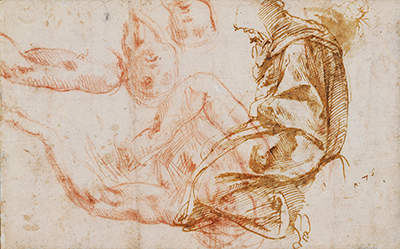
Studies of a Recumbent Youth and a Seated Hooded Figure
One of Michelangelo's most revealing sheets refuses to become one scene. A nude youth lies across the paper in repeated trials while a compact, hooded figure sits nearby. The bodies share a surface, not necessarily a story.
The Royal Collection preserves the work as RCIN 912763 under the careful title Studies of a Recumbent Youth and a Seated Hooded Figure.[1] That plural “studies” matters. It protects the drawing from being mistaken for a finished composition or attached too quickly to a famous sculpture.
The page is best approached as a record of two different bodily problems: exposed weight and enclosed mass.
At a Glance
- ArtistMichelangelo Buonarroti
- TitleStudies of a Recumbent Youth and a Seated Hooded Figure
- CollectionRoyal Collection
- Royal Collection numberRCIN 912763
- Object typeWorking study sheet
- Principal subjectsA nude youth recumbent in more than one trial; a seated, hooded figure
- Compositional statusNo finished multi-figure scene is securely established
- Project statusProposed relationships should remain hypotheses unless supported by a direct figure match
- Key contrastOpen anatomy against enclosed drapery; horizontal extension against compact sitting
Contents
- The Recumbent Youth
- Repetition Is Thought
- The Seated Hooded Figure
- Nude and Draped Bodies
- A Sculptor's Way of Drawing
- The Temptation to Name a Project
- One Sheet, Separate Times
- Absence of a Finished Work
- Rest, Sleep and Death
- Collecting Michelangelo's Working Paper
- How to Look at the Sheet
- Why the Drawing Matters
The Recumbent Youth
A recumbent body presents a deceptively complex problem. Standing figures reveal how weight descends through hips, knees and feet. A lying figure distributes pressure across shoulder, flank, pelvis and limbs.
Michelangelo studies that redistribution rather than merely turning an upright nude sideways. The torso must yield to support. One hip can rise while the ribcage twists; a limb extending toward the viewer changes apparent length.
The youth's nudity removes narrative costume. It lets the artist test skeletal direction and muscular response before deciding whether the body might become a sleeping figure, river god, wounded man, dead Christ or something else.
Those possible identities should not be confused with evidence. Renaissance workshops repeatedly used the same anatomical class for very different eventual subjects.
The study's value lies precisely in its pre-iconographic state: a body can be convincing before it has a name.
Repetition Is Thought
Michelangelo did not need repeated outlines because he had failed to see the model. Repetition tests alternatives that sight alone cannot settle.
A head can tilt farther back; a shoulder can turn; a leg can extend or draw inward. Each change alters emotional potential even when the figure remains anonymous.
One recumbent body may appear asleep, another exhausted, another dead. The boundary is carried by minute differences in tension.
The sheet allows those possibilities to coexist. A finished work would suppress alternatives and choose one.
This is why working drawings should not be judged as incomplete paintings. Their density and overlap are forms of reasoning.
The Seated Hooded Figure
The hooded figure offers an opposite problem. Anatomy is hidden beneath cloth, and the body must be inferred from the envelope around it.
Michelangelo makes drapery structural. The hood locates the head; the breadth of the garment implies shoulders; folds descend toward a seat and reveal the pressure of bent limbs.
The figure's smallness relative to the recumbent studies does not prove lesser importance. Scale on a working page may follow available space or the urgency of a problem.
A hood can suggest mourning, age, monastic identity or simple protection. None should be asserted as a definite subject without an attribute or documented project.
The safest reading is visual: a seated body withdrawn inside cloth.
Nude and Draped Bodies
Placed together, the figures demonstrate that Michelangelo's knowledge of the body did not depend on displaying every muscle.
The nude exposes volume directly. The hooded figure translates volume into folds. In both, the draughtsman must understand where the skeleton bears weight.
The comparison also complicates the familiar claim that Michelangelo cared only for heroic nudity. Drapery can carry gravity, psychology and monumentality.
Cloth does not erase anatomy; it edits its visibility. A fold can reveal a knee more forcefully than a fully modelled contour, while a hood can make inwardness legible without facial detail.
This economy would remain important in Michelangelo's sculpture, painting and late devotional designs.
A Sculptor's Way of Drawing
Michelangelo's drawings often build figures as volumes rather than decorate their surfaces. The Metropolitan Museum describes how his chalk contours can be reinforced with pressure while hatching turns mass, an approach closely bound to disegno as both drawing and conception.[2]
On a sheet of studies, volume is provisional. A line may be tested, abandoned and strengthened elsewhere.
The recumbent youth can therefore seem carved out of paper space. Limbs project, overlap or withdraw as if the artist were circling a three-dimensional model.
The hooded figure is equally sculptural, though its mass is bundled. Broad outer contours matter more than embroidered detail.
Calling the sheet “sculptural” does not prove preparation for a statue. It describes a way of thinking through weight.
The Temptation to Name a Project
Michelangelo made recumbent figures for many contexts. River gods were planned for the Medici Chapel; bodies lie across the Sistine narratives and the Last Judgement; Pietà designs required the dead Christ to be supported or displayed.
The hooded figure could likewise invite comparison with mourners or prophets. Such analogies may help the eye, but they do not by themselves establish destination.
Project identifications need several forms of agreement: pose, date, scale, medium, figure direction and compositional role.
When only one or two correspond, resemblance should remain open.
RCIN 912763 is stronger as evidence of practice than as a missing piece forced into a single monument.
One Sheet, Separate Times
Working sheets need not have been filled in one sitting. Michelangelo could return to paper, turn it or use remaining space for a different thought.
That possibility is important here because the two subject types do not have to form a paired invention. Their coexistence may be practical rather than narrative.
Paper was valuable, and surviving sheets often contain several campaigns. Differences in pressure, chalk condition and overlap can reveal sequence through close technical examination.
Modern mounting fixes a viewing orientation, but the artist may have rotated the page. The notion of a permanent “top” belongs partly to collection history.
Viewing the whole object prevents the most prominent nude from erasing the quieter draped figure.
Absence of a Finished Work
A preparatory drawing without a known destination is not a failed clue. It records artistic knowledge that could remain mobile.
Michelangelo built a repertoire of poses and structural solutions. An idea studied for one purpose could be transformed or remembered years later.
Some intended works were abandoned; others were executed by collaborators; still others leave no surviving document. Many drawings were deliberately destroyed or simply lost.
The surviving sheet cannot be required to repair all those absences.
Its uncertainty is historically honest. Renaissance invention included studies whose usefulness exceeded one commission.
Rest, Sleep and Death
Recumbency carries an unusual expressive ambiguity. In a still image, sleep and death can share closed eyes, slack limbs and horizontal posture.
Artists distinguish them through residual tension. A sleeper may remain folded around warmth or support; a dead body yields to gravity and to the hands of others; an exhausted figure can retain effort in one shoulder or hand.
Michelangelo's repeated youth lets viewers see how such states emerge from structure before attributes explain them. A tiny adjustment in neck or abdomen can change the implied condition.
The hooded figure intensifies that openness. Placed near a body, covered clothing can suggest witness or mourner—but proximity on a study sheet is not proof of narrative relationship.
The drawing keeps the threshold visible. It shows how physical pose offers meanings that a later composition might select and name.
Collecting Michelangelo's Working Paper
Michelangelo's drawings were sought by artists and collectors even while he lived. Later Royal Collection holdings brought intimate working sheets into a setting very different from the workshop.[3]
Collection status encourages viewers to isolate and title each object. That is necessary for care and scholarship, but titles are modern descriptions rather than Michelangelo's declarations.
“Recumbent youth” and “seated hooded figure” tell us what can be seen. They deliberately avoid turning visible forms into unsupported characters.
Digital images now allow close study, while the public-domain reproduction confirms how much object knowledge can travel outside the print room.[4]
Yet scale, paper texture and differences among marks remain clearest before the original.
How to Look at the Sheet
Begin with the recumbent youth's support. Ask which parts of the body bear pressure.
Compare the repeated trials and identify changes in head, torso and limbs.
Then move to the hooded figure. Reconstruct the unseen body from garment and seat.
Notice the contrast between long horizontal extension and gathered vertical mass.
Finally resist assigning a project. Let the drawing first explain its physical questions.
Why the Drawing Matters
RCIN 912763 matters because it widens the idea of Michelangelo's body. Flesh can be uncovered or hidden, stretched or compressed, active in thought even when physically at rest.
It also demonstrates the discipline of uncertainty. A cautious title preserves more history than an attractive but unproved identification.
Most of all, the sheet shows drawing before iconography hardens. A youth lies down, a hooded body sits, and Michelangelo studies how weight creates meaning.
The page is quiet, but not slight. Its two forms condense a central Michelangelo question: how can the body remain expressive when action stops? The answer lies in pressure, fold, extension and withdrawal rather than anecdote.
Their anonymity keeps that answer available. Before a story claims them, both figures demonstrate how posture alone can generate presence, vulnerability and inwardness.
They also register different kinds of time. The repeated nude catches adjustment from one trial to the next, while the bundled sitter seems almost immovable. A single sheet can therefore hold both the rapid time of revision and the suspended time of contemplation.
Frequently Asked Questions
Discussion
What details, sources or comparisons stand out to you in Studies of a Recumbent Male Figure and a Seated Hooded Figure?
Reader Insights
Which formal detail changes how the work reads?
Which documented source or collection history feels most useful?
Which related Michelangelo work should readers compare next?
Join the Conversation
Add a source-led observation, comparison or question for other readers.
References
- Royal Collection Trust, Studies of a recumbent youth and a seated hooded figure,” RCIN 912763:, View source.
- Metropolitan Museum of Art, Michelangelo: Divine Draftsman and Designer,” exhibition galleries:, View source.
- Royal Collection Trust, Collecting Italian Renaissance Drawings”:, View source.
- Wikimedia Commons, public-domain record for RCIN 912763:, View source.