


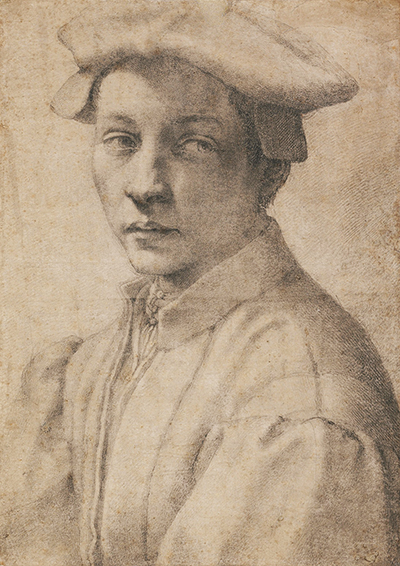

Michelangelo’s Portrait of Andrea Quaratesi
Andrea Quaratesi turns to the left, then looks back. The movement is slight, but it prevents him from settling into the obedient stillness of a posed likeness. His cap spreads above a young face modelled by innumerable chalk touches; his mouth remains closed; his eyes meet the world with a mixture of caution and self-possession. Michelangelo, who rarely made independent portraits, has given attention itself a portrait.
The British Museum dates the black-chalk drawing to 1530 and identifies the sitter as Andrea Quaratesi, a young Florentine nobleman connected with Michelangelo as friend and possible pupil.[1][2] At 41 by 29 centimetres, it is large enough for costume and posture to matter as much as facial detail. It is also an object with a contested modern attribution history, visible corrections and later repairs. Intimacy does not make it simple.
At a Glance
- WorkPortrait of Andrea Quaratesi
- ArtistListed by the British Museum as Michelangelo Buonarroti; the attribution has been debated[1]
- Date1530 in the British Museum catalogue[1][2]
- MaterialBlack chalk on paper, with areas of later integration and retouching noted by the museum[1][3]
- Dimensions41 × 29 centimetres[1][2]
- Current homeBritish Museum, London, registration 1895,0915.519[1][2]
- SitterAndrea Quaratesi, 1512–85, of a noble Florentine family[1][2]
- PoseHead and shoulders turned left while the gaze returns outward
- ClothingFlat cap, collared contemporary tunic and glimpsed shirt fastenings
- RelationshipMichelangelo’s correspondence indicates familiarity, and he may have instructed Quaratesi in drawing[1][2]
- ImportanceWidely described as Michelangelo’s only surviving large independent portrait drawing[2][3]
- CopiesVersions are recorded in the Louvre, Rotterdam and Uffizi[1]
Contents
- A Portrait Built on a Turn
- The Gaze
- A Young Man in Contemporary Dress
- Collar, Shoulder and the Weight of Cloth
- Black Chalk and Parallel Strokes
- Light from the Left
- Corrections and Pentimenti
- Losses and Later Integration
- Who Was Andrea Quaratesi?
- Michelangelo and Portraiture
- Divine Heads and a Real Sitter
- A Presentation Drawing?
- “Andrea, Have Patience”
- Attribution from Bronzino to Michelangelo
- Copies and the Preservation of Identity
- Acquisition by the British Museum
- How to Look at the Portrait
- Artist Up Close
A Portrait Built on a Turn
Quaratesi’s shoulders recede towards the right edge while his head rotates back. The gaze completes the counter-movement.
This is not the theatrical torsion of a Sistine body. It is a social adjustment—the tiny bodily calculation by which someone who has partly turned away remains alert to another person’s presence.
The pose also gives Michelangelo more than a frontal face. One cheek advances into light; the opposite side settles into shade. The neck disappears into collar and shoulder at different depths.
Likeness is therefore constructed through spatial behaviour. Quaratesi does not resemble himself only in nose, eyes and mouth. He appears individual because of the particular way he occupies attention.
The Gaze
The eyes are not dramatically widened, yet they carry the portrait’s pressure. One is more exposed to light; the other sits beneath soft shadow.
Quaratesi looks outward without obvious invitation. His gaze can seem guarded, thoughtful or slightly uneasy, but no document fixes an emotion.
Michelangelo avoids the easy cue of a smile. The mouth is firmly drawn and nearly horizontal, keeping expression unresolved.
That ambiguity has encouraged descriptions of psychological intensity.[3] The phrase is apt if it means that the sitter appears inwardly active, not that a precise secret can be diagnosed from his face.
The portrait makes looking reciprocal. Quaratesi is observed, but he also seems to assess the person observing him.
A Young Man in Contemporary Dress
The sitter wears a broad flat cap and a substantial tunic. Beneath its collar, small fastenings from the shirt are visible.[1]
These details place him in the social world of sixteenth-century Florence rather than in the timeless nudity or invented costume of Michelangelo’s sacred and mythological figures.
The cap enlarges the head’s silhouette. Its irregular brim casts and receives shadow while preventing the portrait from becoming a simple oval face.
Clothing also gives rank without ostentation. Quaratesi’s noble background is consistent with the quality of the dress, but no jewel, heraldic emblem or elaborate setting announces status.
Michelangelo lets fabric support presence rather than compete with it.
Collar, Shoulder and the Weight of Cloth
The face receives the finest attention, but the lower half is not merely filled in. Broad folds descend through the tunic while the collar encloses the neck with a more angular rhythm.
Cloth thickens towards the turned shoulder. Dark chalk there helps the body recede, so that the illuminated cheek advances without an outline forcing the effect.
The shirt fastenings create a narrow vertical interval at the centre. Their scale reminds us how large the head is relative to these tiny signs of dressing.
Michelangelo does not finish every fold equally. Some boundaries remain searching or faint, allowing the torso to dissolve gradually into paper.
The distribution of finish establishes hierarchy without amputating the body. Quaratesi’s face commands attention because shoulder, cap and collar have been calibrated around it.
Black Chalk and Parallel Strokes
Small, careful lines build the shadows, especially along the face and neck.[2]
They are often parallel rather than broadly blended. Seen from a distance, their accumulation becomes soft tone; close up, the face breaks back into the rhythm of drawing.
Michelangelo varies pressure. Some contours are decisive, while others dissolve into the paper. The eyes, nostrils and meeting of lips receive dark concentration; cheeks and forehead retain more of the support’s light.
The technique allows firmness without the unforgiving finality of ink. Chalk can be strengthened, softened and partially lifted.
The sitter’s living presence emerges from that flexibility. Flesh does not become a hard mask even where the structure feels sculptural.
Light from the Left
Illumination enters from the left, crossing the face unevenly.[2]
The nearer cheek, forehead and nose catch light, while the opposite eye socket and the space beneath the cap deepen. On the clothing, shadow grows towards the turned shoulder.
This single directional light unifies head and torso. It also intensifies the turn: the body moves into darkness while the face returns towards visibility.
Michelangelo does not describe a room or window. The illumination is sufficient without a setting.
Portrait space is made from the sitter’s relation to light rather than from furniture or architecture.
Corrections and Pentimenti
The British Museum records visible changes around the face, cap, collar and shoulder.[1]
These reconsiderations are especially valuable in a portrait. They show likeness being sought rather than mechanically transferred.
An edge may move because the first proportion was unsatisfactory, because the sitter shifted, or because Michelangelo changed the design. The exact reason for each adjustment is not documented.
What survives is the process of calibration. Cap and collar must support the head; shoulder must carry the turn; facial outline must feel both particular and structurally clear.
The corrections do not undermine finish. They are the means by which finish became possible.
Losses and Later Integration
The drawing’s surface has suffered damage. The Metropolitan Museum’s exhibition entry describes losses delicately integrated with brush and grey wash.[3]
This means that not every uninterrupted tone belongs to Michelangelo’s chalk in an untouched state. Conservation has helped the image read coherently.
Such intervention should neither be ignored nor treated as falsification. Works on paper are vulnerable to abrasion, handling, light and mounting.
Acknowledging restoration sharpens visual judgement. It asks where original strokes survive, where design has weakened and where later hands assist legibility.
The portrait is both a sixteenth-century drawing and a cared-for historical object.
Who Was Andrea Quaratesi?
Andrea was born in 1512 into a noble Florentine family and lived until 1585.[1][2]
He was around eighteen when the museum dates the portrait. Michelangelo, then in his mid-fifties, appears to have known him personally.
A drawing in Oxford bears Michelangelo’s written encouragement, “Andrea, have patience,” often connected with the possibility that the artist taught Quaratesi to draw.[2]
The phrase is tenderly practical. It suggests instruction, but it does not establish the full shape of their relationship or prove that every Andrea named by Michelangelo refers without question to this sitter.
Enough survives to place the portrait within familiarity rather than formal court commission.
Michelangelo and Portraiture
Michelangelo produced likenesses in sculpture and included recognisable faces in larger works, but independent portrait drawing occupies a small place in his surviving output.
Giorgio Vasari claimed that he disliked making a likeness from life unless the subject possessed extraordinary beauty.[2][3]
The remark should be read with caution. Vasari often shaped artists’ habits into memorable character, and admiration is not a catalogue rule.
Still, the rarity of a large surviving portrait makes Quaratesi exceptional. Michelangelo applies the same concentration he brought to ideal heads without dissolving the sitter into an invented type.
Beauty and specificity coexist. The young man is refined, but not generic.
Divine Heads and a Real Sitter
In the 1530s Michelangelo made highly finished bust-length heads with fantastic headdresses, sometimes called teste divine, or divine heads.[3]
Those inventions draw upon antique gems, elaborate costume and imagined beauty. Quaratesi’s portrait offers a productive contrast.
His cap is fashionable rather than fantastical. His clothing belongs to contemporary life. Most importantly, his identity is attached to a living young man.
Yet the two categories share techniques of finish and close viewing. Michelangelo does not lower his ambition when moving from invention to likeness.
The portrait becomes a test of whether ideal graphic intensity can remain answerable to one person.
A Presentation Drawing?
Highly finished drawings in Michelangelo’s circle could be given to friends rather than used up in workshop preparation. Quaratesi’s portrait is often placed near that presentation culture.[1][2]
Its sustained finish, personal connection and independence from a larger project support the association. No surviving dedication, however, proves the exact occasion of exchange.
It is safer to say that the drawing shares the social and aesthetic world of gifts than to invent a ceremonial delivery.
In such a context, finish is relational. The sheet is made to withstand another person’s prolonged attention.
Portraiture adds a second relation: the recipient may confront not only Michelangelo’s skill, but Quaratesi’s presence.
Google Arts & Culture preserves a phrase attributed to Michelangelo for such carefully finished gifts: they were made “for love rather than duty.”[2] The words should not be forced into a private declaration attached specifically to this portrait, but they clarify the difference between obligation and voluntary attention.
A likeness made under affection or admiration need not idealise away every tension. Indeed, the reserved mouth and watchful eyes make the attention feel more serious. Regard is expressed through sustained looking, not through flattery alone.
“Andrea, Have Patience”
The inscription associated with Quaratesi—“Andrea, have patience”—opens a small window onto teaching.[2]
Learning to draw requires repetition, correction and tolerance of failure. Those same qualities are visible in the portrait’s pentimenti, where Michelangelo himself adjusts cap, face and shoulder.
The phrase can therefore be read beside the object without becoming its caption. Mastery has not eliminated revision; it has made revision exact.
If Quaratesi did receive instruction, the portrait would have offered a formidable lesson. Chalk becomes likeness through the slow organisation of pressure, light and altered contour.
The young man is both subject and, potentially, a person capable of understanding how the sheet was made.
Attribution from Bronzino to Michelangelo
The drawing passed through the Malcolm collection as Bronzino before Johannes Wilde restored the attribution to Michelangelo.[1]
Some later scholars accepted Wilde’s judgement; others did not. Differences of technique, condition and comparison have kept the debate alive.
The British Museum currently lists Michelangelo as the maker.[1] That institutional decision is the proper basis for naming the work, accompanied by the history rather than hidden beneath certainty.
Attribution matters especially here because “Michelangelo’s only surviving portrait drawing” is a powerful claim. It depends upon the sheet being autograph.
The portrait’s status is therefore both visual and historical: a likeness whose maker has also had to be identified.
Copies and the Preservation of Identity
Copies in the Louvre, Rotterdam and the Uffizi testify to the portrait’s circulation.[1]
The Uffizi version by Carlo Dolci carries an inscription identifying its model as Andrea Quaratesi and its prototype as Michelangelo’s work.[1]
Copies can preserve information that an original lacks, but they must be handled critically. An inscription added later is evidence for reception and naming, not automatic proof of every earlier circumstance.
They also reveal that viewers valued more than a generic handsome youth. The sitter’s identity mattered enough to be transmitted.
Each copy introduces another act of looking at Quaratesi through Michelangelo.
Acquisition by the British Museum
The British Museum acquired the drawing in 1895 from John Wingfield Malcolm’s collection.[2]
Earlier ownership included Henry Wellesley and J. Addington.[2]
That provenance situates the sheet within a nineteenth-century culture of collecting Italian drawings in Britain. Names and attributions changed as it moved.
Museum arrival did not end interpretation. Reattribution, conservation and exhibition continued to alter how the object was understood.
The portrait’s modern history is therefore not an appendix to the encounter. It is one reason the young Florentine now appears in London under Michelangelo’s name.
How to Look at the Portrait
Begin with the shoulder line, not the eyes. Follow the body’s turn, then notice how the head and gaze counter it.
Look closely at the shaded cheek until soft tone separates into parallel chalk strokes. Move outward to the cap and compare its searching edges with the more concentrated facial features.
Notice the small shirt fastenings. They return this psychologically charged face to the material specificity of dress.
Finally, keep restoration and attribution in mind without letting them eclipse the sitter. The central achievement remains a young person whose composure and uncertainty have survived the arguments around him.
Artist Up Close
Michelangelo’s fame rests on colossal bodies and immense spaces. Here his attention narrows to the angle of an eyelid, the pressure of a closed mouth and the social meaning of a turned shoulder.
That concentration reveals continuity rather than contradiction. He still thinks through mass, light and bodily direction, but uses them to sustain individuality instead of heroic action.
The drawing also makes patience visible—perhaps appropriately for a sitter associated with the artist’s written instruction to have patience. Hundreds of small chalk decisions gather into a likeness that never feels over-explained.
Michelangelo gives Quaratesi dignity without armour, office or allegory. Being seen is enough.
Frequently Asked Questions
Discussion
How does this sheet change your sense of Michelangelo as a draftsman?
Where does the drawing feel personal rather than official?
How should a public route balance current museum attribution with scholarly debate?
Join the Conversation
Compare the Portrait of Andrea Quaratesi with Michelangelo's other drawing studies and presentation drawings.
References
- British Museum, Portrait of Andrea Quaratesi,” registration 1895,0915.519,, View source.
- Google Arts & Culture and the British Museum, Michelangelo Buonarroti, Portrait of Andrea Quaratesi, a Drawing,, View source.
- The Metropolitan Museum of Art, Michelangelo: Divine Draftsman and Designer—Exhibition Galleries,” section “Divine Heads and Portraiture,, View source.
