


 by Tom Gurney
Tom Gurney BSc (Hons) is an art history expert with over 20 years experience
Published on June 19, 2020 / Updated on November 6, 2025
Email: tomgurney1@gmail.com / Phone: +44 7429 011000
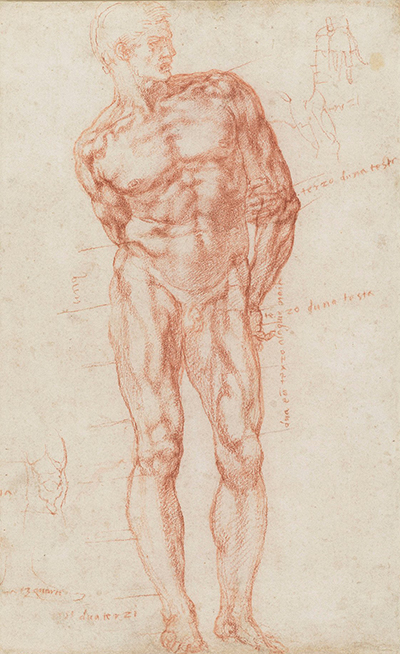
A Male Nude with Proportions Indicated
Michelangelo's standing man is both body and measuring instrument. He turns in contrapposto and reaches one hand behind his back, while numbers, lines and small comparative sketches divide him into units. The figure is powerfully alive, yet the annotations ask how life can be translated into proportion.
The Royal Collection preserves this red-chalk sheet as RCIN 912765. It is generally dated about 1515–1520 and measures approximately 28.9 × 18 centimetres.[1] A second male nude appears on the verso. The recto is not a blueprint for one identified statue; it is an investigation of how bodily parts relate while a model twists.
That combination distinguishes Michelangelo's approach from a rigid canon. Measurement does not replace observation. It tests a moving, imperfect individual against ideas of an ideal human body.
At a Glance
- ArtistMichelangelo Buonarroti
- TitleA Male Nude with Proportions Indicated
- DateAbout 1515–1520
- MediumRed chalk in two shades on paper
- DimensionsApproximately 28.9 × 18 centimetres
- Current collectionRoyal Collection, Windsor
- Royal Collection numberRCIN 912765
- RectoStanding male nude with proportional annotations and marginal comparisons
- VersoA second male nude
- Likely functionAnatomical, proportional and possibly didactic study
- Project identityNo single finished sculpture or painting securely controls the sheet
Contents
- The Pose
- Dividing the Body into Heads
- The Head and Hand Comparison
- Observation and the Ideal
- Renaissance Canons and Michelangelo's Exception
- Michelangelo and Leonardo on Proportion
- The Date and the Julius Tomb
- A Possible Treatise
- The Verso
- Copies and Didactic Afterlife
- How to Look at the Sheet
- Why A Male Nude with Proportions Indicated Matters
The Pose
The nude bears weight on the right leg while the left relaxes. His torso rotates, and the right hand reaches behind the back toward the opposite arm. The movement opens one shoulder and compresses the other.
This is a difficult body to measure. Simple front-facing symmetry has been abandoned. Foreshortening and rotation alter the apparent lengths of limbs and torso.
Michelangelo may deliberately have chosen the pose to test whether proportional relations remain intelligible under movement. A canon useful only for a rigid standing figure would offer little help in narrative art.
The contrapposto also keeps the sheet from becoming a diagram. Weight passes through joints, and annotations remain attached to an observed person.
The hand behind the back makes the arms compare across depth rather than on a flat plane. Drawing must reconcile what is measured physically with what is seen perspectivally.
Dividing the Body into Heads
Michelangelo uses the head—testa—as a unit. Renaissance artists commonly expressed height as a number of head lengths, drawing on ancient and modern proportional traditions.[1]
The annotations divide specific distances rather than merely declaring one total height. The weight-bearing right leg, for example, has been interpreted as measuring six and two-thirds heads from an indicated point, enabling an extrapolation toward a body of roughly ten heads.[1]
Such numbers should be read from the marks themselves and the catalogue's transcription. A damaged fraction or unclear abbreviation can change the result.
Using the head links geometry with the actual model. It is a repeatable unit present within every human body, but heads vary. Ideal proportion therefore requires selection or adjustment.
The system also makes scaling possible. A small drawing can guide a larger figure if part-to-whole relations are maintained, though material and viewpoint still demand alteration.
The Head and Hand Comparison
In the upper right, Michelangelo sketches a head in profile beside a hand to indicate a relation of size.[1] The comparison isolates parts from the main body.
Hands and heads are expressive endpoints. Their proportion strongly affects whether a figure appears heroic, youthful, graceful or awkward.
The marginal sketch behaves like a note to self or lesson. Instead of writing only a fraction, Michelangelo uses images as measuring language.
This visual notation resists a strict separation between word and picture. Numbers, small drawings and the large nude all participate in one argument.
It also suggests the sheet could have served a didactic purpose—whether for Michelangelo's own reference, an assistant or a planned account of anatomy and proportion.[1]
Observation and the Ideal
Proportion theory often seeks stable harmony. A living model supplies variation: one shoulder higher, legs of unequal apparent length, muscle changing through effort.
Michelangelo does not erase that conflict. The main figure remains idiosyncratic and dynamic while measurement is written around it.
The ideal can therefore be understood as an artistic decision rather than a discovered average. Michelangelo might lengthen a body for elevation, compress it for a niche or enlarge a hand to make gesture legible.
His Sistine figures repeatedly depart from ordinary proportions while remaining structurally convincing. Knowledge made controlled alteration possible.
The sheet is valuable because it captures negotiation before a monumental solution hides the calculations.
Renaissance Canons and Michelangelo's Exception
The search for bodily proportion had ancient authority. Vitruvius described relations among the human frame, circle, square and architecture; Renaissance artists and architects repeatedly visualised those claims. A later printed diagram by Vincenzo Scamozzi shows how persistent the idea of divina proportione remained.[5]
Albrecht Dürer also pursued the ideal male nude through classical prototypes and the Vitruvian canon. Such comparisons place Michelangelo within a broad European effort to make beauty teachable rather than treating this sheet as an isolated eccentricity.[6]
Yet Michelangelo's figure is an awkward subject for a universal rule. One arm disappears behind the back, the pelvis tilts and unequal legs occupy different depths. The sheet asks not only what a well-proportioned body is, but how its relationships can be retained when pose obscures them.
That distinction helps explain the unusually elongated result sometimes inferred from the notes. A ten-head figure is not an average body. It is a heroic construction, potentially useful where a nude would be seen from below, confined by architecture or asked to carry exceptional expressive force.
The exercise therefore belongs to practice as much as theory. Its proportions are less like immutable law than a calibrated instrument Michelangelo could alter for each artistic circumstance.
Michelangelo and Leonardo on Proportion
Leonardo's famous Vitruvian Man places a nude inside circle and square, aligning body with ideal geometry. He also measured living models and encountered ratios that did not fit simple theory.[2]
Michelangelo's sheet is less architectural. No encompassing figure contains the man. Numbers cluster around a body already in motion.
The difference should not become a crude opposition between scientific Leonardo and artistic Michelangelo. Both observed, measured and selected. Their surviving sheets simply preserve different questions.
Leonardo often pursued systematic anatomy and mechanics. Michelangelo concentrated on knowledge necessary for painting and sculpture, especially bones, muscles and joints visible through action.
The Royal Academy's account of the sheet stresses pictorial representation: measurement serves how the body will appear, not a medical taxonomy alone.[1]
The Date and the Julius Tomb
The broad date 1515–1520 overlaps Michelangelo's continuing work on the tomb of Julius II, the first version of the Risen Christ commission and the beginning of San Lorenzo projects.
Powerful male nudes were central to several of these concerns, especially the tomb's Prisoners. Yet the sheet is not securely identified as a study for one named marble.
Connecting every male nude to the tomb can erase the independent value of anatomical reference. Michelangelo built a repertoire that could migrate among projects.
The pose may have supported workshop teaching or a contemplated treatise as readily as a statue. Its annotations are more general than a single contour transfer.
Chronology provides context without forcing destination.
A Possible Treatise
Michelangelo discussed anatomy with the physician Realdo Colombo and was reported to have considered an anatomical book. No completed treatise survives.
Vasari claimed to own sheets in which Michelangelo constructed figures of nine, ten or even twelve heads.[1] The Windsor drawing may resemble that lost instructional material.
One sheet cannot reconstruct an unwritten book. Annotations may be private notes, and a cluster of didactic drawings need not imply imminent publication.
Still, the possibility explains why proportional information is preserved so explicitly. Michelangelo was not only solving a pose; he was articulating a transferable principle.
The verso complicates any tidy page design. Paper remained a working surface, and another nude could occupy the reverse of a potentially didactic recto.
The Verso
RCIN 912765 is double-sided. The verso carries another standing male nude, less encumbered by the recto's measuring apparatus.[3]
Viewing only the famous proportional figure reduces the object to half a sheet. The reverse reveals continued study and the economics of paper.
Marks can interact physically. Pressure, chalk offset, trimming and mounting affect both sides. Conservation decisions about display favour one face at a time.
The two nudes may be related as alternative poses or may simply share available paper. No sequence should be invented without line and watermark evidence.
Digital access makes comparison easier than physical exhibition, but screen orientation can hide that the two drawings occupy the same object.
Copies and Didactic Afterlife
Michelangelo's proportional nude was copied by later artists. A recently published Battista Franco variant changes stance and proportions rather than reproducing the sheet mechanically.[3]
Such copies show that the drawing could function as a model for learning. To copy a measured body is also to test whether its relations survive another hand.
Variation is informative. If Franco makes the torso broader or figure more upright, he converts Michelangelo's canon into his own style.
Later academic figure drawing inherited the combination of life study and ideal correction. The Windsor sheet became evidence in debates about whether Michelangelo observed nature or imposed heroic form.
Its real answer is both: observation and construction are visible on the same paper.
How to Look at the Sheet
Start with weight before reading numbers. Identify the supporting leg and the torso's turn.
Then locate each annotation and determine which anatomical endpoints it measures. Do not assume every number expresses total height.
Compare head and hand in the margin with the corresponding parts in the main nude.
View the verso and retain the sheet as one physical object.
Finally compare the pose with a rigid proportional diagram. Michelangelo's distinctive achievement is measuring a body that refuses to stand still.
Why A Male Nude with Proportions Indicated Matters
The drawing matters because it makes idealisation accountable. Michelangelo's heroic figures did not arise from intuition alone; they depended on ratios, joints, live observation and repeated adjustment.
It also prevents proportion from becoming a cage. The man twists, reaches and bears weight while numbers surround him. Measurement follows the body's problem rather than flattening it.
In this modest sheet, Michelangelo comes closest to showing how rule and freedom cooperate. The proportions do not explain the figure away. They make its movement thinkable.
Frequently Asked Questions
Discussion
What details, sources or comparisons stand out to you in A Male with Proportions Indicated?
Reader Insights
Which formal detail changes how the work reads?
Which documented source or collection history feels most useful?
Which related Michelangelo work should readers compare next?
Join the Conversation
Add a source-led observation, comparison or question for other readers.
References
- Royal Academy of Arts, The Renaissance Nude, large-print guide, no. 20:, View source.
- Royal Collection Trust, Leonardo's Study of Anatomy”:, View source.
- Master Drawings New York 2026 catalogue, Battista Franco and RCIN 912765 recto/verso:, View source.
- Metropolitan Museum of Art, The Teacher of Drawing,” in Michelangelo: Divine Draftsman and Designer:, View source.
- Metropolitan Museum of Art, Vincenzo Scamozzi, Diagrams of Proportion and the Human Body:, View source.
- Metropolitan Museum of Art, Albrecht Dürer, Standing Male Nude Holding a Bow:, View source.