


 by Tom Gurney
Tom Gurney BSc (Hons) is an art history expert with over 20 years experience
Published on June 19, 2020 / Updated on August 8, 2026
Email: tomgurney1@gmail.com / Phone: +44 7429 011000
Worship of the Brazen Serpent by Michelangelo
Bodies have become knots. Serpents wind around arms, waists and throats; the afflicted clutch one another, recoil, collapse or turn towards the slender sign that promises life. Michelangelo’s Worship of the Brazen Serpent does not present healing as calm revelation. It holds agony and rescue inside the same crowded instant.
The work fills one of the four corner pendentives of the Sistine Chapel ceiling.[1] Its inherited English title can mislead: in the Book of Numbers the Israelites are not commanded to worship a metal object. They must look at the bronze serpent Moses raises and, through obedience to God’s instruction, survive their bites.[3] Sight is therefore the hinge of both story and composition.
At a Glance
- WorkWorship of the Brazen Serpent, also called The Brazen Serpent
- Artist and techniqueFresco by Michelangelo Buonarroti
- PlacementThe north-west corner field of the chapel vault
- Date and patronExecuted within Julius II’s Sistine undertaking of 1508–1512[2]
- Literary subjectNumbers 21:4–9[3]
- Primary actionSerpent-bitten Israelites struggle, die, assist one another or turn towards a bronze serpent raised on a pole
- Dominant visual contrastA densely entangled crowd against a thin, upright saving sign
- Ensemble roleOne of four corner episodes concerning Israel’s deliverance[1]
- Christian typologyJohn 3 compares the lifted serpent with the lifting up of Christ[4]
- Title cautionLooking in obedient faith is not the same as idolatrous worship
- Identity cautionThe standing figure associated with the pole is often called Moses, but that identification has been debated[6]
- Viewing cautionPhotographs flatten a curved field designed to be seen from far below
Contents
- The Crisis in Numbers
- Why “Worship” Is a Difficult Title
- A Crowd Split by Sight
- The Bronze Serpent and the Pole
- Is the Standing Figure Moses?
- Serpents as Lines of Force
- Pain Made Monumental
- Entanglement and Mutual Aid
- The Pendentive’s Curved Triangle
- From a Drawing to the Crowd
- The Serpent Lifted Up
- Seeing, Believing and Surviving
- Fear Without a Landscape
- The Brazen Serpent Among the Four Corners
- The Opposite Corner and the Altar
- Later History of the Object
- Looking from Below and Looking Close
- Why Worship of the Brazen Serpent Matters
- Artist Up Close
The Crisis in Numbers
Numbers places the episode during Israel’s wilderness journey. The people complain against God and Moses, and poisonous serpents enter the camp. Many Israelites die.[3]
When the people acknowledge their offence, Moses intercedes. God instructs him to make a serpent and mount it on a pole. Anyone who has been bitten may look at it and live.[3]
The remedy is deliberately paradoxical. A representation of the creature bringing death becomes the object towards which the dying must turn.
The bronze serpent has no independent medicinal power in the narrative. Survival follows divine instruction mediated through an act of looking.
Michelangelo concentrates upon this unstable interval: danger continues to strike while rescue is already available.
Why “Worship” Is a Difficult Title
The established title Worship of the Brazen Serpent suggests adoration. That is not what Numbers commands.[3]
Some figures in the fresco raise arms or turn faces towards the pole, gestures that can resemble devotion. Their action is better understood first as desperate orientation: they seek the sign they have been told to see.
The distinction becomes clearer elsewhere in the Hebrew Bible. Centuries later, King Hezekiah destroys the bronze serpent because Israelites had been burning incense to it and treating it as a cult object.[5]
The two passages separate legitimate sign from idol. Numbers describes divinely ordered healing; 2 Kings condemns later veneration of the manufactured thing.
Michelangelo’s work represents the first episode. Retaining its familiar title need not entail repeating its implication uncritically.
A Crowd Split by Sight
The composition is not divided by a rigid architectural wall. Human action creates its own moral and visual separation.
Near the raised serpent, several figures extend their arms and turn towards it. Elsewhere bodies close in upon themselves or upon one another under attack.
The difference is not between serenely saved people and clearly doomed ones. Fear crosses the entire field.
A person may be bitten and looking; another may be supported while still twisting away; a third may point without yet escaping danger. Michelangelo resists an easy before-and-after arrangement.
Instead, he paints orientation as a struggle. The saving sign is visible, but bodies in pain do not turn effortlessly.
The Bronze Serpent and the Pole
The bronze serpent occupies little painted area compared with the mass of flesh. Its significance depends on vertical isolation.
Coiled around a pale upright, it rises into relatively open space. The living snakes below writhe through a crowded human world; the made serpent above is still, singular and legible.
That contrast prevents the emblem from disappearing. Michelangelo gives rescue less mass but more clarity.
The pole also supplies a firm axis inside a field otherwise governed by curves. Bodies bend, snakes loop and draperies fold; the upright steadies the eye.
Because the pole is slight, it can seem almost inadequate to the catastrophe. The imbalance corresponds to the biblical test of faith: survival depends not on a visibly powerful weapon but on attending to a sign.
Is the Standing Figure Moses?
A clothed figure near the raised serpent directs attention towards it. He is commonly understood as Moses because Numbers assigns him the making and elevation of the sign.[3]
The identification is plausible, but it should not be treated as visually incontestable. The Vatican’s general pendentive description identifies the episode rather than labelling every participant, and formal discussions acknowledge debate about Moses’s precise presence.[1][6]
This uncertainty does not weaken the work. Michelangelo makes the function of the figure clearer than the portrait identity: the arm points, linking endangered bodies with the remedy.
The gesture extends the pole into the human field. Instruction becomes a direction that others may follow.
Calling the figure “Moses” is reasonable when accompanied by the qualification that the fresco itself offers no inscription.
Serpents as Lines of Force
The attacking creatures are not minor attributes added to otherwise independent nudes. They reorganise bodies.
One serpent binds a torso; another loops near a neck; others coil through gaps between figures. Their narrow forms travel across anatomical boundaries.
Michelangelo uses them as lines of force. A snake can join two limbs visually, redirect a turn or make a human contour suddenly continue in an alien material.
This invasion destroys bodily autonomy. Hands that might defend instead clutch, pull or seek support. Muscular strength cannot guarantee control over something flexible enough to evade it.
The bronze serpent reverses that relation. Below, serpents command bodies; above, a serpent is fixed to an upright and made into a sign.
Pain Made Monumental
The afflicted are not distant miniatures. Large torsos and legs press into the curved field, many nearly nude.
Michelangelo allows pain to deform these powerful bodies without making them weak in design. Muscles contract, spines arch and heads fall back.
Several figures occupy poses that recall sculptural groups, especially the ancient tradition of bodies struggling against serpents. Comparisons with the Laocoön have often been proposed because Michelangelo knew the celebrated ancient group discovered in Rome in 1506.[6]
Such comparison is illuminating but not a substitute for the biblical subject. Classical bodily pathos provides a language through which Michelangelo imagines Israelite suffering; it does not turn the pendentive into pagan mythology.
The fresco’s decisive addition is collective scale. This is not one father and two sons but a threatened people.
Entanglement and Mutual Aid
The crowd is not merely a catalogue of solitary reactions. Bodies hold, carry and brace one another.
Some gestures may be defensive, others supportive, and the compression makes the distinction difficult. That ambiguity is truthful to panic: self-preservation and assistance occur within the same grasp.
A slumping body can be both compositional weight and human burden. An upraised arm may point, pray or recoil.
Michelangelo’s overlap makes the endangered community visible as a community. Serpents pass between individuals, and survival likewise depends on communicated direction.
The scene therefore avoids reducing the plague to private spiritual choice. Each person must look, but people are physically implicated in one another’s danger.
The Pendentive’s Curved Triangle
The corner field widens above an arch and narrows towards its surrounding borders. Michelangelo packs the broad zone with the main crowd while allowing limbs and serpents to answer the curves.
The pole rises towards an area of open plaster, preserving its silhouette. Dense bodies occupy the opposite and lower regions.
This unequal distribution creates pressure. The crowd appears to spill down the vault even though the painted border contains it.
Foreshortened thighs, shoulders and backs answer an observer standing far below and to one side. When the surface is reproduced frontally, some limbs can seem disproportionately large.
The perceived distortion belongs partly to the loss of architectural viewpoint. Michelangelo paints for a corner, not for a rectangular frame.
From a Drawing to the Crowd
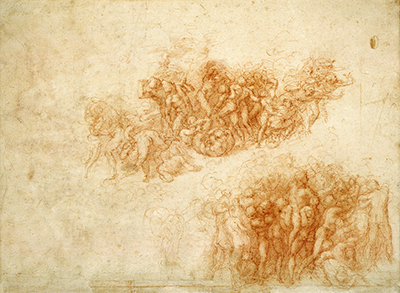
An Ashmolean sheet associated with the subject assembles several groups in red chalk. Figures are tried in compact clusters rather than laid out as one finished scene.[7]
The sheet demonstrates how Michelangelo could think through accumulation. A falling torso, a supporting companion and a tangle of limbs become units that may be revised or combined.
Its status as a drawing must remain distinct from the fresco. Paper permits repetition, overlap and unresolved alternatives; wet plaster requires a final decision at monumental scale.
The survival of such a sheet adds an important dimension to the finished corner. Apparent chaos is underwritten by selection.
It also warns against assuming that every drawn figure reached the vault unchanged. Study and execution are related stages, not identical objects.
The Serpent Lifted Up
In the Gospel of John, Jesus recalls Moses lifting the serpent in the wilderness and compares it with the Son of Man being lifted up.[4]
This scriptural comparison made the episode an established Christian type of the Crucifixion and salvation through Christ. The Vatican accordingly interprets the corner deliverances as prefigurations within the promise of redemption.[1]
Michelangelo does not need to paint a visible cross for this association to operate. The vertical sign and the act of saving sight already support it.
Yet the primary histories must remain layered correctly. On the ceiling, these are Israelites in the wilderness responding to Moses’s bronze serpent. In Christian interpretation, that episode anticipates another lifting up.
Typology connects events without pretending they are the same event.
Seeing, Believing and Surviving
The story gives vision an unusual moral force. Looking is not passive spectatorship; it is the action upon which life depends.[3]
Michelangelo makes this especially apt for painting. Observers look at figures who themselves struggle to look.
The direction of sight becomes infectious. Pointing hands lead to turned heads; turned heads lead towards the pole; the pole redirects attention through the crowded field.
An observer may initially be drawn to the most spectacular suffering. The composition then asks the eye to discover the smaller remedy.
This sequence contains a quiet discipline. Visual fascination with pain must finally yield to understanding of the sign.
Fear Without a Landscape
The wilderness is barely developed as a setting. Michelangelo sacrifices geographical breadth to bodily immediacy.
There are no long roads or expansive desert horizons through which the episode can be comfortably distanced. The human mass becomes the environment.
This compression also differentiates the work from the more dispersed Flood. Both show collective danger, but the earlier Genesis scene distributes groups across water, shore, shelter and ark. The serpent corner collapses catastrophe into one muscular knot.
The change reflects both subject and placement. A pendentive requires concentrated action legible within an irregular field.
The absence of spacious landscape denies the eye a place of escape.
The Brazen Serpent Among the Four Corners
The Vatican groups this scene with David and Goliath, Judith and Holofernes and Haman’s Punishment as episodes of Israel’s miraculous salvation.[1]
Three corners prominently display the defeat or death of an enemy. Here the agents of death are numerous creatures, and rescue comes through healing rather than armed victory.
This difference broadens the ensemble. Deliverance can arrive through courage, cunning, reversal or obedient sight.
The Brazen Serpent corner is also the most collective. No single heroic human body monopolises the action.
Moses may direct, but threatened men, women and children carry the emotional weight.
The Opposite Corner and the Altar
The scene lies at the altar end of the chapel, facing Haman’s punishment across the vault.
Both fields employ a raised vertical structure and bodies subjected to extreme foreshortening. Their biblical meanings differ, but each can be read typologically in relation to Christian redemption.[1][4]
Haman’s displayed body belongs to the persecutor’s reversal. The bronze serpent belongs to an offered remedy. One is punished; the other is looked upon so that the punished community may live.
Their relation gains force through opposition rather than simple repetition.
From below, the worshipper encounters these corner signs in connection with the altar, the painted histories above and the older narratives on the walls.
Later History of the Object
The bronze serpent’s later destruction by Hezekiah protects an important principle: a sacred instrument can become an idol when its material form is detached from its purpose.[5]
That afterlife complicates the word “worship” productively. The title accidentally names the very error condemned in 2 Kings.
Michelangelo’s fresco, however, shows no settled cult. It shows emergency, pain and a prescribed look.
The difference keeps theology from becoming superstition. Bronze does not heal because bronze is magical.
Within the narrative, the sign works because it belongs to a relationship of command, repentance and trust.
Looking from Below and Looking Close
At chapel distance, the pole, pointing figure and great mass of bodies establish the drama. Individual snakes and subtle exchanges among victims are difficult to resolve.
A detailed photograph reveals the astonishing variety of grips, coils and expressions, but it flattens the architecture and equalises areas never equally visible in situ.
Colour also changes across reproductions. Warm flesh, green-blue serpents and red or pale garments may be intensified or dulled by lighting and processing.
Good viewing therefore alternates between ensemble and detail. The whole explains placement; the close view explains human experience.
Neither alone is the work Michelangelo designed.
Why Worship of the Brazen Serpent Matters
The fresco matters because it turns sight into action. Survival depends on redirecting the eyes while the body is under assault.
It matters because Michelangelo makes a community’s terror monumental without losing the gestures through which people support one another.
Most of all, it makes paradox visible: serpent answers serpent, a thin sign counters a massive catastrophe, and the image of death becomes the means through which life is restored.
Artist Up Close
Michelangelo composes panic without surrendering order. Every coil complicates anatomy; every body presses against another; yet the pole remains legible and the pointing gestures keep directing attention. His achievement is not simply the invention of violent poses. It is the conversion of a theological choice—turn and look—into the governing movement of an entire crowd.
Frequently Asked Questions
Discussion
How does the bronze serpent story shape the way this scene reads?
What changes when the subject is treated as a Sistine corner narrative?
How does the Brazen Serpent fit beside David, Judith and Haman?
Join the Conversation
Compare the biblical episode, the corner placement and the relationship to the other Sistine pendentives.
References
- Vatican Museums, Pendentives”:, View source.
- Vatican Museums, Sistine Chapel Ceiling”:, View source.
- United States Conference of Catholic Bishops, Numbers, Chapter 21”:, View source.
- United States Conference of Catholic Bishops, John, Chapter 3”:, View source.
- United States Conference of Catholic Bishops, 2 Kings, Chapter 18”:, View source.
- Web Gallery of Art, The Brazen Serpent”:, View source.
- Ashmolean Museum, Western Art Print Room, Michelangelo, The Worship of the Brazen Serpent, WA1846.64:, View source.