 by Tom Gurney
Tom Gurney BSc (Hons) is an art history expert with over 20 years experience
Published on June 19, 2020 / Updated on November 6, 2025
Email: tomgurney1@gmail.com / Phone: +44 7429 011000
Young Woman Wearing a Helmet
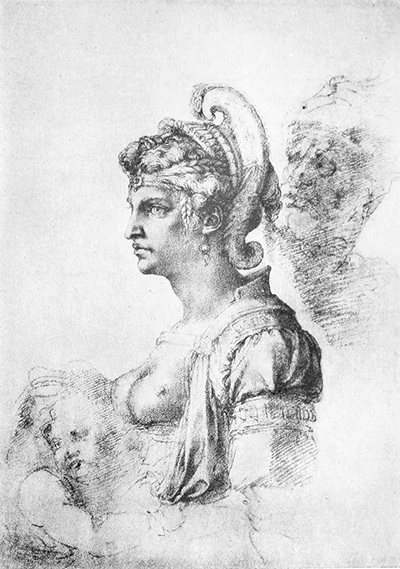
A woman's face turns slightly away beneath an elaborate piece of headgear. Her neck rises from a broad, shadowed base, and the profile is built through firm dark lines and soft passages around cheek and eye. For more than a century the image has circulated under the title Young Woman Wearing a Helmet and under Michelangelo's name.
The title is descriptive rather than securely historical. An illustration with that wording appeared in the 1912 English translation of Romain Rolland's The Life of Michel Angelo.[1] The reproduced drawing has subsequently been associated with the Uffizi's collection of works on paper, but a corresponding inventory number, current institutional title and modern catalogue record are not readily attached to the image.
That gap must remain visible. It would be irresponsible to manufacture a precise date, medium, dimensions or identification of the sitter from an old caption. The drawing can still support close looking and a history of its reception, but its object facts require qualification until the sheet is matched securely to a present catalogue entry.
At a Glance
- Circulating titleYoung Woman Wearing a Helmet
- Traditional attributionMichelangelo Buonarroti
- Historical publicationReproduced under this title in Romain Rolland's The Life of Michael Angelo, English edition, 1912
- Associated collectionTraditionally linked with the Uffizi's Department of Prints and Drawings, Florence
- Current inventoryNot securely established from the published title
- DateOften placed broadly in Michelangelo's mature years; a precise date should not be asserted without the catalogue identity
- Medium and dimensionsRequire confirmation from the matched institutional record
- Subject identityUnknown; “young woman” and “helmet” describe appearance, not a documented sitter or character
Contents
- What the Old Reproduction Establishes
- Is It Really a Helmet?
- Portrait, Study or Ideal Head?
- The Face as a Sculptural Form
- Light, Shadow and the Lost Colour of the Sheet
- Michelangelo and Female Heads
- The Culture of Presentation Heads
- Antiquity Without a Named Goddess
- Attribution and the Need for an Inventory Number
- How Images Lose Their Object Histories
- A Gendered Title
- How to Look at the Drawing
- Why the Drawing Matters
What the Old Reproduction Establishes
Rolland's book supplies three useful facts. An image with this appearance was in circulation by 1912; it was accepted in that publication as Michelangelo's; and the English caption called it a young woman wearing a helmet.[1]
The reproduction does not by itself establish everything modern readers want to know. Early art books often used abbreviated titles, omitted inventory numbers and relied on attributions that later scholarship revised.
Photographic printing also changes a drawing. Paper tone, chalk colour, erased passages and subtle heightening can collapse into monochrome. A dark band may look like a metal helmet when the original material suggested cloth, hair or ornamental fantasy.
The plate is therefore evidence for reception as well as appearance. It shows how an early twentieth-century audience encountered a severe, ideal female head within a heroic account of Michelangelo's life.
It is not a substitute for the physical sheet.
Is It Really a Helmet?
The head covering rises and folds around the crown. Calling it a helmet encourages associations with armour, antiquity and warrior women.
Yet “helmet” may be visual shorthand for an elaborate headdress. Renaissance artists combined cloth, jewellery, braided hair and antique-looking forms in ideal heads without intending a practical object.
If the covering is martial, possible identities might include Minerva, Bellona or an allegorical virtue. If it is ornamental, the figure could belong to the culture of teste divine—highly finished ideal heads made for admiration and exchange.
No inscription or securely connected project identifies her. The safest description stays close to sight: a young female head beneath helmet-like headgear.
The difference matters. Once “helmet” becomes “Minerva,” and “Minerva” becomes “study for a lost painting,” conjecture has hardened into false biography.
Portrait, Study or Ideal Head?
The word “woman” can imply a sitter observed from life. Nothing in the circulating record names one.
Michelangelo's surviving female head studies range from preparatory fragments to independent gifts. Some serve figures in major frescoes; others explore ideal beauty, character or complex coiffure without a known final destination.
An individual likeness would normally invite attention to distinguishing features. An ideal head transforms physiognomy into a type: youthful, grave, heroic or divine.
The helmeted figure feels poised between those categories. The face has enough asymmetry and weight to suggest observation, but the headgear and monumental bearing remove her from ordinary portraiture.
“Ideal head” is consequently a useful interpretive category, not a proved original title. It explains how the work can seem specific without yielding a name.
The Face as a Sculptural Form
The head is not bounded by a delicate contour alone. Shadow builds planes around the nose, cheek, eyelid and jaw.
Michelangelo habitually made drawing behave like sculpture. Rather than colouring a flat silhouette, he used strokes to establish masses that appear to turn in space.
The neck is especially important. Its breadth supports the face like a column and prevents feminine beauty from becoming fragile. Head and throat belong to one continuous structure.
The headgear adds another layer of volume. Its ridges and projecting edges echo carved ornament, creating a tension between soft flesh and constructed covering.
Even in reproduction, the result is architectural. The face does not merely wear the headdress; it is framed, weighted and transformed by it.
Light, Shadow and the Lost Colour of the Sheet
The 1912 plate presents a tonal image, but it cannot tell us reliably whether the original is black chalk, red chalk, ink, or a combination on prepared paper.
This uncertainty affects interpretation. Red chalk would warm the skin and align the work with certain presentation heads. Black chalk would emphasise modelling and allow strong contrast. White heightening on tinted paper could make lit passages actively emerge.
Old photography often exaggerated the darkest marks while losing faint construction. What appears smooth may once have contained a web of exploratory strokes.
Close reading should therefore distinguish visible composition from unverified technique. We can discuss the turn of the face and the distribution of shadow. We should not claim a precise material recipe until the sheet's catalogue identity confirms it.
The discipline is valuable beyond this object. Connoisseurship begins with looking, but object history depends on more than resemblance.
Michelangelo and Female Heads
Michelangelo's female figures rarely conform to a single idea of softness. The Sistine sibyls combine monumental bodies with prophetic concentration. Night in the Medici Chapel turns a female form into an immense allegory. Drawn heads can be exquisitely finished while remaining physically commanding.
The helmeted woman belongs naturally to this visual world. Her youth does not cancel strength, and her elaborate covering does not reduce her to decoration.
Comparison, however, must not become identification. A resemblance to a sibyl does not prove preparation for the Sistine ceiling; resemblance to Night does not make the drawing a Medici Chapel study.
Style can locate a problem within an artist's practice. It cannot on its own supply a missing commission.
The drawing is most compelling when allowed to remain an autonomous confrontation between beauty, armour-like form and inward attention.
The Culture of Presentation Heads
In Michelangelo's lifetime, drawings could function as gifts and finished works rather than only as steps toward painting or sculpture. Carefully made heads were particularly suited to such exchange.
They displayed mastery at close range. A recipient could study transitions of tone, corrections and the artist's touch in ways impossible from a distant fresco.
Michelangelo's celebrated Cleopatra, made for Tommaso de' Cavalieri, is the clearest comparison for a richly imagined female head with an antique identity. That sheet has a documented recipient and a complex reverse.[2]
The helmeted woman lacks equivalent documentation. She may belong to the same broad culture of ideal heads, but there is no basis for assigning her to Cavalieri or calling her a presentation gift.
The comparison clarifies both similarity and limit: polished invention is visible; social destination is not.
Antiquity Without a Named Goddess
Helmet-like headgear immediately evokes the classical world that Michelangelo studied throughout his career.
Ancient coins, reliefs and statues offered profiles of deities and personifications crowned, veiled or armed. Renaissance artists did not always copy one source. They recombined antique signals into new ideal characters.
The woman's strong profile and composed expression could embody chastity, wisdom, victory or martial resolve. These readings are possibilities generated by form, not recovered labels.
An unidentified figure can be intentionally capacious. By withholding a fixed emblem, Michelangelo—or the artist traditionally named—allows viewers to move among portrait, allegory and goddess.
The old title's simplicity may be one reason it endured. It describes the arresting feature while avoiding a mythological name the evidence cannot bear.
Attribution and the Need for an Inventory Number
Attribution is strongest when several kinds of evidence converge: provenance, paper, technique, inscriptions, historical catalogues and comparison with undisputed works.
Here the widely reproduced image and old Michelangelo attribution are a starting point. The missing bridge is the present object record.
An inventory number would allow scholars to verify the sheet's dimensions, condition, watermark, verso, ownership history and current attribution. It would also reveal whether “helmet” survives in the museum's title or belongs only to early publication.
The Uffizi's Euploos catalogue demonstrates why exact numbers matter: thousands of drawings have precise entries, and visually similar female heads can belong to different artists and centuries.[3]
Until the match is made, “traditionally attributed to Michelangelo and associated with the Uffizi” is more accurate than unconditional certainty.
How Images Lose Their Object Histories
Popular art publishing often detaches a picture from the catalogue information that once accompanied it. A plate is scanned, cropped and reposted; the caption becomes a filename; later websites repeat it.
Each repetition can make the title appear more secure while the source trail grows thinner. High visibility is not the same as strong documentation.
Young Woman Wearing a Helmet is a useful example because the image is persuasive. It looks compatible with Michelangelo's ideal heads, so the desire to accept the label is strong.
Responsible art history does not reject the image for that reason. It holds two ideas together: the traditional attribution may be correct, and the current object identity still needs exact confirmation.
That position protects the drawing from invented details while preserving a route toward firmer knowledge.
A Gendered Title
“Young woman” assigns age and gender through appearance. It does not identify the model's lived identity.
Renaissance workshops frequently used male models for female bodies in large compositions, while head studies could draw upon life, sculpture or imagination. No model is documented here.
The title also guides response. “Woman” invites portrait-like empathy; “goddess” would encourage iconographic decoding; “head study” would emphasise process.
Recognising the title as a viewing frame makes the work richer. We can ask how youth, armour and introspection interact without pretending the caption came from Michelangelo.
The figure's ambiguity may be its central achievement. Strength is not masculinised, beauty is not made passive, and costume does not settle identity.
How to Look at the Drawing
Begin with the line of the nose and follow it through brow and forehead into the headgear.
Notice how the neck supports the head and how shadow turns the cheek away from you.
Separate what is visible from what the title suggests. Which forms actually look metallic? Which could be folded cloth or hair?
Then consider the reproduction itself. Ask what tonal information a 1912 printed plate may have lost.
Finally, resist the urge to name the woman. The drawing's authority does not depend upon converting her into Minerva, Cleopatra or a known sitter.
Why the Drawing Matters
Young Woman Wearing a Helmet matters both as an image and as a lesson in how images travel. Its monumental head brings youth, strength and antique fantasy into a concentrated form.
Its publishing history also reveals the distance that can open between a famous attribution and a fully documented object. That distance should produce precision, not filler.
Until a modern inventory record is securely matched, the most faithful account preserves the drawing's beauty alongside its unresolved identity. Michelangelo's name remains the tradition; the missing catalogue facts remain part of the truth.
Frequently Asked Questions
Discussion
What details, sources or comparisons stand out to you in Young Woman Wearing a Helmet?
Reader Insights
Which formal detail changes how the work reads?
Which documented source or collection history feels most useful?
Which related Michelangelo work should readers compare next?
Join the Conversation
Add a source-led observation, comparison or question for other readers.
References
- Romain Rolland, The Life of Michael Angelo, translated by Frederic Lees, 1912; plate captioned “Young Woman Wearing a Helmet., View source.
- Royal Collection Trust, Cleopatra,” Michelangelo's presentation drawing for Tommaso de' Cavalieri, RCIN 912778, View source.
- Gallerie degli Uffizi, Progetto Euploos, online catalogue of the Department of Prints and Drawings, View source.
- Wikimedia Commons, digitised 1912 reproduction, “Young Woman Wearing a Helmet., View source.