


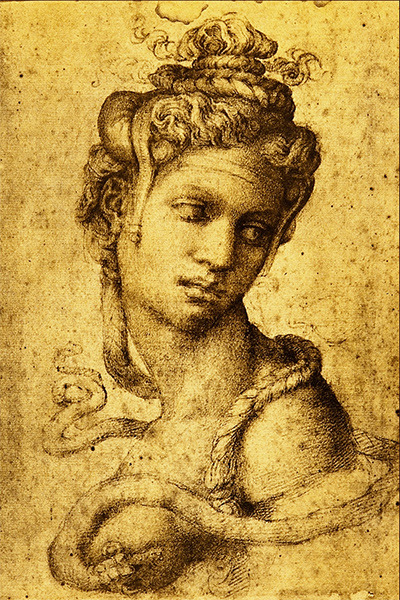

Cleopatra by Michelangelo
Cleopatra’s head tilts as though beauty itself has become too heavy. Her hair rises into an impossible crown of braids, coils and fluttering locks, then descends as a serpent whose body crosses her shoulder and breast. The asp bites beneath the exposed flesh. Her half-lowered eyes register neither theatrical panic nor peaceful sleep. Michelangelo suspends her at the moment when a living queen becomes an image of death.
Drawn in black chalk around 1535, Cleopatra belongs to Casa Buonarroti in Florence, inventory 2 F.[1] Michelangelo made the highly finished front for Tommaso de’ Cavalieri as an autonomous gift. In 1988, removal of an old backing revealed another, far more anguished Cleopatra on the reverse.[1] One sheet therefore holds two incompatible emotional temperatures: controlled classical finality and an open cry.
At a Glance
- WorkCleopatra
- ArtistMichelangelo Buonarroti
- DateAbout 1535[1]
- MaterialBlack chalk[1]
- Dimensions23.2 × 18.2 centimetres[1]
- Current homeCasa Buonarroti, Florence, inventory 2 F[1]
- TypeHighly finished presentation drawing made as a gift
- First recipientTommaso de’ Cavalieri[1]
- FrontIdealised bust-length queen with elaborate hair and asp
- ReverseA more immediate, distressed Cleopatra plus a lightly drawn old man’s profile, revealed during restoration in 1988[1]
- Provenance turning pointCavalieri surrendered it to Duke Cosimo I de’ Medici in 1562 after having a copy made[1]
- Casa arrivalGiven to Casa Buonarroti by Cosimo II in 1614[1]
- Copy traditionContemporary and later versions survive, including examples in London, Paris and Rotterdam[2]
Contents
- A Queen Made as a Bust
- The Lozenge of Empty Paper
- The Tilted Head
- Hair Becoming Serpent
- Where the Asp Bites
- The Cleopatra Belvedere
- Presentation Drawing, Not Preparation
- Tommaso de’ Cavalieri
- Cavalieri’s Pain at Losing the Drawing
- From Medici Possession to Casa Buonarroti
- The Hidden Reverse
- Front and Reverse: Restraint Against Cry
- The Old Man on the Reverse
- Is the Reverse Entirely Michelangelo’s?
- Why No Copies Showed the Reverse
- Copies and Degrees of Distance
- Pentimenti and the Authority of the Original
- Cleopatra Among Transformations
- An Androgynous Beauty
- How to Look at Cleopatra
- Artist Up Close
A Queen Made as a Bust
Michelangelo does not show Cleopatra in a palace, on a bed or surrounded by attendants. Her body ends like a sculpted bust.
The truncation grants iconic force. Shoulder, breast and head appear as an object isolated from narrative time, even while the snake enacts death.
The British Museum’s account of a contemporary copy interprets this tension as a paragone, a comparison among arts: chalk evokes a petrified sculpture while still showing the recoil of life.[2]
Cleopatra is dying and already becoming memorial form. Her gaze will remain suspended after the fatal instant passes.
Drawing competes with sculpture by creating stillness without stone.
The Lozenge of Empty Paper
The snake’s lower coil extends beyond the cut-off shoulder and helps frame a diamond-like opening of bare paper beside the bust.[2]
That void is not a background accidentally left untouched. It sharpens the comparison between a living serpent and a body treated like sculpture.
The asp crosses the boundary that seems to petrify Cleopatra. Its coil projects beyond her truncated form, then bends back towards flesh.
Michelangelo makes absence active. Empty paper separates the queen from the serpent while also locking their contours into one emblem.
The effect would be difficult to duplicate in three-dimensional marble. Drawing can make nothingness into a precise shape and use it to keep death circling the body.
The Tilted Head
The neck bends and the face inclines towards one shoulder. This movement could suggest yielding, but it also sets the head against the elaborate vertical mass above.
Michelangelo’s contours remain controlled. Cheek, nose and lips are refined into an androgynous ideal that resists ordinary portrait likeness.
The eyes turn aside and slightly downward. They do not meet the beholder, making the figure seem inwardly absorbed at the threshold of death.
Her parted lips add a trace of physical response without producing a scream.
The pose is beautiful because it remains unstable. Grace and fatal collapse occupy the same line.
Hair Becoming Serpent
The coiffure is the drawing’s great invention. Braids wrap around the head; coiled tresses rise above it; loose locks flare into the surrounding paper.
One thick length descends over the shoulder and joins visually with the asp. Hair and snake become difficult to separate.[1][2]
This continuity turns ornament into danger. The queen’s splendour generates the instrument of her death rather than receiving it from outside.
Michelangelo also exploits chalk’s capacity for repetition. Short curves build dense braids; darker bands make the serpent more substantial; loose strokes let fine strands escape.
The headdress is fantastical, but its graphic logic is precise. Every coil contributes to a transformation from royal adornment to lethal action.
Where the Asp Bites
The serpent crosses Cleopatra’s left shoulder and bites beneath the exposed breast.[2]
Classical authors Plutarch and Cassius Dio related traditions in which Cleopatra died through an asp, though the historical manner of her death remains uncertain. Renaissance artists found the motif capable of joining erotic exposure and mortal violence.[2]
Michelangelo does not need to provide Octavian, Antony or the political catastrophe surrounding the queen. The bite condenses an entire death history into bodily contact.
Its placement is deliberately intimate. The asp enters the zone where breast, garment and flowing hair meet.
Beauty does not merely accompany danger. The composition makes them physically continuous.
The Cleopatra Belvedere
Michelangelo may have known the celebrated ancient reclining figure installed in the Vatican Belvedere in 1512 and then believed to represent the dying Cleopatra.[2]
That sculpture is now identified as Ariadne. In the sixteenth century, however, its abandoned head and recumbent sorrow shaped ideas of Cleopatra in death.
The drawn head shares the cast of an antique type without copying the entire statue. Michelangelo translates monumental reclining pathos into a compact upright bust.
The comparison adds another layer to the paragone. A drawing of a figure imagined as stone responds to an ancient marble whose identity was itself misread.
Reception and invention become entangled.
Presentation Drawing, Not Preparation
Casa Buonarroti places the sheet among Michelangelo’s presentation drawings: a small group made specifically as gifts rather than as plans for paintings, sculpture or architecture.[1]
These drawings are complete inventions meant for prolonged close looking. Royal Collection Trust describes the broader category as intimate, highly finished works for close friends, made with sharpened red or black chalk.[3]
Calling Cleopatra a gift does not make it casual. Its finish is a form of regard.
The sheet also differs from a commissioned public image. No architectural location or workshop translation governs it. Meaning resides in the exchange between maker, recipient and object.
Tommaso de’ Cavalieri
Michelangelo met the young Roman nobleman Tommaso de’ Cavalieri in 1532. Their friendship endured until the artist’s death.
Cavalieri received the most extraordinary group of Michelangelo’s presentation drawings, including mythological subjects associated with desire, punishment, ascent and transformation.[1][3]
Cleopatra belongs beside this culture without being identical to it. The queen is neither Ganymede carried upward nor Tityus tormented eternally. Her chosen death joins love, loss and metamorphosis into a single bust.
The subject’s emotional charge may have mattered within the gift, but no surviving statement fixes Michelangelo’s private message.
Respecting that limit keeps intimacy from becoming invented confession.
Cavalieri’s Pain at Losing the Drawing
In 1562, while Michelangelo was still alive, Cavalieri was compelled to give Cleopatra to Duke Cosimo I de’ Medici.[1]
His accompanying letter compared separation from the drawing to the loss of a son. Before surrendering it, he arranged for a friendly master to make a copy.[1]
The episode is extraordinary evidence for attachment to a work on paper. Cavalieri did not treat it as a replaceable image whose design could be possessed equally through any version.
Copying preserved appearance, but not the original exchange or Michelangelo’s touch.
The drawing’s value had become personal, artistic and political. A Medici duke could demand what a Roman nobleman grieved to release.
From Medici Possession to Casa Buonarroti
Cosimo II de’ Medici sent the sheet to Casa Buonarroti in 1614.[1]
That transfer placed the Cavalieri gift within the institution formed around Michelangelo’s family memory in Florence.
The move also altered its social identity. An intimate gift became dynastic possession, then part of a collection devoted to the artist.
Such transitions are not peripheral. Presentation drawings survive because private relations eventually enter collecting systems.
Inventory 2 F now fixes the physical object behind countless reproductions of the queen.
The Hidden Reverse
For centuries, the backing concealed the other side. During restoration in August 1988, conservators freed the sheet and discovered another drawing of Cleopatra.[1]
The reverse repeats the basic invention but changes its emotional register. The queen looks more directly outward, her mouth open in acute anguish. Her headdress is reorganised, and the handling is faster.[1][2]
Because the orientation matches rather than reverses the front, the image was not simply traced through the paper.[2]
The discovery changed understanding of the finished drawing. Classical restraint on the front now has an anguished counterpart physically inseparable from it.
What appeared singular became a choice between emotional possibilities.
Front and Reverse: Restraint Against Cry
The two faces do not represent successive moments like frames in a story. Their shared invention and altered expression offer different solutions to the same fatal subject.
On the front, lowered eyes, closed contours and refined modelling turn death into classical permanence. On the reverse, direct gaze and opened mouth make terror immediate.[1][2]
The headdress changes too. This is not a finished face laid over an identical hidden template; emotional revision reaches the entire construction.
Michelangelo may have explored anguish before choosing restraint for Cavalieri, but the exact order cannot be proved solely from finish. A rapid study can precede or follow an elaborate drawing.
The sheet’s physical unity keeps both possibilities alive. Its public face does not erase the crisis beneath it.
The Old Man on the Reverse
Beside the reverse Cleopatra is a lightly indicated profile of an elderly, hook-nosed man.[1][2]
He is smaller than the queen and seems to have been added at another moment. One interpretation imagines a comic observer inspecting the bust from very close range.[2]
That reading is ingenious, but it remains a proposal. The head’s identity and purpose are not documented.
Its presence nevertheless disrupts any belief that the reverse is a single solemn alternative. Michelangelo could reuse space, juxtaposing tragic invention with quick human caricature.
The finished front conceals this workshop-like multiplicity until the sheet is turned.
Is the Reverse Entirely Michelangelo’s?
Casa Buonarroti calls the reverse autograph.[1] Several scholars accepted Michelangelo’s authorship after its discovery, while another attributed it to his pupil Antonio Mini and proposed that it preceded the front.[2]
The British Museum’s curator argues that the vigorous contrast and quality favour Michelangelo, noting that presentation sheets often carry very different sketches on their backs.[2]
The dispute should remain visible without overwhelming the object. Institutional attribution currently supports Michelangelo.
It also demonstrates how conservation can create new connoisseurial problems. Discovering an image does not automatically settle who drew it or when.
Why No Copies Showed the Reverse
Michelangelo’s works were copied repeatedly, but Casa Buonarroti notes that no known copy records the hidden drawing.[1]
That absence suggests the reverse was covered early. Copyists encountered only the refined front.
Consequently, the most anguished version had almost no reception history until the late twentieth century. It could not influence the copies through which the front became famous.
The backing did more than protect paper. It edited the work’s public identity for centuries.
Restoration did not simply recover an extra sketch; it reopened the emotional range of Cleopatra.
Copies and Degrees of Distance
The British Museum owns a contemporary black-chalk copy, while further versions survive in the Louvre and Museum Boijmans Van Beuningen.[2]
The London copy softens contours, reduces pentimenti and changes Cleopatra’s androgynous, horrified presence into a more conventionally feminine expression.[2]
Such differences show that copying is interpretation. A copyist does not transmit only outlines; pressure, finish and uncertainty change.
The British Museum version may derive from the finer Louvre copy rather than directly from the original, though precedence remains open.[2]
Circulation therefore resembles a branching genealogy, not a perfect sequence of facsimiles.
The copy Cavalieri commissioned before surrendering the original cannot be identified with certainty. The rough London version seems unlikely to be the treasured substitute described in the letters; one proposal makes it dependent on the finer Louvre drawing.[2]
This uncertainty reveals a limit of provenance. Documentary evidence tells us that a copy was ordered, while surviving objects provide several candidates and relationships. The two kinds of evidence do not lock together automatically.
The grief of separation is secure. The identity of the replacement remains open.
Pentimenti and the Authority of the Original
The front contains searching contours and variations that copies tend to simplify.[2]
These pentimenti distinguish invention from repetition. A copyist often chooses one boundary where Michelangelo allowed several attempts to remain, making the derivative seem cleaner but less alive.
The serpentine line of the neck, the threshold between hair and asp, and the abrupt end of the arm all change as other hands stabilise them.
This is why a faithful outline can still lose authority. Michelangelo’s uncertainty is part of the finished object.
The original preserves both decision and the pressure that preceded it.
Cleopatra Among Transformations
Many Cavalieri drawings concern bodies changing state: Ganymede ascends, Phaethon falls, Tityus endures punishment.
Cleopatra’s transformation is quieter but equally radical. She changes from living ruler to dead image, from flesh to an almost sculptural permanence.[2]
Her story also joins love and self-destruction. Renaissance tradition understood her death after Antony’s defeat as inseparable from erotic loyalty, political catastrophe and moral judgement.
Michelangelo suspends these narratives within the bust rather than illustrating them.
The serpent is enough to make temporality enter ideal beauty.
An Androgynous Beauty
The original’s face has often been described as androgynous.[2]
Strong neck, broad facial structure and grave expression resist a narrowly decorative femininity. Michelangelo’s ideal heads frequently combine bodily and gendered qualities rather than conforming to portrait realism.
This does not mean Cleopatra becomes male. It means her beauty is constructed through an ideal language Michelangelo used across sacred, mythological and anatomical invention.
The copy tradition’s tendency to feminise the face demonstrates how distinctive the original balance was.[2]
Gender, like emotion, shifts when the image passes through another hand.
How to Look at Cleopatra
Begin at the coiled crown and follow one tress downwards until it becomes difficult to distinguish from the asp.
Find the bite beneath the breast. Then move back to the face and notice how little outward drama answers that violence.
Compare dense hair with lightly defined shoulder and truncated bust. The drawing oscillates between living substance and sculpted object.
Finally, imagine turning the sheet. The reverse does not correct the front; it exposes another emotional answer. One side monumentalises death, while the other cries from within it.
Artist Up Close
Michelangelo made Cleopatra when drawing had become one of his most intimate forms of exchange. Public commissions demanded assistants, contracts, walls and stone. A gift sheet could pass directly from his hand to another person’s keeping.
That intimacy intensified rather than softened ambition. The queen’s headdress, asp, antique resonance and sculptural paradox create a work complete enough to rival larger arts.
The hidden reverse also preserves what completion excluded. Michelangelo’s process could contain anguish beneath classicising control.
For centuries, only control was visible. The restored sheet now makes choice itself part of the masterpiece.
Frequently Asked Questions
Discussion
How does Cleopatra change your sense of Michelangelo's finished drawings as gifts?
What does the hidden verso add to the story of the sheet?
How should a public route discuss a work when reproduction evidence shows only one side?
Join the Conversation
Compare Cleopatra with Michelangelo's other drawings and presentation works.
References
- Fondazione Casa Buonarroti, Cleopatra,” inventory 2 F,, View source.
- British Museum, Cleopatra, after Michelangelo,” registration 1887,0502.120,, View source.
- Royal Collection Trust, Martin Clayton, “Michelangelo’s ‘Presentation Drawings’,, View source.
