


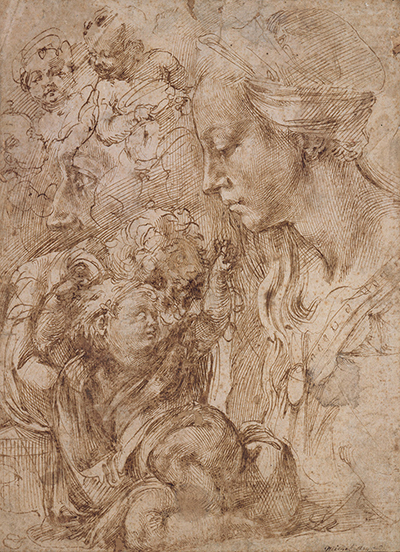

Michelangelo’s Sketches of the Virgin, Christ Child and Infants
One sheet contains several beginnings. A great profile of the Virgin occupies the right, grave and inward. Below her, the naked Christ Child twists vigorously on a cushion. A half-hidden male face emerges between them; at upper left, smaller mothers and infants crowd into rapid lines. Michelangelo does not choose one Holy Family. He allows alternatives to gather, overlap and provoke one another.
The Berlin Kupferstichkabinett drawing is known both as Studies for a Holy Family and by the more descriptive title Sketches of the Virgin, the Christ Child Reclining on a Cushion, and Other Sketches of Infants.[1][2] Dated 1505 and made in pen and brown ink, it measures about 28 × 20 centimetres and bears inventory KdZ 1363.[1] The variety within it is not disorder. It is invention happening visibly.
At a Glance
- WorkStudies for a Holy Family; also Sketches of the Virgin, the Christ Child Reclining on a Cushion, and Other Sketches of Infants
- ArtistMichelangelo Buonarroti
- Date1505[1]
- MaterialPen and brown ink on paper[1][2]
- DimensionsApproximately 28 × 20 centimetres[1]
- Current homeKupferstichkabinett, Staatliche Museen zu Berlin, KdZ 1363[1][2]
- Main motifsLarge profile Virgin, reclining and twisting Christ Child, partially visible male head, and three smaller infant or Holy Family ideas
- Possible portraitSome scholars see the small male face as a distressed self-portrait; the identification is not certain[1]
- Related worksThe sheet reflects concerns also present in the Doni Tondo, Taddei Tondo and Pitti Tondo, without serving as a final diagram for any one of them[1]
- Central valueIt shows compositional and figural thought accelerating through repeated bodies and varied marks
Contents
- A Sheet Without a Single Centre
- The Virgin in Profile
- The Christ Child on a Cushion
- The Male Face Between Mother and Child
- Three Smaller Infant Ideas
- Pen and Brown Ink
- Hatching as Connection
- Sacred Tenderness Without Sweetness
- Relationship to the Doni Tondo
- The Taddei and Pitti Tondi
- The Virgin as Compositional Architecture
- The Infant as a Sculptural Problem
- Many Titles for One Working Sheet
- Dating the Drawing to 1505
- How to Look at the Sheet
- Artist Up Close
A Sheet Without a Single Centre
The large Virgin’s profile immediately attracts attention, but the eye does not remain there. Her downward gaze leads towards the turning infant. The child’s outstretched arms direct attention back into the crowded upper-left group. A male head appears between mother and son as if another thought had surfaced through the first.
Michelangelo refuses a tidy border around each motif. Hatchings bridge adjacent forms; contours approach or cross one another; empty paper becomes scarce.
The result differs from a finished composition in which every glance and gesture belongs to one coherent sacred event.
Here coherence lies in the problem itself: how can adult and infant bodies create tenderness, weight and spiritual relationship?
The Virgin in Profile
The most sustained head is turned to the left and slightly lowered. A veil or headdress encloses the hair, while fine parallel hatching models brow, cheek and neck.
Her expression is reserved. No smile invites sentimental intimacy. The long nose, downcast eye and closed mouth make contemplation physical.
Michelangelo gives the profile a relief-like clarity. It could almost be a carved medallion, yet varied pen strokes keep the surface alive.
Because the Child below turns dynamically away, the Virgin’s stillness becomes structural. She does not mirror his energy; she contains it.
Motherhood is imagined as an unequal relationship between inward attention and restless embodied life.
The Christ Child on a Cushion
In the foreground, the nude infant reclines on a low support. His body twists to the right while his arms reach outward.[1]
The pose is difficult. Shoulder, chest, belly and hips move in related but unequal directions. Bent legs press into the cushion, making softness legible through bodily weight.
Michelangelo’s infants often possess startling muscular energy. This child is not a miniature adult, but neither is he an emblem placed passively in the Virgin’s lap.
Incarnation becomes tangible through dependence and exertion. The divine child must be supported; he also acts upon the space around him.
The cushion matters because it makes pressure visible. Sacred identity is grounded in touch.
The Male Face Between Mother and Child
A smaller male head emerges near the centre, partly obscured by surrounding marks.
Google Arts & Culture reports that many scholars recognise it as a diminutive, agitated self-portrait of Michelangelo.[1] The identification is intriguing but remains interpretive.
The face could also participate in a Holy Family as Saint Joseph. Indeed, the broader title encourages that role, while the suggested likeness introduces the artist into sacred invention.
These readings need not be forced into certainty. A self-resembling Joseph would join observation, role and meditation, but no inscription confirms the identity.
What is visually secure is the face’s different register. Smaller and more abrupt than the Virgin, it appears as an interruption—an anxious human presence between monumental mother and vigorous child.
Three Smaller Infant Ideas
At upper left, three sketched arrangements show the Infant Christ and the young Saint John, or related child motifs.[1]
Their lines are faster and less resolved. Heads, arms and torsos appear through compressed strokes, with some forms nearly overtaken by hatching.
These sketches expand the sheet from one mother-and-child relationship into a field of possible groupings. Infants lean, reach and encounter other bodies.
Scale does not correspond neatly to importance. A tiny motif may preserve a compositional possibility that the larger figures test in detail.
Michelangelo allows rapid notation and sustained modelling to coexist. The sheet records changes in the speed of thought.
Pen and Brown Ink
Brown ink gives Michelangelo no broad tonal eraser. A pen stroke remains, so development occurs through addition, emphasis and redirection.
He exploits this permanence. Contours are restated rather than cleaned away. Parallel hatchings turn around forms; cross-hatching deepens selected shadows. Rapid loops can indicate an infant’s entire limb, while tight lines patiently model the Virgin’s cheek.
The material makes time visible. Dark density often means not simply shadow but repeated attention.
This is why overlap does not feel like failure. Earlier possibilities persist beneath later decisions, allowing the eye to reconstruct an evolving sequence without knowing its exact order.
Hatching as Connection
The museum account emphasises areas of quick hatching that combine the motifs.[1]
Hatching usually models volume, but here it also creates continuity across otherwise separate studies. Lines begun around one head may contribute to the atmosphere around another.
The sheet becomes a shared weather of marks. Figures retain distinct identities while emerging from the same restless graphic field.
This unity is especially important because no enclosing architecture or landscape joins the Holy Family ideas. The act of drawing supplies their common space.
Michelangelo’s hand makes relation before a final composition does.
Sacred Tenderness Without Sweetness
The subject might invite gentle domestic harmony. Michelangelo instead gives it tension.
The Virgin’s gravity, the Child’s twist and the possible Joseph’s anxiety prevent the group from settling into easy delight. Tenderness appears as attention to vulnerability and weight rather than as smiling expression.
Such gravity can foreshadow the Passion without requiring a specific symbol of death. Christian images of mother and infant inevitably hold future separation within present intimacy.
Michelangelo does not narrate that future here. He allows bodily relations—support, reach, withdrawal—to carry emotional complexity.
The Holy Family is sacred because these bodies matter, not because physical strain has been removed.
Relationship to the Doni Tondo
The Doni Tondo, painted around the same early Florentine period, shows the Virgin turning powerfully to receive or pass the Christ Child while Joseph supports the group behind her.
The Berlin sheet shares an interest in interlocked bodies and a Holy Family made through torsion. Its male face between mother and infant can also prompt comparison with Joseph’s place in the painting.
Yet the drawing is not a straightforward preparatory plan for the Doni Tondo. The museum account says its motifs reflect works made in painting and relief, including that tondo, rather than assigning a one-to-one dependency.[1]
Reflection may move in several directions. Michelangelo revisits a problem across works instead of solving it once.
The Taddei and Pitti Tondi
Two marble reliefs from around 1504–06 offer further comparison. In the Taddei Tondo, the Christ Child recoils dynamically in relation to the young Saint John and a bird. In the Pitti Tondo, the Virgin and Child form a denser, more frontal group.
The Berlin drawing shares their attention to mother, child, support and contained movement.[1]
Again, resemblance is not a placement map. No single cluster on the sheet can be named as the definitive drawing for either relief.
The comparison instead reveals a period of concentrated invention. Michelangelo carried related sacred and bodily questions among pen, marble and paint.
Different materials changed the answers. Ink preserves alternatives; relief compresses them into layered stone; painting joins them through colour and full pictorial space.
The Virgin as Compositional Architecture
The large profile is more than a devotional portrait. It establishes an enclosing vertical presence on the right.
Her veil creates a broad outer contour; her lowered face directs movement inward; her torso supplies a stable boundary beside the Child’s diagonals.
Michelangelo repeatedly uses the Virgin’s body to organise sacred groups. She supports Christ physically and orders the field compositionally.
This dual function gives maternal care architectural force. The child can turn energetically because the larger body provides measure and shelter.
Even on a sheet where figures may not belong to one final arrangement, the principle is clear: relationship is built through scale, direction and support.
The Infant as a Sculptural Problem
The reclining Child demonstrates Michelangelo thinking in roundness. Belly, thigh and shoulder project through hatching; the cushion yields beneath them.
An infant’s body differs from the heroic adult nudes for which he is famous. Proportions are compact, flesh softer and balance dependent on another person or object.
Michelangelo does not reduce these differences. He makes them the basis of expressive force.
The child’s twist is powerful precisely because it acts through a small, vulnerable body. Anatomy conveys life before it conveys heroism.
This helps explain why infant studies deserved their own trials. A conventional cherub could not answer the theological demand of the Incarnation: divinity entering the physical dependence of childhood.
Many Titles for One Working Sheet
Modern titles often describe works that Michelangelo himself did not name.
Studies for a Holy Family interprets the motifs as belonging to a broad sacred subject. The Metropolitan Museum’s longer label inventories what can be seen: Virgin, reclining Christ Child and other infants.[1][2]
The two titles emphasise different truths. One proposes relation; the other preserves multiplicity.
Neither should be made to prove more than the drawing contains. The sheet is not a finished Holy Family scene, but its figures plainly arise within that field of invention.
Keeping both names visible protects the object from false simplicity.
Dating the Drawing to 1505
Google Arts & Culture, using information from the Berlin Kupferstichkabinett, dates the sheet to 1505.[1]
Its varied, dense pen work corresponds with other early Michelangelo drawings. The date also places it amid the Doni Tondo and the two marble tondi, strengthening contextual comparison.[1]
Dating by style and relationship is not the same as a dated inscription. The year should be understood as the institution’s current catalogue judgement.
That judgement gives the sheet a productive historical position: after the breakthrough of David, during a period when Michelangelo was transferring bodily invention among major Florentine works.
How to Look at the Sheet
Begin with the Virgin’s eye and follow its downward direction. It does not land neatly on the Child, reminding you that these large motifs may be separate trials rather than one final encounter.
Trace the infant’s reach back towards the central male face. Notice where contours compete and where hatching binds them.
Then move to the upper left and accept the reduced clarity. Try to distinguish three child ideas without forcing every line into one group.
Finally, step back. What first looked crowded reveals an internal rhythm: stillness at right, torque below, interruption at centre and rapid variation above.
Artist Up Close
Michelangelo’s early reputation rested on finished marvels, but this drawing shows how that finish was prepared through tolerated disorder.
He does not protect the beautiful Virgin profile from neighbouring experiments. The self-contained head remains embedded in a field of trial.
That willingness is a form of confidence. A line need not be erased because another thought follows it. Ink records the pressure of continuation.
The sheet also joins Michelangelo’s devotional and anatomical intelligence. Mother, child and possible Joseph are not ideas placed above bodily experience. Their sacred meaning emerges through how bodies look, turn, bear weight and attend to one another.
Frequently Asked Questions
Discussion
How does a page of studies change your sense of a sacred subject?
Where does the sheet feel exploratory rather than finished?
How should a route handle two useful modern titles for the same object?
Join the Conversation
Compare this Berlin drawing sheet with Michelangelo's Madonna and Child routes, drawing studies and finished Holy Family imagery.
References
- Google Arts & Culture and Kupferstichkabinett, Staatliche Museen zu Berlin, “Studies for a Holy Family,” inventory KdZ 1363,, View source.
- The Metropolitan Museum of Art, Exhibition Object Highlights,” entry for Sketches of the Virgin, the Christ Child Reclining on a Cushion, and Other Sketches of Infants,, View source.
