


 by Tom Gurney
Tom Gurney BSc (Hons) is an art history expert with over 20 years experience
Published on June 19, 2020 / Updated on November 6, 2025
Email: tomgurney1@gmail.com / Phone: +44 7429 011000
A Children's Bacchanal
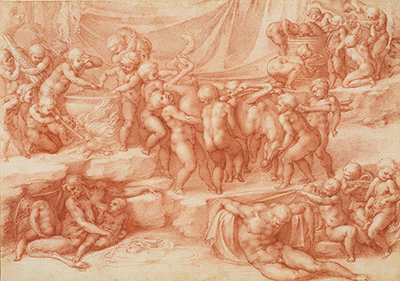
Children cook, drink, fight and carry dead animals through a rocky enclosure. One urinates into a bowl near the wine vat; others struggle under the weight of a deer; an aged satyr-woman nurses an infant while the only adult man sleeps below. Michelangelo has filled the sheet with activity, yet no mature reason appears to govern it.
A Children's Bacchanal is a red-chalk gift drawing made in 1533 for Tommaso de' Cavalieri. The Royal Collection preserves the almost perfectly intact sheet as RCIN 912777.[1] It is not a preparatory study for a known painting. Its extraordinary finish made drawing itself the completed work and made slow looking part of the gift.
The scene is comic, disturbing and morally ambitious. Childhood does not signify innocence here. Bodies ruled by appetite inhabit the lowest state of human life, where heat, food, drink and animal impulse circulate without the guidance of reason or divine love.
At a Glance
- ArtistMichelangelo Buonarroti
- TitleA Children's Bacchanal; also Bacchanal of Children
- Date1533
- MediumRed chalk in two shades on paper
- DimensionsApproximately 27.4 × 38.8 centimetres
- Current collectionRoyal Collection, Windsor
- Royal Collection numberRCIN 912777
- RecipientTommaso de' Cavalieri
- Object typeHighly finished gift or presentation drawing
- SettingRocky cave-like enclosure hung with drapery
- Core imageryChildren preparing meat, carrying game and drinking; sleeping man; nursing satyress
- ConditionAlmost perfectly preserved, with slight edge trimming known through early engravings
Contents
- A Scene Read from Left to Right
- Why Children?
- The Nursing Satyress
- Appetite, Reason and Neoplatonic Order
- A Gift for Tommaso de' Cavalieri
- Red Chalk and Extraordinary Finish
- Antique Sarcophagi and the World of Putti
- Raphael, the Doni Tondo and Artistic Memory
- The Dead Deer as a Compositional Centre
- Animals, Hunting and the Feast Economy
- Time Inside a Crowded Instant
- Humour Without Innocence
- Copies, Engravings and Trimming
- How to Look at A Children's Bacchanal
- Why A Children's Bacchanal Matters
A Scene Read from Left to Right
At the upper left, children attend a cauldron and feed its fire. A hare and boar's head hang nearby, converting the rocky setting into kitchen and slaughter space.[1]
Across the centre, a group strains to carry a dead deer. The weight creates a knot of bodies: backs bend, limbs overlap and effort passes from one child to the next. Another child carries a small boar.
At upper right stands a wine barrel. Children drink from it, while one urinates into a bowl apparently intended for a companion. Appetite becomes contamination and joke at once.
The lower register slows. An adult male lies in sleep or drunken stupor. At the left, an aged female satyr suckles a child. Human and animal categories blur.
The abundance has no obvious central hero. Michelangelo asks the eye to travel, discover and connect. Meaning accumulates through repeated appetite rather than one decisive action.
Why Children?
Renaissance art often used putti as playful attendants, carriers of garlands or spirits of love. Michelangelo turns their familiar beauty toward disorder. These children possess energy without judgment.
The Royal Collection interprets them as the lowest state of humanity, deprived of reason and acting in a semi-animal manner.[1] They cook and cooperate, so they are not simply wild. The disturbing point is that skill can serve appetite without moral direction.
Their small bodies also permit parody. Activities associated with adult hunting, feasting and wine are miniaturised. A child bearing game can look heroic until the surrounding filth and excess undermine the pose.
The sleeping adult offers no corrective. If he is drunk, maturity has surrendered its governing function. If merely asleep, reason is absent when most needed.
Childhood here is philosophical rather than developmental. The sheet does not claim actual children are naturally depraved. It uses the infantile as an image of the soul before rational and spiritual ordering.
The Nursing Satyress
The old satyr-woman at lower left is one of the drawing's strangest inventions. She joins maternal nourishment with an animal-human body.
Satyrs belong to the world of Bacchus, wine and uncontrolled appetite. A female satyr nursing a child makes irrational life reproduce and sustain itself. The scene has care, but care remains inside nature rather than rising beyond it.
Her age contrasts with the children's smooth flesh. Michelangelo refuses an idealised maternal body and gives the lower corner a coarse, ancient presence.
The figure also anchors the title “bacchanal.” Without explicit Bacchus, procession or adult revelers, wine and satyr nature establish the god's sphere.
Modern viewers may find the image grotesque. That reaction belongs to the moral design, but it should not become casual ridicule of age or female flesh. Michelangelo mobilises bodily difference to disturb an ideal world of putti.
Appetite, Reason and Neoplatonic Order
The sheet has no identified literary source.[1] Its broad structure nevertheless aligns with Renaissance accounts of the human being as layered among vegetative appetite, animal sensation, rational mind and divine aspiration.
Food, wine, heat, sleep and sexualised nature occupy the lowest register. None is evil in itself. Disorder arises when appetite becomes the whole horizon.
Michelangelo's earlier gift drawings for Cavalieri had contrasted Tityus, punished for lust, with Ganymede lifted toward the divine. The Bacchanal multiplies that concern across a community. Instead of one condemned giant, it shows a society without upward direction.
The moral meaning does not cancel humour. Urine offered as wine is a coarse prank. A child struggling under an animal can be funny. Laughter may be the drawing's method of recognition: viewers enjoy the disorder before discovering themselves implicated in appetite.
Nor should the interpretation harden into one doctrinal diagram. The absence of a text leaves room for artistic rivalry, antique quotation and affectionate warning within the same gift.
A Gift for Tommaso de' Cavalieri
Michelangelo met the young Roman nobleman Cavalieri in 1532 and formed an intense, lifelong attachment. Letters, poems and finished drawings carried that relationship.[2]
Vasari listed the Bacchanal among the elaborate sheets made for Cavalieri in 1532–1533. The Royal Collection notes that Raffaello da Montelupo copied figures from it while Michelangelo was still in Florence, indicating the drawing began before the artist's final departure for Rome in October 1533.[1]
As a gift, the sheet offered labour, learning and beauty rather than money or precious material. Its density rewards the repeated contemplation Cavalieri reported giving other drawings.
The moral reading may contain a warning about drink addressed by the austere older artist to a young friend.[1] That possibility is appealing but should not reduce the image to a lecture. Cavalieri was an educated participant capable of interpreting myth, artistic quotation and erotic symbolism.
Gift and love do not make the content transparent biography. The drawing creates a space where admonition, delight and technical magnificence coexist.
Red Chalk and Extraordinary Finish
Michelangelo worked mainly with a sharpened point, maintaining minute, controlled marks across an unusually crowded composition.[1] Red chalk gives bodies warmth while allowing fine hatching.
Two shades help separate forms and stages. Pressure varies from delicate modelling to dark accents under limbs and inside the cave. Untouched paper supplies light.
The consistency is astonishing because density creates risk. Dozens of overlapping bodies can become muddy. Michelangelo uses contour, tonal hierarchy and small intervals of paper to keep action legible.
Finish was part of social meaning. A rapidly searching study would reveal thought in process; this sheet presents sustained attention already transformed into a precious object.
Its near-perfect preservation allows modern viewers to see strokes with unusual clarity. That condition is historically exceptional, not an original guarantee. Paper, red chalk and repeated handling are vulnerable.
Antique Sarcophagi and the World of Putti
The Royal Collection connects many motifs with ancient sarcophagi showing children engaged in adult activities.[1] Such reliefs provided a repertoire of small bodies hunting, harvesting, wrestling and celebrating.
Michelangelo did not copy one sarcophagus as a whole. He reassembled antique energies into a new moral environment. The dead game and crowded labour feel archaeologically learned without becoming a reconstruction of Roman ritual.
Ancient relief also encouraged shallow spatial packing. Figures overlap across a horizontal field, and the rocky cave behaves almost like a carved background.
Drawing surpasses relief in one respect: chalk can dissolve edge, vary atmosphere and push some bodies into obscurity. Michelangelo makes imagined stone breathe while retaining its compact organisation.
Antiquity here is neither pure ideal nor pagan liberation. It supplies forms through which appetite can be beautiful and morally dangerous.
Raphael, the Doni Tondo and Artistic Memory
One kneeling child near the upper right echoes a woman in Raphael's Entombment, rotated through ninety degrees.[1] Raphael's figure had itself transformed the pose of the Virgin in Michelangelo's Doni Tondo.
The chain is a sophisticated exchange. Michelangelo sees his invention through Raphael's response and takes it back from another angle. Quotation becomes memory folded twice.
A double-sided drawing in Bayonne strengthens the connection: its recto studies a Lamentation related to Raphael, while its verso sketches putti around a wine vat with a reclining man, preparing the Bacchanal.[1]
This evidence prevents the final gift from seeming effortless. Behind its polish lie study, reorientation and dialogue with a rival who had died in 1520.
The quotation is not a private joke only artists could enjoy. It demonstrates that forms change meaning. A grieving woman in a Christian history can become a child inside pagan disorder when pose is turned and context replaced.
The Dead Deer as a Compositional Centre
The central deer gives several children one shared weight. Their bodies pull in opposed directions but remain tied by the carcass.
The group recalls a carrying of Christ composition at the level of physical structure: a horizontal body supported by straining figures. The analogy is formal rather than a claim that the deer is Christ.
This potential echo makes the moral inversion sharper. Coordinated labour that could serve burial or care is directed toward feasting.
Michelangelo builds the group as a sculptor might build a relief, testing how limbs interlock and where voids prevent confusion. The deer is both subject and structural beam.
Its dead weight differs from the animated children. The contrast lets chalk communicate mass through drooping form and the effort around it.
Animals, Hunting and the Feast Economy
The sheet contains a complete chain from animal death to consumption. Hare and boar's head hang as prepared game; a small boar and a deer are carried; fire and cauldron promise cooking; the wine vat supplies intoxication. Michelangelo does not show a spontaneous picnic but an economy of appetite.[1]
The children cooperate impressively. They gather fuel, transport weight and manage tools. That competence prevents the moral from becoming “activity is bad.” Their labour lacks a higher end, not practical organisation.
Hunting traditionally served aristocratic identity and could signify courage. By assigning its products to children, Michelangelo exposes the distance between heroic pursuit and the feast it enables. Dead animals become burdens before becoming food.
The boar, hare and deer also diversify texture and shape. Fur, antler, hanging flesh and limp mass interrupt the smooth repetition of child bodies. Humanity appears inside a larger animal field rather than clearly above it.
The nursing satyress completes the circulation. Milk, meat, wine and bodily waste occupy one system of intake and output. The image is not simply about drunkenness; it is about life reduced to feeding itself.
Time Inside a Crowded Instant
Although every figure occupies one sheet, the actions imply stages. Animals have already been killed; some are being transported; the fire is being prepared; wine is already consumed; the adult has reached stupor. Michelangelo compresses before, during and after into simultaneous activity.
This temporal layering makes the scene almost cyclical. Appetite produces labour, labour produces feast, feast produces sleep, and the nursing child begins the sequence again.
The viewer's wandering eye supplies duration. No single glance can absorb the tiny incidents, so looking reenacts the drawn community's busyness. Cavalieri's reported habit of contemplating Michelangelo's gifts for long periods would have been answered by this density.[2]
The almost pristine condition sharpens that temporal paradox. A world devoted to perishable consumption survives through fragile paper with extraordinary freshness.
Humour Without Innocence
The urinating child is not a marginal accident. He changes how the nearby bowl is read and turns social trust into a prank. Renaissance viewers were not incapable of enjoying bodily humour merely because the drawing also carried philosophy.
Laughter can lower the viewer into the scene. We recognise the joke before assuming the elevated position of moral judge. That sequence makes admonition more effective: appetite and mischief attract as well as repel.
Michelangelo avoids graphic slaughter or sexual action, allowing indirect details to create disorder. The deer is already dead, the adult already unconscious, and animal sexuality displaced into satyr nature. The drawing remains suitable as a precious gift while refusing decorous innocence.
Its comedy is therefore structural. High artistic finish is spent upon low behaviour. The disproportion between means and subject becomes another reason to look—and another warning about mistaking beauty for moral elevation.
Copies, Engravings and Trimming
The gift drawings became famous quickly. Cavalieri allowed access, and artists copied them in drawings, engravings and other media.[2]
Early prints after the Bacchanal show details at the edges now lost, proving that the Royal Collection sheet was trimmed slightly.[1] A reproductive object thus preserves evidence about the autograph original.
Engraving changes the warm granular touch of red chalk into line. It may reverse the composition and harden shadows, but it also multiplies imagery that one private owner could otherwise control.
The near-perfect sheet and its altered edges therefore tell two histories at once: unusually careful preservation and physical change. “Almost perfect” is not “untouched.”
The route into the Royal Collection is uncertain. After Cavalieri's drawings passed into the Farnese collection, documentation falls silent for roughly two centuries; they were in the Royal Collection by about 1800.[2]
How to Look at A Children's Bacchanal
Begin at the cauldron and follow food across the sheet to wine. This reveals appetite as an organising system.
Find the deer group and count bodies only after tracing their shared burden. Overlap is deliberate.
Move down to the sleeping man and nursing satyress. The lower register comments on the activity above.
Examine the red-chalk strokes at high resolution. Notice how small marks maintain different surfaces—skin, fur, rock and cloth.
Finally look for the rotated Raphael pose. The drawing's philosophical meaning is inseparable from its history of artistic exchange.
Why A Children's Bacchanal Matters
The sheet matters because it turns virtuosity into an ethical problem. Beautiful bodies and exquisite technique depict a world without higher guidance. Pleasure is real, but it is insufficient.
It also expands the meaning of Michelangelo's love gifts. He did not offer Cavalieri only ideal youths and tragic myths. He gave him a crowded, comic and unsettling image demanding intellectual work.
The drawing's survival preserves that demand. Five centuries later, the children remain busy, the adult remains asleep, and the viewer must decide whether admiration itself has awakened reason.
Frequently Asked Questions
Discussion
What details, sources or comparisons stand out to you in Bacchanal of Children?
Reader Insights
Which formal detail changes how the work reads?
Which documented source or collection history feels most useful?
Which related Michelangelo work should readers compare next?
Join the Conversation
Add a source-led observation, comparison or question for other readers.
References
- Royal Collection Trust, A Children's Bacchanal,” RCIN 912777:, View source.
- Royal Collection Trust, Michelangelo's Presentation Drawings”:, View source.
- Metropolitan Museum of Art, Giulio Bonasone, “A Children's Bacchanal with Animals,” engraving:, View source.
- Royal Collection Trust, press release for Drawing the Italian Renaissance:, View source.