 by Tom Gurney
Tom Gurney BSc (Hons) is an art history expert with over 20 years experience
Published on June 19, 2020 / Updated on August 8, 2026
Email: tomgurney1@gmail.com / Phone: +44 7429 011000
Michelangelo’s Entombment
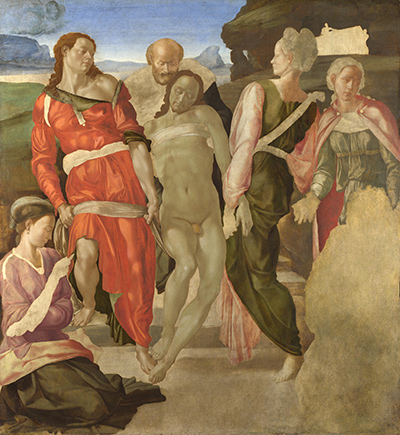
Michelangelo’s Entombment is a procession that never reached completion. The dead Christ is carried through the centre of a dense group, his pale body imposing weight on the living figures around him. Some passages have been developed toward colour and volume; others remain barely established. At the lower right, a major absence may have been reserved for the Virgin. The painting’s unfinished surface turns the work of burial into a scene that is itself suspended.
The National Gallery dates the oil-on-wood panel to about 1500–1501 and calls it The Entombment (or Christ Being Carried to His Tomb).[1] It was probably connected with a funerary chapel in Sant’Agostino in Rome, although both the exact commission and several figure identities require qualification. The work belongs to Michelangelo’s early painting, not to the late marble Deposition that is also called the Bandini Pietà.
At a Glance
- ArtistMichelangelo Buonarroti
- TitleThe Entombment (or Christ Being Carried to His Tomb)
- DateAbout 1500–1501
- MediumOil on wood
- StateUnfinished
- Current locationNational Gallery, London
- SubjectThe dead Christ carried toward burial after the Crucifixion
- Probable commissionA funerary chapel in Sant’Agostino, Rome
- Probable patronal contextChapel of Giovanni da Viterbo, bishop of Crotone
- Figure cautionsSaint John, Joseph of Arimathea, Nicodemus, Mary Magdalene and the Three Marys have been proposed with varying confidence
- Major absenceThe lower-right area was probably intended for the Virgin Mary
- Important distinctionThis is an early painted panel, not Michelangelo’s late four-figure marble Deposition
Contents
- A Dead Body in Motion
- Direction, Pause and the Unseen Tomb
- Who Carries Christ?
- The Virgin as a Reserved Absence
- Hands, Contact and the Distribution of Weight
- A Probable Chapel in Sant’Agostino
- Between Rome and Florence
- Oil Paint and Uneven Development
- Disegno, Bodies and the Logic of Construction
- Entombment, Deposition and Pietà
- The Panel Among Michelangelo’s Paintings
- Artist Up Close
A Dead Body in Motion
The full National Gallery title matters because it specifies action. Christ is not simply displayed for mourning; he is being carried toward the tomb.[1] The group must therefore solve a physical and narrative problem: several people coordinate around a body that cannot support itself.
Christ’s torso forms the central light mass. His body rises or is lifted diagonally rather than lying horizontally across a lap. The bearers adjust around him, and their differing positions turn movement into a network of strain. Burial becomes collective labour.
This motion distinguishes the panel from a conventional Pietà focused primarily on Mary’s lament. It also differs from a Deposition that clearly shows removal from the Cross. No Cross or ladder dominates the composition. Michelangelo condenses the interval after death and before placement in the tomb.
The body’s vertical emphasis creates ambiguity. Are the bearers lifting Christ, lowering him or turning him through space? The title gives the broad destination, but individual gestures remain hard to resolve because the painting stopped before all contours, hands and spatial relations were fully clarified.
The incomplete state therefore affects narrative. It is not just a surface condition laid over a finished story. Where one body ends and another begins, or where a supporting arm makes contact, can remain uncertain. Looking follows the same difficult coordination that the figures perform.
Direction, Pause and the Unseen Tomb
The title gives the procession a destination, but the tomb itself does not dominate the surviving image.[1] Movement is organised through figures rather than landscape or architecture. Christ’s body becomes the path along which the eye understands direction.
This produces a tension between carrying and pausing. The bearers exert themselves, yet the composition is compact enough to suspend them for devotional contemplation. A historical action becomes an enduring encounter with the dead Christ.
The lack of a broad setting also magnifies bodily orientation. A turned shoulder or planted foot carries information that a road, doorway or distant crowd might otherwise supply. Michelangelo makes anatomy do narrative work.
At the same time, incompletion prevents a confident map of the procession. Areas awaiting further development might have clarified the destination and spatial ground. The present panel offers a strong directional impulse without the finished environment that would have contained it.
This openness distinguishes the act from dramatic spectacle. The movement is solemn and physically demanding, not a chaotic rush. Christ’s passivity governs the group; living bodies must adapt their pace to death.
Who Carries Christ?
The National Gallery uses cautious identifications.[1] A figure at the left may be Saint John the Evangelist. One of the women helping to carry Christ is probably among the Three Marys. The man behind the body may be Joseph of Arimathea or Nicodemus. A woman low in the composition may be Mary Magdalene.
These are not trivial labels. John, Joseph and Nicodemus play different roles in the Passion narratives, while the women connect burial with witness and mourning. Yet the unfinished painting does not supply every attribute needed to identify them securely.
The large lower-right space was probably intended for the Virgin Mary.[1] Her absence changes the present emotional balance. The painting’s most important mourner may survive chiefly as reserved space, causing the group to feel weighted toward Christ’s movement rather than maternal grief.
It is tempting to mentally complete the Virgin with a familiar pose from another Michelangelo work. That would substitute later invention for surviving evidence. The blank or underdeveloped zone tells us that Michelangelo had not finished the relationship. Its scale and position are meaningful; its exact final figure is not recoverable.
The uncertainty also keeps the panel distinct from the Bandini Deposition. That late marble contains four bodies with a hooded man usually identified as Nicodemus, the Virgin and Magdalene supporting Christ.[5] Similar names and burial themes do not make the compositions versions of one design.
The Virgin as a Reserved Absence
The probable place for Mary at the lower right is one of the painting’s most consequential unfinished areas.[1] A major figure was not merely left without final colour; her bodily relation to Christ may never have been fully resolved on the surface.
Mary’s expected presence affects the composition even now. Christian viewers know she belongs to the mourning narrative. The eye reads the open or provisional zone not as neutral background but as a missing centre of grief.
If completed, her lower position might have anchored the moving body, redirected attention or created a stronger emotional exchange. These possibilities demonstrate why the absence matters, but none establishes the final pose.
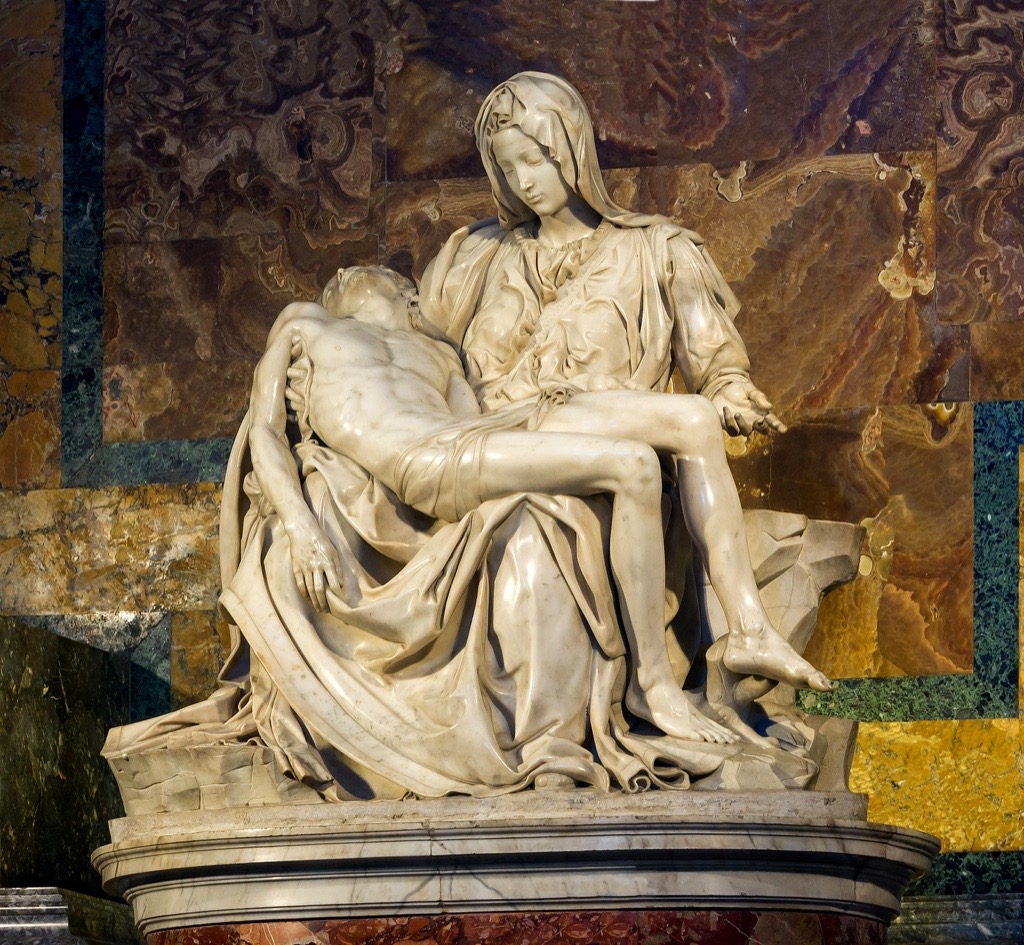
The unpainted Virgin also prevents the panel from reaching the broad maternal structure familiar from Michelangelo’s Vatican Pietà. In London, Christ remains carried by a community while Mary is largely potential. The present emphasis falls on procession rather than lap or embrace.
This is a rare case in which iconographic knowledge makes blankness active. The viewer does not simply notice missing paint; the viewer anticipates a person. Technical incompletion becomes narrative suspense without needing to have been planned as such.
Hands, Contact and the Distribution of Weight
Carrying is communicated through points of contact. Hands meet Christ’s limbs or cloth; arms brace; shoulders incline. Even where finish is uneven, the direction of strain can travel across the group.
Michelangelo’s challenge was to make several helpers appear necessary without letting their bodies dissolve into confusion. Overlap provides unity, but too much overlap hides action. The unresolved panel shows that balance still being negotiated.
Christ’s pallor and exposure separate him from the clothed figures. Flesh becomes a continuous central weight against divided fabrics. A completed colour scheme might have sharpened this distinction further, but the present contrast already gives the body exceptional presence.
The bearers’ identities are less certain than their function. A viewer can understand support before deciding whether one man is Joseph or Nicodemus. This difference between bodily role and named identity is crucial: the composition remains legible even when scholarship preserves alternatives.[1]
The panel’s physical support adds a quiet irony. Wood carries the painted procession, while the figures carry Christ within it. The real object bears every painted body equally; Michelangelo’s illusion creates unequal burdens on its surface.
A Probable Chapel in Sant’Agostino
The National Gallery relates the panel to a commission made in 1500 for the funerary chapel of Giovanni da Viterbo, bishop of Crotone, in Sant’Agostino in Rome.[1] The link is probable rather than absolute, and the precise subject of the intended altarpiece is not documented beyond dispute.
The association nevertheless makes sense of the work’s scale and subject. An Entombment in a funerary chapel could join Christ’s burial to the Christian hope attached to the patron’s own death. The painted body moving toward the tomb would operate within a space of burial, prayer and remembrance.
Michelangelo had returned to Rome after his early Florentine training and had achieved extraordinary success with the Vatican Pietà. An oil panel for a Roman chapel would have placed him in another medium and in direct relation to altar architecture.
The commission appears not to have been completed. Michelangelo returned to Florence in 1501, and the National Gallery connects that departure with the abandoned panel.[1] The chronology is stronger than any psychological explanation. Nothing in the object proves boredom, failure or hostility toward the patron.
The probable chapel context also sets a limit on modern autonomy. The painting now hangs as a museum object whose unfinished technique can be studied closely. It was likely conceived as a sacred image within architecture, seen during worship and in relation to an actual tomb.
Between Rome and Florence
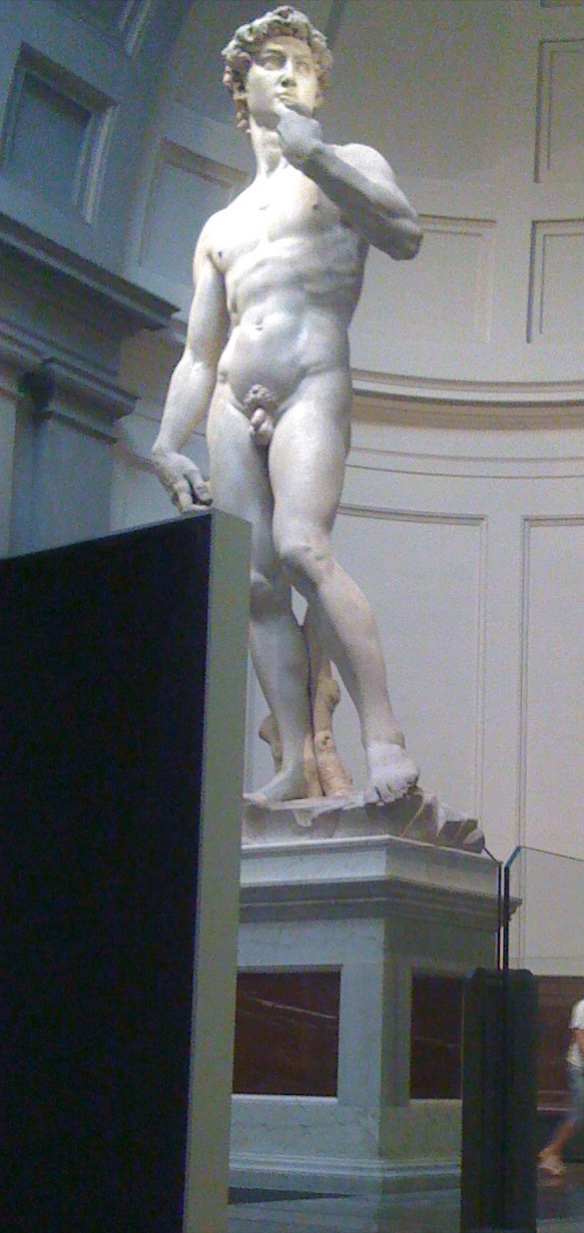
The years around 1500 were decisive. Michelangelo had achieved Roman fame through the Vatican Pietà, yet his return to Florence would lead to the colossal David. The unfinished panel stands between two works that later came to define his early sculpture.
That position should not turn it into a mere transition. Oil painting presented its own problems of support, colour, layering and sacred function. The commission could have extended Michelangelo’s Roman identity beyond marble had it reached the chapel.
Departure made geography consequential. An unfinished object remained behind while the artist entered another civic and sculptural environment. The panel’s stopped condition is therefore tied to mobility across patronal worlds, not only to aesthetic choice.[1]
The work’s later place in London adds another movement. A probable Roman altarpiece associated with a funerary chapel is now studied within a national collection, close to another unfinished Michelangelo panel.[2][6] Its context changed from prayer to comparison.
Museum proximity makes technique accessible but can soften the original funerary charge. The subject once addressed viewers in a space shaped by death and commemoration. The National Gallery preserves the object while necessarily creating a different relation to its dead Christ.
That change also affects scale and approach. In a chapel, the panel would have participated in an altar ensemble and been encountered through ritual distance. In a gallery, visitors can scrutinise scraped areas and incomplete paint as independent evidence. Neither experience exhausts the object; one clarifies function, the other making.
The panel’s movement from probable commission to unfinished survival is therefore not an empty gap before museum acquisition. It is the condition through which a sacred image became a privileged document of process. What failed to serve one architectural purpose now serves another kind of historical knowledge.
Oil Paint and Uneven Development
The Entombment is painted in oil on wood.[1] This distinguishes it from the egg-tempera Manchester Madonna and from Michelangelo’s later fresco technique.[2] The medium permits transitions, modelling and revisions different from those of dry, quickly setting tempera.
Michelangelo did not bring the whole surface forward evenly. The National Gallery describes figures developed in a concentrated sequence, with some passages much further advanced than others.[1] This gives the panel an archaeological quality: stages normally hidden beneath final paint remain accessible.
Blank or lightly worked regions do not all mean the same thing. One may await a figure; another may preserve underdrawing; another may have been scraped or revised. The museum notes scraped passages associated with forms at the tomb.[1] Removal was therefore part of thought, not only an accident of age.
The body of Christ has enough modelling to establish weight, while neighbouring areas reveal more of construction. This unevenness can make Christ appear supernaturally present against provisional companions. That effect is powerful today, but it need not have been the intended final hierarchy.
Colour participates in that hierarchy. Oil permits flesh to gather volume through gradual transitions, while drapery can separate figures through hue and reflected light. Where those relations remain incomplete, anatomy carries more of the compositional burden.
The wood support imposes its own history. Panels can move, join, crack or change with environment, while paint and ground respond differently. The National Gallery’s object record secures medium and condition, but the present surface should not be imagined as untouched since 1501.[1]
Uneven development also complicates emotion. A face brought further toward finish may seem psychologically dominant beside one left schematic. That apparent hierarchy can be a by-product of work sequence rather than a deliberate distribution of spiritual importance.
A completed panel might have altered colour balance, space and attention substantially. The unfinished work should not be treated as a finished painting with a few empty patches. Its present unity is the unity of an interrupted process.
Disegno, Bodies and the Logic of Construction
Michelangelo’s practice is often discussed through disegno, a term embracing drawing and the larger act of design.[4] The Entombment makes that relationship tangible. Bodies are organised as interdependent masses before colour and finish reach every area equally.
The group can feel sculptural because weight is so insistently imagined. Christ is carried; shoulders brace; limbs overlap; empty space is compressed. Yet the painting does not imitate marble. Oil can distinguish overlapping forms through tone and colour without physically cutting a gap between them.
The exposed stages allow viewers to see conception and execution interacting. An outline is not simply filled. Michelangelo adjusts, scrapes and develops selected bodies. Design remains active throughout making.
This is why the panel is more than an incomplete curiosity. A finished surface often conceals how decisions were sequenced. Here the unequal state shows that Michelangelo could work locally and intensively, carrying one figure toward resolution while another remained open.
The Met’s career study provides a broad framework for these crossings among drawing, sculpture and painting.[4] The National Gallery object remains the authority for what this particular panel reveals.[1]
Entombment, Deposition and Pietà
These words describe related but distinct moments and image traditions. A Deposition typically emphasises removing Christ from the Cross. An Entombment emphasises carrying or placing him in the tomb. A Pietà centres devotional mourning, especially the Virgin with the dead Christ.
Artists could compress the sequence, and titles developed after works were made. The categories therefore overlap without becoming interchangeable. Michelangelo’s London panel owns the carrying action named by its holding institution.[1]
The Vatican Pietà presents Christ across Mary’s lap in a finished marble group. The Bandini Pietà or Deposition is a late, damaged and later reworked four-figure sculpture in Florence.[5] The Rondanini Pietà is a radically recut late marble in Milan. None supplies missing parts of the London painting.
The material distinctions are decisive. In marble, support has real structural consequences. In the panel, Michelangelo represents weight while the wood physically supports every figure alike. Incompleteness also means different things: unpainted or scraped zones are not equivalent to uncarved stone.
The Panel Among Michelangelo’s Paintings
The National Gallery’s artist record places the Entombment within a very small surviving panel corpus.[6] Its London companion, the Manchester Madonna, is an earlier unfinished egg-tempera painting.[2] Both preserve technical stages, but one gathers a sacred childhood group while the other moves a dead body toward burial.
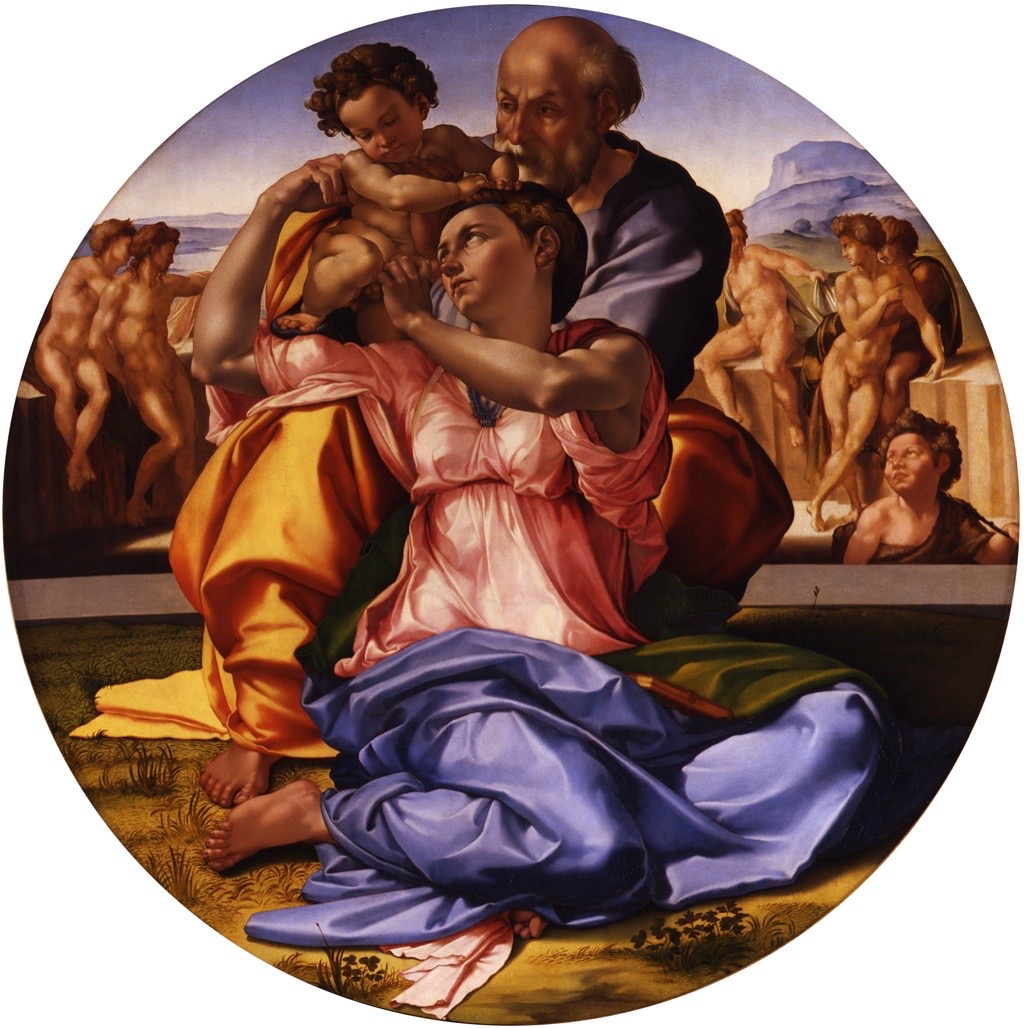
The Uffizi’s Doni Tondo is a finished circular panel made later for Agnolo Doni.[3] Its brilliant colour and fully integrated surface show why the unfinished London works cannot establish an inability or refusal to complete panel paintings.
These three objects reveal different relations between design and closure. The Manchester Madonna retains transferred design and underpainting; the Entombment develops bodies unevenly in oil; the Doni Tondo subordinates preparatory work beneath a resolved public surface.[1][2][3]
Together they also prevent a single definition of Michelangelo as painter. He could translate a print, construct a Madonna in tempera, carry an oil burial scene partway, finish a brilliant circular panel and later organise vast fresco programmes. Medium and circumstance changed what his bodily imagination could do.
Michelangelo’s subsequent frescoes greatly expanded scale, but the panel already asks a monumental question: how can a group of painted bodies make the viewer feel real weight? The answer begins in the central Christ and spreads through every supporting figure.
Artist Up Close
The Entombment shows Michelangelo thinking through contact. No body can be read alone because Christ’s weight alters everyone around him. Composition is not an arrangement of separate figures but a chain of physical consequences.
Its incompletion makes that thought unusually visible. Scraping, blank ground and developed flesh record revisions without explaining them away. Michelangelo’s process appears neither effortless nor linear; it is a sequence of commitments interrupted before closure.
Frequently Asked Questions
Discussion
How does an unfinished burial scene change the way we read Michelangelo's painting?
Reader Insights
Does the unfinished state make the panel feel closer to drawing, sculpture or oil painting?
How does the vertical movement of Christ's body shape the Entombment subject?
What changes when figure identifications remain probable rather than absolute?
Join the Conversation
Set the Entombment between painting, drawing and sculpture. Which part of Michelangelo's method seems most exposed?
References
- National Gallery, London, “The Entombment or Christ Being Carried to His Tomb”:, View source.
- National Gallery, London, “The Manchester Madonna”:, View source.
- Uffizi Galleries, Holy Family, Known as the Doni Tondo”:, View source.
- Metropolitan Museum of Art, Michelangelo: Divine Draftsman and Designer:, View source.
- Opera di Santa Maria del Fiore, Michelangelo Buonarroti, Pietà Bandini”:, View source.
- National Gallery, London, “Michelangelo (1475–1564)”:, View source.