


 by Tom Gurney
Tom Gurney BSc (Hons) is an art history expert with over 20 years experience
Published on June 19, 2020 / Updated on August 8, 2026
Email: tomgurney1@gmail.com / Phone: +44 7429 011000
Michelangelo’s Study of the Torso of a Male Nude Seen from the Back
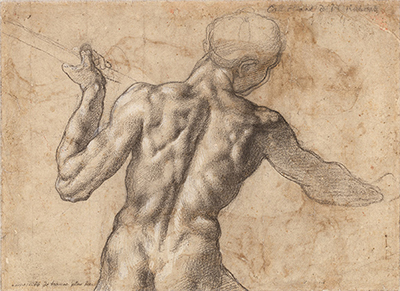
A man turns away while his head bends towards one shoulder and a staff cuts across the space beside him. Almost everything depends on the back. Light catches its ridges, dark chalk gathers beneath the shoulder blades, and the raised arm sets the whole torso under tension. Michelangelo has not drawn a body at rest. He has found the instant when bearing, turning and looking become one action.
Known more precisely as Male Nude Seen from the Back with a Flag Staff, this compact study was made around 1504 and belongs to the Albertina in Vienna.[1][2] Black chalk and white heightening establish a powerful figure on a sheet roughly twenty by twenty-seven centimetres.[2] The generic title often used for it describes its most obvious feature, but the staff is essential: it explains the arms, directs the turn and converts anatomical observation into implied purpose.
At a Glance
- WorkMale Nude Seen from the Back with a Flag Staff, also known by the descriptive title Study of the Torso of a Male Nude Seen from the Back
- ArtistMichelangelo Buonarroti
- DateAbout 1504[1][2]
- MaterialsBlack chalk heightened with white[2]
- DimensionsApproximately 20 × 27 centimetres[2]
- Current homeAlbertina Museum, Vienna[1]
- ViewA muscular male figure from behind, head turned and arms engaged with a staff
- Central concernThe back as an active structure rather than a static display of anatomy
- Historical momentMade in Florence during the period of David and preparations associated with the lost Battle of Cascina
- CautionSimilar rear-view nudes survive in several collections; resemblance alone does not make them the same object or establish one exact function
Contents
- A Back That Performs an Action
- The Flag Staff as Counterforce
- The Head Turn
- Black Chalk and White Heightening
- Drawing Like a Sculptor
- The Productive Difficulty of the Rear View
- Florence Around 1504
- The Shadow of the Lost Battle
- Not Every Back Is the Same Drawing
- A Body Larger Than Its Sheet
- Observation and Ideal Form
- The Discipline of an Unnamed Figure
- How to Look at the Study
- Artist Up Close
A Back That Performs an Action
The figure’s back fills the sheet so completely that it can first seem like an anatomical exercise. Yet each muscle is governed by the pose.
One arm bends upward, pulling the corresponding shoulder into a raised and tightened position. The other extends towards the staff. The head inclines and turns, shortening one side of the neck while opening the other. Across the waist, the torso begins to rotate.
Michelangelo observes the body under unequal pressures. The two shoulder blades do not mirror one another, and the spine does not simply divide a symmetrical mass. Light and shadow register the consequences of exertion.
The drawing is compelling because structure and intention remain inseparable. Anatomy becomes visible through what the man is doing.
The Flag Staff as Counterforce
Only part of the staff is needed. Its straightness contrasts with every curve of the body.
The figure appears to grasp, carry or steady it. That contact sends force back through wrist, forearm and shoulder. The staff also extends the composition beyond the torso, implying an upright object larger than the surviving field.
Without it, the arm positions might look like an arbitrary arrangement designed to expose muscles. With it, they belong to an action.
Whether a flag itself was fully imagined is less important than the staff’s structural role. It supplies resistance. Michelangelo can study how the body accommodates a long vertical or diagonal burden while the head turns away.
The simplest accessory therefore organises the most complex form.
The Head Turn
The head is not shown in clear profile. It tilts and withdraws, partly absorbed into the dark meeting of neck and shoulder.
That suppression keeps the face from becoming the centre. Identity yields to movement. We register that the man attends to something outside the field, but not what he sees.
The turn also complicates the upper back. Muscles rise towards the skull in asymmetrical bands, and the neck becomes a transition rather than a column set squarely on the shoulders.
Michelangelo often makes thought bodily in this way. Attention is not announced by facial expression alone; it changes the alignment of the entire figure.
The unseen object of the gaze leaves the action open, but the body makes looking undeniable.
Black Chalk and White Heightening
The Albertina identifies the materials as black chalk with white heightening.[2] Their opposition gives the back unusual breadth.
Chalk accumulates in the recess beside the spine, beneath the arms and around the shoulder blades. Softer transitions make flesh swell between those darker anchors. White marks catch the planes most exposed to light.
Heightening does more than decorate a completed contour. It helps Michelangelo build outward. Dark strokes cut depth into the torso while light draws selected forms towards the eye.
The paper serves as a middle tone between the two. This three-part economy—dark, ground and white—allows a small figure to acquire sculptural projection.
The body seems modelled rather than merely enclosed.
Drawing Like a Sculptor
It is tempting to call any strongly modelled Michelangelo drawing “sculptural,” but here the term can be made precise.
The torso is understood through planes that turn towards and away from illumination. Edges vary according to spatial pressure: some are firm, others dissolve into shadow. The form appears to occupy depth even though its most visible surface faces outward.
This resembles the sculptor’s concern with how mass changes around an object. Yet chalk permits a different kind of thinking from marble. Michelangelo can reinforce a hollow, move an edge or add light without physically removing material.
The drawing unites volumetric intelligence with the speed of revision. It is not a sculpture imagined on paper, but an investigation possible only through paper.
The Productive Difficulty of the Rear View
A frontal torso offers chest, abdomen and face as familiar landmarks. A rear view removes much of that immediate narrative access.
Michelangelo turns the limitation into strength. The back becomes a landscape of cause and effect. Raised arm, inclined head and rotated waist produce visible changes across a surface broad enough to join them.
The observer must infer intention from posture. This makes the figure less illustrative and more active: his unseen face cannot explain his task for us.
The rear view also preserves an element of privacy. We see the labour of the body without possessing the person’s expression.
That combination—physical clarity and psychological withholding—gives the study much of its intensity.
Florence Around 1504
Around the date assigned to the sheet, Michelangelo was completing David and preparing the enormous battle design commissioned for Florence’s Palazzo della Signoria.
The lost Battle of Cascina centred on soldiers surprised while bathing and scrambling to arm themselves. Surviving studies and copies show Michelangelo using male nudes in abrupt turns, crouches and stretches.
The flag bearer belongs naturally to this culture of preparation, but exact identification requires caution. Several drawings of backs, staffs and soldiers have been associated with the battle, sometimes through later copies or inferred positions in the lost cartoon.
The Albertina presents this sheet as a highlight of its collection and dates it around 1504, but its concise public description does not assign the figure a definitive place in the battle.[1]
The secure context is a moment when Michelangelo was making the moving male body the basis of monumental narrative.
The Shadow of the Lost Battle
No finished mural of the Battle of Cascina survives. Michelangelo completed a cartoon, and artists studied it avidly, but the intended wall painting was never carried through.
That loss changes the status of related drawings. They are not merely subordinate preparations for an extant work. They are among the closest surviving traces of an invention that became famous through fragments, copies and testimony.
The Vienna nude does not reconstruct the entire battle. It offers one potential human unit: a body activated by an unseen demand.
Its staff suggests collective or military identity, but setting and companions are absent. The study suspends a soldier between model and event.
Because the larger composition is lost, the concentrated body retains unusual independence.
Not Every Back Is the Same Drawing
Michelangelo studied rear-view male nudes repeatedly. A well-known pen drawing at the same museum shows a standing figure around 1503; Casa Buonarroti preserves another nude from behind associated with the Battle of Cascina; other sheets place similar bodies on their reverse sides.[3]
These objects can illuminate a shared concern, but they must not be collapsed. Materials, dimensions, pose, date and function differ.
The flag-staff figure uses black chalk and white accents on a broad compact field.[2] The Albertina’s standing nude of about 1503 is executed in brown pen over traces of black chalk and is much taller and narrower.[4]
Comparison becomes valuable when difference remains visible. Michelangelo did not devise a standard “back” and repeat it. He adapted rear-view anatomy to distinct forces and actions.
A Body Larger Than Its Sheet
The composition presses against its boundaries. The staff continues beyond the visible area, and the figure’s extremities feel secondary to the torso’s concentrated mass.
This compression creates scale without large dimensions. The body seems to exceed the support because Michelangelo gives no surrounding landscape to contain it.
The effect also keeps attention on transition. We do not need the full length of the staff or a detailed face to understand the turn. Cropping removes descriptive explanation and preserves bodily consequence.
Such economy is not incompletion in the careless sense. It is selection.
Michelangelo has retained exactly what the problem requires: burden, rotation, muscular response and light.
Observation and Ideal Form
The convincing inequality of shoulders suggests direct study from a posed model. At the same time, the body is not a neutral transcript of one individual.
Michelangelo clarifies and intensifies. Muscular divisions become legible, the waist tightens through the turn, and white accents organise illumination. Observed effects are selected for expressive coherence.
Renaissance figure study often moved between living model and ideal form rather than treating them as opposites. The model supplied contingent truth: how a back changes when an arm rises. The artist transformed that truth into a body capable of carrying monumental significance.
Idealisation here does not erase physical behaviour. It depends on understanding it.
The Discipline of an Unnamed Figure
Many of Michelangelo’s drawings are known by modern descriptive titles rather than names given by the artist.
Study of the Torso of a Male Nude Seen from the Back accurately directs attention, while Male Nude Seen from the Back with a Flag Staff restores the accessory that animates the pose.[1] Neither title supplies a documented personal identity.
The man is not a portrait whose biography can be recovered from his features. He is a model occupying a role, perhaps a soldier or bearer, while Michelangelo works out how that role changes the body.
Anonymity is therefore not emptiness. It is part of the drawing’s function. Individual likeness yields to a transferable act.
How to Look at the Study
Start with the straight staff, then move into the arm that answers it. Trace the force across the raised shoulder, down the spine and through the turn at the waist.
Notice how the two halves of the back differ. One side opens towards light; the other contracts into shadow. The inequality is the action.
Next look at the head. Its partial withdrawal prevents expression from settling the meaning. Ask how much intention can be inferred from neck and shoulders alone.
Finally, step back from individual muscles. The figure’s deepest unity comes not from anatomical detail but from one continuous response to resistance.
The drawing rewards close inspection, yet its force is grasped by seeing the body whole.
Artist Up Close
Michelangelo was not yet thirty in 1504, but he had already completed the Pietà and was bringing David to completion. The public scale of his Florentine commissions did not diminish the importance of intimate drawing.
This study shows why. Monumentality had to be invented through specific bodily decisions before it could command a wall or civic space.
The black chalk is controlled without becoming inert. Corrections and varied pressure preserve the tempo of looking. White heightening reveals not a polished skin but the planes Michelangelo chose to advance.
His achievement lies as much in exclusion as accumulation. No setting, anecdote or facial drama competes with the torso. One human back becomes sufficient to imply readiness, weight and a world beyond the sheet.
Frequently Asked Questions
Discussion
What does the figure reveal when the face and front of the body are withheld?
How does a partial study differ from a finished presentation drawing?
Why does object identity matter when two Michelangelo drawings have similar labels?
Join the Conversation
Compare this torso study with Michelangelo's other drawings and figure studies.
References
- Albertina Museum, Drawings & Prints,” collection highlight entry for Michelangelo’s Male Nude Seen from the Back with a Flag Staff,, View source.
- Albertina Museum, Michelangelo: The Drawings of a Genius—Exhibition Facts, object information for Male Nude Seen from Rear,, View source.
- Fondazione Casa Buonarroti, Nude from the Back,” Michelangelo drawings collection,, View source.
- Albertina Collections Online, Stehender männlicher Rückenakt,” inventory 118r,, View source.