


 by Tom Gurney
Tom Gurney BSc (Hons) is an art history expert with over 20 years experience
Published on June 19, 2020 / Updated on November 6, 2025
Email: tomgurney1@gmail.com / Phone: +44 7429 011000
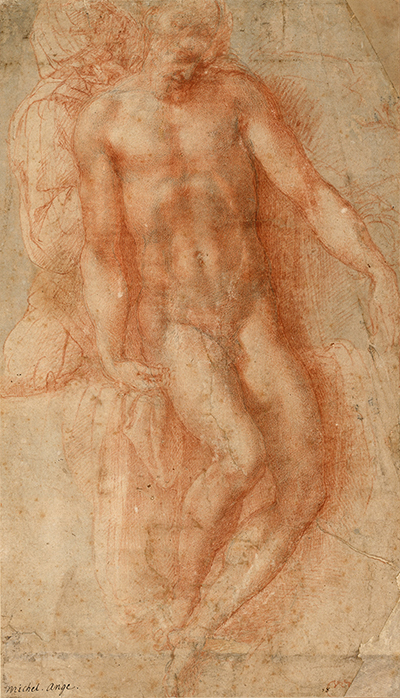
Study Drawings for a Pietà
Michelangelo returned to the dead Christ and the grieving people around him throughout his life. His Pietà drawings do not simply rehearse the marble group in Saint Peter's. They rethink what it means to support, display and mourn a body after the Crucifixion.
One especially important sheet is the Royal Collection's Studies for a Pietà, RCIN 912769. Its faint first idea became clearer through a near-contemporary copy in the British Museum and through a more developed related sheet, also in the British Museum.[1][2]
Other designs in Vienna, Paris and Boston show the subject changing radically. Some were probably made for paintings to be executed by others; another became an intimate devotional gift. None should be forced into preparation for one of Michelangelo's late marble Pietàs.
At a Glance
- Core objectStudies for a Pietà, Royal Collection, RCIN 912769
- Related copyBritish Museum T,12.75, after Michelangelo, second half of the sixteenth century
- Developed related sheetBritish Museum 1896,0710.1, about 1530–35
- Albertina designPietà, inventory 103, about 1530–36, red chalk over black chalk and stylus, 41.1 × 23.4 cm
- Louvre roleDesign associated with Sebastiano del Piombo's Pietà for Úbeda
- Gardner presentation drawingPietà for Vittoria Colonna, 1540, black chalk, 28.9 × 18.9 cm
- Shared themeChrist's dead body supported or displayed before mourners
- Critical controlThese drawings belong to several inventions and functions, not one continuous sculpture project
Contents
- What Makes a Pietà?
- The Windsor First Idea
- The British Museum Copy
- The More Developed Lamentation
- The Albertina Pietà
- Designs for Other Painters
- The Pietà for Vittoria Colonna
- Vittoria Colonna and Reform Devotion
- Red Chalk, Black Chalk and Degrees of Finish
- From Monumental Body to Devotional Image
- No Single Late Sculpture Behind the Sheets
- Copies, Cutting and Reconstruction
- The Viewer as Mourner
- How to Look at the Pietà Studies
- Why the Drawings Matter
What Makes a Pietà?
The Italian word pietà joins pity, compassion and devotion. In art it usually names an image centred on the dead Christ mourned after his removal from the cross.
The most familiar type places Christ across the Virgin's lap, as in Michelangelo's Vatican marble. Yet Renaissance images could add Saint John, Mary Magdalene, angels, Nicodemus or Joseph of Arimathea. Christ could lie horizontally, sit upright or be raised for display.
This flexibility matters when reading drawings. A figure kneeling beside Christ may belong to lamentation, deposition, entombment or devotional display.
Michelangelo repeatedly explored the boundary among those moments. The emotional truth of mourning mattered more than a rigid label.
The Windsor First Idea
RCIN 912769 contains an initial Pietà conception in black chalk. It is so faint that Bernard Berenson observed that its purpose might be obscure without a surviving copy.[1]
Michelangelo drew further studies across and beside the first idea. A kneeling figure, often interpreted as Saint John the Evangelist, turns in relation to the Virgin; a red-chalk arm supports Christ's head in a related developed composition.[2]
The accumulation makes the sheet difficult but precious. Later marks do not merely damage an earlier drawing. They prove that the paper stayed active in the studio.
Architectural studies on the reverse and a column profile on the recto suggest it remained accessible for years.[1] The sheet was an object to return to, not a framed image protected after first use.
Its faintness is itself historical evidence. Michelangelo could begin with lines light enough to be changed before committing pressure and tone.
The British Museum Copy
British Museum T,12.75 reproduces the Windsor idea in harder, more legible black chalk. It shows a grieving figure kneeling to the left, with separate studies of heads and hands.[1]
The copy is not neutral. The stooping figure's right arm and hand are redrawn repeatedly, revealing the copyist's own uncertainty or intervention.
Because RCIN 912769 was later cut, the copy also preserves lost extent. Comparison turns a derivative work into evidence for an altered original.
On the reverse, at right angles to the recto, the copyist drew feet of the crucified Christ after another Michelangelo design formerly in the Seilern collection. The sheet therefore combines sources as artists actually studied them.[1]
Its authorship has been debated: an old mount named Daniele da Volterra; Berenson preferred a later Florentine; Wilde judged it near-contemporary. The British Museum catalogues it safely as “after Michelangelo.”
The More Developed Lamentation
British Museum 1896,0710.1 carries the related idea further. Figures gather around Christ in a compact structure, and the kneeling Saint John study overlaps the first outline.[2]
The dense group does not imitate the broad triangular stability of the Vatican marble. Bodies interlock vertically and diagonally.
A supported corpse is a severe compositional test. Christ must appear truly without muscular agency while the surrounding figures remain capable of bearing him.
If helpers seem too weak, the body floats. If their effort is over-described, devotion becomes a transport scene. Michelangelo searches for a balance in which physical burden becomes emotional burden.
This related sheet has also faced attribution questions. Its history reminds us that the Pietà studies form a scholarly reconstruction, not a simple set signed and dated by the artist.
The Albertina Pietà
The Albertina's inventory 103, dated about 1530–36, is a tall red-chalk design over black chalk and stylus preparation. A later grey wash partly covers the background of the upper sheet.[3]
Christ sits almost upright on a sarcophagus and is supported from behind. The display recalls older images of the dead Christ presented vertically.
The supporting figure could be the Virgin, an angel, Saint John, Nicodemus or Joseph of Arimathea within the wider tradition. The drawing does not require one identity to carry all meaning.[3]
Red chalk gives the intertwined bodies warmth and continuity. The group reads almost as one mass, with outer contours less insistent than the physical knot at the centre.
The later wash demonstrates that even a celebrated Michelangelo sheet can contain intervention by another hand. Material layers should not be silently attributed together.
Designs for Other Painters
Michelangelo sometimes supplied ideas while another artist executed the painting. His close collaboration with Sebastiano del Piombo is essential here.
The Louvre preserves a Pietà study connected with Sebastiano's commission for the church of El Salvador in Úbeda, on which the Venetian painter worked from 1533.[3][4]
Michelangelo could determine the invention or crucial body while Sebastiano translated it into oil and colour. Authorship becomes distributed without becoming vague: design and execution must each be credited.
Some scholars have consequently proposed a painted destination for the Windsor/British Museum Pietà studies, possibly through a collaborator. Others remain cautious.[2]
What matters is that a drawing's painterly purpose does not make it a failed Michelangelo painting. Supplying disegno was a powerful creative role in sixteenth-century practice.
The Pietà for Vittoria Colonna
Around 1540 Michelangelo made a different Pietà for the poet and religious thinker Vittoria Colonna, now in the Isabella Stewart Gardner Museum.[5]
Christ sits frontally between the Virgin's knees, his arms extended across them. Two small angels support those arms. Mary raises her own hands and looks upward, so the composition echoes horizontal and vertical gestures.
A beam or cross above bears words from Dante: “They do not think how much blood it costs.” The inscription turns looking into meditation on sacrifice.
Unlike a rough working sheet, the Gardner drawing is a highly considered presentation image. It could nurture private devotion while circulating through copies.
Its function differs from a model supplied to Sebastiano. Both are drawings, but one coordinates another artist's potential execution while the other can be complete as a gift.
Vittoria Colonna and Reform Devotion
Colonna was not a passive recipient. She was an accomplished poet and belonged to a circle interested in inward faith, grace and the meaning of Christ's sacrifice. Her friendship with Michelangelo included poems, letters and religious exchange.[7]
The drawing's stripped setting suits that encounter. No landscape competes with Mary's upward appeal or Christ's emaciated body.
The Dante fragment is not a decorative caption. It warns that people fail to reckon the blood required by salvation, making contemplation ethically demanding.
Copies of the composition allowed a private gift to enter wider devotional culture. As with Michelangelo's drawings for Cavalieri, intimacy and circulation were not opposites.
The Gardner sheet must therefore be read as both object and relationship: a finished image shaped for a specific viewer whose spiritual intelligence Michelangelo respected.
Red Chalk, Black Chalk and Degrees of Finish
The Pietà group also demonstrates that medium follows purpose. The Windsor first thought is faint black chalk, open to revision. The Albertina design layers red over black and stylus preparation, developing bodies into a more continuous tonal mass.[3]
The Gardner presentation drawing returns to black chalk but achieves high finish through controlled modelling. Colour of chalk alone does not determine whether a sheet is preliminary or complete.
Pressure, density, correction and surface coverage matter more. A pale line can preserve possibility; a dark reinforced contour can declare a chosen edge; soft tonal passages can turn anatomy into devotional presence.
Later wash on the Albertina sheet complicates this evidence. Viewers must separate Michelangelo's graphic construction from a subsequent attempt to alter background or legibility.
Material reading thus prevents “unfinished” and “finished” from becoming simplistic visual labels.
From Monumental Body to Devotional Image
Michelangelo's early Vatican Pietà offers polished marble at public scale. The drawings of the 1530s and 1540s often reduce setting and concentrate encounter.
Christ's body becomes at once corpse, Eucharistic sign and measure of human grief. The supporting figures do not simply hold weight; their gestures instruct contemplation.
The increasing verticality in several designs brings the body before the viewer. Instead of resting safely across Mary's wide lap, Christ confronts the image plane.
That presentation can recall the Man of Sorrows or Eucharistic display without collapsing every image into one iconographic formula.
Drawing enables these transitions quickly. A changed arm can convert cradling into showing; an upright torso can change narrative aftermath into timeless devotion.
No Single Late Sculpture Behind the Sheets
Michelangelo carved the Florentine and Rondanini Pietàs late in life, and similarities of subject naturally invite comparison.
Yet resemblance does not establish that the drawings are preparatory studies for those marbles. The Albertina, Windsor and British Museum inventions cluster earlier and have strong painterly or collaborative contexts.
The Florentine marble has four interdependent figures and a hooded supporter often read as Nicodemus; the Rondanini group was transformed repeatedly toward an extremely vertical union of Virgin and Christ.
Those sculptures show Michelangelo's lifelong return to the theme, not a destination automatically shared by every drawn Pietà.
Parallel meditation is a more responsible claim than direct preparation unless contours, chronology and documents align.
Copies, Cutting and Reconstruction
This family demonstrates why copies matter. The British Museum T,12.75 clarifies the faint Windsor original and records portions later lost through trimming.[1]
Copies also spread Michelangelo's ideas beyond his control. A copyist might combine sources, strengthen contours or invent a transition.
Scholars must therefore move in both directions: use the copy to recover evidence, then identify where it departs from the original.
Cut edges are equally active. A modern rectangle may not be the sheet Michelangelo used. Studies now crowded against margins might once have possessed more space.
Object history becomes part of compositional history.
The Viewer as Mourner
Michelangelo's successive designs change not only Christ and his supporters but the viewer's place. A broad horizontal body can invite lateral reading from face to feet. An upright Christ confronts the spectator more directly.
The surrounding mourners mediate that encounter. Their bent heads, supporting hands and raised arms model possible responses without dictating one emotion.
In a presentation drawing, the recipient holds the image at intimate distance. A painted altarpiece enlarges the same encounter for communal worship. A sculptural group lets viewers move around physical depth.
The Pietà studies negotiate among these modes. Even before a final medium is chosen, orientation and gesture imagine how another person will stand, look and grieve.
This anticipated encounter helps explain why similar sacred subjects could require radically different designs. Michelangelo was not only rearranging figures; he was recalibrating the distance between sacrifice and witness.
Every changed support also changes the emotional work asked of the beholder.
The series finally distinguishes repetition from exhaustion. Michelangelo did not revisit the Pietà because the Vatican marble had failed. He returned because one configuration could not contain every problem of death, motherhood, communal mourning and salvation. Drawing kept the subject open long after marble had made one answer permanent.
How to Look at the Pietà Studies
Start with support. Identify which figure or angel bears each part of Christ's weight.
Separate faint first thought from darker later additions on RCIN 912769.
Compare the Windsor sheet with T,12.75 and ask what the copy preserves or changes.
In the Albertina drawing, follow the vertical rise from sarcophagus through Christ to the hidden supporter.
In the Gardner Pietà, compare Christ's horizontal arms with Mary's lifted hands and read the Dante inscription.
Finally keep medium and function distinct: workshop study, transferable design and presentation drawing are not interchangeable categories.
Why the Drawings Matter
The Pietà studies matter because they show Michelangelo refusing to let a celebrated solution become final. After the Vatican marble, he continued to alter the body's direction, the mourner's role and the viewer's relation to sacrifice.
They also make collaboration visible. A Michelangelo invention could become another painter's work without losing the specificity of either contribution.
Most movingly, the sheets place physical support at the centre of devotion. Hands, knees, shoulders and cloth carry the dead Christ until bodily burden becomes an image of compassion.
Frequently Asked Questions
Discussion
What details, sources or comparisons stand out to you in Study Drawings for Pieta?
Reader Insights
Which formal detail changes how the work reads?
Which documented source or collection history feels most useful?
Which related Michelangelo work should readers compare next?
Join the Conversation
Add a source-led observation, comparison or question for other readers.
References
- British Museum, Studies for a Pietà, after Michelangelo,” T,12.75:, View source.
- British Museum, Michelangelo, related Pietà studies, 1896,0710.1:, View source.
- Albertina, Michelangelo, Pietà, inventory 103:, View source.
- Louvre, Michelangelo, Étude pour une Pietà:, View source.
- Isabella Stewart Gardner Museum, Michelangelo, Pietà, 1540:, View source.
- Wikimedia Commons, Royal Collection RCIN 912769 reproduction record:, View source.
- British Museum, Michelangelo: The Last Decades, “Vittoria Colonna and the spirituali”:, View source.