


 by Tom Gurney
Tom Gurney BSc (Hons) is an art history expert with over 20 years experience
Published on June 19, 2020 / Updated on November 6, 2025
Email: tomgurney1@gmail.com / Phone: +44 7429 011000
An Écorché after Michelangelo
The flayed figure is difficult to look at and difficult to name. Its skin has vanished, but it is not a corpse. Muscles stretch and contract as the body kneels, twists and raises an arm over the head. This is an écorché: an anatomical figure designed to expose the machinery of movement.
The object described here is a nineteenth-century plaster in the Nelson-Atkins Museum of Art. Its maker is unknown. The museum catalogues it as after Michelangelo, meaning that the later sculptor followed a design or tradition associated with him; it does not mean that Michelangelo modelled this plaster.[1] That distinction opens the most interesting question. How did Michelangelo's bodily inventions become teaching objects that artists could copy centuries after his death?
The answer lies between anatomy, sculpture and reputation. Michelangelo studied the body with unusual intensity, probably attended dissections, and transformed anatomical knowledge into figures under extreme physical and emotional pressure. Later generations converted that achievement into a portable language of muscles. The écorché is therefore less an undocumented Michelangelo than a record of what Europe wanted to learn from him.
At a Glance
- TitleÉcorché
- MakerUnknown artist
- Relationship to MichelangeloAfter Michelangelo Buonarroti; not an autograph work
- DateNineteenth century
- MaterialPlaster
- Dimensions25.4 × 15.24 × 12.7 centimetres
- Current collectionNelson-Atkins Museum of Art, Kansas City
- Object number2025.71
- SubjectA flayed male figure revealing surface musculature
- Purpose of this pageTo explain the object, the term after, and Michelangelo's anatomical afterlife
Contents
- What Is an Écorché?
- The Nelson-Atkins Figure
- What “After Michelangelo” Means
- Michelangelo and Dissection
- Anatomy Changed by Action
- The Printed Écorché and the Spread of a Type
- From Renaissance Workshop to Nineteenth-Century Academy
- Anatomy, Idealisation and Error
- How to Look at the Écorché
- Why This Écorché Matters
What Is an Écorché?
The French word écorché means flayed or skinned. In art, it describes a figure represented without the skin so that muscles, tendons and sometimes deeper structures can be studied. An écorché can be a drawing, print, sculpture or cast. It is not necessarily a medical illustration. Its function may be to help an artist understand how visible form arises from anatomy beneath the skin.
That difference matters. A physician may need to distinguish individual muscles, attachments and layers with diagnostic precision. An artist also asks how a shoulder changes when an arm rises, how the abdominal wall compresses in a twist, and how weight passes through a bent leg. The écorché turns anatomy into action.
Three-dimensional examples add something a flat diagram cannot. A student can walk around the figure, compare the back with the chest and see how forms overlap in space. Plaster is well suited to repeated casting. Once a model existed, replicas could populate academies and studios far from the original maker.
The type became particularly important in European academic education. It stood between the skeleton, the dissected body, the antique statue and the living model. Its authority came partly from science and partly from the reputation of artists believed to have mastered the human form.
The Nelson-Atkins Figure
The Nelson-Atkins plaster presents a compact body under intense strain.[1] The lower half is half-kneeling, with the left leg meeting the base. The right elbow presses into the right thigh and the open right hand supports the head. The other arm curves over the body so that both hands gather around the tilted head. The lifted left elbow pulls one side of the torso upward while the waist contracts.
This pose is not a neutral anatomical chart. It makes musculature legible through asymmetry. One flank lengthens and the other shortens; the shoulder girdle rotates against the pelvis; the bent limbs create pressure points. Anatomy is learned through a body that seems burdened.
The small scale—only ten inches high—encourages close, mobile inspection. It could be turned or handled more easily than a life-size teaching cast. White plaster separates the problem from flesh colour and individual identity. The figure becomes a field of ridges, insertions and tensions.
Yet plaster can create false confidence. Crisp surfaces may look exact even when the anatomical scheme has passed through copying, repair or simplification. This object teaches a historical understanding of musculature as much as an anatomically current one.
What “After Michelangelo” Means
Museum authorship language is precise. “By Michelangelo” would claim his own execution. “Attributed to Michelangelo” would identify an informed but unsettled proposal of authorship. “Workshop of” would place making within his immediate studio. “After Michelangelo” identifies a later work dependent upon his invention or reputation.[2]
The Nelson-Atkins lists both an unknown artist and Michelangelo as the artist followed.[1] The nineteenth-century date places the plaster nearly three centuries after Michelangelo's death in 1564. No wording in the record makes it an excavated studio model, lifetime cast or lost autograph object.
Dependence can take several forms. A maker may copy a known work directly, use an intermediary print or cast, combine several Michelangelesque poses, or attach the famous name to an anatomical type long associated with him. Establishing the exact chain would require comparison with other examples and their mould histories.
The qualification does not make the plaster insignificant. Copies show what was selected, transmitted and valued. An academy that placed a figure “after Michelangelo” before students taught them to see his art as a standard of bodily knowledge.
Michelangelo and Dissection
Michelangelo's command of anatomy developed through drawing, sculpture and access to dissected bodies. Early biographical tradition connects his youthful stay at Santo Spirito in Florence with anatomical study. Modern museum accounts cautiously state that he attended dissections on several occasions.[3]
Dissection was not a single initiation that solved the body forever. Knowledge had to be refreshed and translated. A cadaver reveals structures under very different conditions from a living figure: gravity, colour, moisture and muscular action change. The artist had to connect what was seen in death with bodies observed in movement.
Michelangelo's drawings concentrate especially on bones and muscles—the architecture most useful for building a figure—rather than offering a systematic survey of internal organs.[4] Sheets could isolate a leg, repeat a shoulder, or test a pose in which surface and underlying structure become almost indistinguishable.
His anatomy is therefore selective and expressive without being arbitrary. Muscles may be enlarged or clarified to survive distance, fresco technique or marble scale. The goal is not a transparent medical plate but a body whose structure carries meaning.
Anatomy Changed by Action
The strongest Michelangelo figures never look like labels pasted onto a skeleton. Their anatomical force comes from opposition. The torso turns one way while the head resists; a limb bears weight while another searches for release; contraction in one region makes extension elsewhere more visible.
This principle runs from the marble David through the Sistine ceiling to the figures of the Last Judgement. The body becomes the scene of thought. A prophet's inward labour, a Prisoner's frustrated power or a resurrected body's ascent is communicated through posture before narrative attributes are read.
The écorché tradition extracts one component of that achievement: the legibility of muscles in motion. What it cannot fully preserve is the transformation of anatomy by material and setting. A muscle designed for fresco is also a patch of coloured plaster viewed from below; one carved in marble must emerge from stone and remain structurally supported.
Copying Michelangelo's anatomy therefore risks copying the result without the problem that produced it. The Nelson-Atkins figure is most useful when it prompts movement between anatomical naming and sculptural reasoning.
The Printed Écorché and the Spread of a Type
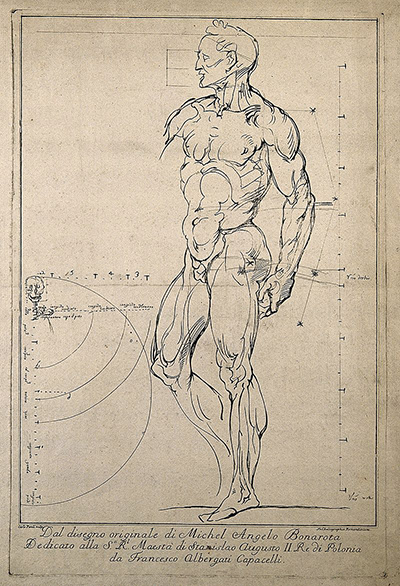
Prints allowed anatomical forms associated with great artists to travel widely. An engraved écorché could be owned where an original drawing could not. It could include proportion lines, inscriptions or alternative views and could be copied by hand into another student's book.
One later print tradition presents an écorché explicitly after a drawing associated with Michelangelo. Such works belong to reception history, not automatically to his accepted corpus. The engraver, publisher, intermediary drawing and current attribution all form part of the object's authorship.
Print and plaster served different study habits. The print flattened and standardised; the plaster restored rotation and cast shadow. Both detached the body from Michelangelo's original projects. A figure no longer needed to be a prophet, captive or damned soul. It could become “Michelangelo anatomy.”
That abstraction helped establish his authority while narrowing him. Students encountered a portable master of muscle even if they never saw the spatial intelligence of the Laurentian Library or the tenderness of the Vatican Pietà.
From Renaissance Workshop to Nineteenth-Century Academy
By the nineteenth century, casts organised a large part of art education. Students copied fragments and celebrated statues before or alongside work from the living model. Museums, academies and commercial moulders created networks through which the same body could appear in many cities.
An écorché after Michelangelo fitted this system particularly well. It joined anatomical instruction to a canonical name. The uncoloured plaster promised clarity, while the contorted pose offered a demanding exercise in foreshortening, light and muscular relief.
The object also belongs to an age of historicism. Nineteenth-century artists did not receive Renaissance form innocently; they catalogued, classified and reproduced it. The label “after Michelangelo” could describe a real compositional descent while also functioning as a claim of prestige.
The Nelson-Atkins plaster should consequently be read in two times. Its bodily language looks back to the Renaissance, but its material life belongs to nineteenth-century teaching and collection. That double history is more informative than an attempt to push it backward into Michelangelo's studio.
Anatomy, Idealisation and Error
Michelangelo is often praised as if anatomical knowledge guaranteed naturalism. In fact, knowledge expanded his freedom to depart from an ordinary body. He could lengthen a torso, deepen a fold or increase a muscle because he understood the structural relation being intensified.
Later copies can exaggerate the exaggeration. A form already clarified for a monumental work may become harder as it passes through a drawing, print, model and cast. Named authority then protects it from question: if it is “Michelangelo,” every ridge may be treated as correct.
Modern viewers should resist choosing between scientific truth and artistic distortion too quickly. Historical anatomical objects record ways of seeing. They show which structures an artist considered decisive and how instruction converted a changing body into a stable model.
The most productive question is not whether the plaster could replace a contemporary anatomy atlas. It is how an anatomical understanding was organised for artistic use—and why Michelangelo became the name attached to that organisation.
How to Look at the Écorché
Begin with the pose rather than individual muscles. Trace weight from the supporting leg through the pelvis and into the elbow on the thigh. Notice that the head is held by the body's own compressed structure.
Then compare the two sides. The raised elbow opens one flank; the bend and turn close the other. Look for muscles changing length, not merely appearing as symmetrical bumps.
Move around the object if display permits. From the side, overlaps among arm, head and chest become clearer. From the back, the shoulder blades and spine explain movements first seen in the chest.
Finally read the label's authorship language. The words “unknown,” “after Michelangelo” and “nineteenth century” are not obstacles to appreciation. They identify the historical work the object actually did: translating a celebrated bodily language into an instrument of later study.
Why This Écorché Matters
The plaster matters because it preserves Michelangelo's reception at the scale of a lesson. It shows how the complex bodies of specific Renaissance projects were detached, regularised and made repeatable.
It also corrects a common misunderstanding about copies. A later cast does not have to be secretly autograph to deserve attention. Its distance from Michelangelo is its subject. Through that distance we see how authority is constructed, how artists learn and how museums inherit educational objects whose makers went unrecorded.
Most of all, the écorché shows that anatomy is not still. Muscles become intelligible because the figure kneels, twists and supports its head. The unknown sculptor understood the central lesson of Michelangelo's bodily art: structure acquires meaning through action.
Frequently Asked Questions
Discussion
What details, sources or comparisons stand out to you in An Ecorche seen from the front?
Reader Insights
Which formal detail changes how the work reads?
Which documented source or collection history feels most useful?
Which related Michelangelo work should readers compare next?
Join the Conversation
Add a source-led observation, comparison or question for other readers.
References
- Nelson-Atkins Museum of Art, Écorché,” object 2025.71:, View source.
- Smithsonian American Art Museum, Q and Art: Copies of Artworks”:, View source.
- National Gallery of Denmark, Michelangelo Imperfect, digital guide:, View source.
- J. Paul Getty Museum, Michelangelo: Mind of the Master:, View source.
- Metropolitan Museum of Art, Art and Anatomy in Renaissance Italy:, View source.