


 by Tom Gurney
Tom Gurney BSc (Hons) is an art history expert with over 20 years experience
Published on June 19, 2020 / Updated on November 6, 2025
Email: tomgurney1@gmail.com / Phone: +44 7429 011000
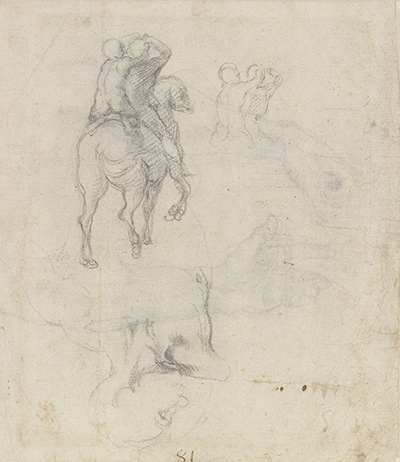
Studies of a Horse with Two Nude Riders and a Male Torso
Michelangelo turned the sheet while he thought. In one orientation, two naked riders crowd a horse; in another, a bared male torso and head look back across the page. On the reverse, two studies of a forearm and hand prepare the raised arms of Noah's sons in the Sistine ceiling's Drunkenness of Noah.[1]
The double-sided black-chalk drawing dates about 1506–1508 and belongs to Museum Boijmans Van Beuningen, Rotterdam. It measures approximately 22.2 × 19.8 centimetres and is catalogued as I 513 recto (PK).[1]
Its several subjects do not form a lost finished composition. The sheet preserves work in different directions and at different levels of certainty. It is an object of revision, not a picture awaiting one title.
At a Glance
- ArtistMichelangelo Buonarroti
- Museum titleStudies of Two Male Nudes on Horseback and a Male Head
- DateAbout 1506–1508
- MediumBlack chalk on paper
- DimensionsApproximately 22.2 × 19.8 centimetres
- Current collectionMuseum Boijmans Van Beuningen, Rotterdam
- InventoryI 513 recto (PK), Stichting Museum Boijmans Van Beuningen loan
- One sideHorse with two nude riders, a variant group and a bared torso and head drawn after rotation
- Other sideTwo forearm/hand studies for sons of Noah in the Drunkenness of Noah
- Secure project connectionsRecto studies for the Battle of Cascina; verso arms for the Sistine ceiling
- Special importanceTwo major commissions were considered on the same small sheet
Contents
- The Horse and Riders
- Horsemen for the Battle of Cascina
- Rotating the Sheet for the Torso
- A Colossal Lost Cartoon
- The Other Side: Arms for the Drunkenness of Noah
- Noah's Story
- Black Chalk and Correction
- A Double-Sided Working Object
- Horse, Human and Scale
- One Sheet Between Florence and Rome
- Attribution and Collection History
- How to Look at the Sheet
- Why the Sheet Matters
The Horse and Riders
At the upper left of one orientation, Michelangelo sketches a horse carrying two nude riders. A variant nearby reconsiders their relation.[1]
The group is compressed. Human legs, torsos and the animal's back create a problem of overlapping masses rather than equestrian portraiture.
Nudity removes military costume and makes bodily mechanics visible. The riders grip or balance through hips and thighs, while the horse provides moving support.
Michelangelo drew horses less systematically than Leonardo, but mounted bodies offered an important test of force passing between species.
The variant indicates uncertainty. He was not recording one observed event neutrally; he was trying alternative arrangements.
Horsemen for the Battle of Cascina
The museum identifies the recto as one of twenty-four surviving preliminary studies for the Battle of Cascina, a vast Florentine mural commissioned by the republican government for the Palazzo Vecchio's Salone dei Cinquecento.[1]
The intended episode concerned Florentine soldiers bathing in the Arno when the Pisan enemy surprised them in 1364. Michelangelo concentrated on the instant men scramble from water and prepare to fight. Riders at the left foreground would have widened that mobilisation beyond the famous central bathers.
In a reduced copy of the lost composition in the British Museum, a single rider on a kicking horse appears at one side and another rider and standing horse at the other. Modern reconstruction connects the Rotterdam group with a horseman riding away while a second soldier climbs or kneels behind him.[1]
The smaller rear figure has a remarkable pose: he kneels on the horse as though he has jumped up in haste. That unstable action suits an alarm rather than a ceremonial cavalry scene.
Michelangelo developed the motif further in a separate nude study now at Casa Buonarroti. Related black-chalk studies at the Ashmolean help reconstruct how he prepared component groups before resolving the giant cartoon.[1]
Rotating the Sheet for the Torso
Michelangelo turned the paper 180 degrees before drawing the male torso.[1] The new orientation allowed unused space to receive a figure without respecting the horsemen's original “up.”
Rotation is evidence of process. Working drawings have no permanent viewing direction until mounting and cataloguing impose one.
The torso and head appear upside down relative to the horse group in reproduction. That is not careless composition. It shows paper treated as a field of opportunities.
The body is isolated and more developed than some swift equestrian lines. The man looks back over his shoulder, a turn that can be recognised at the left of a reduced copy of the bathers at Holkham Hall.[1]
The rotated figure is therefore not an unrelated anatomical exercise. Horsemen and turning man address separate zones of the same unfinished battle design.
A Colossal Lost Cartoon
Michelangelo began the Battle of Cascina commission in 1504, opposite Leonardo's proposed Battle of Anghiari. The confrontation between Florence's two celebrated artists became a defining legend of Renaissance drawing even though neither mural reached durable completion.[1]
Fourteen quires of reale paper were ordered from Bologna for Michelangelo's full-scale cartoon. Modern estimates put its original field at roughly 4.43 by 23.5 metres—more than one hundred square metres.[1]
That scale explains the need for numerous small preliminary sheets. Michelangelo could solve riders, bathers, limbs and turns separately before enlarging and coordinating them.
The cartoon became an academy in practice. Artists studied it while it was displayed, and repeated handling eventually wore it into fragments. Those fragments disappeared, leaving copies and preparatory drawings such as Rotterdam's sheet to recover portions of the invention.
The Other Side: Arms for the Drunkenness of Noah
On the reverse are two studies of a forearm and hand. The museum connects them with the raised right arms of Noah's sons in the Drunkenness of Noah, at the right of the fresco.[1]
This relation is more secure because pose and final figures can be compared directly. Michelangelo adjusts contours, testing hand and arm position.
Hatching describes muscles and tendons. The studies were likely made from a living model, where rotation of wrist and elbow could be observed under tension.[1]
An isolated arm is not merely fragmentary. In fresco design, gesture joins figures and carries narrative: Noah's sons manage cloth and protect their father's nakedness.
The small sheet therefore connects close bodily observation with a monumental moral scene.
Noah's Story
Genesis recounts Noah planting a vineyard, becoming drunk and lying uncovered. Ham sees his father's nakedness; Shem and Japheth walk backward with a garment to cover him.[2]
Michelangelo placed the episode near the chapel entrance as one of the ceiling's first painted scenes. Its compressed bodies helped him learn the scale and viewing demands of the vault.
The raised arms on the sheet belong to actions of covering and turning away. Anatomy is inseparable from modesty and filial conduct.
The battle figures on the other side may feel unrelated, but both study coordinated bodies under unstable support: riders on an animal, sons moving around a recumbent father.
That thematic echo need not imply one compositional project. It shows the kinds of physical problems occupying Michelangelo.
Black Chalk and Correction
Black chalk allows swift outline and dense hatching. Michelangelo can reinforce a contour after changing position, leaving alternatives visible.
Corrections around the arms are especially informative. The final fresco may present one solution, but the sheet records rejected edges.
Unlike a presentation drawing, the page does not conceal searching beneath uniform finish. Different studies receive different levels of attention.
The beige paper moderates contrast and makes chalk marks feel embedded rather than stark. Wear and mounting may affect weaker lines.
High-resolution digital viewing helps separate strokes, though it can falsely equalise recto and verso that cannot be seen simultaneously in person.
A Double-Sided Working Object
Paper was valuable, portable and reusable. Michelangelo drew on both sides and reoriented one side, maximising a small sheet.
The object now has a controlled recto in catalogue language, but “front” may reflect collecting history rather than Michelangelo's priority.
One side's famous title can also conceal the reverse. A complete description must include the arms because they carry the secure fresco connection.
Mounting double-sided drawings presents conservation challenges. Windows can expose both faces, but light dosage and structural support must be managed.
Digital rotation restores some working flexibility. Viewers can turn the torso upright and then return to the riders, approximating how the artist handled paper.
Horse, Human and Scale
The horse is not drawn as an independent zoological study. Its back and movement support a human configuration.
Two nude riders magnify instability. A single rider can align with the horse; two bodies compete for space and require different grips.
The group offered Michelangelo a way to test bodies that had to remain legible inside an enormous wall composition. Horse and limbs require strong separation even before enlargement.
The lost cartoon means the final arrangement cannot be known with certainty. Copies preserve different extents, and one major Holkham grisaille records only the central bathers rather than the horsemen.[1]
Working drawings here compensate for loss rather than documenting omission. Each related sheet supplies a fragment of a composition whose full-scale form was once celebrated but no longer exists.
One Sheet Between Florence and Rome
The recto and verso sharpen a chronological question. The Battle of Cascina was begun years before the Sistine ceiling, yet the museum dates the paper about 1506–1508 and argues that Michelangelo continued thinking about the Florentine project close to his Roman work.[1]
He returned to Florence in 1506 and again briefly in 1508. The juxtaposition of Cascina figures with Noah's arms is therefore not necessarily the casual reuse of an old scrap after a long interval.
Instead, the sheet makes two ambitions contemporaneous: the republican battle mural he could not complete and the papal ceiling that would redefine his career.
The physical turn from one side to the other becomes historical. Florence and Rome occupy the same paper, with no clean border between abandoned and emerging work.
Attribution and Collection History
Museum Boijmans identifies Michelangelo as draughtsman and dates the sheet to the opening Sistine campaign.[1] Its movements through the Koenigs collection and Stichting Museum Boijmans Van Beuningen form part of its modern provenance.
The sheet was acquired by Franz Koenigs, purchased by Daniël George van Beuningen in 1940 and given or lent through the foundation to the museum.[3]
Precise provenance wording matters because the Koenigs drawings have complex histories around wartime collecting. The museum's current legal and loan record should govern.
Attribution is supported by the secure Noah correspondence, handling of chalk and established corpus. The less certain subject connection of the horsemen does not weaken Michelangelo's hand.
Object identity and project identity are different questions.
How to Look at the Sheet
View every orientation. Turn the page until horsemen and the backward-looking torso each become upright.
Compare the two horse groups and locate changed relations.
On the reverse, follow corrections around the forearms before comparing the fresco.
Notice differences in finish. They record which problems demanded more attention.
Keep both projects visible: the recto belongs to the lost Battle of Cascina, while the verso moves into the Sistine ceiling.
Why the Sheet Matters
The drawing matters because it binds two monumental campaigns. Fragments of the lost Battle of Cascina and secure studies for Noah's sons share one piece of paper without becoming one scene.
It also shows Michelangelo thinking through orientation. The sheet is turned, reversed and filled as physical space, much as a body or ceiling must be negotiated.
Most of all, it corrects the myth of a fully imagined Sistine ceiling simply copied onto plaster. Monumental certainty emerged from small pages crowded with alternatives.
Frequently Asked Questions
Discussion
What details, sources or comparisons stand out to you in Studies of a Horse with Two Nude Riders and a Male Torso?
Reader Insights
Which formal detail changes how the work reads?
Which documented source or collection history feels most useful?
Which related Michelangelo work should readers compare next?
Join the Conversation
Add a source-led observation, comparison or question for other readers.
References
- Museum Boijmans Van Beuningen, Albert Elen, “Studies of Two Male Nudes on Horseback and a Male Head,” collection catalogue:, View source.
- Bible Gateway, Genesis 9:18–27:, View source.
- Museum Boijmans Van Beuningen, Italian Drawings 1400–1600 collection research:, View source.
- Vatican Museums, Sistine Chapel ceiling:, View source.