 by Tom Gurney
Tom Gurney BSc (Hons) is an art history expert with over 20 years experience
Published on June 19, 2020 / Updated on August 8, 2026
Email: tomgurney1@gmail.com / Phone: +44 7429 011000
Michelangelo’s Battle of Cascina
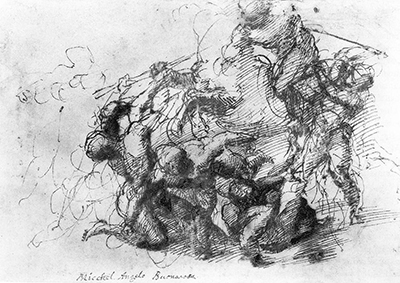
Michelangelo’s Battle of Cascina survives as an absence surrounded by evidence. Florence commissioned a monumental design for the Great Council Hall in 1504, but Michelangelo never painted the fresco and the full-scale cartoon was eventually lost. Preparatory drawings, later copies and written admiration preserve fragments of an invention that no living viewer has seen intact.[1]
The best-known episode did not show combat itself. Florentine soldiers bathing in the Arno are surprised by an alarm and scramble to leave the water, dress and arm themselves. The choice transformed civic military history into a field of exposed bodies caught between leisure and readiness. Backs twist, legs brace, heads turn and limbs reach for clothing or weapons.
Casa Buonarroti’s Nude from the Back: Study for the Battle of Cascina provides direct contact with Michelangelo’s preparation.[1] It is an original drawing, not a surviving piece of the mural. That distinction governs the whole story: the project matters enormously, but every claim must identify whether it concerns the commission, a study, the lost cartoon, a copy or later reception.
At a Glance
- ArtistMichelangelo Buonarroti
- ProjectBattle of Cascina
- Commission1504, for Florence’s Great Council Hall in Palazzo Vecchio
- Historical subjectA Florentine victory over Pisa in 1364
- Chosen episodeBathing soldiers surprised by an alarm and rushing to arm themselves
- Intended mediumMonumental wall painting
- Fresco statusNever executed
- Cartoon statusFull-scale design once made and celebrated, now lost
- Strongest surviving autograph evidencePreparatory drawings, including Casa Buonarroti’s Nude from the Back
- Other evidenceCopies and derivatives after the lost design, plus later descriptions
- Parallel commissionLeonardo da Vinci’s projected Battle of Anghiari for the same civic interior
- Central cautionNo surviving copy is the lost autograph cartoon or completed fresco
Contents
- A Battle Before the Fighting Begins
- Florence and the Great Council Hall
- The Nude from the Back
- From Study to Cartoon to Wall
- The Lost Cartoon and the Problem of Copies
- The Cartoon as a Social Object
- Reconstructing Without Pretending to Recover
- Bodies, Water and Sudden Readiness
- Civic Nudity and Collective Readiness
- Michelangelo and Leonardo
- A Lost Work Within Michelangelo’s Painting
- Why the Project Became a School of Art
- From Civic Failure to Artistic Success
- Artist Up Close
A Battle Before the Fighting Begins
The Battle of Cascina was fought in 1364 between Florence and Pisa. A conventional civic mural might have celebrated organised ranks, armour, cavalry and decisive victory. Michelangelo instead focused on surprise before engagement: soldiers called from bathing in the river.[1]
This choice created a narrative threshold. The men are not relaxed bathers any longer, but they are not yet fully armed soldiers. Each body occupies a different stage of response. One turns, another climbs, another reaches and another struggles with clothing.
The absence of armour makes anatomy carry the event. Alarm becomes visible through contracted backs, flexed legs and torsos rotating toward an unseen call. Michelangelo translates military readiness into bodily readiness.
Nudity was therefore neither incidental nor merely an excuse for display. It made vulnerability part of civic courage. The soldiers must move from exposure to disciplined action. Their physical beauty is tested by urgency rather than arranged in timeless repose.
The episode also multiplied temporal fragments. A battle panorama can distribute action across a field; Michelangelo’s bathers concentrate attention on seconds. The project’s fame rested partly on this ability to make an assembly of nudes feel like many simultaneous answers to one alarm.
Florence and the Great Council Hall
The commission belonged to republican Florence and to the decoration of the Great Council Hall in Palazzo Vecchio.[1] This was not private devotion or papal commemoration. The work was intended for a political interior in which Florentine history could shape civic identity.
The scale demanded a different kind of design from a panel. Bodies had to be legible across architectural distance and work collectively over a broad surface. A full-size cartoon allowed the composition to be developed and prepared for transfer.
Michelangelo’s project was associated with Leonardo da Vinci’s Battle of Anghiari, planned for the same hall. Their parallel presence produced one of art history’s most famous stories of competition. Two Florentine masters, different in age and method, were asked to transform military victories into monumental images.
The pairing should not erase differences. Leonardo’s project has its own lost mural history, experiments and surviving copies. Michelangelo’s evidence begins from his commission, drawing practice and cartoon. Rivalry is context, not a substitute for object study.
The intended hall also mattered politically. Historical victory could present the republic as alert, strong and capable of recovery from danger. Michelangelo’s startled soldiers embody precisely that passage from disorder to action.
The Nude from the Back
Casa Buonarroti identifies its drawing as a study for Battle of Cascina.[1] A male nude is seen principally from behind, his body activated rather than posed for neutral anatomical display. The back becomes a landscape of movement.
Seeing a figure from behind denies the immediate access of a face. Intention must be read through shoulders, spine, hips and limbs. Michelangelo makes anatomy communicate response before expression can explain it.
The drawing is preparatory, but not mechanical. It tests how a body occupies space and how an action can be made clear through contour and internal modelling. It is a site of invention rather than a small copy of a design already complete.
The sheet also exemplifies disegno as both drawing and conception. The Metropolitan Museum’s career study uses the term to connect Michelangelo’s thinking across media.[2] A nude on paper could be revised, incorporated into a cartoon and intended for translation to a wall, while remaining an autonomous record of thought.
One drawing cannot reconstruct the full composition. It establishes a figure type, action and connection with the project. The surrounding soldiers, their scale relationships and the final placement on the cartoon must be approached through other evidence.
From Study to Cartoon to Wall
Renaissance monumental painting often depended on several stages. Small compositional sketches tested the whole; figure studies developed bodies; a full-size cartoon organised the design at intended scale; transfer carried its lines toward the wall.
These categories describe function, not an automatic sequence preserved in every case. Michelangelo could alter figures as the design developed. A sheet associated with the cartoon may record one solution rather than the final intended pose.[1][2]
The Cascina cartoon became famous even though the wall painting did not follow. Artists studied its nudes, and copies transmitted portions of its invention. The intermediary object acquired an afterlife usually reserved for finished works.
Its loss created a hierarchy of distance. An autograph drawing is physically by Michelangelo but shows a fragment. A later copy may show more of the composition but through another hand. A written description preserves reception without giving reliable visual detail for every pose.
No single form of evidence solves the others. The drawing supplies touch and decision; the copy supplies relational breadth; the text supplies historical response. Responsible reconstruction keeps their differences visible.
The Lost Cartoon and the Problem of Copies
A cartoon is not simply an enlarged illustration. At full scale, it mediates between design and architecture. Its lines can bear corrections, joins and traces of use. Michelangelo’s Cascina cartoon was admired as a major work in itself before it disappeared.[1]
Later copies preserve some figures and arrangements. They are indispensable because the larger conception would otherwise be even harder to imagine. Yet every copy selects, translates and potentially regularises. A painter or engraver can alter anatomy, spacing, background and emphasis.
The most misleading label is “Michelangelo’s Battle of Cascina” beneath an unqualified copy. It makes another hand disappear and suggests a surviving finished object. More accurate language names the copyist where known and states “after Michelangelo’s lost cartoon.”
Reproduction can also flatten the chronology. A preparatory figure, a copy of the cartoon and a later derivative may be presented side by side as though they were three views of one stable composition. They instead belong to different moments and degrees of authority.
The loss is therefore not something to disguise with a seamless digital composite. Uncertainty is part of the work’s identity. The project teaches how art history builds knowledge from unequal remains.
The Cartoon as a Social Object
The cartoon’s fame depended on access. Other artists could examine monumental bodies at close range, copy difficult poses and carry those solutions into their own work. A design made for transfer became an academy before formal academies acquired their later institutional shape.
Study changes an object physically and culturally. Sheets are handled, traced, pricked, cut or worn; sections attract more attention than others. The very use that spreads invention can help destroy its support.
This social life differs from the controlled isolation of a finished painting high on a wall. The cartoon existed among artists as working knowledge. Its authority came partly from vulnerability to copying.
The project therefore challenges strict oppositions between original and reproduction. The autograph cartoon was original in hand and scale, but copies became necessary carriers of its form. Without them, less would be known; because of them, later invention can easily be mistaken for Michelangelo’s exact design.
Its destruction was not the end of the work, but a change in how it existed. Influence, quotation and memory replaced the singular object. The Battle of Cascina became dispersed across other surfaces.
Reconstructing Without Pretending to Recover
A modern reconstruction can assemble surviving studies and copies into a coherent proposal. It may clarify the relative position of figures or the broad rhythm of the bathers. Its usefulness depends on visible uncertainty.
Gaps should not be silently filled with plausible Michelangelesque bodies. Differences among copies should not be harmonised as though one must preserve the truth. Every choice in a reconstruction is an argument.
The safest presentation begins with evidence categories. Autograph studies establish Michelangelo’s own hand. Copies after the cartoon preserve broader relations through other makers. Texts report fame and subject. Architectural information establishes the intended room and scale.
Only after those layers are separated can they be joined. The resulting image remains a scholarly model, not a rediscovered work. Its accuracy may vary across zones according to the evidence available.
Loss can be respected visually. Empty or uncertain areas remind viewers that the cartoon’s total appearance is unavailable. Such restraint makes the well-supported figures more, not less, meaningful.
Bodies, Water and Sudden Readiness
The bathing episode allowed Michelangelo to explore the nude without removing it from narrative. Bodies bend to climb the riverbank, twist toward the alarm, crouch to dress or brace for movement. Each action activates anatomy differently.
Water introduces a condition difficult to recover from drawings and copies. Wetness, reflected light and the boundary between river and land would have belonged to a completed painting, but the intended fresco never existed. The surviving evidence is far stronger on bodies than on colour or atmosphere.
That imbalance has shaped reception. Battle of Cascina is remembered as a school of the male nude, an assembly of muscular inventions. Its civic subject and river setting can become little more than a pretext.
The bodies are unquestionably central, but the alarm gives them meaning. Their variety represents collective response. A republic’s defenders do not begin in ceremonial order; they make order out of surprise.
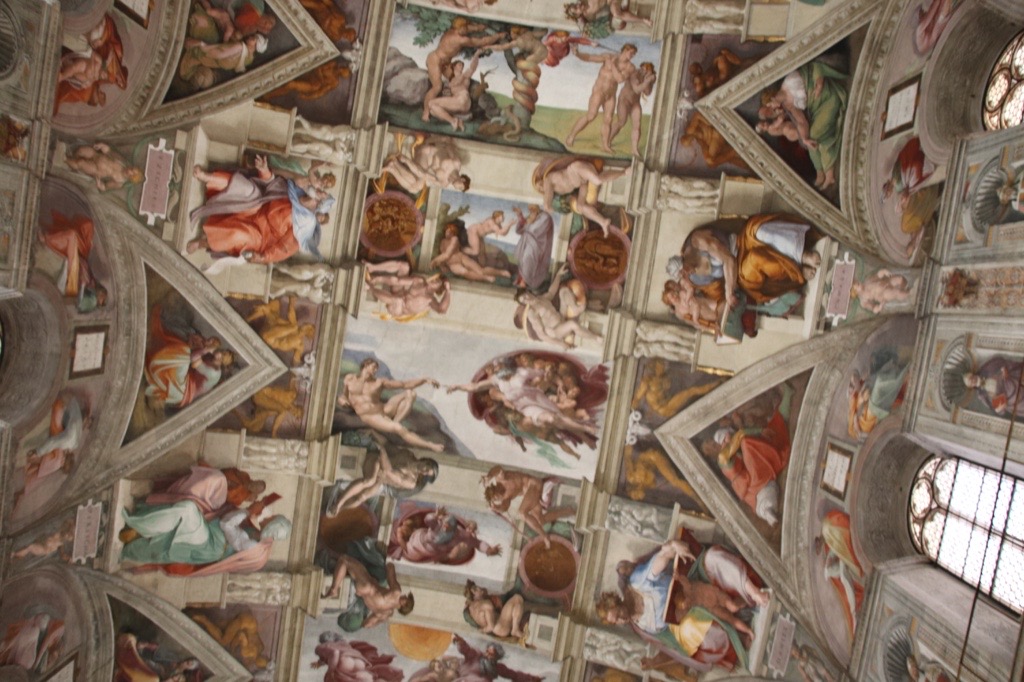
The theme also differs from the later Sistine ignudi. Those youths sit within painted architecture without participating in a literal narrative of military alarm. Similar anatomical power does not make the ceiling figures quotations of Cascina.
Civic Nudity and Collective Readiness
The nude in Renaissance art could carry ancient ideal, Christian vulnerability, heroic force or artistic demonstration. In Cascina, these meanings meet a republican military story. The citizens’ bodies are beautiful, exposed and urgently functional.
Bathing removes the visual markers of rank. Before armour returns, the soldiers appear as a collective of bodies responding to shared danger. Civic identity is built from action rather than costume.
This equality is not complete; Michelangelo’s composition undoubtedly differentiated figures through pose and prominence. Yet the chosen instant shifts emphasis from commanders to ordinary physical readiness.
The episode also avoids depicting violence against an enemy as the principal spectacle. The Pisans remain outside the famous core. Florence’s victory is imagined through self-command—the capacity to move from surprise toward organised defence.
That choice makes the nudes politically legible without fixing one allegory. Their anatomy celebrates the city by making discipline visible in flesh. Artistic mastery and civic preparedness reinforce one another.
Michelangelo and Leonardo
The imagined confrontation between Michelangelo and Leonardo is irresistible: the younger sculptor of force beside the older painter of movement and atmosphere. Contemporary and later reception encouraged comparison between the two battle projects.
Competition likely sharpened attention, but it cannot explain every formal decision. Michelangelo’s bathers arose from his own interest in the nude, civic subject and the opportunity created by surprise. Leonardo’s work must not become the invisible standard against which it is measured.
Nor did the two masters complete matching frescoes. Both projects are known through complicated remains. The famous “duel” survives more clearly in cultural memory than as two intact walls available for direct comparison.
Restraint makes the rivalry more interesting. It asks how Florence mobilised artistic prestige in a political space and how later writers transformed parallel commissions into a contest between personalities.
A Lost Work Within Michelangelo’s Painting
The project belongs to Michelangelo’s pictorial career even though no finished painting survives. It was a commission for a mural, and the cartoon influenced how other artists imagined bodies in large-scale painted action.
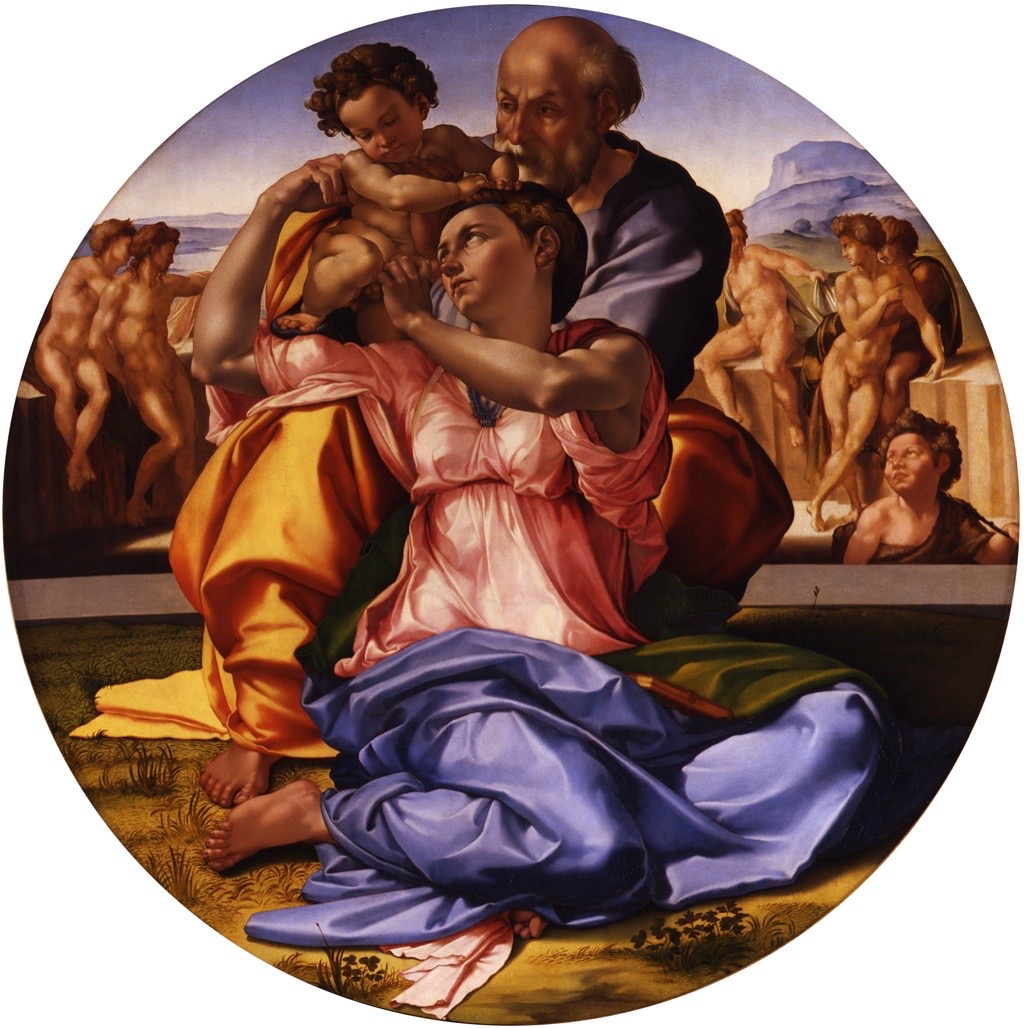
Its evidence differs from the Doni Tondo, whose complete panel and frame remain in the Uffizi.[3] It differs from the unfinished Manchester Madonna and Entombment, whose actual painted surfaces survive in London.[4][5] It also differs from the Kimbell’s small Torment of Saint Anthony, whose attribution is supported by technical and historical study.[6]
The Raising of Lazarus offers another authorship comparison. Sebastiano del Piombo painted that panel while incorporating designs by Michelangelo.[7] It demonstrates that invention and execution can be distributed. Cascina goes further: Michelangelo made the central design, but later hands now mediate much of its visual survival.
These differences enlarge rather than weaken his painting history. They show that pictorial authorship can reside in surface, design, collaboration, preparation or reception in different proportions.
Why the Project Became a School of Art
Artists could learn from the cartoon because it concentrated difficult bodily problems at monumental scale. Foreshortened limbs, turning backs, rapid dressing and interlocking groups offered a repertory of solutions. Study was a form of transmission.
That transmission helped destroy the unity of the object even as it extended the design’s life. A celebrated cartoon could be handled, copied and worn. Its value as teaching material exposed it to physical risk.
Copies then made Michelangelo’s invention available beyond the original room and generation. They contributed to a canon in which a work could remain famous after its principal material support vanished.
The result complicates the idea of masterpiece. Battle of Cascina has no finished original to admire, yet its influence was real. Its canonical status belongs to a chain of acts—commissioning, drawing, enlarging, studying, copying, describing and remembering.
From Civic Failure to Artistic Success
As a municipal mural commission, the project failed to reach the wall. Judged only by completion, it is an abandoned undertaking. Judged by artistic transmission, its cartoon became one of Michelangelo’s most consequential pictorial achievements.
These conclusions can coexist because they answer different questions. Florence did not receive the durable battle fresco it commissioned. Artists nevertheless received a repertory of bodily invention that reshaped practice.
The distinction matters for Michelangelo’s career. Later fame can make every unfinished project seem destined for canonical survival. In 1504, the lost mural represented real opportunity, obligation and interruption. Its afterlife was not guaranteed.
The project’s success through failure also mirrors the role of drawing in Renaissance art. A supposedly intermediate object could outlive its immediate purpose in reputation, while a planned permanent wall never existed. Hierarchies between preparation and completion were overturned by history.
What remains is neither the fresco nor the cartoon, but a network strong enough to sustain study. Battle of Cascina is canonical because fragments and copies still compel disciplined imagination.
That discipline is the opposite of treating loss as permission. The fewer original materials survive, the more carefully each must be described. Precision about absence allows the project’s actual achievement—its extraordinary power as design—to remain visible without being dressed as a painting that never existed.
Artist Up Close
Michelangelo’s decision to show the alarm rather than the clash reveals his central interest: the body becoming action. Military history is compressed into the instant when relaxed men recover purpose.
His drawing practice made that instant transferable. The surviving Nude from the Back is both a fragment and a complete demonstration of thought through anatomy. Loss prevents the whole composition from returning, but it cannot erase the precision of the surviving act.
Frequently Asked Questions
Discussion
How should we read a work whose intended wall and cartoon are gone?
Reader Insights
How should a viewer imagine a lost work without pretending to see it completely?
What is the difference between Michelangelo's invention and a later artist's copy?
Does the Nude from the Back feel like a drawing, a mural fragment or an independent work?
Join the Conversation
Set the lost cartoon beside the surviving study. What kind of evidence feels most trustworthy?
References
- Fondazione Casa Buonarroti, Nude from the Back: Study for the Battle of Cascina”:, View source.
- Metropolitan Museum of Art, Michelangelo: Divine Draftsman and Designer:, View source.
- Uffizi Galleries, Holy Family, Known as the Doni Tondo”:, View source.
- National Gallery, London, “The Manchester Madonna”:, View source.
- National Gallery, London, “The Entombment or Christ Being Carried to His Tomb”:, View source.
- Kimbell Art Museum, The Torment of Saint Anthony,” AP 2009.01:, View source.
- National Gallery, London, “The Raising of Lazarus,” by Sebastiano del Piombo incorporating designs by Michelangelo:, View source.