



Michelangelo’s Risen Christ Drawing
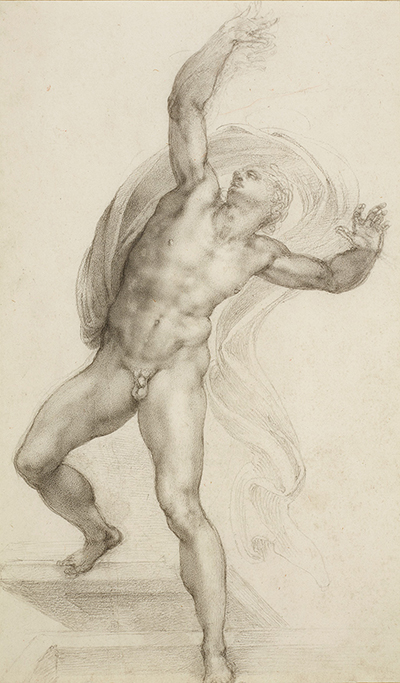
Christ does not step calmly from the grave. He opens across the sheet: one arm flung upward, the other reaching out, legs braced at different angles as the winding cloth spins behind him. The body is intensely present, yet the tomb barely holds it. Michelangelo turns resurrection into the paradox of a muscular form escaping every ordinary law of weight.
The Royal Collection Trust dates The Risen Christ to about 1532. Drawn in black chalk on a sheet measuring 37.2 × 22.1 centimetres, it belongs to a larger group of Resurrection inventions but is worked with such care that the institution considers it a finished drawing, probably made as a gift, rather than a routine preparatory sketch.[1]
At a Glance
- WorkThe Risen Christ, often called the Risen Christ Drawing
- ArtistMichelangelo Buonarroti
- DateAbout 1532[1]
- MaterialBlack chalk[1]
- Dimensions37.2 × 22.1 centimetres[1]
- Current homeRoyal Collection, RCIN 912768[1]
- SubjectThe resurrected Christ rising from a lightly indicated tomb
- Defining featuresExpansive limbs, small head, meticulously modelled torso and swirling shroud
- TechniqueTiny separate chalk strokes build the central body without broad blending[1]
- Probable functionA finished autonomous drawing, perhaps a gift[1]
- Possible wider contextOne of more than a dozen Risen Christ or Resurrection studies made around 1530[1]
- Essential cautionA proposed connection with an abandoned Sistine altar-wall Resurrection remains a possibility, not a certain preparatory role[1][2]
Contents
- Rising as an Event of the Whole Body
- The Magnificent Torso
- A Young and Beardless Christ
- The Tomb as a Thin Threshold
- The Swirling Winding Cloth
- Physical Weight and Spiritual Release
- More Than a Preparatory Sketch
- The Altar Wall Before the Last Judgement
- A Likely Gift
- Not the Cristo della Minerva
- No Witnesses, No Landscape
- The Watermark
- How to Look at the Drawing
- Artist Up Close
Rising as an Event of the Whole Body
The figure’s limbs span almost the entire field. Christ’s left arm reaches high beyond his head; the other opens to the side with fingers extended. One leg bends deeply while the other descends in a long stabilising line.
These oppositions prevent rising from becoming a simple vertical lift. The body turns and unfolds in several directions at once.
Michelangelo gives no angel the task of opening the tomb and no soldiers whose fear would measure the miracle. Christ’s movement is self-sufficient.
The resurrection is not narrated through a sequence of reactions. It is concentrated in the changed capacities of one body.
The Magnificent Torso
The head is relatively small, directing attention towards the chest and abdomen.[1]
Michelangelo models the torso with minute stippled touches of black chalk. Each remains distinct rather than being smudged into an even grey.[1]
The tiny marks accumulate into exceptionally smooth-seeming form. Light travels over ribs, pectorals and stomach while deeper tones define the turn.
This is bodily glory built through patience. A viewer may first experience the torso as almost polished, then discover that its unity consists of countless separate contacts between chalk and paper.
The technique makes radiance material without depicting rays. The body itself appears to hold light.
A Young and Beardless Christ
Michelangelo’s Christ is youthful, beardless and physically ideal. The Royal Collection describes him as virile and Olympian.[1]
The classical comparison identifies heroic perfection, but the subject transforms that ideal. This body has passed through death.
Wounds are not the principal visual argument. Michelangelo emphasises renewed life, presenting flesh without fragility.
Youth also separates this Christ from the older, bearded type familiar in much Christian art. The figure resembles an ancient god while enacting a doctrine that overturns pagan mortality.
That tension is not an accidental borrowing. Michelangelo makes the highest ideal of embodied life serve the triumph over death.
The Tomb as a Thin Threshold
Only a lightly drawn sarcophagus establishes the grave. Its upper edge passes behind the legs, supplying a low horizontal boundary.[1]
Compared with the finish of the torso, the stone is barely there. It cannot compete for substance.
The imbalance changes the relation between body and setting. Christ does not occupy a fully described place; he exceeds the little architecture provided for him.
The tomb remains necessary because resurrection requires death and burial. Yet Michelangelo reduces it to the threshold already being crossed.
What is left behind receives less visual reality than the being who rises.
The Swirling Winding Cloth
Behind Christ, the discarded shroud turns in broad loops. Its lines are flatter and more decorative than the modelling of flesh.[1]
This difference creates relief. The cloth reads as a moving field from which the body projects.
It also carries time. Once wrapped around the dead Christ, it now trails behind the living figure. Burial fabric becomes evidence of release.
The shroud’s curve echoes the spread of arms without enclosing them. Its lightness makes motion visible while the torso remains solid.
Michelangelo therefore gives cloth two functions: a compositional halo and a discarded instrument of death.
Physical Weight and Spiritual Release
The drawing’s central paradox is that resurrection appears both intensely bodily and almost immaterial.
Anatomical finish grants Christ weight. Thighs, abdomen and shoulders belong to a body capable of exertion. At the same time, setting, shadow and ordinary support have been reduced.
The Royal Collection describes the figure as an effusion of light or spirit.[1] That effect does not arise from dissolving the body. It arises from perfecting it beyond common flesh.
Michelangelo refuses an easy opposition in which spirit requires bodily disappearance. The Christian promise is resurrection of the body, and the drawing makes that doctrine sensuous.
The most substantial form becomes the sign of transcendence.
More Than a Preparatory Sketch
Around 1530 Michelangelo made more than a dozen drawings of the Resurrection or the solitary Risen Christ.[1]
Groups of studies naturally invite reconstruction of a lost commission. Scholars have proposed that they relate to an intended Resurrection on the Sistine Chapel’s altar wall.
Yet the careful finish of this sheet argues against treating it as one ordinary stage on the way to fresco. The Royal Collection considers it likely to have been made as an independent work, perhaps for presentation.[1]
The categories need not be absolute. A theme could originate within larger planning and later be elaborated into a gift. What should be resisted is certainty unsupported by the object’s finish or documentation.
The Altar Wall Before the Last Judgement
Late in 1533, Clement VII commissioned Michelangelo to paint the Last Judgement on the Sistine altar wall. Work began under Paul III in 1536 and was completed in 1541.[2]
The earlier Resurrection idea has been proposed for that same location, but no painted version survives. The Vatican Museums’ history establishes what ultimately occupied the wall, not a completed Resurrection programme.[2]
This distinction protects both works. The chalk figure is not a fragment cut from the Last Judgement, and the fresco should not be read as the inevitable outcome of this pose.
The drawing belongs to a field of possibilities that preceded the vast judgment scene.
A Likely Gift
During the early 1530s Michelangelo created highly finished drawings for intimate circulation. Royal Collection Trust describes such presentation drawings as gifts for close friends, executed in sharpened red or black chalk and carrying sophisticated reflections on human trial, love and salvation.[3]
No recipient for The Risen Christ is known. Its finish nevertheless places it near that culture of giving.[1]
A presentation drawing differs from a workshop study in social life as well as technique. It is made to be possessed, contemplated and perhaps discussed by another person.
The sheet’s concentrated theology suits such use. Without narrative crowd or public architecture, the resurrected body offers sustained private meditation.
Not the Cristo della Minerva
Michelangelo also made a marble Risen Christ for Santa Maria sopra Minerva, usually called the Cristo della Minerva. The Royal Collection drawing is not a study for that sculpture.
The marble commission began much earlier and has a complex history involving two blocks, completion by an assistant and later additions.
The standing sculpture holds the instruments of the Passion. The drawing instead shows Christ bursting from a tomb, arms spread and cloth released behind him.
Their shared subject reveals Michelangelo returning to the problem of the post-Resurrection body across decades and materials. It does not create a direct preparatory chain.
Comparison is richest when object histories remain distinct.
No Witnesses, No Landscape
Many Resurrection scenes include sleeping or terrified guards, angels, rocky ground and an open sepulchre. Michelangelo removes almost all narrative circumstance.
The absence grants Christ absolute scale. Without other bodies, nothing fixes how large he is. Without landscape, no horizon restrains his ascent.
It also changes devotion. A witness within the image might mediate the event through fear or belief. Here the beholder encounters the rising figure directly.
The sheet is not empty; it is cleared.
Michelangelo creates room for one body to carry tomb, miracle and future salvation at once.
The Watermark
The paper bears a watermark described as a ladder within a shield, topped by a star and with a splayed support.[1]
Watermarks are practical traces of paper manufacture. They can assist comparison and dating, though they do not by themselves establish the meaning or recipient of a drawing.
Its survival introduces another ladder into an image of ascent—an accidental but evocative correspondence.
The mark belongs to the material support, not to Michelangelo’s intended iconography. Keeping those categories separate allows the coincidence to remain pleasurable without becoming false symbolism.
How to Look at the Drawing
Begin with the feet and tomb edge. The unequal legs show that Christ is not simply floating; the body passes through a moment of release.
Move upward through the torso and observe when individual chalk touches become visible. Close looking converts polish back into labour.
Then compare flesh with shroud. The body is rounded by tiny tonal marks, while cloth turns through broad, flattened contours.
Finally, notice how little is needed beyond the figure. The nearly absent setting is not unfinished neglect. It is part of the drawing’s spiritual concentration.
Artist Up Close
Michelangelo was in his late fifties around 1532. The period joined public ambition to intimate exchange: architectural and sculptural obligations continued while he produced elaborate drawings and poems for a small circle.
The Risen Christ shows his anatomical language becoming devotional without losing physical daring. The nude is neither academic display nor a disguised pagan hero.
Its finish also dismantles the idea of drawing as inherently preliminary. Michelangelo could make chalk into a complete offering, every stipple contributing to an image meant to endure close attention.
The result is monumental without physical size. A body spanning thirty-seven centimetres acquires the scale of doctrine.
Frequently Asked Questions
Discussion
How does the chalk drawing change your sense of Michelangelo's Risen Christ theme?
What details make the figure feel both bodily and spiritual?
How should a page discuss a possible preparatory link without making it sound certain?
Join the Conversation
Compare this Royal Collection drawing with the Minerva sculpture, the Last Judgement and Michelangelo's wider drawing practice.
References
- Royal Collection Trust, The Risen Christ,” RCIN 912768,, View source.
- Vatican Museums, Sistine Chapel,” historical account of the altar-wall commission,, View source.
- Royal Collection Trust, Martin Clayton, “Michelangelo’s ‘Presentation Drawings’,, View source.
