


 by Tom Gurney
Tom Gurney BSc (Hons) is an art history expert with over 20 years experience
Published on June 19, 2020 / Updated on November 6, 2025
Email: tomgurney1@gmail.com / Phone: +44 7429 011000
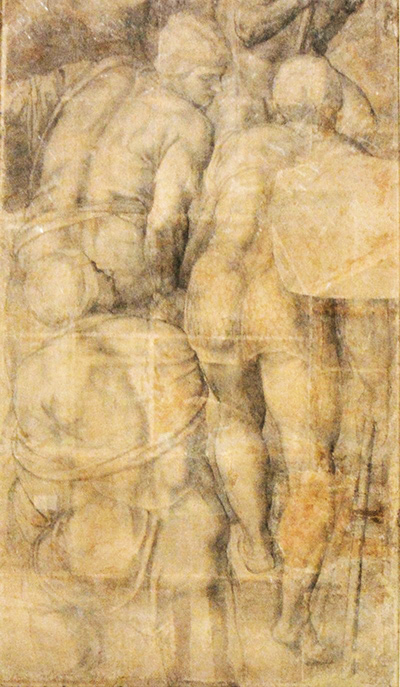
Group of Armed Men (Gruppo di Armigeri)
Michelangelo's soldiers are larger than most viewers. Drawn in charcoal across nineteen joined sheets, the Group of Armed Men is approximately 263 × 156 centimetres—full size for transfer into the Crucifixion of Saint Peter in the Vatican's Pauline Chapel.[1]
The work is not a small preparatory sketch. It is a cartoon: a final-scale working instrument placed against wet-plaster planning so that its contours could be transferred. Tiny holes along the outlines record pouncing, when powdered charcoal was pushed through the paper to mark the wall.[1]
Capodimonte preserves this rare survivor as GDS 1490. Its torn, assembled body brings viewers unusually close to the practical threshold between Michelangelo's drawing and his last fresco.
At a Glance
- ArtistMichelangelo Buonarroti
- TitleGroup of Armed Men (Gruppo di Armigeri)
- DateAbout 1546
- MediumCharcoal on nineteen sheets of Bolognese paper, joined and mounted
- DimensionsApproximately 263 × 156 centimetres
- Current collectionMuseo e Real Bosco di Capodimonte, Naples
- InventoryGDS 1490
- Object typeFull-scale cartoon
- ProjectCrucifixion of Saint Peter, Pauline Chapel, Vatican
- Transfer evidencePricked contours used for pouncing charcoal dust onto the wall
- Collection historyFarnese collection, associated with Fulvio Orsini; transferred to Naples through Bourbon inheritance
- ConservationRestored in the 1980s; protected by a climate frame and controlled light exposure
Contents
- What Is a Cartoon?
- Nineteen Sheets Become One Field
- The Soldiers in the Crucifixion of Peter
- Bodies Before Armour
- Pouncing the Design
- Fresco Time and the Giornata
- Michelangelo's Last Painted Project
- From Fulvio Orsini to Capodimonte
- Restoration and the Nineteen-Sheet Body
- Cartoon and Finished Fresco
- How to Look at the Group of Armed Men
- Why the Group of Armed Men Matters
What Is a Cartoon?
In Renaissance workshop language, a cartoon is a full-scale drawing used to transfer a design. The term derives from cartone, strong paper, not modern humorous imagery.
Small studies establish ideas; a cartoon resolves bodies at the dimensions required on the wall. It exposes whether a hand, head or overlap actually works at scale.
The cartoon can be cut into sections, pricked, traced or pressed. Its working use often damages it, which is why survivors are rare.
Michelangelo's sheet is a fragment or selected group rather than the entire wall composition. It carries enough surrounding relation to place soldiers within the fresco.
Calling it a “drawing” is correct but incomplete. It was a tool built to touch another surface.
Nineteen Sheets Become One Field
Paper mills did not produce a single 263-centimetre sheet suitable for the group. Michelangelo's workshop joined nineteen pieces of Bolognese paper.[2]
Seams create a constructed field analogous to masonry or plaster sections. Bodies cross joins, requiring alignment before transfer.
Different sheets may have been drawn separately or assembled before final charcoal work. Technical study of overlapping strokes and paste can reconstruct sequence.
Joining also made handling possible. Sections could be carried, stored or repaired, though the completed cartoon remained fragile.
The current mounted form includes later lining. Conservation must distinguish original joins from interventions that kept the giant paper object intact.
The Soldiers in the Crucifixion of Peter
Michelangelo painted the Crucifixion of Saint Peter on one side wall of the Pauline Chapel between the early 1540s and about 1550. Opposite stands the Conversion of Saul.[3]
The fresco shows Peter's cross being raised or positioned as the apostle turns toward the viewer. Soldiers, executioners and witnesses occupy a severe landscape.
The cartoon group corresponds to armed men within that narrative. Their bodies support institutional violence rather than heroic battle.
Comparison with the fresco reveals changes introduced during transfer and painting. A cartoon is an advanced design, not a guarantee every contour remained identical.
The soldiers' scale responds to a chapel wall viewed from below. Broad turns and clear overlaps had to survive architectural distance.
Bodies Before Armour
The Italian title armigeri means armed men or bearers of arms. Yet Michelangelo's attention often falls on weight, rotation and stance more than meticulously described equipment.
Charcoal establishes how soldiers cluster and how one body blocks another. Weapons and armour can be clarified later in paint.
This sequence reflects Michelangelo's priority: a convincing action depends first on bodily structure. Costume cannot rescue unstable weight.
The group is not a neutral parade. Men turn toward the execution, and their direction contributes to the moral pressure around Peter.
Their anonymity is functional. They embody the machinery of persecution rather than individual portrait drama.
Pouncing the Design
Small holes follow contours in the Capodimonte cartoon.[1] A workshop pricked the drawing, placed it against the prepared wall and dabbed charcoal through the holes with a pad.
When paper was removed, dotted lines remained on plaster. The painter could reinforce them and proceed with pigments before the wet section dried.
Pouncing sacrifices the pristine drawing. Holes interrupt lines, charcoal rubs, paper tears and repeated placement stresses joins.
Those damages are evidence of use. An untouched cartoon might be a presentation object; this one bears the mechanism that helped create fresco.
The transfer also involved assistants. Positioning a multi-sheet full-scale group against wall plaster required coordinated labour even if Michelangelo designed and painted decisive passages.
Capodimonte describes the practical action vividly: the cartoon was pressed against the wall and tamped with a cloth bag filled with charcoal, leaving a dotted path for the fresco painter to follow.[7] The technique translated a continuous drawn contour into a sequence of marks, which then had to be mentally rejoined on plaster.
That translation is easy to overlook in reproductions. The surviving holes are neither decoration nor simple damage. They are an index of contact among paper, powder, hand and wall.
Fresco Time and the Giornata
True fresco pigment is applied to fresh plaster. Only an area manageable in one working day—the giornata—is prepared at a time.
A full cartoon helps plan the whole while transfer may occur section by section. Join lines in plaster can later reveal daily progress.
The soldier group had to be coordinated with neighbouring figures and landscape before individual giornate separated execution.
Michelangelo's late fresco technique combined preparatory control with changes made on the wall. The cartoon reduces risk but cannot eliminate artistic response.
Its survival lets conservators compare paper contours, pounce marks and painted boundaries to reconstruct decisions.
Michelangelo's Last Painted Project
The Pauline Chapel frescoes followed the Last Judgement and were Michelangelo's final major paintings. He was in his late sixties and seventies, increasingly occupied with architecture.
Their style is more compressed and austere than the Sistine ceiling. Bodies remain powerful, but landscape and crowd produce spiritual unease rather than classical clarity.
The Group of Armed Men shows that late invention still depended on exacting physical preparation. Age did not replace work with spontaneous genius.
The cartoon's scale may have required workshop assistance in transfer and preparation, but Michelangelo's design controls the bodily field.
It bridges his graphic and painted practice near the end of a career that had begun with copied figures and small studies.
From Fulvio Orsini to Capodimonte
Capodimonte records that the cartoon entered the Farnese collection through Fulvio Orsini, the learned librarian and collector who managed acquisitions and exchanges for the family.[4]
The Farnese connection is fitting: Pope Paul III Farnese commissioned the Pauline Chapel and summoned Michelangelo to paint there.
When Charles of Bourbon inherited the Farnese collections, major works moved to Naples in the eighteenth century. The cartoon became part of the foundation of Capodimonte's holdings.[4]
Its journey changed function. A perforated workshop tool became a celebrated drawing displayed beside other Farnese masterpieces.
Inventory GDS 1490 secures the specific object within a collection that also holds Michelangelo-related cartoons and copies.
Restoration and the Nineteen-Sheet Body
The cartoon underwent major conservation between 1985 and 1988. The Italian central archive preserves documentation of lining and treatment and identifies nineteen sheets attached to canvas.[5]
Lining can stabilise tears and joins but also changes flexibility and how the reverse can be studied. Later conservation evaluates old adhesives and tensions.
Capodimonte's 2020 report describes a protective climate frame and a gallery redesign required by its depth.[6] Display architecture had to change around the conserved paper.
Light exposure is strictly limited in intensity and annual hours. Charcoal and paper can fade or embrittle; continuous display would consume the object.
Conservation therefore extends the cartoon's working history. The same seams that once enabled fresco transfer now determine modern support.
Cartoon and Finished Fresco
Comparing the two objects should proceed figure by figure. Identify corresponding heads, shoulders and weapons before judging change.
The cartoon's charcoal has no fresco colour, so tonal masses may not map directly. Paint can merge or separate forms differently.
Scale is one-to-one, but wall curvature, plaster and viewing angle change perception. “Same size” does not mean “same visual effect.”
Differences may be Michelangelo's revisions, assistant transfer variation, damage to paper or later fresco restoration.
The comparison is most valuable as process evidence, not a hunt for mistakes.
How to Look at the Group of Armed Men
First register size. Stand far enough back to see bodies as the fresco required, then approach for charcoal and seams.
Count paper joins and follow figures crossing them.
Look for pricked outlines. Imagine dotted charcoal remaining after the cartoon was removed from plaster.
Compare the corresponding fresco group in the Pauline Chapel.
Finally read conservation labels. Frame, light and lining are part of why a heavily used cartoon survives.
Why the Group of Armed Men Matters
The cartoon matters because it preserves an intermediate object usually destroyed by success. The finished fresco survives in Rome; the transfer instrument survives in Naples.
It also makes collaboration material. Nineteen sheets, pouncing and wall placement required many hands even when Michelangelo's invention governed the group.
Above all, the work turns preparation into presence. Charcoal soldiers made to disappear behind paint now stand full-size before viewers, their perforated contours recording the moment drawing crossed into wall.
Frequently Asked Questions
Discussion
What details, sources or comparisons stand out to you in Gruppo di armigeri?
Reader Insights
Which formal detail changes how the work reads?
Which documented source or collection history feels most useful?
Which related Michelangelo work should readers compare next?
Join the Conversation
Add a source-led observation, comparison or question for other readers.
References
- Museo e Real Bosco di Capodimonte, visitor guide, “Gruppo di armigeri”:, View source.
- Museo e Real Bosco di Capodimonte, 2021 press materials, nineteen-sheet construction:, View source.
- Vatican, Office for Liturgical Celebrations, Pauline Chapel:, View source.
- Museo e Real Bosco di Capodimonte, Oggi è il compleanno di Michelangelo”:, View source.
- ICPAL Photographic Archive, 1985–1988 restoration documentation:, View source.
- Museo e Real Bosco di Capodimonte, 2020 annual report, climate frame and display:, View source.
- Museo e Real Bosco di Capodimonte, I cartoni di Michelangelo e Raffaello tornano nuovamente esposti”:, View source.