


 by Tom Gurney
Tom Gurney BSc (Hons) is an art history expert with over 20 years experience
Published on June 19, 2020 / Updated on November 6, 2025
Email: tomgurney1@gmail.com / Phone: +44 7429 011000
Christ and the Woman of Samaria
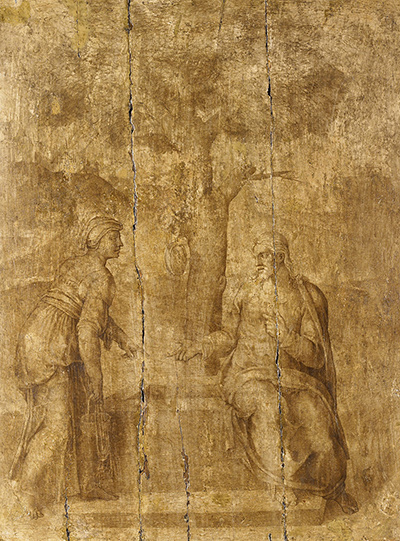
At Jacob's well, Michelangelo's Christ and Samaritan woman meet across more than physical distance. He offers “living water”; she has arrived with a vessel for ordinary water. Their exchange turns thirst into a language for revelation.
The Walker Art Gallery in Liverpool preserves an unusual large work on poplar panel, drawn in ink over a gesso-coated surface. It measures 77.7 × 69.9 centimetres and is dated between 1536 and 1542.[1] The gallery ascribes it to Michelangelo rather than stating unqualified authorship.
Poor condition makes the hand difficult to judge. The underlying invention is securely associated with Michelangelo, but the surviving panel may be his work, a close collaborator's version or a workshop translation of a lost design.[2]
That uncertainty is central to the object's history. It should not be hidden behind a famous name.
At a Glance
- TitleChrist and the Woman of Samaria
- AttributionAscribed to Michelangelo Buonarroti
- Date1536–1542
- Medium/supportInk on gesso-coated poplar panel
- Dimensions77.7 × 69.9 centimetres
- CollectionWalker Art Gallery, National Museums Liverpool
- SubjectJohn 4, Christ and a Samaritan woman at Jacob's well
- ConditionSignificantly worn, complicating attribution
- Design statusMichelangelo's invention is accepted more securely than his execution of every surviving mark
- Notable provenanceAssociated with Liverpool collector William Roscoe
Contents
- The Encounter at the Well
- Two Bodies in Dialogue
- Water, Vessel and Meaning
- Ink on Gessoed Poplar
- Attribution: Invention and Hand
- A Lost Painting for Vittoria Colonna?
- The Samaritan Woman as Theologian and Witness
- The Moment Chosen
- Drawing, Monochrome or Unfinished Painting?
- Grace Across Boundaries
- Comparisons and Copies
- William Roscoe and Liverpool
- Condition and What Is Lost
- How to Look at the Work
- Why Christ and the Woman of Samaria Matters
The Encounter at the Well
In John's Gospel, Jesus rests beside Jacob's well while travelling through Samaria. A local woman arrives alone to draw water. He asks her for a drink.[3]
The request is socially charged. Jews and Samaritans were divided by religious and historical antagonism, and public conversation between an unrelated man and woman crossed convention.
Christ then shifts the meaning of water. If she knew who spoke, he says, she would ask him for “living water.” She first understands a practical impossibility: he has no bucket and the well is deep.
Their dialogue moves through misunderstanding toward recognition. Christ reveals knowledge of her life; she calls him prophet and discusses worship; finally he identifies himself as Messiah.
The subject is therefore a conversation, not simply a miracle. Gesture and attention must carry intellectual change.
Two Bodies in Dialogue
Christ and the woman are arranged around the well as an encounter of distinct but connected masses.
The well is both barrier and shared point. It explains why they meet while giving the conversation a physical centre.
Christ's gesture can direct attention beyond the vessel toward the spiritual gift he describes. The woman remains tied to the act of drawing water, but her body begins to answer his words.
Michelangelo's figures tend to make speech bodily. A turned torso or open hand becomes syntax.
The composition avoids a crowded narrative. By concentrating on two people, it gives doctrinal dialogue the intensity of portrait encounter.
Water, Vessel and Meaning
The woman's container belongs to labour. She has come for water that must be carried home and consumed.
Christ's “living water” promises a spring leading to eternal life. The object in her hand therefore measures the difference between literal and transformed understanding.
The well also possesses ancestral authority: the woman invokes Jacob, who gave it to his descendants. Christ's claim exceeds inherited place without denying its history.
In a static image, that movement of thought cannot unfold through successive speech. The artist must allow earthly objects to remain visible while gestures redirect their meaning.
The panel rewards slow looking because the narrative is conversion through attention, not spectacle.
Ink on Gessoed Poplar
This is not a conventional chalk study on paper. A wooden panel coated with gesso supplies a smooth, pale ground for ink.[1]
Its scale—more than three-quarters of a metre high—places it between intimate drawing and portable painting. The surface could serve as a model, presentation object or underworked monochrome design.
Ink behaves differently on gesso than on absorbent paper. Lines can sit sharply on the surface, while abrasion or cleaning may remove them dramatically.
That vulnerability helps explain present condition. Damage does not merely reduce beauty; it removes evidence needed to distinguish Michelangelo's line from a follower's.
The support also raises questions of intended function. A prepared panel suggests durability, but the monochrome technique leaves the work close to disegno.
Attribution: Invention and Hand
National Museums Liverpool presents the work as “Ascribed to Michelangelo.” Google Arts & Culture's Walker record states that the poor condition prevents secure confirmation, while the first drawing for the composition was certainly by Michelangelo.[2]
Those statements separate two questions. Who invented the composition? Who executed this material object?
Michelangelo's late practice often involved designs translated by Marcello Venusti, Sebastiano del Piombo, Daniele da Volterra or other associates. A follower could preserve an authentic invention while producing a distinct object.
Conversely, damage can make an autograph surface look hesitant or alien. Absence of Michelangelo's most familiar chalk handling is unsurprising on inked gesso.
Responsible attribution must combine technical examination, provenance, related copies and line-by-line comparison. Fame cannot replace that work.
A Lost Painting for Vittoria Colonna?
Michelangelo is documented or reported as making sacred designs for his friend Vittoria Colonna. Scholarship has connected the Samaritan composition with a lost work made for her, known through versions and derivatives.[4]
The subject would suit their religious exchange. It focuses on grace received through encounter and on a woman's active passage from question to witness.
Yet “for Vittoria Colonna” should not be used casually for every surviving version. A composition can originate in one relationship and circulate through workshops, copies and later collections.
If the Walker panel preserves that invention, its distance from the first recipient is part of its meaning.
The association strengthens context without settling the executing hand.
The Samaritan Woman as Theologian and Witness
The woman does not remain a passive listener. She questions Christ about water, ancestry and the proper place of worship.
After recognition, she leaves her jar and tells people in the city what has happened. Her testimony brings others to meet him.[3]
An image centred on dialogue therefore gives unusual weight to female inquiry. The woman's misunderstanding is not stupidity; it is the route by which increasingly profound questions are opened.
Her vessel, initially indispensable, will be abandoned. In narrative terms, changed priority becomes a physical action.
Michelangelo's design can thus be read as an image of teaching in which questions produce revelation rather than merely delay it.
The Moment Chosen
John's account contains several possible pictures: Christ asking for a drink, the woman's surprise, discussion of her husbands, the disciples' return, her abandoned jar and the arrival of townspeople.
The Michelangelo composition concentrates the pair at the well before the story expands into communal witness.
That choice preserves ambiguity useful to painting. A pointing Christ may announce living water or identify worship “in spirit and truth”; the woman's posture can combine resistance and emerging attention.
Rather than illustrating one quoted sentence like a caption, the image compresses the dialogue's whole movement.
The viewer occupies the position of a later listener. We already know what the woman is learning, but her gradual recognition slows our certainty.
Drawing, Monochrome or Unfinished Painting?
Modern categories become unstable before ink on a prepared wooden panel. The work is drawn, yet its support belongs to panel painting. It is monochrome, yet that does not prove it awaited colour.
Renaissance artists used highly finished modelli to secure approval, guide collaborators or preserve inventions. Monochrome objects could also be collected as works in their own right.
The Walker panel's size and material give it more physical authority than a small paper sketch. At the same time, it lacks the layered colour expected of a conventional altarpiece.
Its present worn state makes original finish difficult to recover. Passages that now seem provisional may once have been more continuous.
Calling it simply a “drawing” is useful, provided the unusual prepared support remains visible.
Grace Across Boundaries
The scene's geography is theological. Jesus deliberately travels through Samaria, and revelation occurs outside the expected religious centre.
The woman is marked by place, gender and personal history, yet none disqualifies her. She becomes the means by which others hear.
This logic would have resonated in reform-minded sixteenth-century devotion concerned with grace rather than human merit. It helps explain the subject's suitability for Vittoria Colonna without proving that the Walker surface itself passed through her hands.
Michelangelo's concentrated composition strips away anecdotal superiority. Christ teaches, but the woman remains visibly engaged in the exchange.
The well becomes a border crossed through speech.
Comparisons and Copies
Later artists repeatedly depicted the subject, often placing landscape, city or approaching disciples around the pair. Versions connected to Michelangelo's invention tend to preserve the charged relation of Christ, woman and central divider.
A British Museum drawing by another artist uses a column in place of the tree associated with Michelangelo's lost composition, demonstrating how a structural motif could migrate.[4]
Other sheets show the woman holding a jug or seated opposite Christ. These should not all be treated as direct copies of the Walker panel.
Comparative study asks which elements recur together: pose, gesture, well, tree or column, and direction of gaze.
A family of images can recover a lost design while still containing independent inventions.
William Roscoe and Liverpool
The work entered a city shaped by the collecting and scholarship of William Roscoe, a Liverpool lawyer, historian, poet, botanist and campaigner against the slave trade.[2]
Roscoe's interest in Italian Renaissance art helped form the cultural foundations of the Walker collections.
That provenance creates a later context for the Samaritan subject. A picture about crossing inherited division came to be valued by a reform-minded collector, though one should not claim that this parallel determined his acquisition without documentary evidence.
Collection history also shaped attribution. Once associated with Michelangelo, the worn panel attracted heightened scrutiny and expectation.
Its current museum label preserves that history without disguising doubt.
Condition and What Is Lost
Abrasion can weaken contours, flatten modelling and remove subtle changes of pressure. Retouching may introduce lines by later hands.
On a gessoed support, cracks and losses affect both ground and ink. Photography can exaggerate surviving dark marks while making faint transitions disappear.
Conservation therefore sets limits on stylistic judgement. The present object is not visually identical to its sixteenth-century state.
Damage also creates an ethical demand in interpretation: uncertainty should increase when evidence decreases.
The panel remains valuable not despite condition but partly because its fragile surface records how uncommon Renaissance graphic objects survive.
How to Look at the Work
Begin with the well and identify how it separates and joins the pair.
Follow Christ's gesture, then the woman's response.
Notice the vessel as both practical tool and narrative symbol.
Examine the gesso ground and distinguish confident ink from worn or restored passages where possible.
Finally hold invention and execution apart: the composition can be Michelangelesque or Michelangelo's even while the panel's hand remains ascribed.
Why Christ and the Woman of Samaria Matters
The work matters because it makes theology conversational. Revelation happens through request, misunderstanding, question and recognition.
It also exposes how authorship works around Michelangelo. A powerful design could travel across hands and supports, becoming famous without preserving a simple signature.
Most of all, the worn panel keeps its central exchange alive. At an ordinary well, two bodies transform what water can mean.
Its fragile state makes that survival more consequential. The object cannot answer every authorship question, but it preserves a rare experiment in monumental drawing on panel and a Michelangelo invention centred on reciprocal speech. Ambiguity here is not emptiness; it is the disciplined boundary of what the surface can still prove.
Within those limits, the composition remains remarkably direct. Neither ruin nor disputed hand has erased the central fact that revelation is represented as one person attending to another across a shared, necessary source of water.
The survival of that relation is the panel's strongest attribution-independent truth. It deserves more than treatment as a damaged Michelangelo curiosity: its material uncertainty and narrative clarity illuminate each other.
The woman is essential to that clarity. Without her questioning presence, “living water” would remain an abstract pronouncement. Her practical objection gives Christ's metaphor resistance, duration and the human work of understanding.
Frequently Asked Questions
Discussion
What details, sources or comparisons stand out to you in Christ and the woman of Samaria?
Reader Insights
Which formal detail changes how the work reads?
Which documented source or collection history feels most useful?
Which related Michelangelo work should readers compare next?
Join the Conversation
Add a source-led observation, comparison or question for other readers.
References
- Wikimedia Commons, structured Walker Art Gallery metadata for Christ and the Woman of Samaria:, View source.
- Walker Art Gallery via Google Arts & Culture, Christ and the Woman of Samaria”:, View source.
- Bible Gateway, John 4:1–42, NRSVUE:, View source.
- British Museum, drawing after Michelangelo's lost Samaritan composition, 1943,0710.16:, View source.
- British Museum, Michelangelo sacred figure studies, 1895,0915.516:, View source.