


 by Tom Gurney
Tom Gurney BSc (Hons) is an art history expert with over 20 years experience
Published on June 19, 2020 / Updated on November 6, 2025
Email: tomgurney1@gmail.com / Phone: +44 7429 011000
Archers Shooting at a Herm
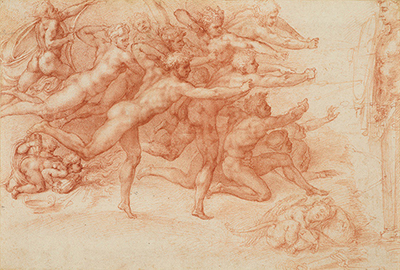
A surge of nude archers races toward a stone target, yet most of them have no bows. Arrows stick in the herm and its base but miss the centre. Below the charge, children kindle a fire while winged Cupid sleeps with his own bow idle in his lap.
Michelangelo drew Archers Shooting at a Herm about 1530 in two shades of red chalk. The Royal Collection preserves the sheet as RCIN 912778.[1] Its original recipient is not known, although its finish places it among the gift or presentation drawings of the early 1530s.
The absent bows are not an error awaiting completion. They strip the action to bodily desire: muscles pull invisible strings, arrows fly without guidance, and frantic striving fails. Passion supplies heat; sleeping Love withholds aim.
At a Glance
- ArtistMichelangelo Buonarroti
- TitleArchers Shooting at a Herm
- DateAbout 1530; often broadened to 1530–1533
- MediumRed chalk in two shades on paper
- DimensionsApproximately 21.9 × 32.3 centimetres
- Current collectionRoyal Collection, Windsor
- Royal Collection numberRCIN 912778
- Object typeHighly finished presentation or gift drawing
- RecipientUnknown
- SubjectNude archers firing toward a shield or target on a herm; sleeping Cupid and fire-tending putti below
- WatermarkCrossbow in a circle, close to but not identical with a catalogued Roberts type
- Core interpretationPassion unguided by higher love cannot reach its true object
Contents
- What Is a Herm?
- The Archers Without Bows
- Sleeping Cupid
- The Fire of Passion
- Male and Female Nudes in Motion
- A Sequence of Impossible Shots
- Invisible Equipment and Visible Evidence
- Desire Directed at an Image
- Gender, Desire and the Collective Nude
- A Presentation Drawing for an Unknown Recipient
- Red Chalk in Two Shades
- Neoplatonic Love and the Missed Centre
- The Possibility of Artistic Allegory
- Copies, Fresco and Engraving
- From Chalk to Crayon-Manner Print
- Provenance
- The Watermark and the Material Sheet
- How to Look at Archers Shooting at a Herm
- Why Archers Shooting at a Herm Matters
What Is a Herm?
A herm is a squared pillar topped by a head or upper body, derived from ancient boundary markers associated with Hermes. Renaissance collections used herms as antique-looking sculpture and architectural ornament.
Michelangelo's target is fixed to such a figure. The archers therefore shoot not at a living enemy but at an image in stone. Art, desire and violence meet.
The herm's vertical stability contrasts with the horizontal rush. Bodies expend enormous energy while the target remains unmoved.
Arrows strike the base, edges and surrounding form, demonstrating failure rather than lack of effort. The centre remains untouched.[1]
Because a herm can embody a beautiful youth, the target may also stand for the desired person. Yet no inscription identifies a named beloved. Allegory should remain broader than a biographical portrait.
The Archers Without Bows
Several bodies perform the full action of drawing a bow—one arm extended, the other pulled back—without any weapon between their hands. Michelangelo includes arrows already embedded at the target, so the absence cannot mean he forgot the equipment.
Omission simplifies the crowded composition and preserves the horizontal flow, as the Royal Collection suggests.[2] Curving bows would create repeated barriers across torsos.
It also intensifies allegory. The archers possess desire and effort but lack the instrument that turns them into effective action. Their gestures are powerful and futile.
One or limited bows may remain, enough to make absence visible. The viewer mentally supplies what hands expect and then recognises that the missing form is the point.
Michelangelo frequently used incompletion productively, but this is not a rough unfinished drawing. The finish around the omitted bows confirms deliberate selectivity.
Sleeping Cupid
Below the main action, winged Cupid sleeps with bow and arrows. The true god of love is physically present and functionally absent.[1]
His stillness contrasts with the archers' frenzy. More effort above does not compensate for missing guidance below.
Renaissance Neoplatonic interpretation distinguished appetitive or physical desire from love capable of leading the soul toward divine beauty. The sleeping Cupid can signify the failure of guiding love, while the archers act under raw passion.
This reading is not perfectly simple. Cupid himself often represents erotic appetite, and classical myth gives him disruptive power. The drawing may depend on a Christianised hierarchy in which a higher Love must awaken.
The body is also a compositional brake. After the horizontal rush, the viewer drops to a compact sleeping child and pauses.
The Fire of Passion
At the lower left, putti tend a fire. Flames make metaphor literal: passion burns beneath the archers and drives their bodies forward.[1]
Fire can purify, illuminate or destroy. Here its low placement and relation to missed arrows favour appetite rather than spiritual illumination.
The putti appear busy and competent. As in the Children's Bacchanal, small figures can serve impulses they do not govern rationally.
The sheet therefore distributes causation vertically. Fire below energises; archers in the middle strive; stone target at right receives failure. Sleeping Cupid lies outside the circuit that could correct it.
Michelangelo turns abstract psychology into a machine of bodies.
Male and Female Nudes in Motion
The archers include bodies read as male and female, some grounded and others seemingly airborne.[2] Clothing and setting have been almost eliminated so that action becomes collective.
Each figure solves a variation on drawing, releasing or reaching. Repetition does not produce sameness. Torsos rotate at different stages, limbs overlap and foreshortening compresses distant bodies.
Michelangelo's anatomical knowledge is used rhetorically. Muscles are not neutral study; they make misguided desire look magnificent.
That beauty complicates moral distance. Viewers may admire the archers' force even after learning they fail. The image asks whether virtuosity can itself become another flame of passion.
The bodies also recall antique reliefs and battle compositions without narrating one known myth. Allegory frees them from historical costume.
A Sequence of Impossible Shots
The group does not represent one archer repeated mechanically. Some figures lean, some kneel, some twist in the air, and others appear to have just released. Michelangelo distributes the phases of shooting across a collective body.
Without bows, arms become the timeline. A hand reaches toward the target; another pair draws apart; a torso recoils; arrows already embedded record completed attempts. The viewer reconstructs weapons and motion from anatomical consequences.
This turns the archers into a catalogue of intention. Every pose is directed, yet none reaches the centre. Failure is not hesitation but accumulated action.
The target at far right stops the surge. Its circular centre offers mathematical stillness against organic bodies. The more the figures accelerate, the more unyielding that geometry becomes.
Michelangelo's choice of a herm rather than a freestanding shield adds vertical resistance. The target is attached to a body already petrified, an image that cannot answer the desire aimed at it.
Invisible Equipment and Visible Evidence
The absent bows invite a useful distinction between what the sheet shows and what action requires. Hands and arrows prove archery; the viewer supplies the missing curved instruments.
This mental completion is not arbitrary reconstruction. It is constrained by pose. The distance between hands, angle of elbows and direction of gaze tell us where each bowstring would be.
At the same time, the omissions cannot all be filled identically. Figures occupy different depths and may be at different phases. A digital overlay of bows could help explain mechanics but would risk cluttering the visual economy Michelangelo protected.
The drawing therefore makes absence active evidence. What is not drawn controls the interpretation as much as chalk marks do.
This principle distinguishes intentional omission from physical loss. No torn strips selectively removed each bow, and the surrounding finish remains coherent. The weapons were not erased by later damage; Michelangelo withheld them.
Desire Directed at an Image
The herm has the upper form of a person but the lower body of a pillar. It offers the appearance of a beloved without reciprocating life.
Arrows conventionally travel from Cupid toward the lover. Here ordinary or superhuman archers reverse the relation and fire at the image of beauty. Desire attempts possession.
Their failure can therefore be ethical as well as technical. A beloved or divine form cannot be reached by assault, quantity or muscular will. The untouched centre remains unavailable to force.
For Michelangelo, sculpture was also a beloved form made from resistant stone. The target's marked surface may evoke the artist's desire to reach an ideal through repeated blows. This artistic analogy is suggestive rather than documented, but it grows from the actual choice of a carved herm.
The drawing refuses to say whether the image suffers. Stone receives arrows without expression. The pathos belongs to the striving bodies whose energy cannot cross into knowledge.
Gender, Desire and the Collective Nude
The Royal Collection describes male and female figures among the archers.[2] Michelangelo's powerful anatomical type can make gender difficult to distinguish where breasts, hair or genital detail are obscured.
That ambiguity broadens the allegory. Misguided passion is not assigned to one sex. Desire becomes a collective human condition.
The lack of clothing removes social rank and historical period. Bodies are differentiated by action more than costume or portrait. Some appear youthful, others more mature, yet all are caught in the same directional field.
Modern interpretation should avoid making every nude a coded portrait of Michelangelo or Cavalieri. The sheet may emerge from personal concerns about love without requiring a biographical identity for each archer.
The mixed collective also complicates a simple homoerotic reading. Michelangelo's admiration for male beauty is central to his gift drawings, but this allegory deliberately generalises passion.
A Presentation Drawing for an Unknown Recipient
The sheet is grouped with Michelangelo's presentation drawings because of its extraordinary finish and conceptual self-sufficiency.[2] Unlike Tityus, Phaethon and the Children's Bacchanal, no recipient is securely documented.
The absence matters. It prevents every theme from being folded into the relationship with Tommaso de' Cavalieri. Michelangelo made elaborate drawings for more than one close friend or patron.
Notes on the verso and the sheet's history contribute to its classification, but “presentation drawing” describes function and finish more than a modern exhibition presentation.
It was meant to be possessed, studied and perhaps discussed. It did not merely communicate a design to a painter or patron for enlargement.
Unknown recipient does not mean contextless. The work belongs to an early-1530s period when Michelangelo explored love, punishment, ascent and bodily striving through finished mythological inventions.
Red Chalk in Two Shades
Two red chalks help Michelangelo manage a dense field. A lighter tone establishes bodies; a darker tone reinforces shadow, contour and the most forceful accents.
Red chalk brings warmth to nude flesh and can move from hairline precision to broad rubbing. Michelangelo largely relies on directed strokes that follow form.
The horizontal sheet encourages procession. Tonal variation separates layers without a fully described landscape.
Paper remains active as light and air. Bodies do not need every edge enclosed; adjacent chalk densities let one form emerge against another.
The crossbow-in-circle watermark offers evidence about paper manufacture and comparison with other sheets.[1] It is a material fact, not an encoded comment on archery, despite the appealing coincidence.
Neoplatonic Love and the Missed Centre
The Royal Collection presents the allegory clearly: arrows of desire miss because passion acts without the guidance of love.[1][2] The untouched centre becomes a spiritual as well as visual absence.
The target may resemble the heart's aim. Renaissance poetry often imagined lovers wounded by eyes and arrows, while philosophical writing could redirect desire from bodily beauty toward its divine source.
Michelangelo's poems repeatedly describe the beloved as both physical presence and ladder upward. The drawing makes the difficulty visible. Desire is not denied; it is shown unable to complete itself.
Yet interpretation should avoid claiming a one-to-one illustration of a particular poem. No identified text controls the sheet.
Its philosophical intelligence lies in spatial economy. Fire, sleeping Cupid and missed centre create an argument without words.
The Possibility of Artistic Allegory
The archers aim at a sculpture. This has encouraged readings in which the drawing concerns artists trying to reach an ideal form, or Michelangelo addressing sculpture itself.
The missing bows could also recall the sculptor's bow drill, known in Italian through archery language. Such wordplay is suggestive but not required by the museum's primary interpretation.
An artistic reading need not replace the love allegory. Renaissance disegno joined desire, imitation and making. Artists strive toward beauty and can miss when technical force lacks judgment.
The herm remains passive but bears marks. Art is the object of attack, admiration and failed possession.
This layered possibility helps explain the drawing's appeal to later artists. It is a display of bodily invention that also questions unguided virtuosity.
Copies, Fresco and Engraving
The composition circulated through drawn copies, prints and a fresco tradition. A Brera drawing is regarded as a likely copy after the Windsor sheet.[3]
A related fresco removed from the destroyed Casino of Raphael and now associated with the Galleria Borghese has a complex attribution history; the Royal Collection's Raphael Collection catalogue currently connects it with Girolamo Siciolante around 1544–1545 rather than treating it simply as Michelangelo's painting.[4]
Francesco Bartolozzi later made a crayon-manner engraving in reverse, a technique prized for imitating chalk softness.[3]
Each translation changes the work. Fresco monumentalises and colours; engraving reverses and standardises; photography records a copy as another object.
These should be credited “after Michelangelo,” not collapsed into the autograph drawing. Their differences map the composition's European fame.
From Chalk to Crayon-Manner Print
Bartolozzi's eighteenth-century crayon-manner engraving deserves particular attention because it tried to reproduce the appearance of drawing rather than merely translate outlines.[3] Stippled and rocked marks could simulate red-chalk grain and tonal softness.
The print is in reverse, changing the original left-to-right surge. Archers that once drove toward the right now move toward the left, and the relation between fire, Cupid and target is reoriented.
Reversal affects meaning less than it affects bodily habit. A viewer familiar with the print may imagine the autograph backwards. Accession numbers and object labels prevent the reproduction from silently becoming the original.
The very attempt to imitate chalk reveals what collectors valued: not only Michelangelo's invention but the touch of his medium. Mechanical multiplication promised intimacy to viewers who could never handle the Windsor sheet.
The imitation remains historically specific. Bartolozzi's fashionable eighteenth-century surface is not a neutral window onto 1530; it is a later theory of how Renaissance drawing should look.
Provenance
Google Arts & Culture's Royal Collection record traces the sheet through Giulio Clovio, who bequeathed it to Cardinal Alessandro Farnese in 1578, and into George III's collection by about 1810.[2]
This path differs in documentation from some Cavalieri gifts, whose passage becomes obscure after the Farnese collection. The exact chain still deserves object-specific caution.
The Royal Collection number RCIN 912778 separates the autograph sheet from later prints, photographs and copies carrying the same title.
That identifier is especially important because “Archers Shooting at a Herm” became a composition as well as one object. The manuscript concerns the Windsor red-chalk original.
The Watermark and the Material Sheet
The paper bears a crossbow-in-circle watermark close to, but not identical with, a catalogued Roberts type.[1] Watermarks arise from wire designs in the papermaking mould and can help group sheets from related stocks.
The crossbow's presence in an archery subject is an extraordinary coincidence, but no evidence shows Michelangelo selected the paper for a visual pun. The mark would be visible most clearly in transmitted light, not necessarily during ordinary viewing.
Material comparison could refine date or place of manufacture. It cannot identify the recipient by itself. Paper might circulate widely and remain in a studio before use.
The watermark reminds us that the allegory depends upon a manufactured object. Chalk, fibre, trimming and inscription history carry evidence different from depicted bodies.
How to Look at Archers Shooting at a Herm
Begin with the hands and locate every actual bow. Let absence become visible rather than assuming incompletion.
Trace arrows at the target and confirm that the centre remains unhit.
Move downward to fire and sleeping Cupid. They explain the action above without a written key.
Follow individual bodies through the surge and note male/female variation.
Then compare a Bartolozzi engraving or Brera copy. Reversal and medium expose what red chalk uniquely achieves.
Why Archers Shooting at a Herm Matters
The drawing matters because it makes failure magnificent. Michelangelo gives the archers every visible resource—strength, speed, number and concentration—except the guidance that would make them effective.
Its formal omission is intellectually exact. The missing bows make the viewer experience what desire lacks.
The sheet also demonstrates how a private, finished drawing could become a public European invention. Copies multiplied the archers, but the Royal Collection original retains the warmth and selective absence through which Michelangelo made passion miss its mark.
Frequently Asked Questions
Discussion
What details, sources or comparisons stand out to you in Archers Shooting at a Herm?
Reader Insights
Which formal detail changes how the work reads?
Which documented source or collection history feels most useful?
Which related Michelangelo work should readers compare next?
Join the Conversation
Add a source-led observation, comparison or question for other readers.
References
- Royal Collection Trust, Archers Shooting at a Herm,” RCIN 912778:, View source.
- Google Arts & Culture with Royal Collection Trust, Archers Shooting at a Herm”:, View source.
- Royal Collection Trust, Francesco Bartolozzi, engraving after Michelangelo, RCIN 854054:, View source.
- Royal Collection Raphael Collection, photograph of related fresco, RCIN 854052:, View source.
- National Galleries of Scotland, engraving after Michelangelo, P 5045:, View source.