



Michelangelo’s Drapery Study for the Erythraean Sibyl
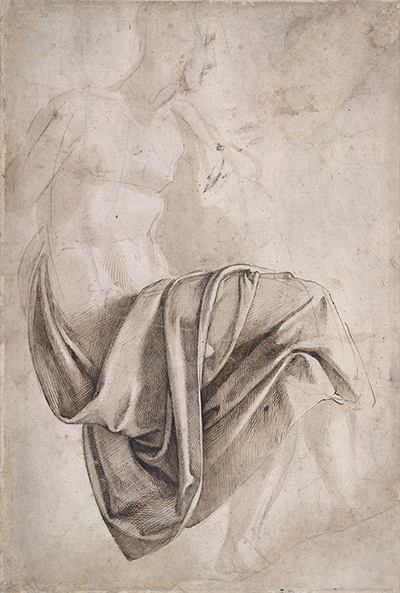
At first the body is almost a ghost. A faint head, shoulders and arms hover above a dense architecture of cloth. Across the lap, however, fabric becomes emphatic: dark folds descend, collide and turn over crossed legs, while brown wash gives the mass gravity. Michelangelo has temporarily allowed clothing to become the principal figure.
Made between 1508 and 1512, the drawing in the British Museum prepares the drapery of the Erythraean Sibyl on the Sistine Chapel ceiling.[1] Pen and dark brown ink, brown wash and a black-chalk underdrawing build the front; the reverse holds another Sibyl study, an early scheme for the vault and a separate hand.[1] Both faces show that drapery was not an embellishment added after the body. It was one of the means by which a seated prophetess acquired weight, movement and monumental coherence.
At a Glance
- WorkStudy for the Drapery of the Erythraean Sibyl
- ArtistMichelangelo Buonarroti
- Date1508–12[1]
- Materials on the frontBrown wash and pen with dark brown ink over black chalk[1]
- ReverseA seated Sibyl, an early scheme for the Sistine ceiling and a left hand in several chalk techniques over stylus indications[1]
- Dimensions38.4 × 25.8 centimetres[1]
- Current homeBritish Museum, London, registration 1887,0502.118[1]
- PurposeDetailed preparation for the clothing over the Erythraean Sibyl’s crossed legs
- Workshop practiceProbably studied from cloth stiffened with wet clay and arranged on a small model or lay figure[1]
- Change before paintingThe fresco simplifies the elaborate fold system preserved here[1]
- Wider importanceThe reverse includes rare evidence for Michelangelo’s developing arrangement of the ceiling
Contents
- When Cloth Takes the Lead
- The Erythraean Sibyl
- Crossed Legs Beneath Fabric
- Pen, Wash and Black Chalk
- A Florentine Drapery Practice
- Observed Cloth and Invented Cloth
- Drapery as a Sculptural Problem
- The Body Left Faint
- The Reverse: Another Sibyl
- A Tiny Scheme for an Immense Ceiling
- The Separate Hand
- From Elaborate Study to Simplified Fresco
- Colour Changes Everything
- Attribution and Debate
- Collecting and Survival
- How to Look at the Study
- Artist Up Close
When Cloth Takes the Lead
The front contains a lightly indicated seated woman, but Michelangelo concentrates labour below her waist. The upper body establishes enough of the pose to locate the fabric; the lap and legs receive the sustained pen and wash.
This imbalance is purposeful. The figure’s anatomy could be considered elsewhere. Here the question is how cloth behaves when one leg crosses another and the body turns to the right.
Folds do not spread evenly. Some pull taut across projecting forms, others bunch in recesses, and still others fall under their own weight. Their pattern explains what lies beneath without exposing it.
The study makes visible a paradox of drapery: clothing conceals the body while giving its posture another kind of legibility.
The Erythraean Sibyl
The Erythraean Sibyl is one of five classical prophetesses seated among seven Hebrew prophets around the Sistine ceiling. Christian interpretation drew ancient Sibyls into a history of expectation, treating their sayings as pagan anticipations of Christ.
Michelangelo’s Erythraean seer sits with a great book open on a lectern. Her head turns towards one side while an attendant behind her tends a lamp. The figure is composed rather than eruptive: crossed legs and layered garments create a broad stable base beneath the upper body.[2]
The drapery study prepares that stability. Before colour distinguishes garments and surrounding architecture, folds establish the physical credibility of the seated mass.
The Sibyl’s authority is therefore not conveyed through face and attribute alone. It begins in the way her clothed body occupies space.
Crossed Legs Beneath Fabric
Crossing the legs creates multiple directions at once. One thigh runs across the lap; the lower leg descends; fabric stretched over the upper surfaces then falls between and around them.
Michelangelo follows these consequences rather than applying a conventional cascade of folds. Long ridges correspond to tension. Compressed darks mark places where material gathers. Broad areas of wash suggest planes too large to describe by line alone.
The underlying legs are never fully outlined for display. Their presence is inferred through the behaviour of the garment.
This indirect construction gives the lower body exceptional density. The Sibyl does not perch lightly. Cloth, limbs and gravity combine into a mass capable of holding its own within the immense painted architecture of the ceiling.
Pen, Wash and Black Chalk
The British Museum describes pen and dark brown ink with brown wash over a black-chalk underdrawing.[1] Each material performs a different task.
Black chalk establishes the whole seated figure and initial placement of folds. Pen clarifies edges, breaks and directional hatchings. Wash spreads tone across larger areas, binding many separate lines into shadow.
Michelangelo does not conceal the sequence completely. In places, faint chalk remains visible beyond the reinforced drapery. The finished study therefore preserves its own construction.
Ink brings decisiveness, but not rigidity. Lines thicken, taper and overlap. Wash can deepen a hollow or soften an abrupt boundary.
The result feels both analytical and richly material: an account of how fabric works and an evocation of its weight.
A Florentine Drapery Practice
The British Museum relates the study to a workshop method described by Giorgio Vasari: cloth could be dipped in wet clay, arranged over a small model or lay figure and then drawn as it hardened.[1]
Stiffening stabilised complex folds long enough for prolonged observation. It also allowed the artist to design configurations that ordinary loose fabric might not retain.
The method connects Michelangelo with established Florentine practice, including the workshop culture of Ghirlandaio in which he trained briefly.[1]
That continuity complicates the legend of solitary invention. Even one of the most singular figures on the Sistine vault could grow from inherited procedures.
Michelangelo’s originality lies not in avoiding workshop knowledge, but in transforming it into a monumental language of his own.
Observed Cloth and Invented Cloth
A clay-stiffened arrangement is not identical to fabric worn by a living seated woman. It is an aid: part observation, part construction.
Michelangelo can study how ridges catch light and how weight creates troughs. He can also rearrange those effects to clarify the body, strengthen the silhouette or suit a distant viewpoint.
The dense network on the sheet should therefore not be understood as photographic transcription. Its logic is selective.
Some folds describe pressure from the crossed legs. Others organise shadow into a rhythm that leads the eye downward. The most elaborate passages make cloth behave almost like carved relief.
Nature supplies effects; design gives them hierarchy.
Drapery as a Sculptural Problem
Michelangelo’s garments are often discussed as coverings for bodies he preferred to imagine nude. This study proves that cloth could itself command sustained invention.
The drapery has peaks, channels and overhanging edges. Pen hatching models their orientation; wash fills the deeper intervals. The whole lower half projects through changes of plane.
Such treatment is sculptural in its concern with mass, but graphic in its means. A passage can become deep through a few concentrations of ink rather than actual physical depth.
Fabric also allows forms unavailable in naked anatomy. It can bridge the space between knees, widen the lap and generate an outer silhouette larger than the limbs beneath.
Michelangelo uses clothing to build the Sibyl’s monumentality, not to hide it.
The Body Left Faint
Above the worked lap, the torso and head remain pale. Arms extend with little modelling, and the face is barely present.
This selective finish tells us what the sheet was for. Michelangelo had no need to complete areas that did not advance the problem under examination.
The contrast also creates a striking modern visual effect: thought seems to condense into matter as the eye travels downward. Yet that effect arises from function, not from an intention to produce an autonomous contrast between abstraction and finish.
Preparation often leaves such uneven beauty. A working drawing can become compelling because concentration is visibly distributed rather than because every part is brought to equal polish.
The Reverse: Another Sibyl
On the reverse, Michelangelo drew a rapidly turning seated figure with legs crossed and head inclined.[1] Small attendants are barely discernible beside her.
This is an earlier, more fluid inquiry into the Erythraean Sibyl’s whole pose. Grey-brown and black chalk move quickly, without the front’s patient accumulation of ink and wash.
The two faces therefore divide stages and tasks. The reverse asks how the complete figure might sit and turn. The front concentrates on how drapery will articulate the lower body.
Turning the sheet shifts from gesture to substance, from an overall possibility to a particular material solution.
Neither side alone contains the finished Sibyl. Together they reveal a process of narrowing attention.
A Tiny Scheme for an Immense Ceiling
The reverse also contains a summary design for the Sistine vault. Michelangelo indicated divisions of the great curved surface and positions for prophets and Sibyls within the fictive architecture.[1]
Its smallness is astonishing beside the scale of the undertaking. A few chalk marks can test relations that will govern hundreds of square metres.
The scheme is not a complete blueprint. It belongs to a developing conception, preserving a moment when major structural decisions were still being clarified.
Its coexistence with figure and hand studies is significant. Michelangelo moves across scales on one piece of paper: entire ceiling, seated body, single hand, concentrated folds.
Grand design and local observation are not separate phases conducted in isolation. They inhabit the same working surface.
The Separate Hand
A left hand is drawn over part of the ceiling scheme on the reverse. Stylus lines established it before hard black chalk reinforced the form, scratching the paper in the darkest passage.[1]
The British Museum reports an identification with a figure beside Noah in the Sacrifice of Noah, rather than with the Erythraean Sibyl herself.[1]
If correct, the hand demonstrates the sheet’s practical reuse. Michelangelo did not reserve each face for one figure or one sequence. Available space remained available.
The overlap is not confusion. It records an active workshop economy in which ideas from different areas of the vault accumulated around one another.
This is one reason the reverse is so valuable: it preserves the ceiling not as a finished unity, but as many simultaneous demands.
From Elaborate Study to Simplified Fresco
The British Museum notes that the drapery became considerably simpler in the painted Sibyl.[1]
Simplification does not mean the study was wasted. By exploring fabric at high complexity, Michelangelo learned which ridges and shadows carried the pose. He could then retain the strongest relations while removing detail that would dissolve at ceiling height.
Fresco also imposes different conditions from ink on paper. Wet plaster requires decisive execution, and distant viewing favours broad forms over delicate crossings.
The drawing’s elaboration is thus part of a process of reduction. Michelangelo does not proceed from simple idea to ever greater detail. He may investigate abundance in order to discover what can be spared.
The finished clarity depends on private complexity.
Colour Changes Everything
The study records tone but not the final chromatic relationships. On the ceiling, colours distinguish the Sibyl’s garments, flesh, book and architectural setting.[2]
Brown wash can model depth, but it cannot anticipate exactly how adjacent hues will separate or join forms. Michelangelo had to translate monochrome knowledge into fresco colour.
Some drawn shadows become coloured folds; some pen boundaries become edges between fabrics; other details disappear in the broader painted organisation.
This translation prevents the study from being treated as a colourless miniature of the fresco. It addresses volume first.
The final garment is both the descendant of this brown structure and a new invention made through pigment and distance.
Attribution and Debate
The front was not always accepted without question. Perceived inconsistencies of technique led one twentieth-century scholar to reject Michelangelo’s authorship there even while accepting the reverse.[1]
The British Museum defends the sheet’s unity, noting that the full figure was first established in black chalk before the drapery was worked up. Differences of finish follow the drawing’s purpose rather than indicating two unrelated hands.[1]
Attribution arguments are especially instructive with working studies. A deliberately faint torso beside dense folds can appear uneven if judged as a finished composition.
Understanding function restores coherence. The very disparity that once troubled authorship is evidence of selective preparation.
Collecting and Survival
The sheet passed through distinguished collections, including those of the artist and collector Sir Thomas Lawrence and the dealer Samuel Woodburn. Henry Vaughan donated it to the British Museum in 1887.[1]
An 1860 sale description already emphasised the contrast between the lightly sketched female figure and the elaborately finished lower drapery, while noting another figure on the reverse.[1]
That history shows the object being valued before modern technical analysis clarified all its functions.
Its survival is particularly fortunate because both faces remain consequential. Displaying one side necessarily hides the other, and light sensitivity limits prolonged exposure.
Digital access can reunite the two visually, but the physical truth remains: these ideas occupy opposite surfaces of one sheet.
How to Look at the Study
Begin at the upper body and notice how little information Michelangelo needs to place it. Then descend into the lap, where every change of pressure becomes visible.
Follow one fold from a point of tension across a raised leg into a dark gathering. Ask whether line, hatch or wash creates each stage.
Look for the body without seeking its outline. The legs emerge through what the fabric does.
Then turn mentally to the reverse. Compare the speed of the whole-figure study with the concentration of the front, and set both beside the tiny vault scheme.
The sheet’s subject is larger than drapery. It is the movement of attention between whole and part.
Artist Up Close
Michelangelo began the Sistine ceiling in 1508, entering a medium and scale that demanded relentless planning. This sheet catches him joining inherited workshop practice to problems without close precedent.
The drapery does not arrive through inspiration alone. Cloth is arranged, stabilised, observed, redrawn and eventually simplified. The vault scheme is likewise tested in miniature before becoming painted architecture.
Such labour does not diminish imaginative power. It explains how imagination acquired durable form.
Michelangelo’s particular strength is the ability to keep every scale bodily. Even the ceiling’s organisation is conceived around seated figures; even a fold records pressure from an unseen leg. Abstract structure and material observation continually return to the human form.
Frequently Asked Questions
Discussion
How does cloth help make a seated body legible in Michelangelo's ceiling designs?
What changes when a page focuses on one drawing rather than the finished fresco?
Why should recto, verso and image-use evidence be kept distinct?
Join the Conversation
Compare this drapery study with Michelangelo's other Sibyl and drawing studies.
References
- British Museum, Study for the Drapery of the Erythraean Sibyl,” registration 1887,0502.118,, View source.
- Vatican Museums Online Catalogue, Michelangelo, Sibilla Eritrea, dipinto murale,” object MVF.IX.38.9,, View source.
