


 by Tom Gurney
Tom Gurney BSc (Hons) is an art history expert with over 20 years experience
Published on June 19, 2020 / Updated on November 6, 2025
Email: tomgurney1@gmail.com / Phone: +44 7429 011000
Three Labours of Hercules
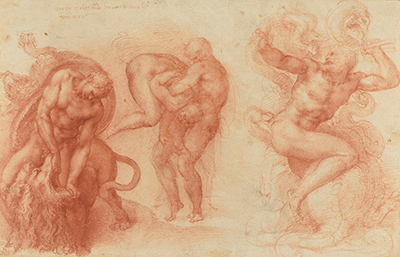
Across one wide sheet, Hercules fights three enemies that demand three different kinds of strength. At left he grapples with the Nemean lion. In the centre he lifts Antaeus away from the earth that renews him. At right he confronts the many-headed Hydra. Michelangelo makes a sequence of myths into an anatomy of problem-solving.
The Royal Collection dates Three Labours of Hercules about 1530 and numbers it RCIN 912770.[1] Drawn in red chalk on paper, it measures approximately 27.2 × 42.2 centimetres.[2] Its recipient is unknown, but the finish places it among the presentation drawings—complete works made for possession and sustained study rather than preparatory sheets for a documented painting.
Hercules is repeated, not continuous. Three bodies of the same hero occupy adjacent trials. The sheet asks how identity survives change of pose and how strength becomes intelligent only when adapted to the enemy.
At a Glance
- ArtistMichelangelo Buonarroti
- TitleThree Labours of Hercules; also Studies for the Three Labours of Hercules
- DateAbout 1530; sometimes 1530–1533
- MediumRed chalk on paper
- DimensionsApproximately 27.2 × 42.2 centimetres
- Current collectionRoyal Collection, Windsor
- Royal Collection numberRCIN 912770
- Object typeFinished presentation or gift drawing
- RecipientUnknown
- ScenesHercules and the Nemean lion; Hercules and Antaeus; Hercules and the Lernaean Hydra
- Narrative formatThree separate labours compressed into a continuous horizontal field
- Core themeStrength transformed by knowledge of each opponent
Contents
- The Twelve Labours
- Hercules and the Nemean Lion
- Hercules and Antaeus
- Hercules and the Hydra
- Three Bodies of One Hero
- Hercules and Michelangelo
- The Lost Florentine Hercules
- Serial Time and the Shape of Reading
- Violence Without Landscape
- A Presentation Drawing with Unknown Recipient
- Red Chalk and the Wide Sheet
- Sculpture Imagined on Paper
- Ancient Sources and Renaissance Reinvention
- Moral and Philosophical Meanings
- Copies and European Fame
- How to Look at Three Labours of Hercules
- Why Three Labours of Hercules Matters
The Twelve Labours
Hercules—Heracles in Greek—performed labours imposed by King Eurystheus as expiation after killing his family in divinely induced madness. Ancient sources varied the list and sequence, but twelve became canonical.[3]
The tasks moved between beasts, monsters, theft, capture and journeys into distant or underworld spaces. They turned superhuman force into service, suffering and eventual apotheosis.
Michelangelo selects only three. They are among the most physically direct and visually recognisable: an invulnerable lion, an earth-powered giant and a multiplying serpent.
The selection avoids the quieter or more logistical labours. No stable, apples or cattle distract from bodily contest.
Yet brute force alone fails in each. The lion's hide resists weapons; Antaeus must lose contact with the ground; Hydra's regrowing heads require strategy. Hercules succeeds because he understands conditions.
Hercules and the Nemean Lion
The Nemean lion could not be pierced by ordinary weapons. Hercules therefore grappled with and strangled it, afterward wearing its skin as armour.[3]
Michelangelo compresses man and beast into a knot. The hero cannot maintain clean distance; his body must close around the animal's dangerous mass.
Limbs overlap and directions oppose. The lion's body offers fur, jaw and curved spine against Hercules's muscular geometry.
Strangulation makes hands and forearms decisive. Strength travels through grip rather than a theatrical club.
The scene also creates the attribute by which Hercules will later be identified. The lion skin is not yet costume; it is an enemy being transformed into protection.
Hercules and Antaeus
Antaeus was a giant who regained strength whenever he touched his mother Earth. Hercules defeated him by lifting him off the ground and crushing him aloft.[1]
The centre therefore reverses ordinary combat. Stability belongs to the enemy; victory requires removing support.
Michelangelo makes one body the base for another. Hercules's legs and torso create a vertical structure, while Antaeus arches or struggles above. The contact point between them carries enormous pressure.
Unlike the lion group, where hero descends into a knot, the Antaeus combat rises. It gives the sheet a central lift.
The myth turns knowledge into leverage. Hercules does not simply become stronger; he changes the terms under which strength operates.
Hercules and the Hydra
The Lernaean Hydra was a multi-headed serpent whose severed heads regenerated, sometimes doubled. Hercules needed help from Iolaus, who cauterised the necks, and buried the immortal head.[3]
Michelangelo focuses on the hero's struggle with the monster rather than narrating every stage or assistant. Repeating necks create a visual opponent unlike the compact lion or human Antaeus.
The hero's body must answer multiplicity. A single grip or blow cannot control all directions. The composition spreads and tangles.
If Iolaus is absent or subordinate, the scene condenses collaborative myth into Herculean identity. That simplification should not rewrite ancient sources, where assistance is essential.
Hydra also gives the sequence an enemy without a human-like torso. Michelangelo tests anatomy against serpentine proliferation.
Three Bodies of One Hero
Hercules appears three times, yet Michelangelo does not rely on portrait likeness. Identity comes from subject, power, recurring proportions and the sequence of labours.
Each pose is adapted. Against the lion, Hercules encloses; against Antaeus, he lifts; against Hydra, he reaches into multiplication. Musculature changes because action changes.
The repetition resembles a sculptor turning a model through alternatives, but these are not three views of one statue. They are different narrative moments.
The wide sheet allows comparison without frames. Empty intervals and monster bodies separate groups while chalk movement carries energy across them.
The viewer reads temporally from left to right but can also compare simultaneously. Drawing becomes both story and table of variations.
Hercules and Michelangelo
Hercules occupied Michelangelo's imagination from youth. Early biography records a lost marble Hercules carved in Florence after the death of Lorenzo de' Medici. The Battle of the Centaurs likewise explored heroic pagan struggle.
Florence used Hercules as an emblem of civic strength, and antique statues made his body a central Renaissance measure. Michelangelo's later Victory and other struggling nudes carry related physical intelligence without depicting the hero directly.
It is tempting to make Hercules a self-portrait of the artist: burdened by impossible tasks and triumphant through strength. Such analogy may enrich reception but is not the sheet's documented programme.
Michelangelo did face commissions described as labours, and his poetry often connected creation with struggle. Still, the unknown recipient prevents a certain biographical message.
The drawing is strongest when Hercules remains mythic enough to test universal relations among power, knowledge and constraint.
The Lost Florentine Hercules
Early biographers report that Michelangelo carved a life-size marble Hercules after returning to Florence in the early 1490s. The sculpture stood at the Palazzo Medici, later travelled to France and is now lost. Documents and copies provide only partial access to its appearance.
The Royal Collection sheet is not a study for that early statue: it was made decades later and shows narrative combats rather than a securely reconstructed freestanding pose. The shared hero instead demonstrates continuity of interest.
As a young sculptor, Michelangelo used Hercules to claim physical and civic ambition. Around 1530, he returned to the hero through serial drawing, making experience and strategy as important as bodily mass.
The lost marble's absence also sharpens the value of paper. A fragile chalk sheet survives where a monumental stone disappeared. Material durability does not determine historical survival.
Serial Time and the Shape of Reading
Ancient cycles often separated Hercules's labours into framed panels. Michelangelo lets the three groups share one unpartitioned field. The viewer supplies the boundaries.
Read left to right, the hero moves from enclosed wrestling to vertical lifting and then outward struggle against many heads. The sequence expands formally even if it does not follow a canonical chronological order.
Read from the centre outward, Antaeus becomes the hinge: one human-like opponent elevated between animal mass and serpentine diffusion. The sheet supports more than one path.
This flexibility is specific to drawing. An architectural frieze fixes viewing through physical procession; a handheld sheet can be scanned, reversed mentally and revisited at will.
The three labours therefore operate less as illustrated biography than as comparative thought. Time becomes a choice made by the beholder.
Violence Without Landscape
Michelangelo removes the locations that make each myth geographically distinct. There is no cave at Nemea, no arena for Antaeus and no swamp at Lerna.
The omission concentrates ethical conditions. Invulnerability, dependence and regeneration are embodied by opponents rather than explained by scenery.
It also keeps violence abstract. Blood and wounds are less important than grips, leverage and direction. The bodies remain beautiful enough for learned contemplation even while they kill.
This restraint differs from a narrative print designed to teach the myths to an unfamiliar reader. Michelangelo assumed a recipient able to recognise them through action alone—or willing to puzzle them out.
A Presentation Drawing with Unknown Recipient
The Royal Collection groups the sheet with elaborate drawings made in the early 1530s.[1] Unlike the Cavalieri gifts, its intended recipient has not been identified.
“Presentation drawing” refers to finish and gift-like autonomy, not necessarily presentation of a proposal for approval. The sheet contains no documented painting project it prepares.
Its width, completeness and multi-scene subject make it suitable for learned contemplation. An owner could compare antique sources, evaluate anatomical invention and discuss moral meanings.
Unknown recipient should remain a meaningful blank. Assigning Cavalieri merely because other mythological sheets went to him would turn resemblance into provenance.
The drawing belongs to a social practice in which graphic labour itself became a prestigious exchange among friends, patrons and connoisseurs.
Red Chalk and the Wide Sheet
Red chalk gives the hero's bodies warmth while keeping the three groups unified. Michelangelo can vary pressure to separate firm contour, internal modelling and deep contact shadows.
The 42.2-centimetre width provides room for sequence without monumental paper. Each labour occupies a compact zone.[2]
The darkest passages occur where bodies interlock, helping the eye read force. Open paper around outer contours prevents the groups from becoming one continuous mass.
The chalk's granular line can describe fur, skin and serpent differently, though anatomy remains the primary visual language.
Finish does not eliminate searching. Corrections and reinforced lines may remain beneath the resolved surface, evidence that clarity was achieved rather than simply copied.
Sculpture Imagined on Paper
Each combat could be turned into a sculpture in the round or a relief. Interlocking bodies, weight and support are sculptural problems.
The Antaeus group is especially concerned with gravity. An actual marble would need bridges or supports for the raised giant; chalk lets Michelangelo test the impossible without engineering it.
The lion group compresses naturally into a stable mass, while Hydra's projections would challenge stone. The sequence therefore ranges from compact to expansive sculptural feasibility.
Drawing frees Michelangelo to compare these conditions on one surface. It is not merely a cheap substitute for marble but a medium where three-dimensional thought can exceed material limits.
At the same time, the bodies are modelled through tonal strokes impossible in finished stone. “Sculptural” should not erase the drawing's own intelligence.
Ancient Sources and Renaissance Reinvention
Hercules's labours appeared on sarcophagi, reliefs, gems and statues throughout antiquity. Renaissance Rome offered abundant fragments and copies from which artists could learn poses and attributes.
Michelangelo selects recognisable types but refuses archaeological setting. No landscape identifies Nemea or Lerna; no architectural border turns the scenes into an antique frieze.
This abstraction makes the bodies carry myth. It also encourages moral reading: obstacles appear as different structures of resistance.
The hero's lion skin, club and other standard attributes may be reduced when the combat itself identifies him. Michelangelo trusts action more than emblem.
Classical culture becomes a living design vocabulary rather than a recovered illustration manual.
Moral and Philosophical Meanings
Hercules could signify fortitude, virtue conquering vice, the disciplined soul overcoming passions or the ruler mastering disorder. Christian readers also moralised his labours as prefigurations of spiritual struggle.
The three selected enemies lend themselves to distinct lessons. The lion requires intimate courage; Antaeus requires knowledge of dependence; Hydra requires persistence against multiplying difficulty.
Together they reject undifferentiated power. Successful strength changes method.
The sheet may also explore artistic invention. One heroic body must be redesigned three times without losing identity, just as an artist meets different materials and commissions.
No inscription chooses among these meanings. Their compatibility is part of the gift drawing's learned openness.
Copies and European Fame
Michelangelo's presentation drawings became known through copying and engraving. Even privately owned sheets could be viewed by popes, cardinals and artists, then translated into other media.[1]
The Hercules composition's clarity made its groups reusable. A copy might isolate one labour, reverse the sheet or harden chalk into engraved contour.
Such derivatives need individual credit. “After Michelangelo” records the design relationship without making a print or copy autograph.
Circulation also changes interpretation. A recipient who saw the three on one sheet could compare method; a print isolating Antaeus might turn it into a general emblem of strength.
The Royal Collection original remains the controlled object, identified by RCIN 912770.
How to Look at Three Labours of Hercules
Name each enemy before judging anatomy. The action only makes sense through the opponent's special condition.
Trace Hercules's centre of gravity in each group: lowered, vertical, then spread.
Compare hands. Grip, lift and attack distribute force differently.
Look at the spaces between groups. They separate episodes without frames.
Finally compare the wide sheet with an ancient labours relief. Michelangelo adopts serial myth while remaking its rhythm through chalk.
Why Three Labours of Hercules Matters
The drawing matters because it refuses to define strength as one body doing one thing. Hercules remains himself only by changing.
It also reveals Michelangelo's ability to make a finished graphic work carry the ambitions of sculpture, narrative and moral philosophy simultaneously.
The unknown recipient adds a productive limit. We cannot turn every myth into a coded love letter. What survives securely is a wide field of intelligence: three enemies, three solutions and one hero measured by his capacity to understand difference.
Frequently Asked Questions
Discussion
What details, sources or comparisons stand out to you in Three Labours of Hercules?
Reader Insights
Which formal detail changes how the work reads?
Which documented source or collection history feels most useful?
Which related Michelangelo work should readers compare next?
Join the Conversation
Add a source-led observation, comparison or question for other readers.
References
- Royal Collection Trust, Michelangelo's Presentation Drawings,” Three Labours of Hercules, RCIN 912770:, View source.
- Metropolitan Museum of Art, Michelangelo exhibition object highlights, Studies for the Three Labors of Hercules:, View source.
- Perseus Digital Library, Pseudo-Apollodorus, Library, Book 2, Labours of Heracles:, View source.
- Getty Museum, The Renaissance Nude checklist, Royal Collection loan dimensions:, View source.