 by Tom Gurney
Tom Gurney BSc (Hons) is an art history expert with over 20 years experience
Published on June 19, 2020 / Updated on November 6, 2025
Email: tomgurney1@gmail.com / Phone: +44 7429 011000
Michelangelo’s Twelve Prophets and Sibyls
Around the central Genesis stories of the Sistine Chapel ceiling, twelve colossal readers sit on painted thrones. Seven are Hebrew prophets; five are sibyls from the pagan cultures of the ancient Mediterranean. Some bend into books, some listen to attendants, some turn as if interrupted and one, Jonah, leans back beneath the great fish associated with his story. Together they make revelation look neither serene nor uniform, but physically demanding.
The Vatican Museums identify the full company as Zechariah, Joel, Isaiah, Ezekiel, Daniel, Jeremiah and Jonah, joined by the Delphic, Cumaean, Libyan, Persian and Erythraean Sibyls.[1] Their alternation along the vault’s sides surrounds the Genesis centre with figures understood in Renaissance Christian culture as witnesses to the coming of Christ. Michelangelo distinguishes every body, book, age and act of attention, turning a theological chorus into twelve individual conditions of knowledge.
At a Glance
- EnsembleSeven prophets and five sibyls on the Sistine Chapel ceiling[1]
- PainterMichelangelo Buonarroti
- MediumFresco within the 1508–1512 ceiling campaign for Pope Julius II[2]
- ProphetsZechariah, Joel, Isaiah, Ezekiel, Daniel, Jeremiah and Jonah[1]
- SibylsDelphic, Cumaean, Libyan, Persian and Erythraean[1]
- PlacementMonumental seated figures occupying alternating thrones along the long sides and at the ends of the vault
- End figuresZechariah is above the entrance; Jonah is above the altar[1][5]
- Common attributesBooks, scrolls, attendants, tablets and fictive marble thrones
- Unifying themeInspired knowledge interpreted through reading, listening, memory and bodily response
- Cultural frameBiblical prophets appear with ancient pagan prophetesses in a Christian programme
- Design evidenceMajor surviving studies include sheets for the Libyan and Erythraean Sibyls[10][11]
- BoundaryThese figures surround but are not characters inside the nine central Genesis scenes[2][3]
Contents
- The Twelve Figures
- Why Prophets and Sibyls Appear Together
- Seated Bodies That Refuse Stillness
- Books, Scrolls and the Labour of Reading
- Attendants and the Social Life of Revelation
- Thrones, Name Tablets and Painted Stone
- Twelve Relations to Time
- Voice, Silence and the Unpainted Word
- Zechariah: Reading at the Entrance
- Joel: Deliberate Attention
- Isaiah: Interrupted Reading
- Ezekiel: Urgency and Exchange
- Daniel: Writing, Reading and Weight
- Jeremiah: Withdrawal and Melancholy
- Jonah: The Altar-End Pivot
- The Delphic Sibyl: Sudden Turning
- The Cumaean Sibyl: Age and Monumental Reading
- The Libyan Sibyl: Turning with the Book
- The Persian Sibyl: Distance and Old Age
- The Erythraean Sibyl: Poise and Preparation
- Age, Gender and Monumentality
- Placement Along the Vault
- Relation to the Genesis Centre
- Drawings and the Making of Monumental Bodies
- Seeing the Twelve in the Chapel
- Restoration and the Return of Colour
- Copies and the Portable Seer
- Why the Ensemble Matters
- Artist Up Close
The Twelve Figures
The seven prophets are:
1. Zechariah 2. Joel 3. Isaiah 4. Ezekiel 5. Daniel 6. Jeremiah 7. Jonah
The five sibyls are:
1. Delphic Sibyl 2. Cumaean Sibyl 3. Libyan Sibyl 4. Persian Sibyl 5. Erythraean Sibyl
The names matter because a generic description such as “prophets around the ceiling” erases half the intellectual structure. The sibyls are not anonymous female variants of the men, and the prophets are not a single repeated type. Each occupies a named seat within a carefully ordered system.[1]
At the same time, identity does not make every attribute transparent. Some figures can be recognised by inscriptions and established placement more readily than by a single personal object. Books, scrolls and attendants recur across the series; pose and location often distinguish the individual more strongly than emblem.
Why Prophets and Sibyls Appear Together
Hebrew prophets belong to the scriptural tradition that Renaissance Christians read as anticipating Christ. Sibyls were legendary prophetesses of the ancient pagan world whose sayings were interpreted in Christian culture as foretelling events connected with salvation.
Placing both traditions in the papal chapel asserts that revelation exceeds one historical community while still being fulfilled within a Christian framework. The pairing is not a modern statement of equal religions. It is a Renaissance theological appropriation of classical authority.
The sibyls also connect the ceiling to humanist interest in antiquity. Their ancient names—Delphi, Cumae, Libya, Persia and Erythrae—map prophecy across places beyond biblical Israel.
Michelangelo does not mark that breadth by giving every sibyl an exotic narrative setting. He places all twelve figures on related thrones within the same fictive architecture. Difference enters through bodies, ages, clothing, books and motion.
Seated Bodies That Refuse Stillness
Each prophet or sibyl is technically seated, yet few feel at rest. Knees project, torsos twist, feet brace, shoulders turn and drapery records the pull between one movement and another.
The throne provides a stable frame against which bodily variation becomes legible. A figure may curl inward over a text, expand across the seat or pivot toward an unseen voice. Repeated architecture makes difference measurable.
This is one reason the ensemble feels sculptural. The bodies possess weight and can be imagined from several sides, but fresco adds qualities unavailable to sculpture: bright garments, illusionistic depth and the ability of one painted figure to turn toward an attendant within the same niche.
Seating also gives reading physical consequence. Books rest on knees, lift above shoulders or demand assistance. Knowledge is shown as something bodies must carry.
Books, Scrolls and the Labour of Reading
Books appear in varied relations to the figures. Zechariah bends toward an open volume. The Cumaean Sibyl peers into a large book held near her face. The Libyan Sibyl twists while moving a heavy volume. Daniel works with a text supported by an attendant. Isaiah turns away from his reading as if interrupted.[1][5][7][9]
These differences prevent scripture and prophecy from becoming abstract attributes. Reading unfolds as concentration, calculation, recollection, interruption and physical handling.
Scale is crucial. Some books are enormous, appropriate to the monumental readers and visible from below. Their weight is implied by tense shoulders, braced arms and helpers.
Scrolls and loose sheets introduce other temporalities. A bound codex can be searched and revisited; a scroll unrolls sequentially; a tablet or sheet may record a more immediate utterance. Michelangelo uses textual objects to vary the experience of inspired knowledge.
Attendants and the Social Life of Revelation
Small attendant figures accompany the enthroned seers. They hold books, peer outward, whisper, listen or support objects. Their scale makes the main bodies appear even larger.
The attendants are not simply decorative children. They create relationships. Ezekiel turns toward one as if responding to urgent speech; Daniel’s helper assists with the weight or arrangement of a text; other companions share in the atmosphere of concentration.[7]
Their presence complicates the idea of the solitary genius-prophet receiving a private vision. Knowledge moves through communities of hearing, recording and response.
Exact identities should remain cautious. The figures are commonly described as genii or attendants, but the Vatican accounts do not name each one as a specific angel or historical person.[1] Function is more secure than biography.
Thrones, Name Tablets and Painted Stone
Each seer occupies a fictive architectural seat marked within the ceiling’s system of cornices, consoles and sculptural supports. Painted name tablets identify the figures, preventing pose alone from carrying the burden of recognition.[1][2]
The thrones establish civic and judicial dignity as well as bodily support. They make prophets and sibyls seem permanently installed within the chapel’s architecture, although every block, recess and moulding belongs to illusionistic paint.
Michelangelo continually tests those frames. Knees project beyond apparent edges, garments spill outward and attendants occupy awkward corners. The architecture names and contains revelation, while the bodies press against containment.
From below, the repeated seats create order before individual inscriptions can be read. At close range, the labels restore specificity. Ensemble and person become visible at different distances.
Twelve Relations to Time
Prophecy concerns events not yet present, but the figures do not all inhabit futurity in the same way. Some read inherited words; others appear to hear an immediate message; Jeremiah carries remembered grief; Jonah’s body recalls a past ordeal that Christian interpretation treats as a sign of future resurrection.[6]
Books introduce duration through study. A turn or raised hand captures an instant. Age places whole lifetimes in faces and shoulders. Michelangelo builds prophetic time from these differing rhythms.
The ensemble therefore avoids the idea of twelve people simultaneously seeing one identical vision. Their knowledge arrives through varied temporal relations: text preserved, voice received, event remembered, sign interpreted.
This variety also answers the ceiling’s central histories. Genesis unfolds through narrated episodes; the seers pause around it, inhabiting the long afterlife of what those episodes can mean.
Voice, Silence and the Unpainted Word
No audible prophecy reaches a modern observer from the frescoes. Michelangelo paints mouths, gestures and texts, but not a sequence of quoted speeches across the vault.
Silence makes the bodies more important. Ezekiel’s open hand implies exchange; Isaiah’s turn implies interruption; Zechariah’s lowered profile implies reading absorbed beyond conversation. Attendants create the conditions of voice without supplying subtitles.[5][7]
The lack of legible extended text at architectural distance also protects the figures from becoming illustrated quotations. Their authority is conveyed through acts of attending to words.
This is a visual theology of interpretation. Revelation is present, yet meaning still requires listening, reading and the difficult work of response.
Zechariah: Reading at the Entrance
Zechariah sits above the entrance wall, at the end opposite Jonah.[1][5] He bends in profile over a large open book, absorbed in sustained reading while attendants look from behind.
The pose is relatively contained. Drapery gathers around his aged body, and the forward tilt concentrates attention within the throne. Visitors entering beneath him may not immediately see the face, an appropriate paradox for a guardian absorbed in text rather than audience.
Zechariah’s position establishes reading as the threshold to the vault. He does not greet with outward gesture. Knowledge begins in inward concentration.
His age and beard contrast with younger prophets and sibyls, making the company span different temporal and bodily types.
Joel: Deliberate Attention
Joel sits with a scroll or sheet extended before him, his posture more open than Zechariah’s. The body turns slightly while the text remains central.
His reading feels measured rather than burdened. Arms create an interval between face and writing, allowing the scroll to occupy visible space.
Attendant figures behind him deepen the niche and introduce secondary directions of attention. Joel’s composure should not be mistaken for passivity; the separated hands and focused gaze make interpretation an active balance.
Among more dramatically twisting neighbours, he supplies a quieter register of prophetic work.
Isaiah: Interrupted Reading
Isaiah turns away from an open book as a youthful attendant seems to address him. His finger holds or marks his place, preserving the link to text even as attention shifts.
The pose captures thought at a threshold. He has not abandoned reading, nor has he fully settled into dialogue. Head, shoulders and hand occupy different moments of response.
This makes inspiration social and temporal. A message arrives; Isaiah pauses over the book; meaning changes direction. Michelangelo transforms interruption into the prophet’s defining visual condition.
Isaiah’s large body remains contained by the throne, but twisting drapery and the raised arm of the attendant animate the surrounding air.
Ezekiel: Urgency and Exchange
The Vatican’s dedicated account emphasises Ezekiel’s sudden turn toward an attendant.[7] The prophet’s head and upper body swing away from the scroll or text, while one hand opens in emphatic response.
His gesture can be read as questioning, receiving or answering. What matters is the immediacy of exchange. Prophecy appears conversational rather than silently possessed.
The attendant’s proximity compresses the turn, making the large prophet seem activated by a smaller voice. Scale does not determine agency.
Ezekiel’s vigorous profile distinguishes him from the closed concentration of Zechariah and the suspended pause of Isaiah. Michelangelo can generate several forms of listening with minute changes in direction and hand.
Daniel: Writing, Reading and Weight
Daniel engages a large book supported with help from an attendant. Another text or sheet relates to his lap, and his posture suggests the physical demands of reading and recording.
The arrangement is busy but ordered. Limbs, book edges and drapery create intersecting directions, as though intellectual activity has become a workshop.
Daniel’s youth and strength contrast with aged seers. Michelangelo does not present study as frailty; a powerful body applies itself to textual work.
The prophet’s connection to writing also evokes interpretation across time. Vision must be held, examined and transmitted, not merely experienced.
Jeremiah: Withdrawal and Melancholy
Jeremiah leans forward with his head supported by one hand. The pose is heavy, inward and famously melancholy. Attendants behind him seem quieter than the active companions of Ezekiel or Daniel.
His body folds around thought. Elbow, knee and hand form a structure that holds the bowed head, converting contemplation into weight.
The image can suggest grief associated with Jeremiah’s prophetic identity, but it should not be reduced to a modern clinical diagnosis or an undocumented self-portrait claim. Its secure meaning lies in visible withdrawal.
Placed among turning and reading figures, Jeremiah represents knowledge that burdens rather than energises.
Jonah: The Altar-End Pivot
Jonah occupies the position above the altar, opposite Zechariah.[1] He leans backward dramatically, face turned upward, while the great fish and accompanying figures identify his story.
The pose breaks the conventional stability of the throne. Torso, head and limbs respond to forces above and behind, making Jonah a hinge between wall and ceiling.
In the Gospel of Matthew, Jonah’s three days in the fish become a sign connected to Christ’s death and resurrection.[6] That Christian typology helps explain his prominence near the altar and, later, above Michelangelo’s Last Judgement.
Jonah closes the prophetic company not with a bookish profile but with bodily revelation. Where Zechariah bends over text, Jonah opens toward vision.
The Delphic Sibyl: Sudden Turning
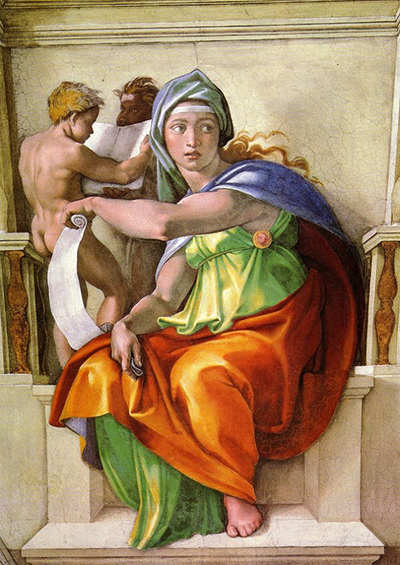
The Delphic Sibyl is youthful, richly dressed and caught turning away from a scroll held across her body. The Vatican describes the head’s movement and the attentive force of her expression.[8]
Her face looks outward with wide, focused eyes, as if sound or revelation has interrupted reading. One attendant peers from behind while another remains partially concealed.
Colour helps articulate the turn. Drapery crosses the torso and gathers around powerful arms, balancing grace with bodily authority.
The Delphic figure became one of the ensemble’s most admired images because alert intelligence replaces passive beauty. She is not an ornament among male thinkers; she embodies the instant knowledge changes direction.
The Cumaean Sibyl: Age and Monumental Reading
The Cumaean Sibyl is aged and immensely muscular, reading a large open book held close. Head, shoulders and arms appear compressed by the task.
Michelangelo refuses an easy equation between female prophecy and youthful loveliness. Wrinkled features and powerful anatomy create a figure whose authority is inseparable from duration and effort.
The large book almost becomes a wall before her face. Reading is private yet physically monumental, and the body must gather around it.
Her age distinguishes rather than diminishes her. Within the five sibyls, Michelangelo makes time one of prophecy’s forms.
The Libyan Sibyl: Turning with the Book
The Libyan Sibyl twists backward while lifting or setting down a substantial book. The Vatican’s description and the Metropolitan Museum’s surviving study illuminate the complexity of this action.[9][11]
Her back, shoulders and arms carry the movement. One foot braces, the torso spirals and the head turns in another direction. Knowledge has literal weight, yet the pose retains extraordinary grace.
The Met drawing studies a nude male model for the body, with additional investigations on the sheet.[11] Michelangelo then transformed that anatomical preparation into the clothed female seer. This does not make the finished sibyl secretly male; it reveals a studio process in which bodily design and depicted identity were distinct stages.
The fresco’s drapery completes the invention. Fabric records rotation, differentiates limbs and gives colour to a pose first explored through the nude.
The Persian Sibyl: Distance and Old Age
The Persian Sibyl is aged, deeply absorbed and turned partly away, reading a smaller book close to her face. Her orientation makes her more withdrawn than many companions.
The pose suggests difficulty of sight or intense concentration without requiring a medical diagnosis. Head and text draw together, creating a compact zone of attention.
Her garments expand around the seated body even as the face recedes. Monumental clothing and small-scale reading create an unusual tension.
Alongside the Cumaean figure, she enlarges the ensemble’s conception of female age. Prophecy can be remote, private and sustained rather than dramatically announced.
The Erythraean Sibyl: Poise and Preparation
The Erythraean Sibyl turns toward an open book while an attendant behind her tends a lamp. Her posture balances reading with elegant counter-movement.
The lamp can be described as part of the visible action without making every flame a fixed theological symbol. At minimum, it joins illumination to study.
A British Museum sheet for the drapery preserves Michelangelo’s careful preparation of clothed form.[10] Folds were not secondary decoration laid over an already complete body. They were designed structures capable of carrying weight, direction and colour.
The Erythraean Sibyl’s relative poise gains meaning among the more violent turns of the Delphic and Libyan figures. Michelangelo varies revelation from flame-lit study to sudden response.
Age, Gender and Monumentality
The twelve figures span youth and age, masculine and feminine identity, exposed limbs and enveloping garments. These differences are not arranged as simple binaries. Young men can be absorbed; old women can be muscular; drapery can reveal force as clearly as nudity.
Michelangelo often used male models while designing female figures, as the Libyan study demonstrates.[11] Renaissance workshop practice and the artist’s anatomical priorities shaped the process. The finished sibyls nevertheless operate as named women within the chapel’s theology.
Their bodies challenge narrow expectations of feminine decorum. The Cumaean and Libyan Sibyls occupy space with a force equal to any prophet, while the Delphic combines youthful beauty with alert intellect.
The prophets likewise resist one masculine ideal. Jeremiah collapses inward, Daniel works vigorously, Jonah arches back and Zechariah withdraws into reading.
Placement Along the Vault
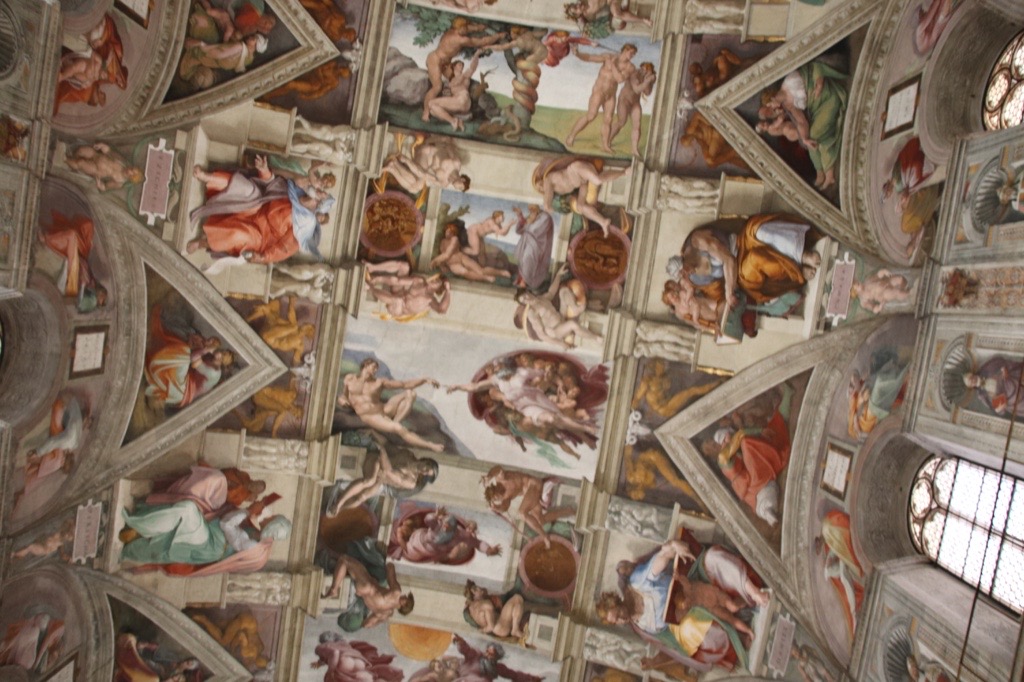
The figures occupy thrones between and around the central narrative compartments, creating a monumental rhythm along both sides.[1][2] Their scale mediates between the smaller Genesis scenes and the actual architecture of the chapel.
Alternation matters. Prophets and sibyls do not occupy separate male and female zones. Their interleaving makes the two prophetic traditions visually reciprocal within the Christian scheme.
At the ends, Zechariah and Jonah establish an especially powerful axis. Entrance and altar, reading and revelation, bowed profile and backward expansion answer one another across the vault.
The arrangement can be understood only through a location plan or whole-ceiling view. Individual crops clarify bodies but erase the long sequence their thrones create.
Relation to the Genesis Centre
The prophets and sibyls are not characters witnessing the Genesis events inside a shared landscape. They belong to another pictorial register, seated outside the central story rectangles within fictive architecture.[2][3]
Their presence nevertheless changes the centre’s meaning. Genesis becomes surrounded by later knowledge and anticipation. Creation and early human history are read within a Christian history of prophecy.
The seers also slow the narrative. A visitor can follow event after event down the centre, while the thrones repeatedly interrupt that motion with acts of reading, reflection and response.
This double rhythm—story unfolding, interpretation pausing—gives the ceiling intellectual depth. Images are presented alongside figures engaged in the work of understanding signs.
Drawings and the Making of Monumental Bodies
The Libyan and Erythraean studies offer complementary evidence. The Metropolitan sheet investigates nude anatomy and pose for the Libyan Sibyl; the British Museum drawing concentrates on drapery for the Erythraean.[10][11]
Together they show design as an accumulation of problems. A figure requires skeletal action, muscular tension, cloth, scale, placement and relation to neighbouring forms.
Drawings should not be treated as miniature versions of finished frescoes. They may isolate a limb, reverse an orientation, test an alternative or use a model whose identity differs from the eventual subject.
Michelangelo’s achievement lies partly in translation: from paper to plaster, nude study to clothed prophetess, individual experiment to a figure legible high above the floor.
Seeing the Twelve in the Chapel
The ceiling’s height makes simultaneous comparison difficult. Smarthistory emphasises the scale and density of Michelangelo’s programme.[12] A visitor may recognise the most dramatic silhouettes before identifying every name.
Books and heads often become the first clues. A turning shoulder, massive volume or backward lean can distinguish a figure across distance even when facial detail recedes.
Photographic series offer an advantage: all twelve can be placed side by side at similar scale. They also remove the bodily labour of looking upward and the architectural distances Michelangelo designed for.
The best understanding moves between formats—whole vault, location diagram, throne group and close detail—without pretending any one reproduces the entire experience.
Restoration and the Return of Colour
The modern Sistine conservation campaign altered the visual evidence available for these figures.[4][13] Garments emerged with brilliant oranges, greens, violets and blues that older dark reproductions had muted.
Colour differentiates the thrones and helps bodies read against their niches. It can also redirect interpretation: a fold previously read mainly as shadow may reveal a strong chromatic structure.
Debate over cleaning and technique should not be collapsed into claims that the work now looks exactly as it did in 1512. The frescoes are aged and conserved material surfaces, while digital photographs add lighting and colour-processing decisions.
Comparisons are most responsible when image date and condition are known. The ensemble’s current vividness is historical evidence, not a timeless transparency.
Copies and the Portable Seer
Prints and drawings detached individual prophets and sibyls from the vault, allowing their poses to circulate widely. The Metropolitan Museum’s anonymous engraving of the Libyan Sibyl is one example of this reproductive afterlife.[14]
Translation changes the work. Engraving converts colour into line and tone, may reverse the pose and turns a painted architectural giant into a hand-held sheet.
Such copies show the fame of individual bodies but can weaken awareness of the twelve-part sequence. A Libyan Sibyl on paper is both Michelangelo’s invention mediated by another maker and a new object with its own history.
Reception should therefore preserve the word “after.” It marks admiration, distance and authorship at once.
Why the Ensemble Matters
The twelve matter because they transform prophecy from a list of names into a field of human actions. Reading, hearing, remembering, carrying, writing and turning all become visible forms of knowledge.
They matter because Michelangelo grants pagan prophetesses the same monumental scale as biblical men while retaining the Christian framework that brought them together. Classical and scriptural authority are intertwined rather than simply blended.
Most of all, the company creates a drama of interpretation around a drama of origins. The Genesis stories show what happened; the surrounding seers embody the difficulty of understanding what history means.
Artist Up Close
Michelangelo repeats a basic commission—seat a named visionary on a throne—twelve times without repeating an inner state. One figure sinks into grief, another wheels toward speech, another carries a book as if it were stone. The variation reveals his deepest interest: not prophecy as supernatural decoration, but knowledge passing through a body. Thought has weight, speed, interruption and fatigue. On the Sistine vault, even revelation must be physically borne.
Frequently Asked Questions
Discussion
Set a preparatory study beside the related ceiling figure. Identify what Michelangelo tested and what changed in the final work.
Reader Insights
Separate the seven prophets from the five sibyls, then mark Zechariah and Jonah at the two short ends.
Choose two figures and compare how a book or scroll affects pose, gaze, hands and attendants.
Read the Vatican’s account of the Delphic or Libyan Sibyl. Separate visible form from proposed meaning.
Join the Conversation
Check whether an image shows one seer, a full field, a preparatory drawing, a later print or the whole ceiling. Rewrite the caption if its object status or orientation is unclear.
References
- Vatican Museums, Sibyls and Prophets”:, View source.
- Vatican Museums, Sistine Chapel Ceiling”:, View source.
- Vatican Museums, Central Stories”:, View source.
- Vatican Museums, Sistine Chapel History”:, View source.
- Vatican Museums, Prophet Zechariah”:, View source.
- United States Conference of Catholic Bishops, Matthew, Chapter 12”:, View source.
- Vatican Museums, Prophet Ezekiel”:, View source.
- Vatican Museums, Delphic Sibyl”:, View source.
- Vatican Museums, Libyan Sibyl”:, View source.
- British Museum, Study for the Drapery of the Erythraean Sibyl”:, View source.
- The Metropolitan Museum of Art, Studies for the Libyan Sibyl”:, View source.
- Smarthistory, Michelangelo, Ceiling of the Sistine Chapel”:, View source.
- Vatican Museums, The Sistine Chapel Twenty Years Later: New Breath, New Light”:, View source.
- The Metropolitan Museum of Art, The Libyan Sibyl, anonymous engraving after Michelangelo”:, View source.